24/09/2015

Pope Francis Calls For Urgent Action On Climate Change In White House Speech

The Guardian

Addressing a crowd of nearly 15,000 on the south lawn, pope invokes Martin Luther King Jr in speaking of the moral need to protect our ‘common home’


Pope Francis struck an unashamedly political tone at the White House during his first public event of a six-day US tour.

Pope Francis addressed one of the thorniest issues in American politics on Wednesday with a White House speech explicitly supporting Barack Obama’s plan to cut carbon emissions and chastising climate change sceptics for failing in their duty to protect our “common home”.
In a tougher-than-expected call for action on global warming, the spiritual leader of more than 70 million American Catholics defied calls among some Republicans to steer clear of politics by making clear he believed this was a moral issue.
“Climate change is a problem which can no longer be left to a future generation,” said the pope, who invited contrast with the civil rights struggle by invoking the spirit of Martin Luther King Jr in support of his argument.
Barack Obama introduced the welcoming ceremony, the pope’s first public event of the six-day trip to the United States, as a moment to “shake our conscience from slumber”.
His target audience was less the 11,000 hand-picked visitors crammed onto the South Lawn – or even the several thousand more faithful on the neighbouring Ellipse – than the millions of watching Americans who remain sceptical of the need for radical climate action.
From the moment his famous cassock materialised under the emblematic White House colonnade on Wednesday, any doubt this would be a deeply political visit by Pope Francis vanished.
“Mr President, I find it encouraging that you are proposing an initiative for reducing air pollution,” the pope said with a slow, deliberate delivery that left little room for misinterpretation.
And, lest a papal blessing for the Environmental Protection Agency’s new emission control standards not prove a shocking enough incongruity, the pope made clear his view that support was a moral imperative for all Americans.
“I would like all men and women of goodwill in this great nation to support the efforts of the international community to protect the vulnerable in our world and to stimulate integral and inclusive models of development, so that our brothers and sisters everywhere may know the blessings of peace and prosperity which God wills for all his children,” he said to loud applause.
Whether Republican opponents of the EPA rule change will consider themselves “men and women of goodwill” in this case will become clearer on Thursday, when the pope is expected to make a similar appeal in a direct address to Congress.
In the meantime, the pontiff emphasised his belief that politicians owe a debt not just to the planet and their children, but particularly to the underprivileged in the world seen as most at risk from the effects of global warming.
“Such change demands on our part a serious and responsible recognition not only of the kind of world we may be leaving to our children, but also to the millions of people living under a system which has overlooked them,” he said.
“Our common home has been part of this group of the excluded which cries out to heaven and which today powerfully strikes our homes, our cities and our societies,” he added. “To use a telling phrase of the Reverend Martin Luther King, we can say that we have defaulted on a promissory note and now is the time to honor it.”
Enlisting the spirit of Dr King – a tactic familiar to president Obama, who used his sing-song pulpit voice to rouse the crowd ahead of the pope’s address – was less conventional territory for the Vatican. The remark contained an implicit reference to the US constitution as well as the teachings of the Bible.
King originally accused America of defaulting on the “promissory note” in his “I have a dream” speech and suggested African Americans had been given “a bad check” by the founding fathers who promised to grant all men inalienable rights.
To this, the pope responded: “We know by faith that the Creator does not abandon us; he never forsakes his loving plan or repents of having created us.” He continued: “Humanity still has the ability to work together in building our common home. As Christians inspired by this certainty, we wish to commit ourselves to the conscious and responsible care of our common home.”
The pope’s direct reference to the Obama administration’s new proposed climate change regulations made this address his most politically charged commentary since Francis began his journey to Cuba and the US. While in Havana, he encouraged leaders of both countries to keep striving for reconciliation, but he steered clear of any direct references to political controversies on either side.
In Washington, the pope appears willing to be more bold, addressing head-on the major controversies that divide a polarised US political establishment. The pope provoked cheers from the crowd, for example, by reminding them that he too was an immigrant and that America was a country built on immigration – another subject of fierce topical debate in the US.

Barack Obama sits with Pope Francis in the Oval Office as the pontiff is welcomed to the White House. Photograph: Jonathan Ernst/Reuters

In pre-released drafts of the speech issued by the Vatican, it was hard to tell how much remarks like this would deliver a political punch.
But there was something about the slow, deliberate diction of the speech and enthusiastic reaction of the Washington audience that gave these tweaks of the American political consciousness a momentous feel.
The pope also made clear he would not shy away from challenging his hosts on other issues too – pointedly pledging to address the “institution of marriage” in future remarks that will be closely scrutinised for criticism of recent US breakthroughs in same-sex marriage equality.
More conservative Americans may also draw solace from the pope’s reference to the need to protect religious liberty, something many believe is infringed upon by requiring state officials to recognise same sex unions despite any personal objections they may have.
But the welcoming event on the South Lawn concluded with a stirring choral performance that transcended the political elements of the speech. “We love you, Pope Francis,” shouted a lone male voice across the lawn at the end of the ceremony, drawing laughter and applause from the crowd before, once again, a military brass band struck up.
Many of the guests at the ticketed event on the South Lawn said they saw the pope as a unifying figure.
“He is particularly good at bringing young people together who are not necessarily the most devout,” said Katharine Connolly, a 23-year-old law student at Georgetown University.
“It’s a once in a lifetime event,” added Alexander Kurien, 51, a government worker also from DC. “I really feel he is a reflection of Christ: he lives by example.”
Obama paid tribute to the Pope for “shak[ing] our conscience from slumber” in a warm welcome that made clear the personal bond between the two men and imbued the sunny South Lawn with a greater than usual mood of bonhomie.
The president also thanked Francis for his diplomatic support for talks between the US and Cuba, although the pope himself did not mention the matter.
“We are grateful for your invaluable support of our new beginning with the Cuban people, which holds out the promise of better relations between our countries, greater cooperation across our hemisphere, and a better life for the Cuban people,” said Obama.
“Holy Father, you remind us that we have a sacred obligation to protect our planet – God’s magnificent gift to us,” he added. “We support your call to all world leaders to support the communities most vulnerable to a changing climate and to come together to preserve our precious world for future generations.”
But not all observers found the love-in quite as appropriate. “Not sure if that was a speech by the head of the Catholic Church or Al Gore,” concluded a tweet from the conservative Catholic website Rorate Caeli.

23/09/2015

Climate Change: What Happens After The Paris Conference?

GRATTAN Institute


Climate Change: What Happens After The Paris Conference?

The Australian Government’s emissions reduction target will join those of the international community in Paris in December. It is likely that the sum total of these contributions will not be consistent with the internationally agreed objective of keeping the average global temperature increase to less than two degrees Celsius. How will this play out in Paris and what does the target imply for the energy sector? Join Tom Arup from The Age as he discusses this issue with David Karoly, Professor of Atmospheric Science at the University of Melbourne and Member of the Climate Change Authority, Anthea Harris, previously CEO of the Authority and now occupying a senior role in the Victorian Government and Tony Wood from Grattan Institute.

Moderator

  • Tom Arup is the environment editor for The Age. 
Speakers
  • Tony Wood has been Energy Program Director at Grattan since 2011 after 14 years working at Origin Energy in senior executive roles. From 2009 to 2014 he was also Program Director of Clean Energy Projects at the Clinton Foundation, advising governments in the Asia-Pacific region on effective deployment of large-scale, low-emission energy technologies. In 2008, he was seconded to provide an industry perspective to the first Garnaut climate change review.
  • Anthea Harris is Lead Deputy Secretary, Strategy and Planning at the Department of Economic Development, Jobs, Transport and Resources.  Formerly Chief Executive Officer of the Climate Change Authority, Anthea is an experienced senior executive with a strong record of leading the collaborative development and delivery of strategic policy for both State and Federal Governments.  Anthea has previously held senior roles within the Department of Climate Change and Energy Efficiency, led the Secretariat for the National Emissions Trading Taskforce and held positions with the Victorian Department of Premier and Cabinet and at the Productivity Commission.
  • David Karoly is Professor of Atmospheric Science in the School of Earth Sciences and the A.R.C. Centre of Excellence for Climate System Science at the University of Melbourne. He is an internationally recognised expert on climate change and climate variability and was heavily involved in the assessment reports of the Intergovernmental Panel on Climate Change  for more than two decades. David is a member of the Climate Change Authority, which provides advice to the Australian government on responding to climate change, including targets for reducing greenhouse gas emissions. He is also a member of  the Wentworth Group of Concerned Scientists. Recently, he was awarded the 2015 Royal Society of Victoria Medal for Scientific Excellence in Earth Sciences.
Register now
  • Date: Tuesday 13 October 2015
  • Time: 6:00-7:30pm
  • Location: State Library of Victoria, Village Roadshow Theatrette, 179 L Trobe St, Melbourne

PM Malcolm Turnbull Has Lost His Courage On Climate Change, Says Bernie Fraser

Fairfax -


Prime Minister Malcolm Turnbull's "courage has deserted him" on climate action, respected former government adviser Bernie Fraser says, predicting the federal Coalition's policies will fail to meet even modest targets to reduce greenhouse gas emissions.
The criticism comes as Senator David Leyonhjelm signalled a crossbench revolt if the Coalition, whose attitude to renewable energy has become more favourable since the leadership change, reneges on a move to ban government investment in wind and household solar.
Mr Fraser, an ex-Treasury head and former Reserve Bank governor, resigned as chairman of the government's Climate Change Authority this month, two years before his tenure was due to end.

Bernie Fraser resigned this month as head of the Climate Change Authority. Photo: Josh Robenstone

Believed to have had a fractious relationship with the Abbott government, he said on Tuesday that Mr Turnbull's climate action rhetoric was disappointing.
"He is just sticking with the status quo ... It's a pity his courage deserted him," Mr Fraser said, adding the party's hardliners were "causing [Mr Turnbull] to back away from what was a pretty strong position earlier on".
Mr Turnbull assured Liberal conservatives before the leadership ballot that he would toe the party line on climate change action. He has since defended the government's Direct Action policy, and its greenhouse gas reduction target of 26 to 28 per cent by 2030, based on 2005 levels.

Prime Minister Malcolm Turnbull's climate action rhetoric is disappointing, according to Mr Fraser. Photo: Andrew Meares

As opposition leader in 2009, Mr Turnbull fought for an emissions trading scheme, a stance that famously lost him the party leadership.
He has also previously described the Coalition's emissions reduction fund, which pays companies to cut their pollution, as a "very expensive charge on the budget". However, last week he told Parliament "the government's policy on climate is right".
The Climate Change Authority, an independent body set up by Labor, wanted the government to pursue far deeper emissions cuts.

Senator David Leyonhjelm signalled a crossbench revolt if the Coalition reneges on a move to ban government investment in wind and household solar.
The centrepiece of Direct Action, the emissions reduction fund, pays companies to cut their pollution. But Mr Fraser said the government "haven't really got any comprehensive set of policies to deliver even on that modest target".
"Direct Action has a very heavy budgetary impost and … the budgetary consequences of that are not reliable or sustainable," he said.
The Climate Change Authority is due to release a draft report on emissions trading schemes by November 30.
Mr Fraser predicted it would show such schemes were the best way, operationally and economically, to cut greenhouse pollution.
Labor has announced plans to implement an emissions trading scheme if it wins power.
There has been speculation that a Turnbull-led government could tweak the Direct Action plan towards an emissions trading scheme, or put a stronger cap on industry emissions and enact new pollution standards for coal-fired power plants.
Mr Fraser said Australians must be "active players in the future and not looking backwards all the time, which the previous prime minister was inclined to do".
The office of Mr Turnbull has been contacted for comment.
The Turnbull government has indicated a new attitude to renewable energy, and it is unclear if it will pursue a draft directive to the Clean Energy Finance Corporation to ban investment in wind energy and household solar projects.
Senator Leyonhjelm, who is opposed to wind power, said a government deal with crossbenchers in June meant efforts would be directed towards "emerging" renewable technologies, rather than wind and small-scale solar.
"If the government were to renege on its commitment, this would not bode well for crossbench support for further government initiatives," he said.
Greens MP Adam Bandt wrote to the government on Monday saying the draft directive to the CEFC hinders the corporation's ability to perform and should be dropped.
"The new Treasurer could turbocharge investment in renewables at no cost to the budget, simply by letting the CEFC do its job without interference," he said.
Responsibility for the CEFC and the Australian Renewable Energy Agency has been transferred to Environment Minister Greg Hunt.
This has raised hopes the Coalition no longer intends to abolish them, but a spokeswoman for Mr Hunt said "there has been no change to government policy".

Coastal Flooding, Erosion Forecast, As Storms Gather Pace

Fairfax -

Researchers from 13 institutions find that patterns in coastal change are connected to major climate cycles.


Brace for impact. Dramatic flooding and erosion across populated coastal regions of the Pacific Ocean will result from more severe storms driven by climate change, climate scientists warn.
The predicted storms will impact areas from south-east Queensland through southern New South Wales to eastern Tasmania. On the eastern Victorian coast, places such as 90 Mile Beach will also be affected, says co-researcher, Professor Andrew Short of Sydney University.
"As a result, coastal erosion on many Australian beaches could be worse than currently predicted, based on sea level rise alone," he warns.
Data for the comprehensive study came from 48 beaches across three continents and five countries bordering the Pacific Ocean, including Australia, New Zealand, Hawaii, Japan, Canada and mainland United States – all of which would be affected by the surge in storms.
Researchers from 13 institutions, who analysed the data from 1979 to 2012, sought to determine whether patterns in coastal change might be connected to major climate cycles.
Global climate change increases the likelihood of stronger El Nino and La Nina weather patterns – the alternative warming and cooling over large parts of the central and eastern tropical Pacific Ocean.
Previous research has analysed coastal impacts at local and regional levels, but this is the first study to collate data from across the Pacific to determine basin-wide patterns.
"La Nina events – the converse of El Nino – result in more intense and frequent storms in the Coral-Tasman seas," Professor Short says.
"These, in turn, produce more waves, and higher waves, from the east. This leads to general beach erosion along the south-east Australia coast."
Professor Short says climate change is driving both rises in sea level, which leads to beach erosion, as well as more intense storms during La Nina years. "These will generate even more beach erosion – so it's a double whammy," Professor Short explains.
While not part of this study, he says that east coast low-pressure systems not only generate big waves but also bring strong damaging winds, heavy rain and flooding to regions of south-eastern Australia, including eastern Victoria.
The research is published today (September 22) in the journal Nature Geoscience.

Link
Read the Nature Geoscience article

22/09/2015

Climate Change May Increase Risk Of Erosion, Flooding Along Pacific Coasts

ABC Science - Anna Salleh

Erosion at Wetherill St, Collaroy Beach. Andrew Short
Climate change will put coastal areas from Sydney to California at increased risk from erosion and flooding, independent of sea-level rise, a new study suggests.The research, published today in Nature Geoscience, is the first to link a pattern of beach erosion around the Pacific with the El Nino-Southern Oscillation (ENSO) climate cycle."Most people, when they talk about climate change and the coast, just talk about sea level," said co-author marine scientist, Professor Andrew Short from the University of Sydney.
"But whether sea level rises or not, we will still be getting shoreline changes taking place because of intensified cycles of El Nino and La Nina."
Storms generate waves and a temporary increase in the sea level, known as a storm surge, due to strong onshore winds and low atmospheric pressure.
The more intense a storm, the bigger the waves and the bigger the storm surge, and together these can have a devastating effect.
In areas with a long shallow continental shelf, for example, this can add metres to water levels during storms, Professor Short said.
"You get a double whammy," he said.
"You not only get big waves but you get higher sea levels so the waves can penetrate further inland and create greater damage."
Professor Short said recent evidence has suggested that the ENSO climate cycle will intensify with climate change, bringing more extreme El Nino and La Nina events, which will bring more stronger storms to the Pacific.

Erosion at Jimmy's Beach, NSW (Supplied: Andrew Short)

In a study designed to look at the impact of climate cycles, Professor Short and his colleagues found ENSO most strongly correlated with beach erosion.
They analysed records on wave conditions and shoreline position from 48 beaches around the Pacific including Australia, New Zealand, Hawaii, North America and Japan.
The data, collected between 1979 and 2012, revealed a pattern of change that matched the ENSO cycle.
The pattern was "synchronised, but out of phase", Professor Short said.
Beaches in the western Pacific, including Australia, would suffer inundation and erosion during a La Nina phase.
At the very same time, beaches in the eastern Pacific, including North America, would experience a relatively calm period, during which they could at least partially recover.
"One side erodes while the other builds up," Professor Short said.
"Anecdotally we've known things are different on either side of the Pacific, but no-one has ever done any study to verify this."
Professor Short said understanding how climate cycles like ENSO drive coastal change is important for predicting what may happen in the future, including the risk posed to coastal development.
"On the New South Wales coast, for example, we have 15 hotspots where development is already at risk," he said.
The erosion hotspots include Kingscliff, Byron Bay, and Jimmy's Beach in the state's north, Stockton Beach near Newcastle, Collaroy in Sydney and Surfside near Bateman's Bay in the state's south.
"If the climate models, which are predicting more intense El Ninos and La Ninas, are right, then we can expect even more extreme changes on our beaches," Professor Short said.
"We expect a significant increase in the amount of property at risk along the east coast of Australia."

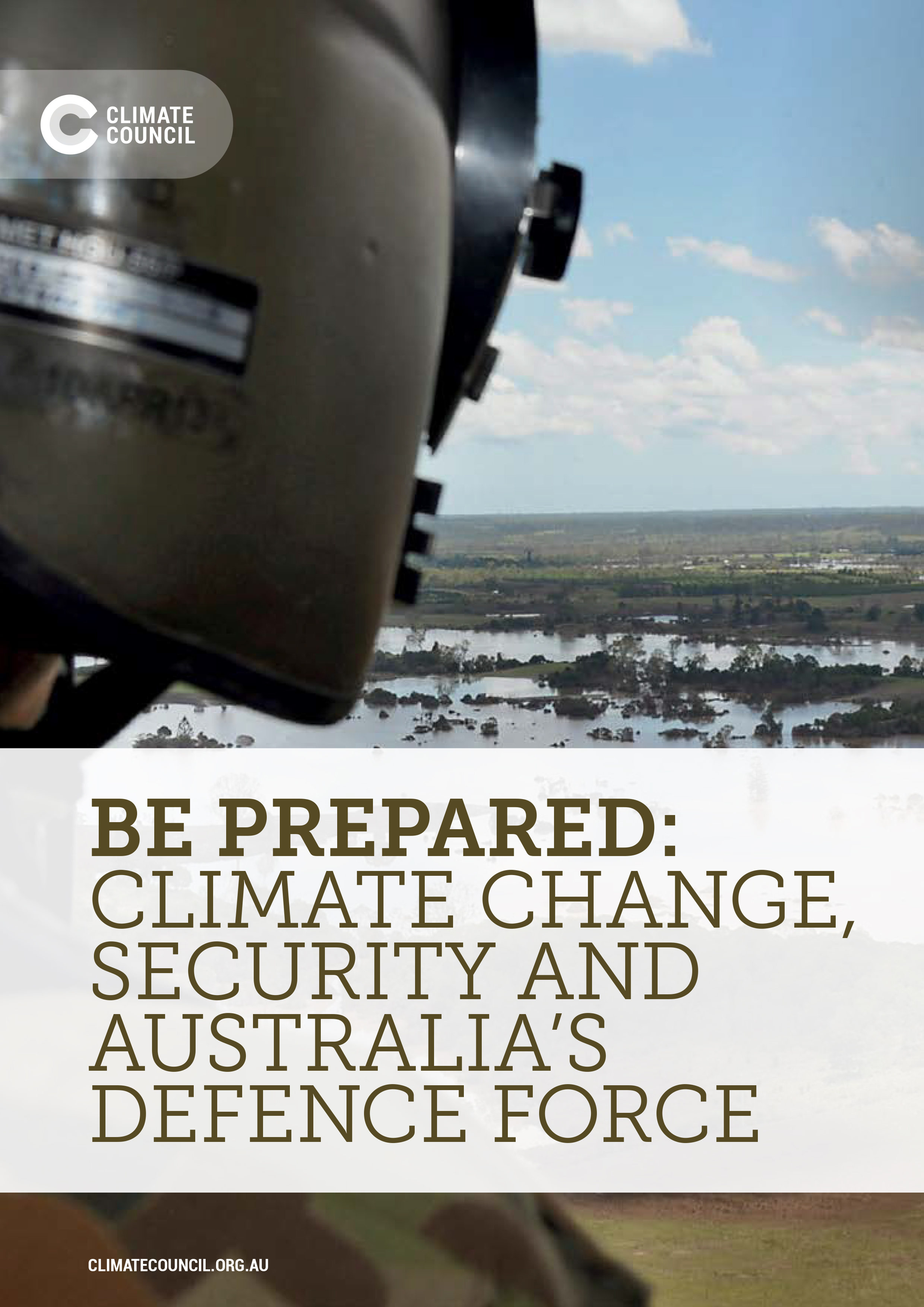
Be Prepared: Climate Change, Security and Australia’s Defence Force

Climate Council - Admiral Chris Barrie (Ret.) and Will Steffen

Climate change is a significant and growing national security threat that is undermining the preparedness of the Australian Defence Force, our new report authored by Australia’s former Defence Chief found.
Be Prepared: Climate Change, Security and Australia’s Defence Force report reveals Australia is lagging behind its UK and US allies in preparing its militaries for climate change, with Australian Defence Force resources already under strain from the increased need for humanitarian assistance in response to climate-induced disasters.


Key Findings

1. Climate change is a security threat. Climate change poses a significant and growing threat to human and societal wellbeing, threatening food, water, health and national security.

  • Food security. The 2008 food crisis increased the number of undernourished people worldwide by 75 million. The cost of wheat increased by 127%, rice by 170% and maize by 300%. By increasing the frequency and severity of droughts in important food producing regions, climate change was a key factor in the crisis.
  • Water security. Climate change will significantly affect the accessibility and availability of freshwater resources. Rising sea-levels can result in saltwater intrusion of coastal acquifers, while rainfall patterns are changing worldwide.
  • Extreme weather. Climate change is increasing the frequency and severity of many extreme weather events. These events affect individuals and societies through the displacement of people, damage to critical infrastructure, and damage to health and livelihoods.

2. Global military forces are labelling climate change a “threat multiplier”.

  • The impacts of climate change can exacerbate other stresses, like poverty, economic shocks and unstable institutions, to make crises worse. For instance, increasing extreme weather events can reduce the availability of food. Extreme weather and water scarcity contributed to soaring food prices, which saw food riots erupt across Africa and the Middle East in 2008. Rising food prices in 2011 have also been identified as one of the factors that destabilised the Middle East, leading, for example, to the “Arab Spring”.
  • Climate change can worsen tensions and increase the risk of conflict between states as sea-level rises, coastlines retreat and the eventual submergence of small low-lying islands affect maritime boundaries and exclusive economic zones where natural resources are located.
  • Leading international organisations and defence forces around the world, from the Pentagon to NATO member states and now the G7, have all identified climate change as a significant threat to national security.

3. Climate change puts the Australian Defence Force under pressure.

  • Australia and the Asia-Pacific region are vulnerable to climate change with over half of the world’s natural disasters occurring in the Asia-Pacific region last year. The ADF will increasingly be called upon to deliver humanitarian assistance in response to extreme weather and its impacts both at home and overseas. In serious cases the ADF may need to coordinate with other countries to provide assistance.
  • Extreme weather could also affect the ADF’s readiness and capability by disabling critical military and civilian infrastructure at times when rapid mobilisation is needed. Defence property (military bases) are also at risk from sea level rise and extreme weather.
  • Rising temperatures and more frequent and intense heatwaves will have implications for the health of Australia’s military personnel when undertaking training and conducting military exercises.

4. The UK and US militaries are rapidly preparing for climate change while Australia lags behind.

  • Governments in the UK and US have taken significant legislative and strategic steps to ensure that climate change is integrated into defence planning. The US has mandated that their military forces address the risks of climate change as a routine part of all mission planning.
  • In Australia, comparatively less action is being taken by the Government to ensure the Australian Defence Force is prepared for the security risks posed by climate change.
  • Increasingly, Australia is out of step with its allies in preparing for climate change, exposing Australian soldiers, sailors and airforce personnel, as well as Australia more broadly, to the considerable strategic risk and uncertainty climate change brings.

5. Strong action to reduce greenhouse gas emissions is critical for limiting the security implications of a changing climate.

  • Global emissions must start tracking downward this decade if there is to be a chance of keeping the warming of the planet to below 2°C, and limiting the severity of climate change and its implications for security.
  • We must adapt to the inevitable changes that are already occurring while working hard to minimise the long-term changes, some of which could be massive, abrupt and disruptive. 
    Audio: Chris Barrie speaks to AM


    DOWNLOAD THE REPORT

    21/09/2015

    Turnbull Government Signals New Approach To Climate Policy

    The Guardian - Lenore Taylor Political Editor

    Staff at the Australian Renewable Energy Agency were told on Monday they were being transferred from industry department to department of the environment

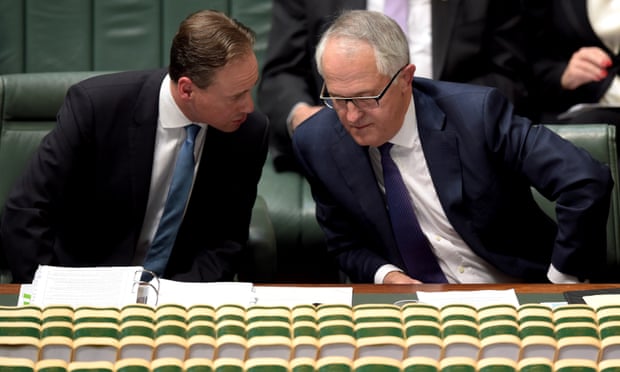
    Australian prime minister Malcolm Turnbull (right) speaks to Australian environment minister Greg Hunt in Parliament House, Canberra. Photograph: Lukas Coch/AAP

    The Turnbull government is signalling a new approach to climate policy despite its pledge to stick with the “Direct Action” climate plan, abandoning Tony Abbott’s attempt to abolish two key renewable energy agencies and considering tougher “safeguards” to ensure the policy actually reduces emissions.
    Staff at the Australian Renewable Energy Agency (Arena), a body set up by the former Labor government to increase the use of renewable energy, were told on Monday they were being transferred from the industry department to the department of the environment.
    The Clean Energy Finance Corporation, which finances clean energy projects on a commercial basis and which Abbott had ridiculed as the “Bob Brown bank” and sought to abolish or ban from investing in wind or small scale solar, is also being transferred to environment minister Greg Hunt’s portfolio. It previously answered to the treasurer and the finance minister.
    Sources said the transfer of the agencies was a clear signal they were no longer slated for abolition. The Senate twice voted down the Abbott government’s attempts to abolish the CEFC. Legislation to abolish Arena has been before the Senate for a year.
    Hunt told Sky news on Monday that “obviously under Malcolm Turnbull there is a history of a deep long support for renewable energy.”
    It is also likely the government will drop or amend the ban on the CEFC investing in wind or small scale solar. The government has been in negotiation with the CEFC over its investment instructions for several months after the investment bank got legal advice that suggested the Abbott government order could contradict its legislated duties. An agreed way forward was set to be announced any day.
    Hunt said the CEFC was “coming back to the government with proposals that might be flexible and we will look at that in time.”
    The government will also be presented with an immediate chance to improve the effectiveness of Direct Action by toughening the so-called “safeguards mechanism”, which is supposed to make sure rising industrial emissions do not undo any emission reductions purchased through the $2.5bn emissions reduction fund (ERF).
    The government had released a draft safeguard mechanism and the deadline for responses was Monday, the same day the new ministry was sworn in.
    The government could be forced to toughen the rules in negotiations to make sure they are not disallowed by the Senate. Independent senator Nick Xenophon has accused the coalition of reneging on a promise of “credible” safeguards made to secure his critical vote for the Direct Action legislation. He has proposed amendments to give the scheme “teeth”.
    Market analyst Reputex says the new rules, as proposed, leave major industry “largely free to grow their emissions” because the “baselines” have been set too high to make any difference and industry has been given even more ways to avoid penalties if they are exceeded.
    Reputex says the detailed rules confirm none of Australia’s top 20 emitting facilities – including brown coal-fired power stations Loy Yang A and B and Hazelwood, and new liquefied natural gas processing facilities such as Wheatstone, Gorgon, Itchys and Pluto – will be forced to reduce emissions.
    But Reputex has also suggested a change that could give the rules “baby teeth” – and the amendment is likely to be backed by some of the Senate crossbench.
    Most analysts believe the current policy has little chance of meeting the long term targets adopted by the Abbott government and reaffirmed by Malcolm Turnbull – to reduce Australia’s emissions by 26-28% by 2030.
    The government has promised to review the safeguards mechanism in 2017, to allow for changes to ensure it meets the 2030 target.
    The suggestion is it promise the “baselines” set for industrial emissions will begin to decline from that time – a move that would over time turn the mechanism into a baseline and credit emission trading scheme.
    The safeguards mechanism applies to facilities with more than 100,000 tonnes of emissions a year.
    Asked about the safeguards mechanism last week, Hunt said “that’s always been designed as a flexible, long-term mechanism – not to 2020 but to 2030, and I hope beyond. So, by definition, it’s been designed in a flexible way.”
    Turnbull lost the Liberal leadership in 2009 over his backing for then prime minister Kevin Rudd’s emissions trading scheme. Since becoming prime minister he has emphasised the important thing is to reduce emissions, rather than being “ideological” about the mechanism used to do so.

    Lethal Heating is a citizens' initiative