02/11/2015

Australian Insurance Companies Slow On Climate Change As Pacific Braces For Infrastructure Damage

New Matilda - 

Labor’s top brass are touring the Pacific to hear about how climate change will affect the region, but closer to home Australian insurance companies have been found to be unprepared for the coming crisis. Thom Mitchell reports.
Typhoon Champi. Image: NASA Goddard Space Flight Center/Flickr 


A new report has found that Australian insurers are lagging behind in recognising the financial risks created by climate change, and that they don’t appear to be on-board with the globally agreed goal of limiting the rise in average temperatures to less than two degrees.
The release of the World Wildlife Fund report this morning comes as Labor heavyweights, including Opposition Leader Bill Shorten and his Deputy Tanya Plibersek, tour the Pacific to investigate how climate change will impact the vulnerable region.
They’re likely to come under renewed pressure to side with Pacific leaders in arguing for a global goal of limiting temperature rises to 1.5 degrees rather than 2, with forecasts indicating Pacific nations will be left acutely at risk from climate change.
Closer to home it appears Australian insurance companies are not factoring in the implications of commitments made by 195 governments to work towards the two degree goal.
“No discussion was found by the Australian insurers about the importance of a 2 degree target in their primary disclosure documents and no self-contained public policies or statements have been identified,” the WWF report said.
The report analysed publicly available statements and policies for mentions of climate change from Australian insurers — IAG, QBE and Suncorp — and compared them with those of three international firms, Allianz, Prudential Financial and AXA.
Four Australian banks — Westpac, ANZ, CBA, and NAB — were also analysed, and were found to be more vocal and transparent about their position on climate risk and the two-degree target.
“Given the insurance industry’s expertise in risk management, weather-related impacts and prominent position in the business community, insurance companies have a responsibility to reduce risks and costs to consumers,” the report said.
In spite of this, WWF found, “None of the Australian insurance companies seem to have self-contained public climate change statement in their annual reviews or sustainability reports.”
The environmental NGO compared this stance to the international insurance companies, finding that foreign firms had warned more explicitly, more publicly, and more often about the risks that hostile weather and the diminishing value of fossil fuel stocks are creating.
This morning Labor leader Bill Shorten touched on similar themes, noting in Port Moresby that “rising sea levels are threatening the livelihoods and homes of our [Pacific] neighbours”.
As New Matilda reported in June, one study in Nature has already projected that the clean-up bill for under-developed South Pacific island nations alone could be as high as $21.9 billion, given their “acute vulnerability to climate change”.
Kiribati, the Marshall Islands, and Tuvalu were deemed particularly at-risk, with researchers from the University of New England finding that more than 95 per cent of their built infrastructure, by value, is located within 500 metres of the typically low-lying coast.
This morning WWF sought to highlight the unholy confluence between the increasing need for insurance, and the expected difficulty in securing it in a climate-changed world.
“The insurance industry will be affected through increased claims, reputational damage, decline in insurance affordability, and an increase in uninsurable sectors or geographies,” the WWF study notes.
The Pacific will be among the ‘geographies’ hardest hit, and Shorten is visiting both Kiribati and the Marshal Islands as part of his tour.
The ABC reports that this morning Shorten said “the message [I am] already getting loud and clear is that climate change is a first-order issue for our neighbours and we need … Australia to have serious policies, credible policies, which will help to contribute to mitigating the effects of climate change in our region”.
The WWF stressed that the policies of Australian insurance companies are also integral to efforts to limit the extent and impact of climate change and help in adaptation efforts.
“The private sector has a key role to play” in driving action toward the internationally agreed two degree target, the report said. “Communicating this target helps do that and also draws attention to whatever specific actions are in place to support it.”
“It is hoped that corporate discussion of a 2 degree Celsius threshold would lead to commitments and specific targets and actions.”

How Climate Change Disproportionately Affects Women

FairfaxMehreen Faruqi *

Tackling climate change is crucial for women, writes Mehreen Faruqi. Photo: Brad Newman

In a few weeks' time, world leaders, policy-makers, scientists and lobbyists will converge on Paris for the 2015 United Nations Climate Change Conference, and hopefully agree to a universal and binding agreement on climate to serve as the successor to the Kyoto Protocol. The outcome of the conference will be crucial for everyone, but especially for the world's women.
As with all complex and wicked problems, gender inequality and climate change are inextricably linked. Like gender inequality, climate change is an issue of deep injustice. Poorer countries such as the Pacific islands, Bangladesh, Pakistan and Sri Lanka already are and will continue to bear much higher burdens of the effects of sea level rise, extreme heat, water scarcity and catastrophic weather events.
This injustice not only exists between nations but also impacts women disproportionately. The gendered impacts of climate change are numerous and are further magnified for women living in poorer countries where, for example, women and girls bear the burden of collecting water and fuel to meet their families' needs. As the United Nations has noted, the impacts of climate change take hold, collecting water and firewood is getting harder and they are having to search further and further to access these essential resources. As a result of these responsibilities, women have less time to earn money, engage in politics or public activities, learn to read or acquire other skills, which further perpetuates the cycle of disempowerment and social injustice.
About 70 per cent of the world's poor are women and gender differences in deaths due to natural disasters correlate with women's social and economic rights. The 1991 the Bangladesh cyclone killed 150,000 people, 90 per cent of whom were women. Women are often not taught survival skills such as swimming or climbing. They have restricted mobility and cultural constraints that decrease their access to escape, shelter and health care. Post-disaster, women are usually at higher risk of being placed in unsafe, overcrowded shelters, which is mainly due to the lack of economic capacity, property or land ownership.
Even in richer countries, many more women than men live in poverty. The number of women in the bottom 10 per cent of income earners in New South Wales is almost double that of men. The increasing severity and frequency of droughts as a result of climate change will contribute to higher prices for food and water, which will disproportionately disadvantage these women even further.
It is somewhat revealing that while climate change is much worse news for women, they are the ones who are more cognisant of environmental change and are more likely to support environmental protection. Yet they also face the historical disadvantage of having limited access to the decision-making process.
Last year, a Climate Institute poll found a growing number of Australians want the nation to lead on finding solutions to climate change and 64 per cent of women want Australia to be a leader. The NSW Office of Environment and Heritage survey entitled "Who Cares About the Environment?" also suggests women are more likely than men to be concerned about environmental problems. On average, women undertake more environmental activities than men.
Women are uniquely positioned to be extremely effective creative agents to influence change, but empowerment, gender equality and equal participation in decision-making are key to unlocking climate change solutions. In Bangladesh, women farmers reported that their profitable chickens were drowning because of frequent flooding. When they were involved in planning for climate change, their solution was to raise ducks.
Addressing climate change will of course not only require global and collective political leadership in Paris, but also national and local leadership in individual countries to get the policy settings right and drive change. For our own part, Australia must invest heavily in renewable energy, phase out coal and bypass the dangerous lure of coal seam gas development. We must also do our fair share of assisting other countries - particularly in our own region - with climate change adaptation and mitigation.
Bringing women to the forefront of political decision-making will help in securing a safe climate future. It is notable that last week Nepal elected its first female president, making it the latest in a long line of South Asian and so-called "third world" countries to elect women leaders. The new Nepalese constitution requires one-third of legislators to be women. Meanwhile, in NSW parliament, I sit in a chamber with only 10 women out of 42 MPs. We should be doing a lot better.
The NSW Government recently objected to my motion calling on the government to "heed the advice and warnings of the world's leading scientists and ramp up efforts to address climate change in our state", and it continually refuses to make the necessary shift towards 100 per cent renewable energy in NSW, which is possible, affordable, and essential.
All governments have a responsibility not only to tackle climate change, but also to involve those who will be most affected by it. This is the 'strong moral imperative' for Australia, not digging up and shipping out more coal. In India, for example, 120,000 people die every year from health complication related to coal. No doubt a heavy burden falls particularly on women. Instead of exporting coal, we should be working with countries around the world to jointly transition to a clean and green renewable energy future.

* Dr Mehreen Faruqi is a Greens MP in the NSW Upper House. She is an engineer, academic, and activist, working for social and environmental justice.

Pacific Islands Make Last-Ditch Plea To World Before Paris Climate Change Talks

The Guardian

‘Unless the world acts decisively in coming weeks, the Pacific as we know it is doomed,’ says Fijian prime minister Frank Bainimarama
For low-lying Pacific islands the likely sea-level rise of a metre by the end of the century means coastal erosion, saltwater seeping into precious rainwater catchments and ruined crops. Photograph: Giora Dan/AAP


Amid the rustling palm trees, blissed newlyweds and colourful attire of a tropical island resort, Pacific leaders have been getting blunt with wealthy nations about the unfolding calamity of climate change that is gradually gnawing away their remote idylls.
At a summit in Fiji last week, the last major gathering of Pacific island nations before crunch UN climate talks in Paris next month, islanders thrashed out their collective plea to the world to help address the health impacts of climate change, particularly upon women, infants and adolescents.
Ratu Inoke Kubuabola, Fiji’s foreign minister, said the country was dealing with the re-emergence of climate-influenced diseases such as typhoid, dengue fever, leptospirosis and diarrhoeal illnesses. Last year, a dengue outbreak in Fiji infected 20,000 people.
But the meeting also showed that Fiji, for one, is not pulling any more punches with large, industrialised nations it sees as culpable for climate change.
“We in the Pacific are innocent bystanders in the greatest act of folly of any age,” said Fijian prime minister Frank Bainimarama.
“Unless the world acts decisively in the coming weeks to begin addressing the greatest challenge of our age, then the Pacific, as we know it, is doomed.
“The industrialised nations putting the welfare of the entire planet at risk so that their economic growth is assured and their citizens can continue to enjoy lives of comparative ease. All at the expense of those of us in low-lying areas of the Pacific and the rest of the world.”
Bainimarama added that he has yet to see the “necessary political will” amongst wealthy nations to head off the worst impacts of climate change at the Paris talks.
These gloomy warnings are becoming grimly regular fodder for Pacific islanders to digest and, increasingly, experience first-hand.
“It’s an everyday issue here,” said Dr Karen Allen, Unicef’s representative in 14 Pacific nations. “Children here in the Pacific talk about climate change like children elsewhere talk about school or TV. It’s so routine.”
Media coverage of climate change in Fiji doesn’t have the luxury of wallowing in the sort of cosseted denialism seen in the US, Britain or Australia.
The lead story in the Fiji Times ​one day last week featured the tale of a seven-year-old child who drowned in an unprecedented high tide in the Namena district. A new FIJI$670,000 ($436,000) sea wall has been approved but the area’s commissioner, Meleti Bainimarama, conceded: “What we are doing is remedial action. I think the best thing to do is relocate the village, but it will come at a cost.”
The other front-page tale featured a man in the same village complaining how his house is regularly swamped by seawater that once lapped 20 metres from his front door. While wealthy nations mull over climate projections and agonise over potential dips in GDP, the stereotypically ebullient Pacific islanders aim to bring some steely reality to Paris.
“I won’t be going to Paris wearing the usual friendly, compliant Pacific smile,” warned Bainimarama. “In fact, I won’t be going to Paris in a Pacific frame of mind at all. I fear that our interests are about to be sacrificed.”
Previous UN climate change forums, where dreary jargon often pours treacle over any sense of urgency, have been enlivened by entreaties from Pacific island leaders. But Paris will see an escalation. Pacific islanders will be turning up in numbers – almost all leaders are expected to attend, unlike in Copenhagen in 2009 – and with a string of demands.
The latest, the Suva Declaration, calls for an end to new coalmines and a more ambitious limit to global warming. The language has sharpened beyond Fiji – Kiribati president Anote Tong recently called Australia, previously venerated as a benevolent protector in the Pacific, “selfish” for its continued enthusiasm for burning vast amounts of fossil fuels.
The cause for concern is clear – Nasa recently reported the world’s sea level has risen nearly 8cm since 1992, with the Pacific experiencing a more rapid increase than other oceans.
A rise of around a metre by the end of the century now looks likely. For low-lying islands in the Pacific, this means coastal erosion, saltwater seeping into precious rainwater catchments and ruined crops.
Meanwhile, rising temperatures will heighten the risk of diseases, including those carried by mosquitos. Cyclones are expected to become more severe. The World Health Organisation estimates climate change will cause around 250,000 deaths globally between 2030 and 2050.
At the Fiji summit, delegates wearing Sulu va Taga, a type of traditional kilt, and floral shirts spell out the problems and what must be done. Jarringly, the gathering is being held at a luxury resort on Denarau island, a manmade construction featuring manicured lawns, fountains and an 18-hole golf course, created through seabed dredging and reshaping of the coastline.
But the Pacific islands mean business. A lack of regional leadership from Australia – where senior government ministers apparently consider seawater inundation hilarious – is forcing Pacific islanders to set aside their reputation for gentle amiability in order to make themselves heard internationally.
“We don’t want to change the way we are but we need to change our approach so that when we say enough is enough, we are heard,” said Satini Tulaga Manuella, health minister of Tuvalu, which is comprised of nine scattered islands, none of which peak higher than 4.5m above sea level.
In March, Tuvalu was pummelled by Cyclone Pam, which washed huge waves over the atolls and ripped apart buildings with 350kmph winds. The dead were upturned from their resting place in cemeteries, crops were ruined, islands reshaped. Tuvalu, the fourth-smallest nation in the world at just 26 sqkm, caught a glimpse of what may cause its demise. But the government is determined the population will not migrate.
“People are worried but they want to stay, our priority is to save our country,” Manuella said. “We say if you save Tuvalu you save the world, because if you bring down emissions enough to save us, the rest of the world will be OK.
“Science is telling politicians in other countries what is happening. So why aren’t they listening? They have to look after their own people but they also have an obligation to the world. Imagine if a whole race, Tuvaluans, we have our own culture, our own ways, is made extinct overnight because we are hit by a cyclone.”
There’s recognition that the smaller of the Pacific islands face the brunt of climate change, even among those in Fiji who have had to move due to its impact.
In January last year, the Fijian village of Vunidogoloa had to relocate several kilometres inland because of the merciless advance of the sea. Saline intrusion was causing crops such as barley and cabbage to fail. The leaves on the trees were turning yellow from the salt. Children were no longer left to play unsupervised after a king tide washed away a young boy.
“We were most vulnerable at night because we didn’t know what was happening with the sea,” said Sailosi Ramatu, leader of the village. “Now people are happy, they can sleep at night. We have land that is higher up in Fiji but other countries don’t have that.”
The unfairness of islanders suffering the consequences of greenhouse gases they mostly didn’t emit is mirrored by the raw deal suffered by the women who form the cornerstone of family life in the Pacific.
The Fiji summit, hosted by the government and the UNFPA, focused on how to deal with the health and gender equity problems thrown up by climate change.
According to figures cited to delegates by Princess Sarah Zeid of Jordan, ambassador for the Every Woman Every Child program, women and children are 14 times more likely to die in a natural disaster than men.
“Cooking food, taking care of children, fetching water, taking care of livestock – climate change disrupts every element of a woman’s life,” said Zeid, who is the latest royal to lend stardust to the Pacific islands’ cause after Prince Albert of Monaco provided his backing, reportedly sinking a few cans of XXXX with aid workers at a recent call to arms in Kiribati.
“When climate impacts are rapid, the consequences for women and children are also severe,” said Zeid. “The greater the gender inequality, the greater the difference.”
As women in developing countries do the bulk of caring for children and elderly relatives, they are less likely to escape floods and cyclones. This was demonstrated by 2008’s cyclone Nargis in India, where most of the fatalities were women who held onto children while the men clung to coconut trees.
In the Pacific, there are a myriad of problems to work through – many health clinics are at risk from inundation and are inaccessible to those in remote areas. Delivery of maternal and reproductive health is patchy and the risk of sexual assault and abuse is heightened following disaster.
“In the Pacific, men surround their thatched homes and hold the poles together to keep their women and children safe inside during a cyclone,” said Unicef’s Allen. “The Pacific has the most incredible strong community spirit of anywhere in the world I’ve been.
“That makes it all the harder to face the reality of abuse. Because when your whole culture is built around how much you love and care for each other, it may be difficult to face the fact abuse is increasing.”
These challenges require money and Pacific islands are eying the $100bn in climate finance that has been repeatedly promised by wealthy nations. The Paris talks have left open the possibility of major help for adaptation, such as sea walls, new types of crops and relocated facilities, as well as a 1.5C, rather than 2C limit on warming.
But proposals for a facility to deal with people displaced by climate change, required because they do not fall under the UN refugee convention, have been dropped, to the dismay of Kiribati, which has purchased land in Fiji and has a “migration with dignity” policy, and the Marshall Islands, where residents of the famous Bikini atoll are currently looking to relocate to the US.
It’s a mixed picture that leaves Pacific leaders far from confident that this will finally be the year where their existential crisis triggers a response.
“We will see,” said Jone Usamate, Fiji’s health minister. “The world is a system – you do something at one end of the world and it has an impact at the other end.
“So we all need to be responsible but this is not our fault. Unfortunately, we are paying the price for it.”

Climate Change Treaty Will Be The Flop Of The Year

Australian Financial Review - Christopher Booker

After failures at Kyoto in 1997, and Copenhagen in 2009, climate change activists face the same obstacles in Paris next month.
Political leaders, officials and green activists from all over the world will converge on Paris later this month, hoping for a treaty to save us all from further global warming. Photo: Reuters
At the end of this month 40,000 politicians, officials, green activists, lobbyists and journalists from 195 nations will converge outside Paris – at Europe's largest airport reserved only for private jets – for a conference they hope will change the world.
Their declared aim is to agree on a treaty that commits to such a massive cut in greenhouse gas emissions that the earth's temperature is prevented from rising more than 2 degrees Celsius higher than when the climate began naturally warming again two centuries ago.
The chief obstacle to such an agreement is exactly the same as it was at Kyoto in 1997, and at that last mammoth conference at Copenhagen in 2009, which so signally failed to get Kyoto renewed. The vast majority of countries have argued all along that, if man-made CO₂ is causing a problem, the fault lies with those "developed" nations that became rich before everyone else by burning fossil fuels to power their industrial revolution.
It is therefore up to the developed countries of the West to make the most drastic cuts, leaving the still "developing" nations to catch up. They say they are prepared to make some contribution to reducing CO₂, but only if they are paid to do so out of a $100 billion a year "Green Climate Fund", financed by the rich countries that originally created the problem.
Now, as Paris approaches – although scarcely noticed by the Western media – we can see just what the 20 countries responsible for 81 per cent of global CO₂ emissions are proposing as their "Intended Nationally Determined Contributions" to cutting emissions by 2030. These have been meticulously analysed on the Notalotofpeopleknowthat website, with further reporting on that site of the Global Warming Policy Foundation.
China, now easily the world's largest emitter, contributing 24 per cent of the total, plans by 2030 to double its CO₂ emissions, not least by building 363 more coal-fired power stations. India, now the third-largest emitter, plans by 2030 to treble its emissions. The fourth-largest emitter, Russia, despite slashing its emissions after 1990 by closing down much of its old Soviet industry, now proposes to increase them from their 2012 level by up to 38 per cent.
Japan, the fifth-largest emitter, does claim that it will cut its emissions by some 15 per cent, but is still planning to build more coal-fired power plants. Although South Korea, the world's seventh-largest emitter, claims that it will cut emissions by 23 per cent (not least by buying "carbon credits" that will allow it to "offset" its continuing production of CO₂ for cash), even its proposed target will still be 100 per cent higher than it was 25 years ago.
As for the Middle East, the oil states such as Saudi Arabia and Iran (the eighth and ninth-largest emitters) have not yet submitted any proposals. But the United Arab Emirates, which have more than doubled their emissions since 2002, show no sign of slowing that increase, apart from a promise to invest in more "carbon-free" solar and nuclear power. As for Brazil, which as the 11th largest emitter has been rapidly increasing its dependence on fossil fuels, it sees its main contribution as being to slow the felling and burning of the Amazon rainforest.
So which countries are obviously missing from this list? President Obama may talk the talk about his ambitious plans for the United States, the world's second-largest emitter. But there is no more chance of Congress agreeing to the proposed treaty than there was in 1997, when the Senate unanimously voted no to Kyoto.
Which leaves the European Union as the only part of the world committed to cutting its emissions by 40 per cent within 15 years. However, Poland is already refusing to sign the treaty, as it builds more fossil-fuel power stations to keep its lights on, while Germany, the sixth-largest emitter does the same.
The only government in the world wholly committed to meeting that 40 per cent target by 2030 is Britain, the 14th-largest emitter, responsible for just 1.3 per cent of global emissions. This is less than China or India are now adding every year, as we shut down those fossil-fuel power plants that still manage to provide 70 per cent of our electricity.
And what about that Green Climate Fund, supposed by 2020 to be dishing out $100 billion every year to help developing countries to "adapt to climate change"? Firm pledges received so far total just $700 million, leaving $99.3 billion still to go.
The only real question that will remain after the failure of this bid for a binding treaty in Paris is how much longer it can be before the most expensive and foolish scare story in history finally falls apart.

01/11/2015

Paris 2015: Carbon Promises Lock In 2.7 Degrees Of Warming, UN Says

Fairfax - Peter Hannam

The United Nation's top official on climate change, Christiana Figueres. Photo: Brendan Esposito


The world remains on course to exceed dangerous temperature increases even if nations carry out pledges they make at next month's global climate summit in Paris, the United Nations says.
An assessment by the UN of 146 national goals and those of the European Union covering about 86 per cent of greenhouse gas emissions found they would cut average per capita pollution by as much as 8 per cent by 2025 and 9 per cent by 2030 compared with the current trajectory.
So-called Intended Nationally Determined Contributions (INDCs) represent a big step forward from the 2009 Copenhagen summit but still fall short of keeping temperatures to within two-degrees warming on pre-industrial levels that scientists say would trigger dangerous climate change.
"The INDCs have the capability of limiting the forecast temperature rise to around 2.7 degrees by 2100, by no means enough, but a lot lower than the estimated four, five, or more degrees of warming projected by many prior to the [pledges]," Christiana Figueres, Executive Secretary of the UN Framework Convention on Climate Change, said.
Just weeks to go before the summit, global heat records continue to tumble. Vrendendal in South Africa recorded 48.4 degrees on Tuesday, the hottest recorded temperature in October anywhere.2015 remains odds on to smash annual records after September was the most unusually warm month in 1629 monthly records kept by US agencies.
This month is also likely to be Australia's hottest October as the powerful El Nino adds to be background warming from climate change.
Australia has promised to cut 2005-level emissions 26-28 per cent by 2030 - a target that while relatively ambitious on a per capita basis would still leave the country with the highest pollution per person among rich nations.
Prime Minister Malcolm Turnbull is expected to attend the opening day of the Paris conference, joining world leaders expected to call for bolder action to curb greenhouse gas emissions.
A climate meeting of negotiators in Bonn, Germany earlier this month made little progress, with the draft text of the Paris agreement swelling out to 55 pages.
The final agreement is expected to contain few specific numbers, in part to enable US President Barack Obama to impose regulatory measures to curb emissions in the world's second largest polluting economy without the need to seek approval in the hostile Republican-dominated Senate.
Key differences, though remain between rich and developing nations. The latter want to see a firm commitment to increase the combined public and private financial aid from a goal of $US100 billion ($141 billion) a year beyond 2020, while the former want greater transparency and accountability for national emissions.
A worst-case scenario could a very minimalist agreement "with a bow-tie put around the INDCs", one source said.
The negotiations at Paris are also likely to focus on the durability of any pact and whether nations will be obligated to lift their commitments at each future review, possibly set at five-year intervals.
With the Paris pledges falling short of the two-degree target, many observers are arguing the event will likely be the start of a new process to reduce emissions rather than the end of the road.
Environment Minister Greg Hunt is expected to attend the first week of the conference with Foreign Minister Julie Bishop likely to attend at least three days in the second week.

It’s Been Australia’s Hottest Ever October, And That’s No Coincidence

The Conversation - &
Early heat in Victoria helped fan bushfires in October. AAP Image/Tracey Nearm


This has been Australia’s hottest October on record. Barring an (extremely unlikely) cold snap, it will also be the hottest October for Victoria, and for Melbourne. And the record-breaking temperatures are at least six times more likely thanks to human-induced global warming.
But hold up, you say, October isn’t over yet! That’s true, but going by the current forecast from the Bureau of Meteorology we can see that new record high October average maximum temperatures are virtually certain.
In fact, the maximum temperature on Saturday would need to be below freezing across Victoria for the record not to be set, and there is no physically plausible scenario that could lead to that happening. Maybe if an asteroid landed in Victoria on Saturday (Halloween) and threw up enough dust to block out the sun? But that is very, very unlikely!

What’s driving the heat?
A record hot spell affected southeast Australia in the first week of October and a second exceptional hot spell followed two weeks later.

The very hot spell that hit Australia in early October. Note parts of south east Australia experienced temperatures 8-10C above average. Australian Bureau of Meteorology


New record highs have been set for monthly and seasonal average temperatures across Australia at 12 times the rate of new record lows. Global warming is the cause.
To understand the role of human-caused global warming in the new records we compare simulations of the Earth’s climate from nine different models from around the world.
We only select climate models that do a good job of simulating the natural year-to-year variability of Australian temperatures. We then compare simulations for the current climate (with human influence) and for the climate without human influence. This approach has been used already to show the important role of global warming in record high Australian temperatures in 2013.
Using this method we can figure out the chances of breaking a record even before it happens. The previous hottest October in Australia was in 2014 with a temperature of 32.9°C. Our analysis shows an increase by at least a factor of six in the chances of setting the new October record maximum temperature for Australia due to global warming.

What about El Niño?
But we also have to factor in El Niño. As noted by the Bureau of Meteorology, such hot and dry spells are typical for the strong El Niño that is currently occurring in the Pacific Ocean.
To do this we use a huge set of data from a citizen science project called Weather@home ANZ. Weather@home allows you to donate your computer’s processing power to simulate Australia’s climate with and without human-caused climate change, and including El Niño.
This modelling approach, undertaken in partnership with the University of Oxford, has been used to assess the role of climate change in extreme weather and climate events in Australia in 2013 and 2014 and for typical El Niño conditions, such as this October.
We have more than 4,000 independent simulations of Australian weather and climate in October under El Niño conditions in the present world, and more than 8,000 simulations for El Niño conditions in a pre-industrial world with no human influences on climate.
These simulations allow us to assess the chances of breaking the existing records for October mean maximum temperature for the whole of Australia, for Victoria and for Melbourne under the current El Niño conditions.
For example, the figure below shows the simulated frequency of different October mean maximum temperatures for Melbourne with and without global warming.

The chances of higher October mean maximum temperature in Melbourne during an El Niño year are much greater due to global warming. The current record is shown by the vertical line.


The current record high mean maximum temperature of 23.7°C was set in October 1940. The chances of breaking the current record are much greater for the current climate, including the influence of global warming, than they would have been with no global warming.
In fact, human-caused climate change has very likely increased the chances of setting the new record for Melbourne by at least six times, even under El Niño conditions.
For the whole state of Victoria, global warming has increased the chances of breaking the existing record by at least six times, while for Australia under El Niño conditions, global warming has increased the chances by at least ten times. This is more than the increase found using the other climate models mentioned above, because now we have also taken into account the influence of El Niño.
Climate change due to human activity has dramatically increased the chances of setting new record temperatures in Melbourne, Victoria and Australia in October this year.
Of course, we have to wait another couple of days to see if our predictions hold true. But we are pretty confident they will.

31/10/2015

Elevated CO2 Levels Directly Affect Human Cognition, New Harvard Study Shows

ThinkProgressJoe Romm

In a landmark public health finding, a new study from the Harvard School of Public Health finds that carbon dioxide (CO2) has a direct and negative impact on human cognition and decision-making. These impacts have been observed at CO2 levels that most Americans — and their children — are routinely exposed to today inside classrooms, offices, homes, planes, and cars.
Carbon dioxide levels are inevitably higher indoors than the baseline set by the outdoor air used for ventilation, a baseline that is rising at an accelerating rate thanks to human activity, especially the burning of fossil fuels. So this seminal research has equally great importance for climate policy, providing an entirely new public health impetus for keeping global CO2 levels as low as possible.
In a series of articles, I will examine the implications for public health both today (indoors) as well as in the future (indoors and out) due to rising CO2 levels. This series is the result of a year-long investigation for Climate Progress and my new Oxford University Press book coming out next week, “Climate Change: What Everyone Needs to Know.” This investigative report is built on dozens of studies and literature reviews as well as exclusive interviews with many of the world’s leading experts in public health and indoor air quality, including authors of both studies.

What scientists have discovered about the impact of elevated carbon dioxide levels on the brain

Significantly, the Harvard study confirms the findings of a little-publicized 2012 Lawrence Berkeley National Laboratory (LBNL) study, “Is CO2 an Indoor Pollutant? Direct Effects of Low-to-Moderate CO2 Concentrations on Human Decision-Making Performance.” That study found “statistically significant and meaningful reductions in decision-making performance” in test subjects as CO2 levels rose from a baseline of 600 parts per million (ppm) to 1000 ppm and 2500 ppm.
Both the Harvard and LBNL studies made use of a sophisticated multi-variable assessment of human cognition used by a State University of New York (SUNY) Upstate Medical University team, led by Dr. Usha Satish. Both teams raised indoor CO2 levels while leaving all other factors constant. The findings of each team were published in the peer-reviewed open-access journal Environmental Health Perspectives put out by the National Institute of Environmental Health Sciences, a part of NIH.
The new study, led by Dr. Joe Allen, Director of Harvard’s Healthy Buildings program, and Dr. John Spengler, Professor of Environmental Health and Human Habitation at Harvard, used a lower CO2 baseline than the earlier study. They found that, on average, a typical participant’s cognitive scores dropped 21 percent with a 400 ppm increase in CO2. Here are their astonishing findings for four of the nine cognitive functions scored in a double-blind test of the impact of elevated CO2 levels:

The researchers explain, “The largest effects were seen for Crisis Response, Information Usage, and Strategy, all of which are indicators of higher level cognitive function and decision-making.” The entire article is a must-read as is the LBNL-SUNY study.
NASA has also observed CO2-related health impacts on International Space Station (ISS) astronauts at much lower CO2 levels than expected and has identified a mechanism by which CO2 levels could affect the brain, as I will discuss in Part 2. As a result, NASA has already lowered the maximum allowable CO2 levels on the space station. The ISS crew surgeon who is the lead for studying the impact on astronauts of CO2 (and other gases) told Climate Progress he considers the original LBNL-SUNY study “very credible.” Indeed, NASA itself is now starting terrestrial studies to look at the impact of CO2 on judgment and decision-making for the astronaut cohort — and it is partnering with the same SUNY team of behavioral psychologists.
All of this new research is consistent with — and actually helps explain — literally dozens of studies in the past two decades that find low to moderate levels of CO2 have a negative impact on productivity, learning, and test scores. See here for a research note and bibliography of some 20 studies and review articles.

The impact of fossil fuels and modern buildings on human cognition
For most of human evolution and modern history, CO2 levels in the air were in a fairly narrow and low range of 180 to 280 parts per million. Also, during the vast majority of that time, humans spent most of their time outdoors or in enclosures that were open (like a cave). Even once humans built dwellings, those were not tightly sealed as modern buildings are. So even though we generate and breathe out CO2, homo sapiens were not generally exposed to high, sustained CO2 levels.

But in recent decades, outdoor CO2 levels have risen sharply, to a global average of 400 ppm. Moreover, measured outdoor CO2 levels in major cities from Phoenix to Rome can be many tens of ppm higher — up to 100 ppm or more — than the global average. That’s because CO2 “domes” form over many cities primarily due to CO2 emissions from traffic and local weather conditions.
The outdoor CO2 level is the baseline for indoor levels. In buildings — the places where most people work and live — CO2 concentrations are considerably higher than outdoors. CO2 levels indoors that are 200 ppm to 400 ppm higher than outdoors are commonplace — not surprising since the design standard for CO2 levels in most buildings is 1000 ppm. In addition, that differential increases when more people are crammed into a space and when the ventilation is not adequate. As the Harvard researchers point out, in recent decades, buildings have become more tightly sealed, and there has been less exchange of inside air with fresh outside air.
How high can CO2 levels get indoors? As but one salient example, the 2012 LBNL-SUNY article notes, “In surveys of elementary school classrooms in California and Texas, average CO2 concentrations were above 1,000 ppm, a substantial proportion exceeded 2,000 ppm, and in 21% of Texas classrooms peak CO2 concentration exceeded 3,000 ppm.” In Part 3, I’ll look at the extensive literature on the relationship between high classroom CO2 levels and poor student performance — and the simple strategies Indoor Environmental Quality experts say that parents, teachers, and school administrators should be doing now to address this serious problem.
Yet, the vast majority of studies linking CO2 levels to poorer performance at work and school merely used CO2 as a measure of ventilation rates and indoor air quality (since monitoring CO2 levels is relatively cheap and easy). As the LBNL-SUNY study notes, “It has been widely believed that these associations exist only because the higher indoor CO2 concentrations occur at lower outdoor air ventilation rates and are, therefore, correlated with higher levels of other indoor-generated pollutants that directly cause the adverse effects,” such as volatile organic compounds and particulates.
As a result, “CO2 in the range of concentrations found in buildings (i.e., up to 5,000 ppm, but more typically in the range of 1000 ppm) has been assumed to have no direct effect on occupants’ perceptions, health, or work performance.” In short, CO2 had not been a suspect in the negative impacts measured in all these studies. Indeed one of the authors of the LBNL-SUNY study, Dr. William Fisk, leader of LBNL’s Indoor Environment Group, told me that he was surprised when the testing showed significant impacts from just raising CO2 indoor CO2 levels 400 ppm.
Yet very few of those other studies offered a specific mechanism for the negative impacts they measured beyond hand-waving assertions of “inadequate indoor air quality.” With the recent work from the Harvard, LBNL, SUNY, and NASA researchers, however, we now have at least a partial answer to the mystery, according to several experts I spoke to: High CO2 levels don’t merely serve as an indicator of poor air quality that causes occupants problems, they are actually one cause of those problems.
Interestingly, the authors of all of these studies — the direct CO2 studies and the CO2-as-a-proxy-for-ventilation studies — are generally public health researchers focused on indoor environmental quality (IEQ). As a result, their published work does not examine the implications these findings have for climate policy.

The risks of doing nothing
But the implications for climate policy are stark. We are at 400 parts per million (ppm) of CO2 today outdoors globally — and tens of ppm higher in many major cities. We are rising at a rate of 2+ ppm a year, a rate that is accelerating. Significantly, we do not know the threshold at which CO2 levels begin to measurably impact human cognition.
The LBNL study found a measurable negative impact on human cognition at 1000 ppm. The Harvard researchers had a more comprehensive study that found significant negative impact at 930 ppm. Moreover, many measurements made by the Harvard team point to a much lower threshold, as the top figure shows. Equally important, the researchers found “The exposure-response between CO2 and cognitive function is approximately linear across the concentrations used in this study.” So the impact threshold may be quite below 930 ppm. Clearly more research needs to be done to solve this detective story.
he latest IEQ research does offer strong suggestions that the threshold could be near (or possibly even below) levels the entire world could experience outdoors over the next hundred years — levels that are essentially irreversible for centuries.
As one clue to where that threshold may be, we can turn to recent research from Carnegie Mellon University (CMU) for the U.S. General Services Administration, which found a threshold of about 600 ppm. At 1,282 workstations in 64 diverse buildings across the country, CMU measured CO2 levels and surveyed occupancy perception of air quality.
The result: “An in-depth analysis reveals that occupant satisfaction with overall air quality is strongly linked to CO2 levels, with significant shifts to satisfaction when CO2 is less than 600 ppm.” That’s from an as-yet unpublished CMU thesis “Are Humans Good Sensors? Using Occupants as Sensors for Indoor Environmental Quality Assessment and for Developing Thresholds that Matter,” for a Ph.D. in “Building Performance and Diagnostics.”
I spoke to the chair of the thesis committee, Vivian Loftness — University Professor and former Head of the School of Architecture — one of the world’s leading experts on “Health, Productivity, and the Quality of the Built Environment,” which is a graduate course she teaches. Over the last quarter century, she has assembled the most extensive database in the world of studies on the health and productivity gains from green building design. I first met her when I was working on a book of case studies on that very subject in the late 1990s.
Loftness, who oversaw the GSA study, explained that CMU’s analysis showed that “humans are pretty good sensors of high CO2 levels.” Occupant perception of indoor air quality drops sharply as CO2 levels rise from 600 to 750 ppm.
She is familiar with the recent work showing a direct link between CO2 and human cognition. She said of the original LBNL-SUNY study, “a seminal piece of work and a great research team.” She considers the Harvard study “an absolutely important study.”
Loftness draws two key conclusions from these studies, her own work, and the vast database of scientific literature she has surveyed. First, the immediate public health message is to increase ventilation and the use of outside air in buildings. And second:
We have to do everything we can to keep outdoor CO2 levels below 600 ppm because something serious starts happening then.
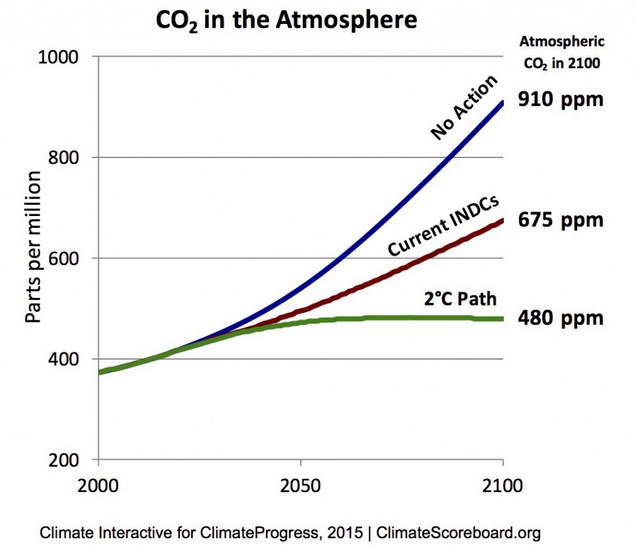
Researchers at Climate Interactive put together a chart of where CO2 levels headed as we head into the crucial Paris climate talks in December.

The world had been on a path toward 900 ppm of CO2 in the air by 2100. Commitments made by major countries to cut or constrain CO2 emissions through 2030 — Intended Nationally Determined Contributions (INDCs) — would put us on a sharply lower trajectory. To avoid catastrophic impacts, however, we will need much stronger commitments post-2030.

Success at Paris, as I have written, would buy us 5 to 10 years in the fight to avoid catastrophe. But we would still be on a path to 675 ppm, which is too high for both the climate change impacts and the direct human cognition impacts. Worse, that level of warming will likely trigger many major carbon-cycle amplifying feedbacks that are not included in the climate models, such as permafrost melting. So we must take stronger action.
On the immediate public health front, we need to start monitoring indoor CO2 more closely and keep inside levls as close as possible to levels outdoors through greater use of outside air. According to the building design experts I have interviewed, such as Dr. Loftness, that can be done without increases in building energy consumption using cost-effective strategies and technologies available today. Indeed, systematic green design will lower total energy consumption. I will examine these design strategies later in this series.

Lethal Heating is a citizens' initiative