15/11/2015

OECD Coal Discussions Highlight Tensions In Australia’s Position On Climate Change

The Conversation - Katherine Lake

The OECD is seeking to limit finance for coal power. Coal image from www.shutterstock.com


While the UN Paris talks approach at the end of November, attention is currently focused on another forum, the Organisation of Economic Cooperation and Development (OECD), where member countries are negotiating a deal to limit public finance to overseas coal projects in emerging and developing countries.
Australia and South Korea are reportedly opposed to an agreement struck by the US and Japan and supported by other member countries, notably Germany and France, to prevent public finance to all but the very cleanest power plants.
How will these discussions at the OECD impact on the UN Paris negotiations? Australia’s approach to these international meetings would seem to be inconsistent.

Many pathways to action on climate change
The UN Framework Convention on Climate Change is still the main negotiating forum through which countries negotiate emission reduction commitments. However, over the last decade, other international forums, in particular the World Bank, International Energy Agency, G20, G7 and the OECD, have played an increasingly important role in progressing emission reduction outcomes.
The OECD’s broad objective is to assist governments foster prosperity and fight poverty through economic growth and financial stability. It helps to ensure that the environmental implications of economic and social development are taken into account. Pursuant to this mandate the OECD has worked with the G20 and G7 to address climate change, in particular through promoting green growth, reducing fossil fuel subsidies, reforming energy regulation and facilitating climate finance
This multi-forum approach to addressing climate change is critical as it diversifies the range of action, but it also maximises accountability in the process and exposes countries' weaknesses and internal inconsistencies in their climate change policy positions.
Given the different membership and mandates of international organisations, outcomes that might be impossible in one forum are able to be achieved in others. Clearly, this multi-layered approach is essential if we are to solve the climate change problem.
The strength of the UN process is in providing an overarching framework, whereas more concrete actions can be achieved through the OECD, the World Bank and other forums.

Limiting coal finance
The work on fossil fuel subsidies by international organisations was undertaken in response to a request by G20 Leaders when they met in Pittsburgh in September 2009.
At that time, leaders agreed to “rationalize and phase out over the medium term inefficient fossil fuel subsidies that encourage wasteful consumption”. They asked the OECD together with the International Energy Agency (IEA), Organization of the Petroleum Exporting Countries (OPEC) and the World Bank to “provide an analysis of the scope of energy subsidies and suggestions for the implementation".
Export credit finance is a particular type of fossil fuel subsidy, through which public credit agencies, such as the Export Finance and Insurance Corporation in Australia, provide government-backed loans and other types of finance to businesses wishing to invest in industries abroad. It is estimated that agencies from OECD countries channelled US$34 billion into coal power projects between 2007 and 2014.
The discussions to phase out export credit finance for coal power stations in the OECD commenced last year, but hit a stalemate in June this year. In November, however, the US and Japan will reportedly announce a proposal which would restrict export credit finance to all but the cleanest power stations, known as ultra-supercritical pressure coal plants, a technology that Japan is a leader in.
The text of the proposal also reportedly includes a clause that a coal plant could only win public funding if cleaner alternatives, such as renewables, were not viable. If adopted, the US-Japan proposal would substantially reduce the number of new power stations built in emerging economies in Asia and South America. Australia opposes these restrictions and also rejects the clause requiring project developers to look at cleaner alternatives.
OECD rules require that decisions are made by consensus by the members, so countries will need to reach a compromise next week, when the process concludes. The ultimate outcome will have a direct impact on the ambition of the Paris negotiations, so is important.

Australia is walking a fine line in climate diplomacy
Are Australia’s positions on climate change in the UN and the OECD inconsistent?
On the one hand, Australia supports the objective of keeping the global temperature rise within 2℃ and is willing to make some domestic emission reductions to assist in achieving this.
On the other hand, it is not yet willing to place any real limits on its coal exports to developing countries. It justifies this position on the basis that coal is required by developing countries to alleviate poverty and that it is not for Australia to decide how other countries allocate their public finance.
Other countries, notably the US, Japan and Germany, however, now accept that if we are to meet the 2℃ goal then developed countries have a responsibility, including through the direction of public finance, to ensure that emerging economies transition away from fossil fuels, by allocating funding to clean energy technologies instead.
This transition is not as fanciful as it once seemed, given the decreasing cost of renewable technologies every year. The International Energy Agency recently highlighted that in order to meet the 2℃ goal, any new power stations must on average emit 200 grams of CO₂ per kilowatt-hour, whereas even super-critical power stations emit above 600 grams per kWh. It is therefore clear that the cleanest power stations will be required to limit warming to 2℃, unless carbon capture and storage technology becomes viable for power stations, which currently seems unlikely.
While Australia’s economy is more vulnerable than others to the effects of restrictions on coal uptake, it seems inevitable that there will be a continuing decline in coal demand and thus the sooner we transition our economy accordingly, the easier this transition will be in the long term. Many businesses recognise this probability and are already planning scenarios around it.
In addition, taking a blocking position at the OECD has the potential to damage Australia’s credibility in other international negotiations and particularly as its role as co-chair of the Green Climate Fund. Overall, to address climate change, our policies on energy and climate change will need to align. As the US, EU and China step up their leadership on climate change, Australia will come under increasing pressure to reconcile its different positions.

Melting Antarctic Ice Sheets And Sea Level Rise: A Warning From The Future

The Conversation - Andrew Glikson

Antarctica is vital to the planet’s climate system. Antarctic image from www.shutterstock.com
The remote location of the Antarctic and Greenland polar ice sheets may leave us with the impression that developments in these regions have little effect on the climate and life in the temperate zones of the Earth, where most of us live. We may therefore be forgiven for asking why should we care when these changes are projected to unfold over tens to hundreds of years.
However, the stability of the polar regions is critical for maintaining a planet with the conditions that allowed the emergence of humans, agriculture and civilisation, as well as many other species. The polar ice sheets serve as “thermostats” of global temperatures from which cold air and cold ocean currents emanate, moderating the effects of solar radiation. The ice sheets regulate sea levels, store volumes of ice whose melting would raise sea level by up to 61 metres.
Unfortunately, what’s happening with the polar ice sheets now ought to warn humanity of what is to come.
For example, a recent paper suggested that melting Antarctic ice sheets could lead to 0.6-3.0 m of sea level rise by the year 2300. This is based on modelling of greenhouse gas emissions out to 2300.
If greenhouse gas emissions continue unchecked, the world may warm by 8–10℃ by 2300. Such a temperature rise could raise sea levels by tens of meters over hundreds of years.
The recent paper only looked at sea level rise from melting Antarctic ice sheets and does not take into account sea level rise contributions from the Greenland ice sheet (currently about 280 billion tonnes per year), which would more than double the Antarctic contribution.

Antarctic warming: Red represents areas where temperatures have increased the most during the last 50 years, particularly in West Antarctica. NASA


Peering into the past to see the future
Much of the discussion in the paper and related papers appears to assume linear global warming – that is, little change to the rate of warming over time.
Little mention is made of feedbacks which could increase the rate of warming. Such feedbacks could arise from reducing albedo, where solar radiation usually strongly reflected by ice is replaced by strong absorption by water.
Other feedback processes associated with warming include methane release from permafrost and bogs; loss of vegetation; and fires.
In a recent article, former NASA climate scientist James Hansen and a large group of climate scientists point to observations arising from detailed studies of the recent history of the atmosphere-ocean-ice sheet system.
The climate records of the past — specifically, the Holocene (from about 10,000 years ago) and the Eemian interglacial period (about 115,000 to 130,000 years ago) — are closely relevant to future climate projections. These records include evidence for rapid disintegration of ice sheets in contact with the oceans as a result of feedback processes resulting in sea level rise to 5-9 m above current levels. All this during a period when mean global temperatures were near to only 1℃ above pre-industrial temperatures.
Sea levels reflect the overall global temperature and thus of global climate conditions. As shown by the position of the circles in the chart below, the ratio of sea level rise (SL) to temperature rise (TR) during the glacial-interglacial cycles was approximately between 10-15 metres per 1℃.
Plots of Temperature rise (relative to the pre-industrial age) vs relative sea level rise in (meters).


By contrast from around 1800 to the present sea level rose by an approximate ratio of 0.2-0.3 m per 1℃. This suggests significant further rise towards an equilibrium state between sea level and temperature. Thus, the points in the right-hand circle represent long-term temprature-sea level equilibria in the past while points in the left-hand circle represent where we’re at now, namely at an incipient stage moving toward future temprature-sea level equilibrium.

Why should long term climate change matter?
Due to the extreme rate of CO₂ and temperature rise during the 20th century relative to earlier events and the non-linearity of climate change trends the timing of sea level rise may be difficult to estimate.
Even on conservative estimates, current global warming is bound to have major consequences for human civilisation and for nature, as follows:
  • Further melting of the ice sheets will destroy the climate conditions which allowed agriculture and the rise of civilisation in the first place.
  • The lower parts of the world’s great rivers (Po, Rhine, Nile, Ganges, Indus, Mekong, Yellow, Mississippi, Amazon), where more than 3 billion people live and the bulk of agriculture and industry are located, sit no more than a few metres above sea level.
  • Further melting of the Antarctic and Greenland ice sheets can only result in sea level rises on the scale of tens of metres, changing the continent-ocean map of Earth.
Global temperatures have already risen 0.9℃ and continental temperatures 1.5℃ degrees above pre-industrial levels. If we account for the cooling effect of sulphur aerosols from industrial pollution, greenhouse gases have already contributed 2℃ of global warming. The current rate of global warming, faster than any observed in the geological record, is already having a major effect in many parts of the world in terms of droughts, fires, and storms.
According to James Hansen burning all the fossil fuels on Earth would result in warming of 20℃ over land areas and a staggering 30℃ at the poles, making “most of the planet uninhabitable by humans”.
In 2009 Joachim Hans Schellnhuber, Director of the Potsdam Climate Impacts Institute and Climate Advisor to the German Government, stated: “We’re simply talking about the very life support system of this planet”, constituting one of the most critical warnings science has ever issued to our species.
Mitigation plans proposed by governments would slow down the rate of carbon emissions but continuing emissions as well as feedbacks from ice melt, warming oceans, methane release and fires would continue to push temperatures upwards.
An effective technology required for global cooling efforts, if technically possible, would require investment on a scale not less than the trillions of dollars currently poured into armaments and war in the name of defence (more than $1.6 trillion in 2014).
Which planet do current decision makers think we are living on?

Fresh Climate Data Confirms 2015 Is Unlike Any Other Year in Human History

Slate - Eric Holthaus
175634038-calved-icebergs-from-the-nearby-twin-glaciers-are-seen
This year is set to be Earth's warmest in millennia, according to new data—with profound implications. Here, calved icebergs are seen floating on the water on July 30, 2013, in Qaqortoq, Greenland. Photo by Joe Raedle/Getty Images

Over the past few days, a bevy of climate data has come together to tell a familiar yet shocking story: Humans have profoundly altered the planet’s life-support system, with 2015 increasingly likely to be an exclamation point on recent trends.
On Monday, scientists at Britain’s national weather service, the Met Office, said our planet will finish this year more than one degree Celsius warmer than preindustrial levels for the first time. That figure is halfway to the line in the sand that scientists say represents “dangerous” climate change and global leaders have committed to avoid—an ominous milestone.
This year’s global heat wave—about two-tenths of a degree warmer than 2014, a massive leap when averaged over the entire planet—can be blamed most immediately on an exceptionally strong El Niño but wouldn’t exist without decades of heat-trapping emissions from fossil fuel burning. Separate data released on Monday by the U.S. National Oceanic and Atmospheric Administration showed the current El Niño, a periodic warming of the tropical Pacific Ocean, has now tied 1997 for the strongest event ever measured, at least on a weekly basis.
"We've had similar natural events in the past, yet this is the first time we are set to reach the 1 degree marker and it's clear that it is human influence driving our modern climate into uncharted territory," said Stephen Belcher, director of the Met Office’s Hadley Centre in a statement.
The Met Office data were quickly confirmed on Twitter by Gavin Schmidt, who leads the research center in charge of NASA’s global temperature dataset, which uses a slightly different methodology:

If that wasn’t enough, the World Meteorological Organization, a division of the United Nations, also confirmed on Monday that global carbon dioxide levels reached a new record high in 2014—for the 30th consecutive year. The more carbon dioxide in the atmosphere, the more efficient the planet is at trapping the sun’s heat, and so global temperatures rise. Since our carbon dioxide emissions have a lifespan of a hundred years or so, there’s a significant lag in this process—temperatures will keep rising for decades even if all human emissions ceased today.
That means not only will 2015 end up as the planet’s warmest year in millennia—and probably since the invention of agriculture more than 10,000 years ago—but that there’s a lot more warming that’s already baked into the global climate system.
All that extra heat is already changing the planet in complex ways. For example, as of last week, there’s fresh evidence that the Atlantic Ocean’s fundamental circulation system is slowing down.
Over the past few years, a notoriously persistent cold patch of ocean has emerged just south of Greenland in the north Atlantic. There have been several theories as to why this is happening, but most involve a slowdown of the Atlantic Meridional Overturning Circulation, part of the global oceanic “conveyor belt” system of heat and water that helps regulate the Earth’s climate by cooling off the tropics and gently warming polar regions.
You wouldn’t necessarily expect persistent record-cold temperatures when the planet overall temperature is at record highs, but that’s exactly what’s happening:
ezgif-2596458038


The AMOC is so important that its slowdown has been linked to past episodes of abrupt climate change, like a three-degree Celsius drop in Northern Hemisphere temperatures in less than 20 years about 8,000 years ago, and formed the highly dramatized basis for the planetary chaos featured in The Day After Tomorrow. Earlier this year, an important study provided further strong evidence that melting ice from Greenland has begun to disrupt and slow down the ocean’s circulation by changing the density of the north Atlantic, with profound consequences: In 2009, East Coast sea levels sharply—and temporarily—jumped by about four inches as water piled up. Stronger winter storms and an interruption of the Atlantic marine food chain also may already be happening.
According to a new analysis released last week, scientists used data from a pair of NASA satellites to track climate-related changes in the north Atlantic—the first time ocean currents have been tracked from space. Over the last decade, the satellites were able to take highly precise measurements of the literal weight of the ocean between Florida and Iceland that corroborated measurements from a network of ocean buoys over the same general place and time. From that information, they were able to calculate that the Atlantic’s circulation is indeed slowing down, a potential climate tipping point that’s been long predicted to occur at some point in the 21st century. Call it one more data point from a rapidly changing planet.
Still, despite the blindingly clear data, there’s hope that the tide could—finally—be shifting on climate change. Later this month, world leaders will be gathering in Paris and are widely expected to agree to the first-ever global agreement to constrain future emissions trajectories in a meaningful way—possibly enough to avoid the worst-case climate scenario.

14/11/2015

Malcolm Turnbull Climate Plan To Deliver Only One-Seventh Carbon Cuts: The Climate Institute

Fairfax - Peter Hannam

Paris climate talks: what you need to know
Leaders from nearly 200 countries are meeting in Paris in December for the United Nation's Climate Change Conference to try and agree on a climate treaty, discuss how we can keep global warming below two degrees.

The centrepiece of the Turnbull government's climate policy will deliver only about one-seventh of Australia's post-2020 carbon reduction goals, according to analysis by The Climate Institute.
The $2.55 billion Emission Reduction Fund (ERF) – which may swell to almost $5 billion by 2030 – will likely deliver about 355 million tonnes of carbon abatement, based on the price paid in the fund's first auction, the group said in a report.
Malcolm Turnbull has maintained the climate goals of predecessor Tony Abbott.
Malcolm Turnbull has maintained the climate goals of predecessor Tony Abbott. Photo: Luis Ascui

After the second auction results were released on Thursday, The Climate Institute updated its calculations based on a lower price per tonne of $12.25. The ERF budget would account for 377 million tonnes, or about 15 per cent of Australia's total abatement, based on the average price of $13.12 over the two auctions.
Prime Minister Malcolm Turnbull has maintained the climate goals of his predecessor Tony Abbott. These project a 5 per cent fall in Australia's 2000 emissions by 2020 and about 19 per cent out to 2030.
Based on government projections, the goals imply Australia will need to cut emissions by a cumulative total between 2015 and 2030 of 2.5 billion tonnes – or about seven times the ERF's likely abatement, The Climate Institute said.
The Turnbull government's main climate policy covers just one-seventh of pledged emission cuts, the Climate Institute says.
The Turnbull government's main climate policy covers just one-seventh of pledged emission cuts, the Climate Institute says. Photo: Fairfax Media

With the second auction paying out $557 million, the total spending now exceeds $1.21 billion. As with the first auction, most of the projects - totaling about 93 million tonnes of carbon - involve land sector projects, such tree planting, savannah burning or carbon farming.
Environment Minister Greg Hunt said in April the first auction "clearly prove[s] that the Coalition's climate change policy is delivering real and significant abatement – just as we always said it would".
A spokesman for Mr Hunt said there is "no doubt that the ERF is incredibly effective".
Wind turbines in California: The Climate Institute said Australia's post-2020 targets should be much higher if nations are to keep global warming to within 2 degrees of pre-industrial limits.
"The results speak for themselves," he said. "Our system is delivering massive emissions reductions."
"We welcome the fact that the Climate Institute – an organisation that for a long time has been highly critical of the ERF and a supporter of a carbon tax/emissions trading system – is now finally beginning to acknowledge some of the 'important strengths' of the [fund]," the spokesman said.

Temperatures rise
The Climate Institute said Australia's post-2020 targets should be much higher if nations are to keep global warming to within 2 degrees of pre-industrial limits.
The UK's Met Office said on Monday that the mean global temperature in the first nine months of 2015 was 1.02 degrees above the 1850-1900 average – passing the symbolic 1-degree milestone for the first time.
"We've probably got 1.5 degrees [of warming] locked in," John Connor, chairman of the Climate Institute, said.
A fairer target for Australia would be to aim for 4.7 billion tonnes of abatement by 2030, of which the ERF would deliver just 7.5 per cent, the Climate Institute said.
The current target may itself be hard to keep because the government is relying on payments to polluters or those storing carbon with little restraint on the rest of the economy to curb emissions, Mr Connor said: "We are not sending a broad-based signal to emitters in the economy that they have to take responsibility".

Emissions 'going the wrong way'
Mark Butler, the Opposition spokesman for climate change, said Direct Action would probably perform even worse than The Climate Institute predicts.
Almost three-quarters of the first auction went to existing projects, some as much as 10 years old, Mr Butler said, citing the Clean Energy Regulator.
"They were simply handing over money to projects that were already in the system, and were already delivering abatement that had been counted," Mr Butler said.
"Every piece of analysis I've seen says that Direct Action will not even constrain emissions, let alone reduce them," he said. "Emissions are actually going the wrong way."
Greens deputy leader Larissa Waters said weak baseline rules meant most big polluters would find ways to increase emissions without penalty.
"The so-called safeguard mechanism, which is meant to cap pollution, is set so high that it is meaningless – it is only safeguarding the Liberal party's big mining donors," Senator Waters said.
The Climate Institute report said Direct Action had its uses but only "as a buttress not a pillar" of climate action. Other policies could include allowing companies to trade pollution permits between them – effectively setting up a carbon price – as well as stricter vehicle fuel efficiency standards.
The Greens have legislation before parliament to raise car standards "so there is no need for the delay to 2017 for the government to merely consider this – these standards can be implemented immediately", Senator Waters said.

The Elephant in Paris – Guns and Greenhouse Gases

Common Dreams - Nick Buxton

Though the Pentagon itself warns about the coming dangers posed by a warming planet, there is evidence that many players in the corporate-military-security industrial nexus are already seeing climate change not just as a threat but an opportunity. (Photo: Stephen Melkisethian/flickr/cc)
There is no shortage of words in the latest negotiating document for the UN climate negotiations taking place in Paris at the end of November – 32,731 words to be precise and counting. Yet strangely there is one word you won’t find: military. It’s a strange omission, given that the US military alone is the single largest user of petroleum in the world and has been the main enforcer of the global oil economy for decades.
The history of how the military disappeared from any carbon accounting ledgers goes back to the UN climate talks in 1997 in Kyoto.  Under pressure from military generals and foreign policy hawks opposed to any potential restrictions on US military power, the US negotiating team succeeded in securing exemptions for the military from any required reductions in greenhouse gas emissions. Even though the US then proceeded not to ratify the Kyoto Protocol, the exemptions for the military stuck for every other signatory nation. Even today, the reporting each country is required to make to the UN on their emissions excludes any fuels purchased and used overseas by the military.
As a result it is still difficult to calculate the exact responsibility of the world’s military forces for greenhouse gas emissions. A US Congressional report in 2012 said that the Department of Defense consumed about 117 million barrels of oil in 2011, only a little less than all the petrol and diesel use of all cars in Britain the same year. Deploying that oil across the globe to the fuel-greedy hummers, jets and drones has become a growing preoccupation of NATO military strategists.
But the responsibility of the military for the climate crisis goes much further than their own use of fossil fuels. As we witnessed in Iraq, the military, the arms corporations and their many powerful political supporters have consistently relied on (and aggressively pushed for) armed intervention to secure oil and energy supplies. The military is not just a prolific user of oil, it is one of the central pillars of the global fossil-fuel economy. Today whether it is in the Middle East, the Gulf, or the Pacific, modern-day military deployment is about controlling oil-rich regions and defending the key shipping supply routes that carry half the world’s oil and sustain our consumer economy.
The resulting expansion of conflict across the globe has consumed ever-increasing levels of military expenditure: in 2014, global military expenditure reached $1.8 trillion dollars. This money is a huge diversion of public resources that could be invested instead in renewable energy as well as providing support for those most affected by climate change. When the UK government in 2014 allocates £25 billion to the Ministry of Defence but only £1.5 billion to the Department of Energy & Climate Change, it is clear where its priorities lie.
Ironically despite their role in the climate crisis, one of the loudest voices calling for action on climate change is coming from the military. US Military Head of Pacific Command Samuel Locklear III is typical of a growing chorus of military generals identifying climate change as the major security challenge of this century. The generals have been echoed by politicians. UK Prime Minister David Cameron has argued that, “Climate change is one of the most serious threats facing our world. And it is not just a threat to the environment. It is also a threat to our national security, to global security…”
This could seem a welcome development. After all who would not want one of the most powerful forces on your side in tackling humanity’s greatest ever challenge? But there is a good reason also to be cautious of who we jump into bed with. A close look at military climate change strategies reveals that they are all about securing borders, protecting supply-routes for corporations, controlling conflicts around resources and instability caused by extreme weather, and repressing social unrest. They turn the victims of climate change into ‘threats’ to be controlled or combated. There is certainly no examination of the military’s own role in enforcing a corporate capitalism and fossil-fuel economy that has caused the climate crisis.
In fact, there is evidence that many players in this corporate-military-security industrial nexus are already seeing climate change not just as a threat but an opportunity. Arms and security industries thrive on conflict and insecurity and climate change promises another financial boon to add to the ongoing War on Terror. British arms giant BAE Systems was surprisingly open about this in one of their annual reports saying “New threats and conflict arenas are placing unprecedented demands on military forces and presenting BAE Systems with new challenges and opportunities.” An Energy Environmental Defence and Security (E2DS) conference in 2011 jubilantly proclaimed that “the aerospace, defence and security sector is gearing up to address what looks set to become its most significant adjacent market since the strong emergence of the civil/homeland security business almost a decade ago.”
One of the critical lessons for climate change movements in recent years has been an understanding that simply pressurising politicians to do the right thing will not deliver effective change. Instead we must target, delegitimise and undermine the corporations that are blocking change. As climate change impacts start to hit home, we must now widen our focus to stop these same forces now disturbingly seeking to profit from the consequences of climate change. As the Paris climate talks take the global stage, it’s time to draw attention to the military elephant in our room and demand that adaptation to climate change is led by principles of human rights and solidarity, rather than militarism and corporate profits.

Coal From Carmichael Mine 'Will Create More Annual Emissions Than New York'

The Guardian -  Lenore Taylor

Australia Institute calculations show average annual emissions from burning coal from Adani’s proposed mine would be more than many countries and big cities
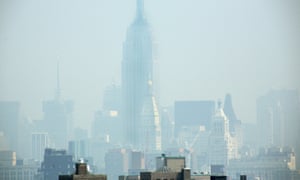
Smog covers midtown Manhattan in New York City.
Smog covers midtown Manhattan. The Carmichael coalmine’s annual emissions are projected to be 20% more than New York City. Photograph: Adam Rountree/AP
Coal from Adani’s proposed $16bn Carmichael project will create annual emissions similar to those from countries like Malaysia and Austria and more than New York City, according to calculations designed to highlight the scale of the mine’s environmental impacts.
The Australian Conservation Foundation has launched another legal action against the federal government’s renewed approval for the mine – this time on the grounds that environment minister Greg Hunt failed to consider its impact on climate change and therefore on the Great Barrier Reef.
Progressive thinktank the Australia Institute has sought to illustrate just how big those emissions will be. It says the average annual emissions from burning the coal from Carmichael – 79m tonnes of CO2 – is more than the annual emissions from Sri Lanka, more than Bangladesh with its population of 160 million, about the same as those from Malaysia and Austria and only slightly less than the annual emissions from Vietnam.
Compared to annual emissions from cities, it says Carmichael’s emissions will be three times the average annual emissions from New Delhi, double those from Tokyo, six times those of Amsterdam and 20% more than New York City.
“As the international community prepares for the Paris talks, the world’s climate change abatement efforts rely on leaving the bulk of coal resources in the ground,” the institute says.
Under international negotiations, emissions are calculated in the country where they occur, not the country where the fuel is sourced, but the conservation movement is arguing against the development of major new coalmines on the grounds that they are incompatible with the globally recognised threshold of limiting warming to two degrees.
The previous successful court challenge, which forced Hunt to re-examine his approval for Adani, was on technical grounds, because he had failed to consider its impact on two species. Hunt reapproved the mine.
The new challenge is a test case for the minister’s obligations to consider the climate change impacts on the Great Barrier Reef from burning the mine’s coal.
Hunt insists the project has been approved in accordance with the law, and that 36 strict conditions have been imposed, including on groundwater monitoring, protecting local fauna and funding research for conservation in the Galilee Basin.
The Environment Protection and Biodiversity Conservation Act requires the minister to consider the principles of ecological sustainable development when assessing projects of national environmental significance, but it is not clear whether this could include the consideration of the climate change impact on the reef of the emissions from the coal when exported and burned.
There have been previous decisions in the federal court where decision-makers were required to take into account these so-called “scope three” emissions.
After the original legal action, the former Abbott government tried to rush through laws preventing such challenges, arguing they were “lawfare” and tantamount to economic “sabotage.” That bill was deferred after Malcolm Turnbull became prime minister, but the new challenge has prompted Queensland Liberal National party senator Matthew Canavan to call for it to be brought forward.
ACF president Geoff Cousins has said the aim of the litigation is to stop the mine.
The ACF application refers to article four of the world heritage convention, which dictates Australia “do ‘all it can to the utmost of its resources’ to identify, conserve, present and transmit to future generations the outstanding universal value of the Great Barrier Reef world heritage area” – and that this must be the “primary purpose” of management of the area.
It says Hunt “made an error of law” by characterising emissions from transport by rail, shipping and then the burning of the Adani coal overseas as “not a direct consequence of the proposed action”.

India’s Fast-Moving Energy Transition: $100 Billion in Renewables Investments So Far This Year

Institute for Energy Economics and Financial Analysis - Tim Buckley

A Crush of Deals With State-Owned Enterprises, Leading Power Companies, Billionaires, Major Firms and Utilities

IEEFA-India-coal-imports-11-11-2015-535x325-v2

Investments worth more than $100 billion over the past eight months are driving an unprecedented shift to renewable energy in India.
The trend is detailed in a report we just posted—India’s Electricity Sector Transformation—that charts the accelerating influx of global capital into India as the country moves toward its goal of installing 175 gigawatts of renewable energy by 2022.
Just a few months ago, global financial markets reflected investor skepticism around whether good intentions and big promises could be turned into concrete actions. The figures we see today speak for themselves, and the $100 billion in firm commitments signed and sealed include deals with state-owned enterprises, leading Indian power companies, a number of Indian billionaires new to the power sector and major global renewable-energy firms and utilities.

Here’s a rundown of what’s happening:

  • Four of the world’s largest solar manufacturers are advancing plans to build Indian solar manufacturing capacity (Trina Solar, JA Solar, Hanwha Q CELLS, LONGi).
  • Three of the world’s top renewable energy utilities are acquiring top Indian renewable project-development firms (EDF Energies Nouvelles, ENEL Green Power, ENGIE);
  • Four of North America’s top solar-development companies are accelerating project development in India (Sky Power of Canada, First Solar, SunEdison and SunPower);
  • Numerous leading Asian innovators and utilities are targeting Indian renewables (Foxconn of Taiwan, SoftBank of Japan, Sembcorp of Singapore, CLP Group of HK);
  • Major Indian energy sector conglomerates are initiating multiple new investment programs in renewables (Adani Power, Tata Power and Reliance Power);
  • Several of India’s wealthiest companies are entering the power markets to invest in renewables (Aditya Birla Group, the Dilip family, Bharti Enterprises, Jindal Steel and Power);
  • Global development banks and leading equity investors are providing innovative green finance (International Finance Corp, the World Bank, KfW of Germany, Asia Development Bank, Abu Dhabi Investment Authority, GE, Goldman Sachs, Actis Capital).
October 2015 alone saw more than a dozen major deals in India’s renewable-energy sector. Among them:
  • Sany Group, China, announcing plans to invest $3 billion by 2020;
  • Chint Group, China, announcing plans to invest $2 billion by 2020;
  • The new SoftBank/Foxconn/Bharti joint venture signing its first $2 billion memorandum of understanding in Andhra Pradesh for 3 gigawatts of renewables;
  • The German government pledging €1.5 billion over five years to support India’s solar energy expansion through a German-Indian solar partnership.
  • The November 2015 SunEdison solar auction win of 500MW at Rs4.63/kWh (US7.1c) set a record low solar price, 10% lower than the previous record low a few weeks earlier, Buckley said.
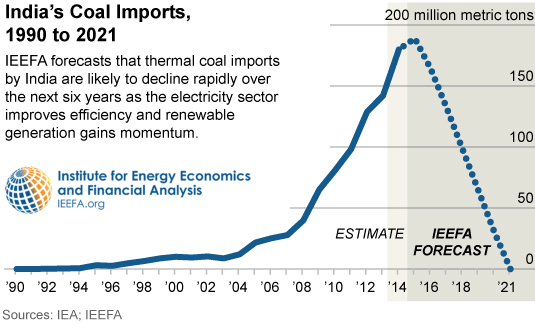
It’s all in line with Energy Minister Piyush Goyal’s repeated assertion that India’s reliance on thermal coal imports is not sustainable.
The consequences for imported thermal coal are stark, and what’s occurring in India today reinforces the fact that the seaborne thermal coal market is in structural decline. There is quite simply no rational economic case for imported coal in India, and the speed of renewable energy developments is now undercutting even domestic fossil fuels.
The smart money on India today is in renewables.

Link

Lethal Heating is a citizens' initiative