21/12/2015

El Niño: State of Emergency

350.org

Intensified by climate change, this El Niño is exceeding previous records and it is on track to unleashing severe and destructive extreme weather in the coming months.


“This El Niño is playing out in uncharted territory. Our planet has altered dramatically because of climate change.” — Michel Jarraud, Secretary-General of the World Meteorological Organization
 Preparation and action is needed now to prevent frightening scenarios of loss and destruction.
One city and five countries have already declared a state of emergency due to the El Niño, while the United Nations has deployed emergency resources to a further 10 countries. The number of places facing a state of emergency is expected to increase considerably in coming months.
This year's El Niño is beginning to expose the dangerous extent of the global warming rapidly accumulating due to human greenhouse gas emissions. Since the last record-breaking El Niño of 1997, a staggering 93% of global warming has been absorbed deep into the oceans.
This El Niño event is now reversing that, with masses of heat energy released from the oceans into the atmosphere. This is effectively speeding up global warming by at least a decade. This has meant that we've now passed one degree of warming since the 1880s.
Continued climate change is likely to increase the frequency and intensity of El Nino events.

Frontlines of El Niño
Papua New Guinea
Months of drought, more than one third of the country going hungry
Since July, more than 100,000 children have been turned away from schools as there’s just not enough water or food left to run them anymore. After a period of severe frosts in the highlands that killed-off staple food crops, the intense El Niño-driven drought has prevented new crops from growing. There have been reports of deaths from starvation and disease.
Arianne Kassman, 350 Papua New Guinea Coordinator: “This crisis shows the importance of addressing the issue of climate change as the survival of our people depends on it. Our people rely on their gardens to survive and now that s being taken away from them. Almost 70% of our people lives in rural areas and rely on subsistence farming to survive.”

Kenya
“All we can do is hope”
Community leader and elders in Ajawa discusion water issues. Photo: Dima CARE

“I grew up in Kisii County, the western part of Kenya. A region that contributes largely to Kenya’s fruit basket, but we too have noticed the absence of rainfall. In the 1970’s my family built a dam within the land my grandfather owned. Though he has departed, that dam has always been there from since I can remember, but in the last two years weather patterns across the country have demanded that our family not take this reservoir for granted. As we experience the second round of drying up, the future remains uncertain. Will the dam refill with rain water as we approach the New Year? Our neighbourhood glares at the skies as if to question where the clouds went. All we can do is hope as we wait for the effects of El Nino to pass.”
— Unelker Maoga

Ethiopia
Worst drought affecting the country in 50 years
Zahara Ali, 9, cooks breakfast in a rural village in Dubti Woreda, Afar Region, Ethiopia. ©UNICEF Ethiopia/2015/Bindra

Ethiopia has plunged into a worsening food crisis as two crop cycles have failed due to the El Niño driven drought gripping the country. The Ethiopian government expects that 10.1 million people will face critical food shortages in the coming year, with 400,000 children at risk of developing acute malnutrition.
“The worst drought in Ethiopia for 50 years is happening right now, with the overall emergency response estimated to cost $1.4 billion,” says John Graham, Save the Children’s country director in Ethiopia.

Chennai, India
El Niño & climate change intensified record breaking floods
Chennai floods. Photo: Wikimedia
The devastating and deadly floods that hit Chennai in early December after 5 weeks of intense deluges were made worse by the El Niño and climate change. In one 24 hour period, the most rain in Chennai’s recorded history fell, washing away aeroplanes at the airport, destroying homes and leaving much of the city without power.

Ecuador, Peru, Bolivia
On alert for severe flooding and erosion
It is estimated that at least 1.5 million people are at risk from flooding in Ecuador alone in the coming months. During the 1997-98 El Niño, Ecuador and Peru experienced rainfall at 10 times the normal intensity, which caused severe flooding, mudslides and damage to infrastructure.

What needs to be done?
Get prepared: It saves lives and a lot of money
Analysis by the World Food Programme of their programs in Niger and Sudan found that responding before disasters hit lowers the cost of a future humanitarian response by a half. Many communities will remember the impacts of the 1997/98 El Niño and are already preparing themselves for the coming months. Different parts of the world are affected differently by the El Niño.

Link

Climate of Procrastination: The Curse of The Short Attention Span

Independent Australia - Mike Dowson

Unless we keep the pressure on our leaders, claims of progress at the Paris Climate Summit will prove hollow.
(Image via freeimages.com)


It’s interesting to look at the trends in popular opinion about climate change, as measured by surveys.
They appear to have little to do with the accumulating weight of scientific evidence, or the increasing certainty of the modelling. Like global temperature, the percentage of concerned people rises and falls. But unlike global temperature, the long term trend in climate concern in the rich countries has been a decline since the GFC.
The ups and downs seem to coincide in part with dramatic events. A natural disaster like a fire or flood may bring the issue to the fore. Other events, such as an act of terrorism, may have the opposite effect.
After 9/11, Americans, when surveyed, rated terrorism as the biggest threat, with climate change hardly worth a mention. The published data on actual causes of death was much like it is now. The top spots were occupied by illnesses, many of them preventable, as well as accidents and suicide.
Despite the relatively small blip caused by 9/11, you had to drill down a long way into the long term data to find terrorism at all. Some wag at the time pointed out you were slightly more likely to die in the U.S. falling off a bar stool.
Changing levels of "worry" about climate change in the United States. Data points show the extent to which U.S. public survey respondents reported personally worrying about climate change over a 25-year period. (Source: WIREs Clim Change 2015, 6:35-61. doi: 10.1002/wcc.321)
What strikes me about this is how we seem to be predisposed to respond to threats that are sudden and violent, regardless of probability. Threats that are remote or gradual – but nevertheless highly likely – don’t seem to be as important.
It’s not hard to see a possible explanation. We evolved in small groups inhabiting fairly small territories. Even as early human populations spread across the world, the experience of individuals would have been mostly local and personal. Mortal danger existed in the form of predators, illnesses and injuries. Environmental change, on the other hand, was relatively gradual and, as it turns out, may have actually helped to facilitate hominin expansion.
Although we recently began to live in large urban agglomerations, detached from the natural world, our brains evolve slowly. We are wired as if the ancient world is still the one we live in. Even the gargantuan forces that disrupt the modern world – wars, economic shifts, technological changes – don’t seem to concern us very much until we perceive an immediate threat.
If we could switch our perception from human time to geological time, we might see things differently. From earth’s perspective, this is a period of cataclysmic change.
Massive stores of carbon are being wrenched from the ground and pumped into the atmosphere. The forests are disappearing in the blink of an eye. The ice caps are melting. The oceans are turning to acid. Innumerable species are being snuffed out like candles in a storm. A few others – including us, our livestock, parasites, pests and pets – are swarming over the earth like a plague, consuming everything in their path, and spreading toxic waste products everywhere.
It’s not the first time the earth has been rocked by violent upheaval. To an individual trilobite or dinosaur, past apocalypses would have been strangely imperceptible too. Nevertheless, in both cases, the world that had supported their dominance for millions of years was rapidly replaced by one that no longer had room for them.
What is new is that the present mass extinction is directly caused by one species. No one species has ever before held in its hands the fate of so many, including its own.
Although dangerous changes in the biosphere are hard to detect in human time, there are some humans who are constantly confronted by them. In place of our ordinary senses, the scientists who study climate gather vast amounts of data and process it with mathematical models. This enables them to see what is happening from earth’s perspective. Numbers that, to the untrained eye, look harmless, may be alarming to someone who understands their implications.
If a lobbyist, politician, fossil fuel magnate or champion of global capitalism says we have nothing to worry about, it may be tempting to believe. Unless you live on an island with water lapping at your door, or on farmland devastated by persistent drought, you may not notice anything that reinforces what climate scientists have been telling us.
This is not simply a case of competing opinions. The motives behind these messages are entirely different. The carbon kings are protecting their assets and the ideology of extractivism, to quote Naomi Klein.
The measure of their success is personal wealth and power.
The scientists are building models, testing them and refining them. The measure of their success is the accuracy of their predictions.
The rest of us do well to differentiate clearly between these two motives when we choose what to believe about climate change.
The imminent danger for us all, in the fading glare of the Paris Climate Summit, is that we assume the job is done and get back to business as usual. Unless we keep paying attention, that is precisely what will happen. The earth will lose the voice that genuine science has given it and that other voice – the one that never ceases to prattle, the voice of narrow self-interest – will once again dominate. This is the curse of a short attention span.
Unless we can agree and, in fact, collectively demand of those who make big decisions on our behalf, that they do so on the basis of genuine scientific consensus, we are doomed to follow the trilobites and dinosaurs. Climate change is only the beginning.

Has The Climate Change Deal Really Averted Catastrophe?

Al Jazeera

We look at the coverage of the COP21 climate change summit and its framing as a success by the mainstream media.

After years of fruitless negotiations, world leaders finally reached an agreement to combat climate change, agreeing to cap greenhouse gases in an effort to slow down global warming.
Asad Rehman, Friends of the Earth
The United Nations Climate Change Conference in Paris, or COP21, set a target of limiting carbon emissions and keep average temperature increases below 2 degrees Celsius.
The deal, which brought the climate change issue back to the top of the news agenda, was hailed as a success by the mainstream media and self-congratulatory political leaders - who made it sound like a major milestone.
However, climate scientists and activists have since said the agreement has little cause for cheer, falling well short of what is needed to forestall a climate change catastrophe.
They say the deal lacks any legally binding mechanism to hold governments or corporations to emission quotas, while other key issues in the accord are not binding at all.
So why is the deal being framed as a success?
Talking us through the story are: Asad Rehman, a senior campaigner at Friends of the Earth; Catherine Happer, lecturer at the University of Glasgow; Atayi Babs, editor-in-chief at Climate Reporters; and James Painter, the director of the Reuters Journalism Fellowship Programme.

5 Climate And Clean Energy Charts From 2015 You Need To See

ThinkProgress - Joe Romm


CREDIT: Global Carbon Project


This was a big year in climate science and solutions. We learned a number of truly astounding things, which generally makes for great charts.

Clean energy progress
My candidate for the top solutions chart of the year comes from a November DOE report, “Revolution…Now The Future Arrives for Five Clean Energy Technologies.” It shows the stunning progress core clean energy technologies have made in the last several years as accelerated deployment created economies of scale and brought technologies rapidly down the learning curve.
DOE-RevolutionNow
Given that the opponents of climate action are generally shifting from a failed attack on climate science to a demonstrably false attack on the availability of climate solutions, this chart should be front and center in the response.
We also learned this year that, just as the solar photovoltaics crossed a key price point several years ago — which initiated explosive growth in PV nationally and globally — “Electric Car Batteries Just Hit A Key Price Point,” which means electric vehicles are likely to continue their recent exponential growth.

A true emissions plateau?
The runner up for top “good news” chart comes from a Global Carbon Project journal article released earlier this month, “Reaching peak emissions.” The GCP concludes, “Rapid growth in global CO2 emissions from fossil fuels and industry ceased in the past two years, despite continued economic growth. Decreased coal use in China was largely responsible, coupled with slower global growth in petroleum and faster growth in renewables.”
Global Carbon Project graph
CREDIT: Global Carbon Project

Chinese coal consumption has begun a downward spiral, with a more than 4 percent drop expected this year alone (see here). China has been scaling back coal use by power plants as well as by some of China’s biggest industrial coal consumers: cement, steel, and iron.
When you combine China’s accelerated action with the successful Paris Agreement and the ongoing cleantech revolution, it seems clear that 2014-2015 marks an inflection point in the CO2 emissions trend line — and could even represent a true plateau. If so, then you can expect to see a version of this chart in the “top charts of the year” for a while to come.

CO2’s direct impact on cognition
There were plenty of worrisome scientific reports this year, but none more unexpected and more potentially impactful than the landmark public health finding from the Harvard School of Public Health that carbon dioxide (CO2) has a direct and negative impact on human cognition and decision-making. Significantly, these impacts have been observed at CO2 levels that most Americans — and their children — are routinely exposed to today inside classrooms, offices, homes, planes, and cars.
They found that, on average, a typical participant’s cognitive scores dropped 21 percent with a 400 ppm increase in CO2. Here are their astonishing findings for four of the nine cognitive functions scored in a double-blind test of the impact of elevated CO2 levels:
co2charts_1024
The researchers explain, “The largest effects were seen for Crisis Response, Information Usage, and Strategy, all of which are indicators of higher level cognitive function and decision-making.”
The key point is that outdoor CO2 levels are the baseline for indoor levels, which are typically 200 to 300 ppm higher in well ventilated buildings, but far higher than that in poorly ventilated buildings. We are at 400 parts per million (ppm) of CO2 today outdoors globally — and tens of ppm higher in many major cities. We are rising at a rate of 2+ ppm a year, a rate that is accelerating.
Significantly, we do not know the threshold at which CO2 levels begin to measurably impact human cognition, but it appears to be well below 1000 ppm. Even after Paris, we are still on a path to 675 ppm, which is too high for both the climate change impacts and the direct human cognition impacts. Given the importance of this story, I will be reporting on it a great deal in 2016.

No ‘pause’ in global warming
Two more charts merit attention. First, 2015 was the year it finally became obvious there was never any “pause” or “hiatus” in surface temperature warming. Of course, scientists had pointed out that the oceans, where more than 90 percent of human-caused global warming heat goes, have seen an acceleration in warming in recent years. As climate expert John Abraham writes in the Guardian, “The oceans are warming so fast, they keep breaking scientists’ charts.”
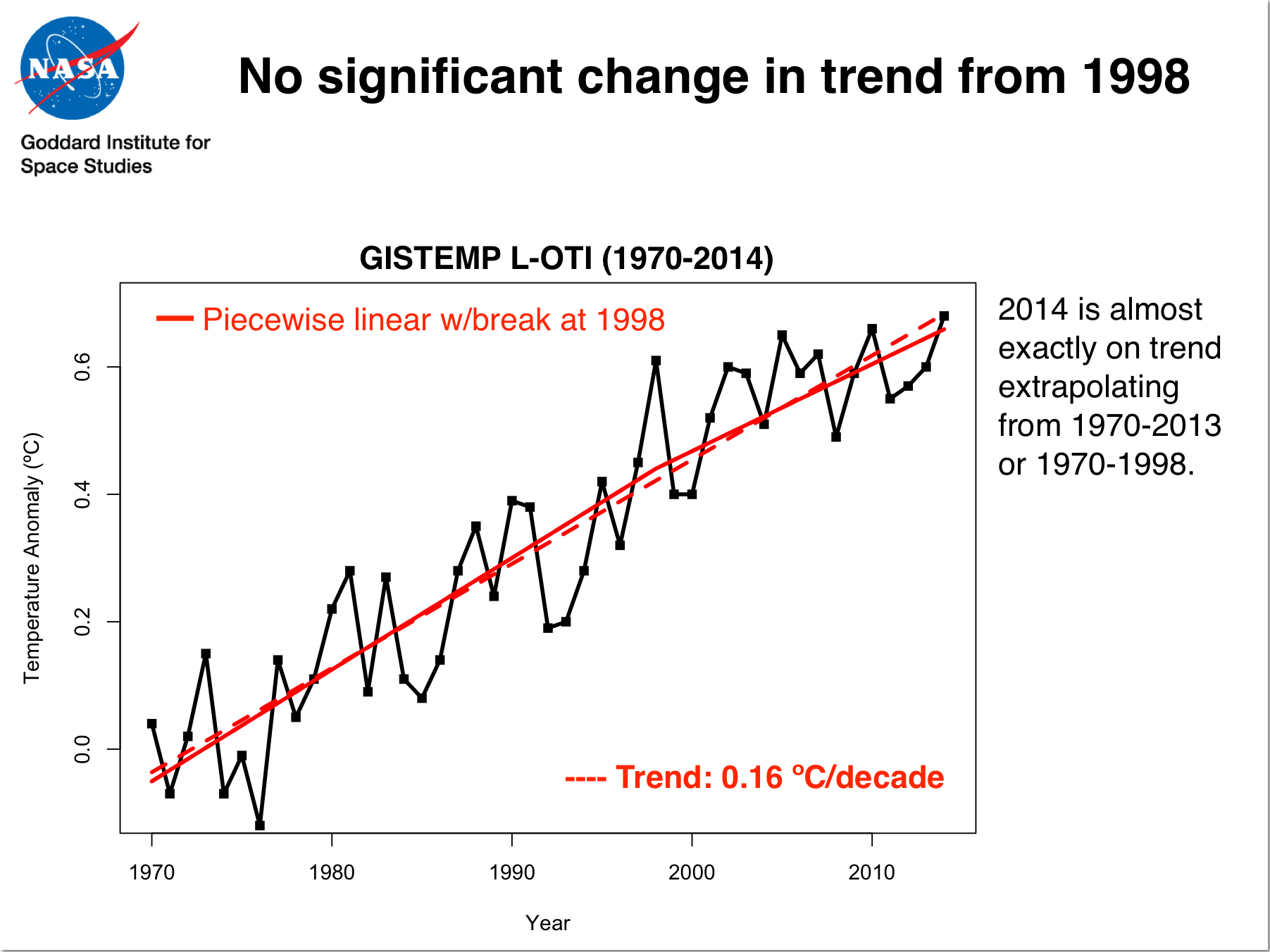
But the climate science deniers and some in the media had been trumpeting a supposed slow down in surface air temperatures. That myth was smashed back in January, when Gavin Schmidt, director of NASA’s Goddard Institute of Space Studies, tweeted, “Is there evidence that there is a significant change of trend from 1998? (Spoiler: No.)” He attached this chart:
NASA temperature data
NASA temperature data make clear that not only has there been no “pause” in surface temperature warming in the past decade and a half, there hasn’t even been a significant change in trend.
Now that 2015 is crushing the temperature records set in 2014 — and 2016 may well top 2015 — here’s the question I’ll be following closely next year: Are we in the midst of of the long-awaited jump in global temperatures?

A call for post-Paris action
Finally, in 2015, NASA gave us a chart that was a reminder of why it is so crucial for us to slash carbon pollution, why every nation including ours must keep ratcheting up our CO2 targets every five years as we promised in Paris.
If we don’t keep taking stronger and stronger action on climate change over time, here is what a 2015 NASA study projected the normal climate of North America will look like. The darkest areas have soil moisture comparable to that seen during the 1930s Dust Bowl.
rcp8.5_soilmoisture-1
The greatest danger to humanity this century from human-caused climate change is Dust-Bowlification and the threat to our food supplies. The Paris agreement and the clean energy revolution have given us a serious chance to avert the worst outcomes. We must do everything possible to take advantage of this opportunity.

20/12/2015

Why Climate Skeptics Are Wrong

Scientific American - Michael Shermer

Izhar Cohen

At some point in the history of all scientific theories, only a minority of scientists—or even just one—supported them, before evidence accumulated to the point of general acceptance. The Copernican model, germ theory, the vaccination principle, evolutionary theory, plate tectonics and the big bang theory were all once heretical ideas that became consensus science. How did this happen?
An answer may be found in what 19th-century philosopher of science William Whewell called a "consilience of inductions." For a theory to be accepted, Whewell argued, it must be based on more than one induction—or a single generalization drawn from specific facts. It must have multiple inductions that converge on one another, independently but in conjunction. "Accordingly the cases in which inductions from classes of facts altogether different have thus jumped together," he wrote in his 1840 book The Philosophy of the Inductive Sciences, "belong only to the best established theories which the history of science contains." Call it a "convergence of evidence."
Consensus science is a phrase often heard today in conjunction with anthropogenic global warming (AGW). Is there a consensus on AGW? There is. The tens of thousands of scientists who belong to the American Association for the Advancement of Science, the American Chemical Society, the American Geophysical Union, the American Medical Association, the American Meteorological Society, the American Physical Society, the Geological Society of America, the U.S. National Academy of Sciences and, most notably, the Intergovernmental Panel on Climate Change all concur that AGW is in fact real. Why?
It is not because of the sheer number of scientists. After all, science is not conducted by poll. As Albert Einstein said in response to a 1931 book skeptical of relativity theory entitled 100 Authors against Einstein, "Why 100? If I were wrong, one would have been enough." The answer is that there is a convergence of evidence from multiple lines of inquiry—pollen, tree rings, ice cores, corals, glacial and polar ice-cap melt, sea-level rise, ecological shifts, carbon dioxide increases, the unprecedented rate of temperature increase—that all converge to a singular conclusion. AGW doubters point to the occasional anomaly in a particular data set, as if one incongruity gainsays all the other lines of evidence. But that is not how consilience science works. For AGW skeptics to overturn the consensus, they would need to find flaws with all the lines of supportive evidence and show a consistent convergence of evidence toward a different theory that explains the data. (Creationists have the same problem overturning evolutionary theory.) This they have not done.
A 2013 study published in Environmental Research Letters by Australian researchers John Cook, Dana Nuccitelli and their colleagues examined 11,944 climate paper abstracts published from 1991 to 2011. Of those papers that stated a position on AGW, about 97 percent concluded that climate change is real and caused by humans. What about the remaining 3 percent or so of studies? What if they're right? In a 2015 paper published in Theoretical and Applied Climatology, Rasmus Benestad of the Norwegian Meteorological Institute, Nuccitelli and their colleagues examined the 3 percent and found "a number of methodological flaws and a pattern of common mistakes." That is, instead of the 3 percent of papers converging to a better explanation than that provided by the 97 percent, they failed to converge to anything.
"There is no cohesive, consistent alternative theory to human-caused global warming," Nuccitelli concluded in an August 25, 2015, commentary in the Guardian. "Some blame global warming on the sun, others on orbital cycles of other planets, others on ocean cycles, and so on. There is a 97% expert consensus on a cohesive theory that's overwhelmingly supported by the scientific evidence, but the 2–3% of papers that reject that consensus are all over the map, even contradicting each other. The one thing they seem to have in common is methodological flaws like cherry picking, curve fitting, ignoring inconvenient data, and disregarding known physics." For example, one skeptical paper attributed climate change to lunar or solar cycles, but to make these models work for the 4,000-year period that the authors considered, they had to throw out 6,000 years' worth of earlier data.
Such practices are deceptive and fail to further climate science when exposed by skeptical scrutiny, an integral element to the scientific process.

Links

Time For Hunt To Stop The Clock On Abbot Point As Documents Reveal Qld Govt’s Secret Plan For Coal Tug Harbour On Reef

350.org


(BRISBANE) –
350.org Australia is outraged that the Queensland Government has hidden plans to build a taxpayer-funded tug boat harbour at Abbot Point for companies like mining giant Adani to ship coal through the Great Barrier Reef.
The revelations were brought to light via a Right to Information request submitted by the North Queensland Conservation Council (NQCC).
The documents confirm that both the QLD Department of State Development (DSD) and the Palaszczuk government are aware of the plans, yet failed to include the information in the Abbot Point coal port Environmental Impact Statement (EIS) submitted to Environment Minister Greg Hunt.

Moira Williams, 350.org Australia’s community campaigner, issued the following statement in response:
“Just days after a global climate deal was reached in Paris, we discover that the Queensland Government has been making secret plans to help expand coal exports here in Australia. We deserve to know what deals are being made behind closed doors to benefit the fossil fuel industry and why the interests of polluters are being put ahead of the Australian people.
“These explosive revelations demonstrate the Queensland Government’s total disregard for due process and lack of concern for the Reef and the climate, both of which will be seriously damaged by the coal port expansion at Abbot Point.
“It’s incredibly concerning that Premier Palaszczuk has chosen to hide these damaging plans from both the Federal Government and Queenslanders. What’s worse is that they are using taxpayer money to fund it. It begs the question – what else are they hiding?”
“The clock must be stopped on the decision to approve Adani’s Abbot Point project. With the deadline that decides the fate of this project just days away, Minister Hunt should do what the Australian public has been demanding for years and reject this reckless proposal once and for all,” concluded Williams.
Polling conducted by Essential Research and commissioned by 350.org Australia has found that two thirds of Australians believe coal mining should be phased because it causes global warming and damages the Great Barrier Reef.

Future For Coal Is More Uncertain Than Economists Would Have You Believe

Fairfax - Ross Gittins

Shocking air pollution is the major reason China is striving to cut its coal use. Photo: Kevin Frayer


With the success of the Paris agreement on climate change, it's clear Australia will have to lift its game if we're not to be seen as global bludgers. But with an early return to carbon pricing an embarrassment for the Coalition, what other approaches should we consider?
Take the campaign for a global moratorium on the construction of new coal mines. Is it just a misguided idea dreamt up by idealistic greenies who don't understand economics?
Jon Stanford, of Insight Economics, thinks so. He's a former senior econocrat and an avowed supporter of action to reduce carbon emissions. But in a long post on John Menadue's blog, Pearls and Irritations, he argues strongly against a moratorium.
He readily acknowledges that substantial "social costs" or "negative externalities" – such as the emission of climate-changing greenhouse gases – are imposed on the community by the use of coal.
"There is little doubt that the combustion of coal to produce electricity has made the greatest contribution to increasing carbon concentrations in the atmosphere," he says.
But the most economically efficient way to deal with climate change is to tax all carbon emissions by means of a carbon tax or an equivalent emissions trading scheme.
"Banning new coal mines would reflect an arbitrary approach to reducing emissions. On what basis should various fuels be permitted or banned? Why is coal to be singled out but other fuel with significant emissions such as oil and gas are not?"
So his first objection to a moratorium is that it seeks to reduce climate change in a way that doesn't minimise the resulting loss of efficiency in the allocation of resources.
His second objection is more practical: it wouldn't work, anyway. He says that, according to the International Energy Agency's latest World Energy Outlook, global demand for electricity will increase by 70 per cent between 2013 and 2040.
The agency's middle projection, based on the commitments to counter climate change that countries took to in the run up to the Paris conference, sees coal's share of global power generation still at 30 per cent in 2040 (compared with 41 per cent in 2013), meaning growth of nearly 25 per cent in absolute terms.
Stanford says that "while the Australia coal industry is a very efficient it does not dominate the global market and could not be said to possess any significant market power".
Australia's coal reserves amount to less than 9 per cent of global reserves. As a producer of steaming (thermal) coal, we rank a distant sixth behind China, the US, India, Indonesia and South Africa, not far ahead of Russia and Kazakhstan.
These other countries are unlikely to agree to a global moratorium on new mines so, were Australia to impose a moratorium on itself, the investment in new mines displaced from Australia would merely take place in other countries. Malcolm Turnbull has used the same argument.
Illustration: Glen Le Lievre.


Sorry, but I'm not convinced. It's true that a global carbon price would be a more economically efficient solution than an arbitrary moratorium on new coal mines.
But with the problem worsening as each year passes, we don't have the luxury of waiting until a "first-best" solution can be agreed upon. In an emergency, second-best solutions are better than inaction.
As for the practicalities of a unilateral Australian moratorium, the facts are more complex than Stanford implies. The International Energy Agency's figure of a 70 per cent increase in global demand for electricity is an assumption, not an estimate.
All 25-year projections are just projections, and likely to be wrong, often because they're overtaken by events. The agency's projections don't take sufficient account of the fall in China's coal consumption over the past 18 months.
Projections that don't allow for further technological advances and price falls in renewables and energy storage, nor for countries to step up their efforts to reduce warming, over the next 25 years, are particularly unreliable.
Stanford's figures for global coal reserves and even global coal consumption aren't relevant. That's because not all coal is the same. Some is high quality – in terms of its ability to generate more electricity – some is low. Some can be extracted quite cheaply, some would be very expensive.
Coal is a low value commodity that's expensive to transport over long distances. This means a high proportion of coal deposits and domestic coal consumption is irrelevant in assessing Australia's market power and the likely effects of a unilateral moratorium.
What determines the world price is seaborne exports of thermal coal. A Reserve Bank analysis shows Indonesia's low-quality coal has 41 per cent of world exports, while we come second with 18 per cent.
Australia is a high quality, low-cost producer, which makes us a more powerful market player than the raw figures suggest.
World prices of steaming coal have fallen a long way since their peak in 2011, in response to a huge increase in supply (mainly by Indonesia and Australia) and flat world demand.
If our 52 proposals to build new coal mines or expand existing ones went ahead, this would eventually double our exports. Do you really think that would have no effect on the world price?
If it caused the world price to be lower than otherwise, this would hurt our existing coal mines, their lenders and their employees. It would also hurt existing and prospective renewable energy projects.
And it would cause the price to be even less reflective of the high social costs caused by carbon emissions, the adverse effect on miners' health and air pollution around coal-fired power stations (the latter a big part of China's reasons for turning against coal).
With the world coal price relatively low, it's not at all clear other, higher-cost producers would happily step in to take our place. If they could, why aren't they doing it already?
The future for coal is a lot more uncertain and less rosy than Stanford implies.

Lethal Heating is a citizens' initiative