30/12/2015

A Still-Growing El Niño Set To Bear Down On U.S.

NASA - Alan Buis

The latest satellite image of Pacific sea surface heights from Jason-2 (left) differs slightly from one 18 years ago from Topex/Poseidon (right). In Dec. 1997, sea surface height was more intense and peaked in November. This year the area of high sea levels is less intense but considerably broader. Credit: NASA/JPL-Caltech.

The current strong El Niño brewing in the Pacific Ocean shows no signs of waning, as seen in the latest satellite image from the U.S./European Ocean Surface Topography Mission (OSTM)/Jason-2 mission.
El Niño 2015 has already created weather chaos around the world. Over the next few months, forecasters expect the United States to feel its impacts as well.
The latest Jason-2 image bears a striking resemblance to one from December 1997, by Jason-2's predecessor, the NASA/Centre National d'Etudes Spatiales (CNES) Topex/Poseidon mission, during the last large El Niño event. Both reflect the classic pattern of a fully developed El Niño.
The images show nearly identical, unusually high sea surface heights along the equator in the central and eastern Pacific: the signature of a big and powerful El Niño. Higher-than-normal sea surface heights are an indication that a thick layer of warm water is present.
El Niños are triggered when the steady, westward-blowing trade winds in the Pacific weaken or even reverse direction, triggering a dramatic warming of the upper ocean in the central and eastern tropical Pacific. Clouds and storms follow the warm water, pumping heat and moisture high into the overlying atmosphere. These changes alter jet stream paths and affect storm tracks all over the world.
This year's El Niño has caused the warm water layer that is normally piled up around Australia and Indonesia to thin dramatically, while in the eastern tropical Pacific, the normally cool surface waters are blanketed with a thick layer of warm water. This massive redistribution of heat causes ocean temperatures to rise from the central Pacific to the Americas. It has sapped Southeast Asia's rain in the process, reducing rainfall over Indonesia and contributing to the growth of massive wildfires that have blanketed the region in choking smoke.
El Niño is also implicated in Indian heat waves caused by delayed monsoon rains, as well as Pacific island sea level drops, widespread coral bleaching that is damaging coral reefs, droughts in South Africa, flooding in South America and a record-breaking hurricane season in the eastern tropical Pacific. Around the world, production of rice, wheat, coffee and other crops has been hit hard by droughts and floods, leading to higher prices.
In the United States, many of El Niño's biggest impacts are expected in early 2016. Forecasters at the National Oceanic and Atmospheric Administration favor an El Niño-induced shift in weather patterns to begin in the near future, ushering in several months of relatively cool and wet conditions across the southern United States, and relatively warm and dry conditions over the northern United States.
While scientists still do not know precisely how the current El Niño will affect the United States, the last large El Niño in 1997-98 was a wild ride for most of the nation. The "Great Ice Storm" of January 1998 crippled northern New England and southeastern Canada, but overall, the northern tier of the United States experienced long periods of mild weather and meager snowfall. Meanwhile, across the southern United States, a steady convoy of storms slammed most of California, moved east into the Southwest, drenched Texas and — pumped up by the warm waters of the Gulf of Mexico — wreaked havoc along the Gulf Coast, particularly in Florida.
"In 2014, the current El Niño teased us — wavering off and on," said Josh Willis, project scientist for the Jason missions at JPL. "But in early 2015, atmospheric conditions changed, and El Niño steadily expanded in the central and eastern Pacific.  Although the sea surface height signal in 1997 was more intense and peaked in November of that year, in 2015, the area of high sea levels is larger. This could mean we have not yet seen the peak of this El Niño."
During normal, non-El Niño conditions, the amount of warm water in the western equatorial Pacific is so large that sea levels are about 20 inches (50 centimeters) higher in the western Pacific than in the eastern Pacific. "You can see it in the latest Jason-2 image of the Pacific," said Willis. "The 8-inch [20-centimeter] drop in the west, coupled with the 10-inch [25-centimeter] rise in the east, has completely wiped out the tilt in sea level we usually have along the equator."
The new Jason-2 image shows that the amount of extra-warm surface water from the current El Niño (depicted in red and white shades) has continuously increased, especially in the eastern Pacific within 10 degrees latitude north and south of the equator. In the western Pacific, the area of low sea level (blue and purple) has decreased somewhat from late October. The white and red areas indicate unusual patterns of heat storage. In the white areas, the sea surface is between 6 and 10 inches (15 to 25 centimeters) above normal, while in the red areas, it is about 4 inches (10 centimeters) above normal. The green areas indicate normal conditions. The height of the ocean water relates, in part, to its temperature, and is an indicator of the amount of heat stored in the ocean below.
Within this area, surface temperatures are greater than 86 degrees Fahrenheit (30 degrees Celsius) in the central equatorial Pacific and near 70 degrees Fahrenheit (21 degrees Celsius) off the coast of the Americas. This El Niño signal encompasses a surface area of 6 million square miles (16 million square kilometers) — more than twice as big as the continental United States.
While no one can predict the exact timing or intensity of U.S. El Niño impacts, for drought-stricken California and the U.S. West, it's expected to bring some relief.
"The water story for much of the American West over most of the past decade has been dominated by punishing drought," said JPL climatologist Bill Patzert. "Reservoir levels have fallen to record or near-record lows, while groundwater tables have dropped dangerously in many areas. Now we're preparing to see the flip side of nature's water cycle — the arrival of steady, heavy rains and snowfall."
In 1982-83 and 1997-98, large El Niños delivered about twice the average amount of rainfall to Southern California, along with mudslides, floods, high winds, lightning strikes and high surf. But Patzert cautioned that El Niño events are not drought busters. "Over the long haul, big El Niños are infrequent and supply only seven percent of California's water," he said.
"Looking ahead to summer, we might not be celebrating the demise of this El Niño," cautioned Patzert. "It could be followed by a La Niña, which could bring roughly opposite effects to the world's weather."
La Niñas are essentially the opposite of El Niño conditions. During a La Niña episode, trade winds are stronger than normal, and the cold water that normally exists along the coast of South America extends to the central equatorial Pacific. La Niña episodes change global weather patterns and are associated with less moisture in the air over cooler ocean waters. This results in less rain along the coasts of North and South America and along the central and eastern equatorial Pacific, and more rain in the far Western Pacific.
El Niño events are part of the long-term, evolving state of global climate, for which measurements of sea surface height are a key indicator.

Links

Switzerland Has Warmest December Ever As Average Temperatures Rise 3.4c

The Guardian

The country that founded winter tourism has seen the mildest end to the year since records began 150 years ago with ski resort owners set to suffer
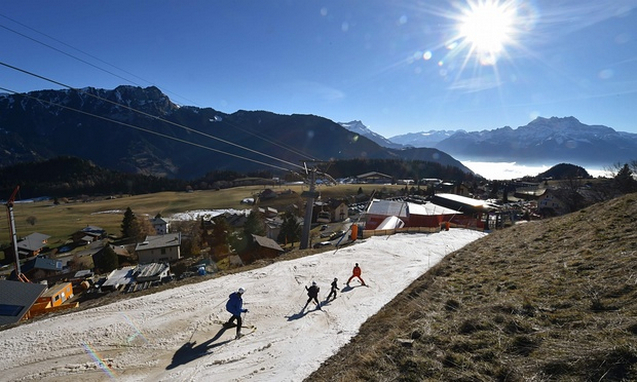
Tourists ski on a thin layer of snow in Leysin, Switzerland during the country's warmest December on record. Photograph: Fabrice Coffrini/AFP/Getty Images


Switzerland has experienced its warmest December since the country that founded winter tourism began keeping records 150 years ago.
Clear skies and dry ground have seen the Alpine nation end the year 3.4C above the long-term historical average for December, a climatologist for the federal office of meteorology and climatology (MeteoSwiss) said on Monday.
"There's no doubt about it," Stephan Bader said. "It's the warmest December in our recorded measurements dating back to 1864 – clearly. And it's especially pronounced at higher altitudes."
The dry warmth and slopes bereft of snow have hurt resort owners and ski lift operators, who are already contending with Switzerland's strong currency discouraging foreign visitors.
MeteoSwiss earlier this month said it expected 2015 to break the annual record for the third time in just a handful of years.
Globally, this year will be the warmest on record and 2016 could be even warmer due to the El Niño weather pattern, the World Meteorological Organization said last month. It warned that inaction on climate change could see global average temperatures rise by 6C or more.
It came as climate scientists in France said that this year's El Niño was the strongest ever measured, surpassing the one in 1997-98, both in terms of ocean surface temperature – up by more than 3C (5.4F) - and the surface area affected.
"It is probably the most powerful in the last 100 years," said Jerome Lecou, a climate expert at the French weather service Meteo France, noting that accurate measurements have only existed since the mid-20th century.
As was true in 1998, this year's super El Nino will have contributed to making 2015 the warmest on record, worldwide.
But the reverse may also be true, with climate change boosting the power of cyclical El Nino events.
"If you add the background global warming to natural weather phenomena, there's a tendency to break records left and right," Le Treut told AFP.

Links

More Americans Were Killed In Christmas Weekend Storms This Year Than In Islamic Extremist Attacks Since 9/11

Salon - Ben Norton

Extreme and deadly weather over Christmas weekend shows Sanders is right: Climate change is the gravest threat

More Americans were killed in Christmas weekend storms this year than in Islamic extremist attacks since 9/11
Lightning illuminates a house after a tornado touched down in Jefferson County, Ala., Friday, Dec. 25, 2015. (Credit: AP/Butch Dill)


When asked in the first Democratic presidential debate what he considers to be the greatest threat to national security, Sen. Bernie Sanders insisted it is climate change.
“The scientific community is telling us that if we do not address the global crisis of climate change, transform our energy system away from fossil fuel to sustainable energy, the planet that we’re going to be leaving our kids and our grandchildren may well not be habitable,” Sanders said in the October debate.
In the second debate, in November, Sanders stood by his statements. A month later, the dangers about which Sanders warned would come into fruition.
Over the Christmas holiday weekend, at least 43 Americans were killed in a series of extreme storms and floods.
More than 20 states from Texas to Maine had severe weather warnings. Tornadoes were spotted in 10 states. Michigan saw a tornado for the first time in the month of December.
Up to 1,000 homes were damaged or destroyed in the storms, causing millions of dollars worth of damage. In Texas alone, 600 buildings were damaged or destroyed.
Millions of people were stranded, on the busiest weekend of the year. Thousands of flights were canceled and delayed. Major highways were covered with floodwater and snow.
While this extreme weather was raging throughout the southern and midwestern U.S., states across the East Coast broke heat records. On Christmas Day, at the same moment that Texas, Oklahoma, and New Mexico were hit with blizzards, it was over 70 degrees in New York City.
The U.S. was not alone. As these storms were hitting the U.S., South America and the U.K. were seeing huge flooding. As many as 160,000 people were evacuated because of storms in Argentina, Brazil, Paraguay and Uruguay.
Overall, 2015 has been the hottest year ever on record. With extremely warm temperatures come extremely cold ones — and extreme weather.
Mountains of scientific studies show that extreme weather is directly linked to anthropogenic (aka, human-caused) climate change.
The World Meteorological Organization (WMO) notes that the “years 2011-2015 have been the warmest five-year period on record, with many extreme weather events — especially heatwaves — influenced by climate change.”
“The state of the global climate in 2015 will make history as for a number of reasons,” WMO Secretary-General Michel Jarraud said in a November statement. “Levels of greenhouse gases in the atmosphere reached new highs… This is all bad news for the planet.”
In other words, all the facts show that Sanders is correct: Climate change is, by far, the largest threat to Americans’ security — and to the security of all other living things on this planet.
Sanders was pilloried by the American political and media establishments, nevertheless, for asserting that something seemingly abstract like climate change poses the greatest threat to the national security of not just the U.S., but also of the world as a whole.
Politicians and news outlets have constantly instead claimed that Islamic extremism poses the greatest threat to U.S. national security. Yet only a handful of Americans have been killed by self-proclaimed jihadists in the past 14 years, while climate change continues to get worse and worse.
To put things into perspective, more Americans were killed in the 2015 Christmas weekend storms than have been killed by Islamist extremists since 9/11.
Since the 9/11 attacks, 40 Americans have been killed by Islamist extremists. From 9/11 to mid-2015, just 26 Americans were killed by self-proclaimed jihadists. Fourteen more were killed in the San Bernardino massacre in December.
In the 2015 Christmas weekend storms, on the other hand, at least 43 Americans were killed.
If politicians and the media did their job — logically and sensibly governing and informing the public, not fear-mongering — this would not be a surprise. A comprehensive U.N. report released in November corroborated Sanders’ warnings. The study found that 90 percent of major disasters in the last 20 years have been weather-related. It also found that the U.S. had been hit with more weather-related disasters than any other nation, including enormous countries like China and India.
In the past 20 years, according to the U.N. report, there were at least 6,457 recorded floods, storms, heatwaves, droughts, and other disasters. 606,000 people were killed in this extreme weather. 4.1 billion more people were injured, made homeless, or left in need of emergency assistance.
The U.N. report estimated that the costs of these thousands of weather-related disasters were between $5 trillion and $6 trillion — or between  $250 billion and $300 billion every single year.
“Weather and climate are major drivers of disaster risk and this report demonstrates that the world is paying a high price in lives lost,” cautioned Margareta Wahlström, the U.N. official who oversaw the study.
The extreme weather that ravaged the U.S. over Christmas weekend is just one of these myriad disasters, yet many American politicians refuse to even acknowledge that it exists, or at least that it is caused by humans.
Nonetheless, as Sanders also stresses, this threat is not unavoidable; tangible actions can, and must, be taken here and now to mitigate it.
“Greenhouse gas emissions, which are causing climate change, can be controlled,” stressed WMO Secretary-General Michel Jarraud in November. “We have the knowledge and the tools to act. We have a choice. Future generations will not.”
Yet substantive action is being prevented by an obstinate reactionary political class and corporate media regime. As journalist Naomi Klein warns in her book and film “This Changes Everything: Capitalism vs. The Climate,” the capitalist system, which puts profit over people, guarantees that large corporations like fossil fuel giants, not scientists, lobby for and even write environmental policies and laws based upon their bottom line, not based on what is good for the world as a whole, and for the people in it.
Much of the media fuels this problem, by giving a platform to climate science-deniers and treating people like Sanders as freakish pariahs when they point out that climate change is a much larger threat that Islamic extremism will ever be.
The U.S. political and media establishments are exponentially more interested in Islamic extremism than they are in anthropogenic climate change-induced extreme weather, but the facts indisputably show that climate change is exponentially more dangerous. Until they begin to treat it as such, there will be more and more tragedies like those millions of Americans endured over Christmas weekend.

29/12/2015

The Comedy Of Climate Change

ABC Science Show - Robyn Williams Presenter


Where are the laughs in global warming? Is there a comedy of climate? Three renowned experts in the field offer their considered opinions: Rod Quantock, Hannah Gadsby and Andrew Denton. Recorded at Womadelaide’s 2015 Planet Talks, our guests provide advice on boiling billionaires for dinner, and how to change the minds of sceptics.

Audio


Transcript

Robyn Williams: And so to WOMADelaide and the comedy of climate change.
My name is Robyn Williams, and in 1971 I did my last Monty Python, and it was a raid on the Tate Gallery to put bras and knickers on all the rude statues. And one of the most delightful things was Graham Chapman dressed as the Queen's mother standing with his moustache and a pipe, and people were wandering past in the street, almost collapsing with amazement at this incredible sight. He took absolutely no notice of that.
Now, I interviewed him for The Science Show a few years later and he was slightly unwell, so I was making him a cup of tea and I said, 'Do you take sugar?' And he said, 'No, I'm gay.' [laughter] That's exactly what my kids did, they laughed as well. It's got no logic to it. And the most amazing thing is, that that juxtaposition of what makes funny, because we are about to talk about climate and comedy, the funny thing about comedy is you can't predict it necessarily.
I have some colleagues here. Rod Quantock used to be in travel, I think he used to take a dead chicken on a stick and go to various other people's posh receptions and lovely dinners. Would you please welcome Rod Quantock?
[Applause]
Hannah Gadsby is a boxer, obviously. Really, she is, and a very enthusiastic one. Would you please welcome Hannah Gadsby?
[Applause]
Andrew Denton has lots of rope but never enough, and we miss you on telly.
[Applause]
So we have a number of juxtapositions in climate where an awful lot of scientists are in this world conspiracy, and some of it is funny, some of it is terribly sad. Rod Quantock, you've done a number of presentations over the years about climate change. I want to ask you, how can comedy illuminate a subject as serious and complex as that?
Rod Quantock: Easily. Okay, next question. Just to give you a bit of my background, I probably am the only comedian in Australia and I think I'm quite rare in the world who actually devotes all of his comedy shows to issues around climate change, but particularly things like peak oil. But to get to that point takes an awful lot of work. And I spent a lot of time being a political comic, and I have the advantage that most of you don't have; I've got nothing to do during the day. I work for an hour or two hours at night, and the rest of the time is my own. And I spend that time reading what you don't have time to read. And I've had people come to me at the end of a show about politics and people say to me, 'I love coming to your shows every year because it means I don't have to read the newspapers for a year.'
So when I got involved in climate change I applied for what used to be called a Keating Fellowship and Howard changed that very quickly to an Australia Council Fellowship. And I applied for it because I was broke, a condition which is with me constantly. And I thought, well, I've been around a while, I deserve some money. So I was about to turn 60 and I thought, well, what I'll do is I'll apply to them to do a project about the world from the day I was born. I was born in [mumbles], and I just look at the world, where it came from and how it got to where it was, contemporaneous with this application.
So I did that, and I began in 1948, the declaration of human rights, the division of Israel and Palestine, North and South Korea, Velcro was invented in 1948, the first Holden rolled off…you know, the roots of our contemporary world are there and a lot of it is still festering today. I'm not what you'd call a bright person but I'm methodical, and I did it chronologically. And as I went through I started to see things like the impact of chemicals in our environment. I'd been aware of that, but as you march back through time and then push your way forward, these become more and more apparent.
And then I hit the 1973 oil shock when the world economy collapsed through lack of oil. So I got interested in peak oil. But as I got closer and closer to the day, I saw climate change looming and looming and looming larger in discussions. So I took that and I really knuckled down and I read everything there is to read about it, and I came to the conclusion that we are all going to die. That's it.
Now, I have a preconditioned attitude to apocalypse. By the time I was 10, I'd seen black-and-white footage of the Hiroshima bomb, I'd seen black-and-white footage of the Holocaust, I'd seen black-and-white footage of Japanese prisoners of war, I've seen the worst that humanity could do to one another. And so it was very clear to me that climate change is something we weren't going to stop because it's not in our nature to be intelligent and clever about these things.
And then you throw in peak oil and you suddenly realise that the brick wall is approaching very, very quickly. So I thought, what do you do? And I thought, well, you tell people about it, that's what you do. So I did a show called Bugger the Polar Bears, This Is Serious, because people were always thinking it's about polar bears. And I did shows called The People We Should Eat First. I actually have a list of people we should eat first. And when climate change really hits, I want you to remember that the person sitting in front of you is made of protein. Just keep that in mind. And as a general warning to you all, try not to look delicious. I actually used to be 18 stone but I'm trying to get less and less a source of food.
But it's a lot of work to understand it. The basics are simple. CO2 is a greenhouse gas and there's lots of it, more in the atmosphere, so we are heating up. But the consequences, the flow-ons, the shift changes in the state of our environment that can happen very, very suddenly, those sorts of things you've really got to study. And I got to a point where I thought it's all over. And I thought, well, you're a comedian, what would you know? So I rang a professor at Melbourne University, one who shared in the Nobel Prize for the IPCC report and said, 'Can I come and have a coffee with you?' And I said, 'We are all going to die, aren't we?' And he said, 'Yeah, we are.' And I spoke to a few more.
And in the end I rang Robyn Williams because I was going to be in Sydney, and I thought he's the man who speaks to all the scientists, I'll save myself a lot of coffees that I can't afford and go and talk to him. So I went to him and I said, 'Look, are we all going to die?' And he said, 'Yes.' So that's where I got to.
And then turning that into comedy was very difficult. It took me approximately two years to be able to go on and do a two-hour show about climate change. But as I go on and I see that my rather naive hopes I suppose of telling people here's the problem and people will respond clearly hasn't worked. So I'm now in a position where I'll keep doing the comedy but I don't have terribly much confidence at all to make a difference.
Robyn Williams: What I want to know, Rod, give me two names of who you would eat first.
Rod Quantock: Well, Tony Abbott…
Robyn Williams: He is too chewy!
Rod Quantock: I know, he's too thin, and I mentioned this to an audience, and a woman put her hand up and said, 'Stock. Boil him down for stock.' That's right, isn't it, that's what you do. You know, Gina Rinehart…
Robyn Williams: No, please!
Rod Quantock: I put out a recipe book called How to Feed a Family of Four to a Family of Eight. But anyway…so…anything else?
Robyn Williams: All right. Hannah, same question.
Hannah Gadsby: Assuming I'm not here because I'm an expert on climate change, as is Rod, I do have all day to myself, but I don't put it to use. A lot of naps, which I think is an energy saving technique. I think I'm doing my bit. I'm here because I've used comedy to make unpopular ideas palatable. In the early days, one of those was making homosexuality palatable in Tasmania.
Robyn Williams: It worked!
Hannah Gadsby: It worked, yes, I take all the credit. When I first started doing comedy I realised comedians are the underdogs, and then I saw that most of the comedians and especially the successful ones are white, middle class, heterosexual men who went to private school. I love it when they get angry. They are like the canaries; you know the world is screwed if they're angry.
What I came to learn very quickly is that I was not only up against it in life, I was up against it in comedy. I'm not everyone's picture of what a comedian should be. I don't hold true to most of the clichés of what I am, as a Tasmanian lesbian with mental health issues. That's an uphill struggle in life, and great for comedy, but I don't hold true to any of the clichés; Tasmanians are simple, lesbians are angry and don't have a sense of humour, women are moody and irrational and emotional and can multitask. None of these things apply to me.
And of course mental health being something that has come into the public consciousness, but certainly when I was first talking about it, it was still a shock that comedians were sad. The cat's out of the bag now, I've lost the element of surprise, that a lot of my work isn't done at these lovely festivals where you're instantly on my side. I do clubs and pubs, I do regional tours, and I will follow comedians who make homophobic, sexist, racist remarks. And I cannot be angry to an audience who have just laughed at that, because they are not going to listen to me, they are not going to like me and they are not going to laugh at me. And if someone is not laughing, they're not listening.
So part of what I think I'm really good at is making people listen to things they normally find uncomfortable. And one of my favourite things that has happened to me in my career is I was in Tasmania once and this bloke came up to me, and he's not my demographic. He'd look at a lot of you and beat a lot of you up, that kind of guy. He came up to me, and I felt threatened, I felt physically threatened, I'm like, oh no. And he just came up to me, 'You're that piss-funny lesbian.' I'm like, 'I hope, because I don't want to disappoint you.'
And then he said, 'That stuff you do about depression, spot on, good onya mate.' And I'm like, 'I don't know what I've done.' It was just a really lovely moment, to think that someone like that has looked at someone like me and listened, and I think that's what comedy can do in a situation like this, take an unpopular and a very miserable topic and make a conversation that is a little bit enjoyable other than just, 'We are all going to die.' It's, 'We're all going to die, ha ha ha.'
Robyn Williams: Yes, it is funny. Thank you. It's actually incredible how serious this bunch were when we were briefing for an hour and a half. How do you do this in front of an audience, an unforgiving audience like us? In the middle of that, Paul Willis turned up with his son Chester, and they had just been to Argentina, to a cathedral, and they walked in and there was this wonderful statue of the Madonna and Jesus, and Chester, who's eight said, 'Look Dad, there's Brian.' It was too. Andrew, same question.
Andrew Denton: Well, my favourite definition of comedy is Mel Brooks who said that tragedy is when I cut my finger, comedy is when you walk into an open sewer and die. I think it's important to frame this conversation with that.
I have for some years now been attempting to form a group of what I refer to as fundamentalist moderates, and our aim is to travel the world and slaughter anyone that won't see both sides of the argument. Because it's hard not to see people of good intent and great intellect and hard work such as scientists who are working on this traduced in the way they are, to hear them referred to as millionaires (although I prefer Jon Stewart's description of them as thousandaires), and to see the scientific method being so thoroughly rubbished and disrespected.
And it's hard not to respond to that with some degree of anger or some degree of sarcastic humour. Part of me tends to think that those who believe that the scientific method that has led us to understand global warming is ridiculous, should have their electricity and planes and cars taken away because clearly they don't work either.
I sometimes think that Andrew Bolt should be given a holiday home on the shores of Vanuatu for a year from which to write his articles, just to get him a little closer to the subject. But then I've realised that the getting angry is kind of a waste of energy, it's not useful energy, and energy is the source of what we are talking about here, and that the energy we should be expending is on that vast group of people in the middle who are uncertain and who are looking for cues about what to think and how to act. And it's a difficult subject to get your head around because it's distant and it's abstract and it's existential, and it's inviting people, as Rod and Hannah have reminded us, to attend their own funeral procession.
So where does comedy sit in this mix? I think we tend to overstate the effectiveness of satire quite often. I thought the reaction to the Charlie Hebdo attacks where some people posited that the terrorists only killed these people because they were so terrified of them was ridiculously and patently nonsense. These terrorists acted with such brazen impunity, terrified was what they were not.
And I'm often reminded of Peter Cook's response when he set up the Establishment Club in London, which was a satirical club, and Peter Cook was one of the finest comic minds we've ever produced. And he was asked, 'What difference do you think this is going to make to British politics?' And he said, 'Well, I think it will affect British politics in the same way as German cabaret unseated Hitler.' And I think we can overstate the value of satire and its impact greatly.
However, I do think comedy, when done in a certain way, has its place. And as evidence of this, those of you that saw John Oliver do that piece where he got 97 climate scientists to debate three climate deniers to visually represent the actual statistics of the debate was a very effective piece of comedy, because even if you're on the other side of the argument, you could sure as hell understand what he was going to say.
Comedy when it's done well shows people ways of thinking, ways of organising their arguments, ways of critically analysing the world. It's why people like Bill Hicks and George Carlin and Lenny Bruce are still remembered and quoted and watched and listened to and read today because they didn't just tell jokes, they put together an argument and they used comedy to make it stick. As Hannah said, if people are laughing at you, they are listening. And people on both sides of the divide, left and right, have a universal desire to laugh and to be made laugh.
However, I think the issue is if comedy is just preaching to the choir, as we are today, hallelujah, then I think it is limited. And the question to me is how does comedy become useful, how does it speak across the gap, how does it speak to the elephant in the room? I keep hearing climate change referred to as the elephant in the room. Well, actually it's not the elephant in the room, it is the room, it is the room we're in, there is no other room. So how do we speak across the gap, and how do we reach that vast group of people in the middle who are looking at ways to act? So my belief is that the way to do that is to put humour together with humanity.
Robyn Williams: Hannah, were you about to use your microphone?
Hannah Gadsby: No…it's not a shape I'm used to…
Andrew Denton: We all want to live in a world, as George W Bush said, where man and fish can live together peacefully. And the question to me is what is it…let's reach beyond the things that we dislike about our opponents and that they hate about us, and what is it that we have in common? One of the greatest primal drivers of civilisation has been the desire to protect the next generation. Even those who you most despise on the other side would not argue the thought of a clean planet would be nice, food security would be good, wars not based on immigration would be excellent, and a decent planet for our children would be great. So if we can agree on those things, and it's surely possible to do that, then how do we move from there? And this is the ultimate human problem, this is human made, and I believe our response to it needs to be based in humanity, emotion, as Hannah said, because when people respond with their hearts…a lot of the climate change argument is about intellect, it's about graphs and information and statistics, and they are shocking and sobering. But if you want people to act, you've got to speak to their heart.
So, for example, the demonization of scientists. I think it would be a very worthwhile thing as a response to what's being talked about, as the entire scientific method has been trashed and their motives have been questioned, to actually go and talk to these people as human beings, and talk to them not just about the work they've done and why they do it and the passion they feel about it, but what about what their doubts are as well. And I think it would be worthwhile and useful to accept the fact that the people who are most passionately committed on both sides of this argument, the activists and the denialists and those who would lie about it, perhaps their motives and passions come from a similar place which is the incredible fear and the almost incomprehensible task of trying to face up to an existential threat.
And in George Marshall's book, one of the interesting things he does is he goes to speak to Christian fundamentalists, and he does this because he wants to know how religions who have been the most effective communicators and instigators of mass communal action, how they've done it. And a man he goes to speak to is Joel Hunter at the Northland Church who says one of the most important things we do is we have a process whereby we accept that there is doubt and uncertainty and there is backsliding in this process, and we encourage people to express it and we acknowledge it.
And I think it would be worthwhile for us in this conversation, rather than simply demonising…and the tactics are deplorable and mendacity needs to be called out where it is, but I think it would be a more worthwhile exercise rather than just launching into that pitched battle, to actually try and get a broader understanding as to why these people think the way they do. Because it's not simply about 'they hate us', and I suspect that their fears and their desires for the planet are not that dissimilar to ours, but when somebody is connected emotionally they can transcend ideology, and that's the broader point I'm trying to make today, which is when we get locked into ideology we don't move forward.
Robyn Williams: Andrew Denton, with Hannah Gadsby and Rod Quantock, at WOMADelaide.

Rich White People Are Ruining The Planet: How The Donor Class Prevents Action On Climate Change

Salon - Sean McElwee, Demos*

Research indicates wealthy white Republicans are less likely to support policy proposals to reduce carbon emissions
(Credit: Volt Collection via Shutterstock)


Although the Paris Climate Deal certainly represents a step forward for the international community, there are still many potential pitfalls to addressing climate change. New data suggest that the overwhelmingly white donor class may be one such obstacle.
Recently, political scientist Brian Schaffner and I wrote a piece in Mother Jones showing that the GOP donor class is both far more likely to deny the reality of climate change and far less likely to support policy proposals to reduce emissions.
However, beyond being more conservative than the population in general, the data so far available suggest that the donor class is far whiter than the general population. CCES data suggest that that may well have a major impact on policy.
Using 2012 and 2014 CCES, we can examine divides between white and non-white donors. These divides are large and consistent: white donors are more likely to deny climate change and oppose action to remedy it. CCES asks a series of questions on climate change, and two of them (“Global Climate change has been established as a serious problem, and immediate action is necessary” and “There is enough evidence that climate change is taking place and some action should be taken”) meet scientific muster. However, while 55% of white donors agree, a whopping 71% of non-white donors do. In addition, non-white donors are more supportive of the EPA strengthening enforcement, even it costs jobs (58% to 49%).
The gap on whether states should adopt minimum fuel requirements for renewables is too small to be statistically significant, thought it points in the same direction, however, the gap on car fuel economy standards is larger (70% to 65%). Finally, on the question of whether the EPA should regulate CO2 emissions, there is also a wide divide (71% to 58%).
As Demos has noted before, the donor class is overwhelmingly white. In 2012, more than 90% of federal contributions came from majority white neighborhoods. A recent study by Alex Kotch finds, “95 percent of the largest North Carolina donors to key federal races in the 2014-2016 election cycles were white, while non-Hispanic whites make up 65 percent of the state population.”
A study of Seattle’s 2013 election suggests that while Seattle is 67 percent non-Hispanic white, the neighborhoods from which more than half of contributions came from were 80 percent white.
On the other hand, as a recent Ben & Jerry’s post shows, climate change will disproportionately impact people of color. As Lew Daly, the director of Policy and Research at Demos notes, “Currently, public policy in support of residential solar mainly takes the form of tax benefits for homeowners who install solar panels on their homes, as well as net metering policies in some states and cities. But less than half of black Americans and even fewer Latinos own their homes, which means that localized renewable energy for many people of color will require shared energy production or ‘community solar,’ where community-owned installations or small neighborhood power plants serve multiple customers in a community.” The United States faces an enormous challenge fighting global warming: the goal must be to ensure that our policy response doesn’t entrench racial inequity.
The overwhelmingly white donor class shares preferences that diverge widely from non-donors. The increasing power of the donor class entrenches racial inequality, and makes progressive change more difficult. Without political equality, racial equality and climate justice are far more difficult to achieve.

*This article originally appeared on Demos.

28/12/2015

UK Floods And Extreme Global Weather Linked To El Niño And Climate Change

The Guardian - 

Scientists say flooding in Britain, record US temperatures and Australian wildfires linked to El Niño making effects of man-made climate change worse
Fire and rescue services evacuate a woman from her flooded home in Littleborough, Greater Manchester. Photograph: Demotix/Corbis

From some of the worst floods ever known in Britain, to record-breaking temperatures over the Christmas holiday in the US and and forest fires in Australia, the link between the tumultuous weather events experienced around the world in the last few weeks is likely to be down to the natural phenomenon known as El Niño making the effects of man-made climate change worse, say atmospheric scientists.
El Niño occurs every seven to eight years and is caused by unusually warm water in the Pacific Ocean. This year's event is now peaking and is one of the strongest on record, leading to record temperatures, rainfall and weather extremes.
"What we are experiencing is typical of an early winter El Niño effect," said Adam Scaife, the head of Met Office long-range forecasting.
"We expect 2016 to be the warmest year ever, primarily because of climate change but around 25% because of El Niño," said Scaife, who added that the phenomenon was not linked directly to climate change but made its effects worse.
Scientists have warned for years that extreme weather would become more common as a result of climate change, but have until recently fought shy of attributing single events to global warming.
But researchers at Oxford University and the Royal Netherlands Meteorological Institute (KNMI) calculated earlier this month that man-made climate change was partly responsible for Storm Desmond's torrential rain, which devastated parts of Scotland, the Lake District and Northern Ireland. The scientists ran tens of thousands of simulations of the flooding event and found it 40% more likely with climate change.
A wildfire burns out of control on Christmas Day in Victoria state, Australia. Photograph: Keith Pakenham/AFP/Getty Images

The UN's World Meteorological Organisation (WMO) also expects 2015 to be the hottest year on record worldwide, with Europe experiencing its second hottest year. It was marked by heatwaves in India, Pakistan and elsewhere.
The latest floods, droughts and extreme weather are what might be expected of a strong El Niño, according to the WMO. "Severe droughts and devastating flooding are being experienced throughout the tropics, and subtropical zones bear the hallmarks of this El Niño," said the organisation's chief, Michel Jarraud.
"Much of eastern Europe has been exceptionally warm, with temperatures higher than in 2014. Only in parts of Ireland were temperatures lower than the 1981 to 2010 long-term average, according to the climate indicator bulletin from WMO's European regional climate centre.
The widespread El Niño effects are are now being felt in Africa, Latin America, Indonesia and Papua New Guinea, the WMO said.
In Central America, one of the most severe droughts on record has left 3.5 million people in Guatemala, Honduras and El Salvador in need of food aid. The UN says that more than 2 million people have been affected in Peru and Ecuador.
In Ethiopia, the government estimates that 10.2 million people will need help in 2016 at a cost of $1.4bn (£944m). Elsewhere in Africa, staple crops have been devastated in Kenya, Malawi and South Africa. Food shortages are expected to peak in southern Africa in February.
"Over 39 million people in Africa are expected to face food insecurity by January 2016, an increase of more than 70% on January 2015", said a spokeswoman at the Department for International Development.
The warm Pacific temperatures have also led to a record number of hurricanes and cyclones. According to the US government's national oceanic and atmospheric administration, there were 18 named storms in 2015, including 13 hurricanes, nine of which were category three or higher. This is the highest number recorded since reliable measurements started in 1971.
In the US, many states experienced record high December temperatures. The mercury reached 30C (86F) in Tampa, Florida; 28.3C in Houston, Texas, and 18.8C in New York.
"Extreme weather will increase with global warming and thus climate adaptation measures, like flood defences, need to constantly be updated. What may appear to be sufficient to withstand a 1 in 100-year event can become quickly out of date as the incidence of extreme weather ramps up and becomes more unpredictable," said Gail Whiteman, the chair of the Pentland centre for sustainability at Lancaster University.

Links

27/12/2015

OPEC Faces A Mortal Threat From Electric Cars

Telegraph (UK) - Ambrose Evans-Pritchard

The oil cartel is living in a time-warp, seemingly unaware that global energy politics have changed forever

A charger stands on display next to a Toyota hydrogen-powered vehicle in Tokyo Photo: Bloomberg

 OPEC remains defiant. Global reliance on oil and gas will continue unchanged for another quarter century. Fossil fuels will make up 78pc of the world’s energy in 2040, barely less than today.
There will be no meaningful advances in technology. Rivals will sputter and mostly waste money. The old energy order is preserved in aspic.
Emissions of CO2 will carry on rising as if nothing significant had been agreed in a solemn and binding accord by 190 countries at the Paris climate summit.
OPEC’s World Oil Outlook released today is a remarkable document, the apologia of a pre-modern vested interest that refuses to see the writing on the wall.
The underlying message is that the COP21 deal is of no relevance to the oil industry. Pledges by world leaders to drastically alter the trajectory of greenhouse gas emissions before 2040 - let alone to reach total "decarbonisation" by 2070 - are simply ignored.

Global demand for crude oil will rise by 18m barrels a day (b/d) to 110m by 2040. The cartel has shaved its long-term forecast slightly by 1m b/d, but this is in part due to weaker economic growth.
One is tempted to compare this myopia to the reflexive certainties of the 16th Century papacy, even as Erasmus published in Praise of Folly, and Luther nailed his 95 Theses to the door of Wittenberg’s Castle Church.
The 407-page report swats aside electric vehicles with impatience. The fleet of cars in the world will rise from 1bn to 2.1bn over the next 25 years – topping 400m in China – and 94pc will still run on petrol and diesel.
“Without a technology breakthrough, battery electric vehicles are not expected to gain significant market share in the foreseeable future,” it said. Electric cars cost too much. Their range is too short. The batteries are defective in hot or cold conditions.

OPEC says battery costs may fall by 30-50pc over the next quarter century but doubts that this will be enough to make much difference, due to "consumer resistance".
This is a brave call given that Apple and Google have thrown their vast resources into the race for plug-in vehicles, and Tesla's Model 3s will be on the market by 2017 for around $35,000.
Ford has just announced that it will invest $4.5bn in electric and hybrid cars, with 13 models for sale by 2020. Volkswagen is to unveil its "completely new concept car" next month, promising a new era of "affordable long-distance electromobility."
The OPEC report is equally dismissive of Toyota's decision to bet its future on hydrogen fuel cars, starting with the Mirai as a loss-leader. One should have thought that a decision by the world's biggest car company to end all production of petrol and diesel cars by 2050 might be a wake-up call.
Goldman Sachs expects 'grid-connected vehicles' to capture 22pc of the global market within a decade, with sales of 25m a year, and by then - it says - the auto giants will think twice before investing any more money in the internal combustion engine. Once critical mass is reached, it is not hard to imagine a wholesale shift to electrification in the 2030s.

Goldman is betting that battery costs will fall by 60pc over the next five years, driven by economies of scale as much as by technology. The driving range will increase by 70pc.
This is another world from OPEC's forecast. Even this may well be overtaken soon by further leaps in science. A team of Cambridge chemists says it has cracked the technology of a lithium-air battery with 90pc efficiency, able to power a car from London to Edinburgh on a single charge. It promises to cut costs by four-fifths, and could be on the road within a decade.
There is now a global race to win the battery prize. The US Department of Energy is funding a project by the universities of Michigan, Stanford, and Chicago, in concert with the Argonne and Lawrence Berkeley national laboratories. The Japan Science and Technology Agency has its own project in Osaka. South Korea and China are mobilising their research centres.
A regulatory squeeze is quickly changing the rules of global energy.The Grantham Institute at the London School of Economics counts 800 policies and laws aimed at curbing emissions worldwide.
An electric car is charged in Oslo, NorwayAn electric car is charged in Oslo, Norway Photo: Alamy
Goldman Sachs says the model to watch is Norway, where electric vehicles already command 16.3pc of the market. The switch has been driven by tax exemptions, priority use of traffic lanes, and a forest of charging stations.
California is following suit. It has a mandatory 22pc target for 'grid-connected' vehicles within ten years. New cars in China will have to meet emission standards of 5 litres per 100km by 2020, even stricter than in Europe.

Beijing's pilot scheme to promote electric cars has fallen short - chiefly because there are not yet enough charging sites - but this will change soon with drastic rationing of permits for petrol cars. If you want a car as the authorities grapple with 'airpocalypse', it may have to be electric.
China's Geely Automobile aims to generate 90pc of its sales from electric vehicles by 2020. Bill Russo from Gao Feng Advisory in Shanghai says China is about to "leapfrog" the rest of the world and become the epicentre of the electrification drive.
OPEC does not deny that the Paris accords change the energy landscape, but they view this as a problem strictly for the coal industry. There will be a partial switch from coal to gas, with a little nuclear thrown in, along with a risible contribution from wind and solar.
Their own charts seems to show that coal, gas, and oil will together emit a further 1,200 gigatonnes of carbon by 2040. This would blow through the maximum carbon budget deemed allowable by scientists if we are to stop temperatures rising by more than 2 degrees above pre-industrial levels by 2100 - let alone to achieve the 1.5 degree 'ambition' agreed by world leaders in Paris.
Saudi Arabia's belief that it can carry on with business as usual into the mid 21st Century is what informs the current OPEC strategy of flooding the crude market to eliminate rivals.
The report admits that this is proving to be a costly undertaking. Tight oil and shale in North America has not buckled - as presumed in last year's forecast - and OPEC now expects it to keep rising slightly in 2016 to 4.5m b/d, and again to 4.7m in 2017.

In the meantime, OPEC revenues have crashed from $1.2 trillion in 2012 to nearer $400bn at today's Brent price of $36.75, with fiscal and regime pain to match.
This policy has eroded global spare capacity to a wafer-thin 1.5m b/d, leaving the world vulnerable to a future shock. It implies a far more volatile market in which prices gyrate wildly, eroding confidence in oil as a reliable source of energy.
The more that this Saudi policy succeeds, the quicker the world will adopt policies to break reliance on its only product. As internal critics in Riyadh keep grumbling, the strategy is suicide.
Saudi Arabia and the Gulf states are lucky. They have been warned in advance that OPEC faces slow-run off. The cartel has 25 years to prepare for a new order that will require far less oil.
If they have any planning sense, they will manage the market to ensure crude prices of $70 to $80. They will eke out their revenues long enough to control spending and train their people for a post-petrol economy, rather than clinging to 20th Century illusions.
Sheikh Ahmed Zaki Yamani, the former Saudi oil minister, warned in an interview with the Telegraph fifteen years ago that this moment of reckoning was coming and he specifically cited fuel-cell technologies.
"Thirty years from now there will be a huge amount of oil - and no buyers. Oil will be left in the ground. The Stone Age came to an end, not because we had a lack of stones."
They did not listen to him then, and they are not listening now. 

Lethal Heating is a citizens' initiative