Thursday, January 21, 2016

Rising Global Temperatures: When Will Climate Change Deniers Throw In The Towel

Fairfax - Peter Hannam

Climate change deniers, it's time to throw in the towel. Photo: Tamara Voninski

Those reluctant to accept man-made climate change tend to resort to outlandish claims, such as the satellite data are doctored or that terrestrial weather stations operated by the Bureau of Meteorology have been manipulated to remove cooler readings to exaggerate the warming.
The former claim defies logic – what would NASA and other space agencies have to gain?
The almost 200 nations that signed up to the Paris climate agreement last month suggest the latter claim isn't very convincing for policymakers either.
In Australia, it's not hard to find statistics that point to a warming trend, with impacts that are often most notable during the bushfire season.
For instance, during the 1985-2000 period there was just one day that somewhere in Victoria hit a 45 degree maximum. During the most recent 15 years, the number of such days soared to 24, according to the bureau.
As researchers noted last year, record hot days in Australia are 12 times more likely than record cold ones since 2000.
Another favourite denial argument is that the planet hasn't warmed for the last 18 years, or some similar period.
The ruse relies on using a previous hot year – 1998 – in which the biggest El Nino on record provided a handy peak to compare later years against.
How come we didn't beat 1998 every year, since carbon emissions continued to climb, went the common refrain, happily ignoring the natural variations driven by influences such as the El Nino (hot) and La Nina (cool) cycles.
Climatologists look beyond any single year and instead focus on a warming trend in which average temperatures have risen 0.07 degrees per decade since 1880. The pace since 1970 has been 0.17 degrees. (See the chart below, showing the decadal trend).


Now 2015 has given us a year that was far warmer than the previous record hot year – which was 2014 – and one 0.27 degrees above the 1998 spike.
The so-called sceptics are unlikely to go away, despite the mounting evidence that the Earth is trapping more heat, greenhouse gases are the main factor and that a range of changes are under way, from increasing acidity of the oceans to declining levels of multi-year sea ice in the Arctic.
According to research by UK-based scientists Constantine Boussalis​ and Travis Coan, major conservative think tanks in the US are counter-intuitively stepping up their attacks on the science rather than the policies to deal with it.

Still, the record heat figures for 2015 – and the prospect that 2016 may be roughly as warm – means the case for climate change denial won't get off the ropes.

Links

Paris Climate Limit Will See Some Parts Of World Warm By 6 Degrees: Nature Paper

Fairfax - Peter Hannam

The Mediterranean, central Brazil and the lower 48 states of the US are among the areas likely to warm by 2 degrees by about 2030. Photo: Leigh Henningham

The Paris pact to limit global temperature increases to less than 2 degrees will still result in some parts of the planet warming by as much as 6 degrees due to regional variations, researchers in Switzerland and Australia said.
While the world will likely pass two degrees of warming by the 2040s on the current trajectory of greenhouse gas emissions, some parts of the Arctic had already passed the 2-degree mark by 2000 compared with pre-industrial times, the scientists at ETH Zurich and the University of New South Wales found.
The Mediterranean, central Brazil and the lower 48 states of the US are among the areas likely to warm by 2 degrees by about 2030, according to the research published on Thursday in Nature journal.
The paper noted that purported impacts of drought in Syria and the regional unrest may be an indication of what is to come if worsening regional extreme undermine fragile socieities.
"Given current political tensions around the Mediterranean basin, implications of locally more rapid climate change could extend to regional impacts, adding to wider political instability," the paper said.


Globally, most land regions will warm faster than oceans in part because the loss of soil moisture and ice or snow amplifies the heating trend.
Sea circulation can also transport additional heat to ocean depths in a manner not possible on land, said Markus Donat, a research fellow at UNSW's ARC Centre for Excellence for Climate System Science and one of the paper's authors.
Interestingly, Australia generally avoids the biggest changes in land temperatures, roughly rising at the same pace as the global average, according to the modelling based on work done for the Intergovernmental Panel on Climate Change.
"There are two possible reasons [for the Australian result]," Andy Pitman, a co-author and director of the ARC Centre, said. "There is something peculiar about the nature of the feedbacks that link average and extreme warming," which leads to land areas in the southern hemisphere warming at a slower pace than in the north.
"Or, it could be that the models are biased to the areas where the modellers are based" in the northern Hemisphere, he said. "Perhaps there are systematic errors so we don't see the amplification."
At the Paris climate summit late last year, almost 200 nations agreed to keep average global warming to less than 2 degrees. On the pledges made so far, temperatures are on track to rise at least 2.7 degrees from pre-industrial times - assuming countries keep their promises to cut back greenhouse gas emissions towards zero net pollution by the second half of the century.
The global budget to keep within 2 degrees mean warming level is cumulative emissions of about 850 gigatonnes (GT) of carbon, the paper said.
To prevent the Mediterranean region warming by that amount, however, the budget is about 600 GT. Since emissions have totalled about 500 GT, rising at about 10 GT, the world has 10 years or less on current trends to avoid that mark, Professor Pitman said.
"It was an urgent problem 25 years ago," he said. "Now it's way past urgent to look at deep and meaningful emission reductions."
One reason for the urgency is that the pattern of warming is unlikely to be a smooth one, with unexpected "tipping points" accelerating the process.
"We have no way of knowing when our climate may change abruptly from one state to another, meaning we could potentially see even greater regional variation than these findings show," Dr Donat said.
The Arctic, as it warms, will likely see more melting of the permafrost, which will release more methane. Methane is about 25 times more potent in trapping heat than C02 over a century.
"Whilst Paris did put us on a better path, it's not a path that is consistent with the science," Professor Pitman said.

Lost At Sea: Rising Ocean CO2 Intoxicates Fish – Study

Climate Home - Alex Pashley

Burning fossil fuels could change ocean’s chemistry enough by 2050 to disorient and confuse marine life, scientists warn
Drink like a fish: A shoal of sardines off the coast of Queensland, Australia (Flickr/robdownunder)

Marine life could become dazed and confused if fossil fuel burning is not reined in, research suggests.
Carbon dioxide emissions that dissolve in the oceans “intoxicate” fish so they can’t spot predators or navigate, warned a study published in journal Nature on Wednesday.
“Essentially, the fish become lost at sea,” explained author Ben McNeil, of the University of New South Wales. “The carbon dioxide affects their brains and they lose their sense of direction and ability to find their way home. They don’t even know where their predators are.”
If atmospheric pollution continues to rise, the study found changing marine chemistry could affect creatures in some hotspots by mid-century. By 2100, up to half the world’s surface oceans will be toxic to their inhabitants.
The researchers drew on a global database with 30 years of seawater readings to study how ocean acidification causes the condition known as hypercapnia.
As ocean CO2 concentrations rise, so do incidences of hypercapnia. They could rise four times between 2000 and 2100. The vertical dashed line indicates the onset of hypercapnia, while the horizontal dashed line marks the time at which the surface ocean experiences such events.


Neil said the findings were “staggering” and had “massive implications for global fisheries and marine ecosystems around the planet.”
The researchers expect hypercapnia to occur when atmospheric concentrations of CO2 pass 650 parts per million.
The UN science climate panel says that could happen as early as 2050 if carbon emissions continue their unrelenting climb.
Capping warming to the 2C level agreed by 195 countries in Paris last year would stabilise levels at around 550ppm, however.
In 2015, the figure passed 400ppm for the first time in millions of years, as measured by the Mauna Loa Observatory in Hawaii.

Links

2015 Was Hottest Year in Historical Record, Scientists Say

New York Times - Justin Gillis

The aftermath of a bush fire in Victoria, Australia, in 2015, which scientists reported was the hottest year in the historical record. Credit David Crosling/European Pressphoto Agency

Scientists reported Wednesday that 2015 was the hottest year in the historical record by far, breaking a record set only the year before — a burst of heat that has continued into the new year and is roiling weather patterns all over the world.
In the contiguous United States, the year was the second-warmest on record, punctuated by a December that was both the hottest and the wettest since record-keeping began. One result has been a wave of unusual winter floods coursing down the Mississippi River watershed.
Scientists started predicting a global temperature record months ago, in part because an El Niño weather pattern, one of the largest in a century, is releasing an immense amount of heat from the Pacific Ocean into the atmosphere. But the bulk of the record-setting heat, they say, is a consequence of the long-term planetary warming caused by human emissions of greenhouse gases.
"The whole system is warming up, relentlessly," said Gerald A. Meehl, a scientist at the National Center for Atmospheric Research in Boulder, Colo.
It will take a few more years to know for certain, but the back-to-back records of 2014 and 2015 may have put the world back onto a trajectory of rapid global warming, after a period of relatively slow warming dating to the last powerful El Niño, in 1998.
Politicians attempting to claim that greenhouse gases are not a problem seized on that slow period to argue that "global warming stopped in 1998," with these claims and similar statements reappearing recently on the Republican presidential campaign trail.
Statistical analysis suggested all along that the claims were false, and that the slowdown was, at most, a minor blip in an inexorable trend, perhaps caused by a temporary increase in the absorption of heat by the Pacific Ocean.
"Is there any evidence for a pause in the long-term global warming rate?" said Gavin A. Schmidt, head of NASA's climate-science unit, the Goddard Institute for Space Studies, in Manhattan. "The answer is no. That was true before last year, but it's much more obvious now."

The Hottest Year on Record
Globally, 2015 was the warmest year in recorded history.


How far above or below average temperatures were in 2015
Compared with the average from 1901 to 2000


Michael E. Mann, a climate scientist at Pennsylvania State University, calculated that if the global climate were not warming, the odds of setting two back-to-back record years would be remote, about one chance in every 1,500 pairs of years. Given the reality that the planet is warming, the odds become far higher, about one chance in 10, according to Dr. Mann's calculations.
Two American government agencies — NASA, the National Aeronautics and Space Administration, and NOAA, the National Oceanic and Atmospheric Administration — compile separate analyses of the global temperature, based upon thousands of measurements from weather stations, ships and ocean buoys scattered around the world. Meteorological agencies in Britain and Japan do so, as well. The agencies follow slightly different methods to cope with problems in the data, but obtain similar results.
The American agencies released figures on Wednesday showing that 2015 was the warmest year in a global record that began, in their data, in 1880. British scientists released figures showing 2015 as the warmest in a record dating to 1850. The Japan Meteorological Agency had already released preliminary results showing 2015 as the warmest year in a record beginning in 1891.
On Jan. 7, NOAA reported that 2015 was the second-warmest year for the lower 48 United States. That land mass covers less than 2 percent of the surface of the Earth, so it is not unusual to have a slight divergence between United States temperatures and those of the planet as a whole.
The end of the year was especially remarkable in the United States, with virtually every state east of the Mississippi River having a record warm December, often accompanied by heavy rains.
A warmer atmosphere can hold more water vapor, and an intensification of rainstorms was one of the fundamental predictions made by climate scientists decades ago as a consequence of human emissions. That prediction has come to pass, with the rains growing more intense across every region of the United States, but especially so in the East.
The term global warming is generally taken to refer to the temperature trend at the surface of the planet, and those are the figures reported by the agencies on Wednesday.
Some additional measurements, of shorter duration, are available for the ocean depths and the atmosphere above the surface, both generally showing an inexorable long-term warming trend.
Most satellite measurements of the lower and middle layers of the atmosphere show 2015 to have been the third- or fourth-warmest year in a 37-year record, and scientists said it was slightly surprising that the huge El Niño had not produced a greater warming there. They added that this could yet happen in 2016.
When temperatures are averaged at a global scale, the differences between years are usually measured in fractions of a degree. In the NOAA data set, 2015 was 0.29 degrees Fahrenheit warmer than 2014, the largest jump ever over a previous record. NASA calculated a slightly smaller figure, but still described it as an unusual one-year increase.
The intense warmth of 2015 contributed to a heat wave in India last spring that turns out to have been the second-worst in that country's history, killing an estimated 2,500 people. The long-term global warming trend has exacted a severe toll from extreme heat, with eight of the world's 10 deadliest heat waves occurring since 1997.
Only rough estimates of heat deaths are available, but according to figures from the Center for Research on the Epidemiology of Disasters, in Brussels, the toll over the past two decades is approaching 140,000 people, with most of those deaths occurring during a European heat wave in 2003 and a Russian heat wave in 2010.
The strong El Niño has continued into 2016, raising the possibility that this year will, yet again, set a global temperature record. The El Niño pattern is also disturbing the circulation of the atmosphere, contributing to worldwide weather extremes that include a drought in southern Africa, threatening the food supply of millions.

Links

Wednesday, January 20, 2016

Climate Change Fails To Top List Of Threats For Business Leaders At Davos

The Guardian - 

Geopolitical uncertainty, over-regulation and cyber attacks among biggest threats to business, survey of CEOs finds
Climate scientists have linked recent extreme rainfall in the UK to climate change, which they say has made the situation worse. Photograph: Ben Birchall/PA

The high profile UN summit on climate change in Paris appears to have had little impact on the decision making and worries of global business leaders.
Despite concerns about its impact on extreme weather events, such as recent flooding in the UK, climate change failed to register near the top of the list of business threats, according to a survey of 1,400 CEOs from around the world compiled by PricewaterhouseCoopers (PwC) and published at Davos this week.
Instead, over-regulation was listed as the biggest threat to business (by 79% of CEOs), followed by geopolitical uncertainty (74%) and other key threats including cyber attacks (61%).
In contrast, climate change and environmental damage was mentioned as a threat to business growth by just 50% of CEOs.
The findings were similar to a separate survey of 13,000 business leaders produced by the World Economic Forum (WEF). It also found a relative absence of concern about climate change and environmental risk amongst business leaders.
Business leaders from developed countries listed fiscal crisis and cyber-attacks as their biggest concerns, while in emerging and developing economies the biggest concern was unemployment, underemployment and energy price shocks. "No executive considers failure of climate mitigation and adaptation as the number one risk for doing business in his/her country," states the report.
By contrast, a wider survey of economists, academics and civil society also produced by the WEF listed climate change as the biggest potential threat to the global economy in 2016. A failure of climate change mitigation and adaptation was seen as likely to have a bigger impact than the spread of weapons of mass destruction, water crises, mass involuntary migration and a severe energy price shock.
PwC suggested that contrary to its findings CEOs were concerned about the impact of climate change. "We don't believe a low score in one question reflects overall thinking and action on it," a spokesperson told the Guardian. "A quarter of all CEOs included 'reduced environmental impacts' in the three outcomes that should be joint government and business priorities in the countries in which they are based... and they are showing greater understanding of environmental impacts in their business and supply chain."
PwC said the results from this year's survey also revealed a higher level of concern of climate change amongst CEOs than they did after the UN summit on climate change in Copenhagen in 2009 (50% vs 37%).
CEO responses to PwC on what they consider the top threats to business growth. Photograph: PwC
  
Links

The ‘Necessity Defence'– Should Climate Activists Be Allowed To Break The Law?

The Conversation - 

delta5trial.org

Can you break the law to stop climate change … and get away with it? That’s exactly what five climate change activists wanted to argue at a recent criminal trial in Seattle, Washington.
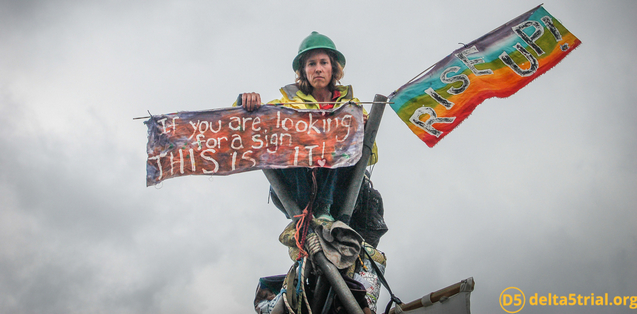
In September 2014 the group tied themselves to a 25ft (8 metre) high “tripod” over a railway line in Washington State, US, to block a train carrying crude oil which, if used, would have contributed directly to carbon emissions and so climate change. The activists, now known as the “Delta 5”, relied on the so-called “necessity defence” to justify their actions and avoid criminal liability.
A successful “necessity defence” needs to show that the crime was necessary in order to prevent an even greater criminal act or irreparable evil. There should be no reasonable legal alternative available under the circumstances. In court, the Delta 5 argued that their actions to prevent the oil from reaching its destination were necessary to stop the greater harm of climate change. As such, they said they shouldn’t be held criminally responsible.
The activists hoped to set a new precedent in the United States which would have paved the way for climate activists in the future to more readily use necessity as a defence to criminal charges. In 2008, for example, a group of six Greenpeace activists were tried in the UK for property damage and trespass after shutting down a coal power station. They used the necessity defence and were acquitted by a jury.
The judge in Seattle, however, ruled that the defendants had failed to show that there was no reasonable legal alternative to their actions. Even though the judge was sympathetic to the activists cause, she was bound by case-law on the lack of evidence supporting a necessity defence and reluctantly instructed the jury to ignore all wider arguments about climate change. The five were found guilty of misdemeanour trespassing.
Legal recognition for “necessity” remains a long-term goal for climate activism, but the latest setback shows how difficult these arguments are to win in court. It’s not just climate change. Attempts to justify the use of marijuana for medical purposes have been met with mixed success, where successful necessity defences have been very much the exception rather than the rule.
Necessity has been most successful in cases involving potential crimes by doctors around the issue of consent, but there are major limits. It’s usually not recognised as a defence against murder charges, for example, a view that dates back to the 1880s when two shipwrecked sailors decided to kill and eat their subordinate, a cabin boy, for survival when lost at sea.

Playing by the rules isn’t working
While necessity is difficult to assert in climate activism trials, the Delta 5 and Greenpeace cases raise a big question: should activists be allowed to take matters into their own hands to prevent global warming and climate change? Given underwhelming results in combating this at the international level to date, arguably they should.
Delta 5 – taking the law into their own hands. delta5trial.org

The Paris climate change agreement in December was celebrated as a major achievement in bringing all states together, developed and developing alike, to agree on a common plan to reduce global carbon emissions. However, on closer inspection, it doesn’t seem to be ambitious enough to work as expected. Warming will be limited to 2.7°C, at best, while the agreement isn’t yet legally-binding. Climate change is still likely to have severe effects.

Robust action – without fear
If states are unwilling or unable to sufficiently reduce their carbon emissions in time to make a real difference, shouldn’t people around the world be encouraged to take robust action without fear of being thrown in jail for their efforts to do good?
Since the 1950s legal theorists have argued about the consequences for people who feel morally compelled to break the law. The so-called “Hart-Fuller” debate, which continues to divide legal scholars to this day, examined among other things the nature of laws in Nazi Germany – for example, was legislation which authorised the transportation of Jews to concentration camps valid law at the time?
The prominent legal philosopher HLA Hart argued yes: he believed laws continue to have legal force, despite a questionable moral basis. Lon Fuller, his rival, said that laws have an inner morality, without which there is nothing to be enforced or obeyed as “law”.
Fuller’s position may provide moral guidance to climate activists who perceive as immoral the legal framework currently configured to see global temperatures far exceed the 2°C limit. They can use society’s understanding of what the law ought to be – one that protects the environment – to justify their decision to disobey.
Hart would say that the law should not be disobeyed despite its questionable moral basis because to do so may open the door to anarchy and conflict. However the necessity defence falls squarely within the letter of the law, and therefore Hart’s theory, though it remains notoriously difficult to prove. Climate activists should bear in mind that they will need convincing proof of no reasonable legal alternative to their actions in order to increase their chances of success when raising necessity as a defence in future criminal trials.
The best way for climate activists to do this would be to leverage conventional legal and political routes as much as possible to achieve their goals. Once all of these options have been exhausted, then there may be no further reasonable legal alternatives left and as such, acts of civil disobedience which break the law may more easily be justified as being necessary. But as yet, strategies that draw upon Fuller’s theory of the inner morality of law, to justify disobeying the law regardless of reasonable legal alternatives, may not help activists keep a clean criminal record.

It is quite clear that necessity isn’t a reliable defence against criminal charges at present. But more sympathetic judges and juries in the future may radically transform the odds of success. The judge in the Delta 5’s case was sympathetic, though it didn’t lead to their successfully defending their position. As the effects of climate change become more and more noticeable, perhaps there will be no reasonable legal alternative in the future but to follow in their footsteps. The law just might keep pace.

Forcing Government Action on Climate Change: Two Noteworthy Legal Initiatives

Global Policy - David Bollier*

The doctrine of public trust compels the state to act as a faithful trustee of resources that belong to the general public. This is highly relevant to talks about climate change.


While much of the momentum to fight climate change is focused on political channels, there are parallel efforts using law to force government to take specific, enforceable actions to reduce carbon emissions. It’s a difficult battle, but in recent weeks two notable initiatives have gained further momentum – a court ruling relying on the public trust doctrine and a new human rights declaration that has broad international support.
The court ruling is related to a series of lawsuits brought by young people invoking the public trust doctrine to force governments to protect the atmosphere. Orchestrated by the advocacy organization Our Children’s Trust, the Atmospheric Trust Litigation suits have been filed in all state courts and in federal courts.
On November 19, one of those lawsuits succeeded. A superior court judge in Seattle issued a ruling that strongly recognizes the public trust doctrine as a applying to the atmosphere. The case sought to uphold science-based plans for carbon emissions reductions developed by Washington State’s Department of Ecology, as a way to protect the atmosphere for eight young people (the plaintiffs) and future generations.
The ruling is especially significant because it echoes a recent ruling by a New Mexico court that also strongly upholds the constitutional principle that the public trust doctrine applies to the atmosphere.
COP21 negotiators, are you listening?
The public trust doctrine is a ancient legal principle that requires government to act as a faithful trustee of resources that belong to the general public and future generations. Historically, this has applied primarily to navigable waters. The Atmospheric Trust Litigation suits want the courts to apply the public trust doctrine to the atmosphere as well, thereby forcing state governments and the federal government to commit to specific actions to reduce carbon emissions.
Judge Hollis R. Hill in Washington State declared that “[t]he state has a constitutional obligation to protect the public’s interest in natural resources held in trust for the common benefit of the people.” He found the public trust doctrine mandates that the state act through its designated agency “to protect what it holds in trust.” The judge also held that it was “nonsensical” to try to separate navigable waters from the atmosphere in applying the public trust doctrine because the two are inextricably linked.
The court validated the youths’ claims that the “scientific evidence is clear that the current rates of reduction mandated by Washington law...cannot ensure the survival of an environment in which [youth] can grow to adulthood safely.” The judge determined that the State has a “mandatory duty” to “preserve, protect, and enhance the air quality for the current and future generations,” and found the state’s current standards to fail that standard dramatically for several reasons.
The ATL lawsuits are potentially significant because they signal that even if the political branches of government will not uphold science-based climate policies to protect the public, the courts will. We need more such rulings that the government has a constitutional obligation to protect the atmosphere as a public trust asset crucial for the survival of our children.

Draft Declaration on Human Rights and Climate Change
There is another important legal initiative that is gaining attention -- the Draft Declaration on Human Rights and Climate Change. The Declaration, prepared by the Global Network for the Study of Human Rights and the Environment, invokes some of the most venerable human rights statements in history before going on to present “an alternative formulation of rights that foregrounds human rights while simultaneously protecting the rights of non-human living beings and systems from climate harms.”
Here are the first six principles of the Draft Declaration:
  1. Human rights and a profound commitment to climate justice are interdependent and indivisible.
  2. All human beings have the right to a secure, healthy and ecologically sound Earth system and to fairness, equity and justice in the provision of climate resilience, adaptation and mitigation.
  3. All human beings have the right to a planetary climate suitable to meet equitably the needs of present generations without impairing the rights of future generations to meet equitably their needs.
  4. All human beings have the right to information about and participation in decision-making related to alterations to the physical environments they rely upon for their health and survival.
  5. All human beings have the right to the highest attainable standard of health free from environmental pollution, degradation and the emissions of environmental toxins and to be free from dangerous anthropogenic interference with the climate system such that rising global temperatures are kept well below the tipping point of two degrees centigrade above preindustrial levels.
  6. All human beings have the right to investments in adaptation and mitigation to prevent the deleterious consequences of anthropogenic climate change, and to timely assistance in the event of climate change driven catastrophes.
The Declaration is open for amendment until February 19, 2016. You can endorse the Declaration or suggest amendments by emailing Kirsty Davies at kirsty.davies/at/mq.edu.au. It is already anticipated that the next draft will focus more explicitly on indigenous rights and emphasize “the presuppositional need for direct protection of the living order as a condition for fulfilling human rights in the era of climate change.”

*David Bollier is author, activist, blogger and consultant. He's the co-founder of the Commons Strategies Group, a consulting project that works to promote the commons internationally. He was Founding Editor of Onthecommons.org and a Fellow of On the Commons from 2004 to 2010.

Links

Lethal Heating is a citizens' initiative