The Guardian - Suzanne Goldenberg
Symbolic clock is now at three minutes to apocalypse, the darkest hour for humanity since the cold war
The symbolic doomsday clock moved to three minutes before midnight on
Thursday because of the gathering dangers of climate change and nuclear
proliferation, signalling the gravest threat to humanity since the
throes of the cold war.
It was the closest the clock has come to midnight since 1984, when
arms-control negotiations stalled and virtually all channels of
communication between the US and the former Soviet Union closed down.
“It is now three minutes to midnight,” said Kennette Bennedict, the
executive director of the Bulletin of the Atomic Scientists, announcing
the two-minute shift toward the midnight hour.
The move came as scientists sounded a warning about climate change
for the second time in three years. The last move of the clock hands,
from six minutes to five minutes to midnight, in 2012, was also because
of climate change.
As the scientists noted last Thursday, 2014 was the hottest year in 130 years of systematic record keeping. Nine of the 10 hottest years on record have occurred since 2000.
But the scientists suggested that the greater danger lay in the failure of leaders to recognise and act on climate change.
“Stunning government failures have imperiled civilisations on a
global scale,” Benedict said. “World leaders have failed to act on a
scale or at a speed to protect humanity from catastrophe.”
The greenhouse gas emissions that cause climate change have risen
more since 2000 than in the three previous decades combined, Richard
Somerville, a research professor at the Scripps Institution of
Oceanography, said. Even so, he observed, negotiators had steadily
lowered their ambitions for a global climate deal.
Meanwhile, the scientists said, global efforts to reduce nuclear
arsenals have slowed since 2009, and all of the nuclear powers were
expanding reactors and weapons programmes.
The Bulletin of the Atomic Scientists created the symbolic clock in
1947 to indicate the cold war threat. In 1991, when the threat of
nuclear annihilation receded with the end of the cold war, the clock
stood at 17 minutes to midnight.
But it was now moving closer to the apocalypse because of climate
change. “We are not saying it is too late to take action, but the window
to take action is closing rapidly,” Benedict said.
Links
27/01/2016
26/01/2016
Climate Change Fuels Bushfire Risk As Australia Heats Up
France 24 - Glenda Kwek, Agence-France Presse
SYDNEY (AFP) - "A sunburnt country... with a pitiless blue sky", so the famous poem goes, but where once Australia could rely on "steady, soaking rain", a trend of hotter and drier weather as the climate warms is making it more vulnerable to severe bushfires.
Climate experts warn that with rising temperatures, as well as decreasing rainfall in the south, parts of Australia are so dry the risk of bushfires is rising.
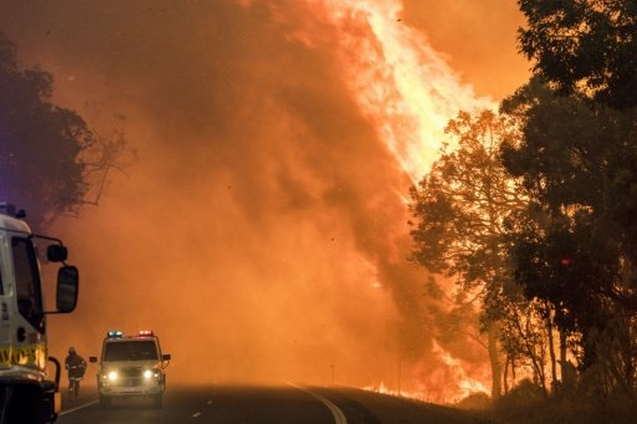
Since November huge swathes of the country have been scorched by ferocious blazes, leaving a total of nine dead and hundreds of homes destroyed. In South Australia, locals told of an "Armageddon-like" inferno sweeping through some areas, while in Western Australia bushfires raged out of control in a situation residents described as "like hell".
Already this year there have been scores more bushfires -- a recent incident at Yarloop, 110 kilometres (70 miles) south of Perth, left two dead.
Firefighters warn they are facing more intense, erratic blazes.
"From my experience, fires appear to be getting more intense, harder to fight, harder to plan for... and this is having an impact on firefighting strategies," Darin Sullivan, a 25-year veteran New South Wales state firefighter, told AFP.
Three of the five hottest years on record in Australia have occurred in the last three years, according to data compiled by the Bureau of Meteorology (BOM).
In 2013, Australia experienced its warmest year on record, 2014 was the third-hottest while last year was the fifth-warmest.
"Studies have shown an increase in the number of days with high levels of fire danger in southern and eastern Australia," BOM climatologist Blair Trewin told AFP.
"One of the things that is apparent is a lengthening of the fire season, so we're seeing more high fire danger days in spring and autumn, as well as in the core of summer."
'Catastrophic fires'
Bushfires are common in Australia's arid summer, which usually begins in December. Former prime minister Tony Abbott, a long-time climate change sceptic, said during the sweltering 2013-14 summer season that the heat was "just part and parcel of life in Australia".
"Australia is, to use the famous phrase, a land of droughts and flooding rains," he added, recalling the well-known Dorothea Mackellar poem "My Country".
But firefighter Sullivan said he and his colleagues were witnessing deteriorating conditions, including an apparent increase in the number of the most severe fires in recent years.
The "catastrophic" category in fire ratings was introduced after Victoria state endured the devastating "Black Saturday" bushfires in 2009 that left 173 dead in Australia's worst natural disaster.
Another issue exacerbating the impact of bushfires is that more and bigger buildings are being built in disaster-prone areas, with Campbell Fuller of Insurance Council Australia adding that often the properties being constructed were not resilient to extreme weather events.
An increase in the number and intensity of blazes is predicted to have a serious economic impact. Bushfires were estimated to have cost Australia US$247 million in 2014, but this is forecast to soar to US$548 million by 2050, according to Deloitte Access Economics, which cited population growth and infrastructure density as factors.
'Increasing danger'
Ken Mansbridge, whose family home was burnt down in the 1983 Ash Wednesday bushfires that killed more than 70 people in Victoria and adjacent South Australia, continues to live in the same region and has noticed a stark difference in weather patterns.
"There's definitely a noticeable change in the weather patterns and in the actual vegetation... I've never seen the local area look as dry as it does," the 70-year-old retiree, who has lived in the Macedon Ranges about 70 kilometres northwest of Melbourne for more than four decades, told AFP.
"The trees are all flowering at different times, the vegetables this year were all wind and sun burnt," he explained.
A November report by the independent Climate Council pointed to longer bushfire seasons across the globe.
"What climate change is doing is loading the dice towards having the sort of conditions that are conducive to fires spreading and being very hot and more uncontrollable," said lead author Lesley Hughes, a Macquarie University biologist and ecologist.
With the BOM and national science body CSIRO expecting Australia to "warm substantially" this century, having already seen temperatures rise approximately 1.0 degree Celsius (1.8 degrees Fahrenheit) since 1950, Sullivan said strategies for fighting fires needed to be overhauled and climate change addressed.
"If this type of intensity and increase continues, then our resources are very close to being overrun at times," he said.
"This is our workplace. When we go to work to fight fires, our workplace is now more dangerous because of climate change as well."
SYDNEY (AFP) - "A sunburnt country... with a pitiless blue sky", so the famous poem goes, but where once Australia could rely on "steady, soaking rain", a trend of hotter and drier weather as the climate warms is making it more vulnerable to severe bushfires.
Climate experts warn that with rising temperatures, as well as decreasing rainfall in the south, parts of Australia are so dry the risk of bushfires is rising.
Since November huge swathes of the country have been scorched by ferocious blazes, leaving a total of nine dead and hundreds of homes destroyed. In South Australia, locals told of an "Armageddon-like" inferno sweeping through some areas, while in Western Australia bushfires raged out of control in a situation residents described as "like hell".
Already this year there have been scores more bushfires -- a recent incident at Yarloop, 110 kilometres (70 miles) south of Perth, left two dead.
![]() |
| A Department of Fire and Emergency Services photo shows a bushfire burning near Waroona, south of Perth, Australia on January 7, 2016. © Department of Fire and Emergency/AFP/File / by Glenda Kwek | |
Firefighters warn they are facing more intense, erratic blazes.
"From my experience, fires appear to be getting more intense, harder to fight, harder to plan for... and this is having an impact on firefighting strategies," Darin Sullivan, a 25-year veteran New South Wales state firefighter, told AFP.
Three of the five hottest years on record in Australia have occurred in the last three years, according to data compiled by the Bureau of Meteorology (BOM).
In 2013, Australia experienced its warmest year on record, 2014 was the third-hottest while last year was the fifth-warmest.
"Studies have shown an increase in the number of days with high levels of fire danger in southern and eastern Australia," BOM climatologist Blair Trewin told AFP.
"One of the things that is apparent is a lengthening of the fire season, so we're seeing more high fire danger days in spring and autumn, as well as in the core of summer."
'Catastrophic fires'
Bushfires are common in Australia's arid summer, which usually begins in December. Former prime minister Tony Abbott, a long-time climate change sceptic, said during the sweltering 2013-14 summer season that the heat was "just part and parcel of life in Australia".
"Australia is, to use the famous phrase, a land of droughts and flooding rains," he added, recalling the well-known Dorothea Mackellar poem "My Country".
But firefighter Sullivan said he and his colleagues were witnessing deteriorating conditions, including an apparent increase in the number of the most severe fires in recent years.
The "catastrophic" category in fire ratings was introduced after Victoria state endured the devastating "Black Saturday" bushfires in 2009 that left 173 dead in Australia's worst natural disaster.
Another issue exacerbating the impact of bushfires is that more and bigger buildings are being built in disaster-prone areas, with Campbell Fuller of Insurance Council Australia adding that often the properties being constructed were not resilient to extreme weather events.
An increase in the number and intensity of blazes is predicted to have a serious economic impact. Bushfires were estimated to have cost Australia US$247 million in 2014, but this is forecast to soar to US$548 million by 2050, according to Deloitte Access Economics, which cited population growth and infrastructure density as factors.
'Increasing danger'
Ken Mansbridge, whose family home was burnt down in the 1983 Ash Wednesday bushfires that killed more than 70 people in Victoria and adjacent South Australia, continues to live in the same region and has noticed a stark difference in weather patterns.
"There's definitely a noticeable change in the weather patterns and in the actual vegetation... I've never seen the local area look as dry as it does," the 70-year-old retiree, who has lived in the Macedon Ranges about 70 kilometres northwest of Melbourne for more than four decades, told AFP.
"The trees are all flowering at different times, the vegetables this year were all wind and sun burnt," he explained.
A November report by the independent Climate Council pointed to longer bushfire seasons across the globe.
"What climate change is doing is loading the dice towards having the sort of conditions that are conducive to fires spreading and being very hot and more uncontrollable," said lead author Lesley Hughes, a Macquarie University biologist and ecologist.
With the BOM and national science body CSIRO expecting Australia to "warm substantially" this century, having already seen temperatures rise approximately 1.0 degree Celsius (1.8 degrees Fahrenheit) since 1950, Sullivan said strategies for fighting fires needed to be overhauled and climate change addressed.
"If this type of intensity and increase continues, then our resources are very close to being overrun at times," he said.
"This is our workplace. When we go to work to fight fires, our workplace is now more dangerous because of climate change as well."
Sea Level Rise From Ocean Warming Underestimated, Scientists Say
The Guardian - Agence-France Presse
Thermal expansion of the oceans as they warm is likely to be twice as large as previously thought, according to German researchers
The amount of sea level rise that comes from the oceans warming and expanding has been underestimated, and could be about twice as much as previously calculated, German researchers have said.
The findings in the Proceedings of the National Academy of Sciences, a peer-reviewed US journal, suggest that increasingly severe storm surges could be anticipated as a result.
Sea level can mount due to two factors – melting ice and the thermal expansion of water as it warms.
Until now, researchers have believed the oceans rose between 0.7 to 1mm per year due to thermal expansion.
But a fresh look at the latest satellite data from 2002 to 2014 shows the seas are expanding about 1.4mm a year, said the study.
"To date, we have underestimated how much the heat-related expansion of the water mass in the oceans contributes to a global rise in sea level," said co-author Jurgen Kusche, a professor at the University of Bonn.
The overall sea level rise rate is about 2.74mm per year, combining both thermal expansion and melting ice.
Sea level rise was also found to vary substantially from place to place, with the rate around the Philippines "five times the global rate."
Meanwhile, sea level on the US west coast is largely stable because there is hardly any ocean warming in that area, said the findings.
Links
Thermal expansion of the oceans as they warm is likely to be twice as large as previously thought, according to German researchers
![]() |
| Sea levels can rise due to melting ice and the expansion of water as it warms. Photograph: Alamy |
The amount of sea level rise that comes from the oceans warming and expanding has been underestimated, and could be about twice as much as previously calculated, German researchers have said.
The findings in the Proceedings of the National Academy of Sciences, a peer-reviewed US journal, suggest that increasingly severe storm surges could be anticipated as a result.
Sea level can mount due to two factors – melting ice and the thermal expansion of water as it warms.
Until now, researchers have believed the oceans rose between 0.7 to 1mm per year due to thermal expansion.
But a fresh look at the latest satellite data from 2002 to 2014 shows the seas are expanding about 1.4mm a year, said the study.
"To date, we have underestimated how much the heat-related expansion of the water mass in the oceans contributes to a global rise in sea level," said co-author Jurgen Kusche, a professor at the University of Bonn.
The overall sea level rise rate is about 2.74mm per year, combining both thermal expansion and melting ice.
Sea level rise was also found to vary substantially from place to place, with the rate around the Philippines "five times the global rate."
Meanwhile, sea level on the US west coast is largely stable because there is hardly any ocean warming in that area, said the findings.
Links
- World's oceans warming at increasingly faster rate, new study finds
- Warming of oceans due to climate change is unstoppable, say US scientists
- Scientists predict huge sea level rise even if we limit climate change
- Thinning Antarctic ice shelf could contribute to sea level rise, says study
- Greenland ice melt underestimated, study says
Two Irrational Responses To Climate Change: Witch Hunts And Denial
Los Angeles Times - Cynthia Barnett*
In late August 1589, a dozen of the fittest ships in the Danish fleet set across a tempestuous North Sea to carry a 14-year-old princess bride to her new husband and new home. King James VI of Scotland had seen Anna of Denmark only in a miniature portrait before arranging a marriage by proxy in her country. Following her wedding-sans-groom in a palace by the sea, Anna boarded the ship of Danish Admiral Peter Munch to travel to her Scottish kingdom.
They met typical storms until close to Scotland, when an extraordinary gale flew at them from the coast. Twice they came within sight of the cliffs of home, and twice a phalanx of rain and winds pushed them back, ultimately all the way to Norway. Munch found the conditions uncommonly fierce, even for the North Sea. So much so, he thought, "there must be more in the matter than the common perversity of winds and weather." Munch blamed witches for conjuring the storms.
As he attempted his third approach, a yet-worse squall roiled up, battering the ship that carried Anna. They limped to a Norwegian sound to await King James's rescue mission. James had been skeptical of the witch hysteria sweeping Europe. But as he tried to reach his bride, his ships, too, were tossed in freak storms. Once united, he and Anna had to wait out icy conditions for half a year before they could attempt a return journey, on which they faced more "unnatural weather." By the time they arrived in Edinburgh in May 1590, James was as convinced as Munch that witches had brewed the worst weather in memory to keep his queen from ascending her throne.
Many assume that witch hunts were caused by religious and socio-political turmoil. German historian Wolfgang Behringer argues that they were born of climate turmoil too. He has tracked the rise of witchcraft prosecutions in the 14th century to the rise of the Little Ice Age, with criminal proceedings reaching their peak during the worst years of the climate extremes, in the decades before and after 1600.
Frequently suffering misfortune themselves, accused witches — around 80% women, and often poor and elderly — were scapegoated for the ills of the age, from infertility to the deaths of children. That they were also blamed for frightening weather is clear in artwork and news bulletins. A German woodcut from 1486 shows a sorceress conjuring enormous chunks of hail; a frontispiece from a 1489 pamphlet called Weather Magic depicts two hags at a tall caldron, as a storm bursts overhead; a German pamphlet from 1580 details 114 executions of witches who had mainly confessed to instigating crop-destroying thunderstorms.
Paranoia often rumbled from hungry stomachs: Villagers harangued reluctant local courts and prince-bishops to do something about the foul weather by rounding up storm-makers. But the events in Scotland debunk the notion that witch mania rose from the desperate and uneducated. There, the zeal for witch-hunting came straight from the top — from the same King James who gave us the King James Bible.
In the University of Glasgow's Special Collections, a 1591 pamphlet called Newes from Scotland tells the story, at least from James's point of view: The tract depicts a storm ravaging the King's ship, with women huddled around a boiling caldron on shore. It describes the torture of a maidservant, who endured graphic agonies before she finally named a ringleader, Agnes Sampson, a renowned midwife and healer.
After unspeakable tortures, Sampson finally confessed to conjuring the storms that had hindered the union of James and Anna. She told James that Satan considered him "the greatest enemie hee hath in the world" and wanted to see him drowned by storm. No words could have rung so true to the self-important king. Sampson was only one of many innocents who paid the price. Seventy people were implicated in the case; not all their fates are known. She was among several burned at the stake.
Europe's witch hunts and trials did not trail off entirely until the 18th-century Enlightenment, which also gave rise to the notion of evidence — in both the courts and the pursuit of science.
Today, scientific evidence makes clear that Earth's current warming cannot be explained by a decrease in solar activity or other natural causes thought to have triggered the Little Ice Age. The resounding consensus is that human activities since the Industrial Revolution adding C02 and other heat-trapping gases to the atmosphere are responsible for rising global temperature. Climate models predict extreme weather events will surge with the thermostat. Super El Nino events like the one sending lashing rains to California could double. Meteorological research has found certain tropical cyclones, along with droughts and heat waves, substantially more likely in a warming world.
Yet many American leaders reject these predictions. The deniers include not only several of the presidential candidates now in the news, but governors of coastal Gulf states with the most to lose from tropical storms; governors of Great Plains states most vulnerable to drought; the chairman of the Senate Committee on Environment and Public Works; the chairman of the House Committee on Science, Space and Technology; and many others in Congress and state capitols.
A study this month in the journal Global Environmental Change reveals not only that climate denial remains robust, but the extent to which our leaders are systematically influenced by a small number of think tanks that have upped their anti-science messaging — from policy papers to speeches to press releases — exponentially. The 19 industry-funded groups produced 16,028 of these contrarian documents between 1998 and 2013. (A content analysis found that in addition to disputing the science, they frequently questioned the integrity of specific climate scientists – modern-day witch hunts alleging mathematical and other "tricks.")
While we no longer burn people at the stake for outlier weather, there is little question that sowing scientific denial with the intent to halt progress on warming will condemn the most vulnerable. A new World Bank report predicts that climate change will push more than 100 million people in the poorest regions of the world back into poverty over the next 15 years. The poor will suffer the most from natural disasters and the health impacts of climate change, from famine to floods to Dengue Fever.
What we have that King James lacked is the science to help us understand our changing climate and take action to protect all life. If we fail to act on what we know, our descendants will one day look back at us with the same head-shaking disbelief we express for King James and his imaginary witches.
![]() |
| A frontispiece to a tract by German legal scholar Ulrich Molitor in 1489 depicts witches brewing "weather magic." (Los Angeles Times) |
In late August 1589, a dozen of the fittest ships in the Danish fleet set across a tempestuous North Sea to carry a 14-year-old princess bride to her new husband and new home. King James VI of Scotland had seen Anna of Denmark only in a miniature portrait before arranging a marriage by proxy in her country. Following her wedding-sans-groom in a palace by the sea, Anna boarded the ship of Danish Admiral Peter Munch to travel to her Scottish kingdom.
They met typical storms until close to Scotland, when an extraordinary gale flew at them from the coast. Twice they came within sight of the cliffs of home, and twice a phalanx of rain and winds pushed them back, ultimately all the way to Norway. Munch found the conditions uncommonly fierce, even for the North Sea. So much so, he thought, "there must be more in the matter than the common perversity of winds and weather." Munch blamed witches for conjuring the storms.
As he attempted his third approach, a yet-worse squall roiled up, battering the ship that carried Anna. They limped to a Norwegian sound to await King James's rescue mission. James had been skeptical of the witch hysteria sweeping Europe. But as he tried to reach his bride, his ships, too, were tossed in freak storms. Once united, he and Anna had to wait out icy conditions for half a year before they could attempt a return journey, on which they faced more "unnatural weather." By the time they arrived in Edinburgh in May 1590, James was as convinced as Munch that witches had brewed the worst weather in memory to keep his queen from ascending her throne.
The resounding consensus is that human activities since the Industrial Revolution ... are responsible for rising global temperature.An aging midwife would burn for the squalls. She was among thousands of accused witches executed for conjuring storms during the climate havoc known as the Little Ice Age. Between 1300 and 1850, deadly winters and alternating acute rains and droughts ruined crops for season upon season, contributing to famines and many other miseries. The extremes evoke our own time, as severe weather rises with global warming. But there's a cruelly poignant difference. Our irrational ancestors blamed innocent people for the crisis. Our irrational contemporaries pretend that people are blameless, our work on climate change futile. The two are equally dangerous.
Many assume that witch hunts were caused by religious and socio-political turmoil. German historian Wolfgang Behringer argues that they were born of climate turmoil too. He has tracked the rise of witchcraft prosecutions in the 14th century to the rise of the Little Ice Age, with criminal proceedings reaching their peak during the worst years of the climate extremes, in the decades before and after 1600.
Frequently suffering misfortune themselves, accused witches — around 80% women, and often poor and elderly — were scapegoated for the ills of the age, from infertility to the deaths of children. That they were also blamed for frightening weather is clear in artwork and news bulletins. A German woodcut from 1486 shows a sorceress conjuring enormous chunks of hail; a frontispiece from a 1489 pamphlet called Weather Magic depicts two hags at a tall caldron, as a storm bursts overhead; a German pamphlet from 1580 details 114 executions of witches who had mainly confessed to instigating crop-destroying thunderstorms.
Paranoia often rumbled from hungry stomachs: Villagers harangued reluctant local courts and prince-bishops to do something about the foul weather by rounding up storm-makers. But the events in Scotland debunk the notion that witch mania rose from the desperate and uneducated. There, the zeal for witch-hunting came straight from the top — from the same King James who gave us the King James Bible.
In the University of Glasgow's Special Collections, a 1591 pamphlet called Newes from Scotland tells the story, at least from James's point of view: The tract depicts a storm ravaging the King's ship, with women huddled around a boiling caldron on shore. It describes the torture of a maidservant, who endured graphic agonies before she finally named a ringleader, Agnes Sampson, a renowned midwife and healer.
After unspeakable tortures, Sampson finally confessed to conjuring the storms that had hindered the union of James and Anna. She told James that Satan considered him "the greatest enemie hee hath in the world" and wanted to see him drowned by storm. No words could have rung so true to the self-important king. Sampson was only one of many innocents who paid the price. Seventy people were implicated in the case; not all their fates are known. She was among several burned at the stake.
Europe's witch hunts and trials did not trail off entirely until the 18th-century Enlightenment, which also gave rise to the notion of evidence — in both the courts and the pursuit of science.
Today, scientific evidence makes clear that Earth's current warming cannot be explained by a decrease in solar activity or other natural causes thought to have triggered the Little Ice Age. The resounding consensus is that human activities since the Industrial Revolution adding C02 and other heat-trapping gases to the atmosphere are responsible for rising global temperature. Climate models predict extreme weather events will surge with the thermostat. Super El Nino events like the one sending lashing rains to California could double. Meteorological research has found certain tropical cyclones, along with droughts and heat waves, substantially more likely in a warming world.
Yet many American leaders reject these predictions. The deniers include not only several of the presidential candidates now in the news, but governors of coastal Gulf states with the most to lose from tropical storms; governors of Great Plains states most vulnerable to drought; the chairman of the Senate Committee on Environment and Public Works; the chairman of the House Committee on Science, Space and Technology; and many others in Congress and state capitols.
A study this month in the journal Global Environmental Change reveals not only that climate denial remains robust, but the extent to which our leaders are systematically influenced by a small number of think tanks that have upped their anti-science messaging — from policy papers to speeches to press releases — exponentially. The 19 industry-funded groups produced 16,028 of these contrarian documents between 1998 and 2013. (A content analysis found that in addition to disputing the science, they frequently questioned the integrity of specific climate scientists – modern-day witch hunts alleging mathematical and other "tricks.")
While we no longer burn people at the stake for outlier weather, there is little question that sowing scientific denial with the intent to halt progress on warming will condemn the most vulnerable. A new World Bank report predicts that climate change will push more than 100 million people in the poorest regions of the world back into poverty over the next 15 years. The poor will suffer the most from natural disasters and the health impacts of climate change, from famine to floods to Dengue Fever.
What we have that King James lacked is the science to help us understand our changing climate and take action to protect all life. If we fail to act on what we know, our descendants will one day look back at us with the same head-shaking disbelief we express for King James and his imaginary witches.
*Cynthia Barnett is the author of three books on water. She tells the King James story in her latest, "Rain: A Natural and Cultural History."
Record Hot Years Near Impossible Without Manmade Climate Change – Study
The Guardian - Damian Carrington
New calculations shows there is just a 0.01% chance that recent run of global heat records could have happened due to natural climate variations
The world's run of record-breaking hottest years is extremely unlikely to have happened without the global warming caused by human activities, according to new calculations.
Thirteen of the 15 hottest years in the 150-year-long record occurred between 2000-14 and the researchers found there is a just a 0.01% chance that this happened due to natural variations in the planet's climate.
2015 was revealed to have smashed all earlier records on Wednesday, after the new study had been completed, meaning the odds that the record run of heat is a fluke are now even lower.
"Natural climate variations just can't explain the observed recent global heat records, but manmade global warming can," said Prof Stefan Rahmstorf, at the Potsdam Institute for Climate Impact Research in Germany and one of the research team.
He said the record heat brought substantial impacts: "It has led to unprecedented local heatwaves across the world, sadly resulting in loss of life and aggravating droughts and wildfires. The risk of heat extremes has been multiplied due to our interference with the Earth system, as our analysis shows."
The UN World Meteorological Organization (WMO) confirmed on Monday that the global average surface temperature in 2015 shattered all previous records and said 15 of the 16 hottest years on record have all occurred since 2000. "We have reached for the first time the threshold of 1C above pre-industrial temperatures. It is a sobering moment in the history of our planet," said WMO secretary-general Petteri Taalas.
The new research by Rahmstorf and colleagues, published in the journal Scientific Reports, is based on a statistical analysis that combines real-world measurements with comprehensive computer simulations of the climate system. This allowed natural climate variability to be better separated from human-caused climate change. The results did not vary significantly when UK Met Office temperature data was used instead of Nasa data.
The research was prompted by earlier claims that the run of record-breaking years was vanishing unlikely, a one in 650m shot, according to one report.
However, the average global surface temperature of the planet each year is influenced by the warmth of the previous year, meaning that a record broken one year is not independent of the year before. The UK Met Office expects 2016 to break the record set in 2015, partly because of the continuing El Niño weather phenomenon.
"Natural climate variability causes temperatures to wax and wane over a period of several years, rather than varying erratically from one year to the next," said Prof Michael Mann at Penn State university in the US, who led the new study. "That makes it more challenging to accurately assess the likelihood of temperature records. Given the press interest, it seemed important to do this right, and address the interesting and worthwhile question of how unlikely it is that the recent run of record temperatures might have arisen by chance alone."
The study concludes: "While considerably greater than cited in some media reports, the odds are low enough to suggest that recent observed runs of record temperatures are extremely unlikely to have occurred in the absence of human-caused global warming."
In 2013, the UN's Intergovernmental Panel on Climate Change concluded with 95% certainty that humans are the main cause of global warming.
Links
New calculations shows there is just a 0.01% chance that recent run of global heat records could have happened due to natural climate variations
![]() |
| Tourists ski on a thin layer of snow towards the resort of Leysin in the Swiss Alps in one of the warmest Decembers on record. Photograph: Fabrice Coffrini/AFP/Getty Images |
The world's run of record-breaking hottest years is extremely unlikely to have happened without the global warming caused by human activities, according to new calculations.
Thirteen of the 15 hottest years in the 150-year-long record occurred between 2000-14 and the researchers found there is a just a 0.01% chance that this happened due to natural variations in the planet's climate.
2015 was revealed to have smashed all earlier records on Wednesday, after the new study had been completed, meaning the odds that the record run of heat is a fluke are now even lower.
"Natural climate variations just can't explain the observed recent global heat records, but manmade global warming can," said Prof Stefan Rahmstorf, at the Potsdam Institute for Climate Impact Research in Germany and one of the research team.
He said the record heat brought substantial impacts: "It has led to unprecedented local heatwaves across the world, sadly resulting in loss of life and aggravating droughts and wildfires. The risk of heat extremes has been multiplied due to our interference with the Earth system, as our analysis shows."
The UN World Meteorological Organization (WMO) confirmed on Monday that the global average surface temperature in 2015 shattered all previous records and said 15 of the 16 hottest years on record have all occurred since 2000. "We have reached for the first time the threshold of 1C above pre-industrial temperatures. It is a sobering moment in the history of our planet," said WMO secretary-general Petteri Taalas.
The new research by Rahmstorf and colleagues, published in the journal Scientific Reports, is based on a statistical analysis that combines real-world measurements with comprehensive computer simulations of the climate system. This allowed natural climate variability to be better separated from human-caused climate change. The results did not vary significantly when UK Met Office temperature data was used instead of Nasa data.
The research was prompted by earlier claims that the run of record-breaking years was vanishing unlikely, a one in 650m shot, according to one report.
However, the average global surface temperature of the planet each year is influenced by the warmth of the previous year, meaning that a record broken one year is not independent of the year before. The UK Met Office expects 2016 to break the record set in 2015, partly because of the continuing El Niño weather phenomenon.
"Natural climate variability causes temperatures to wax and wane over a period of several years, rather than varying erratically from one year to the next," said Prof Michael Mann at Penn State university in the US, who led the new study. "That makes it more challenging to accurately assess the likelihood of temperature records. Given the press interest, it seemed important to do this right, and address the interesting and worthwhile question of how unlikely it is that the recent run of record temperatures might have arisen by chance alone."
The study concludes: "While considerably greater than cited in some media reports, the odds are low enough to suggest that recent observed runs of record temperatures are extremely unlikely to have occurred in the absence of human-caused global warming."
In 2013, the UN's Intergovernmental Panel on Climate Change concluded with 95% certainty that humans are the main cause of global warming.
Links
25/01/2016
The Coming Electrification Of Everything
Renew Economy - Andrew Beebe
There are two simple reasons we'll make this change sooner than most people think. First, electrically powered things just work better. And people want things that work better. The second reason is really just a piece of the first. "Better" increasingly means "better forever." That is, not just better in the moment for that use, but also better for our surroundings, our health, and the health of our planet.
But, at least for the short term, our climate will be served not simply by environmental motivations, but by the same relentless human force that created it: the desire for more, faster, better. Ever-better technology will lead consumers, rather than idealists, to drive this electricity evolution.
Why now? Key trends emerging only in recent years have created the foundation for this evolution.
Electric solutions are finally better
Electric garbage trucks, skateboards, bikes and scooters will soon dominate the streetscape. These products are a big improvement over their predecessors. They are silent, clean, fast and low-maintenance.
We're seeing a big shift at home too. Hybrid hot water heaters, heat exchangers that handle both AC and heat, and induction cooktops are widely considered to be better performing, more durable, and easier to maintain than gas-powered options.
What's to come? Well-funded startups and R&D efforts are underway for battery-powered boats, electric long-haul trucking and even airplanes — and of course, we will see home and commercial battery systems for backup proliferate as costs drop.
Battery costs plummeting and performance is ramping
The distributed grid is on the rise
Homes and businesses making their own power have the means and the opportunity to put it to good use, further fueling motivation to invest in electrically driven systems.
Finally, we're seeing entire countries and states commit to moving closer to carbon-neutral — and of course others will follow. With these commitments comes a clear line of sight to a carbon-free environment in both the creation of energy and the ways in which we use it. The idea of burning anything to move ourselves, power our homes or drive our supply chains will be a thing of the past.
The clean electron era
*Andrew Beebe is a managing director at Obvious Ventures. This article was first published at Greentech Media. Reproduced with permission.
Links
At Obvious Ventures, we believe stored electricity, increasingly derived from renewable sources, will entirely replace fossil fuels as the preferred method to power everything in our lives. From cars to scooters to boats to locomotives to industrial equipment, we are in the midst of a transition that will electrify everything previously driven by combustion.
There are two simple reasons we'll make this change sooner than most people think. First, electrically powered things just work better. And people want things that work better. The second reason is really just a piece of the first. "Better" increasingly means "better forever." That is, not just better in the moment for that use, but also better for our surroundings, our health, and the health of our planet.
But, at least for the short term, our climate will be served not simply by environmental motivations, but by the same relentless human force that created it: the desire for more, faster, better. Ever-better technology will lead consumers, rather than idealists, to drive this electricity evolution.
Cutting-edge electric cars today are better than their gas-powered counterparts. They are both safer and easier to maintain than conventional cars. No trips to the gas station, no oil changes; the bulk of upkeep lies in tires and windshield wiper fluid. They also perform on the road, with better acceleration, torque and responsiveness than their conventional counterparts. The big downside (and it's a big one) of range vs. cost will be overcome by multiple car companies in the coming years.
These benefits cross over to other categories as well. Companies like Proterra are developing in-city electric buses that are virtually silent, with zero emissions and the same simplified maintenance requirements that electric-car owners have come to appreciate. Adoption is relatively easy; defined routes, low speeds and designated charging stations are resulting in programs in an increasing number of U.S. cities.Electric garbage trucks, skateboards, bikes and scooters will soon dominate the streetscape. These products are a big improvement over their predecessors. They are silent, clean, fast and low-maintenance.
We're seeing a big shift at home too. Hybrid hot water heaters, heat exchangers that handle both AC and heat, and induction cooktops are widely considered to be better performing, more durable, and easier to maintain than gas-powered options.
What's to come? Well-funded startups and R&D efforts are underway for battery-powered boats, electric long-haul trucking and even airplanes — and of course, we will see home and commercial battery systems for backup proliferate as costs drop.
Battery costs plummeting and performance is ramping
The key catalyst to allowing for the electrification of everything is improved battery technology. To move into widespread use, we need both lower costs and better density. As I wrote in my piece on lithium-ion batteries, we expect the cost curve for batteries over the next decade to mimic what we've seen in solar over the same time frame. If we're right, we're on the cusp of an order-of-magnitude reduction in the costs of energy storage in almost all shapes and sizes.
Although not tracking at the same rate as costs, energy storage density is increasing as well. Smaller batteries that last longer will power transport for longer range and less cost, pave the way for widespread home storage systems, and make the profound environmental hazards of two-stroke engines (lawn mowers, blowers, outboard motors, etc.) a thing of the past.
Homeowners around the world, particularly in the U.S., Europe and Japan, have decided not to wait for governments and utilities when it comes to clean energy. In ever-increasing numbers, they have used rooftop solar to become their own power producers and HAVE gone green in myriad distributed ways.
The companies that serve them have also taken notice. From Facebook to Google to Apple to Amazon, the world's largest companies are moving toward 100 percent renewable power.Homes and businesses making their own power have the means and the opportunity to put it to good use, further fueling motivation to invest in electrically driven systems.
Finally, we're seeing entire countries and states commit to moving closer to carbon-neutral — and of course others will follow. With these commitments comes a clear line of sight to a carbon-free environment in both the creation of energy and the ways in which we use it. The idea of burning anything to move ourselves, power our homes or drive our supply chains will be a thing of the past.
Hospitals, transport, homes and businesses will increasingly generate and store power on-site. This will in turn grow the functionality of the grid and ensure full resilience after natural disasters like Hurricane Katrina. The insanity and shortsightedness of destroying a finite supply of fossil fuels by burning (rather than leaving them in the ground to minimize carbon release or maximizing their value for plastics, fertilizers, etc.) will be the predominant cultural view. Today's first graders will get to college and shake their heads when we talk about the good old days of using repeated explosions under the hood of the car to get around.
Most of all, we will serve the greater good by aligning with, instead of opposing, the forces that sustain and define us: wind, water, solar and our own human nature to seek abundance for all.There Will Be Chaos: Big Oil's Collapse And The Birth Of A New World Order
Salon - Michael Klare*
Barrel prices have completely cratered. With alternative energies on the rise, geopolitics may never be the same.
As 2015 drew to a close, many in the global energy industry were praying that the price of oil would bounce back from the abyss, restoring the petroleum-centric world of the past half-century. All evidence, however, points to a continuing depression in oil prices in 2016 — one that may, in fact, stretch into the 2020s and beyond. Given the centrality of oil (and oil revenues) in the global power equation, this is bound to translate into a profound shakeup in the political order, with petroleum-producing states from Saudi Arabia to Russia losing both prominence and geopolitical clout.
To put things in perspective, it was not so long ago — in June 2014, to be exact — that Brent crude, the global benchmark for oil, was selling at $115 per barrel. Energy analysts then generally assumed that the price of oil would remain well over $100 deep into the future, and might gradually rise to even more stratospheric levels. Such predictions inspired the giant energy companies to invest hundreds of billions of dollars in what were then termed "unconventional" reserves: Arctic oil, Canadian tar sands, deep offshore reserves, and dense shale formations. It seemed obvious then that whatever the problems with, and the cost of extracting, such energy reserves, sooner or later handsome profits would be made. It mattered little that the cost of exploiting such reserves might reach $50 or more a barrel.
As of this moment, however, Brent crude is selling at $33 per barrel, one-third of its price 18 months ago and way below the break-even price for most unconventional "tough oil" endeavors. Worse yet, in one scenario recently offered by the International Energy Agency (IEA), prices might not again reach the $50 to $60 range until the 2020s, or make it back to $85 until 2040. Think of this as the energy equivalent of a monster earthquake — a pricequake — that will doom not just many "tough oil" projects now underway but some of the over-extended companies (and governments) that own them.
The current rout in oil prices has obvious implications for the giant oil firms and all the ancillary businesses — equipment suppliers, drill-rig operators, shipping companies, caterers, and so on — that depend on them for their existence. It also threatens a profound shift in the geopolitical fortunes of the major energy-producing countries. Many of them, including Nigeria, Saudi Arabia, Russia, and Venezuela, are already experiencing economic and political turmoil as a result. (Think of this, for instance, as a boon for the terrorist group Boko Haram as Nigeria shudders under the weight of those falling prices.) The longer such price levels persist, the more devastating the consequences are likely to be.
A Perfect Storm
Generally speaking, oil prices go up when the global economy is robust, world demand is rising, suppliers are pumping at maximum levels, and little stored or surplus capacity is on hand. They tend to fall when, as now, the global economy is stagnant or slipping, energy demand is tepid, key suppliers fail to rein in production in consonance with falling demand, surplus oil builds up, and future supplies appear assured.
During the go-go years of the housing boom, in the early part of this century, the world economy was thriving, demand was indeed soaring, and many analysts were predicting an imminent "peak" in world production followed by significant scarcities. Not surprisingly, Brent prices rose to stratospheric levels, reaching a record $143 per barrel in July 2008. With the failure of Lehman Brothers on September 15th of that year and the ensuing global economic meltdown, demand for oil evaporated, driving prices down to $34 that December.
With factories idle and millions unemployed, most analysts assumed that prices would remain low for some time to come. So imagine the surprise in the oil business when, in October 2009, Brent crude rose to $77 per barrel. Barely more than two years later, in February 2011, it again crossed the $100 threshold, where it generally remained until June 2014.
Several factors account for this price recovery, none more important than what was happening in China, where the authorities decided to stimulate the economy by investing heavily in infrastructure, especially roads, bridges, and highways. Add in soaring automobile ownership among that country's urban middle class and the result was a sharp increase in energy demand. According to oil giant BP, between 2008 and 2013, petroleum consumption in China leaped 35%, from 8.0 million to 10.8 million barrels per day. And China was just leading the way. Rapidly developing countries like Brazil and India followed suit in a period when output at many existing, conventional oil fields had begun to decline; hence, that rush into those "unconventional" reserves.
This is more or less where things stood in early 2014, when the price pendulum suddenly began swinging in the other direction, as production from unconventional fields in the U.S. and Canada began to make its presence felt in a big way. Domestic U.S. crude production, which had dropped from 7.5 million barrels per day in January 1990 to a mere 5.5 million barrels in January 2010, suddenly headed upwards, reaching a stunning 9.6 million barrels in July 2015. Virtually all the added oil came from newly exploited shale formations in North Dakota and Texas. Canada experienced a similar sharp uptick in production, as heavy investment in tar sands began to pay off. According to BP, Canadian output jumped from 3.2 million barrels per day in 2008 to 4.3 million barrels in 2014. And don't forget that production was also ramping up in, among other places, deep-offshore fields in the Atlantic Ocean off both Brazil and West Africa, which were just then coming on line. At that very moment, to the surprise of many, war-torn Iraq succeeded in lifting its output by nearly one million barrels per day.
Add it all up and the numbers were staggering, but demand was no longer keeping pace. The Chinese stimulus package had largely petered out and international demand for that country's manufactured goods was slowing, thanks to tepid or nonexistent economic growth in the U.S., Europe, and Japan. From an eye-popping annual rate of 10% over the previous 30 years, China's growth rate fell into the single digits. Though China's oil demand is expected to keep rising, it is not projected to grow at anything like the pace of recent years.
At the same time, increased fuel efficiency in the United States, the world's leading oil consumer, began to have an effect on the global energy picture. At the height of the country's financial crisis, when the Obama administration bailed out both General Motors and Chrysler, the president forced the major car manufacturers to agree to a tough set of fuel-efficiency standards now noticeably reducing America's demand for petroleum. Under a plan announced by the White House in 2012, the average fuel efficiency of U.S.-manufactured cars and light vehicles will rise to 54.5 miles per gallon by 2025, reducing expected U.S. oil consumption by 12 billion barrels between now and then.
In mid-2014, these and other factors came together to produce a perfect storm of price suppression. At that time, many analysts believed that the Saudis and their allies in the Organization of the Petroleum Exporting Countries (OPEC) would, as in the past, respond by reining in production to bolster prices. However, on November 27, 2014 — Thanksgiving Day — OPEC confounded those expectations, voting to maintain the output quotas of its member states. The next day, the price of crude plunged by $4 and the rest is history.
A Dismal Prospect
In early 2015, many oil company executives were expressing the hope that these fundamentals would soon change, pushing prices back up again. But recent developments have demolished such expectations.
Aside from the continuing economic slowdown in China and the surge of output in North America, the most significant factor in the unpromising oil outlook, which now extends bleakly into 2016 and beyond, is the steadfast Saudi resistance to any proposals to curtail their production or OPEC's. On December 4th, for instance, OPEC members voted yet again to keep quotas at their current levels and, in the process, drove prices down another 5%. If anything, the Saudis have actually increased their output.
Many reasons have been given for the Saudis' resistance to production cutbacks, including a desire to punish Iran and Russia for their support of the Assad regime in Syria. In the view of many industry analysts, the Saudis see themselves as better positioned than their rivals for weathering a long-term price decline because of their lower costs of production and their large cushion of foreign reserves. The most likely explanation, though, and the one advanced by the Saudis themselves is that they are seeking to maintain a price environment in which U.S. shale producers and other tough-oil operators will be driven out of the market. "There is no doubt about it, the price fall of the last several months has deterred investors away from expensive oil including U.S. shale, deep offshore, and heavy oils," a top Saudi official told the Financial Times last spring.
Despite the Saudis' best efforts, the larger U.S. producers have, for the most part, adjusted to the low-price environment, cutting costs and shedding unprofitable operations, even as many smaller firms have filed for bankruptcy. As a result, U.S. crude production, at about 9.2 million barrels per day, is actually slightly higher than it was a year ago.
In other words, even at $33 a barrel, production continues to outpace global demand and there seems little likelihood of prices rising soon, especially since, among other things, both Iraq and Iran continue to increase their output. With the Islamic State slowly losing ground in Iraq and most major oil fields still in government hands, that country's production is expected to continue its stellar growth. In fact, some analysts project that its output could triple during the coming decade from the present three million barrels per day level to as much as nine million barrels.
For years, Iranian production has been hobbled by sanctions imposed by Washington and the European Union (E.U.), impeding both export transactions and the acquisition of advanced Western drilling technology. Now, thanks to its nuclear deal with Washington, those sanctions are being lifted, allowing it both to reenter the oil market and import needed technology. According to the U.S. Energy Information Administration, Iranian output could rise by as much as 600,000 barrels per day in 2016 and by more in the years to follow.
Only three developments could conceivably alter the present low-price environment for oil: a Middle Eastern war that took out one or more of the major energy suppliers; a Saudi decision to constrain production in order to boost prices; or an unexpected global surge in demand.
The prospect of a new war between, say, Iran and Saudi Arabia — two powers at each other's throats at this very moment — can never be ruled out, though neither side is believed to have the capacity or inclination to undertake such a risky move. A Saudi decision to constrain production is somewhat more likely sooner or later, given the precipitous decline in government revenues. However, the Saudis have repeatedly affirmed their determination to avoid such a move, as it would largely benefit the very producers — namely shale operators in the U.S. — they seek to eliminate.
The likelihood of a sudden spike in demand appears unlikely indeed. Not only is economic activity still slowing in China and many other parts of the world, but there's an extra wrinkle that should worry the Saudis at least as much as all that shale oil coming out of North America: oil itself is beginning to lose some of its appeal.
While newly affluent consumers in China and India continue to buy oil-powered automobiles — albeit not at the breakneck pace once predicted — a growing number of consumers in the older industrial nations are exhibiting a preference for hybrid and all-electric cars, or for alternative means of transportation. Moreover, with concern over climate change growing globally, increasing numbers of young urban dwellers are choosing to subsist without cars altogether, relying instead on bikes and public transit. In addition, the use of renewable energy sources — sun, wind, and water power — is on the rise and will only grow more rapidly in this century.
These trends have prompted some analysts to predict that global oil demand will soon peak and then be followed by a period of declining consumption. Amy Myers Jaffe, director of the energy and sustainability program at the University of California, Davis, suggests that growing urbanization combined with technological breakthroughs in renewables will dramatically reduce future demand for oil. "Increasingly, cities around the world are seeking smarter designs for transport systems as well as penalties and restrictions on car ownership. Already in the West, trendsetting millennials are urbanizing, eliminating the need for commuting and interest in individual car ownership," she wrote in the Wall Street Journal last year.
The Changing World Power Equation
Many countries that get a significant share of their funds from oil and natural gas exports and that gained enormous influence as petroleum exporters are already experiencing a significant erosion in prominence. Their leaders, once bolstered by high oil revenues, which meant money to spread around and buy popularity domestically, are falling into disfavor.
Nigeria's government, for example, traditionally obtains 75% of its revenues from such sales; Russia's, 50%; and Venezuela's, 40%. With oil now at a third of the price of 18 months ago, state revenues in all three have plummeted, putting a crimp in their ability to undertake ambitious domestic and foreign initiatives.
In Nigeria, diminished government spending combined with rampant corruption discredited the government of President Goodluck Jonathan and helped fuel a vicious insurgency by Boko Haram, prompting Nigerian voters to abandon him in the most recent election and install a former military ruler, Muhammadu Buhari, in his place. Since taking office, Buhari has pledged to crack down on corruption, crush Boko Haram, and — in a telling sign of the times — diversify the economy, lessening its reliance on oil.
Venezuela has experienced a similar political shock thanks to depressed oil prices. When prices were high, President Hugo Chávez took revenues from the state-owned oil company, Petróleos de Venezuela S.A., and used them to build housing and provide other benefits for the country's poor and working classes, winning vast popular support for his United Socialist Party. He also sought regional support by offering oil subsidies to friendly countries like Cuba, Nicaragua, and Bolivia. After he died in March 2013, his chosen successor, Nicolas Maduro, sought to perpetuate this strategy, but oil didn't cooperate and, not surprisingly, public support for him and for Chávez's party began to collapse. On December 6th, the center-right opposition swept to electoral victory, taking a majority of the seats in the National Assembly. It now seeks to dismantle Chávez's "Bolivarian Revolution," though Maduro's supporters have pledged firm resistance to any such moves.
The situation in Russia remains somewhat more fluid. President Vladimir Putin continues to enjoy widespread popular support and, from Ukraine to Syria, he has indeed been moving ambitiously on the international front. Still, falling oil prices combined with economic sanctions imposed by the E.U. and the U.S. have begun to cause some expressions of dissatisfaction, including a recent protest by long-distance truckers over increased highway tolls. Russia's economy is expected to contract in a significant way in 2016, undermining the living standards of ordinary Russians and possibly sparking further anti-government protests. In fact, some analysts believe that Putin took the risky step of intervening in the Syrian conflict partly to deflect public attention from deteriorating economic conditions at home. He may also have done so to create a situation in which Russian help in achieving a negotiated resolution to the bitter, increasingly internationalized Syrian civil war could be traded for the lifting of sanctions over Ukraine. If so, this is a very dangerous game, and no one — least of all Putin — can be certain of the outcome.
Saudi Arabia, the world's leading oil exporter, has been similarly buffeted, but appears — for the time being, anyway — to be in a somewhat better position to weather the shock. When oil prices were high, the Saudis socked away a massive trove of foreign reserves, estimated at three-quarters of a trillion dollars. Now that prices have fallen, they are drawing on those reserves to sustain generous social spending meant to stave off unrest in the kingdom and to finance their ambitious intervention in Yemen's civil war, which is already beginning to look like a Saudi Vietnam. Still, those reserves have fallen by some $90 billion since last year and the government is already announcing cutbacks in public spending, leading some observers to question how long the royal family can continue to buy off the discontent of the country's growing populace. Even if the Saudis were to reverse course and limit the kingdom's oil production to drive the price of oil back up, it's unlikely that their oil income would rise high enough to sustain all of their present lavish spending priorities.
Other major oil-producing countries also face the prospect of political turmoil, including Algeria and Angola. The leaders of both countries had achieved the usual deceptive degree of stability in energy producing countries through the usual oil-financed government largesse. That is now coming to an end, which means that both countries could face internal challenges.
And keep in mind that the tremors from the oil pricequake have undoubtedly yet to reach their full magnitude. Prices will, of course, rise someday. That's inevitable, given the way investors are pulling the plug on energy projects globally. Still, on a planet heading for a green energy revolution, there's no assurance that they will ever reach the $100-plus levels that were once taken for granted. Whatever happens to oil and the countries that produce it, the global political order that once rested on oil's soaring price is doomed. While this may mean hardship for some, especially the citizens of export-dependent states like Russia and Venezuela, it could help smooth the transition to a world powered by renewable forms of energy.
*Michael T. Klare is a professor of peace and world security studies at Hampshire College and the author of "Resource Wars," "Blood and Oil," and "Rising Powers, Shrinking Planet: The New Geopolitics of Energy."
Barrel prices have completely cratered. With alternative energies on the rise, geopolitics may never be the same.
To put things in perspective, it was not so long ago — in June 2014, to be exact — that Brent crude, the global benchmark for oil, was selling at $115 per barrel. Energy analysts then generally assumed that the price of oil would remain well over $100 deep into the future, and might gradually rise to even more stratospheric levels. Such predictions inspired the giant energy companies to invest hundreds of billions of dollars in what were then termed "unconventional" reserves: Arctic oil, Canadian tar sands, deep offshore reserves, and dense shale formations. It seemed obvious then that whatever the problems with, and the cost of extracting, such energy reserves, sooner or later handsome profits would be made. It mattered little that the cost of exploiting such reserves might reach $50 or more a barrel.
As of this moment, however, Brent crude is selling at $33 per barrel, one-third of its price 18 months ago and way below the break-even price for most unconventional "tough oil" endeavors. Worse yet, in one scenario recently offered by the International Energy Agency (IEA), prices might not again reach the $50 to $60 range until the 2020s, or make it back to $85 until 2040. Think of this as the energy equivalent of a monster earthquake — a pricequake — that will doom not just many "tough oil" projects now underway but some of the over-extended companies (and governments) that own them.
The current rout in oil prices has obvious implications for the giant oil firms and all the ancillary businesses — equipment suppliers, drill-rig operators, shipping companies, caterers, and so on — that depend on them for their existence. It also threatens a profound shift in the geopolitical fortunes of the major energy-producing countries. Many of them, including Nigeria, Saudi Arabia, Russia, and Venezuela, are already experiencing economic and political turmoil as a result. (Think of this, for instance, as a boon for the terrorist group Boko Haram as Nigeria shudders under the weight of those falling prices.) The longer such price levels persist, the more devastating the consequences are likely to be.
A Perfect Storm
Generally speaking, oil prices go up when the global economy is robust, world demand is rising, suppliers are pumping at maximum levels, and little stored or surplus capacity is on hand. They tend to fall when, as now, the global economy is stagnant or slipping, energy demand is tepid, key suppliers fail to rein in production in consonance with falling demand, surplus oil builds up, and future supplies appear assured.
During the go-go years of the housing boom, in the early part of this century, the world economy was thriving, demand was indeed soaring, and many analysts were predicting an imminent "peak" in world production followed by significant scarcities. Not surprisingly, Brent prices rose to stratospheric levels, reaching a record $143 per barrel in July 2008. With the failure of Lehman Brothers on September 15th of that year and the ensuing global economic meltdown, demand for oil evaporated, driving prices down to $34 that December.
With factories idle and millions unemployed, most analysts assumed that prices would remain low for some time to come. So imagine the surprise in the oil business when, in October 2009, Brent crude rose to $77 per barrel. Barely more than two years later, in February 2011, it again crossed the $100 threshold, where it generally remained until June 2014.
Several factors account for this price recovery, none more important than what was happening in China, where the authorities decided to stimulate the economy by investing heavily in infrastructure, especially roads, bridges, and highways. Add in soaring automobile ownership among that country's urban middle class and the result was a sharp increase in energy demand. According to oil giant BP, between 2008 and 2013, petroleum consumption in China leaped 35%, from 8.0 million to 10.8 million barrels per day. And China was just leading the way. Rapidly developing countries like Brazil and India followed suit in a period when output at many existing, conventional oil fields had begun to decline; hence, that rush into those "unconventional" reserves.
This is more or less where things stood in early 2014, when the price pendulum suddenly began swinging in the other direction, as production from unconventional fields in the U.S. and Canada began to make its presence felt in a big way. Domestic U.S. crude production, which had dropped from 7.5 million barrels per day in January 1990 to a mere 5.5 million barrels in January 2010, suddenly headed upwards, reaching a stunning 9.6 million barrels in July 2015. Virtually all the added oil came from newly exploited shale formations in North Dakota and Texas. Canada experienced a similar sharp uptick in production, as heavy investment in tar sands began to pay off. According to BP, Canadian output jumped from 3.2 million barrels per day in 2008 to 4.3 million barrels in 2014. And don't forget that production was also ramping up in, among other places, deep-offshore fields in the Atlantic Ocean off both Brazil and West Africa, which were just then coming on line. At that very moment, to the surprise of many, war-torn Iraq succeeded in lifting its output by nearly one million barrels per day.
Add it all up and the numbers were staggering, but demand was no longer keeping pace. The Chinese stimulus package had largely petered out and international demand for that country's manufactured goods was slowing, thanks to tepid or nonexistent economic growth in the U.S., Europe, and Japan. From an eye-popping annual rate of 10% over the previous 30 years, China's growth rate fell into the single digits. Though China's oil demand is expected to keep rising, it is not projected to grow at anything like the pace of recent years.
At the same time, increased fuel efficiency in the United States, the world's leading oil consumer, began to have an effect on the global energy picture. At the height of the country's financial crisis, when the Obama administration bailed out both General Motors and Chrysler, the president forced the major car manufacturers to agree to a tough set of fuel-efficiency standards now noticeably reducing America's demand for petroleum. Under a plan announced by the White House in 2012, the average fuel efficiency of U.S.-manufactured cars and light vehicles will rise to 54.5 miles per gallon by 2025, reducing expected U.S. oil consumption by 12 billion barrels between now and then.
In mid-2014, these and other factors came together to produce a perfect storm of price suppression. At that time, many analysts believed that the Saudis and their allies in the Organization of the Petroleum Exporting Countries (OPEC) would, as in the past, respond by reining in production to bolster prices. However, on November 27, 2014 — Thanksgiving Day — OPEC confounded those expectations, voting to maintain the output quotas of its member states. The next day, the price of crude plunged by $4 and the rest is history.
A Dismal Prospect
In early 2015, many oil company executives were expressing the hope that these fundamentals would soon change, pushing prices back up again. But recent developments have demolished such expectations.
Aside from the continuing economic slowdown in China and the surge of output in North America, the most significant factor in the unpromising oil outlook, which now extends bleakly into 2016 and beyond, is the steadfast Saudi resistance to any proposals to curtail their production or OPEC's. On December 4th, for instance, OPEC members voted yet again to keep quotas at their current levels and, in the process, drove prices down another 5%. If anything, the Saudis have actually increased their output.
Many reasons have been given for the Saudis' resistance to production cutbacks, including a desire to punish Iran and Russia for their support of the Assad regime in Syria. In the view of many industry analysts, the Saudis see themselves as better positioned than their rivals for weathering a long-term price decline because of their lower costs of production and their large cushion of foreign reserves. The most likely explanation, though, and the one advanced by the Saudis themselves is that they are seeking to maintain a price environment in which U.S. shale producers and other tough-oil operators will be driven out of the market. "There is no doubt about it, the price fall of the last several months has deterred investors away from expensive oil including U.S. shale, deep offshore, and heavy oils," a top Saudi official told the Financial Times last spring.
Despite the Saudis' best efforts, the larger U.S. producers have, for the most part, adjusted to the low-price environment, cutting costs and shedding unprofitable operations, even as many smaller firms have filed for bankruptcy. As a result, U.S. crude production, at about 9.2 million barrels per day, is actually slightly higher than it was a year ago.
In other words, even at $33 a barrel, production continues to outpace global demand and there seems little likelihood of prices rising soon, especially since, among other things, both Iraq and Iran continue to increase their output. With the Islamic State slowly losing ground in Iraq and most major oil fields still in government hands, that country's production is expected to continue its stellar growth. In fact, some analysts project that its output could triple during the coming decade from the present three million barrels per day level to as much as nine million barrels.
For years, Iranian production has been hobbled by sanctions imposed by Washington and the European Union (E.U.), impeding both export transactions and the acquisition of advanced Western drilling technology. Now, thanks to its nuclear deal with Washington, those sanctions are being lifted, allowing it both to reenter the oil market and import needed technology. According to the U.S. Energy Information Administration, Iranian output could rise by as much as 600,000 barrels per day in 2016 and by more in the years to follow.
Only three developments could conceivably alter the present low-price environment for oil: a Middle Eastern war that took out one or more of the major energy suppliers; a Saudi decision to constrain production in order to boost prices; or an unexpected global surge in demand.
The prospect of a new war between, say, Iran and Saudi Arabia — two powers at each other's throats at this very moment — can never be ruled out, though neither side is believed to have the capacity or inclination to undertake such a risky move. A Saudi decision to constrain production is somewhat more likely sooner or later, given the precipitous decline in government revenues. However, the Saudis have repeatedly affirmed their determination to avoid such a move, as it would largely benefit the very producers — namely shale operators in the U.S. — they seek to eliminate.
The likelihood of a sudden spike in demand appears unlikely indeed. Not only is economic activity still slowing in China and many other parts of the world, but there's an extra wrinkle that should worry the Saudis at least as much as all that shale oil coming out of North America: oil itself is beginning to lose some of its appeal.
While newly affluent consumers in China and India continue to buy oil-powered automobiles — albeit not at the breakneck pace once predicted — a growing number of consumers in the older industrial nations are exhibiting a preference for hybrid and all-electric cars, or for alternative means of transportation. Moreover, with concern over climate change growing globally, increasing numbers of young urban dwellers are choosing to subsist without cars altogether, relying instead on bikes and public transit. In addition, the use of renewable energy sources — sun, wind, and water power — is on the rise and will only grow more rapidly in this century.
These trends have prompted some analysts to predict that global oil demand will soon peak and then be followed by a period of declining consumption. Amy Myers Jaffe, director of the energy and sustainability program at the University of California, Davis, suggests that growing urbanization combined with technological breakthroughs in renewables will dramatically reduce future demand for oil. "Increasingly, cities around the world are seeking smarter designs for transport systems as well as penalties and restrictions on car ownership. Already in the West, trendsetting millennials are urbanizing, eliminating the need for commuting and interest in individual car ownership," she wrote in the Wall Street Journal last year.
The Changing World Power Equation
Many countries that get a significant share of their funds from oil and natural gas exports and that gained enormous influence as petroleum exporters are already experiencing a significant erosion in prominence. Their leaders, once bolstered by high oil revenues, which meant money to spread around and buy popularity domestically, are falling into disfavor.
Nigeria's government, for example, traditionally obtains 75% of its revenues from such sales; Russia's, 50%; and Venezuela's, 40%. With oil now at a third of the price of 18 months ago, state revenues in all three have plummeted, putting a crimp in their ability to undertake ambitious domestic and foreign initiatives.
In Nigeria, diminished government spending combined with rampant corruption discredited the government of President Goodluck Jonathan and helped fuel a vicious insurgency by Boko Haram, prompting Nigerian voters to abandon him in the most recent election and install a former military ruler, Muhammadu Buhari, in his place. Since taking office, Buhari has pledged to crack down on corruption, crush Boko Haram, and — in a telling sign of the times — diversify the economy, lessening its reliance on oil.
Venezuela has experienced a similar political shock thanks to depressed oil prices. When prices were high, President Hugo Chávez took revenues from the state-owned oil company, Petróleos de Venezuela S.A., and used them to build housing and provide other benefits for the country's poor and working classes, winning vast popular support for his United Socialist Party. He also sought regional support by offering oil subsidies to friendly countries like Cuba, Nicaragua, and Bolivia. After he died in March 2013, his chosen successor, Nicolas Maduro, sought to perpetuate this strategy, but oil didn't cooperate and, not surprisingly, public support for him and for Chávez's party began to collapse. On December 6th, the center-right opposition swept to electoral victory, taking a majority of the seats in the National Assembly. It now seeks to dismantle Chávez's "Bolivarian Revolution," though Maduro's supporters have pledged firm resistance to any such moves.
The situation in Russia remains somewhat more fluid. President Vladimir Putin continues to enjoy widespread popular support and, from Ukraine to Syria, he has indeed been moving ambitiously on the international front. Still, falling oil prices combined with economic sanctions imposed by the E.U. and the U.S. have begun to cause some expressions of dissatisfaction, including a recent protest by long-distance truckers over increased highway tolls. Russia's economy is expected to contract in a significant way in 2016, undermining the living standards of ordinary Russians and possibly sparking further anti-government protests. In fact, some analysts believe that Putin took the risky step of intervening in the Syrian conflict partly to deflect public attention from deteriorating economic conditions at home. He may also have done so to create a situation in which Russian help in achieving a negotiated resolution to the bitter, increasingly internationalized Syrian civil war could be traded for the lifting of sanctions over Ukraine. If so, this is a very dangerous game, and no one — least of all Putin — can be certain of the outcome.
Saudi Arabia, the world's leading oil exporter, has been similarly buffeted, but appears — for the time being, anyway — to be in a somewhat better position to weather the shock. When oil prices were high, the Saudis socked away a massive trove of foreign reserves, estimated at three-quarters of a trillion dollars. Now that prices have fallen, they are drawing on those reserves to sustain generous social spending meant to stave off unrest in the kingdom and to finance their ambitious intervention in Yemen's civil war, which is already beginning to look like a Saudi Vietnam. Still, those reserves have fallen by some $90 billion since last year and the government is already announcing cutbacks in public spending, leading some observers to question how long the royal family can continue to buy off the discontent of the country's growing populace. Even if the Saudis were to reverse course and limit the kingdom's oil production to drive the price of oil back up, it's unlikely that their oil income would rise high enough to sustain all of their present lavish spending priorities.
Other major oil-producing countries also face the prospect of political turmoil, including Algeria and Angola. The leaders of both countries had achieved the usual deceptive degree of stability in energy producing countries through the usual oil-financed government largesse. That is now coming to an end, which means that both countries could face internal challenges.
And keep in mind that the tremors from the oil pricequake have undoubtedly yet to reach their full magnitude. Prices will, of course, rise someday. That's inevitable, given the way investors are pulling the plug on energy projects globally. Still, on a planet heading for a green energy revolution, there's no assurance that they will ever reach the $100-plus levels that were once taken for granted. Whatever happens to oil and the countries that produce it, the global political order that once rested on oil's soaring price is doomed. While this may mean hardship for some, especially the citizens of export-dependent states like Russia and Venezuela, it could help smooth the transition to a world powered by renewable forms of energy.
*Michael T. Klare is a professor of peace and world security studies at Hampshire College and the author of "Resource Wars," "Blood and Oil," and "Rising Powers, Shrinking Planet: The New Geopolitics of Energy."
Subscribe to:
Comments
(
Atom
)