09/02/2016

Scientists Just Uncovered Yet Another Troubling Fact About Antarctica’s Ice

Washington Post - Chris Mooney

Highly crevassed ice front of Ferrigno Ice Stream in the Bellingshausen Sea in 2011. (Matthias Braun, University of Erlangen-Nuremberg, Germany)


In the past two years, major scientific developments have suggested that all of our eyes should be on a place that only a tiny fraction of us will ever visit — Antarctica, the frozen South Pole continent that's larger than the continental United States and contains the majority of the planet's land-based ice.
In 2014, scientists revealed that key parts of remote West Antarctica may have been destabilized by warm ocean waters reaching the bases of vast submarine glaciers and melting them from below. (West Antarctica, as a whole, contains nearly 11 feet of potential sea level rise.) And last year, research hinted that a similar vulnerability may exist for the truly gigantic Totten Glacier of East Antarctica.
Now, in a study in Nature Climate Change, researchers provide a new way of looking at how vulnerable Antarctica's ice is — and the approach, unfortunately, largely reinforces the conclusions of the prior studies.
To understand the new research, you first have to understand a truly astonishing feature of Antarctica that is virtually without rival anywhere else — it is ringed with gigantic ice shelves. These are sometimes country-sized sheets of ice extending out over the surface of the ocean and floating on top of it.
Antarctic ice shelves play a critical role in ensuring that Antarctica's inland ice, which flows toward the sea through multiple vast glaciers, moves relatively slowly. They are sometimes likened to the flying buttresses of Gothic cathedrals, because they in effect act as a brace, holding back the flow of glaciers — a role they exert because they tend to be attached to islands or seafloor rises.
"These ice shelves, they are hundreds of meters thick, it's different than sea ice," says Johannes Fürst of the French National Centre for Scientific Research, lead author of the new study. "The ice shelves are really, really huge, and that's why they can support this buttressing basically."
But ice shelves sometimes break off or "calve" large pieces of ice that can be as big as cities. Indeed, they can also collapse entirely, as happened with the Larsen A ice shelf in 1995 and the Larsen B ice shelf in 2002. Meanwhile, the huge Larsen C ice shelf has a large and advancing crack across it.
After Larsen A and B collapsed, scientists documented a rapid acceleration of the glaciers behind them, pouring much more ice into the sea. Ice shelves do not themselves raise sea level if they collapse, since they are already afloat. But the land based glaciers behind them do raise seas if they flow into the water.
Therefore, the stability of Antarctic ice shelves has key implications for global sea level. Enter the new study: Fürst and a group of colleagues from France and Germany examined the totality of ice shelves around Antarctica to see how much ice they could lose before the glaciers that they hold back become destabilized. Ice shelves, they say in the paper, are Antarctica's "safety band."
And they concluded that in the Amundsen Sea region of West Antarctica in particular, the situation is "alarming." This is a region where ice shelves can lose very little ice if they are still to play their buttressing role of holding back larger glaciers.
Calving is shown in 2011 front of Fleming Glacier, an outlet glacier which fed the former Wordie Ice Shelf, which broke up toward the end of the 1990s. (Matthias Braun, University of Erlangen-Nuremberg, Germany)


Fürst and his colleagues use satellite imagery and model simulations to calculate what percentage of each Antarctic ice shelf is "passive," meaning that it isn't playing any major buttressing role. Antarctica-wide, they determined, about 13.4 percent of the total area of ice shelves is comprised of passive ice, and therefore can be lost without worrying about the consequences for the glaciers held back behind them.
In some key regions that "passive" percentage was considerably larger, while in others, it was much smaller. The latter are the danger regions for Antarctica — and for coasts across the planet.
Visually, ice shelves that don't have much passive ice tend to look quite different from those that do, the study notes. They tend to have a concave shape, sinking inward toward land rather than being convex and pushing outward into the ocean. Before they disintegrated, the study notes, both the Larsen A and Larsen B ice shelves took on a concave shape.
So what parts of Antarctica look the most vulnerable? In particular, key regions of West Antarctica were found to have very little margin of safety. Getz ice shelf was comprised of just 4.6 percent passive ice; Cosgrove ice shelf had just 2.7 percent; and Dotson ice shelf had just 1.5 percent. Similarly, along the Bellingshausen Sea between West Antarctica and the Antarctic Peninsula, there were many regions of high vulnerability (although this area contains considerably less total vulnerable ice than West Antarctica does).
"The ice shelves in the Amundsen and Bellingshausen seas have limited or almost no 'passive' portion, which implies that further retreat of current ice-shelf fronts will yield important dynamic consequences," write the authors.
"The regions which don't show so much passive shelf are the ones that already dynamically react, so we there see already a big dynamic signal. That's where we find mass loss as well," says Fürst.
Finally, far over in East Antarctica, Totten Glacier was again identified as a vulnerability zone — with just 4.2 percent of its ice shelf able to be lost without consequences. Destabilization of Totten could ultimately lead to about as much sea level rise as the entirety of West Antarctica.
"It's a confirmation of what some of the vulnerable sectors are, and it's an eye opener on some of the other places that we haven't thought through completely that need a little bit more attention," says Eric Rignot, an expert on Antarctica's ice at the University of California-Irvine, who was not involved in the research. "On Totten, I was a little bit surprised to see a 4.2. Apparently it's a very sensitive one."
"In those places where ice-shelf shrinkage and ice-stream acceleration have been observed, there is little or no passive ice shelf, confirming the inference that these places are sensitive to additional warming and ice-shelf loss, and likely have been subject to ice-shelf loss in the past," added Richard Alley, a glaciologist at Penn State University who was not involved in the study.
Granted, the study also found some more stable zones — including Larsen C. While it looks like this ice shelf may soon lose a large portion in a major calving event, the research suggested that the loss would not speed up glaciers behind it, because although the event would be very dramatic, the ice lost would mostly be passive.
The vulnerability of ice shelves is a separate issue from the question of what might ultimately cause them to lose ice in an amount that pushes beyond a critical threshold, Rignot notes. That could be either warmer air temperatures, which have been blamed for the collapse of Larsen A and Larsen B, or warmer oceans melting ice from below, which seems to be the case in West Antarctica.
But either way, an ice shelf with more passive ice will be more able to weather a warming trend, while one with less passive ice will be more easily pushed over the brink.
What we still don't understand — and the next challenge that arises in the wake of this research — is how to predict when an ice shelf is going to calve a large piece, or collapse, says Rignot.
"It's like studying plate tectonics and earthquakes," he says. "We have good control on the rate of motion of the plates, and the calving is like the next earthquake. It's a bit of different physics, it's more chaotic, it's difficult to understand."
For lead study author Fürst, in the end the research allows scientists to know which regions of Antarctica really need monitoring. "Now we kind of know where to look," he says. It remains to be determined if scientists, studying these key areas, will see what many fear — continued loss of ice and acceleration of the glaciers behind ice shelves.

Links

Long-Term Picture Offers Little Solace On Climate Change

ScienceDaily

Climate change projections that look ahead one or two centuries show a rapid rise in temperature and sea level, but say little about the longer picture. A new looks at the next 10,000 years, and finds that the catastrophic impact of another three centuries of carbon pollution will persist millennia after the carbon dioxide releases cease.
The Philippines is one of many densely-populated nations in and around Southeast Asia that are endangered by rising sea levels caused by global warming. Global average sea level is rising 3.1 centimeters per decade.
Department of Foreign Affairs and Trade
Climate change projections that look ahead one or two centuries show a rapid rise in temperature and sea level, but say little about the longer picture.
A new study published in Nature Climate Change looks at the next 10,000 years, and finds that the catastrophic impact of another three centuries of carbon pollution will persist millennia after the carbon dioxide releases cease.
The picture is disturbing, says co-author Shaun Marcott, an assistant professor of geoscience at the University of Wisconsin-Madison, with a nearly inevitable elevation of sea level for thousands of years into the future.
Most climate projections now end at 2300 at the latest, "because that's the time period most people are interested in," says Marcott, a expert in glaciers and ancient climate.
"Our idea was that this did not encapsulate the entire effect of adding one to five trillion tons of carbon dioxide to the atmosphere over the next three centuries. Whereas most studies look to the last 150 years of instrumental data and compare it to projections for the next few centuries, we looked back 20,000 years using recently collected carbon dioxide, global temperature and sea level data spanning the last ice age. Then we compared past data to modeling results that extend 10,000 years into the future."
Climate -- the interplay among land, ocean and atmosphere -- has a long memory, Marcott says. "I think most people would tell you that temperature and sea level will spike as we continue burning fossil fuels, but once we stop burning, they will go back down. In fact, it will take many thousands of years for the excess carbon dioxide to completely leave the atmosphere and be stored in the ocean, and the effect on temperature and sea level will last equally long."
The study looked at the impact of four possible levels of carbon pollution that would start in 2000 and end in 2300. The complex modeling effort was organized by Michael Eby of the University of Victoria and Simon Fraser University.
"Carbon is going up, and even if we stop what we are doing in the relatively near future, the system will continue to respond because it hasn't reached an equilibrium," Marcott explains. "If you boil water and turn off the burner, the water will stay warm because heat remains in it."
A similar but indescribably more complex and momentous phenomenon happens in the climate system.
New data on the relationship among carbon dioxide, sea level and temperature over the last 20,000 years was the basis for looking forward 10,000 years. "Now that we know how these factors changed from the ice age to today," Marcott says, "we thought, if we really want to put the future in perspective, we can't look out just 300 years. That does not make sense as a unit of geological time."
Current releases of the carbon contained in carbon dioxide total about 10 billion tons per year. The number is growing 2.5 percent annually, more than twice as fast as in the 1990s.
People have already put about 580 billion tons of carbon dioxide into the atmosphere. The researchers looked at the effect of releasing another 1,280 to 5,120 billion tons between 2000 and 2300. "In our model, the carbon dioxide input ended in 300 years, but the impact persisted for 10,000 years," Marcott says.
By 2300, the carbon dioxide level had soared from almost 400 parts per million to as much as 2,000 parts per million. The most extreme temperature rise -- about 7 degrees Celsius by the year 2300 or so -- would taper off only slightly, to about 6 degrees Celsius, after 10,000 years.
Perhaps the most ominous finding concerns "commitment," Marcott says. "Most people probably expect that temperature and carbon dioxide will rise together and then temperature will come down when the carbon dioxide input is shut off, but carbon dioxide has such a long life in the atmosphere that the effects really depend on how much you put in. We are already committed to substantial rises in temperature. The only question is how much more is in the pipe."
The warming ocean and atmosphere that are already melting glaciers and ice sheets produce a catastrophic rise in the ocean. "Sea level will go up due to melting, and because warming expands the ocean. We have to decide in the next 100 years whether we want to commit ourselves and our descendants to these larger and more sustained changes," Marcott says.
First author Peter Clark and co-authors calculated that ocean encroachment from just the lowest level of total carbon pollution would affect land that in 2010 housed 19 percent of the planet's population. However, due to climate's momentum, that effect will be stretched out over thousands of years.
"This is a stunning paper," says Jack Williams, a professor of geography and expert on past climates at UW-Madison. "At one level, it just reinforces a point that we already knew: that the effects of climate change and sea level rise are irreversible and going to be with us for thousands of years," says Williams, who did not work on the study. "But this paper shows just how devastating sea level rise will be, once we look out beyond 2100 A.D."
The melting in Greenland and Antarctica from the highest level of carbon pollution "translates into a sea level rise of 80 to 170 feet," Williams says. "That's enough to drown nearly all of Florida and most of the Eastern Seaboard."
For simplicity, the study omitted discussing other major drivers and effects of climate change, including ocean acidification, other greenhouse gases, and mechanisms that cause warming to accelerate further.
"It's worrisome, for sure," says Marcott. "I don't see any good thing in this, but my hope is that you could show these graphs to anyone and they could see exactly what is going on."
Marcott says a recent slogan of climate campaigners, "Keep it in the ground," is apt. "In the ideal situation, that is what would happen, but I can't say if it is economically or politically viable."
"The paper emphasizes that we need to move to net-zero or net-negative carbon emissions and have only a few more decades to do so," says Williams. "But the real punch in the gut is the modeled sea level rise and its implications."

Links

Sea-Level Rise 'Could Last Twice As Long As Human History'

The Guardian - Damian Carrington

Research warns of the long timescale of climate change impacts unless urgent action is taken to cut emissions drastically
Plastic waste near Dakar, Senegal. Around two-thirds of the national population lives in the Dakar coastal area, which is threatened by sea-level rise. Photograph: SEYLLOU/AFP/Getty Images

Huge sea-level rises caused by climate change will last far longer than the entire history of human civilisation to date, according to new research, unless the brief window of opportunity of the next few decades is used to cut carbon emissions drastically.
Even if global warming is capped at governments' target of 2C - which is already seen as difficult - 20% of the world's population will eventually have to migrate away from coasts swamped by rising oceans. Cities including New York, London, Rio de Janeiro, Cairo, Calcutta, Jakarta and Shanghai would all be submerged.
"Much of the carbon we are putting in the air from burning fossil fuels will stay there for thousands of years," said Prof Peter Clark, at Oregon State University in the US and who led the new work. "People need to understand that the effects of climate change won't go away, at least not for thousands of generations."
"The long-term view sends the chilling message of what the real risks and consequences are of the fossil fuel era," said Prof Thomas Stocker, at the University of Bern, Switzerland and also part of the research team. "It will commit us to massive adaptation efforts so that for many, dislocation and migration becomes the only option."
The report, published in the journal Nature Climate Change, notes most research looks at the impacts of global warming by 2100 and so misses one of the biggest consequences for civilisation - the long-term melting of polar ice caps and sea-level rise.
This is because the great ice sheets take thousand of years to react fully to higher temperatures. The researchers say this long-term view raises moral questions about the kind of environment being passed down to future generations.
The research shows that even with climate change limited to 2C by tough emissions cuts, sea level would rise by 25 metres over the next 2,000 years or so and remain there for at least 10,000 years - twice as long as human history. If today's burning of coal, oil and gas is not curbed, the sea would rise by 50m, completely changing the map of the world.
"We can't keep building seawalls that are 25m high," said Clark. "Entire populations of cities will eventually have to move."
By far the greatest contributor to the sea level rise - about 80% - would be the melting of the Antarctic ice sheet. Another new study in Nature Climate Change published on Monday reveals that some large Antarctic ice sheets are dangerously close to losing the sea ice shelves that hold back their flow into the ocean.
Huge floating sea ice shelves around Antarctica provide buttresses for the glaciers and ice sheets on the continent. But when they are lost to melting, as happened the with Larsen B shelf in 2002, the speed of flow into the ocean can increase eightfold.
Johannes Fürst, at the University of Erlangen-Nürnberg in Germany and colleagues, calculated that just 5% of the ice shelf in the Bellingshausen Sea and 7% in the Amundsen Sea can be lost before their buttressing effect vanishes. "This is worrying because it is in these regions that we have observed the highest rates of ice-shelf thinning over the past two decades," he said.
Avoiding the long-term swamping of many of the world's greatest cities is already difficult, given the amount carbon dioxide already released into the atmosphere. "Sea-level rise is already baked into the system," said Prof Stocker, one of the world's leading climate scientists.
However, the rise could be reduced and delayed if carbon is removed from the atmosphere in the future, he said: "If you are very optimistic and think we will be in the position by 2050 or 2070 to have a global scale carbon removal scheme - which sounds very science fiction - you could pump down CO2 levels. But there is no indication that this is technically possible." A further difficulty is the large amount of heat and CO2 already stored in the oceans.
Prof Stocker said: "The actions of the next 30 years are absolutely crucial for putting us on a path that avoids the [worst] outcomes and ensuring, at least in the next 200 years, the impacts are limited and give us time to adapt."
The researchers argue that a new industrial revolution is required to deliver a global energy system that emits no carbon at all.
They conclude: "The success of the [UN climate summit in] Paris meeting, and of every future meeting, must be evaluated not only by levels of national commitments, but also by looking at how they will lead ultimately to the point when zero-carbon energy systems become the obvious choice for everyone."
"We are making choices that will affect our grandchildren's grandchildren and beyond," said Prof Daniel Schrag, at Harvard University in the US. "We need to think carefully about the long timescales of what we are unleashing."

Links

CSIRO Staff Ponder ­Industrial Action Over Climate Shake-Up

The Australian - 

CSIRO chief executive Larry Marshall in Canberra.


CSIRO staff have taken the first steps towards ­industrial action, and the Bureau of Meteorology has warned of gaps in joint weather research programs, as the fallout from the science agency’s restructure continues.
Climate scientists yesterday filed out of a Melbourne conference to stage a protest over the CSIRO’s plans, which threaten up to 350 jobs, as the agency discontinues some of its modelling work to focus on mitigation and adaptation to climate change. The protesters included former CSIRO researcher Penny Whetton, who shirtfronted Malcolm Turnbull during Sunday’s open day in the grounds of The Lodge.
Dr Whetton, whose partner is Greens senator Janet Rice, told The Australian it would take 20 years to rebuild the expertise now in the firing line. “If there were resources some years down the track to re-establish that capability, money couldn’t buy it,” she said.
The BoM yesterday said there would be “holes” in joint programs if the CSIRO pulled out. “CSIRO aren’t doing everything but they play a very significant role,” chief executive Rob Vertessy said.
Peter Stott, a visiting scientist from the British Met Office, said the decision breached “good faith” in an international project to monitor oceanic conditions.
Dr Stott said the project was an “altogether” enterprise. “If one country withdraws support, somebody may be able to step in. But you need the expertise that Australia has built up because of its position in the southern hemisphere. With research expertise, you can’t just stop it and then start again in a few years’ time.”
On Friday, the CSIRO Staff Association notified management of a dispute, claiming it had breached consultation obli­gations in the staff agreement. Secretary Sam Popovski said the association would today decide whether to refer the dispute to the Fair Work Commission.

Links

08/02/2016

Australia Adds New Colour To Temperature Maps As Heat Soars

The Guardian - 

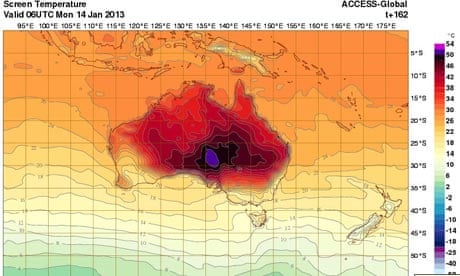
Forecast temperatures are so extreme that the Bureau of Meteorology has had to add a new colour to its scale. It is a sign of things to come

https://i.guim.co.uk/img/static/sys-images/Guardian/Pix/pictures/2013/1/8/1357646861584/Australian-Bureau-of-Mete-008.jpg?w=620&q=85&auto=format&sharp=10&s=7381737e005bb2243b1dc895894e8afa
Australian Bureau of Metereology temperature map - with a new colour for 52-54C. Photograph: BOM.
Global warming is turning the volume of extreme weather up, Spinal-Tap-style, to 11. The temperature forecast for next Monday by Australia's Bureau of Meteorology is so unprecedented - over 52C - that it has had to add a new colour to the top of its scale, a suitably incandescent purple.
Australia's highest recorded temperature is 50.7C, set in January 1960 in South Australia. The record for the hottest average day across the nation was set on Monday, at 40.3C, exceeding a 40-year-old record. "What makes this event quite exceptional is how widespread and intense it's been," said Aaron Coutts-Smith, the weather bureau's climate services manager. "We have been breaking records across all states and territories in Australia over the course of the event so far." Wildfires are raging across New South Wales and Tasmania.
Australia's prime minister Julia Gillard said: "Whilst you would not put any one event down to climate change, weather doesn't work like that, we do know over time that as a result of climate change we are going to see more extreme weather events and conditions."
https://i.guim.co.uk/img/static/sys-images/Environment/Pix/columnists/2013/1/8/1357643667671/Heatwave-in-Australia--Bu-009.jpg?w=620&q=85&auto=format&sharp=10&s=4e5fdb54d129278ac460e645a31b05b9
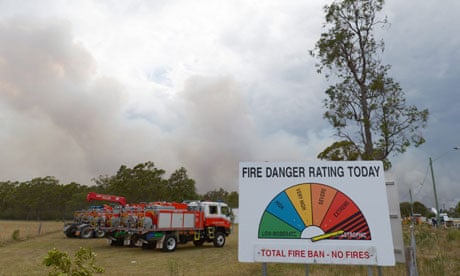
A fire danger rating sign set to catastrophic sends out a clear message on the situation on the outskirts of Wandandian south of Nowra, near Sydney, New South Wales. Four new ares in NSW have been given a 'catastrophic 'fire danger rating meaning that if fires break out they will be uncontrollable and fast moving, so residents should leave. Photograph: Dean Lewins/EPA
She is right of course to be cautious about attributing individual events to global warming, but it is equally clear that new colours will need to be added to scales across the world for heatwaves and other extreme weather events.
We already know that climate change is loading the weather dice. Scientists have shown that the European heatwave of 2003, that caused over 40,000 premature deaths, was made at least twice as likely by climate change. The Russian heatwave of 2010, that killed 50,000 and wiped out $15bn of crops, was made three times as likely by global warming and led to the warmest European summer for 500 years.
The extreme weather forecast is even worse. Mega-heatwaves like these will become five to 10 times more likely over the next 40 years, occurring at least once a decade, scientists predict.
Work by the most authoritative group of scientists, the UN's Intergovernmental Panel on Climate Change, found that it is 90% certain that heatwaves will increase further in length and severity, as will extreme high tides. It is 66% likely that hurricanes and typhoon winds will get faster and that intense rain will increase, as well as landslides. It is more likely than not that droughts will intensify in Europe, North and Central America and, most dangerously given the poverty there, Southern Africa. There are uncertainties of course, but the basic physics is that heat-trapping carbon emissions mean more energy is being pumped into the system, increasing climate chaos.
The two nations in which the fringe opinions of so-called climate sceptics have been trumpeted most loudly - the US and Australia - have now been hit by record heatwaves and, in the US, superstorm Sandy. The scientists are turning up the volume of their warnings, but whether this leads to loud and clear political action to curb emissions or more shouting from sceptics and the vested fossil fuel interests that support them remains to be seen.

Links

‘Like Second-Hand Smoke’: Worst Emitters Least Affected By Climate Change

University of Queensland

Industrial emissions.
Global climate change resembles a room of second-hand smoke, new research has found, with countries emitting the least amount of gasses suffering the most.
The study by The University of Queensland and the Wildlife Conservation Society (WCS) shows a dramatic global mismatch, with the highest emitting countries – including Australia - the least vulnerable to climate change effects.
Lead author Glenn Althor, a PhD student in UQ’s School of Geography, Planning and Environmental Management (GPEM) said, in contrast, the countries emitting the least amount of greenhouse gases were the most vulnerable to effects such as increased frequency of natural disasters, changing habitats, human health impacts, and industry stress.
“There is an enormous global inequality in which those countries most responsible for causing climate change are the least vulnerable to its effects,” Mr Althor said.
“It is time that this persistent and worsening climate inequity is resolved, and for the countries with the greatest emissions to act,” he said.
Co-author Associate Professor James Watson of GPEM and WCS said the situation resembled second-hand smoking.
“This is like a non-smoker getting cancer from second-hand smoke, while the heavy smokers continue to puff away,” he said.
“Essentially we are calling for the smokers to pay for the healthcare of the non-smokers they are directly harming.”
The researchers conducted a global analysis of the relationship between a nation’s carbon emissions and vulnerability to climate change.
They found that 20 of the 36 highest emitting countries – including the U.S. Canada, Australia, China, and much of Western Europe – were the least vulnerable to its impacts.
Eleven of the 17 countries with low to moderate emissions were most vulnerable to climate change. Most were found in sub-Saharan Africa and South Asia.
The authors said these countries were not only exposed to serious environmental change such as oceanic inundation or desertification. They were also generally the least developed nations, having few resources available to cope with these issues.
They said the mismatch between the culprits and the affected areas acted as a disincentive for high-emitting “free-rider” countries to mitigate their emissions.
The researchers predicted that the number of acutely vulnerable countries would worsen by 2030 as climate change-related pressures such as droughts, floods, biodiversity loss and disease mounted.
Associate Professor Richard Fuller of UQ’s School of Biological Sciences said the researchers had quantified these inequities using publicly available data.
 “The recent Paris agreement was a significant step forward in global climate negotiations,” he said.
“There now needs to be meaningful mobilisation of these policies, to achieve national emissions reductions while helping the most vulnerable countries adapt to climate change.
“The free rider countries need to do much more to ensure that they bear the burden of coping with climate change impacts.”
The study appears today in the journal Scientific Reports.

Heat To Stay On CSIRO Climate Cuts Amid Claims Malcolm Turnbull Was 'Blindsided'

Fairfax - 

There are claims Malcolm Turnbull was blindsided by the news.
There are claims Malcolm Turnbull was blindsided by the news. Photo: Alex Ellinghausen

Leading scientists will use a national conference on Monday to appeal to the Turnbull government to intervene to reverse plans by the CSIRO to eliminate most of its climate roles amid claims the Prime Minister was "blindsided" by the move.
The cuts, that will cleave about 110 positions from the CSIRO's 140-odd strong Ocean and Atmosphere staff and a similar number from its Land and Water division, were announced in an email from chief executive Larry Marshall on Thursday.
Mr Turnbull and his staff "didn't see it coming", a senior CSIRO researcher has been told. The PM "blanched" when given a copy of the news of the cuts, and asked his staff to investigate, another source tells Fairfax Media.
Stormy times for the CSIRO: On board RV Investigator .
Stormy times for the CSIRO: On board RV Investigator.
Fairfax Media has sought comment from the PM's office.
Scientists attending Monday's start of the joint national gathering of the Australian Meteorological and Oceanic Society and the ARC Centre of Excellence for Climate System Science in Melbourne are expected to call for a halt to the planned cuts which, including other divisions, will total 350 over two years.
"We strongly believe that the proposed cuts to CSIRO will seriously undermine Australia's capacity to respond to the challenges posed by climate change," the scientists say, according to a copy of the proposed statement obtained by Fairfax Media.
The cuts were announced in an email from CSIRO chief executive Larry Marshall.

Scientists leading the call include David Karoly​ from Melbourne University, Roger Jones from Victoria University and Sarah Perkins-Kirkpatrick from the University of NSW.
"Australia is a continent surrounded by rapidly changing weather patterns, connected to a rapidly changing global climate," the scientists' statement says.
While much has been learnt, there remain many gaps in knowledge, including monitoring changes in the Southern Ocean and how this effects global and regional climate. Another need is to track the changing chemical composition of the atmosphere, including long-term trends based on ice core data, and air quality measurements at Cape Grim in north-west Tasmania, they say.
Senator Richard Di Natale said the Greens plan to use Senate Estimates on Thursday to press Dr Marshall to explain the cuts. The Greens leader also called on the PM to intervene.
"I'd urge the PM to address the situation urgently," Senator Di Natale said. "Our climate science is absolutely critical."
He said Mr Turnbull had inherited a government under Tony Abbott that had attacked climate science, and the PM "has an opportunity to set a different course".
Dr Marshall has said there will be "no net loss" of jobs in two years' time, as other divisions expand. Critics, though, say the dismantling of decades of climate monitoring will be hard to repair and will also undermine the country's ability to participate in international exchanges in climate research.

Links

Lethal Heating is a citizens' initiative