Wednesday, April 06, 2016

Bureau Of Meteorology Plan To Take Over CSIRO Climate Change Research

Fairfax - Adam Morton  |  Peter Hannam

The Bureau of Meteorology has offered to save climate research that CSIRO plans to axe under a plan that would see long-term programs and dozens of jobs transfer between the two national science agencies.
The proposal, discussed at a meeting convened by chief scientist Alan Finkel​ last month, is the most concrete of several ideas thrown up by the scientific community in a bid to retain internationally respected climate researchers and data collection.
The Bureau of Meteorology would take over CSIRO climate programs, including the Cape Grim greenhouse gas station in ...
The Bureau of Meteorology would take over CSIRO climate programs, including the Cape Grim greenhouse gas station in Tasmania, under a plan to save research and jobs.

Scientific agencies were taken by surprise when CSIRO chief Larry Marshall announced in February that the organisation would stop climate data collection as it re-positioned itself as an "innovation catalyst", focusing on work that was financially attractive to government or private partners.
The recasting of the century-old Commonwealth Scientific and Industrial Research Organisation, initially linked to about 350 job cuts including up to 100 climate scientists, has drawn criticism from some research institutions in Australia and overseas.
It is understood the Bureau of Meteorology put forward two proposals that would see it hire either 40 or 50 CSIRO scientists as it took on more climate measurement and modelling – but was contingent on additional funding to pay for them. CSIRO is yet to respond in detail.
CSIRO chief executive Larry Marshall.
CSIRO chief executive Larry Marshall. Photo: Pat Scala
Asked about the plan, Dr Finkel would not go into specifics but said he had helped organise talks between climate research groups in a bid to find a solution. He rebuked CSIRO for taking too long to finalise its restructure, and said Australia needed to maintain its climate modelling capacity.
"I am deeply concerned about the time it is taking to develop a transition plan," Dr Finkel told Fairfax Media.
"Many options have been put forward and we are waiting for the CSIRO planning process to advance. I remain optimistic about finding a way forward, but time is of the essence."
It is understood the Bureau of Meteorology drew up lists of the names of the CSIRO scientists it would hire.
Under its larger proposal, which would see it take on 50 scientists, it would take responsibility for all remaining climate science programs in the oceans and atmosphere division, including the Cape Grim greenhouse gas monitoring station in north-west Tasmania which the two organisations currently run in partnership.
Internal emails between CSIRO senior managers released this week showed they had discussed the need for the organisation's oceans and atmosphere division to stop doing "science for science sake", and getting rid of all "public good/government-funded climate research" as focus shifted to work that would bring in money. CSIRO spokesman Huw Morgan said they were options considered during early planning.
Dr Marshall, a former venture capitalist and trained physicist, told Senate estimates in February that the organisation planned to cut climate monitoring and measuring staff by about half. He has said that all culled jobs would be replaced over the next two years by appointments in new areas, including research to help combat climate change.
On Tuesday night, Mr Morgan said CSIRO was in ongoing discussions with the Bureau of Meteorology and other organisations about a number of options, and consulting with affected staff. "CSIRO is working within a responsible and considered framework and will continue to do so," he said.
The Bureau of Meteorology declined to comment.
Andy Pitman, director of the University of NSW's Centre of Excellence for Climate System Science, said CSIRO had put itself in an untenable situation.
"The email exchange reported by Fairfax Media made perfectly clear to anybody in oceans and atmosphere that senior management doesn't value them," he said.
Professor Pitman said the bureau proposal made some sense if there was money for it. If not, there was the potential for "a downward spiral" in which it would be increasingly difficult to retain staff  and attract the world's best scientists.
Dr Marshall is scheduled to give evidence to a Senate inquiry into the CSIRO cuts on Thursday.

Links

Tuesday, April 05, 2016

Climate Change Threat To Public Health Worse Than Polio, White House Warns

The Guardian - 

Obama administration report details the diversity of risks and claims global warming is a far more challenging danger than polio virus in some cases
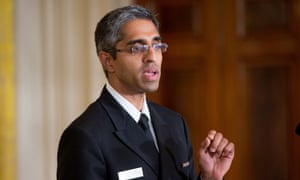
Vivek Murthy,​ the surgeon general
The US surgeon general, Vivek Murthy: 'By the end of the century we are looking at increase of tens of thousands of illnesses and death episodes because of climate change,' Photograph: Andrew Harnik/AP

Climate change poses a serious danger to public health – worse than polio in some respects – and will strike especially hard at pregnant women, children, low-income people and communities of color, an authoritative US government report warned on Monday.
The report, The Impacts of Climate Change on Human Health in the United States: A Scientific Assessment, formally unveiled at the White House, warned of sweeping risks to public health from rising temperatures in the coming decades – with increased deaths and illnesses from heat stroke, respiratory failure and diseases such as West Nile virus.
"Every American is vulnerable to the health impacts associated with climate change," John Holdren, the White House science adviser, told reporters on Monday. "Some are more vulnerable than others," he went on.
These included pregnant women, children, the elderly, outdoor workers, low-income people, immigrants, communities of color and those with disabilities or pre-existing medical conditions.
The diversity of risks – and vulnerable populations – made climate change a far more challenging threat to public health than even the polio epidemics in the past in some regards, said Vivek Murthy, the surgeon general.
"I don't think we have seen something like this before where we have a force that has such a multitude of impacts," Murthy said.
Polio was eradicated with a specific vaccine, but there was no such quick fix for climate change, he said. "Climate change is not like that. There is not one single source that we can target," he went on. "As far as history is concerned this is a new kind of threat that we are facing."
The grim, climate-inflected scenarios in the report – including projections of an additional 11,000 heat-related deaths by 2030 – intensify the efforts by the White House to rally public support for the Paris climate agreement and the clean power plant rules, which face a legal challenge on 2 June.
Governments will gather in New York on 22 April to formally sign on to the agreement reached in Paris. The Obama administration is leading a push by the United Nations to get the agreement signed and into force by the end of this year – a process that requires the support of 55 countries representing 55% of global greenhouse gas emissions.
The White House, Democrats in Congress and campaign groups are also working to gin up public support for the clean power plant rules ahead of the 2 June hearing into a legal challenge brought by a coalition of states and industries.
The findings in the report were broadly in line with a draft released by the White House in April last year.
The research – conducted by 100 scientists working across eight government agencies – represents the most exhaustive look to date at the health impacts of climate change within the US, officials claimed on Monday.
Earlier researchers have called attention to the risks of heatwaves, air pollution and illnesses borne by insects such as mosquitoes under climate change as well as the declining nutritional value of food staples such as wheat and rice. Last year, scientists warned that extreme heat could make outdoor work perilous and parts of the Middle East uninhabitable.
The officials made it clear they hoped the findings would broaden public support for cutting the carbon emissions that cause climate change.
"Climate change is already under way and no matter what we do it can't be stopped overnight," Holdren told reporters. "But there is a huge difference in magnitude of impacts if we fail to act and the much smaller magnitude we expect if we take aggressive action set out in the president's climate action plan."
The urgency of the warning reflects growing understanding among scientists of the widespread impacts of climate change.
It also lays to rest the false claim by those obstructing efforts to cut emissions that there are more positives than negatives in warmer temperature conditions.
Hot, sunny days cook more smog which makes breathing conditions worse for sufferers of asthma, emphysema and other respiratory conditions. Warming temperatures also extend the allergy season and fuel the risk of wildfires – whose smoke also worsens air quality.
"By the end of the century we are looking at an increase of tens of thousands of illnesses and death episodes because of climate change," the surgeon general told reporters.
Higher temperatures were also encouraging the spread of illnesses carried by ticks and mosquitoes such as Lyme disease and West Nile virus, Murthy went on. The report did not look at Zika.
The public health threats laid out in the report were on the cards for future generations of Americans even with the emissions commitments contained in the Paris climate agreement, the officials said.
Governments have been clear from the outset that the agreement reached in Paris last December was only a preliminary step towards limiting warming to 2C above pre-industrial levels.
Under the agreement, governments committed to make even deeper cuts in emissions in the coming decades.
"We will need a big encore after 2030 in terms of further deep cuts in order to avoid the bulk of the deeper impacts described in this report," Holdren said.

Links

Giant Queensland Coal Mine Will Carry Hidden Cost, US Investor Predicts

Fairfax - Peter Hannam

The approval of a giant new coal mine for Queensland is likely to deliver only short-term economic benefits and may carry a hidden cost if its demise triggers a bailout for miners needing new jobs, a leading US investor says.
The Palaszczuk Labor government on Sunday announced the approval of three mining licences for the $20 billion-plus Carmichael coal mine and rail project planned for the Galilee Basin. Its supporters, including India-based owner Adani, say the mine will generate thousands of new mining jobs.
Rockefeller Brothers Fund president Stephen Heintz says investors are increasingly focused on a low-carbon future.
Rockefeller Brothers Fund president Stephen Heintz says investors are increasingly focused on a low-carbon future. Photo: Ben Rushton
But Stephen Heintz, president of the $US860 million ($1.1 billion) Rockefeller Brothers Fund, predicts the world will move rapidly away from fossil fuels to avoid dangerous climate change. Approval of a mine that may produce 4.6 billion tonnes of carbon dioxide - eight times Australia's annual output - is not going to help.
"Some 60-80 per cent of known fossil fuels in the world are going to have to stay in the ground if we are to have any chance to keep to less than 2 degrees" of warming, Mr Heintz said. "In the short term, [Carmichael] may look like a good idea."
The cost of the needed shift to renewable energy will be hefty enough. Approving big new mines means governments, such as Queensland's, will need to find additional funds to pay for the transition of those coal miners out of the industry when it's inevitably curbed, he said.
Adani's Carmichael mine aims to export as much as 60 million tonnes of coal a year, mostly to India.
Adani's Carmichael mine aims to export as much as 60 million tonnes of coal a year, mostly to India. Photo: NYT
Mr Heintz is in Australia as a guest of the United States Studies Centre and will speak at the Divest Invest Conference in Sydney on Tuesday about the opportunities and risks following last year's Paris climate summit at which almost 200 nations agreed to step up efforts to curb global warming.
The falling price of fossil fuels over the past year or so has hindered the development of alternatives, such as solar energy, by making competition "more acute". On the other hand, it has also made investments in coal and oil less valuable, he said.
While some investors would move faster than others to exit carbon-based fuels, the shift would come even if government policies were subject to change.
"The direction of travel has now been set," Mr Heintz said. "As a long-term investor, that's what you're looking at."
By coincidence, Mr Heintz arrived in Sydney after a short holiday on Lizard Island, one of the sites on the Great Barrier Reef hit by one of the worst coral bleaching episodes in history.
"You can see the world's most specular maritime life, whether the corals or the fishes, and you can also see the effects of the bleaching," he said. "It's heart-breaking."
Marine scientists, such as Professor Terry Hughes of James Cook University, had blamed climate change for the bleaching, noting that waters off northern Australia - and many other reef locations - are at record levels. They have also been critical of the Adani approval.

Links

No 'Science For Science Sake': Emails Show CSIRO Plans To Cut Climate Research

Fairfax - Adam Morton, Peter Hannam

Australia's national science organisation planned to stop "doing science for science sake" and would no longer do "public good" work unless it was linked to jobs and economic growth, according to internal emails between CSIRO senior managers.
The emails contradict claims that the Commonwealth Scientific and Industrial Research Organisation has remained committed to research that does not bring in revenue, and illustrate the scale of the restructure planned under new chief executive Larry Marshall.
Under Dr Marshall, CSIRO has shifted its focus to making money to pay for its work. The vision sees the iconic Australian science organisation as an "innovation catalyst".
Climate research, including Antarctic programs, were ear-marked for some of the deepest cuts.
Climate research, including Antarctic programs, were ear-marked for some of the deepest cuts. Photo: Pete Harmsen
The emails confirm the century-old organisation was particularly focused on – in the words used in an exchange between managers in CSIRO's oceans and atmosphere division – "eliminating all capability" of its climate change research programs.
An email from Andreas Schiller, science and deputy director of oceans and atmosphere, on January 18 suggested CSIRO aim to make a "clean cut" to get rid of "public good/government-funded climate research".
Sent two weeks before the cuts were announced, it suggested axing 120 climate science staff.
Larry Marshall, chief executive of CSIRO, at a recent AFR business summit in Melbourne.
Larry Marshall, chief executive of CSIRO, at a recent AFR business summit in Melbourne. Photo: Pat Scala
"If we aim for less we will inevitably face the problem of keeping some of the climate scientists (who will no longer be aligned with the new CSIRO strategy)," Dr Schiller wrote.
A full draft plan for the oceans and atmosphere division from February, when the cuts without announced with few details, shows the proposed changes included:
  • Abolishing research on global greenhouse gas emissions.
  • Abolishing research on sea level rise.
  • Abolishing research in Antarctica.
  • Abolishing multi-year, multi-decadal climate modelling and analysis.
  • Reducing collection and analysis of ocean carbon levels, due to "insufficient demand".
  • Reducing research into the management of the impact on biodiversity, due to reduced demand.
  • Reducing research in Australia's tropical north, and northern Australian fisheries.
  • Continuing research on "fugitive emissions" – greenhouse gases unintentionally released during industrial activity.
CSIRO scientists working on optics – another sector of public-good research that has been hit by large cuts.
CSIRO scientists working on optics – another sector of public-good research that has been hit by large cuts. Photo: CSIRO
Where the draft plan refers to insufficient or reduced demand, it is understood it means that research area does not bring in enough money from government or private sources. CSIRO's public-good research spans many of its disciplines, including agriculture, energy and astronomy.

Email dump
The emails are among nearly 700 pages of internal CSIRO documents released in response to a request by a Greens-Labor convened Senate inquiry into the plan to cut as many as 350 CSIRO jobs. More emails between senior CSIRO managers are yet to be released.
Dr Marshall, a physicist and former Silicon Valley venture capitalist, has said sacked staff were expected to be replaced over the next two years by a similar number in different areas. They would include 35 new climate jobs looking at how to tackle the problem, rather than measure what is happening.
The cuts to monitoring, measuring and analysing climate data have been condemned by scientists in Australia and internationally, including criticism by the head of the World Meteorological Organisation's climate research program and an editorial in the New York Times.
Managers at science agencies that partner with and rely on CSIRO – including the Bureau of Meteorology, the Australian Antarctic Division and the University of Tasmania's Institute of Marine and Antarctic Studies – were surprised by the cuts and unclear what it would mean for joint research projects.
Within CSIRO, the reaction has at times been hostile. Scientists from the land and water division in Canberra walked out of a meeting session with Dr Marshall two weeks ago over cuts to their numbers, and the staff union is challenging the cuts in the Fair Work Commission.
It is understood the external pressure is likely to have helped save dozens of jobs, with one climate-related unit now expected to lose about 35 staff, down from an initial plan to cut 65 jobs.

'Deep dive'
The union may cite documents released to the Senate inquiry, including an email from Dr Schiller to other managers sent in November ahead of "deep dive" discussions about redistributing funding within CSIRO.
It says a group of senior managers had discussed that CSIRO's focus would be to "maximise the impact on the nation", and that it should not "do science for science sake" – that having your research published in the prestigious journal Nature alone was not enough to "cut it".
"Public good is not enough, needs to be linked to jobs and growth, but science that leads to SLO [social licence to operate] is ok," Dr Schiller summarised. He said the CSIRO executive wanted "investible propositions" and "growth cases".
In the January 18 email two months later, Dr Schiller suggested to division director Ken Lee and a fellow manager that the oceans and atmosphere division should aim to sack about 120 staff – considered the "high" option by CSIRO management – to get rid of all "public good/government-funded climate research".
Dr Lee replied: "I agree – let's overshoot first."
(To put this into context: the Senate inquiry has heard that Dr Lee and his team initially proposed that 35 climate related jobs be cut. They were told by Dr Marshall and his executive that they needed to sack 100.)
CSIRO spokesman Huw Morgan said on Monday the comments in the emails were options considered during an early stage of planning. "They didn't meet our criteria once we looked at the external contract obligations, changes in and impacts on other oceans and atmosphere programs or across CSIRO business units and so those options weren't progressed," he said.

Only by half
Dr Marshall has denied all climate researchers would be cut. Giving evidence at Senate estimates in February – after the above email exchange – he said the organisation would cut climate monitoring and measuring staff in half and try "to be smarter about how we do things" by collaborating better with other organisations.
In evidence to the Senate inquiry in early March, CSIRO environment, energy and resources executive director Alex Wonhas – Dr Lee's boss, and a member of Dr Marshall's executive – denied public-good research would be abolished. He said it had been the foundation of what CSIRO had done and would remain on its agenda.
"I think, in this debate, it can appear that CSIRO is pulling out of public-good research. I really want to categorically say, 'This is not our intent'," he said.
"I, and I would say several thousand of our employees, are committed to continuing to do public-good research. It is probably a fair criticism that we maybe have not articulated that position sufficiently well, especially in the last couple of weeks. But I can assure you that that is something that we are working on and that we endeavour to rectify."
Dr Marshall is due to give evidence to the Senate inquiry into the cuts on Thursday. CSIRO staff are expected to be told details of the cuts later this month.

'Barbarism'
Greens Senator Janet Rice said the released documents showed the organisation had no justification for cutting so many climate research jobs.
Senator Rice, whose partner Penny Whetton is an honorary CSIRO research fellow, called on Prime Minister Malcolm Turnbull to intervene.
"It is vandalism and barbarism," she said.
"It is particularly galling because it is our premier research organisation, and our only research organisation that has guaranteed long-term funding."Labor has previously called on the government to halt the cuts until after the election. The government says CSIRO operates as an independent statutory agency.

Links

Science Says Climate Change Will Cost Investors Up To $30 Trillion

Chris Pash

Kiama, NSW, last year. Mark Nolan/Getty Images
Scientists have for the first time estimated the potential costs of climate change for global financial assets including stocks and bonds.
Continuing to pump out CO2 at current rates would wipe out at least $3 trillion from the market. But the situation could be much worse with the upper estimate for losses at $30 trillion.
The study published in the journal Nature Climate Change says that policies to prevent temperatures rising by more than 2 degrees Celsius above pre-industrial levels substantially would reduce the risk.
Previous research has shown that policies to limit emissions and pollution may strand some assets such as oil, coal and gas reserves. These will lose value.
However, climate change can directly destroy capital assets through damage from extreme weather events or reduce productivity.
Simon Dietz of the London School of Economics and colleagues modelled the impact of climate change on global economic growth and the value of global financial assets.
They estimate that a business-as-usual emissions path will put 1.8% of the present market value of financial assets at risk.
That is equivalent to $US2.5 trillion ($3 trillion) or about half of the estimated current total stock market value of fossil-fuel companies.
However, up to $US25 trillion ($30 trillion) of assets could be at risk if climate change is worse than expected.

Links

Monday, April 04, 2016

Cutting The Public Good Out Of CSIRO: We All Lose

Fairfax - Will Steffen*

The sign in front of CSIRO's long-time headquarters on Limestone Avenue in Canberra proudly proclaimed "Australian Science, Australia's Future". With the savage cuts to the organisation's public good research, that lofty ambition now appears to be abandoned and trashed.
CSIRO CEO Larry Marshall believes that transferring public funding away from the public good to support widgets and spin-offs will deliver more value towards Australia's future. But does that simplistic assertion stack up under careful analysis?
Professor Will Steffen.
Professor Will Steffen. Photo: Alex Ellinghausen / Fairfax

We know that public investment in research on average pays off at least five to one in terms of the public good over a decade or so, even discounted to present value. In comparison, a typical angel investment portfolio averages 2.5 times return on capital put into start-ups, and venture capital funds not much better on average, at least over the past 10 years. Of course, someone has to support new businesses, but it is clearly not a good use of public research funding.
In fact, the drastic cuts at CSIRO are part of an alarming worldwide trend towards dismissing or misunderstanding the value of public good research. This misguided trend was given an added boost in Australia by the actions of the Abbott government, the shades of which are playing out through the disruptions at CSIRO at the moment, but has ramifications for us all.
Does transferring public funding away from the public good stack up?
Does transferring public funding away from the public good stack up? 

Let's be clear what we mean by "public good" as the term can easily be twisted to suit a variety of purposes.
The public good has a clear formal definition around benefits that are not easily privatised nor readily valued in any market, so that everyone benefits from them but no one feels responsible for them. Issues such as clear air, national parks, public health and a stable climate spring to mind.
In reality there is a grey area, as the benefits that tourism gets from national parks can be privatised to some extent, and private benefits from a new vaccine may nonetheless deliver public outcomes. Often the distinction is as much between short and long-term benefits as much as strictly private and public outcomes.
However, the voting public generally has a pretty good sense of how they get value from public good research. They can see where businesses are really in it for a quid, compared to where researchers are delivering something that helps society and which no company would invest in.
Indeed, such issues were clearly a major part of the mission of the Commonwealth Scientific and Industrial Research Organisation when it was established over 80 years ago, and remain a firm part of its legislative base. In fact, it has been the public outcry in support of its public good research record that has always protected CSIRO when ideologues have sought to dismantle it in the past.
It is thus particularly dismaying to see what is being dismantled in CSIRO at present. There has been much public outcry about the gutting of climate science in the Oceans and Atmosphere unit, but, much more quietly and controversially, its Land and Water section is slated to lose just as many staff from critical public good areas of research in cities and landscapes. Many of these staff are Canberra-based.
Consider cities. Globally everyone knows cities are crucial, with more than 50 per cent of the human population now urban, growing at a rate that requires the equivalent of a new city of two million people to be built every week for the next 20 years. Australia is on the cusp of this trend with nine out of ten people already living in our cities.
Yet there are profound public good questions to ask about our urbanisation. Cities are currently planning for growth (with all its challenges) that is only half that actually expected in Australia this century: where should the other 20 million people go once the current cities get full? Where will they live and work? How will they travel around the city? Will there be adequate green (living) infrastructure?
Here's another complex challenge. Our capital cities all say they want to halt urban sprawl, yet all of our cities are sprawling as fast as ever: what incentives are need to overcome this seemingly inexorable trend?
Last year, for the first time a conservative government in Australia established an urban portfolio to deal with these sorts of issues nationally (previous Labor governments have established such portfolios, and the conservatives have subsequently abandoned them). Yet in the midst of all of these trends, CSIRO's senior management is dismantling the urban systems capability within the organisation. This does not make sense.
Gutting CSIRO's urban research capacity leaves a gaping hole nationally that universities cannot fill. The complex, system-level challenges of rapid urbanisation create big picture policy questions, needing highly interdisciplinary teams to address them. By their nature, universities are not well equipped to deal with these challenges as they often run on three-year funding cycles and are built around individuals or small research teams. While such research is valuable, it is CSIRO's unique niche to lead the longer-term, highly interdisciplinary, large team research that these "wicked problems" demand.
In fact, university and CSIRO research are complementary, and create an effective national-level research system. Gutting the CSIRO component also reduces the ultimate value of university-based research.
Urbanisation isn't the only complex, long-term research challenge. Consider our landscapes. We all know that Australia has its own remarkable landscapes and biota, its own challenging soils and variable – and now rapidly changing – climate. Managing these issues is not something we can take off the shelf from elsewhere in the world. Indeed, our expertise in dryland agriculture is just one of the examples of where our solutions to our local challenges have given our rural industries an edge, providing advice and investment in drylands around the world.
But it is not just that good landscape management is critical to maintaining returns from agriculture. A healthy Great Barrier Reef and other reserves underpin a significant part of our tourist industry – delivering $1 billion a year just in Victoria. Healthy coastlines mean less damage in extreme weather and storm surges. Healthy waterways mean less need to invest in expensive water treatment infrastructure (for example, New York City spent $1.5bn on catchment protection to save itself at least $6 billion in water treatment). In fact, healthy environments directly support our human health and mental well-being – national parks in Victoria contribute an estimated $200 million a  year in avoided healthcare costs alone. On top of all this are the many important benefits to our wellbeing that cannot be easily quantified in a monetary sense.
Understanding our landscapes and the ecosystem services they provide in order to manage them well not only pays dividends directly here in Australia, but it also provides immense comparative advantages for our businesses. Yet once again, CSIRO is disinvesting​ in the landscape management skills in the organisation. Does this make any sense?
Research on urban systems and on landscape ecosystem services are two key areas of public good research that are being destroyed in CSIRO at present. Yet these are precisely the areas where the interdisciplinary capability to bring together large teams to work on national challenges is the specific leadership role that CSIRO can and has previously played. In fact, while research in CSIRO generally is conservatively estimated to return $5 for every $1 invested, research in Land and Water in particular has been estimated at double this – $10 for every $1 invested – in line with other analyses of similar work. Furthermore, these are also two of the most significant areas in which responses to climate change, both mitigation and adaptation, must play out.
The public can obviously see that these cuts are crazy. Surely these decisions must be reversed. Of course CSIRO management may say that CSIRO cannot do this alone, without active investment in public good research from government. But surely political parties of all persuasions should be interested in making investments of public funds with such assured returns.

*Will Steffen is emeritus professor at the Fenner School of Environment and Society, Australian National University.

Global Warming Gives Science Behind Nuclear Winter a New Purpose

New York Times - 

Carl Sagan and other Cold War scientists once feared that a nuclear war could plunge the world into a deadly ice age. Three decades later, does this theory still resonate?

With global temperatures rising inexorably, some scientists and national security theorists have pondered cooling things down by tinkering mechanically with the planet's climate.
The goal of this geoengineering would be to create an effect not unlike when clouds suddenly block the sun and chill a warm afternoon. Average surface temperatures might be held down by a few degrees worldwide, these experts suggest — enough, they theorize (maybe with fingers crossed), to stave off environmental cataclysm.
How to do this? With smoke and mirrors. For real.
One idea is to launch giant mirrors into space, where they would bounce back some of the sun's energy. Another suggestion involves spraying ocean water into the air to whiten clouds and thereby increase their capacity to deflect sunlight. Then there is a widely discussed plan to pump sulfate aerosols into the stratosphere. Those particles, too, would reflect the sun's radiation back toward space, comparable to the effects of natural phenomena like volcanic eruptions. The haze created by the eruption of Mount Pinatubo in the Philippines in 1991 spread so widely that average global temperatures dropped by nearly one degree for more than a year.
Let's set aside these proposals for a moment to first note that the aerosols plan faintly echoes a terrifying scenario that informs the latest offering from Retro Report, a series of video documentaries that study the continuing impact of major news stories of the past.
In the 1980s, fears took hold that a war-prone world lived in the shadow of catastrophic global cooling, a potential disaster called nuclear winter. Perhaps no one was more effective in warning of the peril than the astronomer and science communicator Carl Sagan, who died in 1996. In 1983, Dr. Sagan and four other scientists published their conclusion that an all-out nuclear war, presumably between the United States and the Soviet Union, could doom humankind. The horror would go well beyond the immediate devastation of cities and mass deaths in the hundreds of millions. What would follow would be a winter so severe that the living might well envy the dead.
With forests and scores of cities set ablaze, enough dust and smoke would be hurled into the upper atmosphere to blot out the sun. The darkening would last for many months, most oppressively in the Northern Hemisphere, though the Southern Hemisphere would hardly be immune. Beneath the sun-blocking canopy, surface temperatures would plummet, conceivably by as much as 60 degrees Fahrenheit. Plant and animal life would die. Famine would spread across the globe.
Climatic change could become climactic change. In the ominous concluding words of a paper published in the journal Science in December 1983, "the possibility of the extinction of Homo sapiens cannot be excluded."
But soon enough, scientist skeptics weighed in. The temperature drop would not be as precipitous as Dr. Sagan and Company had forecast, they said. Nor would the quantities of combustible material — plastics, wood, petroleum, vegetation — be as vast as first thought. For some scientists, "nuclear winter" was a good deal less probable than a milder "nuclear autumn." The end was not nigh. By 1990, even those who had issued the earlier doomsday warnings took a step back.
One of them was Richard P. Turco, a physicist who had coined the phrase "nuclear winter." Not that menace no longer loomed, he asserted. "Essentially, what we say is that the basic physics we proposed turned out to be correct, although the magnitude of the effects has been moderated somewhat," Dr. Turco said in 1990.
Actually, he said, he never believed humankind was likely to be wiped out. "That was a speculation of others, including Carl Sagan," he said. "My personal opinion is that the human race wouldn't become extinct, but civilization as we know it certainly would."
Some might see an element of the surreal in a debate about whether the long-range effects of a full-scale nuclear war would be (a) indescribably horrible or (b) cosmically ruinous. That said, the specter of nuclear winter helped spur major reductions in the superpowers' nuclear arsenals, by making the utter folly of nuclear warfare plainer than ever. Any country that dared to launch an attack would inevitably wind up under the same toxic gauze as everyone else, and thus commit national suicide.
The worldwide inventory of nuclear weapons is now believed to be about one-fourth what it was in the early 1980s. Last year, the total stood at an estimated 15,850, with more than 90 percent of them in the hands of the United States and Russia, according to the Stockholm International Peace Research Institute, which tracks the armaments.
But there are also now more nuclear-armed countries than in the 1980s — nine of them, by the institute's count: the United States, Russia, Britain, France, China, India, Pakistan, Israel and North Korea. Not all are paragons of rational behavior. And not every scientist is convinced that the world is out of danger.
It would not take an American-Russian conflagration to inflict enormous environmental damage, said Alan Robock, a climatologist at Rutgers University.
"A 'small' nuclear war between India and Pakistan, with each using 50 Hiroshima-size bombs (far less than 1 percent of the current arsenal), if dropped on megacity targets in each country would produce climate change unprecedented in recorded human history," Dr. Robock wrote in 2011 in the journal Nature. Temperatures, he continued, "would be lower than during the 'Little Ice Age' (1400-1850), during which famine killed millions."
Back to geoengineering. Pumping chemicals into the upper atmosphere would amount to a mild — one can only hope extremely mild — version of a nuclear winter effect. Ideas along this line have been around for a while, but putting them into practice has proved elusive. For starters, who gets to choose what method, if any, should be employed? Do all countries have a say? How much would the project cost?
And how does anyone keep the immutable rule known as the Law of Unintended Consequences from kicking in? "Anything built by humans and operated by humans can fail," Dr. Robock told Retro Report. "So would you trust our only planet to this?"
A concern often expressed about geoengineering is that it might undermine efforts to achieve the fundamental goal of keeping greenhouse gases out of the atmosphere. Would people change their carbon-spewing ways if they believed some quick fix existed?
Similarly, in the hypothesizing over the extent of climate change in the aftermath of a nuclear war, might not a more useful focus be how to keep the bombs from falling in the first place? Thoughts turn to "WarGames," a 1983 film in which a supercomputer, thinking that it is merely caught up in an exercise, nearly touches off global nuclear warfare.
"A strange game," the computer finally concludes, to everyone's relief. "The only winning move is not to play."

Links

Lethal Heating is a citizens' initiative