Wednesday, April 27, 2016

New Climate Science Centre Doesn’t Make Up For CSIRO Cuts: Experts

The Conversation - James Whitmore

CSIRO chief executive Larry Marshall has announced a new climate research centre. AAP Image/Mick Tsikas
Hobart will be home to a new climate science research centre in plans announced by the CSIRO. The centre, which will focus on climate measurement and modelling, will be staffed by 40 climate scientists and guarantee research for ten years. In February 2016, CSIRO chief executive Larry Marshall announced broad job cuts at the organisation. The latest announcement reduces the total job losses from 350 to 275.
Around 75 positions will still be lost within the CSIRO's Oceans and Atmosphere division, which is responsible for climate science, from around 420 full-time staff.
The cuts were widely criticised by climate scientists in Australia and overseas.
The new centre will be housed within the Oceans and Atmosphere division. It will be overseen by a new National Climate Science Advisory Committee, including experts from the CSIRO and the Bureau of Meteorology, answering to federal Industry Minister Christopher Pyne. Environment Minister Greg Hunt will help establish the committee.
Chief Scientist Alan Finkel, who has previously urged CSIRO to ensure climate science is maintained, has welcomed the announcement.
CSIRO research fellow John Church said the new centre was "a step forward from where we were a few weeks ago".
"But it's only 40 people so it's significantly less than we had previously. I don't see how that few people are going to deliver on what Australia's requirements are," he said.
Church said the ten-year research guarantee was longer than most CSIRO research cycles.
"I would hope that with such commitment maybe it will be possible to grow the areas over that time frame," he said.
He also welcomed co-ordination across the CSIRO, the Bureau of Meteorology and universities under the advisory committee.
However, Matthew England, a researcher at the ARC Centre of Excellence for Climate System Science at UNSW Australia, said he was "worried about the very small size of the centre".
"Forty staff is woefully low in number. Equivalent centres overseas house five to ten times this number, even in nations not nearly as vulnerable to climate change as Australia is. [It is] great to set up a centre – now we need it to house real capacity.
"CSIRO management needs to get realistic about what this centre needs and how important it is for the nation," he said.
Sarah Perkins-Kirkpatrick, also at UNSW Australia, said there were "small positives" but "it seems like they've [CSIRO] basically rebranded what they were doing in the first place".
"They're just shuffling people around. I fail to see how they can operate a national climate centre with just 40 staff."
Cuts to other CSIRO divisions, particularly land and water, would also affect climate science, she said.
But she welcomed a commitment to maintain CSIRO support for ACCESS, the model used to develop climate projections and weather forecasts for Australia.
She called for a national government-funded centre separate from the CSIRO, perhaps modelled on the UK Hadley Centre, which works alongside the UK Met Office.
Steven Sherwood, director of the UNSW Climate Research Centre, said the cuts still represent a decrease in research investment. He said the UK Met Office generated at least A$6 of economic benefit for the UK per dollar spent on it.
"So, from a broad perspective, we appear to be downsizing an activity that was probably already underfunded even from a purely economic perspective."

Links

Labor Proposes Two Emissions Trading Schemes Costing $555m

The Guardian - 

Opposition maintains ambitious targets but aims to minimise cost to households and defers details until after election
Power lines in early morning fog near the brown-coal-fuelled Hazelwood power station in Melbourne.
Power lines in early morning fog near the brown-coal-fuelled Hazelwood power station in Melbourne. Labor has proposed a scheme for retiring the highest polluting power stations early. Photograph: Hamish Blair/Getty Images
Labor is proposing two emissions trading schemes – one for big industrial polluters and an electricity industry model similar to one once backed by Malcolm Turnbull – in a climate policy that trumps the Coalition's ambition but minimises the hit on household power bills and leaves important detail to be determined post-election.The policy will cost $555m over four years, with $300m earmarked to help regions and industries facing upheaval in the transition to a cleaner economy. As Australia's greenhouse emissions from electricity generation continue to rise, Labor's policy promises to speed the shift to renewables, through a radical plan under which power generators would be forced to pay for the closure of a competitor's dirty brown-coal fired plant and also through an electricity-industry specific "intensity based" trading scheme, similar to the kind of scheme many in business expect will be created post-election after a review of the Coalition's Direct Action plan. But the policies have been cautiously crafted – and some crucial details deferred – to avoid a repeat of the anti-carbon tax campaign waged by the Coalition in the past.
The intensity-based scheme would require generators with an emissions intensity above an electricity industry wide baseline to buy "credits" from those below it – effectively penalising polluting power stations and rewarding clean ones.
The idea was most recently proposed by the Australian Energy Market Commission in a submission to the Coalition government, with the AEMC stating that it could operate "without a significant effect on absolute price levels faced by consumers." The plan is similar to the model originally proposed by Turnbull in 2009 when he was opposition leader, and to the sort of scheme that could evolve from existing Coalition policy if the government "ratchets up" the baselines, leaving open some prospect of bipartisanship in the bitterly-contested policy area.
Australian National University academics first proposed the second-part of Labor's policy – the radical scheme under which big brown-coal generators, near the end of their operational life, would submit bids for how much money they would need to receive in order to shut straight away and deal with the community and employment fallout, with the cost of the winning bid spread across all the other generators in the market, who would enjoy higher prices because of their competitor's closure.
The academics estimated the scheme could cause a one-off rise of between 1% and 2% in retail power bills, but subsequent modelling by Reputex found the impact could be even lower – between 0.2% and 1.3%.
Labor is hedging on the third aspect of its policy to force change on national electricity generation – the possibility of an extension to the renewable energy target – saying it remains committed to to its 50% renewable generation target by 2030 but would consult on what extra policies might be needed to achieve it, with a further RET not the favoured option.
With the costs of "gold plating" investments in poles and wires now washed through the electricity market, residential power prices are forecast to fall in coming years, meaning Labor is likely to argue that any minor cost increases from its policies will be barely noticed.
The ALP is also taking a highly cautious approach to reducing emissions from heavy industry, proposing a two-stage ETS and deferring decisions on details.Between 2018 and 2020 a "cap" would be imposed on big industrial emitters, but those exposed to international competition exceeding the cap would be allowed to meet their entire liability by buying international permits, currently priced at less than $1 a tonne. This means the cost would be minimial.
After 2020 the scheme would morph into a more traditional ETS, but Labor says it will consult on the details. Agriculture, road transport and refrigerants will be left out of the first phase of the scheme.
The Labor leader, Bill Shorten, who will unveil the policy with his environment spokesman, Mark Butler, on Wednesday, said that unlike the Coalition, Labor accepted climate science and was prepared to avoid the high costs of inaction.
"We do not consider climate change a question of 'belief', we know it is an economic and environmental reality ... The cost of inaction, to our economy and the environment, will be profound. This is not a price Labor is prepared to make the next generation of Australians pay," he said.
Labor's policy would also:
  • Establish a legal "trigger" so the commonwealth government can prevent runaway land clearing, particularly in Queensland, which is threatening to undo Australia's emissions reductions elsewhere. The trigger is likely to be included in the Environment Protection and Biodiversity Conservation Act. The New South Wales premier, Mike Baird, is also poised to unveil a winding back of land clearing restrictions.
  • Continue the life of the Climate Change Authority, with $17.4m extra funding
  • Offer $90m to help local communities shift to cleaner power generation
  • Double Australia's energy productivity by 2030, compared with the Coalition's promise to increase in by 40%.
  • Accept the target of "zero net pollution" by 2050. The Coalition has committed to it by the end of the century.
  • Stick with the target of reducing emissions by 45% by 2030 based on 2005 levels – as recommended by the Climate Change Authority, compared with the Coalition's pledge of a reduction between 26% and 28%.
  • Provide an extra $200m to the Australian Renewable Energy Agency
  • Remove restrictions on the investment mandate of the Clean Energy Finance Corporation imposed to appease Coalition senators opposed to wind farms.
When Labor first committed to the 45% reduction several Coalition frontbenchers, including the environment minister, Greg Hunt, said Labor's plan would cost the economy $600bn. That claim was discredited by the leading economist Warwick McKibbin, in modelling done for the government, who found that a 45% reduction in emissions would result in a loss 0.12% of Australia's gross domestic product, compared with 0.7 % for the Coalition's target. $600bn is about 2% of Australia's GDP.
Most experts believe Direct Action has little chance of meeting Australia's long term greenhouse commitments. The Coalition has said it will review the policy next year.

Links

China Curbs Plans for More Coal-Fired Power Plants

New York Times - Michael Forsythe

Residents living near a coal-fired power plant in Shanxi, China, wear masks for protection from air pollution. Credit Kevin Frayer/Getty Images


HONG KONG — Coal-fired power plants have propelled much of China's economic rise for decades, helping make the nation the world's biggest emitter of greenhouse gases. Even with economic growth slackening, and other energy sources taking hold, new coal plants have been added.
Now Beijing is trying to slow things down.
In guidelines released on Monday, China halted plans for new coal-fired power stations in many parts of the country, and construction of some approved plants will be postponed until at least 2018.
The announcement, by the National Development and Reform Commission and the National Energy Administration, means that about 200 planned coal-fired power generators — those seeking approval and those approved but not yet under construction — may not be completed, said Lauri Myllyvirta, who analyzes China's energy production for Greenpeace.
The total of 105 gigawatts of power those plants would have been able to produce is considerably more than the electricity-generating capacity of Britain from all sources.

More Plants, but Less Coal
Although China is by far the largest single consumer of energy from coal, and the country continues to build new coal-fired plants at a rate not seen in a decade, coal consumption in China is beginning to decline. On Monday, China announced new measures that would halt the planned construction of about 200 new coal-fired power plants.


"That's a big chunk of power," said Bob Hodge, a coal specialist with IHS Energy, a consulting firm. "It's a lot of power. It's a heck of a lot of power."
Electricity generated from fossil fuels like coal is the biggest single contributor globally to the rise in carbon emissions, which scientists say is causing the earth's temperature to rise. Leaders from 175 countries, including China, gathered in New York on Friday to sign the Paris climate accord, which aims to halt and eventually reverse the rise in carbon emissions, keeping the increase in global temperatures below 2 degrees Celsius, or 3.6 degrees Fahrenheit.
China, by far the world's biggest emitter of greenhouse gasses, is aiming to reach a peak in carbon emissions by 2030. A recent economic slowdown, policies to discourage coal-fired power plants near big cities, and a huge investment in wind and solar energy capacity helped reduce coal use in China last year.
But even as coal becomes unpopular in China, the country's biggest state-owned electricity generators are adding new coal-fired power plants at a pace not seen in a decade, said Mr. Myllyvirta of Greenpeace, which is acknowledged as an authoritative analyst of China's energy production. Such plants add to existing overcapacity, he said.
A coal miner in Liaoning Province, China. An economic slowdown, policies to discourage coal-fired power plants, and a huge investment in wind and have helped reduce coal use in China. Credit European Pressphoto Agency


The announcement does not stop projects already under construction, which amount to about 190 gigawatts of new coal-fired power generation, he said.
"It's definitely a positive step, but it's not even enough to prevent the overcapacity from getting worse," Mr. Myllyvirta said.
While the curbs on new coal projects, if rigorously enforced, may help China meet its long-term goals on climate change and air pollution, the primary motivation for the move appears to be short-term economic considerations.
In the face of the slowest economic growth in a quarter-century, electricity demand has fallen so sharply in China that some coal-burning power plants are operating only 40 or 50 percent of the time. Construction of wind turbines and solar panels has also eaten slightly into the market share of the coal plants.
A coal-powered station in Shanghai. China is discouraging such plants near big cities and is pushing renewable energy sources, but its overall number of coal plants continues to grow. Credit Johannes Eisele/Agence France-Presse — Getty Images


Yet in China's highly regulated power industry, market signals are weak, and planning and construction of new power plants had continued apace, pushed forward by local governments eager for the construction jobs and expanded tax base. With its new decrees, the central government seems to be trying to halt the development of power plants that might well be underused if they were built.
Mr. Hodge, the consultant at IHS Energy, said that as of two weeks ago, there were 1,200 new coal-fired plants on the drawing boards in 59 countries, mostly in Asia, and China was the single largest contributor.
"In my opinion, if they needed the power, they would build them," he said of China. "I think if you are Beijing, and you don't need the power, you can delay them until you might need them. They are not scrapping them."
The guidelines, dated March 17, state that 13 provinces and regions, including top coal producers like Shanxi and Inner Mongolia, as well as the southern economic powerhouse of Guangdong, should "strictly control" new capacity, delaying the approval of new projects until after 2017. A slightly longer list of provinces — 15, with considerable overlap — were told to put off construction of approved projects that had not yet broken ground.
A coal plant in Shanghai. Electricity generated from fossil fuels like coal is the biggest single contributor globally to the rise in carbon emissions. Credit Johannes Eisele/Agence France-Presse — Getty Images


In both instances, an exception has been made for projects aimed at the "people's livelihood," a phrase that was not explained but may include measures like providing steam heat to homes in wintertime.
The government announcement also calls for an acceleration of the closing of outdated coal-fired plants that use older, dirtier technology. But China is adding about 1 gigawatt in coal-fired capacity a week, Mr. Myllyvirta said, as companies that have easy access to loans from state banks build new plants.
That is in stark contrast to the United States, the world's second-biggest carbon emitter, where it has become increasingly difficult to build new coal-fired plants under the Obama administration.
Last year, almost 14 gigawatts of coal-fired capacity was retired in the United States, according to the Energy Information Administration in Washington. At the same time, there are only six new coal-fired plants on the drawing boards in the United States through at least the next five years, with a total capacity of less than 2 gigawatts, according to the agency.
In China, however, as coal prices drop, the big state-owned electricity generators are benefiting because highly regulated electricity prices have not fallen in tandem.
Because of the political power of the coal industry and the falling price of coal, larger percentages of wind- and solar-generated electricity are not being put on the grid, a phenomenon called curtailment. To combat this, the Chinese government has recently issued a directive for operators of coal-fired plants to pay operators of wind and solar plants whose electricity is not used, the Paulson Institute, a policy group focused on China and based in Chicago that was founded by the former Treasury secretary, Henry M. Paulson, wrote last week.

Links

Tuesday, April 26, 2016

$7.7 Billion Fossil Fuel Subsidies ‘Like Being In Bed With Big Tobacco’

New Matilda - 

Federal treasurer Scott Morrison.


Calls for an end to fossil fuel subsidies are growing louder in the lead up to Treasurer Scott Morrison's May 3 budget, with a diverse coalition of advocates demanding an end to the $7.7 billion free ride they claim the fossil fuel industry gets each year.
At a press conference in Canberra this morning academics, religious leaders, renewable energy interests and unionists said it was illogical and counter-productive for the government to continue to subsidise fossil fuels if it's serious about transitioning to clean energy.
"Continuing to fund polluters when we know the damage being done to the environment is unforgivable intergenerational theft," said Luke Stickels, from the Australian Education Union.
"It is grossly foolish and unfair. Developing our nation's future is foremost in the minds of educators in schools across the country, but that future is not secure when the government continues to defy the urgent public desire for strong action on climate change," he said.
In a letter sent late March, a group of more than 50 civil society groups spelled out the savings they believe could be made if the government winds back subsidies to the industries which are fuelling climate change. They urged the government to:
  • End non­agricultural fuel tax credits, boosting the budget by $5.5 billion in 2016­/17
  • End exploration and prospecting deductions for the mining industry ($650m)
  • End statutory effective life caps for the oil and gas sector ($349m)
  • End the concessional rate of excise levied on aviation gasoline and aviation turbine fuel ($1.24b)
  • Confirm that the Northern Australia Infrastructure Facility will not invest in fossil fuel projects or in infrastructure that primarily assists such projects
Emissions Generic (IMAGE: Gerry Machen, Flickr)
IMAGE: Gerry Machen, Flickr.


This morning, former Anglican Church Bishop George Browning reiterated that the government "must stop handing over billions of our dollars to the fossil fuel industry, whose activities are driving dangerous climate change".
"Science and Christianity are on the same page in urging human responsibility in the face of escalating climate change," he said. "The clock is ticking. We cannot sit on our hands any longer."
Treasurer Scott Morrison will hand down his first budget on May 3, with the Prime Minister Malcolm Turnbull excepted to pull the trigger for a July 2 double dissolution election shortly thereafter. Tax reform has been at the top of the national agenda in recent months, but the issue of fossil fuel subsidies has not penetrated the mainstream debate.
At the Paris climate conference late last year, Malcolm Turnbull controversially declined to lend Australia's support to a communique signed by over 40 governments which urged the phase out of inefficient subsidies for coal, oil and gas.
IMAGE: Greenpeace.
IMAGE: Greenpeace.


Australia is the world's largest exporter of coal. As New Matilda reported last week, Greenpeace Australia has crunched the numbers and found that through coal exports alone, Australia will sell off a billion tonnes of carbon this year. Yet the government is working to expand the export coal market, and expects to become the leading seller of liquified natural gas in coming years.
This carbon intensive strategy has drawn an increasingly caustic response. According to the public health Professor Peter Brooks, from the University of Melbourne, Australia's keen alliance with the fossil fuel sector is akin to being in bed with big tobacco.
"Given that the largest contribution to this warming is the use of fossil fuels, don't you think they should come with a health warning much like cigarettes? Our government must stop pumping billions of dollars of our money into this damaging sector," Professor Brooks said.
IMAGE: Chuck Coker, Flickr.


The community has more mixed views, going off a ReachTEL poll from April 12. It found that only 48 per cent of the 2,664 Australians surveyed believe that the claimed $7.7 billion in fossil fuel subsidies is too much, while a minority of 8.5 per cent of respondents believed $7.7 billion was 'too little' a subsidy.
A quarter of respondents said the hand-out was 'about right', and 18.5 per cent of the people surveyed said they 'don't know'.
But the poll also contained troubling results for the government. The ReachTEL poll found 36.4 per cent of respondents would favour a phase out of fossil fuel subsidies ahead of key issues that have cropped up on the national agenda over recent months as the government hunts for savings measures.
An end to taxpayer handouts for polluting industries proves more popular than hiking the GST, a reduction in tax breaks associated with negative gearing, an increase in taxes on capital gains, and a tightening of tax concessions for supernatants.
Ahead of the Paris climate conference last year, the Federal Government committed to reducing emissions by at least 26 per cent on 2005 levels by the year 2030.

Links

We Already Know 2016 Will Be the Warmest Year on Record—and It’s Only April

Slate - Eric Holthaus

Filming-the-coral-bleaching-at-Lizard-Island3
Coral bleaching at Australia's Lizard Island on the Great Barrier Reef, in March 2016. XL Catlin Seaview Survey


It's now abundantly clear: When it comes to global warming, 2016 is in a class by itself.
On Tuesday, scientists at the National Oceanic and Atmospheric Administration confirmed that March 2016 was not only the warmest March in recorded climate history, it was also the most unusually warm month of any month ever measured, breaking the record set … the month prior.
March was the 11th consecutive month of a new record warm global monthly temperature, the longest streak since NOAA records began in 1880—a horrendous feat that's led to a bit of complacency in climate circles.
We should not be complacent.
Gavin Schmidt, director of NASA's Goddard Institute for Space Studies, calculated that no matter how the rest of the year progresses, there's a greater than 99 percent chance 2016 will be the warmest year on record.
That he's able to say this in April is mind-boggling.
In past record-warm years, we needed to wait until October or November to make predictions with this high of confidence.


Though the current planetary heat wave is likely peaking, it's still rending entire ecosystems and plunging tens of millions of people into food shortages.
On Wednesday, Australian scientists revealed a stark new summary of their comprehensive survey of the Great Barrier Reef: 93 percent of reefs there have experienced bleaching over the past several weeks—which happens when corals become overheated and expel their symbiotic algae, and can quickly lead to coral death.
The imminent death of large parts of the Great Barrier Reef should shock the world.
About 1 billion people depend on coral reefs for their livelihood.
"We've never seen anything like this scale of bleaching before," said Terry Hughes, who led the survey.


The current global boost of heat is linked to El Niño, but experts think El Niño is taking a back seat to human greenhouse gas emissions when it comes to the reasons for the incredible hot streak.
Last month's record warmth touched all ocean basins and all continents, and, together with February—which still ranks as the most unusually warm month in NASA records—the Earth's temperature is going through what amounts to a step change.
The current warm streak is a perfect illustration of what climate scientists have long expected: There are natural oscillations (like the current warming boost from El Niño) overlaid on top of the long-term trend of global warming.
The shift to La Niña, which is expected later this year, will temporarily bend global temperature back down a bit, and likely bring an end to the current streak of record-warm months.
With climate change, not every year will be record warm, but it's quite certain that even if 2017 doesn't top 2016, there'll be a year in the near future that will.
So far, 2016 has been the warmest start to any year on record, with record warm temperatures on every continent and in every ocean basin. NOAA
We've reached a unique moment in the history of humanity's relationship with our home planet: No matter when the current streak ends, the relentlessness with which the global climate system has been breaking records is now unmatched by any moment since industrial civilization began, and likely long before that.
New data show atmospheric carbon dioxide concentrations at Mauna Loa briefly exceeded 409 parts per million on a daily basis around April 10, the highest absolute level in millions of years—and the biggest year-to-year jump on record.
Last month, an analysis by a team of British and American climate scientists showed that the current rate of increase of atmospheric carbon dioxide likely has no equal in Earth's entire history, with current levels rising about 10 times faster than the previous fastest era of increase, about 56 million years ago.
We're locking in change that has no precedent, possibly since long before humans and countless other species first evolved. And it's the rate of change that's the big problem here.
Human activity is profoundly changing the planet in a geologic blink of an eye—which is why scientists are worried that everything from migrating birds to fracturing ice sheets to coastal cities won't have time to adapt.
If climate change were slow—playing out over millennia, as in times past—it wouldn't be much of a problem. Instead, in our world, climate change is happening very, very fast.
As the United Nations' leading climate diplomat said on Tuesday after seeing the latest NOAA data, the most recent record is a "stark reminder that we have no time to lose." This urgency has immediate global political implications.
As the Washington Post's Chris Mooney and Brady Dennis point out, "the Earth itself has upped the stakes for the Paris climate accord," agreed to just four months ago and set to be signed at a ceremony in New York this week.
From the tropics to the Arctic, these past few months have pushed the bounds of "dangerous" change the accord was designed to prevent.
An analysis released Tuesday by Climate Interactive and the Massachusetts Institute of Technology showed that even with the pledges made in Paris, the world is still on track for about 3.5 degrees Celsius of warming—and global leaders would need to agree to substantial further reductions before 2020 to meet the Paris target of keeping global warming "well below" 2 degrees Celsius.
That's a huge ask, but the stability of our climate system requires that it happens.

Links

CSIRO Sets Up Special Climate Centre But Doubts Remain Over Scale Of Cuts

Fairfax - Peter Hannam

The CSIRO will split its climate science into two, creating a special unit based in Hobart but leaving in doubt the future of at least 50 climate researchers.
A new CSIRO Climate Science Centre, foreshadowed by Fairfax Media, will coordinate the work of 40 scientists carved out of existing CSIRO teams, and also tap into work by the Bureau of Meteorology and universities.
However, a separate email sent to staff on Tuesday morning shows the Oceans and Atmosphere division which houses the main climate modelling and monitoring units will still shed about 75 of its 140 staff.
All at sea?: Australia's marine science flagship, RV Investigator. Photo: CSIRO
In the email, chief executive Larry Marshall said the agency's executive had used "feedback" on the planned cuts to lower the total number of jobs to go from across the agency to 275 rather than the original 350.
"To achieve this change, we won't be able to make as many new recruitments in the areas as previously planned," Dr Marshall said."Our goal is still for our staffing numbers to return to the current level, but it will take us longer to achieve."
The staff reductions now planned are in Minerals (about 35), Land and Water (about 70), Agriculture (about 30), Manufacturing (about 45), Oceans and Atmosphere (about 75) and Food & Nutrition (about 20), the email to staff said.
While the CSIRO described the new climate science centre as a "win", the reaction from within was dismissive.
CSIRO boss Larry Marshall hopes the new centre will resolve ongoing concerns about climate science's home within the agency. Photo: Daniel Munoz
"It looks like a con," a senior CSIRO climate researcher told Fairfax Media. "Once again, there was no consultation with staff. The plan is to separate the climate scientists into two lots. What are they planning to do with those left out of the centre?"
CSIRO and the Turnbull government have been under pressure since early February to explain why the science agency was planning to cull as many as 110 of its 140 staff within the Oceans & Atmosphere division.
The cuts, which have been pared back after complaints from partner agencies, were part of a plan by Dr Marshall to shed 350 jobs and re-hire a similar number of two years in areas deemed to be more promising for external revenue.
Environment Minister Greg Hunt said CSIRO was an independent agency but added that the government and Chief Scientist Alan Finkel had to intervene "to help broker" a resolution.
"From what was frankly a difficult situation, we worked to engage with the organisation and, I think, to get the longest, deepest national climate program that Australia has ever had," Mr Hunt told ABC Radio.
Labor's shadow industry minister Kim Carr said the new centre appears to be aimed at heading off another damning senate committee hearing on Wednesday.
Dr Marshall was due to attend, along with three other executives, but chairman David Thodey was also due to make his first appearance. Mr Thodey has asked for his evidence to be made in camera and without accompaniment from CSIRO management, Fairfax Media understands.
"The only thing scientific about the new centre is political science," Senator Carr said. "It's been cobbled together as a means to save marginal seats [in Tasmania]. I call on the government to halt the job cuts to CSIRO pending the election."
Dr Marshall said Tuesday's announcement was "a culmination of the ongoing consultation and feedback we've had from our staff and stakeholders, and this new Centre is a reflection of the strong collaboration and support right across our system and the global community".
The response to the original plan to gut climate science at the agency drew criticism from more than 3000 scientists internationally.
The urgency of understanding how fast the climate is changing has been fuelled by record global heat so far in 2016 as the ebbing giant El Nino event in the Pacific adds to the background warming.

Links

Monday, April 25, 2016

The Guardian View On The UN Climate Change Treaty: Now For Some Action

The Guardian - Editorial

It was a spectacular signal of global intent on Friday when more than 170 governments signed up to the Paris deal. But it's just the start of a long, hard road 
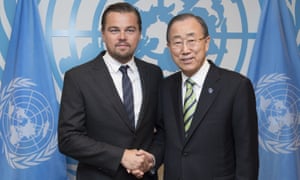
UN secretary-general Ban Ki-moon and actor Leonardo DiCaprio at the UN in New York on 22 April 2016
UN secretary-general Ban Ki-moon and actor Leonardo DiCaprio at the UN in New York on 22 April 2016. 'Now the gap between reality and the ambition of holding global warming below 2C needs addressing.' Photograph: UPI/Barcroft Media


The danger of gala events like the official signing of the climate change treaty at the UN in New York on Friday, crowned with a guest appearance from Leonardo DiCaprio and with 60 heads of state in attendance, is the impression they create that the job is done. It was certainly a spectacular demonstration of global intent to get more than 170 signatures on the deal agreed in Paris in December at the first time of asking; but what matters is making it legally binding. For that, it must be not just signed but ratified by at least 55 countries, and it must cover 55% of emissions. Nor does the Paris deal go far enough. It was only a step on a long, hard road. The targets that each country set themselves do not go nearly far enough. Now the gap between reality and the ambition of holding global warming below 2C needs addressing. In Churchillian rhetoric, this is not the end, nor the beginning of the end, but it is the end of the beginning.
There are powerful reasons to pursue the Paris summit objective. According to the Japan Meteorological Agency, each of the past 11 months was warmer than the 20th-century average. Nasa statistics showed that 2015 was even hotter than the previous record-setting year of 2014. Yet despite the way the evidence is stacking up, political leaders in polluting countries continue to argue about whether and how fast they need to act. In the US, President Barack Obama's climate plan has hit trouble in the supreme court, where the regulation of emissions from coal-fired plants has been blocked. Hillary Clinton, the likely Democratic candidate for the presidency, is pledged to continue Mr Obama's commitment to tackling emissions, but her probable rival, Donald Trump, is certainly not. The US and China are committed to ratifying the climate change treaty, but for others, such as India, it may be more complicated.
In the UK, 10 years after David Cameron hugged that husky, his record is in tatters. Not only has "the green crap" been whittled back by big cuts in subsidies and incentives that have left solar power, onshore and even offshore wind all less attractive, but policies to limit emissions have been repeatedly portrayed as harmful to the economy. High energy costs have been widely blamed for the crisis in British steel. Yet, while it is true that energy prices are higher than elsewhere in Europe – partly because of climate change programmes and partly because of the fragmented nature of the privatised industry largely beyond government control – they are mitigated by compensation. As fact-checkers point out, for steel, actual energy costs amount to around just 1% of total manufacturing costs. The double whammy of an uncompetitive currency and a slump in global demand are the real problems that Tata and other steelmakers are facing. Energy costs get the blame because that's where the government might have real traction.
As divestment lobbies chalk up triumph after triumph, there are signs of parallel trends. In the past few days, Norway's sovereign wealth fund has pulled out of scores of companies for being over-reliant on fossil fuel, and the Rockefeller Foundation has divested from fossil fuel entirely. Yet governments still resist the commitment to greening their economies that will turn the Paris deal from an exercise in global cooperation to a watershed for global warming.

Links

Lethal Heating is a citizens' initiative