Flooding is a 'humanitarian crisis waiting to happen'
Flood damage in low-lying Miami could be the most costly in the world Getty
More than a billion people will be at risk from flooding caused by climate change in just a few decades' time, a leading charity has warned.
Christian Aid says that huge numbers of people in coastal cities would exposed to rising seas, flooding, extreme weather and storm surges by 2060.
The urban poor – a demographic expected to grow in coming years -
would be hardest hit, the charity said, in a “humanitarian crisis
waiting to happen”.However, the report says a widespread catastrophe was not inevitable and protective measures implemented now could negate the worst effects.
If trends continue, many of the places likely to be hardest hit will
be in Asia, but the US will also badly suffer the effects, according to
the paper.
South Asia will be the hardest hit, with the Indian cities of Kolkata
and Mumbai, and the Bangladeshi city of Dhaka, predicted to have the
largest populations – all of at least 11 million people - exposed to
coastal flooding by the 2070s.
Severe flooding hits India 2015
Cities in East Asia – Guangzhou and Shanghai in China, Ho Chi Minh
City in Vietnam, Bangkok in Thailand and Myanmar’s Yangon - are also
likely to have populations of millions at risk of flooding.
All of these places are characterised by rising inequality, the
report said, and it is the “poorest people with the fewest assets who
have the most to lose”.
Miami, with 4.7 million residents, is the ninth city in terms of
populations at risk, but the most at risk in financial terms, with more
than $3.5 trillion assets predicted to be exposed to extreme weather and
flooding by 2070. New York’s assets, predicted $2.1 trillion, are third
most at risk.
Chinese cities are also set to take a "financial hammering”.
In Europe, the low lying Dutch cities of Amsterdam and Rotterdam are ranked the 14th and 15th most at financial risk.
London is deemed a “vulnerable city” by the report, at risk from
tidal and surface flooding -- a result of rain pressure on the city’s
drainage systems. There is also risk from water shortages because of an
increased population, water demand and drought.
The report also highlighted how women are worse affected by men in
climate related disasters and said a “gender responsive” approach to
planning and preparation was critical.
Christian Aid called for a community led response to develop skills
and preparation measures. It also said at least $1billion should be
invested by the international community into infrastructure measures in
the most vulnerable places. The group also said “every effort” should be
made to meet the Paris climate targets but that the world should also
prepare for “loss and damage”.
SORRY, folks. The news is not good.
This
weather is only getting more extreme, natural disasters are getting
increasingly more deadly, and we puny humans seem pretty content to sit
back and accept our murky fate.
The World Bank has issued a warning to
major cities around the world that we're underprepared for major risks
from extreme weather and other hazards, which will only intensify due to
population growth and surging migration.
By 2050, 1.3 billion people and $AU217 trillion in assets will be affected by worsening river and coastal floods alone.
The report says many city officials have no clear idea of the range of disaster risks they face and how serious they could be.
A
combination of sea-level rise and sinking of coastal cities, including
from excessive extraction of the groundwater, could drive disaster
losses in 136 coastal cities from $US6 billion a year ($A8.1b) in 2010
to $US1 trillion a year by 2070.
In Indonesia, for instance,
chances of flooding from overflowing rivers is expected to grow 166 per
cent over the next 30 years, while coastal flooding risk could rise 445
per cent.
Nepal's capital Kathmandu could see a 50 per cent rise in earthquake risk by 2045 as more slums and informal buildings go up.
Overall, the message is clear: parts of the world are pretty screwed. What does this mean for australia?
The
report identified rising sea levels, extreme heat and drought as some
of the biggest natural disasters that will affect Australia over coming
years.
"Sea-level rise is an extremely important influence on evolving hazard," it says.
"It
contributes more to increased storm tide heights in Victoria,
Australia, than higher wind speeds. This suggests that storm surge risk
is likely to increase under climate change, despite the remaining
uncertainty around regional changes in cyclone frequency and intensity."
The
report also stressed the importance of addressing extreme heatwaves,
which Australia, of course, is renowned for. It warned that, since
they're already a prime driver of mortality, and since long-duration
temperature extremes lead to drought, this could trigger climate-related
human migration.
Australia is already seeing an increase in its number of heatwaves. Source: BOM
While
we're reasonably lucky when it comes to hazards like earthquakes and
volcanoes, we're already seeing an increase in the number of heatwaves.
Dr
Sarah Perkins-Kirkpatrick, a research fellow at UNSW's Climate Change
Research Centre, told news.com.au that many people don't seem to realise
that heatwaves have killed more people than any other natural disaster,
so much so that she dubbed it the "silent killer".
"By 2050, this
will have huge implications for public health and infrastructure," she
said. By 2050, Sydney and Perth can expect 15 more heatwaves per season,
with Melbourne and Adelaide between five and 10.
She said that
heatwaves get more frequent going north, but more intense going south,
meaning the whole country is more or less affected one way or another.
Meanwhile,
The Bureau of Meteorology and CSIRO project the number of extreme fire
weather days will grow in southern and eastern Australia by 100 and 300
per cent by 2050 compared to 1980 to 1999.
What are heatwaves?
Dr Perkins-Kirkpatrick stressed that a key part of the problem was
Australia's attitude to heatwaves, and climate change more broadly.
"There's
this whole culture where we're like 'Just suck it up'," she said. "We
need a culture shift. You look at the trade industry where people are on
rooftops building houses in 40 degree heat, because if they don't work
they don't get paid. We need to take heatwaves more seriously, accept
that it's happening, so we can change the course of the century."
Extreme heatwaves will be a growing problem for Australia over the next few decades. Source: News Corp Australia
She
warned that on the east coast residents of western Sydney would be the
most vulnerable. It's the hottest part of the city, being further away
from the ocean, and a hotspot for rapid population growth.
Reports
in the past few years have estimated that Australia's population will
reach 42 million by 2050, with about eight million of these people
living in Sydney. The World Bank said there's a correlation between
population growth and natural disasters.
Earlier this year, the
Australian Business Roundtable for Disaster Resilience and Safer
Communities predicted that our nation's natural disaster bill will
triple to $33 billion by 2050, which is 50 per cent greater than
previous estimates.
This was based not only on the physical impact
of natural disasters, but the social impacts such as mental health
issues, chronic disease and alcohol misuse as a result.
Australian
Red Cross Director of Australian Services, Noel Clement, said this
filled a critical gap in the research on medium and long-term impact of
disasters on Australian communities.
"Governments, business and
communities need to work together to address the medium and long-term
social impacts of natural disasters through further investment and
research into community resilience programs," he said.
Dr Perkins-Kirkpatrick shared this view.
"The Budget barely mentioned climate change — that speaks volumes," she said.
"The CSIRO debacle speaks volumes too.
"We
need to adapt. We need to prepare our hospitals so they can be ready
when a heatwave occurs. We need education for the elderly, who are the
most vulnerable to heatwaves. We need to shift towards mitigation and
adaptation."
The world is underprepared for natural hazards, and Australia is not immune. Source: News Limited
In
the 2016 Budget, it was announced that the Clean Energy Finance
Corporation (CEFC) and the Australian Renewable Energy Agency (ARENA)
would refocus their activities "towards the government's innovation
agenda".
The CEFC will be responsible for allocating $1 billion in
existing funding over 10 years to establish a Clean Energy Innovation
Fund. The fund will provide money to assist emerging clean energy
technology become commercially viable. The fund will be jointly managed
by ARENA, which will also continue to manage its existing portfolio
through the new fund.
Climate change at the centre of this year's election.
Environment groups, such as the Australian Conservation Foundation
and the Australian Youth Climate Coalition, expressed their
disappointment with the government's response to tackling climate change
in the Budget, with the latter pointing out that the "Budget provides no new funding for renewable energy".
Regardless,
Dr Perkins-Kirkpatrick said we're already locked in for a set amount of
change by 2050, meaning that, even if we did take drastic measures to
lower our carbon emissions, we wouldn't be free from the effects of
what's already been done.
That's a scary thought.
Deutsche Welle - Reuters | AFP Climate experts are meeting in Bonn to draw up a rule book from the 2015 Paris Agreeent. Their deliberations come after seven months of record temperatures around the world.
Delegates to the latest round of talks following the Paris Agreement
began their work on Monday to work out a detailed plan on how
governments are to report and monitor their national plans to curb
greenhouse gas emissions.
Their 10-day meeting comes as US space agency NASA reported that last
month was the warmest April in statistics dating back to the 19th
century. April was the seventh month in a row to break temperature
records.
Spiralling global temperatures from 1850-2016.
Costa Rican diplomat Christiana Figueres, the retiring executive secretary of the UN Framework Convention on Climate Change
Retiring UN climate director Christiana Figueres told the
conference on Monday that the record temperatures were partly caused by
the natural warming effect of the El Nino weather activity in the
Pacific Ocean but that it was magnified by the build-up of man-made
greenhouse gas emissions.
Addressing delegates at the start of the 10-day meeting, Figueres said:
"The whole world is united in its commitment to the global goals
embodied in the Paris Agreement," telling the 196-nation UN meeting:
"Now we must design the details of the path to the safe, prosperous and
climate-neutral future to which we all aspire." The meeting in Germany is the first since the UN members reached a deal in Paris
to limit climate change by moving away from the use of fossil fuels to
renewable energy by 2100. Last month, the agreement was signed by 175
governments at a ceremony in New York, including top greenhouse-gas
emitters China and the United States.The agreement still needs to be ratified by national governments. It
will come into force when 55 nations, representing 55 percent of world
emissions, have signed up to the plan. French Environment Minister
Segolene Royal said she would submit a bill on Tuesday to the French
National Assembly, seeking ratification.
Speaking to the Bonn conference on Monday, Royal said: "The Paris
Agreement represents the foundations ... Now we have to raise the walls,
the roof of a common home."
Warmest April
US scientists have reported that last month was the warmest April
recorded, the seventh consecutive month to exceed previous highs. The
record means that 2016 will become the warmest calendar year in NASA's
database.
NASA records the warmest April on record.
During each of the past seven months, global average surface
temperatures have exceeded the 20th century average by more than 1
degree Celsius (1.8 degrees Fahrenheit).
Water pipelines from the Tansa dam, near Mumbai, India
On Monday, the Japan Meteorological Agency backed up NASA in finding
that April was the warmest such month since their records began in 1891.
The warm weather was most pronounced across the Arctic, from Siberia to
Greenland and Alaska. There were
deadly heat waves in Thailand and India.
The UN climate talks in Bonn continue until May 26, and will also set
the agenda for the next high-level gathering in Marrakesh, Morocco in
November.
Organisation urges better city planning and defensive measures to defend against rapid rise in climate change-linked disasters
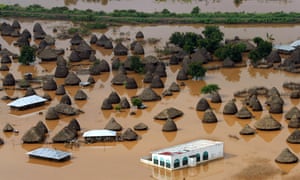
Flooding and drought will affect more people but few countries are planning for it, warns the World Bank. Photograph: Tony Karumba/AFP/Getty Images
The global community is badly prepared for a rapid increase in
climate change-related natural disasters that by 2050 will put 1.3
billion people at risk, according to the World Bank.
Urging better planning of cities before it was too late, a report
published on Monday from a Bank-run body that focuses on disaster
mitigation, said assets worth $158tn – double the total annual output of
the global economy – would be in jeopardy by 2050 without preventative
action.
The Global Facility for Disaster Reduction and Recovery said total
damages from disasters had ballooned in recent decades but warned that
worse could be in store as a result of a combination of global warming,
an expanding population and the vulnerability of people crammed into
slums in low-lying, fast-growing cities that are already overcrowded.
"With climate change and rising numbers of people in urban areas
rapidly driving up future risks, there's a real danger the world is
woefully unprepared for what lies ahead," said John Roome, the World
Bank Group's senior director for climate change.
"Unless we change our approach to future planning for cities and
coastal areas that takes into account potential disasters, we run the
real risk of locking in decisions that will lead to drastic increases in
future losses."
The facility's report cited case studies showing that densely
populated coastal cities are sinking at a time when sea levels are
rising. It added that the annual cost of natural disasters in 136
coastal cities could increase from $6bn in 2010 to $1tn in 2070.
The report said that the number of deaths and the monetary losses
from natural disasters varied from year to year, but the upward trend
was pronounced.
Total annual damage – averaged over a 10-year period – had risen
tenfold from 1976–1985 to 2005–2014, from $14bn to more than $140bn. The
average number of people affected each year had risen over the same
period from around 60 million people to more than 170 million.
Although developed countries have been responsible for the bulk of
historic global emissions, poorer countries are more vulnerable to the
impact of climate change and they demanded financial help from the west
as part of last December's breakthrough global deal to reduce emissions.
Oxfam this week called on rich countries to make good on the pledges
made at the Paris conference to provide the funding to help developing
countries adapt to the effects of global warming.
"Climate change is a brutal reality confronting millions of the
world's most vulnerable people. Their need for financial support to
adapt to climate extremes is urgent and rising," Oxfam said in its Unfinished Business report.
"International support for adaptation falls well short of what is
needed. Latest estimates indicate that only 16% of international climate
finance is currently dedicated to adaptation – a mere $4bn–$6bn per
year of which is public finance."
According to the the facility, disaster risk is affected by three
factors. It said these were: hazard – the frequency of potentially
dangerous naturally occurring events, such as earthquakes or tropical
cyclones; exposure – the size of the population and the economic assets
located in hazard-prone areas; and vulnerability – the susceptibility of
the exposed elements to the natural hazard.
It
added that hazard was increasing due to climate change; exposure was
going up because more people were living in hazardous areas and that
vulnerability was on the rise because of badly designed and poorly
planned housing.
The World Bank-run body said the population was expected to rise by
at least 40% in 14 of the 20 most populated cities in the world between
2015 and 2030, with some cities growing by 10 million people in that
period. "Many of the largest cities are located in deltas and are highly
prone to floods and other hazards, and as these cities grow, an ever
greater number of people and more assets are at risk of disaster."
Francis Ghesquiere, head of the secretariat at the The Global
Facility for Disaster Reduction and Recovery, said: "By promoting
policies that reduce risk and avoiding actions to drive up risk, we can
positively influence the risk environment of the future. The drivers of
future risk are within the control of decision makers today. They must
seize the moment."
A significant marker of rising global greenhouse gas emissions has been passed, with a key monitoring site on Tasmania's north-west tip recording atmospheric carbon-dioxide exceeding 400 parts per million for the first time.
As foreshadowed by Fairfax Media last week, a baseline reading at the Cape Grim station that exceeded the 400-ppm mark of the primary gas driving global warming was imminent.
Cape Grim, one of the world's most important monitoring stations for gauging changes in the atmosphere. Photo: Auscape
As it turned out, "the unfortunate milestone" was reached on
Tuesday May 10 at 8am, local time, said Paul Krummel, who heads the
CSIRO team analysing data from the most important site in the southern
hemisphere. (See chart below.)
"It's a bit sooner than we expected," Mr Krummel told Fairfax Media. "It just rocketed up there."
Australian emissions are on the increase, particularly in the electricity sector. Photo: Michele Mossop
Atmospheric readings from Cape Grim, along with two stations in
Hawaii and Alaska, are closely watched as they date back decades and
closely track a range of pollutants from ozone-depleting chemicals to
the various greenhouse gases resulting from burning fossil fuels and
clearing forests.
Mr Krummel said that while mostly symbolic, the
400-ppm reading "highlights the problem of rising emissions, which are
increasing more rapidly than they used to be". A report out earlier this year
from the World Meteorological Organization noted atmospheric readings
of CO2 at the Mauna Loa site in Hawaii rose 3.05 ppm in 2015 alone – the
biggest increase in the 56 years of research.
Melting moments: A polar bear off the coast of Svalbard, Norway. Photo: Steven Kazlowski
Sun-Herald editorial illustration from May 15. Photo: David Rowe
The recent surge in CO2 levels was not unexpected because of the
giant El Nino event now breaking up in the Pacific. In El Nino years,
global temperatures get a kick higher and droughts tend to be worse. As a
result, vegetation take out less CO2 from the atmosphere.
CSIRO's
Mr Krummel said the El Nino influence was evident in Cape Grim's
reading with barely a dip in the past year as might otherwise be
expected in spring.
"This year, it's just plateaued and now it's
taken off again," he said, adding the site was "probably one of the last
places on earth" to remain below 400 ppm.
Sites in the northern hemisphere exceeded 400 ppm from 2012
onwards. But as the region has greater seasonal variation – mostly
because there is more terrestrial vegetation – CO2 concentrations
dropped back below that mark each spring.
Once Cape Grim gets past
a short period with CO2 levels gyrating around 400 ppm, it will need a
huge global effort to curb greenhouse gas emissions to push the level
back down.
"It's not going to go back below 400 ppm for a very
long time unless we get very good at mitigation," Mr Krummel said.Global
CO2 levels were running at roughly 280 ppm up until about 1850 when
they started to take off. (See chart below).
Climate scientists, such as David Karoly at Melbourne
University, note that when other greenhouse gases, such as methane, are
included, the situation is even bleaker.
The so-called carbon dioxide-equivalent level that takes in the full global warming impact is now about 485 ppm.
Both
2014 and 2015 were record hot years globally in data going back about
130 years. With the effect of a strong El Nino overlaying long-term
trends, this year is likely to be even hotter after a scorching start.
Ed
Hawkins, a climate scientist at the UK's University of Reading, has
constructed the following animation showing how the world has warmed in
the past 166 years.
Many regions of the world are experiencing unusual warmth for
May, with parts of Alaska expected to be 15 degrees warmer than average.
Even
Sydney is running about 5 degrees above average so far for May and
Australia on the whole is headed for close to its warmest autumn on
record.
The Cape Grim site, meanwhile, celebrated its 40th
anniversary in March with a cloud over its future because of the CSIRO
job cuts.
While management has promised to maintain the facility
that it runs in cooperation with the Bureau of Meteorology, the number
of CSIRO staff analysing the gases collected at the site is expected to
be cut by about one-third from the current tally of about 30
researchers.
Latest monthly figures add to string of recent temperature records and all but assure 2016 will be hottest year on record
Global land and sea temperature was 1.11C warmer in April 2016 than the average temperature for April during the period 1951-1980. Photograph: Stephane Mahe/Reuters
April 2016 was the hottest April on record globally – and the seventh month in a row to have broken global temperature records.
The latest figures smashed the previous record for April by the largest margin ever recorded.
It makes three months in a row
that the monthly record has been broken by the largest margin ever, and
seven months in a row that are at least 1C above the 1951-80 mean for
that month. When the string of record-smashing months started in February, scientists began talking about a "climate emergency".
Figures released by Nasa over the weekend show the global temperature
of land and sea was 1.11C warmer in April than the average temperature
for April during the period 1951-1980.
It all but assures that 2016 will be the hottest year on record, and probably by the largest margin ever.
The new record broke the previous one by 0.24C, which was set in 2010,
at 0.87C above the baseline average for April. That record itself broke
one set three years earlier at 0.75C above the baseline average for
April.
NASA records the warmest April on record.
The current blast of hot air around the globe is being spurred by a massive El Niño,
which is a release of warm water across the Pacific Ocean. But it's not
the biggest El Niño on record and that spike in temperatures is
occurring over a background of rapid global warming, pushing
temperatures to all-time highs.
"The
interesting thing is the scale at which we're breaking records," said
Andy Pitman, director of the ARC Centre of Excellence for Climate System
Science at the University of New South Wales in Australia. "It's
clearly all heading in the wrong direction.
"Climate scientists have been warning about this since at least the
1980s. And it's been bloody obvious since the 2000s. So where's the
surprise?" said Pitman.
Pitmans said the recent figures put the recent goal agreed in Paris
of just 1.5C warming in doubt. "The 1.5C target, it's wishful thinking. I
don't know if you'd get 1.5C if you stopped emissions today. There's
inertia in the system. It's putting intense pressure on 2C," he said.
The record temperatures were wreaking havoc with ecosystems around
the world. They've triggered the third recorded global coral bleaching,
and in Australia 93% of the reefs have been affected by bleaching
along the 2,300km Great Barrier Reef. In the northern parts of the
reef, it's expected the majority of coral is dead, and on some reefs
over 90% of the coral is dying.
A recent analysis showed the bleaching on the Great Barrier Reef was made 175 times more likely because of climate change, and the conditions that caused it would be average in fewer than 20 years.
The April figures come as the symbolic milestone of CO2 concentrations of 400 parts per million (ppm) have been broken at the important Cape Grim measuring station in Tasmania, Australia.
Reflecting on the CO2 concentrations, Pitman said: "The thing that's
causing that warming, is going up and up and up. So the cool ocean
temperatures we will get with a La Niña are warmer than we'd ever seen
more than a few decades ago … This is a full-scale punching of the reef
system on an ongoing basis with some occasionally really nasty kicks and
it isn't going to recover."
Energy efficiency projects could receive more subsidies if Direct Action is continued. David González Romero/Flickr, CC BY
Direct Action is the centrepiece of Australia's current
greenhouse gas reduction efforts. To date, A$1.7 billion in subsidies
has been committed from the government's Emissions Reduction Fund to projects offering to reduce emissions.
The scheme replaced Australia's two-year-old carbon price in 2014 and is a key part of the government's plan to reduce emissions by 5% below 2000 levels by 2020, and 26–28% below 2005 levels by 2030.
Environment Minister Greg Hunt has called Direct Action a "stunning success" and "one of the most effective systems in the world for significantly reducing emissions".
In a new article
in Economic Papers, I look into the economics of Direct Action and how
it is working. I conclude that the scheme is exposed to funding projects
that would have happened without government funding.
This issue has long been known as a threat to schemes of this type,
and means that the scheme is likely to be less useful in reducing
emissions than the government is claiming. Commonwealth Procurement Rules require value for money in government purchases. It is not clear we are getting that with Direct Action.
Information problems
The key challenge for schemes like Direct Action is information. What
exactly is the scheme buying, and would that have happened without it?
Direct Action works by inviting voluntary project proposals and then allocating funds to the lowest bidders in reverse auctions.
Unfortunately, projects that would have gone ahead even without a
subsidy – call them "anyway projects" – have a cost advantage that makes
them well placed to win the auctions. It is often difficult for the
government to identify such projects. When projects of this type receive
funding, taxpayers' money is being used ineffectively.
Economists call this adverse selection, or the "lemons problem".
All about that baseline
The government has developed a set of methods
for defining projects and measuring the emission reductions provided by
each project against estimated baselines. It is an economy-wide scheme,
and there are methods covering everything from energy efficiency to aviation.
As is, the methods leave opportunities for anyway projects to qualify. The Emission Reduction Fund White Paper states that a "flexible approach" is being pursued so as to encourage participation.
One rule
is that projects be new. But across the Australian economy, new
projects are launched every year. Some happen to reduce emissions. These
projects are being attracted into the Direct Action auctions.
Carry-overs from the former Carbon Farming Initiative have also been allowed to side-step the newness requirement.
The experience so far
Three Direct Action auctions have been held to date, with the most recent in late April 2016.
Some of the funded projects are likely to be providing genuine
reductions in emissions. Unfortunately, however, some project categories
are rather questionable.
Landfill operators have been awarded Direct Action subsidies in each of the auctions. Their projects are often already generating revenues from electricity sales and renewable energy certificates.
Other projects to win subsidies include upgrades to lighting in
supermarkets and to the fuel efficiency of vehicles. These are
activities that are supposed to happen anyway.
The biggest winner to date has been vegetation projects. Among these
are projects to reduce tree clearing, including of invasive native
species near Cobar and Bourke in New South Wales. The large payments for
these projects are likely to have preserved some vegetation. But some
farmers appear to have not actually been planning to clear. If so,
funding is going to anyway projects.
This vegetation could be protected under the avoided deforestation category of Direct Action. But was it going to be cleared, and is a taxpayer-funded subsidy the best way to save it?Paul Burke, Author provided
Projects potentially in line for the next auction include boiler upgrades and modifications to aircraft. If Direct Action were to continue for years to come, the bill could become very big.
Journalists such as Lenore Taylor and Tristan Edis are among those who have raised concerns about the quality of Direct Action projects. The government has yet to properly engage with this issue.
This problem could be avoided
There are far better policy approaches than Direct Action subsidies.
A key advantage of either an emissions tax or an emissions trading scheme is that the government does not need to evaluate individual projects from covered enterprises.
These schemes instead introduce a price per unit of emissions and leave the private sector to decide which projects to implement. Large emitters are already required to report their emissions, so implementation is comparatively straightforward. Any revenue raised could be used to reduce other taxes or Australia's budget deficit.
Regulations could also be put to more use. Strengthened restrictions on vegetation clearing and on the release of coal mine gas are examples.
Eligibility to generate offset credits should be tightened to cover only credibly genuine emission reductions that are difficult to achieve using other policies. Some carbon farming activities can meet this criterion, and could generate revenue from private-sector buyers. Public expenditure on new offset projects could be ended.
Better off going back to what was working
There are many other downsides to Direct Action. These include its administrative complexity, the issue of emissions reappearing elsewhere in the economy, and the subsidy culture it inculcates.
The scheme is yet to induce emissions reductions in key sectors of the economy. Emissions from electricity generation are rising again.
Australia has a big challenge ahead in decarbonising our economy. There are many opportunities, but we need to get our policy settings right. It would be better to move on from Direct Action subsidies. An approach centred on pricing emissions makes more sense.
An open-access version of Paul's paper can be downloaded here. Links




 Climate scientists, such as David Karoly at Melbourne
University, note that when other greenhouse gases, such as methane, are
included, the situation is even bleaker.


