24/06/2016

Power To The People: How Communities Can Help Meet Our Renewable Energy Goals

The Conversation -  | 

Hepburn Wind is one of Australia's largest community renewable energy schemes. Hepburn Wind/Flickr, CC BY-NC-ND

The federal election campaign has highlighted the very different visions of Australia's renewable energy future held by the major parties. The Coalition government supports the present Renewable Energy Target (RET) of 33,000 gigawatt-hours from large-scale projects in 2020, which it negotiated with the Labor opposition in 2015.
It's expected to deliver just over a 23% contribution of renewables to the Australian electricity sector in 2020. There is, most likely, only one more federal election before then.
For the longer term, the Coalition proposes no change to this target before 2030 which, given future demand growth, might well see renewables' contribution to Australian electricity supply actually fall.
By comparison, Labor has a target of 50% renewable electricity by 2030 and the Greens a 90% target. Complicating the situation further are the ambitious targets of some state and territory governments.
Targets require means to actually achieve them. The RET is a target, but also a mechanism based around trading in Renewable Energy Certificates. Meeting the agreed 2020 target requires new renewable energy generation to provide these certificates.
The Clean Energy Council estimates that an additional 6,000 megawatts of new renewable generation, requiring around A$10 billion of investment, will be required by 2020.
The new generation and investment required to meet Labor or the Greens' far more ambitious 2030 targets is, of course, far greater.

Energy for the people
Community renewable energy (CRE) may have a key role to play. Community energy can involve supply-side projects such as renewable energy installations and storage, and demand-side projects such as community education, energy efficiency and demand management.
In short, community renewable energy revolves around community ownership, participation, and consequent benefits from community-scale renewable energy projects.
Why would these small-scale projects matter for reaching ambitious renewable energy targets? Surely large industry players are better placed to develop renewables than the community?
Perhaps, but the transition to a renewable energy future will almost certainly require high levels of social consensus and engagement, and community renewable energy can play a key role in building this.
The 2016 edition of the highly authoritative Renewables Global Status Report has just been released, and includes a special chapter on CRE.
If we consider industrialised countries with major progress on renewable energy over the past few decades and ambitious future targets, community energy seems to have played a key role in a number of them.
For example, Denmark has already nearly reached its 50% target for renewable electricity by 2020 and was a pioneer in community energy, beginning in the late 1970s.
Germany reached 32% renewable electricity in 2015 with a target of 40% to 45% by 2025, and has some 850 energy cooperatives. Almost half of its installed capacity is owned by households, communities and farmers.
Community ownership has become a well-established part of the renewable energy sector, and to the energy transition in western countries such as Germany, Denmark, Britain and, increasingly, the United States.
But it is still a fairly new concept to Australia.

Australia's Renewable Energy Target
One reason for this may be the design of our RET itself.
It is actually two schemes: one specifically tailored for households and small business, and the other for far larger-scale projects.
As a result, Australia's renewable landscape is characterised by large utility-sized projects, mostly wind, hydro and bioenergy. Large-scale solar now looks to be taking off too.
At the other end of the spectrum are some 1.5 million household solar photovoltaic (PV) systems; indeed, Australia has the most household PV systems per person in the world.
Community renewable projects, by comparison, are usually mid-sized. They lack the economics of larger renewable projects, and the targeted RET support and simple PV grid connection available to households.
Do we need them given the community's enthusiastic embrace of household PV? Well, not all households have a roof to call their own on which they can install a PV system. For example, 14% of Australians live in apartments. There are also other promising renewable opportunities such as mid-sized wind and biomass projects whose deployment is generally beyond the capabilities of individuals.
Australia's small but growing community movement with over 70 groups and more than 30 operating projects, would certainly seem to highlight the opportunity that now presents itself here – and raises the question of what governments might do to assist them.

Building support
International experience highlights that a range of policy support and other initiatives are a prerequisite for community energy success. Communities often lack the funding, knowledge, capacities or network to organise and construct a project. Specific support for community energy can help reduce risks, build community capability and increase the economic viability of these projects.
Indeed, it is interesting to note that recently announced, more market-focused, changes to the German Renewable Energy Act are being widely criticised because of their likely adverse impacts on community renewable energy.
In Australia, Labor has pledged A$98.7 million and the Greens a total of A$265.2 million to support CRE projects ahead of the election.
Both commitments include support to provide local groups with technical, legal and administrative expertise as seen in so-called "community powerhouses", which are modelled on the Moreland Energy Foundation. Funding for a network of these new support organisations could help to leverage the efforts of community members, local governments and private business towards CRE projects.
The Greens' plan also comprises a range of other initiatives such as tax incentives to support the emerging community renewable energy sector.
The Coalition, by comparison, has pledged A$5 million for grants of up to A$15,000 to community groups to install rooftop PV, solar hot water, other small-scale renewables, and battery energy storage systems, as part of their Solar Communities program.
This might seem strange given the opportunity for CRE to create rural and regional investment and jobs. The Green Tea Party movement in the United States highlights that even the most conservative can get behind community renewables.
Importantly, experience in Australia and elsewhere shows that we need to revisit electricity market arrangements, including regulations governing connection and network tariffs, to facilitate CRE. Our research (just accepted for publication in the Journal of Energy Research & Social Science) has also highlighted that local governments can play a key role in supporting community engagement with renewable energy.
Given the opportunity to spread the benefits of renewables more broadly across the community, we really need all levels of government to get involved.

Links

Without Emissions Cuts, Summer Heat Will Get Even Deadlier

InsideClimate News - Bob Berwyn

New study shows dangerously hot summers will become the norm across much of the globe unless greenhouse gas emissions are significantly reduced.
Heat waves, like the one that baked India this year, will become the new normal without emissions cuts, a new study says. Credit: Reuters
By 2060, large swaths of the planet could be hit by unprecedented heat waves during the summer months that would exceed all historical records, according to a new study by scientists at the National Center for Atmospheric Research.
Just as a severe heat wave sizzles the U.S. Southwest, sending temperatures in parts of Arizona to 120 degrees, this new study predicts similarly dangerous heat will become more commonplace. Without major reductions in global greenhouse gas emissions, the study said there is a 90 percent chance that every summer will be at least as warm as the hottest to date across large parts of North and South America, Central Europe, Asia and Africa.
That means summers like 2012, when extreme heat was blamed for 32 deaths in a two-week period across the U.S., will become the new normal.
Already, four deaths in Arizona have been attributed to the current heat wave and several large wildfires have begun burning out of control in Arizona as well as in California.
The study said that by 2070, as much as 87 percent of the world's people could face record summer temperatures every second year, unless greenhouse gas emissions are reduced. More extreme temperatures would lead to more heat-related deaths from direct exposure, as well as contributing to the spread of heat-related disease, like mosquito-borne Zika virus, other research has found. Hotter summers also raise the risk of drought that wipes out crop production causing food price shocks and hunger.
"Recent examples of fatal heat waves and food crises linked to record-breaking summer temperatures can therefore serve as case studies for a potential future norm," the study said.
Many previous studies have confidently singled out climate change as the critical factor in heat waves, which are widely predicted to become more frequent and intense as global warming worsens. But the researchers said because they used an advanced climate model, this is the most accurate assessment yet of the extreme summer heat expected if greenhouse gas emissions continue at or above current rates.
To project the impact of greenhouse gases on future temperatures, they first reproduced past climate using observed global temperature data from 1920 to 2014. The model allowed them to simulate temperatures for 1,425 possible past summers for the same period. That resulted in a much larger range of temperatures to better compare variations caused by natural factors (such as volcanic eruptions) with the effects of increased greenhouse gases.
They then used two simulations to project future summer temperatures through 2100: one assumed greenhouse gas emissions would continue to rise, while the other assumed emissions would fall because of countries meeting their obligations to the Paris climate accord. The next step was to compare those results with the past temperature data to isolate the influence of man-made climate change from natural variability.
From 1980 through the present and into the future, the trend toward more extreme summer heat caused by global warming became clear, the study found.
"By re-running the model multiple times in different conditions we get a broader range of the evolution of climate. That gives us a better sense of what the warming can be attributed to, and  how much of this variability is natural," said lead author Flavio Lehner, a climatologist at NCAR. The results showed that most of the increase in summer heatwaves can be attributed to increasing concentrations of greenhouse gases.
"People still have a choice. To some extent we can make changes now to mitigate this," Lehner said. Cutting greenhouse gas emissions in line with a 2-degrees Celsius temperature target, the goal of the Paris climate agreement, would lower the chances of extreme summer heatwaves by 41 percent, the study concluded.
The new research reinforces other recent studies that show a large percentage of the world's population—especially the poor—could soon be exposed to deadly heat and potential drought conditions more often. Africa could see deadly heat waves every year beginning as soon as 2040, according to a study published in April in the journal Environmental Research Letters.
Africa "will be affected very soon and very heavily," said co-author Jana Sillmann, who specializes in studying climate extremes at CICERO, a climate research institute based in Norway. "So far, everybody is saying we can avoid dangerous climate change if we stay below 2 degrees," Sillmann said. But that doesn't hold true for Africa. It's the only continent that sits squarely in the tropics, which means there's a risk of heat waves all year round, not just in summer. From 2000-2015, Africa experienced hotter, longer and more extensive heat waves than in the last two decades of the 20th century.
Another new study—by researchers with the Max Planck Institute for Chemistry and the Cyprus Institute—predicted extreme and persistent heat across North Africa and parts of the Middle East by mid-century that would directly threaten human health. The average summer maximum temperatures in the region covered by the study would rise from 109 degrees Fahrenheit to about 115 degrees by 2050, and as high as 122 degrees Fahrenheit by the end of the century, the study concluded. It was published online and will appear in July in the journal Climatic Change.
Yet another recent study, also in the journal Environmental Research Letters, found that the poorest 20 percent of the world's population will feel the heat extremes sooner than people in wealthier regions. Countries around the Horn of Africa and West Africa would be most affected, the researchers found.
The latest projections of increases in dangerous summer heat in developing countries are a big part of the reason that the United Nations upped its estimates of the global cost of adapting to climate change. In a report released during the international climate talks in Bonn, Germany last month, the UN said those costs could soar as high as $500 billion—four to five time higher than estimated just two years ago.
In addition to calculating how much of the Earth's surface area will be affected by extreme heat in the future, the NCAR researchers also measured the percentage of the Earth's population that will affected by those changes. They found that the greatest probability of increases in extreme summer heat overlaps with the world's most populated regions, including parts of Brazil, Central Europe and eastern China.
Cutting emissions now would benefit a disproportionately large percentage of Earth's total population, it concluded.

Links

Climate Change Poses Urgent Threat to Poor of Coastal Bangladesh

World Bank

Image
From left to right: Susmita Dasgupta, Asli Demirgüç-Kunt, Stéphane Hallegatte
Summary
  • Nearly 12 million people live in poverty in the coastal region of Bangladesh.
  • Poor households in coastal Bangladesh will confront increasingly severe challenges from climate change through heightened cyclonic inundation, rising river salinity, and increased soil salinity.
  • The World Bank is working with the Government of Bangladesh to enable poor households to adapt to the impacts of climate change.
Nearly 12 million people live in poverty in the coastal regions of Bangladesh.
The climate already poses a challenge to the lives and livelihoods of these households, seen vividly in the damage caused by Cyclone Roanu a few weeks ago.
New projections published by the World Bank suggest climate change will pose an even more severe challenge over the next three decades.
"Climate change is a major issue for all of us, but particularly the poor and vulnerable", said Research Director Asli Demirguc-Kunt, who recently hosted a Policy Research Talk on the issue.
"It's been leading to crop failures, natural disasters, and the spread of water-borne diseases, and it's an important push factor for migration."
Lead Environmental Economist Susmita Dasgupta, the main speaker at the event, presented the results of a seven-year body of research projecting the likely impact of climate change in coastal Bangladesh through 2050.
Dasgupta's projections highlight three current and growing risks with severe consequences for the poor: cyclonic inundation, river salinity, and soil salinity.
Perhaps the most visible of all threats, cyclones destroy lives and livelihoods with alarming regularity in coastal Bangladesh: severe cyclones strike every three years on average.
Rising sea levels—a direct result of climate change—will increase the land surface exposed to high levels of cyclonic inundation by more than 50 percent.
Rising river salinity presents a less visible but equally damaging threat.
River salinity increases health risks, causes a scarcity of drinking water and water for irrigation, and reduces the number of fish species—a critical source of protein for many households. Dasgupta projects a more than doubling of the number of poor exposed to saline rivers.
"Climate change is going to create severe poverty traps. Unless we address the climate change problem now, sustainable poverty reduction will remain a dream."
Susmita Dasgupta
Lead Environmental Economist Increases in soil salinity will challenge a country where 48 percent of the labor force works in the agricultural sector.
Dasgupta projects that soil salinity levels will exceed a critical threshold resulting in large yield losses in at least 24 sub-districts of Bangladesh by 2050, a pattern that is already evident in some sub-districts.        
The World Bank has been working closely with the Government of Bangladesh and other development partners on critical measures to enable poor households in coastal Bangladesh to adapt to the impacts of climate change.
These include strengthening coastal embankments, construction of multipurpose emergency shelters, and improving early warning and evacuation systems.
But based on this new body of research, Dasgupta warned that more needs to be done.
Many working-age adults have already been migrating out of threatened areas, and Dasgupta called for more efforts to provide vocational training and assistance to cope with the process of out-migration.
Another option is investment in roads outside the critical biodiverse areas of the UNESCO World Heritage Sundarbans.
Those who remain in threatened areas will be able to take advantage of better connections to market centers.
"Bangladeshi households are in the forefront of climate change. Their behavior and their path to adaptation can help us understand how millions of households around the world will behave in the future," said Dagupta.
"Climate change is going to create severe poverty traps. Unless we address the climate change problem now, sustainable poverty reduction will remain a dream."
Stéphane Hallegatte, a Senior Economist in the Climate Change Group of the World Bank, added that "if you can find a solution that works in coastal Bangladesh, it will be very useful for other coastal regions where the challenge is not as severe."

Links

Timeline: Australia’s Climate Policy

The Conversation -  | 

Australia’s Renewable Energy Target was reduced in 2015. Wind turbine image from www.shutterstock.com
With the Australian federal election just over a week away, it’s a good time to review the key milestones in Australian climate policy since the last federal election in September 2013.
After winning office, the Abbott government successfully repealed the “carbon tax”. However, an eclectic group of senators banded together to thwart attempts to remove other elements of Julia Gillard’s carbon price package, including several influential climate change agencies.
Heading into the July 2 election, both parties are clear on their climate policy platforms, committing to distinct approaches to meet international and domestic obligations.
Labor has pledged to establish two emissions trading schemes and achieve a goal of 50% renewables by 2030. While the Coalition, under prime minister Malcolm Turnbull, is standing by its Direct Action plan and the pursuit of technological innovation.
The timeline below highlights Australian climate policy interventions from the past three years. A more comprehensive survey of the climate and clean air policy landscape since the last election is detailed in a working paper from the Australian-German Climate and Energy College.
   

23/06/2016

Federal Election 2016: Polls Point To Rising Support For Climate Change Action

Fairfax - 

Political parties that dither on tackling climate change do so at their own electoral peril if two polls out this week pointing to rising voter concern are any guide.
The Lowy Institute's annual poll on Australian Attitudes to The World surveyed 1202 adults earlier this year and found support for taking action to curb global warming "even if it involves significant costs" to be at its highest since 2008, up 17 percentage points to 53 per cent after hitting a nadir in 2012.  (See chart below.)
"This is a result which puts climate policy firmly on the agenda for whichever party wins government on 2 July," Michael Fullilove, Lowy's executive director, said in a statement.


A separate poll out on Wednesday from the Climate Institute found a similar rebound from 2012, with almost two-thirds wanting Australia to be "a world leader in finding solutions to climate change". (See chart of results below.) The survey was of a similar size, covering 1100 people at voting age, conducted earlier this month. Those calling for Australian leadership is also at its highest level since 2008.
Among voters, 72 per cent say they are either very or fairly concerned about climate change and only about 7 per cent say they are "not at all concerned", the Climate Institute survey found. That was up from 53 per cent and 12 per cent, respectively, in 2013.


Coalition shift

Among those disclosing party support, Coalition backers have shown the most notable shift, with 62 per cent saying they were either very or partly concerned about a warming world, up from 41 per cent in 2013 - at the height of the carbon tax debate.
For Labor supporters, concern about climate change was 79 per cent, up from 63 per cent three years ago. Some 96 per cent of Greens supporters are either very or fairly worried about climate change, up from 84 per cent in 2013.
Climate change issues have increasingly featured in the past year, including the 2015 Paris climate summit in which the Turnbull government signed up with other nations to commit to trying to stop global temperatures rising 1.5-2 degrees above pre-industrial levels.
Those global temperatures, though, have been breaking monthly records for the past 13 months, US agencies say, with May the latest to set new highs. Australia has also had its warmest start to any year and autumn posted the biggest departure from long-term averages for any season on record, the Bureau of Meteorology said earlier this month.
While the El Nino climate system has given global temperatures a boost in the past year, the spurt has been built on background warming as rising greenhouse gas levels trap more solar heat that would otherwise have radiated back to space. Cape Grim, the longest-running monitoring site in the southern hemisphere recorded 400 parts per million of carbon dioxide last month, up from about 280 in pre-industrial times and the highest for about four million years.
Extreme weather events are among the triggers for increased voter concern about climate change, with two-in-three polled saying they believe such events will prompt increases in the cost of living, the Climate Institute survey found. About 60 per cent of Coalition supporters were concerned.
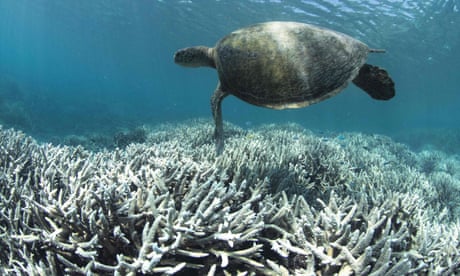
The severe bleaching of the Great Barrier Reef this year which may have killed about a quarter of the corals, has also contributed to the climate concerns of two-thirds of those surveyed, although the share drops to 55 per cent for Coalition backers, the poll found.

Voter doubts
We've had the warmest start to any year.
We've had the warmest start to any year. Photo: Leigh Henningham
According to the Climate Institute survey, only about one in three Coalition supporters think their own parties have an effective plan to combat climate change. The government says Australia will cut carbon emissions by 26-28 per cent on 2005 levels by 2030.
The Coalition is yet to announce what share of renewable energy Australia should have by 2030. The current bipartisan-backed 2020 Renewable Energy Target aims to deliver 33,000 gigawatt-hours a year of solar, wind or other renewable energy by the decades end.
Labor's policy, which would aim to cut Australia's 2005-level carbon emissions by 45 per cent and derive 50 per cent of electricity by 2030, is considered effective by only 40 per cent of Labor supporters, the Climate Institute survey found.
The Greens support cutting emissions by 63-82 per cent on 2005 levels by 2030 and net zero pollution by 2040.
"Our research shows that all our political parties need to do more to develop policies that not only build credibility but also build community and investor confidence," John Connor, chief executive of the institute, said.
The Lowy survey also found significant support for renewable energy, with 88 per cent of those polled saying use of fossil fuels "is in decline around the world and Australia should invest more in alternative energy sources or risk being left behind". (See chart below.)


While almost four in five Australians think we should cut reliance on fossil fuels, a slim majority - or 53 per cent - said Australia should continue to use and export them "to keep our economy strong".
"Our poll results over the last two years confirm that most Australians are looking for a future beyond fossil fuels, but there are deep divisions over how to achieve this," Alex Oliver, the poll's director, said.
While only 15 per cent of those polled by Lowy found climate change to be "not important", that ranking was enough to push it down to equal eighth of 10 "important issues facing Australia", on a par with immigration and just behind refugees and asylum seekers. Education and health topped the list.

Links

Business And Academic Leaders Urge New Conversation About Coal-Free Future

The Guardian - 

Leadership forum hears of 'huge gap' between experts' advice on phasing carbon out of the economy and public willingness to go along with that advice
Policy experts at a leaders forum in Canberra say Australia will inevitably decarbonise its economy, and the sooner the better.
Policy experts at a leaders forum in Canberra say Australia will inevitably decarbonise its economy, and the sooner the better. Photograph: Dave Hunt/AAP
A group of business and academic leaders have bemoaned the "huge gap" between what experts say ought to be done to decarbonise Australia's economy and the public's willingness to accept such a policy. They want Australia's leaders to restart a conversation after the federal election about the need to transition the economy towards renewable and cleaner energy.
They also say the public may not realise it but a carbon price has already been built into Australia's economy with the Turnbull government's decision, at the Paris climate conference last year, to reduce emissions to 26% to 28% on 2005 levels by 2030.
The Coalition and Labor must stick to that target, they say, so businesses can make the long-term investment decisions that will eventually see coal phased out of Australia's energy mix.
The Australian National University's leadership forum, held over Monday and Tuesday, convened talks on a range of topics, including the rise of mega-corporations, employment prospects in modern capitalism, and the likelihood of political reform in China.
But a session on energy and climate change heard policy experts venting frustration about the state of Australia's climate change debate.
The conversation was led by: Jennifer Westacott, the chief executive of the Business Council of Australia; Grant King, the managing director of Origin Energy; Frank Jotzo, the director of Climate Economics; Tania Constable, the chief executive of the Cooperative Research Centre for Greenhouse Gas Technologies.
The session also heard from economists David Gruen and Warwick McKibbin, the chair of the Clean Energy Finance Corporation, Jillian Broadbent, and the managing director of Australian Ethical Investment, Phil Vernon.
They agreed Australia would inevitably decarbonise its economy and it was in everyone's interest to do so sooner rather than later.
There was frustration about the gap between what they knew had to be done, and the public's willingness to accept certain instruments of climate change policy.
They said the public had been too easily spooked by politicians or the media rebranding the discussion of a carbon price – which the public says it wants – as a discussion about a carbon tax.
"Last time we had this discussion with the community, people were bewildered by this," Westacott said.
"So 60% of people said were saying they wanted a price on carbon until someone calls it something else, and then they don't like it.
"So how do we ... cross this divide?"
Jotzo said Australia's experts had failed to convince voters about the need to adapt to climate change because they were using technocratic language.
The discussion should start focusing on the reality of what adaptation would mean, he said, starting with an admission that Australia was taking the Paris agreement seriously which means "no more coal in the electricity sector".
"That's a major transition, and that is the debate that needs to be had with the Australian public," Jotzo said.
"It's not about the precise instruments – leave that to the technocrats. It's about the transition."
King said if the 26% to 28% target from Paris was bedded down, Australia would have a carbon price built into its economy whether the public knew it or not.
He hoped this would happen because it would start to phase out coal-fired power stations from the energy mix, a situation he was preparing for.
"No one's set a carbon price but they have set a carbon target," he said. "We just back-solve [from that] and say what's the cost of achieving that target? That's the implied carbon price.
"We are permitting and contracting and building utility-scale solar, because we think it's a very safe decision given all the costs ... [But] our risk is a political risk that the target doesn't stick.
"If we solve the 26 to 28% target and that sticks, if they have bipartisan political commitment at a minimum ... if we solve and we run forward our market-based models against that decision, coal will come out.
"And it has to come out because you cannot hit that 26-28% [target] without substitution of low-emission, effectively renewable [energy]. And when that happens coal economics deteriorate."
Ken Baldwin, director of ANU's Energy Change Institute, said there were "clear points of difference" between the climate change policies of the Coalition, Labor and the Greens.
"However, we're not hearing anything about it on the airwaves," he said. "It's ceased to be a point of discussion."

Links

Political Leaders Urged To Take Action On Climate Change And Prevent Devastation To Regional Economies

ABC Rural - Bridget Fitzgerald

A dry sheep farm in Tasmania in 2011. (ABC News: Cate Grant)
A signatory to an open letter calling for climate change action says regional Australia is going to bear the brunt of its damaging effects.
More than 20 prominent Australian scientists, community and business leaders signed an open letter in The Age newspaper on Thursday to declare a climate emergency.
The letter was addressed to those appointed to the new Federal Parliament after the July 2 election and called for "an immediate ban on new coal and gas developments" and an "emergency-speed transition" to zero emissions.
Environment Victoria chief executive Mark Wakeham was one of the letter's signatories, who said climate change would devastate rural and regional communities unless political leaders take action.
He believes regional economies are already feeling the effects of a warming climate.
"Places like the Great Barrier Reef or the Murray-Darling Basin are damaged by climate change," he said.
"So we think the next Australian government should be declaring a climate emergency and facing up to the fact that we need a credible plan to deal with global warming."
We need to look at [climate change] as a threat to our existing industries and our existing way of life.
Mark Wakeham, Environment Victoria
Mr Wakeham said severe weather events as a result of global warming would have a major effect on primary production, unless there was political will to take action on climate change.
"We're going to see more frequent and more severe drought but also more frequent and more severe flooding."
He added Australians "needed to stop looking at this as an environmental issue".
"We need to look at it as a threat to our existing industries and our existing way of life."
Mr Wakeham said the Coalition "did not have a credible plan" to reduce emissions, and Labor had "a more credible plan" but, added both parties lacked urgency on the issue.

Links

Lethal Heating is a citizens' initiative