Thursday, October 13, 2016

Australia’s Car Industry Ignored The Elephant In The Room: Carbon Emissions

The Conversation - 

Australia’s car industry got left behind on emissions standards. Exhaust image from www.shutterstock.com
Ford’s closure of its Geelong manufacturing plant on Friday is part of a broader story about Australia’s manufacturing sector. But one side of this story has so far been overlooked: the role of Australia’s lax attitude to vehicle emissions.
Globally, car manufacturers are taking climate action seriously by significantly improving fuel economy, in turn reducing a car’s CO₂ emissions.
Repeated policy failure and a marked reluctance by the Australian car industry to shift from manufacturing mostly high CO₂-emitting vehicles contributed to Ford ending operations. The Australian car industry ignored the elephant in the room.
This effectively contradicts former-Treasurer Joe Hockey’s assertion that climate change has no impediment on economic growth, as Australia gets left behind in a world embracing action on climate change.

Warning signs
In 2008, the international community launched the Global Fuel Economy Initiative (GFEI) to facilitate and promote large reductions of greenhouse gas emissions by establishing a global target to improve fuel efficiencies. The target included a 50% improvement in vehicle fuel economy in new light duty vehicles by 2030. The GFEI offered to assist successive Australian governments in the development of better fuel policy.
European car manufacturers made slow progress and continued manufacturing larger high-performance vehicles. But in 2009, the European Parliament introduced CO₂ emission standards of 130 grams of CO₂ per km by 2015 and long-term target of 95g CO₂ per km by 2021.
By 2013, 80% of global passenger vehicle sales were subject to CO₂ standards. Complementary economic measures were introduced to support the standards by influencing consumers into choosing low CO₂-emitting vehicles.

Australia left behind
In 2005, the Australian car industry adopted voluntary targets of 222g CO₂ per km by 2010. This wasn’t in line with international standards and masked the poor fuel efficiency of locally manufactured vehicles as shown in the chart below.

Average CO2 emissions (grams per kilometre) for new vehicles
With voluntary standards, the local car industry was under no pressure from the government to improve its fleet’s fuel efficiency. The Australian car industry failed to meet the target. Average emissions from cars manufactured in Australia in 2010 were 247g per km – 11% higher than the voluntary target.
In April 2012, the Australian government mandated that 100% of all Commonwealth vehicles would be Australian made. This explicitly excluded acquiring vehicles on the grounds of “environmental considerations, such as fuel efficiency”.
In 2013, the government announced a Productivity Commission review of the industry that would examine international competitiveness, exports, trade barriers and long-term sustainability. At this point the local car industry announced its decision to abandon manufacturing in Australia. As a result, the commission didn’t examine the impact of climate policy measures on the local car industry, although it did suggest that environmental policies could serve as a barrier to international trade.
Industry actors also criticised other measures such as vehicle or excise taxes that it said would impede Australian exports.
For example, Ireland’s 36% vehicle tax on new light passenger vehicles with emission greater than 225g per km would apply to most Australian-made vehicles. Such measures support emission standards, and are imposed on all vehicles sold (whether imported or manufactured domestically) for the protection of the environment. They have been effective in shifting consumer demand to fuel-efficient vehicles.
Under the rules of the World Trade Organization national governments can ban imports that do not comply with product standards, if they do not constitute non-tariff barriers. To meet this exception, the policy must be measurable (such as an excise tax based on CO₂ emissions), apply to all goods sold (domestic and imports), and contribute to the fight against climate change.
The adoption of regulatory standards and supporting economic instruments, meant car manufacturers/importers will not be able to sell as many larger high CO₂-emitting vehicles. To sustain economic production runs, manufacturers will seek to sell these vehicles to countries with lenient or no standards, such as Australia, which then become “dumping grounds”.

Government and industry caught off guard
In 2014, the Abbott government supported the G20 Energy Efficiency Action Plan, which included “improving vehicle energy efficiency and emissions performance” by strengthening domestic standards in vehicle emissions and vehicle fuel efficiency. Despite the plan, there was no recommendation to introduce emissions standards in the government’s 2015 Energy White Paper.
Successive Australian governments, trade unions, and industry actors have all failed to appreciate the impact of climate action on the economic interest of the local car industry. The Australian government is now examining fuel efficiency standards and complementary measures, but will only report next year. It’s a little too late to save the industry.
Forcing the local car industry to meet similar standards would have been to its benefit and would have outweighed the costs of being shut out from the market. As more global car manufacturers began adopting emissions standards more pressure was placed on car manufacturers to remain competitive.
Car manufacturers were known to lobby their governments to adopt European emission standards to increase their competitiveness and restrict importation of high CO₂-emitting vehicles. The former Vice-Chairman on General Motors, Bob Lutz, said the fall of GM in the United States was largely a result of a terrible government policy on fuel economy, which gave its competitors, the Japanese automakers, a free pass.
The European Commission stated that if a car industry fails to embrace a shift towards more fuel-efficient vehicles, it will continue to be structurally unprepared for the future.
To compete globally, the Australian car industry had to decide whether to embrace cleaner technology to meet the standards of its importers, or abandon the export market. Unfortunately for the workers, Ford chose to close its operations on October 7, and GM Holden and Toyota will close by the end of 2017.

Links

5 Places To Visit Before They're Lost To Climate Change

Huffington Post - Tyler Moss

As ice caps melt and wildfires rage, scientific assertions that climate change is occurring at a rate faster than formerly expected have become manifest in locales around the world. The effects of global warming have put many of the world's prime travel destinations at risk of suffering serious consequences, with some facing the prospect of vanishing entirely. From the Amazon, to Mumbai, to Napa Valley, here are places to add to your itinerary before they change irrevocably. Photographs from Getty.
1. The Great Barrier Reef
Spanning more than 1,400 miles, the Great Barrier Reef — located off the northeast coast of Australia — is the largest coral reef system in the world. Replete with marine life, the reef draws slews of scuba divers each year. But rising ocean temperatures have caused coral bleaching in vast portions — a condition in which the coral turns white and is prone to mass die-offs. Recent studies have revealed that more than 90 percent of the Great Barrier Reef has experienced bleaching to some degree.

2. The Alps
This European mountain range has long served as a Shangri-La for skiers, stretching across eight countries and providing some of the most sought-after slopes in the world. With increasing temperatures, however, significant snowmelt continues to shorten the season for winter sports. Many resorts have already begun to compensate by offering spa treatments and outdoor activities like horseback riding or tennis to lure more off-season visitors.

3. The Rhone Valley
Situated in the south of France, the Rhone Valley is among the most vaunted winemaking regions in the world. Covering a corridor of more than 120 miles in length, visitors could spend a full week driving from one tasting to the next, admiring the sprawling vineyards surrounded by mountainous backdrops. But as global temperatures rise, making the environment inhospitable for grapevines, many experts predict production will shrivel and winemakers will creep further north toward cooler climates.

4. Venice
It's impossible to walk the streets of Venice without being seduced by its anachronistic charm: The Adriatic Sea coursing through its canals, the romance of a gondolier's serenade as you float beneath the Bridge of Sighs. In a place so at one with water, locals have come to expect flooding in Piazza San Marco and other parts of the low-lying city — but as ocean levels rise, Venice inches toward more serious inundation. Activists have taken on the challenge, investing in advanced flood gates and other technologies to stymie the impending swells, but only time will tell how these systems fare.
5. The Amazon
The largest rainforest on Earth, the Amazon covers roughly 40 percent of South America. Travelers will find scarlet macaws and blue poison dart frogs living side-by-side with jaguars and brown-throated sloths in the wet broadleaf rainforest. Yet despite its size, climate change has made the Amazon a fragile habitat. Extreme droughts have left tree species throughout the tropical jungle parched, leaving them vulnerable to large-scale dieback — as well as more susceptible to forest fires.


Links

Australia Facing Questions At UN Over Post-2020 Climate Change Stance

Fairfax - Adam Morton

Australia is facing renewed international pressure to explain what it is doing to tackle climate change, with a United Nations review finding its emissions continue to soar and several countries calling for clarity about what it will do after 2020.
Countries including China and the US have put more than 30 questions to the Turnbull government, asking for detail about how Australia will meet its 2030 emissions target and raising concerns about a lack of transparency over how the government calculates and reports emissions.
It comes as the federal government has been facing calls at home - sparked by its own criticism of ambitious state renewable energy targets - to reveal what it would do on climate change and clean energy beyond 2020.
An expert review commissioned by the UN found, based on data submitted by Australia, its emissions would be 11.5 per cent higher in 2020 than they were in 1990.
Industrial emissions – not counting those from forestry and land-clearing – were expected to rise 33.5 per cent over the three decades.
The reviewers found a recent Australian report lacked transparency about how it estimated its future emissions. And they noted the report failed to mention the abolition of the carbon price scheme, or explain what impact scrapping the policy would have on it meeting targets.
Prime Minister Malcolm Turnbull addressing the Paris climate summit last year. Photo: AP
Australia's previous report two years earlier put the carbon price at the centre of its response to global warming.
Separately, countries have put questions that Australia is expected to answer before the end-of-year climate summit in Morocco, including:
  • China wanting to know what the repeal of the carbon price has done to Australia's emissions, and whether it has considered other approaches to carbon pricing.
  • The US asking whether Australia is introducing any longer-term policies that will help it meet its 2030 target that it may not know about.
  • New Zealand following up a pledge Australia made to release modelling this year of what its emissions would be in 2030.
Alden Meyer, of the US-based Union of Concerned Scientists, said the review and questions put to Australia made it made clear it was yet to convince the world it was up to playing its part in meeting the goals agreed at the Paris climate summit.
Hazelwood brown coal power plant in Victoria's Latrobe Valley. Photo: Arsineh Houspian
He  said those goals implied reaching net zero emissions by mid-century. The Paris agreement will take effect next month after the world's biggest emitters ratified the deal more quickly than expected.
"The US, China, Europe and other major economies are clearly making low-carbon development a priority," Mr Meyer said.
Average global temperatures from 1880 to 2016 (covering January to June). Photo: NASA
"There will be diplomatic and economic consequences for any country that's perceived as not joining in this effort... That's a risk that Australia shouldn't, and doesn't need to, take."
Physicist Bill Hare, chief executive of Climate Action Tracker and an adviser to developing countries at climate negotiations, said the questions asked of Australia showed deep scepticism and frustration beneath a diplomatic veneer.
"It is very strange that the government had put forward no projections, which are the sine qua non [essential ingredient] of this area of policy," he said.
"It is as if the Treasury produce a report for the International Monetary Fund with no future numbers in it. It raises alarm bells."
A Climate Action Tracker analysis found Australia's emissions were headed to be more than 27 per cent greater than 2005 levels in 2030.
The Coalition's emissions targets are a 5 per cent cut by 2020 compared with 2000 levels, and a 26-28 per cent cut by 2030 compared with 2005 levels. It has committed to reviewing its climate policies next year.
Environment and Energy Minister Josh Frydenberg said Australia was making an important contribution to the global effort on climate change, and was on track to beat its 2020 Kyoto Protocol target.
He said Australia was in the process of ratifying the Paris agreement and its 2030 target was one of the highest in the G20 on a per capita basis.
"Whether it's through the ambitious set of targets we took to Paris or our significant levels of investment in renewables, we have a strong suite of policies to manage our transition to a lower emissions future," he said.
The UN expert review suggests Australia's emissions are likely to be higher in 2020 than in 2000, but this does not necessarily mean it would fail to meet its 2020 target. Under Kyoto Protocol rules, the target is measured against average emissions between 2013 and 2020.
The questions Australia is facing are part of an assessment introduced to boost transparency about climate policies. Australia received more questions than the other countries examined in the current assessment round, including most of Europe and New Zealand.
Some questions submitted included praise for what Australia is doing. Japan was impressed that Australia updates emissions projections nearly every year; Brazil offered congratulations that it had listed 26 actions to cut emissions, up from six in a previous report.
But Jake Schmidt, international program director with the US National Resources Defence Council, said many countries were questioning the disconnect between Australia's international targets and what it was doing at home, including expanding coal mines and cutting its incentives for renewable energy.
Climate Institute deputy chief executive Erwin Jackson said the scrutiny Australia was facing was an example of a new global reality.
"The world is moving inexorably into a future that will be driven by clean energy," he said.
Liz Gallagher, of British think tank E3G, said Australia had been a force for good at the Paris summit last December, but it needed to have a transparent and credible plan.
"Words are important but action is what matters," she said.

Links

Wednesday, October 12, 2016

Media Blackout: Aunty’s Assault On Renewables


Reporting that renewable energy caused the blackout in South Australia was led by the national broadcaster. Ben Eltham says the ABC was wrong, and reviews the fallout in the wake of the storm.
On September 27, a vicious low pressure system developed in the Great Australian Bight. As it rotated, the ‘mid-latitude cyclone’ sucked cold air up from the frigid southern ocean, pushing a cold front towards South Australia with 100 km/h winds.
The storm smashed into South Australia the next day, felling trees, ripping off roofs and buckling high-voltage transmission lines. There were at least two local tornados, including one at Blyth.
Shortly after 4.18pm, the entire South Australian electricity grid went down. Widespread damage to the network, including to several 275kV transmission towers, led to the grid overloading and shutting down.
In the wake of the shut-down, the national grid operator AEMO worked frantically to restart the system. It took several hours before the grid got back up and running again; local damage meant some homes were without electricity for days.
But if you thought the weather was severe, the political storm that enveloped renewable energy in the wake of the blackout was even more damaging.
That’s because the blackout provided the perfect opportunity for the enemies of clean energy in the Coalition to launch an unprecedented assault against renewables, even before the full details of the blackout were known.
Anti-renewable rhetoric is nothing new from the Coalition. But what surprised many was the enthusiastic support of the ABC.
Just hours after the storm had struck, the ABC’s political editor Chris Uhlmann was on the airwaves, blaming the blackout on South Australia’s relatively high concentration of renewable energy.
ABC’s chief political reporter, Chris Uhlmann.
Apparently briefed by both government figures and Nick Xenophon, Uhlmann reached an editorial judgment even before the wind had stopped howling. Leveraging the ABC’s cross-platform capabilities, Uhlmann appeared on radio, TV and online in the hours after the blackout.
His article on the morning of September 29 sounded a clarion call against the spectre of renewables that he claimed were haunting Australia’s electricity grid.
“The key question is whether that state’s heavy reliance on wind turbines might have increased the risk of a state-wide blackout,” Uhlmann thundered. “Renewables are the future but, today, they present serious engineering problems,” he warned, adding a nice twist for the climate denialist right: “To deny that is to deny the science.”
Uhlmann even warned of nation-wide blackouts, unless renewables were addressed. “The grid is being transformed, and that transformation needs to be managed sensibly, or the entire nation might go to black.”
At the time he wrote that article, Uhlmann had no credible evidence for these claims. It’s hard to know how he could possibly have known, in fact. If he did have private briefings from AEMO, Electranet or the South Australian government, he did not disclose them.
The night before, in a media conference, South Australian Premier Jay Weatherill had sheeted home the grid failure to the storm. “Essentially what happened is a massive set of power was removed and when that happens it trips the system,” he told the media on Wednesday evening.
In a statement released an hour before Uhlmann’s September 29 article was published, AEMO also quite clearly stated that the grid was taken down by a cascade of transmission failures that began with fallen towers in the state’s north.
Initial investigations have identified the root cause of the event is likely to be the multiple loss of 275 kilovolt (kV) power lines during severe storm activity in the state.These transmission lines form part of the backbone of South Australia’s power system and support supply and generation north of Adelaide. The reason why a cascading failure of the remainder of the South Australia network occurred is still to be identified and is subject to further investigation.
Uhlmann’s article did not initially mention either Weatherill’s remarks, nor the AEMO statement. Later that day, it was updated to include them.
A delighted government leapt on the assertion that renewable energy might be to blame. Senior ministers, and then Malcolm Turnbull himself, made statements questioning the role of wind generation in the event, and attacking state government renewable energy policies.
On October 4 and then again two days later, Uhlmann wrote further ‘analysis’ pieces for the ABC. He again blamed South Australia’s renewable energy policies for the blackout.
Australian Prime Minister Malcolm Turnbull. (IMAGE: Veni, Flickr).
On  October 6, he even adopted the position of a religious ‘heretic’, warning that “if those who claim to be friends of renewables continue to respond to any criticism with hysterics, then they will be responsible for ensuring the budding renewable industry suffers irreparable reputational damage.”
Uhlmann’s rhetorical flourishes made for great reading. They came complete with some impressive technical details about “synchronous” and “asynchronous” energy supply sources. It was all grist for the mill of a hungry media cycle.
But Uhlmann was wrong.
New Matilda approached a number of noted energy analysts and grid consultants in an attempt to verify Uhlmann’s claims. Their responses ranged from negative to derisory.
Respected energy analyst Bruce Mountain is the Director of energy consultancy CME. He told us flatly that “there is no doubt that absent the weather this would not have occurred”.
“The falling of the power lines, and consequential loss of  generation, caused the tripping of the interconnector,” he said in a phone interview.
Mountain said he could not understand Uhlmann’s claims about asynchronous generation by wind farms.
“There is a rectifier in every wind turbine which takes direct current out of the wind-powered generator, it is rectified into an AC signal and it goes into the grid. The power electronics ensure a constant frequency of oscillation of the current from the wind generator, irrespective of wind speeds.”

Mountain added that Australia does need to ensure back-up capacity to address the intermittency of wind and solar. Renewable sources (hydro and pumped storage) and storage devices such as batteries, smarter grid systems, and demand-side management are likely to be valuable in this back up.
“Wind is a huge energy resource just about everywhere, it’s a well-established technology,” Mountain said.
Mountain also said the investigation into the events of South Australia would consider the operation of the power system and market. “Might the network failures and consequential impact have been anticipated?” he asks.
At UNSW, the Institute for Environmental Studies’ Mark Diesendorf is widely known as a pioneer in the research of renewable energy systems in Australia.
“Yes, it was a weather event,” he told New Matilda. “We don’t now what would have happened if there hadn’t been any wind turbines, but it’s a pretty reasonable assumption to make that the whole system would have collapsed anyway – three of its main transmission lines were down.”
“There does have to be continuing balance between supply and demand, so to that extent Uhlmann was just stating the obvious, but under most conditions with lots of renewables you can maintain the balance,” he explained.
“I was very disappointed with the ABC’s coverage,” Diesendorf said. “It certainly created the impression that wind power was the cause of all our problems, and there’s not a shred of evidence that has been produced [for that]yet.”
“They should have been taking a more critical view of the statements of the government that has proven it is hostile to renewable energy,” he argued.
Dr Hugh Saddler is the Senior Energy Consultant for energy engineering firm Pitt & Sherry. He contradicts Uhlmann’s assertion that “the state’s heavy reliance on wind generation might have made its grid more vulnerable to a blackout.”
“No,” he wrote in an email in response to our questions. “There was enough local synchronous generation on line in South Australia at the time, plus Heywood, to provide more than enough inertia and also FCAS (Frequency Control Ancillary Services). AEMO has been doing reports each year for several years calculating how much synchronous generation will need to be online at all times, plus Heywood.”
A file image of a storm in Adelaide, in January 2014. (Andy Watson, Flickr)
Saddler describes Uhlmann’s descriptions of synchronous and asynchronous supply as “deeply wrong” and “a classic manifestation of Alexander Pope’s aphorism, ‘a little learning is a dangerous thing …’”
Saddler gives perhaps the best succinct explanation of what happened on September 28: a cascade of events triggered by the loss of transmission towers.
“Had the storm not taken out the whole of one 275kV line and the northern segment of two others (leaving just one fully operational), there would have been no blackout,” he wrote. “The final triggering event was the loss of output from six wind farms, presumably because they tripped out because of their protection settings.”
“The load then switched to the Heywood Interconnector (within a fraction of a second), which was overloaded and tripped, followed immediately by the two gas generators online at the time.”
Saddler explained that the wind turbines shut down to protect themselves in the wake of the transmission failure – a fact confirmed by Neoen Australia yesterday. “There is probably an issue about the protection settings being ‘too conservative’,” he added.
Like Mountain, Saddler argues that the real lesson here was the need for more distributed energy supply, particularly batteries and hydropower. “Apart for storing energy for short periods, batteries are perfect for providing system inertia.”
Other energy experts quoted in the media – including by the ABC itself – have come to similar conclusions. Gizmodo carried interviews with engineering professors Ken Baldwin and Roger Dargaville, both of whom stressed the weather as the cause, not the energy supply mix. Baldwin told Gizmodo’s Rae Johnstone that there was “almost unanimity” on this point.
Finally, a number of ABC outlets themselves carried interviews with the Grattan Institute’s Tony Wood. Wood is known to be a prominent sceptic of high renewable energy targets. But even he maintained last week that “there’s no evidence to suggest this was caused by too much wind power, or the dependence on wind power.”

UNFORTUNATELY for the accuracy of the ABC’s coverage, Uhlmann’s reporting set the tone for the national broadcaster as it covered the South Australian blackout, as an analysis of the ABC’s coverage establishes.
A content analysis of the ABC’s blackout reporting reveals a clear bias against renewable energy in the ABC’s reporting of the blackout.
New Matilda analysed all ABC content since September 28 on the blackout, using the Factiva news database and the ABC’s own search engine. A total of 54 articles were examined between September 28 and 11 October. Each article was read or listened to, and coded according to angle and its attitude towards renewable energy.
Of the 54 articles, 23 blamed renewable energy for the blackout, or led with claims by the government that blamed renewables for the outage. In contrast, there were 12 that were either positive about renewable energy, or that reported that renewable energy was not the cause. 19 were neutral.
Perhaps the most common thread in ABC coverage was to lead its reports with anti-renewable attack lines from the Coalition or South Australian Senator Nick Xenophon.
The ABC ran at least 11 separate articles covering politicians blaming the blackout on renewable energy, including comments from Malcolm Turnbull, Josh Frydenberg (several times), Greg Hunt, Barnaby Joyce, and state opposition leader Steven Marshall. The ABC’s Fran Kelly even interviewed Ceduna mayor Alan Suter on his views about renewable energy.
On September 29, the ABC covered Prime Minister Malcolm Turnbull’s attack on state renewable energy policies, directly linking the blackout to renewable energy. Stephanie Anderson’s report led with the attack on renewables.
“Prime Minister Malcolm Turnbull has criticised the state Labor governments, saying they have prioritised lower emissions over energy security, following a state-wide blackout in South Australia yesterday.
South Australia’s entire power supply was cut off when wild weather toppled dozens of transmission towers and tripped the interconnector with Victoria.
Mr Turnbull said measures targeting lower emissions had to be consistent with energy security.
He told reporters in Tasmania this morning that intermittent renewable energy sources posed a ‘real threat’ for energy security.
Later in the piece, Anderson cautioned that “experts have dismissed suggestions a reliance on renewable energy was to blame for the outage.” But this was well down the page, and underneath a subheading that stated “Concern raised over renewable energy.”
This kind of reporting, in which government attacks against renewable energy were reported prominently, dominated the ABC’s coverage of the blackout.
Another good example was this article on October 3 by the ABC’s Alexandra Beech. “Federal Industry Minister Greg Hunt has blamed the South Australian Government for exacerbating last week’s state-wide power outage,” the article led, reporting Hunt’s recent opinion piece in Fairfax Media attacking the South Australian government’s energy policies.
After running Hunt’s attack lines at the top, it quotes Labor’s Bill Shorten second, and the Greens’ Richard Di Natale at the end.
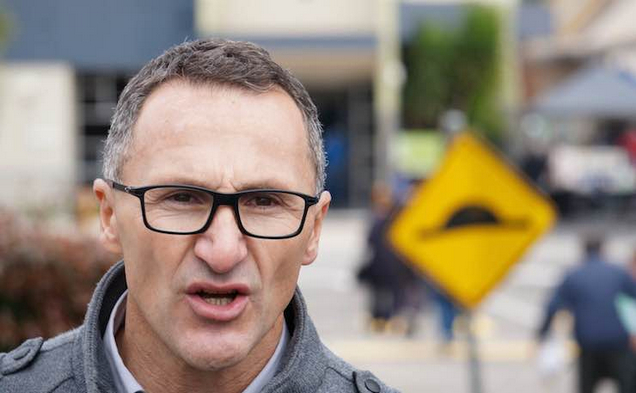
Greens leader Richard Di Natale. (IMAGE: Thom Mitchell)
A similar example was the ABC’s online explainer, published on September 29.
The article was entitled “SA power outage: How did it happen?” Again, the article leads by questioning whether renewable energy is to blame.
“South Australia and its 1.7 million residents were left without power on Wednesday evening following severe storms.”
So have recent events and a focus on renewable energy created the ‘perfect storm’ for a state-wide blackout?”
The explainer quotes South Australian Premier Jay Weatherill first, but then goes on to extensively quote Xenophon and Josh Frydenberg, both attacking the state’s renewable energy policies.
David Lipsom’s Lateline report on the blame game followed the pattern. The report was introduced with the following lead: “A political debate is underway about how best to integrate renewable energy into Australia’s power grid following a state-wide blackout in South Australia.”
But the report itself contradicted this. Lipsom spoke to a number of experts, including Bruce Mountain, all of whom reiterated that renewable energy was not to blame.
Days after the blackout, and even after the AEMO interim report had been released, the ABC was still framing its reportage by questioning renewable energy.
On October 6, Weatherill was interviewed by the ABC’s Michael Brissenden. This is how Brissenden introduced the segment:
As [Tom Iggulden] explained, the dramatic blackout in Australia last week has injected new energy into the political debate over the transition to renewables.
The Federal Government has warned the states that their targets are too ambitious, and a meeting of state energy ministers will be urged to look at a more national approach.
A preliminary report from the Australian energy market operator yesterday suggested that a drop in generation at six wind farms during the storm may have contributed to an overload of the crucial interconnector with Victoria.
I spoke earlier to the South Australian Premier, Jay Weatherill.
Weatherill went on to stress the findings of the AEMO report, and to argue that the state’s energy mix was not to blame for the blackout. Brissenden was having none of it, asking repeatedly whether wind farms were to blame.
There was some balance. A notable counter-example to the prevailing trend was this article by Matthew Doran, entitled “SA weather: No link between blackout and renewable energy, experts say.” In contrast to the reporting from Uhlmann and others, Doran actually approached engineers and energy analysts like the Grattan Institute’s Wood, who told him that renewables were not to blame.
ABC political reporter Chris Uhlmann.
But the line from Uhlmann was consistent throughout. In addition to his appearances on TV and radio, he wrote three opinion pieces in the wake of the blackout. All blamed renewable energy for the outage.
The ABC’s coverage of the blackout is a good example of how a dominant frame, once established, can exert a long-lasting influence over media coverage of a particular event.
On October 6, the ABC’s AM program carried an interview with US entrepreneur Ilen Zazueta-Hall. Zazueta-Hall was generally supportive of renewables (although warning about the rise of so-called ‘dumb solar’), but the article was once again introduced with a lead questioning the role of renewable energy in the blackout:
Yesterday’s release of the preliminary report into the state-wide power outage after last week’s super storm in South Australia hasn’t stopped argument over the role of renewables – especially wind energy – in the crisis.
The report – by the Australian Energy Market Operator, or AEMO – said that the blackout was ‘triggered’ by the extreme weather, but there were still questions to be answered about how each component of the electricity system responded.
A leading US solar energy developer says that the South Australian crisis will drive the roll-out of even more renewables.
There were other angles to pursue. Matthew Doran’s article suggested one possible way to report on the blackout: by speaking with experts and to AEMO, and in reference to the established facts on the public record such the interim report.
Another interesting aspect of the ABC’s coverage is what it has ignored. Buried in the AEMO interim report was an intriguing suggestion that the electricity grid’s backup power generation systems had failed.
These back-up generators are called “System Restart Ancillary Services.” There were two supposedly on duty on September 28. Both were fossil-fuel generators. Both failed. AEMO’s report says it was unable to start up the state’s main gas generator at Torrens Island, because the two ‘black start’ generators didn’t work as they should have.
Ironically, the reason for this was because of damage from the storm. “SRAS provider 2 was not able to provide black start capability due to the damage caused by the storm to its auxiliary diesel units which are necessary for the gas turbine to provide restart capability,” AEMO’s report notes on page 19.
This is not a trivial matter – AEMO pays electricity generators millions of dollars for the SRAS back-up service. But in the crucial moment, neither of the two ‘black start’ generators could be brought online.
IMAGE: Chuck Coker, Flickr.
No  less a figure than Ross Garnaut pointed this out last week. Referring to the failure of the back-up generators, Garnaut questioned what had happened on 28 September. “There are some quite big questions about why the National Electricity Market systems did not work as they were designed to,” Garnaut told reporters in Adelaide, in remarks that were picked up by Renew Economy and the Australian Financial Review, but not by the ABC.
We’ve heard nothing about the failure of the back-up generators from the ABC or Chris Uhlmann so far.
The ABC’s coverage of the South Australian blackout matters because, as taxpayers and citizens, Australians require independence and accuracy from the national broadcaster.
Accuracy is central to the ABC’s mission. It is enshrined in 80 years of tradition, as well as formal Editorial Policies.
As the ABC’s editorial policy states:

The ABC has a statutory duty to ensure that the gathering and presentation of news and information is accurate according to the recognised standards of objective journalism. Credibility depends heavily on factual accuracy. 
But there were grave inaccuracies in Chris Uhlmann’s reporting of the South Australian blackout, and those inaccuracies leached into the ABC’s broader coverage.
There are shades here of the ABC’s repeated failures to adequately cover the unfolding infrastructure disaster of the National Broadband Network. Once again, political considerations appear to have trumped sober assessment and diligent factual reporting of a complex policy issue.
As New Matilda revealed in January, the ABC’s senior management pressured its former technology editor Nick Ross to write anti-Labor articles on broadband policy in 2013. Ross had written a prescient 11,000 word article that predicted many of the technical problems and cost blowouts that the National Broadband Network is now encountering. Ross’ highly critical appraisal of Coalition broadband policy had angered then-Communications spokesperson Malcolm Turnbull.
Ross eventually left the ABC, after being sidelined by ABC management. The ABC continues to deny that any editorial policies were breached.
The ABC is certainly still capable of sound, substantive reporting. But the Uhlmann line on renewables reveals another, more disturbing sort of journalism at Aunty: pre-determined, ideologically coloured, and thinly-sourced. In other words, exactly the sort of journalism that the ABC is often criticised for by conservatives.
Uhlmann was right to point out that the blackout was a significant event. He was right to ask how that blackout happened, and what the implications are for Australian energy policy.
But on the most important aspects of the South Australian blackout, Uhlmann was wrong.
The entire nation is not about to go black.
Asynchronous power was not the issue. The blackout was not caused, or exacerbated, by renewable energy. It was not caused by the number of wind turbines connected to the South Australian grid.
It was caused by the storm.

Links

Scientists Discover New Additional Culprits For Global Warming

Daily News & Analysis

Methane-producing micro-organisms have been discovered in Australia, which could be contributing to climate change.
(Getty Images)
Scientists have discovered two new clusters of microorganisms contributing to climate change, the second major breakthrough in 12 months towards mapping the tree of life.
The previously unknown group of methane-metabolising micro-organisms appeared to be ancient and widespread in nature, said Gene Tyson from the University of Queensland in Australia.
He said methane-producing and consuming organisms played an important role in greenhouse gas emissions and consumption, contributing to climate change.
"The environments in which the new methane-producing cluster is found includes wetlands, lake and river estuary sediments, mud volcanoes and deep-sea vents," said Tyson.
"This research expands our knowledge of diversity of life on Earth and suggests we are missing other organisms involved in carbon cycling and methane production," he said.
Last year Tyson's lab was part of an international project which discovered a new group of methane-metabolising organisms called Bathyarchaeota, also found in a wide-range of environments. "Traditionally, these type of methane-metabolising organisms occur within a single cluster of microorganisms called Euryarchaeota," he said.
"We have now found two new clusters of microorganisms, leading us to wonder how many other types of methane-metabolising microorganisms are out there."
The newly discovered group of methanogens so far contained five genomes but there could well be more, said lead author Inka Vanwonterghem from the Australian Centre for Ecogenomics.
"There are many questions we will need to answer in future, including 'can these organisms be grown in the lab and at large scale to produce methane, what is their role in the global carbon cycle and climate change, and what is the evolutionary history of these organisms?'" she said.
The research was published in the journal Nature Microbiology.

Links

German Lawmakers Vote to Ban the Internal Combustion Engine

Gizmodo - Rhett Jones

Photo: AP
The modern internal combustion engine first came from Germany and now Germany wants to put a nail in its coffin.
The Bundesrat has passed a resolution to ban the ICE beginning in 2030.
Germany’s Spiegel Magazine reported this morning that the country’s top legislative body was able to reach a bi-partisan agreement that hopes to allow only zero-emission vehicles on EU roads in 14 years.
For the resolution to be instituted across Europe, it will have to be approved by the EU. But according to Forbes, “German regulations traditionally have shaped EU and UNECE regulations.”
Greens party lawmaker Oliver Krischer told Spiegel,
“If the Paris agreement to curb climate-warming emissions is to be taken seriously, no new combustion engine cars should be allowed on roads after 2030.”
The resolution calls on EU automakers to “review the current practices of taxation and dues with regard to a stimulation of emission-free mobility.” Creating a tougher tax burden could encourage manufacturers to push electric vehicles into production sooner, rather than later.
While larger approvals will still need to go through the legislative process, the fact that the country with the fourth-largest auto industry in the world is spearheading such sweeping change is a big sign of where we’re headed.
It’s a road paved with slow-moving politicians making incremental changes and hoping the industry will warm up to the idea of not killing us all.

Links

Tuesday, October 11, 2016

The Health Impacts Of Climate Change Are Huge And Very Real

Huffington Post - Josh Butler

Health leaders implore government to do more, from a public health standpoint.
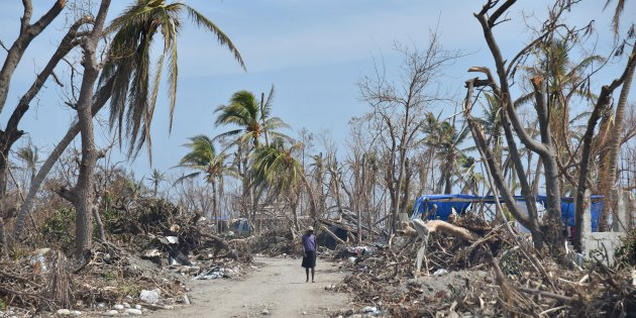
A woman in Les Cayes, Haiti, following the passage of Hurricane Matthew. AFP/Getty Images
Think of climate change, you probably think of melting polar ice caps, rising sea levels, crazy weather and environmental havoc. While the health of Planet Earth is usually the biggest factor, it's not often that the health of the human race enters significantly into the discussion.
A roundtable forum of public health leaders in Canberra hopes to change that, and to place health at the forefront of Australia's action on climate change.
The Climate and Health Alliance (CAHA), along with a number of healthcare and nursing groups, hosted the meeting of around 40 professionals in Parliament House. Assistant Health Minister Ken Wyatt, Shadow Health Minister, Catherine King, and Greens leader Richard Di Natale attended, hearing about how climate change is a "public health emergency", according to CAHA executive director Fiona Armstrong.
"There has been advocacy on climate change over several years, but we're concerned that as the issue becomes more urgent, there has been a failure to reflect the concerns of the health sector in climate policy decisions," she told The Huffington Post Australia.
"The health sector is committed to a public policy response. We'd like to work with the government to get a solution, beginning a discussion about what a public health framework would like."
Armstrong said climate change was about more than rising sea levels, that there are obvious -- and less obvious -- health implications. Continuing to burn fossil fuels for energy causes air pollution, leading to asthma and other respiratory problems; that's a clear one. Heatwaves leading to heat stroke, exhaustion and heat stress are another. However, wild and rapidly changing weather events can wreak massive devastation and cause huge health issues, such as Hurricane Matthew in Haiti and Florida just this week where more than 1000 were reported dead.
"Health impacts of climate change are very diverse. There are direct impacts and then the less direct, but it is is being described as the greatest threat to public health," Armstrong said.
"It's being emphasised by the World Health Organisation, and we're urging all governments to take action on climate change. To be frank, its a public health emergency."
People stand next to their destroyed house in Les Cayes, Haiti following Hurricane Matthew. Haiti faces a humanitarian crisis that requires a 'massive response' from the international community, the United Nations said , with at least 1.4 million people needing emergency aid. AFP/Getty Images
A recent report by CAHA found that Australia's health community thought the country was underprepared for the challenge of climate change-related health issues. It found that 52 percent of health professionals considered the government's direct action plan 'not at all effective'; 78 percent thought Australia's climate policies were not consistent with our international obligations, including the Paris Agreement; and that 98 percent agreed Australia needed to develop a national strategy on climate, health and well-being. Read the full report here.
Armstrong said the politicians attending the meeting had seemed receptive and eager to learn about the intersection of climate and health, and how to prepare Australia's health sector for the incoming climate-related issues. She added, however, that urgent action to lower emissions was the most important immediate priority.
"Mitigation is a top-line issue. Unless we're mitigating then we're not addressing the cause of the problem. Emissions reductions targets must be consistent with the science. Australia needs to accept its fair share of the responsibility, to be a good global citizen, and not be consuming the emissions budgets of developing nations who are using a range of energy systems to lift their populations out of poverty," Armstrong said.
"As a wealthy nation we've emitted our fair share in the past. We have the wealth to get our way to a zero emissions society."
"The health sector is already under considerable pressure. Climate change amplifies every risk factor there is, in every sector. Unless health sector is assisted to develop its climate responsiveness, it may become overwhelmed and unable to respond."

Links

Lethal Heating is a citizens' initiative