Wednesday, October 26, 2016

Global CO2 Concentration Passes Threshold of 400 ppm—And That’s Bad for the Climate

Time - 

Scientists say humans may need to take some carbon dioxide out of the atmosphere to stop global warming 
Steam rises from the cooling towers of the coal power plant of RWE, one of Europe's biggest electricity and gas companies in Niederaussem, Germany, on Mar. 3, 2016. Wolfgang Rattay—Reuters 
The average level of carbon dioxide in the atmosphere across the globe passed 400 parts per million (ppm) last year, a symbolic and worrying milestone in growth of manmade climate change, the World Meteorological Organization (WMO) confirmed Monday.
The carbon dioxide concentration is unlikely to dip below the 400 ppm mark for at least several decades, even with aggressive efforts to reduce global carbon emissions, according to the WMO report, which confirms similar findings reported last month. Carbon dioxide can last in the atmosphere for thousands of years without efforts to remove it.
“The year 2015 ushered in a new era of optimism and climate action,” said WMO Secretary-General Petteri Taalas, referring to the landmark Paris Agreement to address climate change. “The real elephant in the room is carbon dioxide, which remains in the atmosphere for thousands of years and in the oceans for even longer.”
Governments from across the globe committed to cutting their carbon dioxide emissions in the Paris Agreement, negotiated at the end of 2015, but most climate policy experts believe that scientists will need to develop cost-effective methods to actually pull the gas out of the atmosphere to keeping the globe from warming more than 2°C (3.6°F) by 2100. That’s the temperature goal of the Paris Agreement and the level that, if crossed, scientists say could bring the worst effects of climate change.
Passing the 400 ppm threshold will not trigger any devastating effect by itself, but it does provide one metric of just how fast humans are emitting carbon dioxide. It is the concentration of carbon in the atmosphere that actually intensifies the greenhouse effect, in turn warming the climate. (On Venus, where carbon dioxide concentrations in the atmosphere reach 30,000 ppm, the average surface temperature is a toasty 864 F (462 C).
Just what level of carbon concentration in the atmosphere poses an irrevocable danger is up for debate. Many scientists pegged 450 ppm as a red line, while others have said 350 ppm—which the Earth passed years ago—is the safe upper limit. (The Bill McKibben-led climate advocacy group 350.org takes its name from that number.)
The reality is that there is no absolute red line—climate change isn’t catastrophic at 401 ppm and safe at 399 ppm. But we do know that the more carbon we put into the atmosphere with no ability to take it out, the warner the world will get.
The finding comes as the globe continues to experience record a series of temperature records. Eleven of the last 12 months have been the hottest on record and 2016 is widely expected to be the hottest year ever recorded. At the same time, governments from around the globe have made significant progress on the issue in the last several months—from quick ratification of the Paris Agreement to passage of new deals on aviation and HFC emissions.

Links

Coal Will Be Important 'For Many, Many Decades To Come', Says Turnbull

The Guardian - 

Turnbull arguses that the effort to ‘strangle the Australian coal industry is not going to do anything to reduce global greenhouse gas emissions’. Photograph: Dave Hunt/AAP
Malcolm Turnbull has declared coal will be part of Australia’s energy mix for “many, many, many decades to come” as a critical Senate bloc expressed opposition to so-called “green lawfare” changes designed to limit the legal standing of conservation groups in court proceedings.
Turnbull made the bullish observation about coal during a radio interview in Brisbane on Tuesday morning, arguing that the effort to “strangle the Australian coal industry is not going to do anything to reduce global greenhouse gas emissions”.
The prime minister’s comments came as Nick Xenophon said he was very unlikely to support legislation removing the right of most environmental organisations to challenge developments under federal laws unless they can demonstrate they are directly affected.
He said he might support amendments “around the edges, in cases where legal challenges were vexatious” but he was not persuaded about the need for a substantial overhaul.
“I have not been convinced of the need for change,” Xenophon told Guardian Australia.
Xenophon opposed the change in the last parliament when it was proposed by Tony Abbott, backed by the majority of the then Senate crossbench.
On the ABC, Turnbull suggested the government might attempt to persuade Labor to look at the Environment Protection and Biodiversity Act on the basis that decisions were being “unreasonably delayed” and unreasonable delay in many instances was the same as a denial.
The prime minister linked the issue to housing affordability.
“If you talk to developers, if you talk to investors, this has been an issue across Queensland, across Australia, that the processes for getting approval take too long.
“It’s one of the issues that affects housing affordability, there’s too much red tape, there’s too much delay,” Turnbull said.
“Nobody wants to take shortcuts on environmental matters, least of all me. But there has been far too much delay.”
Turnbull’s comments on coal are something of a departure from a signal that the environment and energy minister, Josh Frydenberg, sent when taking on his new portfolio in July.
In an interview with Guardian Australia, Frydenberg said “I accept that a transition is occurring away from coal and that is not a bad thing.
“Coal-generated power is still a part of our energy mix, with today about 60%, but that has come down from 70% a decade ago,” Frydenberg said on 28 July. “It’s coming down, and the market is bringing on this change.”
On Tuesday, Turnbull said his government had signed an agreement in Paris to reduce carbon emissions, but coal remained part of the energy landscape, either because Australia exported it, or because other countries exported it.
“Coal is going to be an important part of our energy mix, there is no question about that, for many, many, many decades to come, on any view,” the prime minister told the ABC.
“The reality is that Australia’s coal, compared to that from other countries, is relatively clean. The fact is if we stopped all of our coal exports tomorrow you would simply have more coal exported from other countries, like Indonesia, like Colombia, like China, that would be filling the gap,” he said.
“Trying to strangle the Australian coal industry is not going to do anything to reduce global greenhouse gas emissions.”
Federal cabinet was meeting in Brisbane on Tuesday.
Turnbull was asked during a press conference how it felt to be a more unpopular prime minister than Tony Abbott after the latest Newspoll indicated his voter support had dropped below Abbott’s last ​reading before he was ousted as prime minister in September last year.
“Thank you very much,” the prime minister said in response to the question.
He got a follow-up question on voter approval. Turnbull said he was focused on delivery, not popularity.
“The important thing for me, as prime minister, and for my government, is to get on with the job of governing and delivering, and that is what we’re doing,” Turnbull said.
“We are delivering, we are governing, we are delivering the jobs and growth that we promised, and we will continue to do so.”
“There will be distractions, of course. That’s in the nature of politics. But we will govern, we will lead, and we will deliver.”

Links

Climate Change Could Spark The World’s Next Financial Crisis, Former Bank Of England Executive Warns

The Independent - Emily Cadman

‘You don’t need to believe in climate change, you don’t need to believe that it is man-made. You just need to believe that governments are going to do stuff and that is going to affect your business. And then it is a material risk'
A sudden repricing of assets as a result of climate change could trigger the next financial crisis, according to a former BoE veteran Getty
Climate change could spark the world’s next financial crisis, according to Paul Fisher, who retired this year as deputy head of the Bank of England body that supervises the country’s banks.
“It is potentially a systemic risk,” Mr Fisher said Monday in an interview in Sydney.
A sudden repricing of assets as a result of climate change “could be the trigger for the next financial crisis,” he added.
Mr Fisher, a 26-year veteran of the UK central bank, pointed to the renewed fall in sterling earlier this month, after the Government set out a timetable for leaving the European Union, as an example of the way that prices can shift suddenly.
“That is exactly the sort of event you might get with climate change,” said Mr Fisher, formerly deputy head of the UK’s Prudential Regulation Authority.
Signs that governments are growing increasingly serious about tackling climate change suggest that businesses need to be ready for greater regulation, Mr Fisher said.
China and the US agreed at the G20 meeting in Hangzhou last month to ratify the Paris accord designed to limit global warming, bringing two of the world’s largest emitters of carbon pollution on board with an agreement to control temperature increases.
A paper presented to the Hangzhou G20 meeting by the UK’s Cambridge Centre for Sustainable Finance urged financial institutions to improve the way they assess climate risks.
“You don’t need to believe in climate change, you don’t need to believe that it is man-made,” Mr Fisher said.
“You just need to believe that governments are going to do stuff and that is going to affect your business. And then it is a material risk.”
Climate change protests around the world. View 25 images
Risks associated with climate change come both from the effect on valuations of the transition towards a lower carbon economy, as well as from the cost of adapting if global warming isn’t checked, according to Andrew Gray, an investment manager at AustralianSuper, the country’s biggest pension fund.
“Climate change is a genuine investment risk,” Mr Gray said at a Citigroup Inc conference in Sydney last week.
Mr Fisher said there is a possibility of unexpected moves in financial markets as a result of climate change.
He warned of the chance of a: “system-wide repricing of assets happening quite suddenly.”

Copyright Bloomberg

Links

Tuesday, October 25, 2016

Editorial The Guardian View On Climate Change: Good News – But Not Yet Good Enough

The Guardian - Editorial

Eleven of the last 12 months have been the hottest on record. Though progress on cutting carbon emissions is encouraging, more must be done
‘Scientists say we have a rapidly closing window to reorient the world’s economies to a low-carbon future, just a few years before we are locked into dangerous levels of warming.’ Photograph: Planet Observer/UIG/Rex
The Montreal protocol is the most successful environmental treaty in history, and arguably one of the most successful of any international pact. It phased out the gases that were destroying the ozone layer, averting potential catastrophe and healing the hole that human activities had opened in our protective layer. Unfortunately, it had a side-effect overlooked when it was signed in the 1980s: some of the chemicals substituted for the ozone-destroyers had an effect on the climate thousands of times higher than carbon dioxide.
This month, world governments agreed to address that by eliminating the substitute chemicals – called HFCs – potentially reducing rising temperatures by as much as 0.5C in a relatively short time. Scientists put the safe limit on future rises at 2C above pre-industrial levels by the middle of this century: beyond that, catastrophic and irreversible climate changes are judged likely. So the reduction agreed under the Montreal protocol could have an enormous, and swift, impact.
This is just the beginning of the good news. The International Civil Aviation Organisation agreed this month to measures to combat the impact of flying. Planes are not only a rising source of greenhouse gases, but also contribute through the vapour they produce, which – coming at such high altitudes – has a greater warming effect.
This week, international shipping will debate similar rules to cut its impacts. This is a trillion-dollar business, and ships use particularly dirty fuel. Governments should take the simple measures needed. Altering the fuel to be less polluting, preventing outflow during shipping and harbourage, and improving monitoring to reduce emissions need not be costly and will be invaluable in the fight against marine and air pollution as well as climate change.
These progressive moves, though belated and insufficient, must be welcomed. They represent an unprecedented run of helpful measures set out internationally since the Paris accord on climate change was signed last December. In further good news, the Paris accord itself has now been ratified, making it harder for future governments in any nation, and of any stripe, to unpick it. Supporters said Paris would unleash a slew of contributory measures that would help reverse the rising trend in greenhouse gases. Based on these conclusions, it looks as if they were right.
Now the bad news. Last Tuesday, Nasa confirmed that September was the hottest on record, albeit by a small margin, making 11 out of the last 12 months record-breakers. This year is expected to set a new record – as last year did, and 2014 before it. These results give the lie to climate sceptics’ claim that global warming has “paused”.
The biggest obstacle to action on climate remains, as it has been for more than 20 years, the US political system. The US has led the world on other environmental reforms, but the Senate is, incredibly, threatening to block the improvements to the Montreal protocol, apparently from partisan spite, industry lobbying and climate denialism rather than any rational basis. And if Donald Trump were to win the White House, though polls now indicate that is unlikely, all bets on action on global warming would be off. He has declared himself a climate change denier and vowed to renege on the Paris agreement.
Scientists say we have a rapidly closing window to reorient the world’s economies to a low-carbon future, just a few years before we are locked into dangerous levels of warming. In 1987, the Montreal protocol was agreed despite clamour from industry that phasing out these destructive gases would be technically impossible or economically catastrophic.
Those voices were wrong: the change happened ahead of schedule, with no discernible economic effect. Multiple studies, not least the landmark 2006 Stern review, have shown that reducing greenhouse gases will have an economically beneficial effect. Industries such as coal can be compensated while others flourish, creating jobs and economic opportunity.
To achieve what is needed before the window closes, we must recapture the sense of urgency that motivated the Montreal protocol. Then, a clear and imminent danger – based on only two decades of scientific research, compared with more than 100 years of global warming – led nations, even during the cold war, to come together to protect our planet. Climate change may be slow-burning compared with the ozone layer’s destruction, but it is no less threatening. Montreal should provide the template by which we tackle it.

Links

Spain Aiming For 100 Per Cent Renewable Energy, Company Director Says

ABC News - Lisa Millar

El Vedadillo wind farm is 60 kilometres south of Pamplona. (ABC News: Niall Lenihan)
Enough wind energy is being generated in Spain to power more than 29 million homes every day, according to one of the country's biggest renewable energy companies.
Key points:
  • 9,500 wind turbines around the world monitored by energy company
  • At its peak, wind energy provided 70pc of Spain's electricity needs
  • But critics say power bills remain high
While Australia debates the future role of renewables after the blackout in South Australia, Spain is determined to remain one of the global leaders in the field.
Spanish firm Acciona gave ABC News access to its control centre in Pamplona where it monitors 9,500 wind turbines around the world on a minute-by-minute basis.
A large screen allows employees to zoom in on specific wind turbines — some up to 17,000 kilometres away in Australia — and determine if the blades are pitched perfectly or if maintenance is needed.
"The important thing is to predict and forecast what is going to happen," the centre's director Miguel Ezpeleta said.
Acciona's control centre in Pamplona monitors 9,500 wind turbines around the world. (ABC News: Lisa Millar)
'It's a real situation'
During the night in November last year, wind energy provided 70 per cent of Spain's electricity needs.
A daytime record was reached in January 2015, when 54 per cent of electricity use was provided by wind.
"It's incredible. Some years ago people would say we would be crazy people saying these kinds of things, just dreaming but today it's a real situation," Mr Ezpeleta said.
But he was adamant the peak of 70 per cent was not the limit.
"I think people are going to tell me we're crazy but I'm pretty sure we'll arrive at 100 per cent for one moment for sure," Mr Ezpeleta said.
The European Union target for 2020 is for Spain to reach 20 per cent of all energy needs, including electricity, heating, cooling and transport using renewable energy.
It is currently at 17.4 per cent — just below that target.

Cradle of Renewable Energy
Every July, thousands of tourists come to Pamplona for the famous running of the bulls.
But the area is also renowned for being the Cradle of Renewable Energy.
It was here the power and possibilities of wind were recognised in the 1980s.
On any given day, 37 per cent of Spain's electricity comes from wind energy (ABC News: Niall Lenihan) 
Spain is not rich in oil or gas and has very little coal, so it either imported the resources or began finding other ways to create energy.
Spain's mix has been very broad. Nuclear power accounts for 20.9 per cent, while natural gas and coal are both just above 15 per cent each.
There is no talk of closing down Spain's nuclear power stations, but they do want to decrease the amount spent importing fuel from elsewhere.
And that is where wind comes into the picture.
At the El Vedadillo wind farm, 60 kilometres south of Pamplona, the turbine blades spin slowly, casting shadows on the ground.
The nearest village, Falces, earns a third of its yearly budget from the surrounding wind farms.
Its Mayor Valentin Garcia said residents were happy to rely on renewable energy and he could not remember the last time there were any blackouts.
"There's a very good perception of wind technology because of two reasons," Mr Garcia said.
"One reason is the economical benefit for the town and the second is we are helping to produce cleaner energies."

High power bills remain
Critics said renewable energies had not brought down electricity prices in Spain, in fact some suggested they had increased as much as 60 per cent since 2006.
"Every day is getting more expensive. I don't know if it's because of the taxes or why," Falces resident Maria Angeles Verjara said.
Falces resident Maria Angeles Verjara said electricity prices were becoming more expensive. (ABC News: Niall Lenihan)
One argument is, while wind is cheap, there will always be the need for backups — because wind is unpredictable and keeping other power sources, like Spain's nuclear power stations, operational is costly.
But Acciona executives disputed those criticisms and director for the Asia-Pacific region Javier Montes said countries should not be discouraged from setting high renewable energy targets.
"Properly managed, there should be no issues with that. The examples in Europe show that," Mr Montes said.
"The one thing going in Spain's favour is that the electrical system has been built with the goal of making it very reliable and able to take very heavy knocks with extreme weather events or major technical failures."

Links

World’s 15 Countries With The Most People Exposed To River Floods

World Resources Institute - 

Citizens flee floods in Sri Lanka. Photo by trokilinochchi/Wikimedia Commons.
In  September, 2014, Hamberton Nongtdu woke to a loudspeaker at a nearby mosque blaring a warning: Floods were coming.
Nongtdu, a Kashmiri resident, barely had time to rush to the third floor of her house before water burst through her gate and inundated the first and second floors. Nongtdu and her family survived, but unusually heavy monsoon rains in September 2014 triggered floods in India and Pakistan that claimed more than 500 lives. It was the year’s costliest catastrophe.
Those floods may have been the most dramatic of recent river floods, but the threat extends well beyond Southeast Asia. More people are affected by floods than by any other type of natural disaster. New analysis shows that approximately 21 million people worldwide are affected by river floods each year on average. That number could increase to 54 million in 2030 due to climate change and socio-economic development.

Quantifying and Visualizing River Floods Worldwide
The Aqueduct Global Flood Analyzer, a new online tool, quantifies and visualizes the reality of global flood risk. WRI co-developed the tool with four Dutch research organizations: Deltares, the Institute for Environmental Studies of the VU University Amsterdam, Utrecht University and PBL Netherlands Environmental Assessment Agency, supported by the Netherlands’ Ministry of Infrastructure and the Environment.
The Analyzer estimates current and future potential exposed GDP, affected population and urban damage from river floods for every state, country and major river basin in the world.
We ranked 164 countries by the number of people affected by river flooding. We found that the top 15 countries account for nearly 80 percent of the total population affected every year. These countries are all considered least developed or developing. Roughly 167,000 people in the United States, the highest-ranked high-income country, are affected every year.

River Flooding Affects GDP
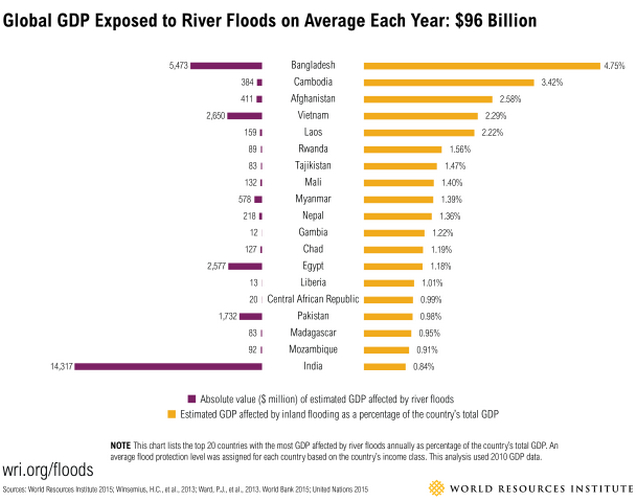
WRI analyzed which countries have the highest percentage of total GDP affected by river flooding on average per year, and each of the top 20 is classified as least developed or developing. India has by far the most GDP exposed, at $14.3 billion. Bangladesh is a distant second, at $5.4 million.
We judged the potential national economic consequences of river floods to be highest in countries with the largest percentage of affected GDP. China and Brazil, for example, would fall first and fifth respectively on a list ranked by gross GDP affected. However, their national incomes are so large that they drop off a list of countries ranked by percentage of GDP exposed.

GDP Exposure in 2030: Disparity between the Developed and Developing Countries
Our analysis shows a clear trend across the world. In lower and middle-income countries, socio-economic development is expected to concentrate more people, buildings, infrastructure and other assets in vulnerable regions. So, the developing world is expected to see more GDP exposed to flood risks in 2030, driven largely by socio-economic change.
India, for example, faces more potential change in exposed GDP than any other country. Using a middle-of-the road scenario, the Analyzer estimates that India’s current $14 billion in GDP exposed annually could increase more than 10-fold to $154 billion in 2030. Approximately 60 percent of that increase could be caused by socio-economic development.
In the developed world, Australia, Croatia, Finland, Portugal, and Israel are expected see more GDP exposed to floods in 2030, driven primarily by social-economic change. On the contrary, countries like the Netherlands, Slovenia, Belgium, Ireland, and Switzerland will likely see increased GDP exposure driven primarily by climate change.

Climate Change Will Expose More People to River Floods
Climate change is a greater driver of change in population exposure to river floods than socioeconomic development, because both the frequency and intensity of river floods is expected to increase due to climate change in many areas. This phenomenon would expand flood-prone areas, and make floods more likely to occur in those areas more often.
Climate change drives populations at risk in the developed and developing world alike – there is no clear distinguishing pattern. In Ireland, for example, 2,000 people face flood risks currently. By 2030, 48,500 more people could face river flood risk, and 87 percent of that difference would be driven by climate change. From the developing world, 715,000 people in Pakistan are at risk today. By 2030, river floods could affect 2 million more people, with climate change driving 70 percent of that increase.

A Tool for Awareness and Action
The risks may be escalating, but public and private sector decision makers can do more to prevent catastrophic damage before it happens.
Sharing the Analyzer’s easily accessible data with public and private sector decision makers will immediately raise their awareness about current and future river-flood risks. Armed with the right information, decision makers can then prioritize risk reduction and climate adaptation projects, and implement the most viable, cost-efficient options (see sidebar).
It will take decades and many billions of dollars to protect the tens of millions of people at risk from river floods and coastal storm surges. But starting now and following the direction of tools like the Global Flood Analyzer will help decision makers in international relief organizations, reinsurance companies, multinational companies, and many others build advanced protection systems to protect people and infrastructure.

Who Can Use the Flood Analyzer?
  • International development and financing organizations like the World Bank can prioritize investments in promising natural disaster risk-reduction strategies.
  • International natural disaster risk-reduction monitoring organizations like the United Nations Office for Disaster Risk Reduction can evaluate baseline risk conditions and monitor progress of risk reduction activities.
  • (Re-) insurance companies can rapidly assess risk and projected risk trends across their portfolios and explain the importance of insurance to potential clients.
  • Multinational companies can assess risks to their global manufacturing facilities and supply chains and prioritize locations for further analysis and risk mitigation actions.
For more on the ranking and methodology behind this analysis, access our data sets or test the tool.

*This blog was co-written with Hessel Winsemius and Philip Ward. Hessel is a researcher at Deltares. Philip is a senior researcher at the Institute for Environmental Studies of the VU University Amsterdam.

Links

Monday, October 24, 2016

The World’s Poorest Most at Risk From Drought, Conflict

Climate Central - 

Agriculture is the key source — and in many cases, the only source — of income for many living in the developing world. When drought hits, it has the potential to take away everything and unravel the threads that stitch together society.
New findings published Monday in the Proceedings of the National Academies of Science are part of a burgeoning body of literature showing how climate change can lead to conflict. It shows that drought exacerbates existing conflicts in some of the poorest countries and the farmers who are most dependent on a stable climate for their livelihoods. The findings highlight why climate change is intimately tied with development, national security and morality.
Drawing water in Mauritania during a severe drought that hit East Africa in 2012. Credit: Oxfam International/flickr
The impact of climate change on conflict is an area of intense research and interest. With carbon pollution expected to continue altering the climate, knowing its impact on conflict would be a major asset to researchers and policymakers looking to make the world a more peaceful place.
A number of previous studies have studied climate and conflict. Among the more tantalizing findings was that drought in Syria helped spark the subsequent civil war that has torn the country asunder. Rather than taking a high-level view as a number of previous studies have or focusing on a specific conflict, the new research zooms in to the subnational level in Africa and Asia and looks at drought during the growing season.
The results show that drought during growing seasons can prolong or intensify existing conflicts, though it’s not as likely to spark new ones.
“This effect is most pronounced in countries that are not very developed economically,” said Nina von Uexkull, a peace and conflict researcher at Uppsala University in Sweden who led the new study. “It’s also pronounced in groups excluded from political power.”
Von Uexkull’s findings also show that groups heavily reliant on agriculture are most at-risk. In essence, drought preys on already weak groups and institutions, eating away at what little stability they have. The results specifically show that drought increases the odds of conflict by about 5 percent.
That might sound small, but Marshall Burke, an economist at Stanford University, said the number belies how big that risk might be even in communities where the linkage seems relatively weak.
“This could represent like a 50 percent or greater increase in the probability of conflict,” Burke said in an email. “That is a HUGE effect.”
Research and reality have regularly pointed to the fact the world’s poorest will be hit the hardest by climate change. The findings are the latest to underscore how climate change is as much a development and justice issue as it is an environmental one.
Women carry cotton during the harvest in Burkina Faso. Credit: CIFOR/flickr
“This important study sheds light on the importance of context when examining the complex and often controversial relationship between climate, drought and conflict,” said Colin Kelley, a researcher at the International Research Institute for Climate and Society who authored the research on Syria. “Existing vulnerability, due to a host of potential factors, is extremely important when considering the impact that drought may (or may not) have on civil conflict.”
The findings could add fuel to the discussion at United Nations climate talks next month in Morocco, which will focus on the thorny topic of loss-and-damage or how developed countries will help developing countries recover from climate and weather disasters. With climate change expected to make dry places drier and increase the incidence of drought in some locations, the findings could make conflict a bigger part of the loss-and-damage discussion.
For all the bad news in the study, there’s also a sliver of good news. Groups that are more stable and have access to diverse sources of income aren’t as prone to conflict following drought. Von Uexkull said the findings are a compelling case for targeting international development in a way that also helps people adapt to changes in the climate.
“It’s extremely important from an climate adaptation point of view to understand these circumstances,” she said. “It will help design policies in areas where this relationship occurs and where in the future climate change will make drought worse.”

Links

Lethal Heating is a citizens' initiative