01/11/2016

Climate Change Wars Are Coming And Building Walls Won’t Help, Top General Warns

The Independent - Ian Johnston

The effects of global warming ‘are becoming so severe they hold tremendous conflict potential’ in some areas and the world should prepare for millions of refugees
Major General Munir Muniruzzaman pointed to the recent diplomatic row between bitter regional rivals India and Pakistan Reuters
Climate change is threatening to force millions of people to become refugees and spark major wars that could “completely destabilise” the world, a leading general has warned.
And countries which attempted to deal with the coming crisis by resorting to “narrow nationalistic instincts” – for example, by building walls to keep out refugees – will only make the problem worse, according to Major General Munir Muniruzzaman, chairman of the Global Military Advisory Council On Climate Change (GMACCC).
He added that, while countries had talked a lot about the problems posed by global warming and how to address them, there did not seem to be “much action” on the ground.
The GMACCC was set up in 2009 to investigate the security implications of climate change and its members include serving and retired military officers from around the world, such as the UK’s Rear Admiral Neil Morisetti and Brigadier General Stephen Cheney, a former US Marine.
Speaking ahead of the United Nations climate summit in Marrakesh next month, General Muniruzzaman said it was time to make good on the promises made at last year’s historic meeting in Paris with global warming already contributing to flooding and droughts, threatening financial security and affecting people's health.
“In our analysis, we are seeing the risk is now becoming all-pervasive from climate change in the sense that it is touching multiple sectors … many of the sectors are being gravely challenged,” he said.
“In some areas of the world, some of the issues we are touching on are becoming so severe they hold tremendous conflict potential."
He pointed to the recent diplomatic row between bitter regional rivals India and Pakistan, which both have large militaries and nuclear weapons, over water supplies.
“There was a possibility of a break down [of diplomacy] … which could have led to the first major water conflict of the world,” he said.
The events of the Arab Spring and the Syrian civil war were also connected to unrest caused by droughts and crop failures.
General Muniruzzaman pointed to projections that sea-level rise could result in the loss of 20 per cent of Bangladesh’s territory as early as 2050, which would force up to 30 million people to look for a new home.
“Imagine, with an international community unable to cope with a few thousand Syrian refugees, what will happen when millions of people are on the move,” he said.
The reaction to the refugee crisis by some European countries – such as Hungary, Norway and the UK – has been to build walls and fences to keep people out.
But General Muniruzzaman said: “I’m very strongly of the opinion that walls are never a solution. You cannot build walls to stop people when they want to go to safety.
Turkey has two million Syrian refugees.
“If you build walls and high fences, they will break them and cross over. The risk people are taking when they cross the water [the Mediterranean] … many have drowned.”
Instead of trying to hold back the tide of climate refugees, General Muniruzzaman said it would be better for the world to work out “international understanding and mechanisms” to enable mass movements of people to take place peacefully. 
But the solution might need a significant rethink of the whole concept of the modern nation, which is said by some historians to have been born out of the Peace of Westphalia treaty in 1648.
“People have moved before. Environmental changes have forced people to relocate themselves historically,” he said.
Refugees welcome here: Protesters demand UK resettle more migrants in response to refugee crisis.
“What has become more difficult now is we have boxed ourselves into the Westphalian system of states.
“That is in conflict with nature, with the movement of people … we need to find a common ground.
“We need leaders with vision … we have to have a global solution to the problem, this is a civilisational problem.
“If we want to solve [these problems] with narrow nationalistic instincts, we will be adding more problems, not solving them.”
Refugees break through Macedonia border fence in February.
Major wars and mass migration had the potential to “completely destabilise” not just countries and regions, but the entire world, the general said.
But he warned that most countries and most armed forces were “ill-prepared to meet the challenge for which they will be called upon to meet somebody and not too long away”.
“We have to understand and meet the challenge, so we are not completely overwhelmed when they happen on the ground,” General Muniruzzaman said.
“We don’t have the proper strategies and policies in place to meet the security impacts of climate change.
Calais refugee camp evacuation.
“I  would like to warn everybody we are way behind schedule to trying to find a solution to the problems we can see. In most cases we have been shying away from the problems we can absolutely identify and see.
“For a long time, we have been talking about the issues, but on the ground we don't see much action. As a soldier, I have a more action-orientated approach."

Links

Amitav Ghosh: Where Is The Fiction About Climate Change?

The Guardian - Amitav Ghosh*

The climate crisis casts a much smaller shadow on literary fiction than it does on the world. We are living through a crisis of culture – and of the imagination
In the eye of the storm … a tornado in Kansas. Photograph: NZP Chasers/Getty Images 
It is a simple fact that climate change has a much smaller presence in contemporary literary fiction than it does even in public discussion. As proof of this, we need only glance through the pages of literary journals and book reviews. When the subject of climate change occurs, it is almost always in relation to nonfiction; novels and short stories are very rarely to be glimpsed within this horizon. Indeed, it could even be said that fiction that deals with climate change is almost by definition not of the kind that is taken seriously: the mere mention of the subject is often enough to relegate a novel or a short story to the genre of science fiction. It is as though in the literary imagination climate change were somehow akin to extraterrestrials or interplanetary travel.
There is something confounding about this peculiar feedback loop. It is very difficult, surely, to imagine a conception of seriousness that is blind to potentially life-changing threats. And if the urgency of a subject were indeed a criterion of its seriousness, then, considering what climate change actually portends for the future of the Earth, it should surely follow that this would be the principal preoccupation of writers the world over – and this, I think, is very far from being the case. But why?
It is as though, in the literary imagination, climate change were akin to extraterrestrials or interplanetary travel
Why does climate change cast a much smaller shadow on literature than it does on the world? Is it perhaps too wild a stream to be navigated in the accustomed barques of narration? But the truth, as is now widely acknowledged, is that we have entered a time when the wild has become the norm: if certain literary forms are unable to negotiate these waters, then they will have failed – and their failures will have to be counted as an aspect of the broader imaginative and cultural failure that lies at the heart of the climate crisis.
Clearly, the problem does not arise out of a lack of information: there are surely very few writers today who are oblivious to the current disturbances in climate systems the world over. Yet, it is a striking fact that when novelists do choose to write about climate change it is almost always outside fiction. A case in point is the work of Arundhati Roy: not only is she one of the finest prose stylists of our time, she is passionate and deeply informed about climate change. Yet all her writings on these subjects are in various forms of nonfiction.
When I try to think of writers whose imaginative work has communicated a more specific sense of the accelerating changes in our environment, I find myself at a loss; of literary novelists writing in English only a handful of names come to mind: Margaret Atwood, Kurt Vonnegut Jr, Barbara Kingsolver, Doris Lessing, Cormac McCarthy, Ian McEwan and T Coraghessan Boyle. No doubt many other names could be added to this list, but even if it were to be expanded to 100, or more, it would remain true, I think, that the literary mainstream, even as it has become more engagé on many fronts, remains just as unaware of the crisis on our doorstep as the population at large.
Viggo Mortensen, left, and Kodi Smit-McPhee in the 2009 film adaptation of Cormac McCarthy’s The Road.
I have been preoccupied with climate change for a long time, but it is true of my own work as well, that this subject figures only obliquely in my fiction. I have come to be convinced that this discrepancy is not the result of personal predilections: it arises out of the peculiar forms of resistance that climate change presents to what is now regarded as serious fiction.
In his seminal essay “The Climate of History”, Dipesh Chakrabarty observes that historians will have to revise many of their fundamental assumptions and procedures in this era of the Anthropocene, in which “humans have become geological agents, changing the most basic physical processes of the Earth”. I would go further and add that the Anthropocene presents a challenge not only to the arts and humanities, but also to our common sense understandings and beyond that to contemporary culture in general.
There can be no doubt, of course, that this challenge arises in part from the complexities of the technical language that serves as our primary view of climate change. But neither can there be any doubt that it derives also from the practices and assumptions that guide the arts and humanities. To identify how this happens is, I think, a task of the utmost urgency: it may well be the key to understanding why today’s culture finds it so hard to deal with climate change. Indeed, this is perhaps the most important question ever to confront culture in the broadest sense – for let us make no mistake: the climate crisis is also a crisis of culture, and thus of the imagination.
Culture generates desires – for vehicles and appliances, for certain kinds of gardens and dwellings – that are among the principal drivers of the carbon economy. A speedy convertible excites us neither because of any love for metal and chrome, nor because of an abstract understanding of its engineering. It excites us because it evokes an image of a road arrowing through a pristine landscape; we think of freedom and the wind in our hair; we envision James Dean and Peter Fonda racing toward the horizon; we think also of Jack Kerouac and Vladimir Nabokov. When we see an advertisement that links a picture of a tropical island to the word paradise, the longings that are kindled in us have a chain of transmission that stretches back to Daniel Defoe and Jean-Jacques Rousseau: the flight that will transport us to the island is merely an ember in that fire. When we see a green lawn that has been watered with desalinated water, in Abu Dhabi or southern California or some other environment where people had once been content to spend their water thriftily in nurturing a single vine or shrub, we are looking at an expression of a yearning that may have been sparked by the novels of Jane Austen. The artefacts and commodities that are conjured up by these desires are, in a sense, at once expressions and concealments of the cultural matrix that brought them into being.
This culture is, of course, intimately linked with the wider histories of imperialism and capitalism that have shaped the world. But to know this is still to know very little about the specific ways in which the matrix interacts with different modes of cultural activity: poetry, art, architecture, theatre, prose fiction and so on. Throughout history these branches of culture have responded to war, ecological calamity and crises of many sorts: why, then, should climate change prove so peculiarly resistant to their practices?
New York freezes in director Roland Emmerich’s The Day After Tomorrow. 
From this perspective, the questions that confront writers and artists today are not just those of the politics of the carbon economy; many of them have to do also with our own practices and the ways in which they make us complicit in the concealments of the broader culture. For instance, if contemporary trends in architecture, even in this period of accelerating carbon emissions, favour shiny, glass-and-metal-plated towers, do we not have to ask, what are the patterns of desire that are fed by these gestures? If I, as a novelist, choose to use brand names as elements in the depiction of character, do I not need to ask myself about the degree to which this makes me complicit in the manipulations of the marketplace?
In a substantially altered world, when sea-level rise has swallowed the Sundarbans and made cities such as Kolkata, New York and Bangkok uninhabitable, when readers and museum-goers turn to the art and literature of our time, will they not look, first and most urgently, for traces and portents of the altered world of their inheritance? And when they fail to find them, what can they do other than to conclude that ours was a time when most forms of art and literature were drawn into the modes of concealment that prevented people from recognising the realities of their plight? Quite possibly, then, this era, which so congratulates itself on its self-awareness, will come to be known as the time of the Great Derangement.
On the afternoon of March 17, 1978, when I was 21, I was stuck in the middle of the first tornado to hit Delhi in recorded meteorological history. As is often the case with people who are waylaid by unpredictable events, for years afterwards my mind kept returning to my encounter with the tornado. Why had I walked down a road that I almost never took, just before it was struck by a phenomenon that was without historical precedent? To think of it in terms of chance and coincidence seemed only to impoverish the experience: it was like trying to understand a poem by counting the words. I found myself reaching instead for the opposite end of the spectrum of meaning –for the extraordinary, the inexplicable, the confounding. Yet these too did not do justice to my memory of the event.
Novelists inevitably mine their own experience when they write. No less than any other writer have I dug into my own past while writing fiction. It is certainly true that storms, floods and unusual weather events do recur in my books, and this may well be a legacy of the tornado. Yet oddly enough, no tornado has ever figured in my novels. Nor is this due to any lack of effort on my part. Indeed, I have returned to the experience often over the years, hoping to put it to use in a novel, only to meet with failure at every attempt.
I was stuck in the middle of the first tornado to hit Delhi – but no tornado has ever featured in my novels Amitav Ghosh
On the face of it there is no reason why such an event should be difficult to translate into fiction; after all, many novels are filled with strange happenings. Why then did I fail, despite my best efforts, to send a character down a road that is imminently to be struck by a tornado?
In reflecting on this, I find myself asking, what would I make of such a scene were I to come across it in a novel written by someone else? I suspect that my response would be one of incredulity; I would be inclined to think that the scene was a contrivance of last resort. Surely only a writer whose imaginative resources were utterly depleted would fall back on a situation of such extreme improbability?
Before the birth of the modern novel, wherever stories were told, fiction delighted in the unheard-of and the unlikely. Narratives such as those of The Arabian Nights, Journey to the West and The Decameron proceed by leaping blithely from one exceptional event to another. Novels too proceed in this fashion, but what is distinctive about the form is precisely the concealment of those exceptional moments that serve as the motor of narrative. This is achieved through the insertion of what Franco Moretti, the literary theorist, calls “fillers”. According to Moretti, “fillers function very much like the good manners so important in Austen: they are both mechanisms designed to keep the ‘narrativity’ of life under control – to give a regularity, a ‘style’ to existence”. It is through this mechanism that worlds are conjured up, through everyday details, which function “as the opposite of narrative”.
It is thus that the novel takes its modern form, through “the relocation of the unheard-of toward the background ... while the everyday moves into the foreground”. As Moretti puts it, “fillers are an attempt at rationalising the novelistic universe: turning it into a world of few surprises, fewer adventures, and no miracles at all”.
This regime of thought imposed itself not only on the arts but also on the sciences. That is why Time’s Arrow, Time’s Cycle, Stephen Jay Gould’s brilliant study of the geological theories of gradualism and catastrophism is, in essence, a study of narrative. In Gould’s telling of the story, the catastrophist recounting of the Earth’s history is exemplified by Thomas Burnet’s Sacred Theory of the Earth (1690) in which the narrative turns on events of “unrepeatable uniqueness”. As opposed to this, the gradualist approach, championed by James Hutton (1726‑97) and Charles Lyell (1797–1875), privileges slow processes that unfold over time at even, predictable rates. The central credo in this doctrine was: “Nothing could change otherwise than the way things were seen to change in the present.” Or, to put it simply: “Nature does not make leaps.”
A satellite image of the Ganges delta, which is vulnerable to flooding as sea levels rise. Photograph: UniversalImagesGroup/UIG via Getty Images 
The trouble, however, is that Nature does certainly jump, if not leap. The geological record bears witness to many fractures in time, some of which led to mass extinctions and the like: it was one such, in the form of the Chicxulub asteroid, that probably killed the dinosaurs. It is a fact that catastrophes waylay both the Earth and its individual inhabitants at unpredictable intervals and in the most improbable ways.
Distinctive moments are no less important to modern novels than they are to any other forms of narrative, whether geological or historical. It could not, of course, be otherwise: if novels were not built upon a scaffolding of exceptional moments, writers would be faced with the Borgesian task of reproducing the world in its entirety. But the modern novel, unlike geology, has never been forced to confront the centrality of the improbable: the concealment of its scaffolding of events continues to be essential to its functioning. It is this that makes a certain kind of narrative a recognisably modern novel.
Here, then, is the irony of the “realist” novel: the very gestures with which it conjures up reality are actually a concealment of the real. What this means in practice is that the calculus of probability that is deployed within the imaginary world of a novel is not the same as that which obtains outside it; this is why it is commonly said, “If this were in a novel, no one would believe it”. Within the pages of a novel an event that is only slightly improbable in real life – say, an unexpected encounter with a long-lost childhood friend – may seem wildly unlikely: the writer will have to work hard to make it appear persuasive.
If that is true of a small fluke of chance, consider how much harder a writer would have to work to set up a scene that is wildly improbable even in real life. For example, a scene in which a character is walking down a road at the precise moment when it is hit by an unheard-of weather phenomenon?
To introduce such happenings into a novel is in fact to court eviction from the mansion in which serious fiction has long been in residence; it is to risk banishment to the humbler dwellings that surround the manor house – those generic out-houses that were once known by names such as the gothic, the romance or the melodrama, and have now come to be called fantasy, horror and science fiction.
So far as I know, climate change was not a factor in the tornado I experienced. But the thing it has in common with the freakish weather events of today is its extreme improbability. And it appears that we are now in an era that will be defined precisely by events that appear, by our current standards of normality, highly improbable: flash floods, hundred-year storms, persistent droughts, spells of unprecedented heat, sudden landslides, raging torrents pouring down from breached glacial lakes, and, yes, freakish tornadoes.
This, then, is the first of the many ways in which the age of global warming defies both literary fiction and contemporary common sense: the weather events of this time have a very high degree of improbability. Indeed, it has even been proposed that this era should be named the “catastrophozoic” (others prefer such phrases as “the long emergency” and “the penumbral period”). It is certain in any case that these are not ordinary times: the events that mark them are not easily accommodated in the deliberately prosaic world of serious prose fiction.
An Indian woman pulls a prawn fishing net from the mud embankment on the Matla river, in the Sundarbans delta. Photograph: Deshakalyan Chowdhury/AFP 
Poetry, on the other hand, has long had an intimate relationship with climatic events: as Geoffrey Parker points out, John Milton began to compose Paradise Lost during a winter of extreme cold, and “unpredictable and unforgiving changes in the climate are central to his story. Milton’s fictional world, like the real one in which he lived, was ... a ‘universe of death’ at the mercy of extremes of heat and cold.” This is a universe very different from that of the contemporary literary novel.
I am, of course, painting with a very broad brush: the novel’s infancy is long past, and the form has changed in many ways over the last two centuries. Yet, to a quite remarkable degree, the literary novel has also remained true to the destiny that was charted for it at birth. Consider that the literary movements of the 20th century were almost uniformly disdainful of plot and narrative; that an ever greater emphasis was laid on style and “observation”, whether it be of everyday details, traits of character or nuances of emotion – which is why teachers of creative writing now exhort their students to “show, don’t tell”.
Yet fortunately, from time to time, there have also been movements that celebrated the unheard-of and the improbable: surrealism for instance, and most significantly, magical realism, which is replete with events that have no relation to the calculus of probability.
There is, however, an important difference between the weather events that we are now experiencing and those that occur in surrealist and magical realist novels: improbable though they might be, these events are neither surreal nor magical. To the contrary, these highly improbable occurrences are overwhelmingly, urgently, astoundingly real. The ethical difficulties that might arise in treating them as magical or metaphorical or allegorical are obvious.
But there is another reason why, from the writer’s point of view, it would serve no purpose to approach them in that way: because to treat them as magical or surreal would be to rob them of precisely the quality that makes them so urgently compelling – which is that they are actually happening on this Earth, at this time.

*Amitav Ghosh’s The Great Derangement: Climate Change and the Unthinkable is published by University of Chicago.

Links

Before the Flood - Full Movie | National Geographic

National Geographic

Join Leonardo DiCaprio as he explores the topic of climate change, and discovers what must be done today to prevent catastrophic disruption of life on our planet.
Watch the full documentary until 6th November.


Links

31/10/2016

Climate Change Is Invisible, Insidious And Urgent. Can The Arts Help Us See It?

The Guardian - Lucy Wood*

The fact of climate change is beyond serious dispute, but has yet to become part of mainstream discourse in the UK or indeed beyond. Arts and climate science collaboration can help change this
Diamonds in the Sky by HeHe, part of the Cloud Crash commission for the Manchester Science Festival, at the Museum of Science and Industry, Manchester. Photograph: Jason Lock
Soaring mercury, sinking cities, mass extinctions. It is easy to catastrophise climate change: faced with the sheer enormity of the climate challenge, people can tend towards despair and nihilism. For others, its seeming distance (both chronologically and, for many of us in the global north in particular, geographically) can seduce us with the easy denial that it is someone else’s problem to fix.
The technology and resources to move towards a post-carbon society are essentially all there. What we lack is a broad, civic movement to get behind the urgency – and significant opportunities – of this transition. So rather than looking darkly into a dystopian future in which we are passive victims, it is vital to make climate change relevant in the here and now – the air we breathe, the food we eat, the way we travel. Human-scale things we have agency to change. We need to find new ways to narrate and envision a fairer, cleaner future in which we can actively participate.
This year’s annual Lovelock Commission Cloud Crash by artist duo HeHe, a collaboration of Cape Farewell, the Natural Environment Research Council (NERC) and the Museum of Science and Industry (MSI) in Manchester, is an example of how art can enable major public engagement in what former chief scientific advisor Sir David King posits as ‘the biggest challenge of all time’.
The Lovelock Commission takes inspiration from pioneering climate scientist James Lovelock’s Gaia Theory, which posits the earth as a single self-regulating organism – and this year the commission focuses on atmospherics - namely, man-made emissions. The headline event for this year’s Manchester Science Festival, Cloud Crash seeks to make pollution – and its component part, climate change – visible, and asks some uncomfortable questions of society.
The role of the scientist and that of the artist is to make the invisible visible. Gone are the pea soupers that choked London 60 years ago. Today’s pollution is largely invisible to the naked eye – and all the more insidious for it. A recent study by King’s College London revealed that 9,500 Londoners die each year due to long-term exposure to air pollution, and that levels of pollution in major cities including London, Leeds and Birmingham will exceed legal limits until at least 2030. WHO estimate exposure to the particulate matter - small particulate matter of 10 microns or less in diameter (PM10)- caused 3 million premature deaths worldwide per year in 2012 through cardiovascular and respiratory disease, and cancers.
This invisible menace needs to brought into the light so that we can understand what we are fighting. With Cloud Crash HeHe took as point of departure the air quality forecast maps produced by the (NERC funded) National Centre for Atmospheric Science (NCAS) – that show, in hauntingly beautiful detail, levels of ozone, particulate matter and nitrogen dioxide as it sweeps across the UK.
Airbag by HeHe, part of the Cloud Crash commission. Photograph: Jason Lock
 What they have produced are three new pieces placed in-situ across the MSI site. In Airbag an ordinary car has crashed against a steel post in the courtyard. In a playful reversal of the polluting emissions of everyday cars (one of the largest contributors to lethal nitrogen dioxide and particulate matter emissions), this car has become a suspended cloud chamber, insulating a floating microclimate from the outside world. It is an object of reflection and provocation – as HeHe explain ‘there is a certain irony in admiring the beauty of such a fragile atmosphere, held inside an object which is so violently transforming our own unprotected airspace.’
Diamonds in the Sky is an immersive audio-visual experience based in the Air and Space Hall, that imagines a swarming cloud of pollution particles slamming into the side of Beetham Tower – Manchester’s landmark skyscraper which has come to symbolise the post-industrial reinvention of the city. Expanding on pollution forecast maps, this video piece highlights invisible ozone, nitrogen dioxide and particulate matter using vivid saturation colour – each particle per million represented by a pixel.
Burnout by HeHe, part of the Cloud Crash commission. Photograph: Olivia Hemingway
Finally, Burnout asks difficult questions of the arts industry and its role in climate change. A scale-model of the Tate Modern belches out vapour clouds – as if it is simultaneously an art museum and an active energy producer. The building’s original incarnation was Bankside, London’s major fossil-fuel power station from 1952 to 1981, whereas today Tate Modern is often referred to as an ‘art powerhouse’. By so doing, Burnout confronts both the building’s past and the arts sector’s modern day collusion with the fossil industry. Despite a recent decision from Tate to drop BP sponsorship after 26 years, the sector is still overshadowed by certain partnerships. For instance, what many pressure groups such as BP or Not BP call the ‘controversial and ironic’ sponsorship of ‘Sunken Cities’ exhibition by BP (a show rebranded as ‘Sinking Cities – Flooding our World’ by Greenpeace in a publicity stunt back in May).
Above and beyond, Cloud Crash explores a key issue – that to consume and create culture of all kinds is also to consume energy, however it may be sanitized. Brilliant organisations such as Julie’s Bicycles are doing vital work in helping the arts sector reduce their own environmental impacts. Without this, even the most successful public engagement activity and artworks relating to climate change could prove something of a Phyrric victory.
Artists and scientists are natural collaborators, both are explorers and storytellers, seeking out new ways of understanding, communicating (and indeed, changing) the world around them. So when it comes to the dry (or simply terrifying) language of climate science, the marriage of the two can be particularly fruitful. Artists can respond to environmental data in work that provokes real engagement. By communicating these issues in lateral, innovative ways, by using humour and humanity, these sorts of works can reach us on a more animal, cellular, level – and therefore, hopefully, demand our response.
It is important to remember that the dialogue between artists with scientists is two-way. The innate creativity of artists can also inform the work of scientists. NERC’s recent call for public engagement pilot activity celebrates this dialogue, as they seek to support new work that engages members of the UK public with relevant contemporary issues of environmental science whilst also building engagement capacity in the environmental science research community - in particular providing opportunities for early career researchers and PhD students to develop skills in they way they approach, and present, their own research. The arts can come to the service of sciences as much as the other way round.
When it comes to climate science it is all about finding the right language and tone for it - reframing it as an opportunity not sacrifice, making tangible the intangible and giving agency where once there is apathy. Above all, we need to make climate change relatable to us all – and in this there is a great deal more work to do. It is vital that climate-focused arts reach as wide and varied an audience as possible. Diversity is critically important in the climate battle, enabling the society-wide engagement it demands.
Cloud Crash runs across the Museum of Science and Industry (MSI) site from 20 October 2016 – 4 February 2017.

*Lucy Wood is an arts producer with a focus on climate change, food systems and migration. She is Director of international environmental arts charity Cape Farewell. She is on twitter as @lucywoodie.  

Links

Company Directors To Face Penalties For Ignoring Climate Change

Fairfax - Jessica Irvine

Australia's fall from grace as a global leader in the fight against dangerous climate change was rapid and inglorious.
But any Australian business leaders who think they got away with sticking their heads in the sand should think again.
Reduction in arctic ice has threatened the habitat of mammals such as the polar bear, walrus and ice seals. Photo: Nick Cobbing / Greenpeace
New legal advice by senior Sydney silk Noel Hutley being released on Monday, suggests it is almost certain that directors of an Australian company will one day face legal action for neglecting to properly account for the potential impact of climate change on their business.
"It is likely to be only a matter of time before we see litigation against a director who has failed to perceive, disclose or take steps in relation to a foreseeable climate-related risk that can be demonstrated to have caused harm to a company (including, perhaps, reputational harm)," the advice, commissioned by the Centre for Policy Development and the Future Business Forum, titled "Climate Change and Directors Duties" concludes.
Politicians who fail in their endeavours to combat climate change can simply retire on a taxpayer-funded scheme.
For company directors who fail in their duties, the penalties are much more severe, including fines of up to $200,000 and disqualification from holding directorships.
Under the Corporations Act, directors have a duty to apply care and diligence in considering all the risks that might apply to their company.
They are required to take into account all "foreseeable" risks.
Given the weight of scientific evidence of climate change, Hutley's advice is that it will not be sufficient for company directors to argue they could not reasonably have believed that climate change was real or human induced.
In considering the risks posed by climate change, directors are not required to become green-caped climate change crusaders.
But many are failing in their most basic duty to consider and disclose the potential risks or to form a business case about whether action is needed to protect their company.
There are two classes of risk posed to Australian companies by climate change.
First, there is physical risk. Rising sea levels, for example, make writing mortgages on coastal properties a riskier business for banks. Rising incidence of severe weather events makes writing insurance products riskier. In a more recent example, power outages resulting from severe weather may affect power supply to all sorts of businesses. Companies that fail to take into account these risks will suffer lower profits.
But the risks are even greater than that.
There is also "transition risk" that must be taken into account. As the world inevitably moves to a lower emissions footprint, governments are likely to make sudden rule changes that will adversely affect firms. Consumers will also dictate the pace of change. It depends what question you ask them, but citizens are demonstrating a greater preference for more sustainable "green" products.
If this means less demand for emissions-intense products, company directors who fail to take account of this would be failing in their duty to protect their company into the future.
Diligent directors can still make a "business judgment" that their company is still best served by continuing with potentially risky activities. But they must at least consider it.
Many people are rightly disappointed by the inadequacy of the Australian government's current policies to reduce emissions.
But regardless of what actions policymakers take, this new legal perspective leaves some hope.
Rather than a top-down approach by government, company directors facing legal action if they fail to plan for the risks of climate change should help drive bottom-up reforms to Australian business that will assist in the transition to a lower emissions economy.
If they don't, they will be sued. Already actions are being brought against US firms, such as Peabody Coal, for failing to take into account the risks of climate change to business as usual.
Company directors looking to avoid a similar fate need to act now.
"To consider climate change risks actively, and disclose them properly, will reduce exposure to liability, and maximise the potential for activating the 'business judgment' rule," the legal advice states.
The penalties for a breach of fiduciary duties are listed in the Corporations Act and include a maximum penalty for individuals of $200,000, potential disqualification from being a director and payment of compensation to a corporation for damage suffered.
Mark Joiner was the chief financial officer of NAB when it was subject to several class actions. He is now a director on a number of boards and agrees it's only a matter of time before an Australian firm is sued for failing to take climate change into account.
"Australia hasn't found a way to advance the progressive values of business. You have got to realise that social values are changing all the time."
It is no longer good enough for companies to make money and spend some of it on progressive issues, like charities. Companies today must earn their "social licence" by finding a purpose that fits with societal values.
The Paris Agreement will enter force on November 4. Current policies are inadequate to achieve even the modest emissions reduction target pledged under the Paris agreement.
Bank of England governor  Mark Carney has warned this presents serious "transition risk" for companies as it brings forward the need for action to meet targets.
Australian companies are highly exposed to climate change risk.
It's time Australian company directors realised they are too.

Links

Australia's Climate Change Challenge To Make Clean Energy Work

The Age - Editorial

So much of what we read and hear about climate change is bad news. Recent days brought a welcome update on how far we have come as a global community in starting to address this epoch defining problem, but also a reminder of how far we have to go in Australia.
In a market analysis last week, the Paris-based International Energy Agency found across the globe there is now more renewable energy capacity installed than coal. This is an extraordinary shift, hastened by a dramatic fall in the cost of clean electricity that few predicted just a handful of years ago. Over the past five years, the price of wind energy has decreased by about a third and solar by two-thirds.
The question Australia faces is not whether to embrace clean energy, but how to make sure it works. Photo: Paul Rovere
Coal and other fossil fuels continue to be the largest source of power and the shift to emissions-free technology is still much slower than necessary, but agency executive director Fatih Birol was right to describe the change under way as nothing short of a transformation of global electricity markets. His team predicts a further 15 per cent drop in the cost of wind and 25 per cent for solar by 2021.
Despite this, the story in Australia is otherwise not as positive as elsewhere. The scale of the problem the country faces was described in detail last week by Australian Industry Group chief executive Innes Willox in a speech to the Re-powering NSW Conference. While some media coverage has focused on Mr Willox's concern about state renewable energy targets in Victoria, South Australia and Queensland that are out of step with the national goal, in truth his speech was much broader in scope.
We  hope our leaders were listening to his full message. It included taking it as a given that the climate agreement reached in Paris last year means the world has set itself the challenge of global net zero greenhouse gas emissions, and that we need to take that goal seriously. It means that we are going to have to replace most of our electricity system, and will need to do that while ensuring supply and keeping price rises down as much as possible.
Mr Willox stressed that Australians need to re-think their expectations about the cost of electricity. Australia has historically enjoyed cheap power, but prices are rising and are likely to continue to increase due to the cost of building new generation.
That cost is coming regardless of what sort of electricity plants we build to replace today's ageing infrastructure, but no business is going to build traditional coal power in Australia again given they reasonably assume at some point there will be policies in place to put the country on a trajectory to meet that zero emissions goal. They are not viable commercially.
As Mr Willox also pointed out, the projected cost of building new electricity generation appears significantly cheaper overseas compared with Australia. It is possible it has been overestimated and that cleaner energy will be cheaper than previously thought. There is already evidence that costs in Australia have been less than expected. Alternatively, it is possible projections that Australia will pay more are correct, but not inevitable. Mr Willox raised the prospect that construction costs were inflated and could be reduced, but also that finance costs were higher here than they need to be, in significant part because energy and climate policies have been so unstable.
We agree with the growing call from leaders across business, labour, welfare, science and the environmental movement that policy stability is key. The question Australia faces is not whether to embrace clean energy, but how to make sure it works across a vast but lightly populated continent. The country urgently needs enduring cross-party policies that can be scaled up to meet increasingly ambitious climate targets at lowest cost. It also needs new electricity market rules to ensure a rapidly changing system delivers reliable supply across the grid. This may not be easy, but is achievable. Overwhelmingly, politics is the major barrier. We urge the government to listen and take the lead.

Links

30/10/2016

Global Mass Extinction Of Wildlife By 2020 Warning Issued In Living Planet Index

Huffington Post - Kathryn Snowdon

The global wildlife population is expected to drop 67% by 2020.


Nature is facing a global "mass extinction" for the first time since the demise of the dinosaurs as global wildlife populations are expected to drop by more than two thirds by the end of the decade.
A landmark report of 14,152 populations of 3,706 species of mammals, birds, fish, amphibians and reptiles from around the world reveals a 58% fall between 1970 and 2012 - with no sign the average 2% drop in numbers each year will slow.
By 2020, populations of vertebrate species could have fallen by 67% over a 50-year period unless action is taken to reverse the damaging impacts of human activity, the Living Planet Index from WWF and the Zoological Society of London (ZSL) said.
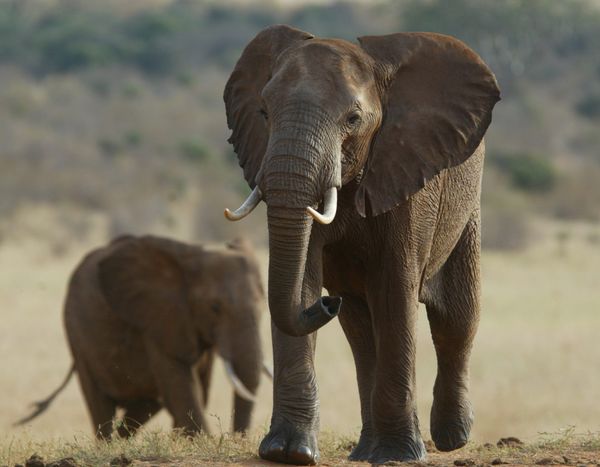
African elephants, orcas, tigers, mountain gorillas, amphibians and leatherback turtles are just some of the species most under threat of extinction.
African elephants in Tanzania have seen numbers crash due to poaching, maned wolves in Brazil are threatened by grasslands being turned into farmland and European eels have declined due to disease, over-fishing and changes to their river habitats.
Species are being increasingly affected by unsustainable agriculture and fishing, as well as mining and other human activities that cause habitats to be lost or become degraded.
Wildlife is also being hit by over-exploitation, climate change and pollution, the report warned.

African elephant
Africa's elephant population has crashed by an estimated 111,000 in the past decade primarily due to poaching.  2016 estimates suggest there are 415,000 elephants across the 37 range states in Africa. Karel Prinsloo/AP
Maned wolf
The maned wolf, along with other large mammals including the giant anteater, is threatened by the increasing conversion of grasslands into farmland for grazing and growing crops in the Brazilian Cerrado. Auscape via Getty Images
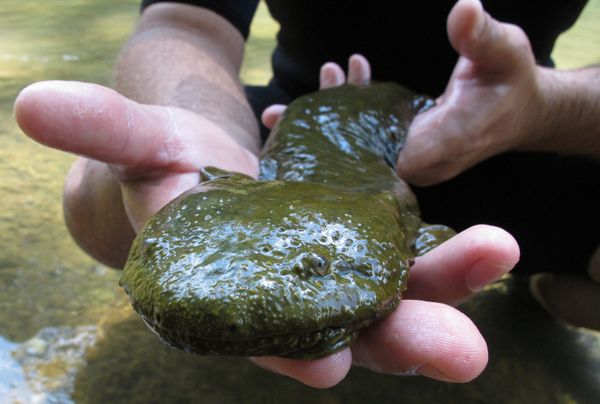
Hellbender salamander
The hellbender salamander underwent population declines of 77 per cent across five locations in Missouri between 1975 and 1995. Degradation of habitat from the effects of agriculture and the recreational use of rivers is believed to be the main cause of the decline. Rick Callahan/AP
Orca
Orca populations in European waters are under threat from persistent organic pollutants (POPs). Despite legislative restrictions on their use, these pollutants are still present in orcas' blubber at levels that exceed all known marine mammal toxicity thresholds. ASSOCIATED PRESS
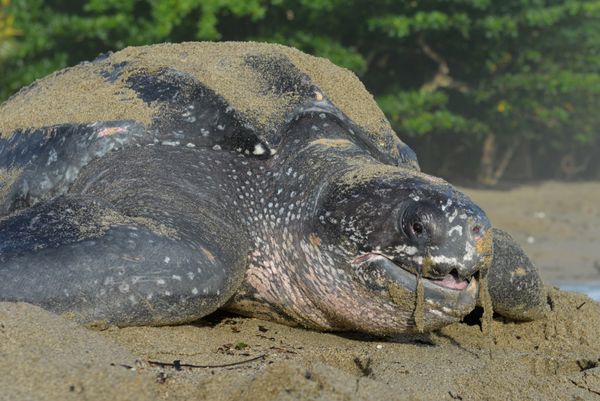
The leatherback turtle
The leatherback turtle has become increasingly rare in both the tropical Atlantic and Pacific. For example, it declined by 95 per cent between 1989 and 2002 in Las Baulas National Park in Costa Rica. This decline was caused mainly by mortality at sea due to individuals being caught as by-catch and by development around nesting beaches. Similar trends have been observed throughout the species range. David McFadden/AP
The European eel
The European eel is declining due to disease, overfishing and changes to its freshwater habitat that impede its migration to the sea to breed. Yannis Behrakis / Reuters
Himalayan griffon, White-backed vulture, long-billed vulture and slender-billed vulture
The White-backed vulture, long-billed vulture, slender-billed vulture and the Himalayan griffon (pictured) have been decimated throughout South East Asia over the past 20 years due to the widespread use of the anti-inflammatory cattle drug diclofenac. The drug causes kidney failure in birds that eat the carcasses of recently-treated cattle. AP PhotoWichai Taprieu
Yangtze river dolphin
The Yangtze river dolphin has declined largely due to incidental mortality by collisions with fishing vessels and entanglement in fishing gear An intensive survey carried out in China in 2006 failed to find any evidence that the species survives. Stephen Leatherwood/PA Archive
Gharial
India and Nepal: degradation of its habitat, accidental bycatch in fishing nets and harvesting of eggs have led to declines of this critically endangered species of crocodile. PRAKASH MATHEMA via Getty Images
Amphibians
A species of fungus that causes chytridiomycosis, a disease of amphibians, is implicated in the steep decline or extinction of more than 200 species. ASSOCIATED PRESS
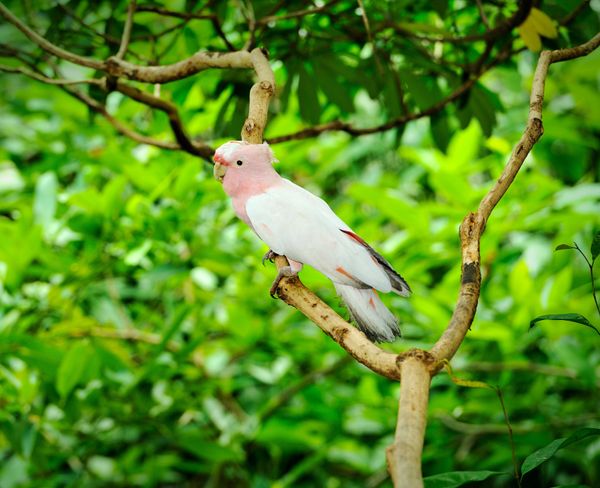
Major Mitchell's cockatoo
Major Mitchell's cockatoo underwent a precipitous population crash in Australia, largely due to the illegal taking of eggs for the pet trade. The population is now slowly recovering due to better enforcement of the law, but the species remains at risk from the clearing of woodland habitat and the destruction of nesting trees. slpu9945 via Getty Images
Asian tiger
About 3,900 tigers are left in the wild facing threats of habitat destruction, climate change, and human wildlife conflict. The species is critically endangered. Ratnakorn Piyasirisorost via Getty Images
Amur leopards
As few as 70 Amur leopards are left in the wild, facing  threats of habitat destruction and human wildlife conflict. The species is critically endangered. ASSOCIATED PRESS
Giant Panda
1,864 giant pandas remain in the wild. Threats include human wildlife conflict and climate change. The species is listed as vulnerable. ASSOCIATED PRESS
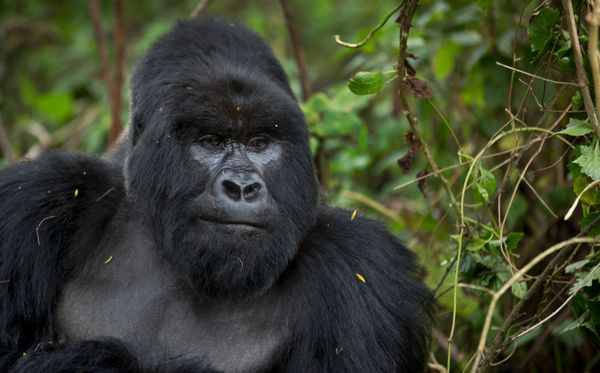
Mountain gorilla
880 of the critically endangered mountain gorilla remain in the wild facing threats of habitat destruction and human wildlife conflict.  Ben Curtis/AP
It  is not just wildlife that is being affected, with humans also the "victims" of the deteriorating state of nature, as they depend on breathable air, drinkable water and nutritious food, the report said.
While wildlife continues to decline on average, species that depend on certain habitats have seen some improvements in recent years, the report revealed.
Grassland species have increased slightly since 2004, which the report puts down to conservation efforts for some mammals in Africa, though bird populations continued to decline.
Overall terrestrial species, which are found in habitats ranging from grasslands to forests, have seen populations drop by two-fifths (38%) since 1970.
Freshwater species are faring even worse, with declines of four-fifths (81%) between 1970 and 2012.
Wetland wildlife has seen an increase since 2005, and marine species have been stable since 1988 - although the majority of stocks that contribute most to global fish catches are now either fully fished or overfished, the report warned.
Mike Barrett, director of science and policy at WWF-UK, said: "For the first time since the demise of the dinosaurs 65 million years ago, we face a global mass extinction of wildlife.
"We ignore the decline of other species at our peril – for they are the barometer that reveals our impact on the world that sustains us.
"Humanity's misuse of natural resources is threatening habitats, pushing irreplaceable species to the brink and threatening the stability of our climate."
But he added: "We know how to stop this. It requires governments, businesses and citizens to rethink how we produce, consume, measure success and value the natural environment.
"In the UK, this demands a serious plan to strengthen protection for habitats and species and new measures to fast-track low-carbon growth."
Professor Ken Norris, director of science at ZSL said: "Human behaviour continues to drive the decline of wildlife populations globally, with particular impact on freshwater habitats.
"Importantly, however, these are declines – they are not yet extinctions – and this should be a wake-up call to marshal efforts to promote the recovery of these populations."
The report highlights the success of habitat protection and strict controls on hunting in Europe to help restore populations of wildlife including bears, lynx, wolverines and wolves.

Links

Lethal Heating is a citizens' initiative