09/11/2016

Climate Change Is Intergenerational Theft. That's Why My Son Is Part Of This Story

The Guardian

By including Toma in my film at the Great Barrier Reef I want to show how environmental disasters are creating a lonely world for our children
Naomi Klein with her son Toma and John Rumney from the Great Barrier Reef Legacy project. ‘The strongest emotions I have about the climate crisis have to do with Toma and his peers. I have flashes of sheer panic about the extreme weather we have already locked in for them. But even more intense than this fear is the sadness about what they won’t ever know.’ Photograph: Josh Wall for the Guardian
The short film I’ve made with the Guardian stars my son, Toma, aged four years and five months. That’s a little scary for me to write, since, up until this moment, my husband, Avi, and I have been pretty careful about protecting him from public exposure. No matter how damn cute we think he’s being, absolutely no tweeting is allowed.
So I want to explain how I decided to introduce him to you in this very public way.
For the past eight years, I have been writing and speaking about climate change pretty much around the clock. I use all the communication tools I can — books, articles, feature documentary, photographs, lectures.
Yet I still struggle with a nagging feeling that I’m not doing justice to the enormous stakes of this threat. The safety and habitability of our shared home is intensely emotional terrain, triggering perfectly rational feelings of loss, fear and grief. Yet climate discourse is usually pretty clinical, weighed down with statistics and policy jargon.
All that information is important, of course. But I have started to worry that, by being so calm and clinical, we may be tacitly sending the message that this isn’t really an existential emergency after all. If it were, wouldn’t the people raising the alarm sound more … alarmed? Wouldn’t we share more of our own emotions?

Naomi Klein at the Great Barrier Reef: what have we left for our children?

I was thinking a lot about these questions when the Guardian approached me about making a short film at the Great Barrier Reef while I visited Australia to receive the Sydney peace prize. I initially refused. I had already decided to travel to Queensland and see the bleaching and die-off for myself. But I was planning to go with my family and saw our visit as a very personal experience. Precisely because I knew I would be overwhelmed by seeing this tragedy through my son’s eyes, I didn’t want cameras around.A few days later, the Guardian asked again. And I started thinking: maybe this was a chance to get at aspects of climate disruption that scientific reports and political arguments just can’t convey. Perhaps it could communicate, in a visceral way, the intergenerational theft at the heart of this crisis.
There is no question that the strongest emotions I have about the climate crisis have to do with Toma and his peers. I have flashes of sheer panic about the extreme weather we have already locked in for them. But even more intense than this fear is the sadness about what they won’t ever know. These kids are growing up in a mass extinction, robbed of the cacophonous company of being surrounded by so many fast-disappearing life forms.
According to a new WWF report, since I was born in 1970 the number of wild animals on the planet has dropped by more than half – and by 2020 it is expected to drop by two-thirds. What a lonely world we are creating for these kids. And what more powerful place to illustrate that absence than the Great Barrier Reef, on the knife-edge of survival?
So this film shows the reef through Toma’s eyes. He’s too young to understand concepts like coral bleaching and dying – it’s tough enough for him to understand that coral was ever alive in the first place.
It also shows the Great Barrier Reef through the eyes of his mother: moved by the beauty that remains, heartbroken and infuriated by what has been lost. Because what has happened to this wondrous part of the world is not just a tragedy, it’s a crime. And the crime is still very much in progress, with our respective governments busily clearing the way for new coalmines and new oil pipelines.
In a way, that’s the good news: we still have both the time and power to force our politicians to change course. It’s too late for most of the world’s coral reefs but it’s not too late for all of them. And it’s not too late to keep temperatures below levels that would save millions of lives and livelihoods.
For that kind of rapid change to happen, however, we are all going to have to stop being so impeccably calm and reasonable. We’re going to have to find that part of ourselves that feels this threat in our hearts, as well as our heads.
So meet Toma, who just discovered that there is a magical world beneath the waves.

Links

2015’s Record-Breaking Temperatures Will Be Normal By 2030 - It’s Time To Adapt

The Conversation

Australia's 2013 'angry' summer was characterised by heatwaves and major bushfires. Such a summer will be normal by 2035. AAP Image/Dean Lewins
Generation Y has grown up in a rapidly warming world. According to the US National Climate Data Centre, every month since February 1985 has seen above average global temperatures, compared with the twentieth century. I have no memories of a "normal" month.
2016 is on track to be the hottest year on record, surpassing the previous records set in 2015 and in 2014. These are just a few of the flurry of recent record temperatures, which includes Australia's hottest day, week, month, season and year.
The question now is what the future will look like. At some point in the decades to come, these record-breaking temperatures will not be rare; they will become normal. But when exactly?
In a new study just released in the Bulletin of the American Meteorological Society, I (together with co-authors Andrew King and Sarah Perkins-Kirkpatrick) find that on the current greenhouse gas emissions trajectory, global temperatures like 2015 will by normal by 2030, and Australia's record-breaking 2013 summer will likely be an average summer by 2035.
While we still have time to delay some of these changes, others are already locked in - cutting emissions will make no difference - so we must also adapt to a warmer world. This should be a sobering thought as world leaders gather in Marrakech to begin work on achieving the Paris Agreement which came into force last week.

Today's extremes, tomorrow's normal
The recent record-breaking temperatures have often been described as the "new normal". For example, after the new global temperature record was set in 2016, these high temperatures were described as a new normal.
What is a new normal for our climate? The term has been used broadly in the media and in scientific literature to make sense of climate change. Put simply, we should get used to extremes temperatures, because our future will be extreme.
But without a precise definition, a new normal is limited and difficult to understand. If 2015 was a new normal for global temperatures, what does it mean if 2017, 2018, or 2019 are cooler?
In our study we defined the new normal as the point in time when at least half the following 20 years are warmer than 2015's record breaking global temperatures.
We examined extreme temperatures in a number of state-of-the-art climate models from an international scientific initiative. We also explored how different future greenhouse gas emissions impact temperatures.
We used four different greenhouse gas scenarios, known as Representative Concentration Pathways, or RCPs. These range from a business-as-usual situation (RCP8.5) to a major cut to emissions (RCP2.6).
It is worth emphasising that real-world emissions are tracking above those covered by these hypothetical storylines.
2015's record temperatures will likely become normal between 2020 and 2030.
Future extremes
Our findings were straightforward. 2015's record-breaking temperatures will be the new normal between 2020 and 2030 according to most of the climate models we analysed. We expect within a decade or so that 2015's record temperatures will likely be average or cooler than average.
By 2040, 2015's temperatures were average or cooler than average in 90% of the models. This result was unaffected by reducing greenhouse gas emissions or not - we are already locked in to a significant amount of further warming.
We also looked at the timing of a new normal for different regions. Australia is a canary in the coal mine. While other regions don't see extreme temperatures become the new normal until later in the century, Australia's record-breaking 2013 summer temperatures will be normal by 2035 - according to the majority of the models we looked at.
At smaller spatial scales, such as for state-based based temperature extremes, we can likely delay record-breaking temperatures becoming the new normal by committing to significant greenhouse gas cuts. This would clearly reduce the vulnerability of locations to extreme temperatures.
Cutting emissions (top) and business as usual (bottom) makes little difference to the new normal globally. Author provided

Living in a warmer world
If you like heading to the beach on hot days, warmer Australian summers seem appealing, not alarming.
But Australia's position as a hot spot of future extremes will have serious consequences. The 2013 summer, dubbed the "angry summer", was characterised by extreme heatwaves, widespread bushfires and a strain on infrastructure.
Our results suggest that such a summer will be relatively mild within two decades, and the hottest summers will be much more extreme.
My co-authors, Andrew and Sarah, and I all grew up in a world of above-average temperatures, but our future is in a world were our recent record-breaking temperatures will be mild. Our new research shows this is not a world of more pleasantly hot summer days, but instead of increasingly severe temperature extremes.
These significantly hotter summers present a challenge that we must adapt to. How will we protect ourselves from increases in excess heat deaths and increased fire danger, and our ecosystems from enhanced warming?
While we have already locked ourselves into a future where 2015 will rapidly become a new normal for the globe, we can still act now to reduce our vulnerability to future extreme events occurring in our region, both through cutting emissions and preparing for increased heat.

Links

Record Hot Year May Be The New Normal By 2025

ANU

Bushfires are expected to be more common in Australia in future years. Image: Peter Shanks, Flickr.
The hottest year on record globally in 2015 could be an average year by 2025 and beyond if carbon emissions continue to rise at the same rate, new research has found.
Lead author Dr Sophie Lewis from the ANU Fenner School of Environment and Society said human activities had already locked in this new normal for future temperatures, but immediate climate action could prevent record extreme seasons year after year.
"If we continue with business-as-usual emissions, extreme seasons will inevitably be the norm within decades and Australia is the canary in the coal mine that will experience this change first," said Dr Lewis, who is also from the ARC Centre of Excellence for Climate System Science.  
"If we don't reduce our rate of emissions the record hot summer of 2013 in Australia - when we saw temperatures approaching 50 degrees Celsius in some areas - could be just another average summer season by 2035.
"This research tells us we can potentially prevent record-breaking seasonal temperatures from becoming average at a regional level."
The idea of a new normal has been used repeatedly when talking about climate change but had never been clearly defined until Dr Lewis and colleagues developed a scientific definition for the term.
"Based on a specific starting point, we determined a new normal occurred when at least half of the years following an extreme year were cooler and half warmer. Only then can a new normal state be declared," Dr Lewis said.
This process was also used to determine new normal conditions for seasonal and regional changes to the climate, she said.
Using the National Computational Infrastructure supercomputer at ANU to run climate models, the researchers explored when new normal states would appear under the Intergovernmental Panel for Climate Change's four emissions pathways.
The research team examined seasonal temperatures from December to February across Australia, Europe, Asia and North America.
"The results revealed that while global average temperatures would inevitably enter a new normal under all emissions scenarios, this wasn't the case at seasonal and regional levels," Dr Lewis.
"We found that with prompt action to reduce greenhouse gases a new normal might never occur in the 21st century at regional levels during the Southern Hemisphere summer and Northern Hemisphere winter."
The research, supported by the ARC Centre of Excellence for Climate System Science, is published in the Bulletin of the American Meterological Society.

Links

08/11/2016

Climate Pledges Will Fall Short of Needed 2 Degree C Limit

Scientific AmericanUmair Irfan, ClimateWire

Just a day before the Paris accord takes effect, the U.N. says nations must make deeper emissions cuts
Credit: FLICKR, CC BY-SA 2.0
The U.N. Environment Programme dumped a bucket of cold water this morning on nations riding high from the Paris climate change accords’ taking effect this week.
In a new report, UNEP found that even if every country that made an emissions-cutting pledge in the Paris Agreement keeps its promise, the world will still fall 12 to 14 gigatons short each year of keeping temperature rise below 2 degrees Celsius over preindustrial levels.
The individual commitments would only keep warming below 3 degrees at best, the report finds. Meanwhile, nations are on course to further miss the mark of the Paris Agreement’s more ambitious pledge to “pursue efforts to limit the temperature increase to 1.5 Celsius above pre-industrial levels” by 15 to 17 gigatons per year.
“If we don’t start taking additional action now, beginning with the upcoming climate meeting in Marrakesh, we will grieve over the avoidable human tragedy. The growing numbers of climate refugees hit by hunger, poverty, illness and conflict will be a constant reminder of our failure to deliver. The science shows that we need to move much faster,” UNEP chief Erik Solheim said in a statement.
The annual report comes as climate diplomats prepare for two weeks of U.N. negotiations in Morocco that will be aimed at making the promises of the Paris Agreement a reality. The deal officially goes into effect tomorrow.
“Compared to the 2°C goal that was the reference point of earlier Emissions Gap Reports, these new objectives require stronger short-term action and deeper cuts in the medium and longer term, as the remaining carbon dioxide budget is now considerably lower,” according to the report.
Researchers said the Paris Agreement’s early entrance into force signals a strong commitment from countries to address climate change—but this concern wasn’t reflected in their pledges to ratchet down their emissions.
“In summer 2015, all major countries had submitted INDCs [intended nationally determined contributions], and they showed in aggregate that there is a large [emissions] gap,” said Niklas Höhne, a researcher at the NewClimate Institute in Germany, who was the lead author of two chapters of the UNEP report.
“This insufficiency was accepted in Paris but led to several provisions in the Paris Agreement meant to encourage countries to increase their ambition level,” he added in an email. “The first opportunity to raise ambition was to change the ‘intended’ contribution into a more ambitious final one when ratifying the Paris Agreement. But no major country has done that.”
The planet’s current policies put it on a trajectory to emit carbon dioxide at a rate between 58 and 62 gigatons in 2030. Pledges under the Paris Agreement would bring that down to a range between 52 and 57 gigatons of carbon dioxide. Keeping the planet’s temperature rise below 2 degrees Celsius would require limiting greenhouse gas emissions between 31 and 44 gigatons per year.
In response, the report called for strong climate mitigation efforts before the year 2020, at which point the world will be on a warming trajectory that would be hard to reverse. This would require much stronger policies, deploying vastly more clean energy, reducing costs and coming up with new ways to cut greenhouse gases.
“The large number of nationally determined contributions was only possible because renewable energy has become so cheap,” Höhne said. “But also other areas see breakthroughs such as electric mobility, where the transition seems to happen faster than expected. In addition, the cost of air pollution is more and more factored into the economic evaluation and often point against coal.”
Philip Killeen, a research associate at the Worldwatch Institute, who was not involved with the UNEP report, noted that 2015 was a record year for the deployment of clean energy but that the pace of progress still isn’t fast enough to meet climate targets (ClimateWire, Oct. 28).
“We still need to double what we achieved in 2015 every year for the next 20 years,” he said.

Links

Earth ‘At Risk Of Ecological Breakdown’

EIN Presswire - Springer International

Earth's life support systems are at risk
The Earth is risking a major ecological breakdown that could eventually render it largely uninhabitable.
This is one of the warnings contained in "Surviving the 21st Century" a powerful new book released recently by global science publisher Springer International.
Our combined actions may be leading to "…a gross ecological breakdown that will strike humanity harder than anything in our experience", the book cautions.
This is absolutely a book about solutions – and opportunities. It is about hope – though a hope that is well-founded, on science and fact. — Julian Cribb
Author and science writer Julian Cribb says, "In the past week alone has come news that global populations of fish, birds, mammals, amphibians and reptiles declined by 58 per cent between 1970 and 2012. From 20-30 per cent of known species now appear at risk of extinction.
"This is an extermination of life on Earth without precedent. The human impact is on track to exceed the catastrophe that took out the dinosaurs.
"Many people don't realise it, but our own fate is completely bound up with these other creatures, plants and organisms we heedlessly destroy. They provide the clean air and water, the food, the nutrient recycling, the de-toxing, the medications, the clothing and timber that we ourselves need for survival.
"Humans are now engaged in demolishing our own home, brick by brick. Every dollar we spend on food or material goods sends a tiny, almost-imperceptible signal down long industrial and market chains to accelerate the devastation.
"Together those signals are causing the very systems we ourselves need for survival to break down."
A recent study by Princeton University found oxygen levels in the Earth's atmosphere have fallen by 0.1 per cent in the past 100 years, probably due to land clearing, ocean acidification and burning of fossil fuels.
"Though it is still a small signal, it is another indicator of our ability to disrupt the Earth's life-support system," Cribb says.
The world is currently burning enough fossil fuels to raise its temperature by 4-5 degrees Celsius by 2100 – an event that will probably prove unsurvivable for the majority of large wild animals, and most humans too.
"Yet we're still arguing about whether its real and what we should do," he adds.
"Today humanity is facing ten huge existential threats, all of our own making. The good news is that we have the brains and the technologies to solve them – and to prosper from their solution.
"However we currently lack the collective will, the ability to co-operate and the institutions to save ourselves. That is a worry."
Drawing on the world's leading scientific thinkers, "Surviving the 21st Century" identifies systemic solutions for all of the ten major threats facing humanity, and actions which we must take both as a species and as individuals.
"This is absolutely a book about solutions – and opportunities. It is about hope – though a hope that is well-founded, on fact and science, not simply on belief, ignorance or wishful thinking. It's about understanding and facing up to the things which imperil out future, so that we can overcome them," Cribb says.
In the book he argues that by moving food production back into cities, using advance technologies and recycling of water and nutrients, humanity can re-wild 24 million square kilometres of the Earth's surface. This would help to end the 'sixth extinction' now taking place as well as locking up huge amounts of carbon causing climate change. It would create new jobs and new industries for both urban and rural populations.
'Surviving the 21st Century – Humanity's ten greatest challenges and how to overcome them', is published by Springer US and Springer International Publishing AGF, Switzerland.

Links

Show This Cartoon To Anyone Who Doubts We Need Huge Action On Climate Change

Vox - Alvin Chang | David Roberts


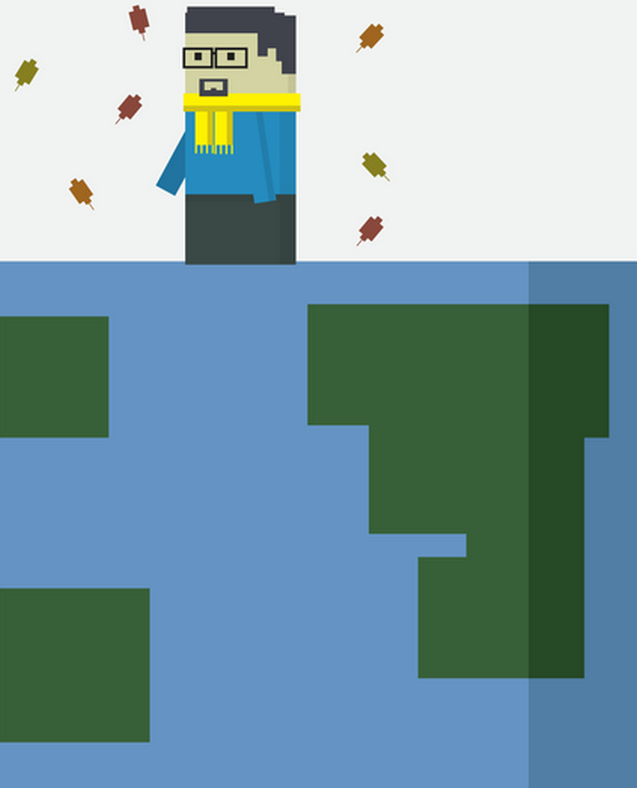
This is Earth. It's a crisp fall day. So why would you believe Earth is in a dire situation?


Let's look a little deeper. The brown area below represents all the fossil fuels — oil, coal, and natural gas — that humans have identified as recoverable with current technology. The black spot is what we're currently harvesting with mines and wells.

So what if, tomorrow, all the world leaders got together and decided to stop building new mines and wells?

And then we used all the fuel in existing mines and wells.What would that do to Earth?
It  would release about 1.1 trillion tons of carbon dioxide into the atmosphere.
Scientists have figured out that this scenario would almost certainly drive up the Earth's average temperature by more than 2 degrees Celsius (3.6 degrees Fahrenheit), relative to preindustrial levels. That's not a big deal, right?

Actually, it would be a massive catastrophe. The human suffering would be unthinkable.
When most of us think about Earth warming by 2 degrees, we think about it being, well, 2 degrees warmer.
But that's not quite right. First of all, it means Earth would get an average of 2 degrees warmer. This means some regions, especially on land, will get much hotter — far more than 2 degrees.
The Arctic, which houses much of the world's ice, would warm by almost 11 degrees Fahrenheit.
The US Southwest, already suffering from increased drought, could warm by almost 10 degrees Fahrenheit, enough to create near-permanent "superdroughts."
The other problem is that Earth's ecosystems would behave differently. For humans, it would mean rising sea levels, freshwater shortages, reduced agricultural productivity, food stress, and the conflicts and emigration that come in their wake.
A lot of people will die, and not because they burn to death. It'll be because we don't have enough food and water.
It would be like slightly heating up a fish tank, which is okay for the fish but kills the algae the fish eats.
All of this will be well underway by the time we hit 2 degrees — and the further we go past it, the worse it will get.
So we all agreed, in Paris, not to let it happen.
About 200 countries, including all the world's major emitters, agreed at a summit in Paris in 2015 that letting the planet warm beyond 2 degrees is unacceptable, and even 2 degrees is awful. We vowed to do our best to stop warming at 1.5 degrees — although most climate researchers believe that target is no longer realistic.
That's why we hear so much about efforts to stop warming at 2 degrees.
But how do we do it?
First, we figure out how much carbon dioxide we're allowed to emit
When we burn fossil fuels, we emit several harmful gases. But we focus on carbon dioxide for one reason: It stays in the atmosphere for centuries, accumulating and trapping heat.
This means we can calculate how much carbon dioxide it would take to warm the Earth a certain amount.
According to our best calculations, it would take about 843 billion tons of carbon dioxide to warm Earth about 2 degrees.

If  we decide to keep using fossil fuels at the same rate, we'll hit our limit in 21 years
Currently we emit about 39.2 billion tons of carbon dioxide per year — and that number is only rising. But if we were able to keep it at that amount, what would happen?
After one year, our mug would look like this:
It's not a huge hit. But after 21.5 years, we'd be here:
That's the year 2037.
If we reduce emissions until we get to zero in the year 2065, we still need to invent world-changing technology.
Let's say that over the next 49 years, we drive down our use of fossil fuels all the way to zero.
It's an optimistic long shot. But this is the scenario climate scientist Joeri Rogelj proposes:
The kicker is that even in this crazily ambitious scenario, we have to rely on "negative emissions" technologies that pull carbon out of the air and bury it.
The problem: We have no clue if that's even possible.
Negative emissions technologies have not been tested or proven at any scale. We are literally gambling our species' future on the idea that we're going to be able to invent it and scale it up to enormous size ... by 2065.

Let's say, somehow, we get to no emissions in 2065 — and we invent this world-changing technology.
We've saved the world, right?
Not definitely. It would only give us a 50 percent chance at staying under 2 degrees.

Remember when we all agreed in Paris that 2 degree warming cannot happen? This long shot is what they were committing to.
Given the evidence, the global community has committed not to let the Earth warm by more than 2 degrees. In doing so, countries committed to rapidly reducing and eliminating all production and use of coal, oil, and natural gas and to inventing and scaling up negative emissions technology.
The problem is they don't seem to realize that's what they committed to.
No country is taking this long shot seriously. This means Earth will probably warm past 2 degrees. It's terrifying.
Right now, the cool fall wind is flowing through windows, and everything feels fine. Nothing seems dire. So it's understandable why many of us don't feel this is an urgent political priority.
But here's the reality: We're heading toward a global catastrophe that will cause unthinkable human suffering. The data is clear: We need to turn the ship now — or else we'll never be able to avoid disaster.
But no country is taking this 2 degree goal seriously. It hasn't even been mentioned in a presidential debate.
Instead, we're focusing on threats that feel more imminent. It's just the way most humans are calibrated. So our true test is figuring out a way to comprehend that a mortal threat is on the horizon, and act accordingly.

Links

07/11/2016

As Climate Disaster Looms, Malcolm Turnbull Needs To Stop Appeasing And Start Leading

The Guardian

Hazelwood’s closure should force both federal and state governments to acknowledge the future is here already

Malcolm Turnbull has long shed the leather jacket persona of his Q&A days, when he took pride in his then principled stand on climate change policy. Photograph: Leigh Winburn/AAP
As the Chicago Cubs finally won the baseball World Series, Twitter was awash with comments on things that had happened since 1908 – the last time the Cubs won. For example, since then there had been two world wars, the beginning and end of the Soviet Union and media had moved from a time when baseball wasn’t even broadcast on radio to when you could watch the game in HD on your phone on the other side of the world.
And also, in the time since, the planet has warmed by around 1.5C.
I throw in this little nugget of information because it’s always worth reminding ourselves that while the flotsam and jetsam of daily news and politics flies by, so too are the temperature records.
Nasa recently announced that September was the warmest September on record. There’s nothing too surprising about that – 11 of the past 12 months have been the warmest of each month. Only July did not set a record – it had to be content with being the third-warmest July on record.
The 12 months to September set a new high for the warmest 12-month period recorded (breaking the old record set in August) of 1.04C above the average of the 1951-1980. The same period in 1908 was 0.42C below the average.
So things have changed.
Back in 1908 there was also a US presidential election. There were no debates then but, ironically, the same number of questions on climate change were asked in this year’s debates as back then – zero.
We now have the prospect of a US president who either believes climate change is a hoax perpetrated by the Chinese, or at best believes it’s just a hoax perpetrated by some vague group because “it’s a money-making industry”. And yet this hardly rates a mention – lost amid an avalanche of stories about the emails of the other candidate.
Now we could get on a high horse, except Australia doesn’t fare much better. Climate change at least was the topic of one question in the leaders’ debate but it hardly dominated the election. And, like the US, we also have multiple politicians who fall at the first hurdle when it comes to intelligence by professing that climate change is a con.
Mostly here, the topic comes up as the cause of blame – such as renewable energy being cited as the cause for the blackout in South Australia or even again this week with the announcement of the Hazelwood power station closing.
As such, the discussion revolves around the negative aspect of the cost of policies that will reduce carbon emissions. It’s a framing that has the underlying foundation that not pursing policies to reduce carbon emissions is a credible alternative.
It is rather similar to businesses complaining of the cost of introducing domestic violence leave rather than worrying about the horrific fact that there is actually a need for such a type of leave.
As Gay Alcorn noted on Friday – the closure of the Hazelwood power station was inevitable – and yet the sense is that both state and federal governments were caught flat footed.
Unsurprisingly, the first reaction was to focus more on compensation packages for the workers. But there is a lack of any sense of governments accepting this is just the first of such closures and that plans and responses for them should be well in place by now.
As the Climate Council noted this week, Australia’s climate change policy is mired in a valley of uncertainty, where our emissions reductions target for 2030 are based on measures that have been yet to be brought into force.
We don’t have a gibbering fool like Trump for a leader who screams about China and international hoaxes on climate change but Turnbull has long shed the leather jacket persona of his Q&A days when he took pride in his then principled stand on climate change policy.
Now more likely we’ll hear him talk of the great future for coal and rush to blame renewable energy rather than to push it as a solution. No, he’s not the gibbering fool; he is just the appeaser of those fools within his government. And that is no less damaging.
It is not a strategy that can last, because while it might help to keep the issue off the political agenda, and keep his leadership somewhat more safe, the months keep passing and the temperature keeps rising.
Because of its size, age and dirtiness, Hazelwood carries with it greater significance than do other coal-fired power stations. Perhaps its closure – regardless of the reasons for it – will force both federal and state governments to acknowledge that the future is here already.

Links

Lethal Heating is a citizens' initiative