17/11/2016

Sydney Homeowners Face Properties Being Reduced In Value Because Of Climate Change, Climate Risk Group Says

Fairfax - 

Sydney's coastal homeowners face their property values being reduced, as the future risk of increasingly extreme weather events grows, a climate risk consultant says.
Dr Karl Mallon, director of science and systems for Sydney-based consultants Climate Risk, said Australia's quintessential problem is that "you can build a house which is insurable tomorrow, but is wholly unsuitable 30 years down the track".

What are east coast lows?
They bring wild storms that lash the east coast of Australia, but despite their destructive force we need them more than you may realise. Produced in association with UNSWTV.

The message follows the release by the independent Climate Council of its latest report, Super-charged storms in Australia, which argues that the nation is highly vulnerable to "storm surges associated with tropical cyclones and extra-tropical cyclones, including [more intense] east coast lows."
"The evidence for the link between climate change and extreme weather is already very strong for heatwaves and bushfire weather, and it is getting stronger for intense cyclones and heavy rainfall events," the report said.
After months of little rain, storm cells lashed the east coast of Australia, with rising waters inundating Sydney's northern Beaches. Photo: james Alcock
"Seven storms since 2010 in Australia have resulted in insured losses of more than $500 million each, and five of them resulted in over $1 billion in insured losses."
Dr Mallon said that many Australians do not realise that a change in a property's value does not occur when an extreme weather event takes place, but "when the market realises the event will occur and revalues the house...it's the homeowner which is the sitting duck in all this."
He pointed to a "disconnect," between banks, government planning and the insurance industry, which is leaving Australian homeowners vulnerable to "climate change foreclosure".
"There are potentially millions and millions of dollars of revaluation that has to happen in the property sector and it's not going to be pretty. We could end up with suburbs where there is a wholesale collapse in value," he said, highlighting "erosion, actions of the sea, landslip and ground contraction," as some of the main impacts which are still largely uninsurable.
Catastrophic failure of transmission towers in the wake of the South Australian storm. 
"It's the banks who probably need to lead the charge…to sit down with insurers and planners and say, 'Will you start providing insurance on this?'."
Storm damage, hail and flooding caused 70 per cent of all insurance losses in NSW between 1970 and 2013, a report by insurance giant IAG and consultancy firm SGS Economics and Planning showed last week. That report identified Hawkesbury as the most disaster-prone region of greater Sydney, ranking among the city's highest risk council areas for flood, storm and bushfire. It was among 10 council areas identified as having a "high" or "very high" risk of major flooding, including Camden, Fairfield, Rockdale and Woollahra.
At the start of next year, Climate Risk will launch an online valuation tool, in which users can type in an address and run an analysis on how climate change could impact on the property's value in future.
The system recalculates the value of a property at the end of a mortgage,  by analysing climate and coastal data; such as tide, tectonic and wave gauges.
"We are not building with climate change in mind....we need someone to start talking about the risks going forward. So we've been building these products to be able to do that."
This week the Insurance Council of Australia launched a national campaign, urging Australian home and business owners to prepare for a potentially severe disaster season.
A sewerage pipe is exposed in storms at South Narrabeen. Photo: Peter Braig
"An above-average cyclone season has been forecast by the weather bureau, while the Bushfire and Natural Hazards Cooperative Research Centre predicts heightened risk across much of southern Australia, especially in New South Wales, Victoria and Western Australia," said ICA chief executive officer Rob Whelan.
Campbell Fuller, the Insurance Council's general manager of communications, said around "95 per cent of household insurance policies purchased now include cover for flooding but consumers can also buy policies where flood cover is optional, or which exclude flood damage.
For coastal dwellers, he said there was a small number of available policies that covered damage caused by actions of the sea.
"Australian governments could do more to prepare the community and reduce the impacts through mitigation, a process sometimes held back by a lack of understanding of the risks [and] budgetary pressures," he said, adding that governments at every level needed to lift their level of mitigation spending.
"This process is accelerating, as government's understanding of the impact of natural disasters grows, although insurers continue to deal with the consequences of historical decisions."
In March, the Australian Business Roundtable for Disaster Resilience & Safer Communities revealed that the total cost of natural disasters in Australia in 2015 exceeded $9 billion, or 0.6 per cent of GDP, a figure expected to double by 2030 and reach an average of $33 billion by 2050.

Links

One Looming Consequence Of Climate Change: Small Island Nations Will Cease To Exist

Los Angeles Times - 

Moroccan and international demonstrators shout slogans and hold placards against pollution during a demonstration in Marrakech, Morocco, on the sidelines of the climate conference on Nov. 13, 2016. (Fadel Senna / AFP/Getty Images)
As  United Nations climate change talks get set to wrap up on Friday in Marrakech, Morocco, negotiators representing the Alliance of Small Island Nations underscored the need to speed up efforts to combat global warming and adapt to its effects.
“I’m happy about the progress that we are making, but we have a lot more work to do,” said Hugh Sealy, a climate change consultant for the United Nations who helped negotiate last year’s Paris agreement, which committed the world’s nations to reduce greenhouse gas emissions, and is attending the Morocco conference as the lead negotiator for small island countries.
“We are still on a trajectory for at least 3 degrees of warming even if all the countries in the world did what they promised to do,” he said. “So it’s absolutely essential that we increase our efforts and that we reduce our emissions as quickly as possible.”
Speaking from Marrakech, Sealy, a professor at St. George’s University in Grenada, shared his thoughts on the urgency of tackling climate change and the key concerns for the 44 low-lying coastal countries that are among the most vulnerable.
His comments have been edited for length and clarity.

Hugh Sealy, a climate change consultant for the United Nations helped negotiate last year’s Paris Agreement, and is the lead negotiator for small island countries at the 22nd Conference of the Parties to the U.N. Framework Convention on Climate Change. (Courtesy of Hugh Sealy)
What are small island nations hoping will come out of the conference?
Mitigation, adaptation and finance are the three key priorities for us.
The Paris agreement last year was historic because, for the first time, it locked in long-term temperature goals, like what we hope to achieve in terms of combating climate change. That’s what we call mitigation. In Paris, we agreed that we would limit global warming to 2 degrees above pre-industrial times and pursue keeping it below 1.5 degrees of warming because the small islands have clearly indicated that even 2 degrees of warming will be too much. We see 1.5 degree of warming as essential to our survival.
So at this conference, we want to move toward keeping that 1.5 degrees of warming and raising our global ambition as far as mitigation goes, which is saying we have to reduce our emissions as quickly as possible.
A second priority for us is finance. Developed countries have promised that they would give us $100 billion a year. But right now the Green Climate Fund [established by the United Nations to help developing countries counter climate change] is only financed at $10 billion over a four-year period, which is $2.5 billion a year. So we’re very, very far away from that $100 billion a year that was promised to us.
So what’s terribly important to us at this conference is that the developed countries lay out a road map as to how we’re going to get to that $100 billion a year by 2020.
The third priority for us is adaptation. And adaptation to climate change is a realization that some of the effects of climate change are already occurring. For example, sea level rise. We know we are going to face at least 1 meter (3.3 feet) of sea level rise by the end of the century. Last year was the hottest year on record. This year is headed toward breaking that record. If it does, it will of course push 2015 to second place and 2014 into third place. So we’ve had the three hottest years in a row. We are in the middle of climate change now, so being able to adapt is a huge priority for small islands as well.
View of a palm field suffering from desertification near Morocco's eastern oasis town of Erfoud in the Sahara desert. (Fadel Senna / AFP/Getty Images)
What is the greatest climate change threat to small island states?
Rising sea levels, because we have the majority of our infrastructure on the coastlines — our seaports, our airports, our tourism resorts. A number of islands rely on tourism. But also, ocean acidification [is a threat]. As more carbon dioxide is absorbed into the ocean the water becomes more acidic. And as it becomes more acidic it will start to dissolve our coral reefs, and that’s disaster for us. If we lose our coral reefs, we lose our beaches. If we lose our beaches, we lose our tourism and therefore we lose our economy.
So I think most of our perils will come from the sea side of things and our coast being affected. That’s why small island nations are perhaps the most vulnerable to climate change. I would call ourselves the canaries in the coal mine. In other words, what happens to small islands will eventually occur to even larger countries. That is why for us climate change is not only an economic issue. For a lot of us, climate change is an existential issue. We will cease to exist as viable human settlements if climate change is allowed to continue in the way it is occurring now.
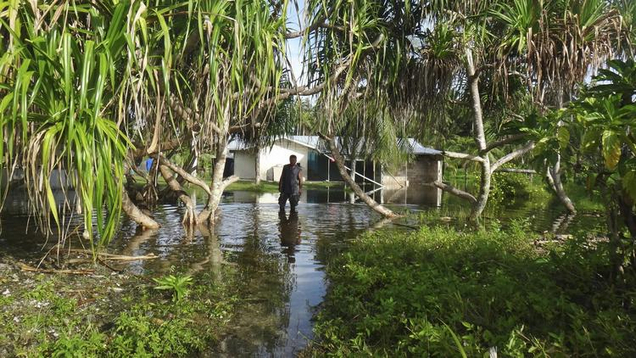
A man walks through knee-deep water to reach his home during a king tide event in 2015 on Kili in the Marshall Islands, where climate change poses an existential threat. (Bikini Atoll Local Government via Associated Press)
With the election of Donald Trump, is there concern that the U.S. might renege on its commitment to tackle climate change?
I think there are valid concerns because of what President-elect Trump said before the election. But we’re optimistic that he will realize that climate change is a global issue that America cannot divorce itself from. And we hope that the United States will continue to show the leadership that it has in the past.

What is a carbon market and how would creating a carbon market help small island nations?
It was the United States that originally used the force of markets to bring down pollution. It was President George H.W. Bush who used markets to combat acid rain. He invented a system called “cap and trade,” where he put a cap on sulfur dioxide emissions. Utility companies that were able to reduce their emissions by a significant amount got these credits and were able to sell these credits to other power companies that were not as efficient in reducing their emissions. And everyone stayed below this cap.
A heating factory spews smoke in northeastern China's Heilongjiang province. Carbon emissions from burning fossil fuels have decreased, but scientists say it’s not enough to stave off dangerous global warming. (AFP/Getty Images)
We are applying the same principle to carbon dioxide. You have states within the U.S., like California and some of the Eastern Seaboard states, that have created their own carbon market. Quebec in Canada has created one and it has linked itself to California. Australia is looking to join the market that the European Union has created. So we in the Caribbean … see there is a possibility under Article 6 of the Paris agreement to create our own carbon market within the Caribbean.

What are small island nations doing to combat the effect of climate change?
We are lobbying for the financing to do so. In a lot of cases our capacity to adapt is constrained. Even without this issue of climate change, we are poor developing countries that have not yet recovered from the Great Recession of 2008. We’re cash-strapped. We have sustainable development issues that we have to deal with over and above the threat of climate change.

So does the answer lie in financing?
Primarily yes. If we get enough finance then we can adapt. Of course, small islands reducing their emissions will do absolutely nothing in the global fight against climate change. You could add up all the emissions of small islands and we would probably still be less than half a percent of what the global emissions are.

Links

Trumping Trump

MAHB - Julian Cribb

People’s Climate March at the Trump International Hotel and Tower, New York City. Beyond My Ken Wikimedia | CC BY-SA 4.0
Contrary to appearances, Donald Trump might just be the best thing that ever happened to climate action.
The presence of a climate denier in the White House and his obtuse, fossil-funded minions in key government posts is liable to ignite such fury among sensible people across America and around the world as to accelerate the demise of coal, oil and gas (’the fossils’) and the adoption of climate-saving policies at every level from home to city to industry, to nation, to the world itself.
Trump might be just the bitter medicine we needed to jerk us out of our complacency about what a +4 or +5-degree world will really be like: approaching uninhabitable.
Depending on the rate at which Arctic methane is released, the world has somewhere between 15-20 years to do away with fossil fuels completely. After that, a hot world of +4 or +5 degrees, with all the food, water, conflict and migration crises for billions that entails, becomes almost unavoidable.
The US election result has gifted the sedate pace of climate action from Paris COP22 with a fresh urgency as, round the world, people wake up to the brutal fact that if they wait for government action then Hell will, not freeze over exactly, rather, engulf the planet in a conflagration which may consume their children and grandchildren.
Waiting for governments to agree on the necessity of saving civilization is, in the Australian vernacular, a mug’s game. Their hearts aren’t in it, and there are far too many juicy bribes and sinecures for individual politicians not to mention political parties paid off by the coal lobby to posture and then sit on their hands. In Australia, for example, a recent survey tagged more than 40 retired Ministers, MPs, their staffers and former public servants as working for the dark side – that’s the side that doesn’t care if your grandkids fry.
If Trump and his ilk are to be stopped from their headlong, selfish pursuit of planetary devastation, it will be by the people of the planet – not the institutions or politicians. Here’s how:

——————–
Go Green:
Not even Trump can defy world market reality. The one thing that can undermine the price and profitability of coal, oil and gas is low-cost renewable energy. As they well know –hence all the campaigns against wind turbines and solar farms. Put solar on your home, support your city or local government in taking your community off-grid. Invest in tidal, wave, geothermal and the new energies to balance the power supply. Resources companies have the option to go green themselves – they just don’t want to. They will end up with stranded assets and bankrupt, like many US coal majors already are.

Divest Now:
Don’t put your life savings into anything that might destroy your grandkids. It’s not a formula for human survival. Ethical and green investment services are mushrooming. Concerned citizens can compel their bank, super fund, university, local government, etc. to invest ethically by demanding accountability, including divestment in fossil fuels – and by shifting their accounts. In the Trump years, there will be massive global divestment by hundreds of millions in the source of the greatest hazard facing humanity.

Sue the Bastards:
Though they may look like pinpricks for now, there is a rolling wave of lawsuits around the world against their governments for failing in their duty of care, and against the fossils for risking human lives and destroying the environment. Every lawsuit adds to the sovereign risk of investing in fossil fuels – and unnerves other, less ethical, investors. Shrewd investment analysts are already advising their clients to bail out of fossils, and there’s not a darn thing Trump and his acolytes can do to stop it.

Protest:
Many people still underestimate the power, in a social media age, of peaceful citizens’ protests to change minds, values and perceptions within communities and countries. The way the world, especially its indigenous communities, has rallied behind the Sioux nation to oppose the Dakota Access tar sands pipeline is a case in point. As are the Australian citizens’ protests over the Liverpool Plains and Adani and similar protests in the UK and Europe. Local protests over just causes now reverberate worldwide. There is a global movement building that responds at lightspeed.

Trust the Youth:

Following the US election the following electoral map of how 18-24 year olds voted, gained currency. Young Americans, at any rate, are not willing to be pawned to the interests of the fossils. Globally, many of the lawsuits against government or the fossils are led by youngsters, even teenagers – and for similar reasons. This is a demographic that can only grow and, aided by social media, can do so rapidly and universally.
Electoral Map for Millennials (age 18-34) | Source: SurveyMonkey
Change Your Habits:
The food industry contributes roughly 30% of global climate change drivers, and wastes around 40% of all food. So stop wasting food, and buy it from farmers who care, not from supermarkets who don’t. Don’t buy your kids plastic toys – you are only funding the very petrochemical industry that threatens their future. Likewise look for organic food, clothing and household products, which are produced without petrochemicals (pesticides, dyes, preservatives, etc.). Again, there’s nothing the Trumpists can do to stop you eating and shopping more safely and sustainably – and contributing your dollar signals to a burgeoning global marketplace.

Electrify:
Electric cars are only a climate solution if the electricity they run on is renewable not fossil –but some stunning technologies are just around the corner, including using vehicles themselves as generators of green energy into the local grid. The worldwide spread of high voltage DC (HVDC) cables over thousands of kilometres is the genesis of an international grid for moving energy efficiently around the planet: one day your home may help run a factory in China. Sunlight in the Sahara will help power Europe, etc.

——————–
In the face of universal threats like climate change, people often feel powerless to influence the future. This is no longer the case, as these seven examples show. You can have quite a big impact simply by choosing how and where you shop, bank, mortgage your home and save your money. Aligned with hundreds of millions of others, equally concerned, equally empowered, you can change the world.
If humanity itself forms a consensus to prevent and mitigate climate change it will be a political act like none other in history. No nation, corporate, religious order, political party or belief system can stop it, because they will have no power over it. It will unleash the next great phase of global economic growth and development, the new industries, jobs and opportunities that transition us into a sustainable, prosperous world.

So, thanks Donald, for supplying the wake-up call.

Links

16/11/2016

2016 ‘Very Likely’ To Be The Hottest Year On Record, U.N. Agency Declares

Washington Post - Chris Mooney

Moroccan security stand guard in front of the entrance of the U.N. Climate Change Conference in Marrakesh, Morocco. (Youssef Boudlal/Reuters)
In  an announcement timed for the ongoing international climate meetings in Marrakesh, Morocco, the U.N. World Meteorological Organization has affirmed what many scientists had already considered inevitable — 2016, the agency said, is “very likely” to be the hottest year on record. That would mean that the past three years — 2014, 2015, and 2016 — have set ever more impressive temperature records in quick succession.
The agency was able to say as much, despite the year not even being over yet, because of the jaw-dropping heat seen throughout much of the year. Multiple months in 2016 set temperature records, buoyed by a strong El Niño event.
Sixteen “of the 17 hottest years on record have been this century,” noted the agency.
Overall, the WMO said, 2016 was 1.2 degrees Celsius warmer on average than temperatures for the preindustrial Earth. That’s a highly significant number, in that it puts the planet quite close to the 1.5-degree-Celsius temperature threshold enshrined as an aspirational goal in the Paris climate agreement. Some scientists have said we could cross 1.5 degrees for good by 2030.

The agency noted that warmth in the Arctic was particularly extreme in 2016. “In parts of Arctic Russia, temperatures were 6°C to 7°C above the long-term average. Many other Arctic and sub-Arctic regions in Russia, Alaska and northwest Canada were at least 3°C above average. We are used to measuring temperature records in fractions of a degree, and so this is different,” said Petteri Taalas, the secretary-general of the WMO, in a statement. The warmth accompanied a host of records, including a peaking of atmospheric carbon dioxide concentrations at 407.7 parts per million in May at the Mauna Loa Observatory in Hawaii and astounding winter warmth, with February and March in particular blowing away global temperature records. This early move to crown 2016 — albeit only in a preliminary way — does not come as much of a surprise. The warmth was so off the charts in early 2016 that as early as May, Gavin Schmidt, who directs the NASA’s Goddard Institute for Space Studies (which manages one highly influential temperature data set), tweeted this:

There were also some oddities in 2016 — one patch of ocean near the Antarctic Peninsula has remained surprisingly cool all year. “The most prominent area of below-normal sea surface temperatures was the Southern Ocean south of 45° South (especially around the Drake Passage between South America and Antarctica, where temperatures were more than 1°C below normal in places),” wrote the WMO.
The El Niño event also brought on a surprising surge in global sea levels, which rose 15 millimeters between late 2014 and early 2016, far outstripping the usual pace of around 3 millimeters per year, the WMO reports.
While the WMO relied on data from NASA and the National Oceanic and Atmospheric Administration in proclaiming the 2016 record, these agencies have not announced a formal record yet. They will presumably do so early next year once all the data is in. The WMO said its statement is “provisional” and will be updated in early 2017.
At this point, it seems unlikely that 2017 will set yet another temperature record and exceed that of 2016, especially since the El Niño event has concluded and the world has swung back to La Niña conditions. But that hardly detracts from a record run of temperatures that have coincided with an unprecedented global policy push toward climate action.

Links

Oil Billionaire Considered To Lead Energy Department

PBS NewsHour - 

File photo of Harold Hamm, founder and CEO of Continental Resources, by Steve Sisney/Reuters
WASHINGTON — An oil billionaire, a North Dakota lawmaker and a former Bush administration official are being considered to run Donald Trump’s Energy Department, according to transition planning documents obtained by The Associated Press.
The documents, which are being closely scrutinized by energy lobbyists in Washington, also outline early policy priorities for a Trump administration. Topping the list is repealing the Clean Power Plan, an Obama administration effort to limit carbon pollution from coal-fired power plants. Implementation is currently on hold awaiting a court ruling.
Those under consideration for energy secretary include Harold Hamm, an Oklahoma oil tycoon and leading proponent of fracking, and North Dakota Rep. Kevin Cramer, an early Trump supporter from a major oil drilling state. Venture capitalist Robert Grady, who worked in President George H.W. Bush’s administration, is listed as a contender to lead both the Energy and Interior Departments.
It’s unclear whether the list is exhaustive or has been reviewed by Trump. The Republican is in the early stages of setting up his administration, having named only his White House chief of staff and chief strategist thus far.
The Trump to-do list targets recent Obama administration efforts to reduce air and water pollution that have been opposed by Republicans and industries that profit from the extraction and burning of fossil fuels, including the “waters of the United States” rule and ozone regulations.
Trump calls climate change a “hoax” perpetrated by China and others and has said he will rescind the Clean Power Plan — the linchpin of President Barack Obama’s strategy to fight climate change.
A coalition of conservative states has challenged the Clean Power Plan and also has challenged an EPA rule that expanded the definition of waters protected under the Clean Water Act to smaller non-navigable waters and seasonal tributaries.
The Obama administration says the rule would safeguard drinking water for 117 million people, but Republicans and some Democrats representing rural areas say the regulations are costly, confusing and amount to a government power grab. Federal courts have put the rules on hold as judges review lawsuits.
On his campaign website, Trump called for rescinding “all job-destroying Obama executive actions” and has vowed to unleash an American energy revolution, allowing unfettered production of oil, coal and natural gas. He would sharply increase oil and gas drilling on federal lands and open up offshore drilling in the Atlantic Ocean and other areas where it is blocked.
Senate Majority Leader Mitch McConnell, R-Ky., said last week he has asked Trump to move quickly to approve the Keystone XL oil pipeline from Canada, which Obama rejected last year.
Trump highlighted the stalled Keystone project during a late October campaign swing through Florida, saying: “We’re going to approve energy infrastructure projects like the Keystone pipeline and many more.” He listed the project among his top priorities for the first 100 days of his administration, saying it could provide “a lot of jobs, a lot of good things.”
In addition to repealing the power plant rules, the transition document also says Trump’s energy team is considering modifications to Obama’s ozone rule, which is meant to reduce smog.
Also on the chopping block are Obama administration regulations intended to limit harmful emissions and chemical-laden waste water from hydraulic fracturing operations at oil and gas wells.

Links

Climate Change an Influence Behind Rare SA Storm and NSW Coastal Damage, Climate Council Says

ABC News - Malcolm Sutton

The Climate Council says September's mid-latitude cyclone was influenced by climate change. (Supplied: Bureau of Meteorology)
Storms that knocked out electricity infrastructure in South Australia and brought coastal flooding to New South Wales were influenced by climate change and more could be expected in coming years, the Climate Council says.
A report released by the council said climate change was fuelling more intense and damaging storms in Australia and would have "powerful consequences" for critical infrastructure.
What was described by the Bureau of Meteorology as a mid-latitude cyclone hit SA during September and created tornadoes that knocked over more than 20 transmission towers and resulted in a state-wide blackout.
BOM also released a report today confirming at least seven tornadoes touched down on September 28, an outbreak caused by multiple supercell thunderstorms.
Winds of up to 260 kilometres per hour were recorded with sheds destroyed and a caravan overturned in the state's Mid North.
One tornado lasted for 25 minutes and travelled about 23 kilometres, while another lasted 20 minutes and travelled 30km.
Separately, an intense low pressure system that hit NSW in June resulted in the evacuation of parts of Sydney and tens of millions of dollars in damages.
The NSW storm surge of 17.7 metres was the highest on record, the council said, and was exacerbated by rising sea levels "as a result of climate change".
The Climate Council's Professor Will Steffen said the atmosphere was "packing more energy and carrying more moisture than it did in the 1950s".
"Our infrastructure is built for last century, not for a changed climate and a number of our major cities and towns are vulnerable," he said.
Beachside homes in Sydney were damaged by June's storm event. (Fairfax Media: Peter Rae)
Extreme rainfall events projected to increase in intensity
The report said extreme rainfall events were projected to increase in intensity across the continent, with the exception of south-west Western Australia where reduced rainfall was projected.
The annual frequency of severe thunderstorm days was expected to increase 14 per cent in Brisbane, 22 per cent in Melbourne, and 30 per cent in Sydney by 2100.
It said tropical cyclones were predicted to become less frequent but more intense, with stronger winds, higher rainfall and more severe storm surges.
The council warned that infrastructure and essential services needed to be designed for increasingly intense and severe weather caused by climate change.
It said seven storms since 2010 in Australia have resulted in insured losses of more than $500 million, with five them causing more than $1 billion in insured losses.
BOM meteorologist Matthew Bass said it was difficult to attribute single events, such as the storms in SA or NSW, to climate change.
"Those sorts of storms are not unheard of, but they're very, very rare," he said.
"For example, the surface air pressure in Adelaide was the lowest on record, but that's our historical record that goes back 100 years or so. It's probably likely that we have had similar lows, with recurring intervals of 150 years or so, that we just don't know about."
On the subject of extreme rainfall events, however, when the atmosphere is hotter due to climate change and holds more moisture as a result, it was easier to point to climate change.
"And when you're talking about a bushfire [for example], you can measure the excess heat in the atmosphere, and the excess dryness due to the heat," Mr Bass said.

Australia's worst storms of the past six years
DateLocationEventInsured losses
March 2010Melbourne, VicLarge hailstones hit the city of Melbourne, damaging schools, businesses and homes. $1.04 billion
March 2010Perth, WAWinds of up to 120 kilometres per hour damage houses, schools and vehicles.$1.05 billion
January 2011Brisbane, Lockyear Valley, Ispwich, QldExtreme rainfall causes major flooding that inundates housing and destroys roads. Some 25 people are killed.$2.4 billion
February 2011Cardwell, Tully, Mission Beach, Innisfail, North Qld Category 5 tropical cyclone Yasi hits, resulting in one death. Homes are destroyed and agriculture and mining infrastructure are damaged.$1.4 billion
December 2011North and eastern suburbs, Melbourne, VicThunderstorm brings torrential rain, hailstones and tornadoes. $729 million
November 2014Brisbane, QldStrong hail storm hits the city along with winds of up to 140kph.$1.39 billion
April 2015Hunter Valley and NSW coastMore than 400mm of rain falls in 48 hours. Wind gusts of 135 kph hit, three deaths are caused and 370,000 properties experience a power outage.$950 million
May 2015South-east QldSome 183mm of rain falls in just 24 hours in Brisbane, its wettest day in May for 175 years. Houses are damaged and five deaths are caused.$349 million
June 2016East coast of NSW, southern Qld and SydneyA record-high storm surge of 17.7 metres results in coastal erosion and the deaths of five people. $235 million
September 2016SAExtreme rainfall and at least seven tornadoes result in a state-wide blackout affecting nearly 1.7 million people that lasts up to three days in some areas.Undetermined
Compiled by the Climate Council

Large hail events more frequent in eastern states
A spring thunderstorm slammed parts of Adelaide and SA with golf ball-sized hailstones late last week.
Hail stones collected from Stepney in Adelaide's east on Friday. (ABC News: Simon Christie)
Mr Bass said such storms were common in the eastern states but less common in SA.
"We've found four instances in the last six years, of what we call large hail in the Riverland, which is greater than two centimetres," he said.
"If that goes right through your cropping area, or the middle of Adelaide as well, that's going to be pretty significant.
"If you're in Sydney or Brisbane, you'd be pretty used to seeing a couple of these every year, but in Adelaide, it's more like once every five years or 10."
The Climate Council said Australia needed to do more to reduce its carbon emissions and help "stabilise" the world's climate.
It said Australia's "very weak target" of a 26 to 28 per cent reduction in 2005 emission levels by 2030 was well behind the targets of other OECD countries and Australia was on track to miss its target anyway.

Links

15/11/2016

The Guardian View On Climate Change: Trump Spells Disaster

The Guardian - Editorial

Delegates have gathered in Marrakech to celebrate ratification of the Paris deal on climate change. But the US elections risk turning it into a wake
Indigenous people from the Mesoamerican Alliance of Peoples and Forests protest outside the UN climate change conference in Marrakech, Morocco. Photograph: Youssef Boudlal/Reuters
Reaching a global agreement on climate change took more than 20 years of tortuous negotiations. Signed just under a year ago, the insufficient but workable Paris agreement at last constructed a legally binding framework for the principle of cutting carbon emissions. It was to be the foundation of a sustained ratcheting up of ambition that would hold global warming below 2C. Last Tuesday night, as one by one from east coast to west the United States went Republican red, that progress was wiped out.
Donald Trump is the first self-declared climate denier to lead of one of the world’s biggest emitters. Even President George W Bush, though he surrounded himself with sceptics, did not publicly disavow climate science. He even managed a few helpful moves. But Mr Trump has pledged to unpick the Paris agreement. In Marrakech, where delegates are meeting for the first time since Paris, they are putting a brave face on proceedings. But they know the outlook is bleaker than it has been since the collapse of the Copenhagen talks in 2009.
Mr Trump cannot instantly extricate the US from the Paris accord: legal technicalities means withdrawal would take four years, although he may try to speed up the process. That, though, is just legal stuff. His chilling effect on climate negotiations has already begun. That is because these talks rely as much – if not more – on trust, good faith and political will as they do on law and legal process. Remember, for instance, that only the framework of the Paris pact is legally binding, not each country’s commitments on greenhouse gas emissions.
Trust and goodwill can go a long way: the personal charm offensive that President Obama launched on Beijing when he made climate change a legacy issue led to the historic joint statement without which the Paris deal could never have been made. The prospect of its success drew the presence of almost all major world leaders to Paris for the launch of the talks last December, sending an unmistakable signal to their negotiating teams. Now, even if the US remains technically a signatory for a while longer, all this is lost from inauguration day in January.
With a hostile US, China may cool on its commitments, or at least take a tougher stance, as it has done before. India was already a reluctant participant and the change in the US position is likely only to make its grumbles louder.
Games of “what if” are irresistible at this stage. As delegates started to gather in Marrakech, the world appeared on the brink of an unprecedented phase of stability. The Paris agreement had come into force within a year of its agreement, an astonishing achievement after the discord and mistrust that had threatened all the preceding meetings and even the whole UN climate process. But now that huge achievement may be shattered. Diplomats are working furiously to reassure countries that the departure of the US would not mean the end of the road and the process can continue.
And it is not only the global talks. In the US, too, more climate-unfriendly actions from a Republican-dominated Congress, like changes to clean energy subsidies, are on the cards, while President Obama’s clean power plan to regulate power stations is under grave threat. Mr Trump’s proposed leader of the Environmental Protection Agency is a prominent climate sceptic, Myron Ebell, a man once described by a senior George W Bush aide as “crazy Myron”.
Finally, a right-leaning supreme court may put a brake on future legal challenges from environmental groups. Taken with Mr Trump’s support for coal, US emissions may soon be back firmly on their upward track. And if he really wants to “cancel” Paris, Trump could even pull the US out of the UN framework convention on climate change, the foundation treaty under which Paris was signed. If he did, the world would lose its global forum for taking fair and effective action on greenhouse gases and adapting to climate change.
Withdrawal may be a step too far even for Trump, for the treaty gives the US a seat at the table that pragmatists would rather retain, even if they try to saw the legs off.
For delegates in Marrakech, the only source of optimism may be their years of experience in holding the talks together. But they cannot do it on their own. In the end, it may all come down to scientifically literate Republicans in Congress. They must be the voice of the two-thirds of Americans who understand the link between human activity and global warming – and want to break it.

Links

Lethal Heating is a citizens' initiative