02/12/2016

Direct Action Review Could Bring Changes To Renewable Targets, Says PM

The Guardian - Katharine Murphy

Malcolm Turnbull says ‘mechanisms’ to meet 2030 Paris emission reduction targets may need to be examined
The prime minister, Malcolm Turnbull, has acknowledged a Direct Action climate policy review could lead to change. Photograph: Lukas Coch/AAP
Malcolm Turnbull has acknowledged the looming review of the Direct Action climate policy in 2017 “may result in some changes” to the federal renewable energy target.
The prime minister’s hedged observation on Thursday morning comes ahead of the release of the preliminary findings of the Finkel energy security review determining whether the national electricity market can deliver reliable base load power while meeting Australia’s climate change commitments.
Some participants in the Finkel process think it is possible the review could float the desirability of an emission intensity trading scheme for the electricity sector – a form of carbon trading currently being championed by the South Australian government through the energy ministers council.
Even if Finkel doesn’t go down that path, pressure from business, energy and climate groups will build on the Turnbull government once the new political year opens, because there is widespread criticism that the Coalition’s climate policy won’t deliver the emissions reductions required to ensure Australia meets its international commitments.
Business and climate groups have been dismayed by a rerun of Australia’s toxic climate politics triggered when the prime minister linked a statewide blackout in South Australia in September explicitly to the state’s use of renewable energy – which led to brawling between Canberra and the states on renewable energy targets.
In a joint statement issued in October, major business organisations and energy users warned that, in the absence of bipartisanship, “uncertainty will cause essential energy investments to be deferred or distorted, to the ultimate cost of us all”.
Many groups will use the review of Direct Action to call for greater policy certainty, either through a carbon trading mechanism, or longer legislative timelines on the federal renewable energy target – eventualities that would trigger renewed internal brawling within the Coalition about climate policy.
The government’s recent decision to ratify the Paris climate agreement triggered a small internal breakout, with the chairman of the government’s backbench committee on the environment and energy, the Liberal MP Craig Kelly, declaring on Facebook after Donald Trump won the presidential election in the United States the Paris agreement was now “cactus”.
George Christensen, the outspoken Liberal National party backbencher from Queensland, later backed Kelly’s view.
Anticipating internal turbulence, both Turnbull and the minister for environment and energy, Josh Frydenberg, have been careful to play down the potential for the Direct Action review to lead to major changes in the existing policy.
In his remarks on Thursday morning, Turnbull acknowledged the review could lead to change, but he also attempted to fence-sit on the issue.
“The climate policy will be reviewed and the renewable energy target is agreed, it is legislated, we have got no plans to change it,” the prime minister said. “But the 2017 review, which has been part of our policy for a very long time, is to examine the mechanisms that we have to meet the 2030 Paris targets, which, as you know, is a reduction of our emissions by 26 to 28%.”
But while playing down the prospect of big changes in the Direct Action review, Frydenberg has been making the case since he assumed the energy and environment portfolio for gas as the transitional fuel to help Australia continue to deliver reliable base load power while lowering carbon emissions.
An emissions intensity scheme for the electricity sector is a favourable regulatory regime for gas, because gas would be considered preferable to coal in the short term to deliver base load power.
Frydenberg used a speech this week to argue gas provided “a pathway to a lower emissions generation future with up to 50% fewer emissions than coal, depending on the generation technology”.
“Recent events in South Australia in particular have brought home the role of gas in providing capacity to balance the intermittent nature of solar and wind. Gas can be dispatched in a short timeframe, something renewables cannot do in an affordable way at this stage.”
Frydenberg has consistently criticised current moratoria on coal seam gas exploration.
“We need to improve market efficiency and competitiveness while attracting further investment in exploration and development,” the minister said this week. “We need to make it easier for new producers to enter the market and for buyers to more efficiently move that gas around our pipeline networks.”

Links

2,300 Leading Scientists Send Trump A Clear Warning: We’re Watching You

Huffington Post - Chris D’Angelo

An open letter signed by America’s top minds hopes to counter the influence of climate change deniers and oil execs.
President-elect Donald Trump’s administration needs to “support and rely on science as a key input for crafting public policy,” the scientists wrote. Mike Segar / Reuters
More than 2,300 scientists, including 22 Nobel Prize recipients, have a warning for Donald Trump: Respect science or prepare for a fight.
In an open letter Wednesday to the president-elect and Congress, scientists representing all 50 states called on the incoming administration to sufficiently fund scientific research as well as “support and rely on science as a key input for crafting public policy.”
Anything short of that, they stressed, is a direct threat to the health and safety of Americans and people around the world.
“The consequences are real: without this investment, children will be more vulnerable to lead poisoning, more people will be exposed to unsafe drugs and medical devices, and we will be less prepared to limit the impacts of increasing extreme weather and rising seas,” the letter reads.
The letter, organized by the Union of Concerned Scientists, comes amid growing concern about what a Trump presidency will mean for combatting today’s environmental challenges, namely climate change.
Trump and his fellow climate deniers have made it quite clear where they stand on the phenomenon and funding its continued study. Trump has dismissed climate change as “bullshit” and a Chinese “hoax,” and promised to pull the U.S. out of the historic Paris climate agreement. He has also said he would cut all federal spending on the issue, increase America’s production of coal, oil and natural gas, and do away with Obama administration regulations aimed at cutting emissions.
Respect for science in policymaking should be a prerequisite for any Cabinet position.
Physicist Lewis Branscomb
In the weeks since the election, Trump has only added to scientists’ concerns by selecting climate change denier Myron Ebell and fossil fuel lobbyist Mike McKenna to lead transition work at the Environmental Protection Agency and Department of Energy. Former Alaska Gov. Sarah Palin and oil executive Harold Hamm are front-runners to head the Interior Department, and Trump’s senior adviser on space policy wants to eliminate NASA’s research into climate change.
The letter, published Wednesday, features an impressive list of signatories, including David Baltimore, president emeritus of the California Institute of Technology; Eric Chivian, the founder and director of the Center for Health and the Global Environment at Harvard Medical School; and Wolfgang Ketterle, a German physicist and professor at Massachusetts Institute of Technology.
The scientists call on Trump and the 115th Congress to “adhere to high standards of scientific integrity and independence in responding to current and emerging public health and environmental threats.”
In a news release on the letter, Lewis Branscomb, a physicist and professor at the University of California, San Diego, said: “Americans recognize that science is critical to improving our quality of life, and when science is ignored or politically corrupted, it’s the American people who suffer. Respect for science in policymaking should be a prerequisite for any Cabinet position.”
The group also promised to keep a close eye on Trump ― and fight back if necessary.
“We will continue to champion efforts that strengthen the role of science in policy making and stand ready to hold accountable any who might seek to undermine it,” the letter states.

Links

Australia Has Its Own Dakota Pipeline Story, And It’s Happening Right Now

1 Million Women - Shea Hogarth


The world has been following the protests at Standing Rock for the last few months, watching as a social media trend has been kicked-up by our keyboard-grazing era offering solidarity with protestors on the ground. Whilst some might say this demonstrates a modern-day delusion that clicking a button makes a difference, I believe that displaying solidarity through a tool readily available to us, at least, starts the conversation that leads to action.
Over the past months, hundreds of indigenous persons and their allies have gathered near the crossing of the Missouri and Cannon Ball River in the ancestral territories of the Standing Rock Sioux tribe. Their goal is to stop the building of the Dakota Access Pipeline (DAPL), which would connect production fields in North Dakota to refineries in Illinois. The main concern is that an oil leak would threaten water quality for many members of the tribal community.
Oil pipes burst, a lot. Since 1995 there have been more than 2,000 significant accidents involving oil and petroleum, and between 2013-2015 an average of 121 accidents happened every year.

But what some of us might not realise is, this is happening in Australia too…
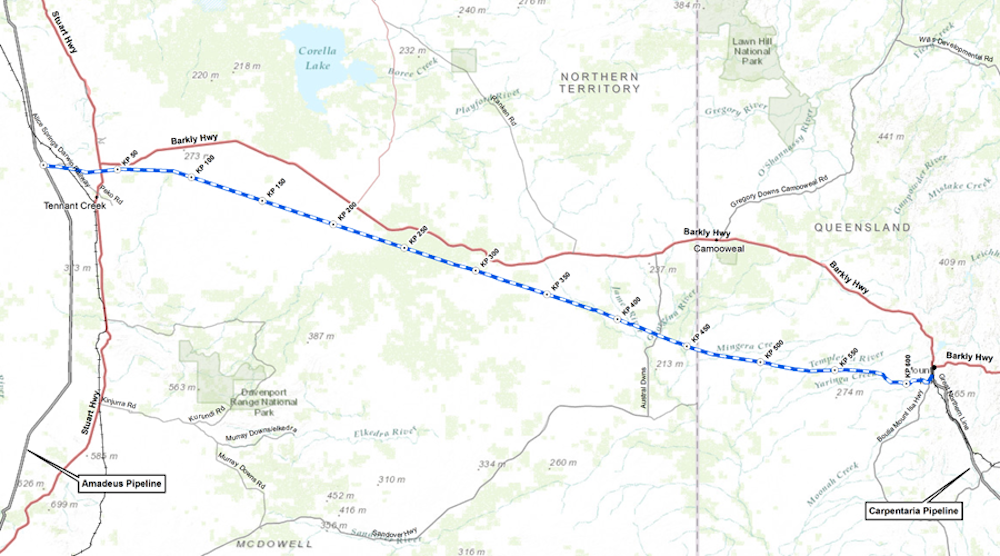
In November 2015, Jemena (A gas, electricity and water provider) was selected by the Northern Territory Government to construct and operate the Northern Gas Pipeline (NGP).
LARGE IMAGE

This is a 622km high-pressure underground pipeline that will connect gas fields in the Northern Territory with customers in the Eastern Gas Market. The NGP will run between Tennant Creek in the Northern Territory and Mt Isa in Queensland. The construction of the NGP is expected to commence in early 2017 and be completed by 2018.
Back in July of this year Northern Territory Traditional Owners, whose land is being targeted for the proposed gas pipeline, walked out of a joint Central and Northern Land Council meeting. The Wakaya Traditional Aboriginal Owners say that authorities are unconcerned about the potential damage to the environment and sacred sites. They are anxious about the impacts of fracking gas fields and disdainful about the threats this has on their land, water and livelihoods. The Wakaya Traditional Owners are unanimous in their decision to oppose the NGP.

A Traditional Owner named Max Priest explains,
" If we say yes to the pipeline we would be helping the fracking industry to expand across the whole Territory and damage not just our own but other mob's country. We are standing up and saying no to this pipeline not just for our sake but on behalf of a lot of station owners and Native Title mob who don't have any rights to stop the gas companies walking on and damaging their land."
According to an open letter to Chief Minister Michael Gunner and NT Labor, over 380 Traditional Owners and members of the Alawa and Mangarrayi Aboriginal Land Trusts contest the fracking agreement and believe they were not officially consulted or explained the scale and risks of an operational shale gas field.
The NT Gunner government have implemented a moratorium on fracking, however this is to be reviewed in the future and it is uncertain what will happen or how long it will remain. Victoria is introducing legislation to permanently ban exploration and development of unconventional gas in the state, including coal seam gas and fracking. This it the outcome one could hope for through protesting and what will hopefully become of this moratorium in the Northern Territory.

Climate justice
In Dakota, the pipeline's construction has already destroyed some of the Sioux Tribe's sacred burial grounds. According to Associate Professor of Philosophy and Community Sustainability, Michigan State University Kyle Powys Whyte, standing up for water quality and heritage are intrinsically tied to climate justice and decolonization for indigenous peoples.
Whyte explains how climate justice means that it is ethically wrong for some groups of people to suffer the detrimental effects of climate change more than others. We know that indigenous communities are already being affected by climate change impacts and are the first climate refugees.
For the Wakaya tribe, not being consulted about the environmental impacts of the Northern Gas Pipeline (NGP) is a discredit to their sacred ownership of the land and a danger to the livelihood it provides. Wakaya Traditional Owners are calling for support too.

Mni Wiconi features water protectors from the Standing Rock Sioux Tribe and allies trying to stop the 1,100-mile Dakota Access Pipeline - DAPL. Interviews in the film include Standing Rock Sioux Tribe’s Chairman Dave Archambault II; Jodi Gillette, former White House advisor for Native American Affairs; Ladonna Allard, founder of Sacred Stone Camp; Winona LaDuke, founder of Honor the Earth; and Cody Hall, Red Warrior Camp spokesperson. Created by Divided Films with support from the WK Kellogg Foundation.

Links

01/12/2016

Mark Ruffalo, Noam Chomsky and Sir David Attenborough Join Forces for Climate Change Documentary

1 Million Women - Shea Hogarth

A new climate change documentary by Liberatum called ‘In This Climate’ will be released in January 2017, and intends to set the record straight on climate change.

This has been a film 15 years in the making, but there has never been a more important time to release it. This world is a hotbed for denial (excuse the pun), the President of the free world believes anthropogenic climate change is a hoax, people out there don't deviate from their single-minded media outlets and not nearly enough people changing their lifestyles, thus there has never been a greater need for poignant motivation. Video is a powerful course of action to raise awareness.
The film uses notable visionaries, thinkers, scientists and some of the most celebrated creative minds of our time in order to express the urgency of this issue. From David Attenborough, Noam Chomsky and Christiana Figuerez to Cher, Mark Ruffalo and Ian McEwan, the documentary is not short of ranging audiences.

Just from the trailer you are taken through a whirlwind of emotions in order to arrive at the one emotion we need… hope.
The facts are daunting, "By 2050 we are going to have more plastic in the ocean than fish" and "The next war is going to be a mortal war." But as long as after we learn all this and go through the stages and we arrive at hope, then there can be real action to create change.
As Christiana Figuerez mentions in the trailer "Any transition is messy by definition" and when Ian McEwan says "We are paralysing ourselves with pessimism."
Utilising notable figures in society is a key method to spread the message. There cannot be a cultural shift if so many of us are still left in the dark or are yet to truly understand the impacts of anthropogenic climate change. Combining creative forces, various reputable figures from all over the world and a strong message is a powerful way to raise awareness and empower change.
The important concept to remember is that this is the awareness stage; one must never think they can't make a difference because they are not scientists, activists, world leaders or celebrities. These people are great motivators because their audiences are vast and diverse. However, this is only one stage of the process to engage the conversation and once you get the grip on climate change, then you can create change.
One can create change in their daily lives through the way we live. Cutting CO2 through practical changes in your lifestyle is a sure way to make a difference. Our Carbon Challenge has more that 50 activites to cut pollution. Make a personal goal to cut a minimum of 1 tonne of CO2 pollution from your daily life within a year.

Links

Will The Latest Electricity Review Bring Climate And Energy Policy Together At Last?

The Conversation -  | 

The Australian government is reviewing our electricity market to make sure it can provide secure and reliable power in a rapidly changing world. Faced with the rise of renewable energy and limits on carbon pollution, The Conversation has asked experts what kind of future awaits the grid.
Australia's National Electricity Market brings power to millions of people. Power image from www.shutterstock.com
Australia's National Electricity Market (NEM) is under review following the state-wide blackout that hit South Australia in September.
The review, led by Chief Scientist Alan Finkel, will "develop a national reform blueprint to maintain energy security and reliability".
Importantly, the Council of Australian Governments (COAG) specifically agreed that the review would consider Australia's commitment under the Paris climate agreement, and how climate and energy policy can be integrated.
Before we consider how the NEM might need to change, it is important to understand how it came about.

State responsibility
Electricity supply began as a state responsibility. Originally, state-based utilities owned and operated the entire supply chain, from generation to transmission, distribution and retail. With the exception of the Snowy Hydro Scheme, there were no interstate transmission lines.Accessibility and affordability were (and still are) key concerns for the states. As such, electricity prices were equal for all citizens, irrespective of their location or the actual cost of bringing electricity to them. This is still partly reflected in network tariffs today.
In the late 1980s, concerns about rising costs to government, but also a worldwide ideological move towards privatisation of public services, drove a shift away from publicly owned utilities. This began with a New South Wales inquiry, which found that NSW could avoid billions of dollars in new investment by connecting its network with Victoria.
This set the scene for the development of a more interconnected grid and more general reform. In particular, this was followed by a report from the former Industry Commission in 1991 and the Hilmer Review on National Competition Policy in 1993. These reports were dominated by market logic. They argued that competition would make the system more efficient.
Governments specifically agreed to reforms that would lead to a fully competitive national electricity market. This involved breaking up and selling the three layers of the electricity sector: generation, networks and retail.
The network businesses were seen as natural monopolies, and were to be regulated as such. Generators and retailers were to compete within their own layer, increasing efficiency and keeping prices down.

The national system

Following these preparatory measures, the state and federal governments agreed to pass the National Electricity Law (NEL) under a cooperative national arrangement. This provided the legal basis to create the National Electricity Market (NEM). The NEM is the national electricity market governed by the NEL and includes the wholesale markets as well as network regulation.
In 2001, the state and federal governments established the Ministerial Council on Energy with the broad aim of overseeing and coordinating national energy policy. In 2002, the council commissioned an independent review of energy markets, which highlighted many deficiencies, including governance and regulation.
The review found that the state-based regulators' responsibilities overlapped with those of the national regulators and led to costly inconsistencies. It also found that greenhouse policy responses were "ad hoc and poorly targeted".
The ministerial council subsequently proposed a package of reforms. This led to the formation of the Australian Energy Market Commission for developing market rules, and the Australian Energy Regulator for enforcing them, which governments endorsed through the Australian Energy Market Agreement.
This agreement contains a commitment to reducing greenhouse gas emissions. However, this remained outside the National Electricity Objective, which was introduced in 2005 and is the highest point of reference for policy setting. The National Electricity Objective is to:
…promote efficient investment in, and efficient operation and use of, electricity services for the long-term interests of consumers of electricity with respect to price, quality, safety, reliability and security of supply of electricity; and the reliability, safety and security of the national electricity system.
Parallel to these regulatory developments, the states participating in the market became increasingly intertwined. Five new interconnectors were added between 1990 and 2006.
The competitive layers of the industry also began a period of consolidation, leading to the emergence of the so-called "gentailers". The wholesale market is now dominated by three gentailers (Origin, AGL and Energy Australia), which collectively supply 71% of all retail customers.

The new review

Shortly after the blackout in South Australia, Federal Energy and Environment Minister Josh Frydenberg called for harmonisation of state renewable energy policies, and announced the latest review.
The Finkel Review is a review into the "security and reliability" of the NEM. However, its scope is wide enough to allow for a fundamental rethink of the role of the electricity sector in addressing climate change.
The blackout provides a great example of the kind of challenge the NEM will face in the future. On one hand, climate policies, especially the RET and state-based renewable energy goals, put pressure on the networks and influence the wholesale electricity market.
On the other hand, climate change is expected lead to more frequent and increasingly severe storm events, such as the one that destroyed transmission towers in South Australia. Networks, markets and their governance framework under the NEM aren't necessarily prepared for these changing conditions.
As shown by the 2002 review, the overlap of state energy policies and ad hoc climate policies is not a particularly new phenomenon. But market governance frameworks have so far kept climate policies separate from the narrow efficiency concerns of the electricity market and network regulation.
Clearly, in the age of climate change, the NEM and its regulatory and institutional frameworks will need to take account of these new and increasing climate mitigation and adaptation pressures.
Recently, South Australian Energy Minister Tom Koutsantonis called for the federal government to "get serious about bringing climate policy and energy policy together".
With the energy and environment portfolios combined in some governments (including now the federal one), perhaps the Finkel Review can support a convergence of climate and energy policy on a national level.

For more details on the history of reforms in the electricity market see Environmental norms and electricity supply: an analysis of normative change and household solar PV in Australia and A Barrier for Australia's Climate Commitments? Law, the Electricity Market and Transitioning the Stationary Electricity Sector.

Why Land Rights For Indigenous Peoples Could Be The Answer To Climate Change

The Guardian - 

Preventing deforestation is central to curbing carbon emissions – and a case study on the Amazon shows the most cost-effective way of doing it
Munduruku Indians demonstrate in front of the offices of the Brazilian ministry of mines and energy in Brasilia. Photograph: Lunae Parracho/REUTERS
I've spent a lot of time with indigenous peoples in remote places. So when I argue that the best way – or at least the cheapest way – to stop climate change is to grant land rights to indigenous communities, you might suspect I'm not coming from an entirely objective viewpoint. You've probably also heard various industry spokespeople saying the best and cheapest way to stop climate change is through windfarms, solar panels, electric cars and cavity wall insulation. But while I may be biased, and may even have "gone native" now and then, I'm not trying to sell you anything.
On a global scale, one of the main causes of climate change is land-use change, and particularly changing land from forest to agriculture. Stopping deforestation is the most economically efficient way of preventing carbon emissions because, in simple terms, all it amounts to is not flooding forests for dams or cutting down and burning them for agriculture.
The efficiency of not cutting down trees as a climate change mitigation strategy is fairly well-established. The UN is pushing the international community to cooperate on an agreed plan to stop deforestation and its associated emissions, which add up to about the same level as road transport and haulage emissions.
But this is where a beautifully simple idea becomes complicated. How exactly do you stop deforestation? How do you compensate industries reliant on the agriculture that entails deforestation? And how do you compensate them in a way that doesn't create perverse incentives and unforeseen consequences?
What is the value of a forest and the land it stands on? There's the value of the timber it can produce, and after that, the crops that could be grown. Or the value of an Amazonian valley flooded for a hydroelectric dam.
Then there's the forest's value if we don't chop it down. Its value as a carbon sink, its value as a biodiversity reservoir, its value as a weather maker and regulator, its value as a source of oxygen and air purifier. All the things that are invisible to accountants but vital to humans.
And forests also have a value that even environmental scientists can miss, but is very, very real to forest peoples. As the environmentalist David Suzuki says: "The way we see the world shapes the way we treat it. If a mountain is a deity, not a pile of ore; if a river is one of the veins of the land, not potential irrigation water; if a forest is a sacred grove, not timber; if other species are biological kin, not resources; or if the planet is our mother, not an opportunity – then we will treat each other with greater respect."
This is why indigenous peoples are the forests' greatest conservationists. They can cut through the Gordian knot of the UN's interminable processes. They see and understand the value that enlightened, developed cultures are blind to, and which modern science is only beginning to rediscover.
Translating that value into the hard currency we value is difficult. The World Resources Institute has taken a step in that direction, with a study of the environmental and economic costs and benefits of governments granting indigenous land rights in Brazil, Bolivia and Colombia. It reports that giving indigenous people land rights leads to the preservation of forests as carbon sinks. And, as a means of storing carbon, it is between five and 42 times more cost-efficient than fitting carbon capture and storage systems to fossil-fuel power stations.
If we are unwilling to spend money on protecting rainforests, their spectacular biodiversity, indigenous cultures, their ecosystems and their ineffable beauty and meaning, then we'll have to spend a lot more sucking from the atmosphere what was once a rainforest, and burying it in the ground.
There is a test case going on right now in Brazil, home of the world's biggest rainforest. The country's official body for looking at indigenous people's land rights, FUNAI, is due to decide this month on whether to grant them to the Munduruku people. They live in the Tapajos basin, an area in the heart of the Amazon being eyed up for the construction of more than 40 hugely destructive mega-dams.
The Munduruku can protect their bit of the Amazon for us, as they have done for centuries, preserving its amazingly varied flora and fauna and saving us the money we'd have to spend on taking carbon out of the atmosphere if industry is allowed turn it into carbon emissions.
The Munduruku have been campaigning for their rights for decades. The Brazilian constitution says they should be given them. A cold, hard, financial cost/benefit analysis says they should be given them. And if the Munduruku don't get their land rights, there's an industrial-scale queue of people waiting to trash their beautiful home. While many of us have yet to fully understand this, the truth is, their home is also our home.

Links

30/11/2016

Farmers Demand The Coalition Government Do More On Climate Change

Fairfax - Fergus Hunter

A thumping majority of Australian farmers have concluded they are witnessing the effects of climate change, urging the Coalition government to reduce greenhouse gas emissions and prepare the country for a future that is drier, less predictable and more prone to bushfires.
This is according to a survey of 1300 primary producers across states and agricultural sectors, conducted by advocacy group Farmers for Climate Action with the co-operation of the National Farmers Federation.

It found 88 per cent of respondents want rural and regional politicians to start advocating for stronger climate change action. Two thirds have seen changes in rainfall over their time on the land and half have seen an increase in droughts and floods.
Nine in 10 are concerned about damage to the climate and eight in 10 support Australia moving towards 100 per cent renewable energy.
A delegation of six farmers visited Parliament House on Monday and Tuesday to convey the findings, meeting with politicians of all persuasions to make their case for emissions reductions, global leadership and boosted research on new technology.
Derek Blomfield, a beef producer from the Liverpool Plains in Nationals leader Barnaby Joyce's New South Wales electorate, has observed increasing unreliability of weather.
He now finds managing his property more difficult and wants to see "strong leadership" from the Coalition government and thinks farmers shouldn't be scared of initiatives like emissions trading schemes and carbon taxes.
"For our industry, it's critical that we don't let this thing get out of hand. When I say for our industry, it actually means for everyone. Because we all need a farmer three times a day."
Victorian dairy farmer Karrinjeet Singh-Mahil and Liverpool Plains beef farmer Derek Blomfield at Parliament House in Canberra on Tuesday. Photo: Alex Ellinghausen
To  some of the MPs more sceptical of climate change, including Mr Joyce and other Nationals, "we just try and point out how critical this is for our industry," he said.
The survey found changes to rainfall had been observed by 67 per cent of respondents, more frequent and worse droughts by 47 per cent, floods by 46 per cent, increased temperatures by 42 per cent, changing planting times by 41 per cent and more frequent and worse bushfires for 22.5 per cent.
Victorian cattleman Craig Porter takes his cattle for grazing on the roadside due to the 2007 drought. Photo: Justin McManus
They were most concerned about less reliable rainfall, higher temperatures that increase evaporation, heatwaves, pollution from mining, bushfires, rising costs and invasive species.
Karrinjeet Singh-Mahil, a dairy farmer from Crossley in Victoria, wants boosted climate change research funding and improved access to the Emissions Reductions Fund for farmers to pursue new initiatives.
Dried up vineyards near Menindee, NSW hit by drought in 2016.  Photo: Edwina Pickles
"We want them to get over the ideology and to accept that change is happening, for whatever reason, and we want them to have a consistent message that it is and that it is affecting farms," she told Fairfax Media.
Ms Singh-Mahil said her property is suffering from increased erosion and pastures not surviving the season. She is satisfied with the reception from Canberra MPs, especially the understanding of those who have real experience on farms.
Climate change, which scientific consensus has found to be a unique threat driven by the human-generated increase in greenhouse gas emissions, gradually lifts air and ocean temperatures, making weather more unpredictable, raising sea levels and undermining critical environmental processes.
The average global temperature has already risen one degree celsius above pre-industrial levels and 2016 is set to knock off 2015 as the hottest year on record.

Links

Lethal Heating is a citizens' initiative