26/02/2017

'Going Gangbusters': Solar Surge Has Only Just Begun And Batteries' Charge Close Behind

Fairfax - Peter Hannam

Solar energy's surge is only just getting started in Australia as utilities join the rush to a source of power that is now far cheaper than new coal plants, a report by the Climate Council finds.
The report also comes as the world's biggest supplier of batteries, Warren Buffett-backed China's BYD, marks out Australia as its second market to target consumers anxious to shield themselves from rising electricity prices.

Solar photovoltaic prices have fallen almost 60 per cent in five years and can now supply electricity as low as $78 per megawatt-hour for large-scale plants. That's close to half the cheapest levelised cost of ultra-super critical coal-fired power, the council report said, citing Bloomberg New Energy Finance data.
The cost of solar power is now below the retail prices of all Australian capital cities, with the exception of Canberra, the report says. The average small-scale solar system has a capacity of 5.4 kilowatts.
But while households have led Australia's take-up of solar PV so far, the next push will come from large-scale systems. There are more than 20 projects likely to reach financial close this year alone. (See chart below of 12 of them).
"It's really starting to take off," Andrew Stock, an energy industry veteran and author of the report, said. The current projects have more than 1 gigawatts of capacity, with a total of 3.7 gigawatts in the development pipeline.
"Solar is really going gangbusters globally," Mr Stock said, noting that new PV installations jumped almost 40 per cent to 73 GW in 2016 from the previous year. "These large solar plants can now produce electricity well, well under the costs of conventional [fossil fuel] thermal plants."

CSIRO builds solar partnership with China
The CSIRO will sign a technology licensing agreement with a Chinese solar company that could reap millions of dollars in royalties for the national science and industry organisation. Video of the solar research plant in Newcastle courtesy of CSIRO.


Solar can provide power when demand peaks, which is why EnergyAustralia, AGL and Origin are jumping into the market for utility-scale plants, he said.
While household panels have largely been pointed to face northwards in Australia to maximise midday generation, new large-scale plants are being built to track the sun's trajectory.
"Single-axis tracking will hold up better through to sunset," Mr Stock said.
During the recent record-breaking heatwave in NSW, large-scale solar supplied 132 MW of electricity at the 6pm (AEDT) peak of demand on February 10. Rooftop PV supplied an estimated 291 MW, the Australian Energy Market Operator said in a report released on Wednesday.
At that time, Tomago Aluminium, the largest electricity user in the state, was operating at a reduced load of about 580 MW, as the state struggled to avoid blackouts.
While Australia has world-class solar resources, other nations are so far achieving much lower prices for new solar projects. (See chart below.)
The Climate Council report blames a relative lack of experience in such projects but also higher financing and construction costs.

Whether 2017 can top last year in terms of worldwide solar installations remains unclear, with the Global Solar Council last month saying it expected a tough year before a recovery next year.
Big installers in China and the US were among those likely to curb construction this year.
Bloomberg New Energy Finance, though, predicts global PV will rise to 78.4 GW of new capacity this year and 88.3 GW next year, according to Jenny Chase, the group's head of solar analysis.
India will be among the nations expected to take up some of the market slack, with installations likely to more than double this year from 2016 to 9.4 GW, Ms Chase told Fairfax Media.

Australian appeal
BYD, which supplies about 12 per cent of global batteries though its electric car and utility storage businesses, is among the storage companies hoping to grab market share in Australia.
Buffett, the US billionaire investor, holds 10 per cent of the firm.
The company on Wednesday unveiled its range of batteries for households up to larger commercial users, with the smallest size with 2.5 kw-hour capacity likely to start from "under $3000", Julia Chen, a company spokeswoman told Fairfax Media.
BYD is hoping to target households that have lost generous feed-in tariffs that paid as much as 60¢ per KW-hour exported to the grid. Many will now be earning a tenth of that sum or less, and instead will be facing steeply higher electricity bills for any electricity they buy from utilities.
Australia is the second market after Germany that BYD has targeted. Demand for storage is expected to rise to 20,000 to 30,000 units this year, and BYD is aiming to grab 20 per cent of the market, Ms Chen said.
BYD estimates the market opportunity is about 200,000 households already with PV to add batteries as prices continue to fall. That number will swell as more homes add panels.
Technology gains are likely to see energy density levels for lithium batteries continue to fall for another two or three years. After that, cost gains are likely to be driven increasingly by scale savings and other improved manufacturing processes, Ms Chen said.

Links

Can Australia's Wicked Heat Wave Convince Climate Change Deniers?

Deutsche Welle

Sydney's sweltering recent record high of 47 degrees Celsius has brought the reality of climate change into sharp focus for many Australians. Skepticism in the country is waning - quickly enough?
Thousands of bats fell dead out of the trees as Sydney's parched suburbs reached their hottest temperature on record earlier this month: 47 degrees Celsius (117 degrees Fahrenheit) saw parts of the city receiving the dubious honor of being the hottest place on the planet that day.
That would be considered an unusually hot day, even in the Sahara Desert.
The city's human residents fled to beaches, shops sold out of fans and power cuts hit more than 40,000 homes in southern Australia after the electricity grid struggled to cope with air conditioning demand. A total of 87 fires raged across the state of New South Wales at the heat wave's peak in February.
For Australia, these heat waves are likely to only get worse. Although it is the developed country already most feeling the effects of climate change, heatwaves that are longer, hotter and more frequent are yet to come, according to a 2016 report from the Climate Council.
Professor David Karoly from the University of Melbourne told DW that in the best case scenario, if global greenhouse gas emissions are effectively curbed, Australia would be on course to experience heat waves five times as frequently by the end of this century compared with the latter part of the 20th century.
Sydney's citizens flocked to its beaches to cool down - those living farther inland didn't have that luxury
But if emissions remain high - which Professor Karoly pointed out as the current track in Australia and the rest of the world - then heat waves would increase in frequency by a factor of 10 by the end of this century in the country. Average heat wave temperatures would rise 3 degrees Celsius to an unbearable 50 degrees Celsius in some places, including Sydney.
For Professor Karoly, a member of the Climate Change Authority that advises the Australian government on climate change policies, global warming isn't some far-off scenario.
"It’s very clear: It's not just expected to worsen in the future, it's happening now," he told DW.

Skepticism down - but far from out
In a country revealed as having the highest rates of climate skepticism in the world - at the end of the list of 14 industrialized countries in a study published in 2015, showing nearly one in five Australians didn't believe climate change was happening - the blistering heat is bringing the realities of climate change to the fore. And with this, a seeming shift in attitudes.
Around 60 percent of Australians believe climate change is real and caused by human activity, a 6 percent rise since December 2016, according to a poll carried out by Essential Research and published this week.
The proportion of those believing we may just be witnessing a normal fluctuation in the earth's climate fell slightly, by 2 percent to a total of 25 percent over the same period.
An earlier, separate survey for the Climate Institute published in September 2016 put the proportion of Australians saying climate change is happening at 77 percent, up from 70 percent in 2015.
Adrian Enright, policy manager on climate change for WWF Australia, told DW he believes that Australians witnessing whatvthe devastating effects of higher temperatures are is helping turn the tide.
Following a series of smashed heat records, he told DW it's "not surprising that in a recent poll, we saw a jump in people associating global warming with human activities."
"The impacts of the recent heatwave, including off-the-scale bushfire risk warnings, have illustrated to Australians the sorts of risks we are being exposed to if we fail to curb carbon pollution," said Enright.
Sports fans tried to keep cool while watching tennis at the Sydney Olympic Park in January this year
"Climate change skepticism is overall declining, as both the scientific evidence and our first-hand experience of heatwaves and extreme weather events increases."
The devastating coral bleaching suffered by the Great Barrier Reef that reached its peak in 2016 "brought the reality of climate change home for many Australians," added Enright.

Lobbying fueling climate denial flame
But although climate change skepticism may be seeing a decline, Professor Karoly thinks it remains worryingly prevalent - thanks in no small part to a powerful fossil fuel lobby.
"In Australia 40 years ago, there was consensus on climate change," he told DW. "The conservative Australian government of the late 1980s and 1990s was committed to reducing greenhouse gas emissions."
But he said that as soon as there seemed to be serious government plans to reduce greenhouse gas emissions and reduce growth in fossil fuels, the coal industry and a number of media outlets effectively downplayed signs of climate change.
Stocking up on water to keep dehydration at bay during the deadly heat
Professor Karoly told DW that although heat waves have "had some impact on the population wanting strong action on climate change," this is "being combated by well-funded and well-organized campaigns that have led to a continuing apparent policy debate around what action on climate change is needed."

Australia's poor climate credentials
The current government, headed by the conservative Liberal Party and the rural-based National Party, revoked Australia's carbon trading scheme two years ago, Karoly pointed out.
"Since then, emissions have grown for two years, [although they had] fallen during the previous five years," he said.
Australia is the least-active country among the G20 when it comes to climate protection, according to a report by Climate Transparency in 2016, receiving the worst possible rating of "very poor" for its performance on overall climate policy. And Australians are feeling the repercussions.
Simon Bullock, senior campaigner on climate change at Friends of the Earth, told DW: "Ordinary Australians' health, agriculture and nature are all at increasing risk from drought, heat, flood and fires.
"Sadly, people are now seeing and experiencing climate change in their own lives. No amount of media misinformation from climate deniers can alter that."

Links

India’s Air Pollution Rivals China’s As World’s Deadliest

New York TimesGeeta Anand

Smog blanketed New Delhi in 2016. About 1.1 million people die prematurely in India every year from the effects of air pollution. Credit Roberto Schmidt/Agence France-Presse — Getty Images
NEW DELHI — India’s rapidly worsening air pollution is causing about 1.1 million people to die prematurely each year and is now surpassing China’s as the deadliest in the world, a new study of global air pollution shows.
The number of premature deaths in China caused by dangerous air particles, known as PM2.5, has stabilized globally in recent years but has risen sharply in India, according to the report, issued jointly on Tuesday by the Health Effects Institute, a Boston research institute focused on the health impacts of air pollution, and the Institute of Health Metrics and Evaluation, a population health research center in Seattle.
India has registered an alarming increase of nearly 50 percent in premature deaths from particulate matter between 1990 and 2015, the report says.
“You can almost think of this as the perfect storm for India,” said Michael Brauer, a professor of environment and health relationships at the University of British Columbia and an author of the study, in a telephone interview. He cited the confluence of rapid industrialization, population growth and an aging populace in India that is more susceptible to air pollution.
An Indian farmer walked through his field after burning his crops. A court has ruled that farmers can no longer burn their crops near New Delhi, but many still do. Credit Saurabh Das/Associated Press
Pollution levels are worsening in India as it tries to industrialize, but “the idea that policy making should be led by government is lacking,” Bhargav Krishna, manager for environmental health at the Public Health Foundation of India, a health policy research center in New Delhi, said in an interview.
As air pollution worsened in parts of the world, including South Asia, it improved in the United States and Europe, the report said, crediting policies to curb emissions, among other things. The report’s website that provides country-by-country data on pollution levels and the health and mortality effects.
Environmental regulations in the United States and actions by the European Commission have led to substantial progress in reducing fine particulate pollution since 1990, the report said. The United States has experienced a reduction of about 27 percent in the average annual exposure to fine particulate matter, with smaller declines in Europe. Yet, some 88,000 Americans and 258,000 Europeans still face increased risks of premature death because of particulate levels today, the report said.
A fraction of the width of a human hair, these particles can be released from vehicles, particularly those with diesel engines, and by industry, as well as from natural sources like dust. They enter the bloodstream through the lungs, worsening cardiac disease and increasing the risk of stroke and heart failure, in addition to causing severe respiratory problems, like asthma and pneumonia.
The report offers good news globally, in some ways.
Although deaths caused by air pollution grew to 4.2 million in 2015 from 3.5 million in 1990, the rate of increase of about 20 percent was slower than the rate of the population rise during that time. That’s because of improved health care in many parts of the world, as well as public policy initiatives undertaken in the United States, Europe and other regions that reduced emissions from industrialization, the authors of the study said in telephone interviews.
Villagers near a newly built state-owned coal fired power plant in southern China. Credit Kevin Frayer/Getty Images
China also offers an encouraging sign. Premature deaths from particulate matter each year have stabilized at around 1.1 million since 2005, the report said. Still, that is an increase of 17 percent since 1990, when it was a little more than 945,000.
The health effects of the ultrafine particles are still being studied and the full effects are only beginning to be understood, said Majid Ezzati, a global environmental health professor at the Imperial College, London.
“These studies are hard to do, and isolating the effects of air pollution is hard,” Dr. Ezzati said. “The numbers are still dynamic and nobody should claim an exact number of deaths is known.”
The Eiffel Tower seen through a haze of air pollution in Paris last month. The United States and Europe have made good progress in cutting fine particulate air pollution since 1990. Credit Philippe Wojazer/Reuters
But if he were an Indian citizen, he said, “I’d say, ‘Let’s not sit there and do nothing about it. Let’s not be exposed to it today as more research is being done.’”
Although few studies of the health problems brought by air pollution are based in India, Dr. Ezzati said, “it’s hard to imagine air pollution that is bad for people in London is not bad for people in India.”
Neither India’s environment minister nor its environment secretary could be reached for comment Monday evening.
Robert O’Keefe, vice president at the Health Effects Institute, said China’s trajectory on deaths from air pollution had stabilized as a result of the country’s efforts to reduce air pollution.
Emissions from the Kentucky Utilities Ghent Generating Station in Ghent, Ky., in 2014. Credit Luke Sharrett for The New York Times
India, on the other hand, had yet to undertake sustained public policy initiatives to reduce pollution, said Gopal Sankaranarayanan, an advocate at the Supreme Court of India who successfully petitioned it to ban licenses to sell fireworks in the New Delhi metropolitan area last year. Fireworks during the festival of Diwali contributed to hazardous levels of air pollution late last year.
Weak environmental regulation in India, he said, leaves India’s citizens with few alternatives other than to petition the courts to take action to protect the public’s health.
But the courts often lack the power or mechanisms to enforce their actions, he said. India’s environmental court, the National Green Tribunal, ordered farmers to stop burning their crops in the region around New Delhi in 2015, but the practice still continued last year. Smoke from the farm fires contributed about one quarter of the levels of the most dangerous air pollution in the Indian capital, environmental experts said.
“If you can’t enforce the directives of the courts — it becomes a problem,” Mr. Sankaranarayanan said. “We need practical solutions to save lives here in India.”

Links

25/02/2017

50 Reefs: World-First Global Plan Says Only 10 Pc Of Coral Reefs Can Be Saved From Extinction

ABC NewsGreg Hassall | Rebecca Latham

A before and after image of coral bleaching in March 2016 (left) and later dying in May 2016 (right) at Lizard Island. (Supplied: The Ocean Agency/XL Catlin Seaview Survey)
 Key points:
  • New focus on reefs that are least vulnerable to climate change and have best chance of survival once global temperatures have stabilised
  • List of 50 reefs to be finalised by end of the year
  • Uncertainty whether entire Great Barrier Reef will make list of reefs to be protected
A new global plan aims to save the meagre 10 per cent of the world's coral reefs predicted to survive beyond 2050.
It is the first worldwide initiative aimed at protecting reefs from extinction and to date funding is coming from philanthropic organisations, not governments.
Scientists estimate 90 per cent of the world's coral reefs will disappear in the next 35 years due to coral bleaching induced by global warming, pollution and over-development.
The grim outlook accounts for the targets set by the Paris Agreement on climate action being met and ocean temperatures stabilising.
The 50 Reefs initiative, launched today at the World Ocean Summit in Bali, is an ambitious plan to identify and protect the world's most critical reefs.
Built on the work of a team led by University of Queensland Professor Ove Hoegh-Guldberg and the Ocean Agency's Richard Vevers, it brings together a coalition of scientific experts and philanthropic innovators from around the world to fund and implement the plan.
Professor Hoegh-Guldberg insisted their approach was realistic, not pessimistic.
"It's based on the best science. It's saying we will only have 10 per cent left but let's make sure those 10 per cent have the best chance of survival."
Coral bleaching is a highly visual direct impact of the ocean absorbing 93 per cent of climate change heat, The Ocean Agency says.
"There's no global plan at the moment to save coral reefs.
"This is the first of its kind. It's a massive plan."
The 50 Reefs initiative is radical in both its scope and approach. Importantly, it shifts the focus from the most critically endangered reefs to those that have the best chance of survival once global temperatures have stabilised.
Professor Hoegh-Guldberg referred to the process as one of "triage".
"We're only going to have 10 per cent of today's reefs there so, knowing that, how can we best provide support for those reefs so they do survive?"
Mr Vevers said the plan was about scientifically identifying the reefs least vulnerable to climate change and also the ones most important as seed centres to allow reefs to repopulate over time.
He said the predictions were a real wake up call that the planet was potentially losing its most biodiverse ecosystems.
"It's not about losing a tiger or a single species; it's an ecosystem of up to a million species. We're not just talking about corals; we're talking about all the species that are dependent on those corals — that's what's so shocking about what's happening right now," he said.

Global plan paints bleak picture for reefs (Image: The Ocean Agency / XL Catlin Seaview Survey) (ABC News)

Which reefs will make the list?
Ground-breaking technology, involving 360-degree virtual reality images, have helped document the state of reefs across the globe and will be used in the 50 Reefs program.
"No-one had ever tried to take 360-degree imagery underwater while motoring along a reef environment," Mr Vevers said.
So far, thousands of images have been taken across 22 countries.
Given the various criteria involved, the job of selecting the 50 reefs will fall to a team of international experts, who are expected to finalise their list by the end of this year.
Whether the Great Barrier Reef is included remains to be seen, although given its size and diversity there is an expectation parts of it would meet the criteria.
"We're going to leave the decision about how we select those 50 sites to the expert group but it's entirely possible that there might be part of the Great Barrier Reef that might be of special importance," Professor Hoegh-Guldberg said.
"Certainly the Great Barrier Reef is an important part of the mix," Mr Vevers said.
"So we're expecting the science to show the areas most vulnerable to bleaching and global impacts and the areas which are least vulnerable and hopefully that will help with the management."
Thousands of 360-degree virtual reality images will form part of the research into which reefs will be chosen for the 50 Reefs project. (Supplied: The Ocean Agency / XL Catlin Seaview Survey)
International non-government funding behind plan
Professor Hoegh-Guldberg says it's worth pouring effort into protecting the remaining 10 per cent of reefs expected to survive past 2050. (Australian Story: Rebecca Latham)
"The first phase — to identify those 50 reef systems and to begin to engage with business and governments and so on — is going to cost about a million dollars," Professor Hoegh-Guldberg said.
"The second phase, where we intervene and start to make changes on the ground, we're really talking about a much larger project — we're probably taking about $100 million at the very least."
Frustrated by a lack of political leadership with the management of climate change, the team has secured initial funding for the project from a range of non-government organisations including Bloomberg Philanthropies, The Tiffany and Co Foundation and the family foundation of Microsoft co-founder Paul G. Allen.
It comes after research found the temperatures that caused last year's devastating coral bleaching on the Great Barrier Reef will occur almost every year by 2050 unless greenhouse gas emissions are curbed quickly.

Links

Fish Under Threat From Ocean Oxygen Depletion, Finds Study

The Guardian

Oxygen levels in oceans have fallen 2% in 50 years due to climate change, affecting marine habitat and large fish such as tuna and sharks
Large fish like marlin will be driven into ever narrower bands of oxygen-rich water near the surface, leading to more competition for food sources. Photograph: Bill Boyce/Geomar
The depletion of oxygen in our oceans threatens future fish stocks and risks altering the habitat and behaviour of marine life, scientists have warned, after a new study found oceanic oxygen levels had fallen by 2% in 50 years.
The study, carried out at Geomar Helmholtz Centre for Ocean Research in Germany, was the most comprehensive of the subject to date. The fall in oxygen levels has been attributed to global warming and the authors warn that if it continues unchecked, the amount of oxygen lost could reach up to 7% by 2100. Very few marine organisms are able to adapt to low levels of oxygen.
The paper contains analysis of wide-ranging data from 1960 to 2010, documenting changes in oxygen distribution in the entire ocean for the first time. “Since large fish in particular avoid or do not survive in areas with low oxygen content, these changes can have far-reaching biological consequences,” said Dr Sunke Schmidtko, the report’s lead author.
Some areas have seen a greater drop than others. The Pacific – the planet’s largest ocean – has suffered the greatest volume of oxygen loss, while the Arctic witnessed the sharpest decline by percentage. “While the slight decrease of oxygen in the atmosphere is currently considered non-critical, the oxygen losses in the ocean can have far-reaching consequences because of the uneven distribution,” added another of the report’s authors, Lothar Stramma.
It is increasingly clear that the heaviest burden of climate change is falling on the planet’s oceans, which absorb more than 30% of the carbon produced on land. Rising sea levels are taking their toll on many of the world’s poorest places. Warming waters have devastated corals – including the Great Barrier Reef – in bleaching events.
Acidic oceans, caused by a drop in PH levels as carbon is absorbed, threaten creatures’ ability to build their calcium-based shells and other structures. Warming waters have also caused reproductive problems in species such as cod, and triggered their migration to colder climates. Lower oxygen levels in larger parts of the ocean are expected to force animals to seek out ever shrinking patches of habitable water, with significant impacts on the ecosystem and food web.
Callum Roberts, the author of Ocean of Life and a marine conservation biologist at the University of York, is unsurprised by the latest findings. “What we’re seeing is fallout from global warming,” he says. “It’s straightforward physics and chemistry playing out in front of our eyes, entirely in keeping with what we’d expect and yet another nail in coffin of climate change denial.”
Scientists have long predicted ocean deoxygenation due to climate change, but confirmation on this global scale, and at deep sea level, is concerning them. Last year, Matthew Long, an oceanographer at the National Center for Atmospheric Research in Colorado, predicted that oxygen loss would become evident “across large regions of the oceans” between 2030 and 2040. Reacting to the German findings, Long said it was “alarming to see this signal begin to emerge clearly in the observational data”, while Roberts said, “We now have a measurable change which is attributable to global warming.”
The report explains that the ocean’s oxygen supply is threatened by global warming in two ways. Warmer water is less able to contain oxygen than cold, so as the oceans warm, oxygen is reduced. Warmer water is also less dense, so the oxygen-rich surface layer cannot easily sink and circulate.
“As the world warms up, the thickness and temperature of the surface layers are increasing,” said Roberts. “This acts like a stronger lid on the world’s oceans, so there’s less oxygen transported down below.”
“Unless we address greenhouse gas emissions urgently we’ll see more and more of this,” said Roberts. “Life will become harder for creatures that live in the sea and for those that depend on them – ie us.”
A CTD-rosette is lowered into the ocean to analyse conductivity, temperature and depth and measure dissolved oxygen. Photograph: Geomar
Fish that rely on dissolved oxygen will grow more slowly, peak at a smaller body size, and produce fewer offspring. And, Roberts pointed out, larger fish such as tuna, swordfish and sharks will be badly affected given their greater dependence on larger amounts of oxygen – they will be driven into ever narrower bands of oxygen-rich water near the surface, as will much of their prey, leading to more competition for food sources and other changed behaviour.
One knock-on effect is likely to be an increase to overfishing: “The eastern Pacific has huge tuna fisheries already,” he pointed out. “If the tuna can’t dive down where it is uninhabitable, as oxygen deficient areas expand, they have less space at the surface, they’re squeezed into ever tighter spaces and they’re more vulnerable to being caught.”

Links

Climate Change Threatens Ecosystem Collapses In Ocean Hot Spots: Study

Fairfax

Six ocean hot spots that teem with the biggest mix of species are getting hit hardest by global warming and industrial fishing, an international study co-authored by an Australian scientist has found.
The study published in the journal Science Advances looked at 2100 species of fish, seabirds, marine mammals and even plankton to calculate Earth's hot spots of marine biodiversity.
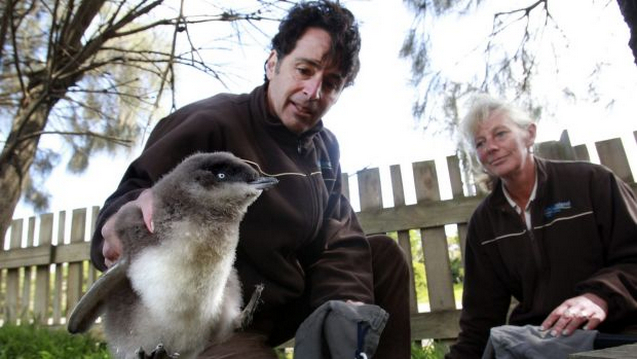
Research scientist Andre Chiaradia and research technical officer Leanne Renwick at the Penguin Parade Reserve on Phillip Island. Photo: Rebecca Hallas
It found overfishing and warming temperatures were hurting the lush life in these areas.
"Human activities drive environmental changes at scales that could potentially cause ecosystem collapses in the marine environment," the study says.
Co-author Andre Chiaradia, a senior scientist and penguin expert at the Phillip Island Nature Parks in Australia, said: "In those hot spots, the changes are already happening.
"They are the most at risk."
Researchers found the liveliest ocean hot spot also happens to be where the science of evolution sprouted: the Pacific Ocean off the central South American coast.
Other hot spots include the the south-western Pacific off Australia's southern and eastern coast, south-western Atlantic Ocean off Argentina; the western Indian Ocean off the African coast; the central western Pacific Ocean surrounding Malaysia, Indonesia and the Philippines and the Oceania region of the Pacific around the international date line.
Four of the six hot spots are in the Pacific; all are either in the southern hemisphere or just north of the equator.
"What makes this biodiversity? It's the isolation," Dr Chiaradia said.
"On land, we have kangaroos and weird animals like the platypus. And in the ocean it's not different."
Penguins, which are near the top of the food chain, were a good example of the impact of changing water temperatures and currents, Dr Chiaradia said.
Warm El Nino waters have decimated Galapagos penguins and the population of southern African penguins had dropped by about 90 per cent in just 20 years.

Links

24/02/2017

Tackling Climate Change Conservatively: How A Republican Calls For Action In The Trump Era

ABC NewsPatrick Wood

Bob Inglis is on a mission in Australia to convince conservatives to combat climate change. (Supplied: RepublicEn.org)
Bob Inglis was a Republican Congressman, which to him meant one thing: "Climate change was nonsense."
It was the mid '90s and the representative from South Carolina says he didn't know anything about climate change except that it was something for the other side of politics to fuss over.
"I was just from the reddest district in the reddest state in the nation and it seemed that that was the business of the other tribe," he said.
Fast forward to 2004 and Mr Inglis was preparing for yet another run at office when his eldest son, who was about to vote in his first election, approached him.
"He said to me, 'Dad I'll vote for ya, but you're gonna clean up your act on the environment'."
"It was the first of a three-step metamorphosis for me."
The next two steps in Mr Inglis's transition from critic to climate action champion were visits to Antarctica and Australia's Great Barrier Reef.
These trips, and discussions with scientists along the way, convinced him there was a serious problem with the environment that had to be fixed.
Opinion: Climate change isn't just a Leftist cause
I'm a Liberal voter and I'm passionate about action on climate change. Did that sentence seem strange, asks Dale Hughes
He rushed back to the US and promptly introduced a bill to put a tax on combustible fossil fuels.
It promptly fell flat and he promptly lost his seat in Congress.
That was 2010.
Since then Mr Inglis has become a fierce advocate of action on climate change, but with a very specific focus: to tackle the problem with policies that are true to conservative principles, and in so doing convince his fellow Republicans they should get on board.
And he's brought that message to Australia, where he is currently touring the country to speak at public forums as well as with political and business leaders.
"I'm trying to help conservatives to overcome their inferiority complex," he said.
"We apparently think we're no good when it comes to energy and climate."
Mr Inglis tracks the split between the left and right on climate change in the US back to the global financial crisis, which broke in 2008.
He said prior to that former US Republican president Ronald Reagan had success with the Montreal Protocol to address the hole in the ozone layer, and George HW Bush introduced a cap-and-trade program to address acid rain.
"But then came the great recession, and some people with some vested interests created a wave of publicity that built on to the very high tide of distrust and discontent in America, particularly in the right, and that wave came over the sea wall and shorted out all of the climate change equipment," he said.
"So really we've been bailing ever since and trying to rewire."

What are the conservative answers?
Mr Inglis is certain conservatives can take the lead on addressing climate change, and that the answer is policies based around ideas of free enterprise, limited government and accountability.
He has established a group, RepublicEn.org, which proposes environmental tax reform in the US.
Specifically, the group wants to eliminate all subsidies for all fuels and "make all fuels fully accountable for all of the costs they bring upon society."
This would mean taking into account the health costs and any damage to the environment.
"So if you made it so the incumbent fuels could no longer subsidise their soot by spreading it all across society and made them accountable for that, well yes the price of their electricity would go up, but not artificially, it would go up to its actual cost," he said.
"So if you put all of the costs in on all of the fuels … then consumers, in the liberty of enlightened self-interest, would seek cleaner, better fuels.
"Then in the free enterprise system, on a level playing field, innovation will happen."
Mr Inglis is not alone in his mission to spread a conservative case for climate action.
Another conservative lobby group, the Climate Leadership Council, has recently formed and includes veteran Republicans who propose a four-point plan to reduce carbon dioxide emissions, including the introduction of a carbon tax.
The council met with White House officials earlier this month to propose replacing nearly all of Barack Obama's climate policies with a carbon tax starting at $40 a tonne. It's something Mr Inglis is keen to follow.


Bob Inglis on Radio National

What hope do these ideas have under President Trump?
President Donald Trump's recent moves on environmental policies, as well as his previous comments on climate change, suggest a shift away from regulations and a renewed focus on fossil fuels.
The man he chose to head the Environmental Protection Agency, Scott Pruitt, is a known critic of the agency's regulations, having filed 14 lawsuits against the EPA during his time as Oklahoma attorney-general. One of them was over the EPA's attempt to limit carbon emissions from coal-fired power plants.
And the White House website's current statement on energy policies says "the Trump Administration is also committed to clean coal technology, and to reviving America's coal industry, which has been hurting for too long."

Scott Pruitt questioned on climate change in confirmation hearing (ABC News)

Nevertheless, Mr Inglis said he remained hopeful President Trump would be open to his ideas.
"I don't for a minute think that Donald Trump actually believes that it's a Chinese hoax and conspiracy, he's clearly playing to the crowd," he said.
"Admittedly it's a 'bank shot', but there's a chance that he might decide to complete the sentence this way: 'Richard Nixon went to China; Bill Clinton did welfare reform; Donald Trump did climate change'."
For now, Mr Inglis takes heart seeing young conservatives joining the environmental cause and embracing principles that speak to their beliefs.
For him, it's a sign the right is ready to rejoin the discussion.
"I see it on talk radio in America, where on first hearing they're sceptical, but then they hear it in their own language," he said.
"They don't hear a progressive talking, they hear a conservative using conservative language, and that moves them."

Links

Lethal Heating is a citizens' initiative