08/03/2017

Climate Change Has ‘Irreversible Impact’

The Australian

The Great Barrier Reef has experienced a bleaching event. Picture: Brian Cassey
A major independent review into the state of Australia’s environment has found climate change is placing an “increasingly important and pervasive pressure” on the nation and some of its impacts “may be irreversible”.
The state of the environment report, produced every five years independently of government, shows the country has faced a mix of improvements and challenges since 2011 but the “main pressures” — climate change, land use change, habitat fragmentation and degradation, and invasive species — remain the same.
The effects from humans were greatest in Australia’s more populated coastal areas and some urban “growth” areas, particularly in the southeast.
“Climate change is an increasingly important and pervasive pressure on all aspects of the Australian environment. It is altering the structure and function of natural ecosystems, and affecting heritage, economic activity and human wellbeing,” the report states.
“Climate change will result in location-specific vulnerabilities, and people who are socially and economically disadvantaged are most sensitive to climate change. Evidence shows that the impacts of climate change are increasing, and some of these impacts may be irreversible.”
The Department of Environment and Energy, which commissioned the report, lists profiles of its lead authors. They range from scientists at the CSIRO and Australian Antarctic Division to environment experts at the Australian Bureau of Statistics and marine ecologists.
Environment Minister Josh Frydenberg, who concedes the government’s target of 23.5 per cent renewable energy generation by 2020 “will be quite a stretch”, said good news from the report included improvements in the ozone layer above the Antarctic, the protection of more indigenous areas, and the listing of more Australian places on the national and world heritage lists.
But he said climate change continued to be a “major challenge”.
“We’ve seen a bleaching event last year in the Great Barrier Reef and we’re concerned about further bleaching events and climate change and the El Nino effect causes for that,” Mr Frydenberg told ABC TV.
“We’re also seeing some real challenges with invasive species, particularly feral cats that prey on marsupials and birds and reptiles, many of which are on the endangered list.”
The report’s panel of independent authors, including environmental consultants, scientists and public servants, said a key challenge for the government was to produce an “overarching national policy that establishes a clear vision for the protection and sustainable management of Australia’s environment to the year 2050.
“Meeting these challenges requires: integrated policies and adaptive management actions that address drivers of environmental change and the associated pressures, national leadership, improved support for decision-making, a more strategic focus on planning for a sustainable future, new, reliable sources of financing,” the report says.
A “new and emerging” stress in coastal and marine zones was the “increasing amount of human litter”, with plastic making up about three-quarters of debris found along the Australian coast.
Grazing continued to be a “major threat” to biodiversity.
The authors adopt a mildly optimistic tone, saying with the right choices, policies, management and technologies Australia “has the capacity” to ensure economic prosperity and look after people’s health, education, social and cultural needs, while protecting the environment for future generations.
“Evidence shows that some individual pressures on the environment have decreased since 2011, such as those associated with air quality, poor agricultural practices, commercial fishing, and oil and gas exploration and production in Australia’s marine environment,” they say.
“During the same time, however, other pressures have increased — for example, those associated with coalmining and the coal-seam gas industry, habitat fragmentation and degradation, invasive species, litter in our coastal and marine environments, and greater traffic volumes in our capital cities.”
The Australian Conservation Foundation seized on the report, declaring the government needed to increase funding for conservation and environmental protection “by at least 400 per cent” if the “dramatic decline” of wildlife, reefs and forests was to be reversed.
“Our national anthem proudly says our land abounds in nature’s gifts, but based on this report we need to seriously question how much longer this will be the case,” the foundation’s CEO Kelly O’Shanassy said.
“This report documents how big polluters, mining companies and land clearers continue to greedily grab nature’s gifts – our forests, rivers, air and seas – and exploit them for profit.”

States and Trends of the Environment:
  • Australian average temperatures have increased by 1C since 1910.
  • Australian rainfall has been variable during the past 100 years, particularly the last 40 years, with declining long-term rainfall observed across much of southern Australia.
  • Air quality is generally good in our urban areas, with some local areas of concern.
  • Advserse human health impacts appear to occur at lower concentrations of air pollution than previously thought.
Links

Climate Change Impact On Australia May Be Irreversible, Five-Yearly Report Says

The Guardian

Exclusive: State of the Environment report says heritage and economic activity are being affected and the disadvantaged will be worst hit
The Tarkine wilderness area in Tasmania. Josh Frydenberg says the State of the Environment report indicates the impact of changing weather patterns is being felt on both land and sea. Photograph: Jason Edwards/Getty Images/National Geographic RF
An independent review of the state of Australia’s environment has found the impacts of climate change are increasing and some of the changes could be irreversible.
The latest State of the Environment report, a scientific snapshot across nine areas released by the federal government every five years, says climate change is altering the structure and function of natural ecosystems in Australia, and is affecting heritage, economic activity and human wellbeing.
It warns climate change will result in “location specific vulnerabilities” and says the most severe impacts will be felt by people who are socially and economically disadvantaged.
Record high water temperatures caused “widespread coral bleaching, habitat destruction and species mortality” in the marine environment between 2011 and 2016, it says.
The minister for energy and the environment, Josh Frydenberg, was due to release the report card on Tuesday morning.
In a column for Guardian Australia, Frydenberg says the report indicates the impact of changing weather patterns is being felt in the ocean, on the Great Barrier Reef and on land, affecting biodiversity and species habitat.
“While carbon emissions per capita have declined from 24.1 tonnes in 2011 to 22.2 tonnes in 2015 and energy efficiency improvements are reducing electricity demand, the report makes clear that, for the world to meet its Paris goals, there is much more to do,” Frydenberg says.
The minister says the report makes clear Australia needs to prepare for changes in the environment and “put in place a coordinated, comprehensive, well-resourced, long-term response”.
He warns that failure to do so “will have a direct and detrimental impact on our quality of life and leave a legacy to future generations that is inferior to the one we have inherited”.
The minister says the report presents the government with a mixed picture. “Good progress has been made in the management of the marine and Antarctic environments, natural and cultural heritage and the built environment – while pressures are building in relation to invasive species, climate change, land use and coastal protection,” he says.
Frydenberg says the doubling of Australia’s population in the past 50 years and growing urbanisation “have all combined to contribute to additional pressures on the environment”.
Australia’s heavily populated coastal areas are under pressure, as are “growth areas within urban environments, where human pressure is greatest”, the report finds.
Grazing and invasive species continue to pose a significant threat to biodiversity.
“The main pressures facing the Australian environment today are the same as in 2011: climate change, land use change, habitat fragmentation and degradation, and invasive species,” the report’s summary says. “In addition, the interactions between these and other pressures are resulting in cumulative impacts, amplifying the threats faced by the Australian environment.
“Evidence shows that some individual pressures on the environment have decreased since 2011, such as those associated with air quality, poor agricultural practices, commercial fishing, and oil and gas exploration and production in Australia’s marine environment.
“During the same time, however, other pressures have increased — for example, those associated with coal mining and the coal-seam gas industry, habitat fragmentation and degradation, invasive species, litter in our coastal and marine environments, and greater traffic volumes in our capital cities.”
The report criticises the lack of “an overarching national policy that establishes a clear vision for the protection and sustainable management of Australia’s environment to the year 2050”.
It points to poor collaboration, gaps in knowledge, data and monitoring and a lack of follow-though from policy to action.
“Providing for a sustainable environment both now and in the future is a national issue requiring leadership and action across all levels of government, business and the community,” it says. “The first step is recognising the importance and value of ecosystem services to our economy and society.
“Addressing Australia’s long-term, systemic environmental challenges requires, among other things, the development of a suite of stronger, more comprehensive and cohesive policies focused on protecting and maintaining natural capital, and ongoing improvements to current management arrangements.”
Late last year, the government established a review of its Direct Action climate policy. The current policy has been widely criticised by experts as inadequate if Australia is to meet its international emissions reduction targets under the Paris climate change agreement.
Shortly after establishing the review, Frydenberg ruled out converting the Direct Action scheme to a form of carbon trading after a brief internal revolt. Many experts argue carbon trading would allow Australia to reduce emissions consistent with Paris commitments at least cost to households and businesses.
The Direct Action review still allows for the consideration of the potential role of international carbon credits in meeting Australia’s emissions reduction targets – a practice Tony Abbott comprehensively ruled out as prime minister – and consideration of a post-2030 emissions reduction goal for Australia.
The review also requires an examination of international developments in climate change policy, which is code for an assessment of what is happening on global climate action in the event the US pulls out of the Paris climate agreement.
The New York Times reported last week that the White House was fiercely divided over Trump’s campaign promise to cancel the Paris agreement.
Its report said Trump’s senior strategist Steve Bannon wanted the US to pull out of the Paris agreement but Bannon’s stance was being resisted by the new secretary of state, Rex Tillerson, and the president’s daughter, Ivanka Trump, who are concerned about the diplomatic fallout.
The Turnbull government has already indicated that it intends to stay the course with the Paris agreement, and has argued it would take the US four years to withdraw from the deal under the terms of ratification.
But if the US withdraws from Paris, internal pressure inside the Coalition will intensify, and the prime minister will face calls from some conservatives to follow suit.
In his column for Guardian Australia, Frydenberg says the Coalition is doing good work on the environment and the conservative parties in Australia have been responsible for establishing legislation such as the Environment Protection and Biodiversity Conservation Act, and programs such as the Natural Heritage Trust and the first mandatory Renewable Energy Target.
“The task now is to build on this proud Coalition tradition and to use this report to continue the good work the Turnbull government is already doing across so many areas of environmental policy,” he says.

Links

World Is Facing A Water Crisis

EIN News

The world faces an acute water crisis within ten years, affecting food supplies, megacities and industry globally, a leading science writer has warned.

“World water use is already more than ten trillion tonnes a year. While the human population has tripled since 1950, our water use has grown sixfold,” says Julian Cribb, author of ‘Surviving the 21st Century’ (Springer International 2017). The book focusses on the ten greatest threats to the human future – one of which is resource scarcity – and what we can do about them.
“Rising demand from megacities, mining, agriculture and the fossil fuels sector in particular is combining with climate change to threaten major water scarcities across the world’s subtropical, arid and semi-arid regions. When this affects the food supply there will be vast migrations of people – like the world has never seen before.”
Mr Cribb says that scientific studies show:
  • groundwater is running out in practically every country in the world where it is used to grow food, posing risks to food security in northern India, northern China, Central Asia, the central and western US, and the Middle East. Most of this groundwater will take thousands of years to replenish.
  • the icepack on high mountain chains is shrinking, emptying the rivers it once fed in practically every continent. 
  • around the world, large lakes are drying up, especially in Central Asia, China, sub-Saharan Africa and the South American Andes. 
  • 50,000 dams break up the world’s rivers, sparking increased disputes over water between neighbouring countries
  • most of the world’s large rivers are badly polluted with chemicals, nutrients and sediment.
“The water crisis is sneaking up on humanity unawares. People turn on the tap and assume clean, safe water will always flow. But the reality is that supplies are already critical for 4 billion people - over half the world’s population. During times of drought, megacities like Sao Paulo, La Paz, Los Angeles, Santiago, 32 Indian cities and 400 Chinese cities are now at risk.”
Among world leaders, Pope Francis recently warned that we could be moving toward “a major world war for water”. He deliberately altered his prepared speech to issue this caveat when addressing an international seminar on the human right to water, hosted by the Vatican’s Pontifical Academy of Sciences on Feb. 23 and 24, 2017.
Each of the last three UN secretaries-general – Ban Ki-Moon, Kofi Annan and Boutros Boutros-Ghali – has warned of the dangers of world water scarcity and of ‘water wars’ in the future. The world’s leading scientific journal, Nature, issued a sobering warning of water scarcity under climate change in December 2013.
“Other than in water circles, these warnings seem to have passed largely unheeded by governments and the population at large,” Cribb says. “The sense of urgency necessary to prevent a world water crisis is not there.”
“Especially overlooked is the impact of water scarcity on the world food supply. As cities and energy corporations combine to rob farmers of the water needed to grow crops, the global irrigation sector is stagnating at a time when it needs to double food output to meet rising global demand for food. This will directly impact the availability and price of food to city people everywhere.
“We commonly assume that the natural hydrological cycle of evaporation and rainfall means there will always be ample water. In reality, we pollute and misuse water so badly, it is often not safe for drinking, domestic use or food production. Meanwhile rainfall, effluent and wastewater in most cities is wasted or discharged to the ocean.
“The average citizen of Planet Earth uses 1,386 tonnes of water per year, and the demand continues to rise every year, stressing supplies in many cases to their limits,” Cribb says.
A study by NASA (2015) shows that a third of the world’s major groundwater basins are stressed, and people are using the water without knowing when it will run out.
A timeline maintained by Professor Peter Gleick of the World Water Institute reveals the increasing frequency and tempo of disputes and conflicts over water globally.
“The evidence points to serious trouble for the world over water within the next ten years. The world focus of attention has been on climate – rightly so, as it is an integral factor in water scarcity – but the massive water crises that will disrupt food supplies and dislodge huge populations are much closer than other climate impacts. Present policy does not reflect this.”
Mr Cribb says it is time to put world water science, technology and management on a war footing, if the crises are to be averted. “Currently humans spend US$1.8 trillion a year on new weapons. If we spent a tenth of that on clean water technologies, fixing leaky supplies, recycling city water, measuring availability, agricultural water efficiency, effective water markets and controlling demand we could avoid the conflicts which the Pope and UN heads foresee.
“Current evidence suggests most countries prefer war to water.”
"Surviving the 21st Century" (Springer International Publishing 2017) is a powerful new book exploring the main risks facing humanity: ecological collapse, resource depletion, weapons of mass destruction, climate change, global poisoning, food crises, population and urban overexpansion, pandemic disease, dangerous new technologies and self-delusion – and what can and should be done to limit them.

The author: Julian Cribb FTSE is an Australian science writer and former newspaper editor, with over thirty awards for journalism to his credit. The author of 9 books and 8000 media articles, his other works in this series include The Coming Famine (UCP 2010), chosen as a 'Book of the Times' by the NY Times, and Poisoned Planet (Allen&Unwin 2014).

The book: Surviving the 21st Century: humanity's ten great challenges and how we can overcome themby Julian Cribb is published by Springer NY, 2017. ISBN 978-3-319-41269-6. DOI  10.1007/978-3-319-41270-2 is available online in softback and e-book formats from the following suppliers and from quality book shops. 

Links

‘Claim The Sky’: A New Climate Movement For The Trump Era

The Conversation

We need to take back the atmosphere to save it from pollution. China Stringer Network/Reuters Pictures
President Donald Trump is making it less likely the United States will meet the emissions targets it agreed at the 2015 Paris climate conference. These targets are themselves insufficient to meet the Paris Agreement’s overall goal of keeping global warming well within 2℃.
But there is another possibility for those who want action. The idea is called “claim the sky” and it would involve a global movement, working together with the most affected countries, to claim ownership over our atmosphere.
Trump has promised to withdraw from the Paris Agreement, appointed the former chief executive of oil giant Exxon as his secretary of state, and is planning huge changes to Obama’s Clean Power Plan and the Environmental Protection Agency.
It is true that the cost of renewables like solar and wind energy is dropping rapidly. It’s therefore conceivable that economic factors alone will drive the shift away from fossil fuels. But if nothing more is done, and America and other countries continue to dish out billions in subsidies to the fossil fuel industry, it may take far longer than necessary to achieve the goals of Paris, if they can be met at all.

Claim the sky
“Claiming the sky” could help reduce emissions more quickly. At the same time it would assist with adaptation, poverty reduction and public perception, and counter policies of the Trump administration and other countries that support fossil fuels.
It involves establishing a trust to collect fees when damage is done to the atmosphere. That money can then be used to reduce poverty, rebuild communities and restore the atmospheric commons.
After all, the atmosphere is a community asset that belongs to all of us. The problem is that it is an “open access” resource – anyone can emit carbon dioxide with very little direct consequence for themselves, despite the huge cumulative consequences for everyone.
Charging companies and individuals for the damage their emissions cause – for example through a carbon tax or trading system – would encourage lower emissions. However, despite some interesting regional experiments, implementing such a system at a global scale has proved to be next to impossible.
Global civil society could change this, if it claims property rights over the atmosphere. By asserting that we all collectively own the sky, we can begin to use the legal institutions that uphold property rights to protect our collective property, charging those who damage it and rewarding those who improve it.

A public trust
The Public Trust Doctrine is a legal principle that holds that certain natural resources are to be held in trust as assets to serve the public good. Under this doctrine it is the government’s responsibility to protect these assets and maintain them for the public’s use. The government cannot give away or sell off these public assets. The doctrine has been used in many countries in the past to protect water bodies, shorelines, fresh water, wildlife and other resources.
Several court cases have confirmed this responsibility. Just before the Paris talks, a Washington state judge ruled that the government has “a constitutional obligation to protect the public’s interest in natural resources held in trust for the common benefit of the people”. Earlier in 2015, a New Mexico court recognised that the state has a duty to protect the state’s natural resources – including the atmosphere – for the benefit of residents. The same year, a court in the Netherlands ordered the Dutch government to cut the country’s emissions by at least 25% within five years.
The time has come to expand this principle to cover all of the natural capital and ecosystem services that support human well-being, including the atmosphere, oceans and biodiversity.

Creating a trust
Holding climate polluters accountable for their damage is more straightforward than it might seem. Just 90 entities are responsible for two-thirds of the carbon emitted into the atmosphere.
I and several colleagues wrote an open letter asking nations to establish an atmospheric trust on behalf of all current and future generations. The proceeds could fund restoration projects or expedite the transition to non-nuclear, renewable energy. In addition, governments could charge for ongoing damage via a carbon tax or other mechanisms.
Many of us already know or have experienced the benefit of a trust. There are private land trusts, such as the Nature Conservancy in America, or water trusts like the Murray-Darling’s Environmental Water Trust in Australia. The Alaska Permanent Fund and the Norwegian Sovereign Wealth Fund are examples of trusts that put aside royalties from fossil fuel extraction for public benefit.
Just as governments individually levy fines in the event of an oil spill or other environmental damage within their borders, the creation of a trust is an opportunity to do this on a wider scale. The trust will maintain transparency through the internet, publishing financial carbon accounts of projects funded by polluters.
In addition, all governments need not agree in order to create the atmospheric trust. As all governments are co-trustees in the global atmospheric asset, a subset of nations could create the trust and bring the claims.
But given that governments have not acted on their own, pressure from civil society will be required to compel them to act and to counteract the inevitable corporate resistance. In other words, a concerted effort to “claim the sky” as a public trust on behalf of all of global society, in combination with the solid legal framework provided by the Public Trust Doctrine, may just do the trick.
As US Senator Bernie Sanders has said, “When millions of people stand up and fight back, we will not be denied.” It is time to claim our right to the atmospheric commons and a stable climate.
We need a broad coalition of individuals and groups to claim publicly that the atmosphere belongs to all of us and our descendants, and to demand that polluters pay for damage done and for restoring and maintaining our climate.
The fossil fuel era is coming to an end. The industry is making a last-ditch attempt to sell off its assets before these become stranded, aided by government policies and subsidies. This will cause severe and lasting damage to our atmospheric commons.
But if we can claim the sky, create an atmospheric trust and bring damage claims against the biggest polluters, we can further tip the economic scales against fossil fuels and toward renewable energy sources. We can speed up the transition to the 1.5-degree world that the Paris Agreement aims for, and that current and future generations of humans claim as our common asset.

Links

07/03/2017

Big Australian Banks Invest $7bn More In Fossil Fuels Than Renewables, Says Report

The Guardian

ANZ, NAB, Commonwealth Bank and Westpac provided three times more for non-renewable than clean energy projects in 2016, says Market Forces
Australian banks continued to fund coalmines in 2016 despite committing to support the Paris climate agreement pledge to keep global warming below 2C. Photograph: Viktor Drachev/Tass
Australia's big four banks invested three times as much in global fossil fuels as they did in clean energy in 2016, despite pledging to help Australia transition to a low carbon economy.
The banks provided a combined $10bn to projects around the world that expanded non-renewable energy, according to finance group Market Forces.
ANZ and the Commonwealth Bank were the worst offenders, investing over $3bn each in fossil fuels. In the same period, ANZ only lent $225m to renewables, giving it a 14:1 ratio.
Overall the banks invested $7bn more in fossil fuels than clean energy.
Only NAB approached parity, lending $1.35bn to non-renewables and $1.3bn to renewables. Commonwealth Bank and Westpac invested $846m and $426m in clean energy respectively, which was 3.5 and 4.6 times less than what they invested in fossil fuels.
Loans for renewable and fossil fuel energy projects from Australia's big four banks in 2016. Illustration: Market Forces
 These figures come despite all four banks publicly supporting a 2C global warming limit laid out in the Paris climate agreement.
"The first step to back up that commitment is to stop expanding the carbon fuel economy," said the executive director of Market Forces, Julien Vincent. "We're not talking small projects, we're talking about opening up one of the largest offshore oil bases in Norway, or a new gas field in PNG."
The report cited, among others, investments in Norway's Johan Sverdup oil field, America's Creole Trail natural gas pipeline, and the Browse basin gas field off the coast of Western Australia.
The Commonwealth Bank environment policy states it should "actively seek opportunities to lend to, invest in, and support businesses that decrease dependence on fossil fuels".
"The updated policy expresses our commitment to support the transition to a low carbon economy", it said in a 2015 press release.
Greenpeace, which is launching a campaign to stop the Commonwealth supporting new coalmines, said the bank was risking the credibility of its brand through fossil fuel investment.
"The Commonwealth Bank claims to support the Paris Agreement's goal of keeping climate change to well below 2 degrees but it has lent more to fossil fuel projects since the Paris Agreement was signed than any other Australian bank," its climate campaigner, Nikola Casule, said.
"The Commonwealth Bank knows it has one of the most recognisable brands in Australia, it also knows that most Australians support stronger action on climate change. [Chief executive] Ian Narev ... needs to decide whether he wants that brand associated with dirty coal or a future powered by clean renewable energy."
ANZ's climate change statement notes that while "some of our stakeholders view our financing of fossil fuel industries as in direct conflict with our stated position on the need to reduce greenhouse gas emissions", it supports a "gradual and orderly transition".
Vincent said the figures included loans made to coal and gas projects "across the entire supply chain – from extraction to transport and combustion". For companies with part-investments in fossil fuels, Market Forces apportioned the loan according to the percentage of the company's business in non-renewables.
However, he noted that 2016 saw less fossil fuel investment than 2015, and no loans to new coal projects, in what he described as an "important trend".
"I think it's definitely become a lot harder for banks to fund coal because it's so clearly connected to climate change and other environmental and social issues," he said. He called for Australian banks to put a blanket bans on funding new coalmines.
"I wouldn't ever take the kind of positive trends we see in the lending and assume the banks aren't going to fund the Adani coalmine, for example. Politically there is a lot of leaning on the banks to not cave in to environmental campaigns. We need them to show a little bit of courage and say no to the Carmichael coalmine and expansion."
An ANZ spokesperson said that "lending to the sector was relatively modest."
"The resources industry is a core part of the Australian economy. It remains essential for power generation … we consider that decarbonisation of the economy must be managed responsibly and over time," it said.

Links

Sydney’s Swelter Has A Climate Change Link, Scientists Say

New York TimesHenry Fountain

A wildfire in New South Wales in February. Australia has been hit by brutal heat waves in the last two months. Credit NSW Rural Fire Service, via Associated Press
South-eastern Australia has suffered through a series of brutal heat waves over the past two months, with temperatures reaching a scorching 113 degrees Fahrenheit in some parts of the state of New South Wales.
"It was nothing short of awful," said Sarah Perkins-Kirkpatrick, of the Climate Change Research Center at the University of New South Wales, in Sydney. "In Australia, we're used to a little bit of heat. But this was at another level."
So Dr. Perkins-Kirkpatrick, who studies climate extremes, did what comes naturally: She looked to see whether there was a link between the heat and human-driven climate change.
Her analysis, conducted with a loose-knit group of researchers called World Weather Attribution, was made public on Thursday. Their conclusion was that climate change made maximum temperatures like those seen in January and February at least 10 times more likely than a century ago, before significant greenhouse gas emissions from human activity started warming the planet.
Looked at another way, that means that the kind of soaring temperatures expected to occur in New South Wales once every 500 years on average now may occur once every 50 years. What is more, the researchers found that if climate change continued unabated, such maximum temperatures may occur on average every five years.
For the overall 2016-17 summer in New South Wales, the researchers say, climate change made the hot average temperatures — which set records for the state — at least 50 times more likely than in the past.
The findings are the latest in what has become a growing field: studies that try to assess the influence of climate change on extreme weather as soon as possible. The idea is to offer scientific analyses of heat waves, floods and other events while people are still talking about them, and to counter the spread of misinformation, intentional or not, about the impact of global warming.
Climate scientists have long said that climate change should bring an increase in extreme events like dry spells and heat waves. Because warmth causes more evaporation and warmer air holds more moisture, climate change should also lead to more intense and frequent storms.
Studies have shown that these effects are occurring on a broad scale. But the natural variability of weather makes looking at individual events more difficult.
World Weather Attribution, which is coordinated by Climate Central, a research organization in Princeton, N.J., is one of a number of groups doing rapid analysis. Among other events, they have looked at flooding in Germany and France last May; high temperatures in the Arctic in November and December; and an usually strong storm that hit northern Britain in 2015.
Not all attribution studies have found a climate-change link. In general, studies of heat waves tend to produce the clearest signal of the influence, or not, of global warming.
Australian heat waves have been examined in the past, most recently in several studies that showed a clear link between climate change and a period of torrid weather in 2013. David Karoly, a scientist at the University of Melbourne, was involved in one of the studies, which took more than six months to produce.
"That was considered very rapid at the time," Dr. Karoly said.
As a member of World Weather Attribution, Dr. Karoly helped with the study of the recent heat waves, which took about two weeks.
A big difference between the two studies is in the use of computer climate models — both of the current atmosphere with its greenhouse gas emissions and of a hypothetical atmosphere as if those emissions had never occurred and climate change was not happening.
For the older study, as for most attribution studies in the recent past, the models were run over and over again, which took months. The newer, rapid studies use models that have already been run, extracting data as needed.

Links

New York 2140: A Novelist’s Vision Of A Drowned City That Still Never Sleeps

The Conversation


Climate fiction: A novel describes New Yorkers keeping on even after 50 feet of sea-level rise next century. www.shutterstock.com
Earth’s climate system is replete with potential surprises, and the climate science community tends to be conservative when projecting future changes. The world also suffers from a creative deficit in imagining the human response to climate change – a deficit that fiction is well-suited to help alleviate.
One focus of my research is on sea-level change, both in the past and in the future. In his new work of climate fiction, “New York 2140,” author Kim Stanley Robinson supposes that climate scientists like me will be surprised by how quickly the world’s ice sheets will shrink and sea levels will rise. His novel explores how civilization might nonetheless muddle through to remake this reshaped world.
In Robinson’s future, the First Pulse of Antarctic and Greenland ice sheet collapse in the 2050s led to 10 feet of global sea-level rise in the course of a decade. The First Pulse and the food crisis of the 2070s served as focusing events, leading the world to take greenhouse gas reductions more seriously. Electricity generation shifted to renewables; container ships were replaced with fleets of wind-powered clippers; lighter-than-air airships replaced airplanes.
Yet these efforts were not enough to avoid a Second Pulse at the end of the 21st century, driven first by melting at the Aurora Basin in East Antarctica but then cascading around the world’s ice sheets, leading to a further 40 feet of sea-level rise.
Current science suggests the speed of sea-level rise in Robinson’s future is implausible. The United Nations’ Intergovernmental Panel on Climate Change (IPCC)’s 2013 report estimated that, under a future with high greenhouse gas emissions, global average sea level would likely rise by between about 1.5 and three feet over the course of this century. My research group’s projections generally agree with the IPCC’s assessment. But the IPCC assessed only what is “likely”; our group’s work also suggests that sea-level rise as high as about eight feet by 2100 and 18 feet by 2150 is physically plausible, though extremely unlikely.

To understand how much sea levels will rise in the decades ahead, scientists study the mechanics of the land, ice, air and water in Greenland and Antarctica. NASA, CC BY
But there’s a lot we don’t know about the behavior of ice sheets, particularly those – like the West Antarctic and parts of the East Antarctic including the Aurora Basin – that sit on ground that is below sea level. For example, warm water can attack submarine ice from beneath. If the ground underneath the ice sheet is sloping the wrong way, deepening toward the continent’s interior, the water’s advance will set up a self-sustaining cycle that exposes a growing cross-section of ice to erosion.
In addition, ice sheets can form unstable ice cliffs at their margins. A recent study that incorporated the collapse of ice cliffs found that, under a future of high emissions, it may be significantly easier to get to eight feet by 2100 and 18 feet by 2150 than previously thought. Still, even that study could not produce Robinson’s 50 feet until after 2200.

Venice on the Hudson
Robinson’s novel, however, is not a scientific projection: It is an exploration of human resilience in the face of extreme pressure. There are four basic ways coastal communities can respond to sea-level rise: suffering damage, developing protective infrastructure, finding ways of accommodating flooding and retreating from the coast. Robinson’s New Yorkers engage in all four – and Robinson’s vision of accommodation is profoundly richer than in the imaginings of adaptation strategies developed by national, state and local governments.
Despite the environmental apocalypse, life carries on in a flooded New York that has remade itself as a super-Venice. (See Climate Central’s Surging Seas maps to explore what Manhattan would look like with 10 meters (33 feet) or 20 meters (66 feet) of sea-level rise.) The submerged streets of Lower Manhattan have turned into canals, crisscrossed by pedestrian high lines. Vaporettos have replaced taxis. Skyscrapers whose bases have fallen beneath the waves are protected by nanodiamond coatings and powered by solar microgrids.

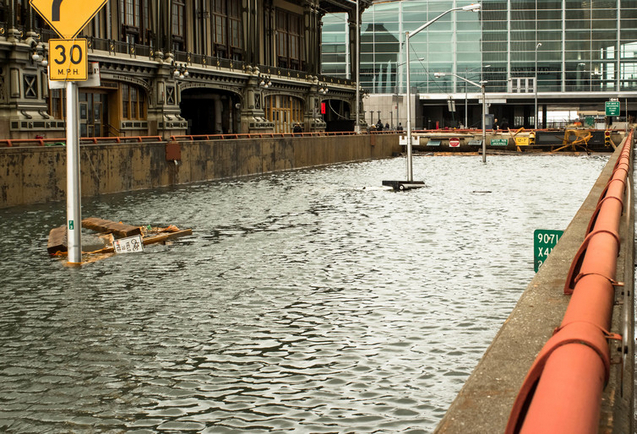
Hurricane Sandy as precursor? In the climate fiction novel ‘New York 2140’ New Yorkers adapt to sea-level rise by converting streets into canals. ruanon/flickr, CC BY-SA
Retreat has occurred mainly from the intertidal zone of Midtown Manhattan, where the forces of the daily tidal cycle wreak havoc on structural integrity. On the dry land surrounding the Cloisters, far uptown, carbon nanomaterials originally intended for space elevators allow new buildings on the shrunken island to reach hundreds of stories upward.
Technological progress focused on improving lives rather than accommodating the changed world has apparently slowed to a crawl – in some ways, not much has changed from today. Airships are steered by chatty but rule-bound AIs, and communications take place by tablet, with celebrities broadcasting live feeds of real-world adventures through the cloud.
Though this slow pace of progress may be literary license taken to make the world more relatable, it may also be a fair projection: If environmental crises consume the world’s R&D budget, there may be little left for innovations without a survival benefit.
Meanwhile, financial capitalism proceeds much as it did in the early 21st century, periodically growing and imploding bubbles and receiving government bailouts. As in most of Robinson’s works, the limits of the capitalist system serve as a motif: The book culminates in a democratic-socialist fantasy of an alternative political response to a bursting financial bubble that seems more rooted in 2008 than 2140.

Creative rethinking
In the real world, when climate change first entered the mainstream of civic discourse in the late 1980s, policy discussion focused almost entirely on limiting greenhouse gas emissions. While the world has made some progress, reflected in the United Nations’ Paris Agreement and in the recent near-stability of global carbon dioxide emissions, the pace has been slow. The planet is increasingly feeling the effects of climate change, and so adapting to these effects has become a growing part of both scientific research and public discourse.
But most work on climate change adaptation has focused on near-term, marginal changes: for instance, making communities more resilient in the face of ever more common weather extremes, or installing pumps and elevating infrastructure to deal with the rapid growth of minor “nuisance” flooding along the shore.
Climate change and sea-level projections usually end by 2100, and on that timescale, two to three feet of global sea-level rise is far more likely than Robinson’s 50 feet. But the world will not end in 2100, and many of the public works built today will still be around a century from now. In New Jersey, for example, many of the electric grid’s switching stations that flooded in 2012 during Superstorm Sandy were sited more than a century earlier, during the age of Thomas Alva Edison.
So climate fiction can play a critical role in the face of the large-scale experiment we humans are conducting with the world’s climate system: inspiring creative rethinks of the designs and technologies needed to reshape how we relate to our environment.
Science tells us that, by reshaping our global energy and agricultural systems, we can avoid the magnitude of planetary change that Robinson depicts. But to make those changes and to adapt to the changes we don’t avoid, the world’s best minds need to focus, not on new apps or financial innovations, but on the civilizational challenges at hand.
Works like Robinson’s – starkly beautiful and fundamentally optimistic visions of technological and social change in the face of some of the worst devastation we might bring upon ourselves – can inspire that focus in a way that myopic discussions of the near term or grim, apocalyptic tales cannot.

Links

Lethal Heating is a citizens' initiative