Wednesday, April 12, 2017

Vital Groundwater Depleted Faster Than Ever

Climate News Network - Alex Kirby*

Global use of irreplaceable groundwater is exhausting the supply so fast that researchers say it will drive up food prices and hit international trade.
Vast quantities of groundwater are used in Pakistan to irrigate crops such as rice. Image: Abbrar Cheema via Flickr
China, the world’s most populous country, doubled within just 10 years its use of irreplaceable groundwater from underground reservoirs that are replenished more slowly than they are drained.
And in the same decade, 2000 to 2010, global use of this non-renewable water resource for irrigation increased by a quarter, according to a new study published in Nature journal.
The research suggests that unless producers and consumers of food make changes, this trend could lead to depleted water reserves, limited availability of food imports, and higher food prices.
Groundwater – from underground supplies, as opposed to water in rivers or lakes – supplies global agriculture with 43% of its crop irrigation needs.
The country exporting the most crops produced using irreplaceable groundwater is Pakistan, with 29% of global non-renewable sources embedded in trade – closely followed by the US (27%), with India (12%) in third place.

Groundwater abstraction
The study’s authors say excessive abstraction of groundwater for irrigation – part of the wider virtual water trade – is leading to rapid depletion of aquifers in key food-producing regions, including north-western India, the North China Plain, central US, and California.
“This depletion of the largest liquid freshwater stock on Earth,” they write, “threatens the sustainability of food production, and water and food security, not only locally, but also globally via international food trade.
“Aquifer depletion can also induce significant environmental degradation, such as land subsidence and seawater intrusion.”
In another example of the way in which climate change works to intensify existing threats, the researchers say the depletion of local water reserves also risks putting large populations at serious danger during emergencies such as droughts, earthquakes or fires, when immediate access to water is needed.
Using UN trade data and estimates of non-renewable groundwater removal, researchers traced the sources of water used to produce agricultural crops. They found that the crops contributing most to the non-renewable groundwater trade are rice (29%), wheat (12%), cotton (11%), maize (4%) and soybeans (3%).
“Under future climate change, droughts may be more frequent in many regions and we may want to keep groundwater reserves for these periods”
The study was conducted by an international group of researchers led by Carole Dalin, senior research fellow with the Institute for Sustainable Resources at University College London (UCL), and including scientists at the International Institute for Applied Systems Analysis (IIASA) in Austria, at NASA in the US, and colleagues in Germany.
“People are rightfully food shopping with the environment in mind more than ever before – but it is not just about meat versus vegetables, organic or fair trade,” Dr Dalin says..
“Where and how the products are grown is crucial, and basic foods like rice and bread could have a damaging impact on global water supplies.
“Our research shows that unless both consumers and producers agree to adopt strategies that maximise the long-term sustainability of water use, most of the world’s population risks seeing increased food prices or disrupted food supply.

Potentially dangerous
“Under future climate change, droughts may be more frequent in many regions and we may want to keep groundwater reserves for these periods.”
Thomas Kastner, senior scientist at the Senckenberg Biodiversity and Climate Research Centre, Germany and the Alpen-Adria University, Austria, says: “Our work shows where trade flows are contributing to the unsustainable, and ultimately potentially dangerous, use of water resources. The use of non-renewable water in one place can put food supply in distant regions at risk.”
Yoshihide Wada, a co-author of the report and deputy director of the IIASA Water Programme says: “The products that consumers buy at a supermarket may have very different environmental impacts depending on where they are produced and how they are irrigated.
“In order to help consumers make more sustainable choices about their food, producers should consider adding water labels that make these impacts clear.”

*Alex Kirby is a former BBC journalist and environment correspondent. He now works with universities, charities and international agencies to improve their media skills, and with journalists in the developing world keen to specialise in environmental reporting.

Links

Girl, 9, Sues Indian Government Over Inaction On Climate Change

Reuters - Rina Chandran

India is home to four of the 10 worst ranked cities in the world for air pollution
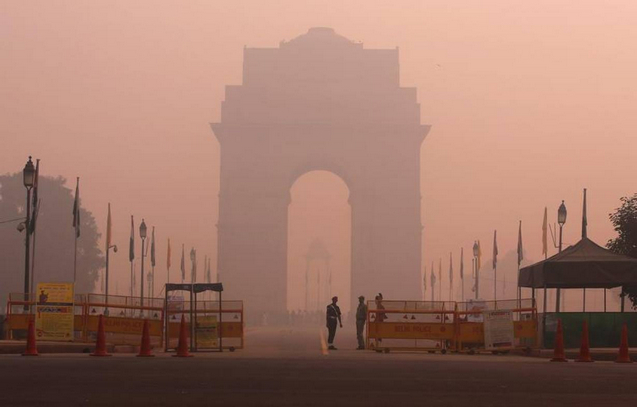
Security personnel stand guard in front of the India Gate amidst the heavy smog in New Delhi, India, October 31, 2016. REUTERS/Adnan Abidi
MUMBAI - A nine-year-old girl has filed a legal case against the Indian government for failing to take action on climate change, highlighting the growing concern over pollution and environmental degradation in the country.
In the petition filed with the National Green Tribunal (NGT), a special court for environment-related cases, Ridhima Pandey said the government has failed to implement its environment laws.
"As a young person (Ridhima) is part of a class that amongst all Indians is most vulnerable to changes in climate, yet are not part of the decision making process," the 52-page petition said.
The petition called on the tribunal to direct the government "to take effective, science-based action to reduce and minimise the adverse impacts of climate change".
The tribunal has asked the Ministry of Environment and the Central Pollution Control Board to respond within two weeks.
A spokesman from the Ministry of Environment told the Thomson Reuters Foundation that they would respond as directed by the tribunal.
India is home to four of the 10 worst ranked cities in the world for air pollution. Along with China, India accounted for more than half the total number of global deaths attributable to air pollution in 2015, according to a recent study.
Despite several laws to protect India's forests, clean up its rivers and improve air quality, critics are concerned that implementation is poor, and economic growth often takes precedence over the environment.
Flash floods and landslides in the Himalayan state of Uttarakhand, where Ridhima lives, killed hundreds of people and left tens of thousands homeless in 2013.
The devastation affected Ridhima, the daughter of an environmental activist, said Rahul Choudhary, a lawyer representing her.
"For someone so young, she is very aware of the issue of climate change, and she is very concerned about how it will impact her in future," he said.
"She wanted to do something that can have a meaningful effect, and we suggested she could file a petition against the government," he told the Thomson Reuters Foundation.
Ridhima is not the first child in India to take the government to task over inaction to protect the environment.
Last year, six teenagers filed a petition with the NGT over air pollution in New Delhi which has the worst air quality in the country.
India is taking some action to mitigate the damage. As a signatory to the Paris agreement on climate change, it is committed to ensuring that at least 40 percent of its electricity is generated from non-fossil-fuel sources by 2030.
In her petition, Ridhima asked the court to order the government to assess industrial projects for climate-related issues, prepare a "carbon budget" to limit carbon dioxide emissions, and create a national climate recovery plan.
"That a young girl is doing so much to draw the government's attention is something. We hope the case puts some pressure on the government to act," said Choudhary.

Links

Adani: Prime Minister Malcolm Turnbull Meets With Chairman, Reiterates Support For Mine

ABC News - James Bennett


Malcolm Turnbull says there is 'very strong support' for changing Native Title legislation (ABC News)

Key points:
  • A Senate inquiry threw into question more than 100 mining and pastoral agreements with Native Title holders — including one covering the Carmichael project
  • PM Turnbull met with Guatam Adani and senior executives of the Adani mine
  • Adani is seeking a $900-million Federal Government loan for a railway link to the port; Mr Turnbull said the loan is outside his control
Prime Minister Malcolm Turnbull has told the Adani Group chairman the issue of Native Title in Australia will soon be resolved, which could clear the way for the controversial Carmichael coal mine.
Mr Turnbull met privately with Gautam Adani and senior Adani executives for approximately half an hour last night in New Delhi, during the Prime Minister's three-day state visit to India.
The meeting came as Mr Adani prepared to make a final investment decision on the $21-billion Carmichael mine in Queensland's Galilee basin — which, if built, would be Australia's biggest.
A recent federal court ruling threw into question more than 100 proposed land use agreements with Native Title holders, including one covering Adani's Carmichael project.
The Federal Government is trying to pass legislation which would reverse that court ruling and make it easier for the deals to be registered.
It is understood Mr Adani asked Mr Turnbull during their meeting for a resolution to uncertainty over Native Title.
"Mr Adani noted that this is an issue for his development, but frankly it's an issue for just about every development in Australia where native title issues are involved," Mr Turnbull told reporters in New Dehli.
The Coalition and Labor agree the recent court decision needs to be reversed but will not be able to pass changes until Parliament returns next month.
The Wangan Jagalingou Traditional Owners Council, which claims the project impinges on their rights, questioned Mr Turnbull's assurance of a fix to Native Title uncertainty.
Marrawa Johnson, a spokeswoman for the tribe's governing council, said the Government was attempting to register a spurious Indigenous Land Use Agreement (ILUA).
"So I guess what he's promising is that there will be a legislative change that could allow for Adani's fake ILUA to be registered," Ms Johnson told The World Today.
"But at the moment with other legal cases we have running Adani can't just rely on the Australian Government to change the law for them and think that they can build the largest coal mine in the world in our country and destroy who we are as people.
"Adani only has seven out of the 12 signatures that they need. So at the moment while the amendments have not been passed through the Senate to the Native Title act, Adani's ILUA is dead.
"They don't have what they need to even be considered for registration with the Native Title Tribunal."

No promise of loan for Abbot Point rail link
Abbot Point is located about 25 kilometres north of Bowen on the north Queensland Coast, near the vast coal reserves of the Galilee Basin
Adani is also seeking a $900-million Federal Government loan for a railway linking the mine to port, from the Government's Northern Australia Infrastructure Fund.
It is understood Mr Adani acknowledged to Mr Turnbull that the loan needed independent approval.
Wetlands: Before & After
Satellite imagery appears to show sediment-laden water flowing from the nearby Abbot Point Coal Terminal prompting an investigation.
"The funding, were it to be made for part of the railway, is only a relatively small part of the total capital that is required for this coal mine and associated infrastructure," Mr Turnbull said.
Earlier yesterday Mr Turnbull said while he was "looking forward" to meeting Mr Adani, the loan was outside his control.
Mr Turnbull also said he supported exporting Australian coal and other resources to India to assist with India's "enormous need" for more electricity.
"We play a big role as a coal exporter of course and [we are] now in a position to export uranium," Mr Turnbull said.
Environmental activists have threatened to disrupt construction if the mine goes ahead, arguing the emissions from burning coal will drive climate change and threaten Queensland's Great Barrier Reef.

Trade talks to be resuscitated
Separately, following a lengthy one-on-one meeting with India's Prime Minister Narendra Modi yesterday, last night Mr Turnbull re-iterated the two leaders' decision to work out what stood between them on trade.
"That is a very important prime-ministerial commitment to getting on with it and dealing with it and identifying where the parties are close, where they're apart," Mr Turnbull said.
"The process needed some energy, and it has been re-energised today."
Former prime minister Tony Abbott visited India in 2014 and set the ambitious target of signing a free trade agreement by 2015, but since then there has been little, if any, progress.
Planning Australia's biggest mine
Step through the key events in the planning of Australia's biggest mining project, the Carmichael coal mine in remote central Queensland.
At a speech on India-Australia education links last night, Mr Turnbull praised Mr Modi for agreeing that progress had been "too slow" and that the talks should be resuscitated.
"We have agreed to direct our chief negotiators to meet as soon as possible," Mr Turnbull said, describing the development as an "important prime-ministerial commitment to getting on with it".
The Prime Minister's comments last night reflect a change of attitude from his criticism of Indian protectionism ahead of his meeting with Mr Modi.
"It will take some time," Mr Turnbull warned when asked about progress on the deal.
"India has a long tradition of protection, particularly for agriculture."
Neither side has committed to a timeframe for concluding a deal.
Adani's complex corporate web (ABC News)

Links

Tuesday, April 11, 2017

Great Barrier Reef: Severe Coral Bleaching Hits Two-Thirds Of Reef, Aerial Surveys Show

ABC News


Aerial survey shows extent of coral bleaching

Two-thirds of the Great Barrier Reef has now been devastated by severe coral bleaching, with damage occurring further south this year, Queensland scientists say.
Two of the world's leading experts on coral bleaching in the Great Barrier Reef said aerial surveys they conducted this year along the reef's entire length showed an accelerated rate of bleaching in the central section.
The ARC Centre of Excellence for Coral Reef Studies undertook the aerial surveys in both 2016 and 2017.
In 2016, bleaching was most severe in the northern third of the Reef, while one year on the middle third has experienced the most intense coral bleaching.
The main areas of coral bleaching in 2016 and 2017. (Supplied: ARC Centre for Excellence for Coral Reef Studies)
Dr James Kerry from James Cook University in north Queensland, who was one of the scientists involved in the surveys, said the latest damage had occurred in a stretch from Cooktown to Townsville.
"Last year we saw severe bleaching in the northern third, and this year we have seen severe bleaching on the Great Barrier Reef from about Cooktown down to Townsville, so we are calling that the central third," he said.
"So about two-thirds of the reef now in the past 12 months have had a fairly serious bleaching event."
He said there was little doubt that bleaching was being caused by record-breaking temperatures driven by global warming.
"It is fair to say that this is extremely concerning for the long-term health of the reef," he said.
"It is facing a number of stresses, but I think the outside stress is coral bleaching, and we have now seen two major events in two years, which we have never seen before - that is unprecedented."
He said it was the fourth time the Great Barrier Reef had bleached severely.
"In 1998, 2002, 2016, and now in 2017 - bleached corals are not necessarily dead corals, but in the severe central region we anticipate high levels of coral loss," he said.
"It takes at least a decade for a full recovery of even the fastest growing corals, so mass bleaching events 12 months apart offers zero prospect of recovery for reefs that were damaged in 2016."
Coupled with the 2017 mass bleaching event, Tropical Cyclone Debbie struck a section of the Great Barrier Reef in March.
Scientists said the intense, slow-moving system was likely to have caused varying levels of damage along a path up to 100 kilometres in width.
Researchers said any cooling effects related to the cyclone were likely to be negligible in relation to the damage it caused, which unfortunately struck a section of the reef that had largely escaped the worst of the bleaching.

Footage shows areas of the Great Barrier Reef in the Whitsundays devastated by Cyclone Debbie (ABC News)

Links

'Barbaric': Adani's Giant Coal Mine Granted Unlimited Water Licence For 60 Years

Fairfax - Peter Hannam

The proposed Adani coal mine, which will be Australia's biggest, has been granted unlimited access to groundwater by the Queensland government in a move farmers fear will drain huge amounts of water from the Great Artesian Basin.
According to a copy of Adani's water licence signed last Wednesday and obtained by Fairfax Media, the $16 billion Carmichael mine merely needs to monitor and report the amount of water it extracts under a permit that runs until 2077.


Great Barrier Reef's coral crisis
The mine – one of nine proposed for the Galilee Basin west of Rockhampton – can conduct its own review of its groundwater model without independent or government oversight.
There are also no impact levels specified that will trigger a halt to mining, and the company is able to offset any significant water loss elsewhere, the licence shows.
"It's bloody-minded and barbaric," said Bruce Currie, a grazier who lives in the region and has joined legal action against Galilee mines. "This is going to definitely impact on the integrity of [the Great Artesian Basin]."
According to a supplementary environmental impact statement, the mine will draw 26 million litres of water a day from its pits by 2029 as it ramps out annual production to as much as 60 million tonnes.
"In granting this licence, the Department of Natural Resources and Mines has carefully considered a broad range of information," a spokesperson said, adding modelling shows that as much as 4.55 gigalitres of groundwater could be taken per year.
"Adani will also need to establish make-good agreements with groundwater users who could potentially be affected by changes to water availability or quality," the spokesperson said. Some 100 conditions are in place to ensure water resources are protected.
Nine coal mines are planned for Queensland's Galilee Basin. Photo: Glenn Hunt
The licence, though, would not be subject to the new Water Act Referral Panel set up to ensure "the sustainable management of water in Queensland".
The opening of mining in the Galilee Basin is shaping up to be one of country's big environment battles. Proponents say it will generate exports and bring jobs to a depressed part of the state, and even reduce carbon emissions if it displaces the use of dirty coal in India or elsewhere.
Protesters gathered as Adani's local mining chief executive Jeyakumar Janakaraj spoke at a business lunch in Brisbane last week. Photo: Supplied
Opponents, though, argue the coal is largely poor quality and the basin will require huge subsidies to become viable. Burning the fuel will also release a "carbon bomb" that will contribute to harming the Great Barrier Reef, which is already being hammered by unprecedented coral bleaching blamed on global warming.
Fairfax also sought comment from Adani Mining, the local subsidiary of the Indian company.

Limited scrutiny
Unlike other controversial mines, such as the New Acland coal mine planned for the Darling Downs, Adani's water usage is not subject to public submissions and appeals, said Jo Bragg, chief executive of Queensland's Environmental Defenders Office.
Groundwater evidence is often the most controversial feature and public scrutiny is often the most significant aspect of any review, Ms Bragg said. "It's a matter of grave concern that there's not that opportunity."
It was "absolutely anomalous" that the Carmichael mine – which will dwarf New Acland's output of about 7.5 million tonnes a year – should go through with a less vigorous process for its water licence, she said.
Carmel Flint, a campaigner for anti-mining group Lock the Gate, said the open-ended water licence for Adani amounted to a "free kick" to take water from important aquifers such as the Dunda Beds and Clematis Sandstone formations.
Water from the Great Artesian Basin "is just essential for farming communities", Ms Flint said. "Without the water, their businesses are basically finished."
Mr Currie, who runs about 1700 head of cattle "in a good season" over his 25,000-hectare property, said Adani was "the linchpin" to the basin's mines.
If it proceeded, "a lot of the others will go ahead", worsening the groundwater disruption, he said.

Links

Australia's Politicians Have Betrayed The Great Barrier Reef And Only The People Can Save It

The Guardian - 

The big lie propagated by government and big business is that it is possible to turn things around for the reef without tackling global warming

How did the Great Barrier Reef reach 'terminal stage'?

Once upon a time, in the distant 60s and 70s, the Great Barrier Reef faced imminent destruction. Tenement applications for drilling and mining covered vast swathes of the reef, with both government and industry enthusiastically backing the plans for mass exploitation.
In the face of the reef’s impending doom a motley collection of ordinary Australians shared a common determination that something had to be done. But the odds didn’t look good. The poet turned campaigner Judith Wright wrote that “if it had not been for the public backing for protection of the reef that we knew existed, we might have given up hope”.
The optimism of the poet was well founded. First in the hundreds, then in the tens of thousands, a people’s movement grew to defend the reef. Everyday Aussies turned activists and campaigners. Scientists and lawyers came forward with vital expertise. At a crucial moment the Queensland Trades and Labour Council approved a total black-ban by all affiliated unions on oil drilling on the Great Barrier Reef.
As hard as is now to believe, the Murdoch-owned Australian opined that the ban would have an unprecedented measure of public support and would probably succeed. It deserved to. Only finally did the politicians follow the will of the people. Through the power and determination of the Australian people, the greatest marine park in human history was established and the Great Barrier Reef lived to fight another day.

Two-thirds of Great Barrier Reef hit by back-to-back mass coral bleaching

Inherently democratic in its size and closeness to the shore, the Great Barrier Reef is truly the people’s reef. Looking back on the first great struggle for the reef between the Australian people and the fossil fuel industry, Wright wrote that “if disasters in the shape of weather, accident and climate change lie ahead, the work done already has shown what can be done to shield it from such dangers and has proved that people will agree, in the event, to supplying the help it needs”.
Unhappily, those disasters are now upon us. Global warming brought the great bleaching of 2015-16 and the dreadful and unprecedented sequel over the summer that has just finished. Our reef is in dire trouble.
But while the people’s reef is grievously wounded, it is still very much alive. And life fights for life. Innumerable animals are now doing what creatures do, navigating the hazards of life as best they can to survive and reproduce in the warming waters. Given time and the right conditions, the people’s reef can recover and life will flourish again.
So how this time around do we supply the help the reef needs? The big lie propagated by Australian government and big business is that it is possible to turn things around for the reef without tackling global warming. As scientists have made clear, it isn’t – we have to stop climate pollution to give our reef a chance.
It is true that Australia can’t save the reef alone because climate change is a global problem. But that does not mean we are powerless to act and we should not be deterred. Because when you love something deeply – as we Australians cherish our people’s reef – then you do all that is within your power to save that thing which you hold so dear. And there is much that is within our power to do.
So what is to be done? The answer does not lie in false techno-fixes or the faux-democratic farrago of the government-business funded Citizens of the Great Barrier Reef. Australia’s greatest contribution to global warming is through our coal, exported and burned in foreign power stations. So our most determined Australian efforts to save the reef must be directed to closing down the coalmining industry, while ensuring decent new jobs and fair transitions for all affected workers and communities.
Again, the balance of power seems loaded against us. First the Queensland premier, Annastacia Palaszczuk, and now the prime minister, Malcolm Turnbull, have betrayed both the reef and the trust of the Australian people by snivelling across the seas, pledging allegiance to the Carmichael coalmine. All too often, the rest of big business is complicit in the crisis by explicitly or tacitly supporting the coal industry. Financial institutions such as CommBank continue to invest in the fossil fuel projects that are bringing disaster to the reef.
But, once we are roused, never underestimate the power and determination of the Australian people to defend our iconic animals and the natural beauty of our lands and seas. The extraordinary success of the Stop Adani Roadshow – which sold out across the eastern Australian capital cities reaching an audience of thousands – is just a glimpse of the popular will to fight the coal industry for the future of our reef.
We have the opportunity to write our own story, not of despair but of defiance. If we, the people of Australia, stand determined together against coalmining and the rest of the fossil fuel industry then the future of our reef is not bleak but hopeful.
The roadmap to full recovery for our reef will be decades or even centuries in the making. And it is going to get worse before it gets better. But we, the Australian people, can again agree to supply the help it needs, to give the reef we love the best chance of future flourishing. Now is the time to get involved.

Links

Monday, April 10, 2017

New Study Links Carbon Pollution To Extreme Weather

The Guardian - 

Human activities are altering the jet stream, which leads to extreme weather patterns getting stuck in place
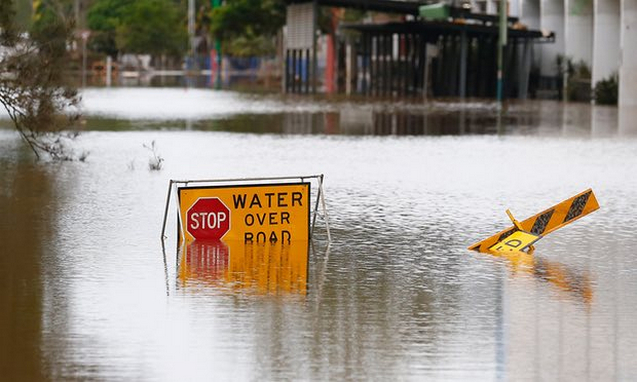
Parts of Lismore, Australia affected by floodwaters on April 2, 2017. Photograph: Jason O'Brien/Getty Images
It was only a few weeks ago that I wrote about changes to extreme weather in a warming world. That prior article dealt with the increase of extreme precipitation events as the Earth warms. I termed the relationship a thermodynamic one; it was driven by local thermodynamic processes. But extreme weather can also occur because of large-scale changes to the atmosphere and oceans. This issue is the topic of another just-published paper that makes a convincing case for a whole new type of influence of humans on extreme weather. In a certain sense, this study confirms what was previously reported here and here. With the march of science, the tools, methods, and evidence get better each year.
Before getting into the study, a little background. The jet stream(s) are high-speed rivers of air that flow in the upper atmosphere. There’s more than one jet stream; they blow west to east and they mark the separation of zones of different temperatures. A good primer on jet streams is available here.
If you were to stand at the northern pole and travel southwards, you would experience a gradual increase in temperature. However, when you reached the first jet stream (the Polar Jet), temperatures would rapidly become warmer. That is, the Polar Jet separates two different temperature air regions. Typically, if you are north of the jet stream, you are in a colder zone whereas if you are south of the stream, it is warmer. Sometimes, the jet streams undulate as they encircle the planet and these undulations move. So, sometimes you happen to be in a position north and sometimes south of the stream, even though your location is fixed.
Diagram of undulating jet streams. Illustration: National Oceanic and Atmospheric Administration
The interface between warm and cold temperatures creates a lot of weather-pattern changes. In addition, if the undulations of the streams become fixed, it means your weather patterns will get stuck. For instance, you could find yourself in an upward undulation for weeks or longer and experience warm and potentially dry weather. Alternatively, if your location is north of a stuck jet undulation, you may experience persistent cold weather. Perhaps even more importantly, these stuck waves can become larger in their magnitude.
So, scientists really want to know what affects these undulations – both their magnitudes and their persistence. We also want to know whether these undulations will change in a warming planet. This is precisely where the new study comes in. The researchers used both weather observations and climate models to answer these questions. What they found was very interesting.
Using measurements, the authors documented what conditions led to extreme weather patterns that persisted for extended durations. They found that many occur when the jet stream becomes stationary with the undulations stuck in place. They also saw that under certain situations, the jet stream undulations do not dissipate in time; they become trapped in a wave guide.
Interestingly, this pattern of a stuck jet stream would occur when the number of undulations was between six and eight. When these circumstances all lined up, according to study co-author Stefan Rahmstorf:

the same weather persists for weeks on end in one region, then sunny days can turn into a serious heat wave and drought, and lasting rains can lead to flooding
And this is also how humans come into the story. As humans emit greenhouse gases, the planet warms. We know that, we predicted it, and it is occurring. However, the warming is not uniform. The Arctic, for instance, is warming more rapidly than the rest of the planet. As a result, the temperature difference between the Arctic and the rest of the world is reducing. It is this temperature difference that maintains the jet stream patterns. As stated by lead author, Michael Mann:

The warming of the Arctic, the polar amplification of warming, plays a key role here. The surface and lower atmosphere are warming more in the arctic than anywhere else on the globe. That pattern projects onto the very temperature gradient profile that we identify as supporting atmospheric waveguide conditions.
The authors compared the observations to computer models and they found similar patterns. The authors went on to say in a press release:

Using the simulations, we demonstrate that rising greenhouse gases are responsible for the increase ... We are now able to connect the dots when it comes to human-caused global warming and an array of extreme recent weather events.
This is really where the science is. We know humans are causing climate change and we know that weather will change as this process evolves. What we really want to know is how human-caused climate change will influence extreme weather. It’s extreme weather like droughts, floods, heat waves, etc. that cause high social and economic costs. These authors have concluded a convincing study that connects the dots. Perhaps the study is best summarized by Michael Mann, who said:
We came as close as one can to demonstrating a direct link between climate change and a large family of extreme recent weather events.
Links

Lethal Heating is a citizens' initiative