Thursday, April 20, 2017

Adani's Coal Will Worsen The Lives Of India's Poorest

Fairfax - Harita Sridhar*

Last week, I told my dad I was going to speak outside the Indian high commission at an anti-Adani rally against the proposed Carmichael mine. Soon after, he called me up and he was not happy.
My parents are Indian migrants and I am a young, second-generation, Indian-Australian woman. My father reminded me that there are 300 million people living without electricity in India, and of the times we ourselves were without power in our ancestral village and our home in the coastal city of Visakhapatnam.
Prime Minister Malcolm Turnbull met India's Adani Group founder and chairman Gautam Adani in Delhi on Monday. Photo: Mick Tsikas
He's right: energy poverty is an obstacle to inclusive development in India, and difficult to empathise with here in Australia, where we generally have the privilege of energy security.
But the coal from Adani's Carmichael mine is not the answer for those living without electricity. It will further pollute the air they breathe and the water they drink. It will cause dangerous climate change and extreme weather that always affects the poorest first. Australia's coal will make their lives harder in the long run.
A Stop Adani protest in Melbourne in December. Photo: Wayne Taylor
That's why I decided to speak out. I believe that, if the Australian government or Adani were genuinely serious about extending our energy security to India, they would be generous with technology transfer, or provide untied funding to help India's renewables sector grow. Instead, we face the potential construction of what would be Australia's largest coal mine, and the prospect of irreversible environmental degradation to our climate, groundwater and the Great Barrier Reef.
Adani's project is a terrible idea. The company has a record of serious environmental and human rights violations in several countries, including India I don't trust it to keep the Australian environment safe.
Prime Minister Malcolm Turnbull is offering Adani $1 billion of public money as a subsidised loan for this project, though India doesn't even want our coal! Just last week, India's Energy Minister, Piyush Goyal, said India didn't want to keep buying foreign coal and wanted instead to transition to a renewable-energy economy. This is the safer, cleaner and more sustainable solution to India's energy deficit, and the only one that doesn't harm the global environment.
Closer to home, more than two-thirds of Australians polled say they don't want the mine to be built either. This year alone, more than 140 "Stop Adani" groups have formed, and the national Stop Adani roadshow sold out at every major city along the east coast, gathering about 4000 passionate people (500 in Canberra!) who are concerned about the mine and don't want it to go ahead.
The Carmichael mine is bad for Australia, for India and for the global climate. The rest of the world is getting smarter about climate change and stepping away from coal. Australia shouldn't embarrass itself by taking a huge step backwards.

*Harita Sridhar is a Canberra student.

Links

Salt, Silicon Or Graphite: Energy Storage Goes Beyond Lithium Ion Batteries

The Guardian - 

Technologies that use gels, liquids, and molten silicon or salt could all claim a slice of the growing renewable energy storage market
Solar power plants don’t produce energy when the sun doesn’t shine, but renewable energy storage batteries are becoming more competitive. Photograph: Tim Phillips Photos/Getty Images
Between the political bickering following a spate of blackouts in South Australia and the billionaire entrepreneur Elon Musk tweeting that he had a fix, and then the South Australian government announcing that it will build a grid-connected battery storage facility, interest in renewable energy storage has never been higher.
While lithium ion batteries sold by Tesla and others are perhaps the most widely known storage technology, several other energy storage options are either already on the market, or are fast making their way there.
All are hoping to claim a slice of what, by all indications, will be a very large pie. The Australian Energy Market Operator forecasts that more than 1.1m new battery storage systems will be installed in Australian households by 2035. And, according to a 2015 report by the Climate Council, battery storage capacity is expected to grow 50-fold in under a decade.
“The market for storage is huge,” says Kevin Moriarty, the executive chairman of 1414 Degrees, an Adelaide-based thermal storage company hoping to win South Australia’s 100MW storage system tender. The South Australian system will be the largest in Australia so far but Moriarty describes it as “a drop in the ocean” compared with what will be needed as Australia transitions away from carbon-dioxide emitting fossil fuels.
The need for energy storage solutions is the natural consequence of an energy grid that has an increasing amount of renewable energy sources. Solar power plants don’t produce energy when the sun doesn’t shine and windfarms grind to a halt when the wind doesn’t blow.
At the grid level, the resulting fluctuations in supply, combined with demand that can rapidly spike during hot weather, for example, can play havoc with the steady 50Hz electricity supply needed to power everything from microwaves to factory production lines.
Traditionally, fossil fuel-powered turbines are used to rapidly respond to load changes. If switched on when needed, electricity output ramps up or down so that there is enough electricity, at the right frequency, to supply demand.
Renewable energy storage systems, which include batteries and thermal storage systems, run from small household units to power plant and grid-scale technologies. What they aim to do is enable electricity to be released into the system when it is needed – so-called load shifting – rather than only when solar collectors or wind turbines are operating.
“Storage allows you to spread out the load and, if you can do that, you no longer need the big so-called base-load generators,” Moriarty says.
In thermal storage systems, renewable electricity or electricity purchased from the grid at off-peak rates is used to heat a material to a high temperature. 1414 Degrees uses molten silicon – an abundant and cheap element that is the main component of sand – that is heated to its melting point of 1414 degrees. The stored heat can then be used at a later time to generate electricity – using turbines – that is fed back into the grid. It can also release heat to be used in district heating systems for hot water or space heating.
The company has developed 10MW or 200MW systems, which can store heat for up to two weeks, although they are designed to be able to constantly charge and discharge according to demand. Unlike batteries, which have a finite number of charge/discharge cycles, the molten silicon can be used indefinitely and can be recycled when the units reach the end of their 20-year service life.
Other thermal storage systems take heat directly from the sun to heat storage materials. In these systems, concentrating solar collectors – rather than photovoltaic cells – are used to heat a liquid that can then heat a storage medium. Pilot scale facilities in Jemalong and Lake Cargelligo, both in central west NSW, use molten salt or graphite, respectively, to store heat.
According to Prof Frank Bruno, leader of the Thermal Energy Storage Group at the University of South Australia, one of the advantages of thermal storage is the ability to operate at high temperatures, unlike batteries, whose components suffer once temperatures go above about 50 degrees.
The other advantage is price. “Storing energy as thermal energy is much cheaper that battery storage,” says Bruno, although photovoltaic power plants currently out compete concentrated solar collectors.
The Australian Solar Thermal Research Initiative, of which Bruno is a member, is trying to bring the cost of concentrated solar collectors down, which would make integrated solar thermal storage systems more price competitive overall.
Battery makers are concentrating on trying to solve some of the key limitations of lithium ion batteries. One of those is the scant supply of raw materials required to make them, a supply that is unlikely to meet future energy storage demands, according to Prof Thomas Maschmeyer, co-founder of the University of Sydney spin-off company Gelion.
Gelion batteries use zinc and bromide, elements with more stable and abundant supplies than the lithium and cobalt of lithium ion batteries. Unlike lithium ion batteries, which will become more costly as demand for raw materials outstrips supply, the price of Gelion’s batteries will only decrease with increased production scales.
Gelion’s technology is based on a tweak of zinc/bromide chemistry – which is already used in Redflow batteries – that means the battery operates with a gel rather than a liquid. The resulting batteries look and work much like a lithium ion battery, but with greater heat tolerance. Gelion is currently raising funds to get their prototype into commercial production.
While there’s currently no front-runner to replace lithium ion batteries, according to those working across the range of storage devices available, there will be plenty of options ranging from household electricity storage, to grid-level systems like that proposed for South Australia.
“The market’s big enough and the needs are varied,” says Moriarty, so “there’s a place for all of them.”

Links

Geothermal: A Technology That Blows Hot And Cold In Sydney's Booming West

Fairfax - Peter Hannam

A Sydney housing estate is streets ahead when it comes to energy efficiency.
Fairwater is a new geo-thermal cooled mini-suburb near Blacktown. Photo: Wolter Peeters
During the peak of last summer's heat, an energy experiment the size of a mini suburb involving hundreds of new homes in western Sydney was under way.
With temperatures reaching 45 degrees for three days in a row, residents of the Fairwater estate going up at Blacktown relied on pipes to pump excessive heat as much as 90 metres under their homes to stay cool.
The geothermal technology itself is not revolutionary but Fairwater is the first housing estate to introduce it at scale in Australia.
Working much like modern airconditioners that can warm and cool, the Australian-made heat pumps use the temperature difference between the air and the ground to extract or reject heat.
Since the temperature below that area of Sydney's west barely budges from about 22 degrees all year round, the earth can serve as a heat dump during summer or a source of warmth in winter. The challenge is to make it at least as efficient as standard products on the market.
A $1 million drill, more commonly found on a mining site, drills a simple hole before any of the other construction work begins on the homes. Later, a copper loop containing refrigerant is added, with developers Frasers Property promising energy savings of as much as 60 per cent compared with regular airconditioning.
"We're hoping it will exceed that total [saving]," Ray Baksmati, the Fairwater development director, said. "The payback is about five years."
The extra engineering required adds about $3000-$5000 to costs to houses ranging from about $650,000 to more than $1 million. Geothermal costs for two-bedroom houses are lower because pipes only go down 60 metres through the mudstone compared with 90 metres for four-bedders.

Mini suburb cooled by geothermal technology
Homes in Blacktown's Fairwater estate rely on pipes to pump excessive heat deep underground to stay cool.

Mr Baksmati said Frasers worked for more than four years with QPS Geothermal, the drillers, and local airconditioner maker Actron Air to hone the process. The developer is now doing "real life testing" to see how systems performed.

Early response
A straw poll by Fairfax Media earlier this month found experiences ran hot and cold.
Fairwater construction manager Adam Chymiak with the rig that drills the geothermal pipelines. Photo: Wolter Peeters
Sid and Nimarta Banga said they were "mostly positively exuberant" since moving into Fairwater before summer's height. Their electricity bill came in at $260 for about eight weeks.
"You can't even feel like the airconditioning is working" because it's so quiet, Mr Banga said, adding "it works really quickly".
Fairwater residents have mixed views of the success of geothermal so far. Photo: Peter Hannam
Around the corner, Manvinder and Deepti Verma were also glad their three-month electricity bill came in at $450 for their four-bedroom house. "We were expecting a lot more," Ms Verma said.
The geothermal unit "should pay for itself in three or four years," Mr Verma said, adding that "very few people know about this system".
Fairwater development residents Sid and Nimarta Banga in front of their new home. Photo: Wolter Peeters
The equipment, though, has not been without glitches, with a portion of the Vermas' street tripping for several days. The fault left them – and their 15 month-old child – without cooling for two "unhappy" nights and a day during the heat peak.
Marc Crook, who rents in another street, is not happy, either. His summer's power bill came to $1385 and the system struggled so much to keep his house cool he resorted to spraying water on the coolant pipes to try to cool them.
"They really don't cope at all" once the mercury climbs above the low-30s, he said. "We'd be lucky to get it 24 degrees inside" even with the thermostat turned down to 16 degrees.
Mr Crook, who works in the boiler industry, said it stood to reason that "the harder and further you have to pump something, the more heat you're going to generate at the pump", reducing efficiency and effectiveness.

'Great achievement'
Adam Chymiak, Fairwater's construction manager, said that while there may be teething troubles at individual sites the overall outcome was "a great achievement".
The energy efficiency of the homes, which include fans in most rooms and LED lightning, meant the estate "lessened the demand on the overall grid" especially at peak times, he said. Fairwater is also the first community in NSW to be awarded a 6 Star Green Star Rating for sustainability.
Fairwater is planning to monitor and make public the performance of the geothermal systems, Mr Baksmati said.
Graham Morrison, an emeritus professor at the University of NSW said that geothermal could be an attractive option provided it delivered the promised energy savings: "Sixty per cent is quite OK – technically, it's close to the average of competing products."
Frasers is examining rolling out geothermal at its Edmondson estate near Liverpool, and says other developers are looking at the technology for their large sites too.
Professor Morrison said geothermal may work better for cooler climates, such as Melbourne, where heating is a bigger part of the annual energy bill. "Generally, the colder the climate is worse for solar [energy] but better for heat pumps," he said.
For Nimarta Banga, the benefit of installing geothermal in new homes may be that residents of a whole community start with lower energy use that may otherwise have been the case – whether they are aware of it or not.
"For us, it was a blanket package," she said. "No one will pay out of their pocket for [geothermal]."

'Living building'
Frasers Property is involved in another pioneering venture, the $115 million Burwood Brickwoods project in Melbourne's east.
The centrepiece of the mixed retail and housing project over 20.5 hectares on a former industrial site is the shopping centre. The developers are seeking the first "Living Building" certificate issued for a retailer by the International Living Future Institute.
The US-based group, which has certified about 360 projects worldwide, demands projects achieve at least net-zero energy, waste and water, and avoid a range of harmful "red-listed" materials from lead and cadmium to chemicals that don't break down in the environment.
Frasers will aim to generate 105 per cent of the energy used by the site, deploying as much as 3 megawatts of solar panels and batteries to meet its own needs and to export to neighbours or recharge customers' electric cars. Geothermal technology is not being considered as part of the project.
A 2000-square-metre farm, the largest of its kind in Australia, will supply vegetables and even poultry from within the retail site.
"It's called a challenge for a reason," Amanda Sturgeon, chief executive of the institute, said.
Peri Macdonald, ‎executive general manager for retail at Frasers, said meeting the building's ambitious sustainability goals will boost the retail portion's cost by about $12 million to $60 million.
"It's really going to push the envelope," Mr Macdonald said, adding the extra outlay is worthwhile because shoppers would be expected to linger longer – and spend more – in the more sustainable setting.
Tenants, such as Woolworths, have indicated a willingness to meet the higher energy and other standards.
"We don't expect it will change the tenant mix," Mr Macdonald said.

Links

Wednesday, April 19, 2017

Humans On The Verge Of Causing Earth’s Fastest Climate Change In 50m Years

The Guardian - 

Humans are changing Earth’s climate at an alarmingly fast rate
As climate scientist Wallace Broecker once said, “The climate system is an angry beast, and we are poking at it with sticks.” Photograph: Alamy
A new study published in Nature Communications looks at changes in solar activity and carbon dioxide levels over the past 420 million years. The authors found that on our current path, by mid-century humans will be causing the fastest climate change in approximately 50 million years, and if we burn all available fossil fuels, we’ll cause the fastest change in the entire 420 million year record.
Changes in atmospheric carbon dioxide and in the combined solar and carbon dioxide forcing over the past 420 million years. Illustration: Foster et al. (2017); Nature Communications.
The study relates to a scientific conundrum known as the “faint young sun paradox” – that early in Earth’s history, solar output was 70% less intense than it is today, and yet the planet was warm enough to have a liquid ocean. A stronger greenhouse effect due to higher carbon dioxide levels in the atmosphere may be one explanation.
Over time, solar output has grown stronger, and atmospheric carbon dioxide levels have fallen due to an effect known as “weathering” of rocks and an increase in plant life. The authors of this study found that over the past 420 million years, the slow heating of the sun and slow decline of the greenhouse effect have roughly offset each other, leading to a fairly stable long-term global climate.
Changes in the solar and carbon dioxide forcings over the past 420 million years. Illustration: Foster et al. (2017); Nature Communications.
In particular, as shown in the first chart above, Earth’s climate has been fairly stable over the past several million years. The wiggles in the blue line represent transitions in and out of ice ages, due to wobbles in the Earth’s orbit around the sun, amplified by changes in the amount of carbon dioxide in the atmosphere (these are known as Milankovich cycles).
The bottom frame in the chart shows the change in forcing (global energy imbalance) caused by the combination of changes in solar activity and the greenhouse effect. When the line is flat, the Earth’s energy balance is stable, and thus so is its climate. When there’s a steep change, something is upsetting that balance and causing a rapid climate change. The five colored lines toward the end of the chart show potential pathways we’ll follow, depending on how much fossil fuels humans burn over the coming decades.
In every case the line is already quite steep due to the hundreds of billions of tons of carbon pollution humans have dumped into the atmosphere thus far. The size of the global energy imbalance we’ve caused is already on par with those previous blue wiggles – Earth’s ice age transitions. If we keep burning lots of fossil fuels, we could soon cause higher carbon dioxide levels and faster climate change than the Earth has seen in 50 million years. If we burn all available fossil fuel reserves (the black “Wink12k” line), we’ll see faster climate change than in the entire 420 million year record.
It’s an alarming proposition. Climate deniers will often argue against taking action to curb carbon pollution because climate changed naturally in the past and carbon dioxide levels were higher in the past. One Republican congressman repeated these talking points in the latest House “Science” committee hearing. While both arguments are technically true, they miss several important points.
First, the rate at which we’re currently causing climate change is alarmingly fast – much faster than in most natural climate change events. Second, similar past rapid climate changes have caused mass extinction events. Third, the sun’s cooler past helped keep temperatures lower.
As renowned climate scientist Wallace Broecker once said, “The climate system is an angry beast, and we are poking at it with sticks.”

Denial101x lecture by Peter Jacobs.

As this new study shows, our poking sticks are getting bigger and bigger, and we’re poking the beast faster and faster. Meanwhile, climate deniers are egging us on because the beast has been angered in the past, and we’re not sure just how soon it will decide to maul us.

Links

Antarctica’s Sleeping Ice Giant Could Wake Soon

Nature - Jane Qiu

The massive East Antarctic Ice Sheet looks stable from above — but it's a dangerously different story below.
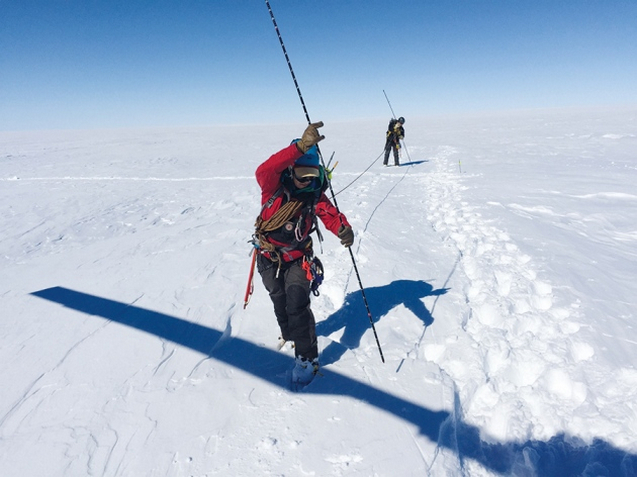
A research team probes for crevasses on Totten glacier, the largest in East Antarctica. Hayden Henderson/Helires/AAD
On a glorious January morning in 2015, the Australian icebreaker RSV Aurora Australis was losing a battle off the coast of East Antarctica. For days, the ship had been trying to push through heavy sea ice. It rammed into the pack, backed up and crashed forward again. But the ice, several metres thick, hardly budged. Stephen Rintoul, an oceanographer at the University of Tasmania in Hobart, Australia, nearly gave up his goal — to reach a part of the continent that had thwarted all previous expeditions. "I really thought that would be it," he says. "It'd be another failed attempt."
Then the weather came to the rescue, with a wind change that blew the ice away from the shore, opening a path through the pack. The ship managed to break free and wove its way through 100 kilometres of ice, reaching the edge of the frozen continent shortly after midnight. Rintoul and his team were the first scientists to reach the Totten Ice Shelf — a vast floating ice ledge that fronts the largest glacier in East Antarctica. "It was a really exhilarating experience," says Rintoul, chief scientist of the expedition.
The team had to work fast before the ice closed again and blocked any escape. For more than 12 hours, Rintoul and his colleagues carried on non-stop, probing the temperature and salinity of the water, the speed and direction of ocean currents as well as the shape and depth of the ocean floor. They also deployed instruments that would continue taking measurements after the ship had departed.
These first direct observations confirmed a fear that researchers had long harboured: that warm waters from the surrounding ocean can sneak underneath the floating glacier tongue and eat the ice away from below1. "This could explain why Totten has been thinning in the past few decades," says Rintoul.
Findings such as these are revealing some scary truths about East Antarctica — the vast, remote landmass to the east of the Transantarctic Mountains (see 'Ice king'). This region is about as big as the entire United States and the majority of it stands on a high plateau up to 4,093 metres above sea level, where temperatures can plunge to −95 °C. Because the East Antarctic Ice Sheet seems so cold and isolated, researchers thought that it had been stable in the past and was unlikely to change in the future — a stark contrast to the much smaller West Antarctic Ice Sheet, which has raised alarms because many of its glaciers are rapidly retreating.
In the past few years, however, "almost everything we thought we knew about East Antarctica has turned out to be wrong", says Tas van Ommen, a glaciologist at the Australian Antarctic Division in Kingston, near Hobart. By flying across the continent on planes with instruments that probe beneath the ice, his team found that a large fraction of East Antarctica is well below sea level, which makes it more vulnerable to the warming ocean than previously thought. The researchers also uncovered clues that the massive Totten glacier, which holds about as much ice as West Antarctica, has repeatedly shrunk and grown in the past2 — another sign that it could retreat in the future.
Although East Antarctica doesn't seem to be losing much ice today, there are indications that it is feeling the heat of climate change and is responding in measurable ways. This is disconcerting because its ice sheet is more than ten times bigger than the one in the west. If all the ice below sea level in East Antarctica were to disappear, the height of the world's oceans would swell by nearly 20 metres.
Researchers are now trying to gather as much information as possible about East Antarctica to better predict what's to come. Their concern is that over the next few centuries, the ice sheet there might reach a tipping point. "Once glaciers retreat beyond a certain point, things may go downhill very quickly and cause rapid sea level rise," says Eric Rignot, a glaciologist at the University of California, Irvine. "We don't want to sleepwalk into a calamity like this."
Deep danger
Rignot was one of the first scientists to warn about possible trouble in East Antarctica — a region long neglected by climate researchers. In 2013, his team detailed the behaviour of ice around the margin of Antarctica by combining satellite imagery, airborne surveys and climate models. The researchers found evidence that six East Antarctic ice shelves, including Totten, were melting from below at rates much higher than expected — with some even rivalling those of fast-retreating glaciers in West Antarctica3.
More surprises emerged when the researchers took a closer look at some of those East Antarctic glaciers. Satellite imagery and airborne surveys between 1996 and 2013 showed that the surface of the Totten glacier dropped by 12 metres and that its grounding line — the point at which the ice flowing off the continent begins to float on the ocean — retreated inland by a shocking amount of up to 3 kilometres4.
"This is not an isolated incidence," says Chris Stokes, a glaciologist at Durham University, UK. His team analysed satellite imagery obtained between 1974 and 2012 that covers all the coastal regions in East Antarctica. Most areas had no net ice gain or loss. The only exception is the Wilkes Land region — an area larger than Greenland that includes Totten glacier5. Three-quarters of the glaciers there retreated between 2000 and 2012. "Wilkes Land may be East Antarctica's weak underbelly," says Stokes.
As researchers were pondering the surprising retreat of East Antarctic glaciers, van Ommen and his colleagues were flying over Totten to probe its underside. "The landscape underneath the ice is fundamentally important for how glaciers flow and how they respond to climate change," he says. When the team launched an international initiative called ICECAP (International Collaboration for Exploration of the Cryosphere through Aerogeophysical Profiling) a decade ago to systematically survey the hidden landscape of East Antarctica, "we almost knew nothing about what's going on down there", he says.
Every Antarctic summer since then, ICECAP's aircraft have been criss-crossing the vast continent to peer through the ice using radar as well as gravitational and magnetic sensors. "They are the best flights in the world," says Martin Siegert, a glaciologist at Imperial College London and a principal investigator of the project. The seemingly featureless ice sheet is ever-changing — with wind-sculpted snow dunes and ice shimmering in thousands of shades under the unearthly Antarctic light. "It's just like another planet," he says.
The flights have revealed an astoundingly dramatic landscape hidden beneath the relatively flat ice sheet. Preliminary results from airborne surveys this January, led by glaciologist Sun Bo at the Polar Research Institute of China in Shanghai, confirmed the existence of a 1,100-kilometre-long canyon — the longest in the world, and almost as deep as the Grand Canyon in the United States. In previous flights over Wilkes Land, van Ommen's team discovered that 21% of the Totten glacier catchment is more than 1 kilometre below sea level — an area 100 times larger than previous estimates. "We really didn't expect it to be as extensive as it has turned out to be," says Donald Blankenship, a geophysicist at the University of Texas at Austin and another ICECAP principal investigator.
The team also found underwater troughs that extend all the way from the edge of the Totten Ice Shelf to the grounding line 125 kilometres inland, and as deep as 2.7 kilometres below sea level6. This deeply contoured landscape could allow warming waters from offshore to quickly reach and erode the ice.
"Almost everything we thought we knew about east antarctica has turned out to be wrong."
The first chance to study the fate of that water came when the RSV Aurora Australis reached Totten in 2015. Near the glacier tongue, Rintoul and his colleagues detected waters as warm as 0.3 °C — much warmer than the −2 °C freezing point of sea water1. "They are driving rapid rates of melt," says Rintoul. The instruments he and his team left behind show that warm waters are present all year round. If these waters follow the recently discovered channel beneath Totten to the grounding line, they will be at least 3.2 °C warmer than the freezing point at that depth. "That would be really bad news," he says.
Threats to ice shelves could also come from the Antarctic interior — from lakes under the ice sheet that periodically send flood waters towards the coast. A decade ago, Lake Cook beneath the ice sheet in Wilkes Land suddenly drained, gushing 5.2 billion cubic metres of flood water — the largest event of this type ever reported in Antarctica. Such floods could be another destabilizing factor, causing faster ice flow and more iceberg calving, says Leigh Stearns, a glaciologist at the University of Kansas in Lawrence.

Troubled past
These scenarios are not just hypothetical, say researchers. Studies in the past few years have revealed that East Antarctica has lost a lot of ice in the past, and could do so again in the near future.
Some of the evidence for that comes from a 2010 expedition supported by the Integrated Ocean Drilling Program, which retrieved sediments from the sea floor off the coast of East Antarctica. Getting those sediments was a dangerous endeavour. The ship had to repeatedly stop drilling and dodge massive icebergs. "The waters around Antarctica present some of the most challenging environments for ocean drilling," says Tina van de Flierdt, a geochemist at Imperial College London and a principal investigator of the expedition.
The efforts paid off, however, by revealing surprising changes in the ice sheet's history. "We had long thought when the East Antarctic Ice Sheet grew to the current size about 14 million years ago, it's the end of the story," says van de Flierdt. "It's this big stable block of ice that isn't really doing anything in the face of climate change."
In 2015, the icebreaker RSV Aurora Australis transported the first scientists to the Totten Ice Shelf. Paul Brown/AAD
Instead, the sea-floor sediments revealed that the ice sheet waxed and waned many times between 5.3 million and 3.3 million years ago7 — an epoch called the Pliocene, when air temperatures were up to 2 °C higher than today. "We got a clear signal every time it was warm, suggesting that the ice sheet was sensitive to climate warming," says van de Flierdt.
The researchers say that they have some intriguing preliminary results from the most recent interglacial period, between 129,000 and 116,000 years ago — when the globe was as warm as it is today. The ice sheet retreated just slightly less at that time than it did during the much warmer Pliocene. "That's a big surprise," says van de Flierdt.
"If the results prove to be robust, I'd say it's really interesting," says Maureen Raymo, a geochemist at the Lamont-Doherty Earth Observatory in Palisades, New York. "This may mean that you can lose a certain amount of ice quite easily with a little bit of warming," she says.

Fast forward
As East Antarctica's vulnerability comes into focus, researchers are increasingly concerned about the future. The only way to forecast decades or centuries ahead is to use computer models that simulate how ice sheets respond to a changing climate. But the models are relatively simplistic, and until recently they couldn't accurately reproduce some past events, such as the significant glacial retreats that scientists have been discovering in East Antarctica's history.
Climate researchers Robert DeConto of the University of Massachusetts in Amherst and David Pollard of Pennsylvania State University in University Park have tried to make the simulations more realistic by factoring in some processes that were left out of earlier studies. Their model allows meltwater on the ice surface to deepen crevasses and splinter the ice shelves, and it simulates how ice cliffs collapse once they lose the ice shelves that buttress them.
When DeConto and Pollard included these processes, their model showed East Antarctica's glaciers retreating substantially during the last interglacial period and in the Pliocene8. "It's really the first successful attempt to roughly match ice-sheet simulations with our best understanding of past glacier retreat and sea-level rise," says van Ommen.
After looking back in time, the researchers turned their model to the future. There, they saw a mix of good and bad news. In their simulations, the entire Antarctic Ice Sheet does not change much in the next 500 years if global warming is limited to less than about 1.6 °C above pre-industrial levels by the end of the century — roughly in line with what the Paris climate agreement aims to achieve.
But if temperatures rise more than about 2.5°C above pre-industrial levels by 2100 and continue climbing, Antarctic ice melt will raise ocean levels by 5 metres by 2500 (ref. 8), with nearly half of that coming from East Antarctica. With Greenland ice also melting, the global sea level would rise by at least 7 metres — enough to inundate large parts of major coastal cities such as Mumbai, Shanghai, Vancouver and New York. "This would drastically reshape the world's coastline and affect millions," says DeConto.
He cautions that the model is still rather crude — mainly because observations of East Antarctica are so limited. "Most of the coastline is simply unmapped," he says.
The lack of data has also resulted in extremely poor ocean models that grossly underestimate the amount of warm water reaching the ice shelves, says DeConto. "This really calls for long-term monitoring of ocean conditions."
In East Antarctica now, temperatures are dropping rapidly as the austral winter sets in; researchers are cosy at home reviewing the latest haul of data from the field season. A priority for the future is to map the bedrock beneath all major ice shelves. That will help researchers to identify other glaciers that might be eaten away by warm ocean waters, and to predict how the interior might respond once the ice on the coastal margins disappears.
One of the scariest finds would be large valleys in the continental interior that get deeper as they slope towards the ocean. These could destabilize large sections of East Antarctica's glacial cap when its margins start to disintegrate over the coming decades and centuries. "Then the entire ice sheet could slide off easily," says Blankenship. "There would be nothing to hold it back."

References
  1. Rintoul, S. R. et al. Sci. Adv. 2, e1601610 (2016).
  2. Aitken, A. R. A. et al. Nature 533, 385–389 (2016).
  3. Rignot, E., Jacobs, S., Mouginot, J. & Scheuchl, B. Science 341, 266–270 (2013).
  4. Li, X., Rignot, E., Morlighem, M., Mouginot, J. & Scheuchl, B. Geophys. Res. Lett. 42, 8049–8056 (2015).
  5. Miles, B. W. J., Stokes, C. R. & Jamieson, S. S. R. Sci. Adv. 2, e1501350 (2016).
  6. Greenbaum, J. S. et al. Nature Geosci. 8, 294–298 (2015).
  7. Cook, S. P. et al. Nature Geosci. 6, 765–769 (2013).
  8. DeConto, R. M. & Pollard, D. Nature 531, 591–597 (2016).
Links

Artist Sets Futuristic Dinner Party In World Reshaped By Rising Seas

NPR - Rhitu Chatterjee

Allie Wist's "Flooded" dinner spread includes burdock and dandelion root hummus with sunchoke chips; jellyfish salad; roasted hen of the woods mushroom; fried potatoes with chipotle vegan mayo; salted anchovies; and oysters with slippers. Most of these are foods that might be more resilient to climate change and, therefore, what we could be eating in the future, Wist says. Heami Lee/Courtesy of Allie Wist, food stylist C.C. Buckley, prop stylist Rebecca Bartoshesy
What will our dinners look like when temperatures and sea levels rise and water floods our coastal towns and cities?
Allie Wist, 29, an associate art director at Saveur magazine, attempts to answer that question in her latest art project, "Flooded." It's a fictional photo essay (based on real scientific data) about a dinner party menu at a time when climate change has significantly altered our diets.
Wist has been following news about climate change with a growing sense of urgency. Global temperatures have risen in recent decades and extreme weather – droughts, floods, hurricanes – is more common. Sea levels are rising, causing coastal erosion and flooding and even the disappearance of small islands in the South Pacific. Our oceans are becoming more acidic from dissolved carbon dioxde, hurting marine life. And, in some parts of the world, farmers are struggling with unpredictable growing seasons.
Climate change has "become this future vision that's right in front of us," Wist says.
The fishing village of Nueva Venecia is situated in a lake deep in the marshlands of northwestern Colombia. The marshlands could be inundated with ocean water by 2100, if sea levels rise by 3 feet or more as projected by scientists. Courtesy of Allie Wist
But the issue is a politicized one in the United States, she says. Many people don't believe climate change is real. And many find it difficult to understand, because it's too abstract.
"I felt this need to subversively convince people," Wist says. "I wanted to hook them more emotionally, with something they can relate to."
So she chose food. "It is so integral to how we see ourselves and how we live every day," she says.
Climate change is already having an effect on food production. In 2011, a study in Science found a small, but measurable decline in the world's wheat and corn production. As global temperatures rise, some places will become more favorable for agriculture, while many others will become too hot and dry to grow crops. Extreme weather will also influence food prices, as we saw in 2010-2011, when drought in some parts of the world and unusually big cyclones and floods in others led to a spike in wheat prices. Warmer ocean temperatures have and will continue to affect fisheries.
All this means we might be forced to change what we eat in the coming decades, says Wist. People "have to start to realize that their daily activities could change, will change, because of this thing that they consider abstract," she says.
A dinner plate floats in New York City's East River. "It said something about just getting swept away and belongings being flooded," says Wist. But it also implied "us persevering... and eating dinner despite that." Courtesy of Allie Wist
Wist and her team, fellow photographer Heami Lee, food stylist C.C. Buckley and prop stylist Rebecca Bartoshesy, started out by making a list of foods that scientists think "are either threatened by climate change or would be more available in an era of climate change," she says. They chose to anchor the essay in New York and New England to think more specifically about the kinds of food and eating habits that would have to change.
Rising sea levels put coastal cities like New York, where Wist now lives, at a greater risk of flooding. That means in the not-too-distant future, residents might have to turn more to the ocean for food, says Wist.
So her fictional menu includes an array of foods harvested from the sea.
This dish features a scallop in its shell. Bivalves, like scallops are threatened by rising ocean acidification. Wist left it in the shell, so people would think of it "as an animal and not just a scallop on a plate." Heami Lee/Courtesy of Allie Wist, food stylist C.C. Buckley, prop stylist Rebecca Bartoshesy
Bivalves, for example, play a key role in protecting the ocean environment, by filtering out pollutants. But they are threatened by climate change – the increasing acidity of ocean waters is eroding their shells. If we can save bivalves, they could become a good source of food in the future, Wist suggests.
Wist says they chose mustard greens to serve alongside the bivalves on her menu because the hardy plants "can survive volatility in climate."
And Wist thought about what might be in our glasses as well as on our plates.
Left: Mollusks in broth with mustard greens. Mustard greens are hardy plants that could withstand climate fluctuations. Right: A DIY method for desalinating ocean water for cooking and drinking. Heami Lee/Courtesy of Allie Wist, food stylist C.C. Buckley, prop stylist Rebecca Bartoshesy
According to the U.S. Geological Survey, rising sea levels are likely to contaminate ground water. "I don't think anyone thinks about it, that we might have to desalinate ocean water in order to have drinking water," says Wist.
Some countries, especially in the Middle East, already desalinate ocean water to provide more fresh water to their citizens, but Wist envisions the use of an at-home method involving a bowl, a rock and plastic wrap.
When it gets too hot or dry to grow crops, we could turn to mushrooms for food, too, suggests Wist. They grow in all sorts of environments and can even detoxify soil.
Left: Mushrooms have incredible potential as a future food source and can absorb toxins from the soil, says Wist. Right: Carob agar-agar pudding with whipped cream. Carob is substituted for chocolate, as cocoa production is threatened by rising temperatures. Heami Lee/Courtesy of Allie Wist, food stylist C.C. Buckley, prop stylist Rebecca Bartoshesy
The picture on the right above, depicting a pudding made with carob and an algae-derived gelatin called agar-agar, is one of Wist's favorites. It forces viewers to "acknowledge that chocolate's being replaced," she says. It's a reality cocoa farmers in West Africa are already facing.
"West Africa is thought to rise by about two degrees in the next 100 years," says Wist. "It will be too hot, too dry for cocoa production." And carob, which is less vulnerable to climate change, may be a good substitute.
Another major ingredient in these recipes is seaweed. A recent study has suggested that seaweed farming could be a good source of nutrition, as well as help mitigate climate change.
"Seaweed can absorb five times as much CO2 as land plants," says Wist. "I was really inspired by that research and thought what if someone did that? What if we started farming this more earnestly?"
Kombu, kelp, oysters, clams and other mollusks. If we farm seaweeds like kelp and kombu and protect bivalves, they could become a reliable source of food in the future, especially for coastal communities, says Wist. Heami Lee/Courtesy of Allie Wist, food stylist C.C. Buckley, prop stylist Rebecca Bartoshesy
"Part of this [essay] is dystopic," says Wist. "Because we're losing all these things, and that's bad." But part of it is utopic, too, she says, because it shows how human creativity can help us find alternative sources of food.
You can see Wist's entire essay and some creative recipes for the dishes above on her website.

Links

Tuesday, April 18, 2017

March Was Second Hottest On Record Globally

Climate Central - 

The exceptional global heat of the past few years continued last month, with March ranking as the second hottest on record for the planet. It followed the second hottest February and third hottest January, showing just how much Earth has warmed from the continued buildup of heat-trapping greenhouse gases in the atmosphere.
Global temperature anomalies for each month since 1880. March 2017 was the second warmest March, behind only 2016. Click image to enlarge. Credit: NASA

March was 2.02°F (1.12°C) warmer than the 1951-1980 average, according to NASA data released Friday. It ranks behind only March 2016, which was 2.29°F (1.27°C) above that same average. NASA’s global temperature records extend back 137 years.
While global temperatures in 2016 received a small boost from an exceptionally strong El Niño — which features warmer-than normal ocean waters in the eastern tropical Pacific  — the majority of the temperature rise is due to human-caused global warming.
Current levels of carbon dioxide — the main greenhouse gas driving up global temperatures — are unprecedented in human history, and if they continued unabated, could reach a level not seen in the atmosphere in 50 million years, according to a recent study.
Since the beginning of the Industrial Revolution, carbon dioxide levels have risen from about 280 parts per million to more than 400 ppm. Those levels are expected to top 410 ppm in the next few weeks.
While 2017 isn’t expected to top 2016 as the hottest year on record globally, in part because El Niño has dissipated (though there are some signs it could return later this year), it is still likely to rank among the hottest years, according to projections from the U.K. Met Office.
So far, global temperatures this year are on track with those projections, Adam Scaife, head of long-range prediction at the Met Office, said.
“We have said a number of times now that we would likely see three record years in a row and then another very warm, but perhaps not record year, in 2017, so the small number of data we have so far for 2017 also concur with that,” he said in an email last month.
How temperatures around the world varied compared to the 1951-1980 average, with red colors denoting warmer-than-average temperatures and blue cooler-than-average. Much of the U.S., as well as all of Europe and Russia were abnormally warm. Click image to enlarge. Credit: NASA
Of the 17 hottest years on record, 16 have occurred in the 21st century (the exception was the strong El Niño year of 1998), according to the National Oceanic and Atmospheric Administration. The five warmest years have all occurred since 2010, according to NOAA, which will release its own global temperature data for March on April 19.
So far this year NOAA’s rankings have agreed with NASA’s.

Links

Lethal Heating is a citizens' initiative