Monday, May 01, 2017

Australians Could Save $100bn On Electricity 'If Government Had Clear Policy'

The Guardian - 

Energy transmission industry ramps up call for market mechanism and says clear regulation could lead to zero net emissions by 2050
The Australian energy market is in the middle of a profound transformation, according to a new report from Energy Networks Australia. Photograph: Paul Miller/AAP
Australia’s electricity and gas transmission industry has intensified a call for a market mechanism to drive orderly transformation in the energy sector, warning a lack of clear regulation will result in higher prices for consumers and a less secure grid.
Energy Networks Australia (ENA) says clear policy settings could ultimately save Australian energy customers $100bn, and allow a smooth transition, where large-scale variable renewable energy can be integrated securely, creating the prospect of Australia’s electricity sector achieving zero net carbon emissions by 2050.
A new roadmap from the ENA to be released on Friday says the energy market is in the middle of a profound transformation that will only intensify over the next two decades.
Modelling produced for the report suggests that by 2050, up to 45% of Australia’s electricity supply could be provided by millions of distributed, privately owned generators, in homes and businesses.
The report notes the trend towards decentralisation of power generation creates “profound adaptation challenges for the system’s architecture, stability and efficiency given it was originally designed for almost 100% of generation at the transmission end of the system”.
The report’s estimated $100bn in cost savings is a function of governments rolling out nationally consistent policies that would encourage the two parts of the system to work harmoniously together – the current poles and wires of the national market, and the virtual grids in homes and businesses.
Allowing efficient co-optimisation would prevent overinvestment in poles and wires.
The ENA’s chief executive, John Bradley, said with stable policy settings, networks could buy grid support from customers instead of building their own infrastructure.
The rise of distributed energy between now and 2050 will coincide with decarbonisation in the national grid.
The report suggests by 2030, around 40% of generation could come from renewable technologies in Victoria and Western Australia, with an increasing share in New South Wales and Queensland as coal generators are retired.
The report points out that Queensland alone will boast solar generation capacity almost as large as its current coal-fired generation capacity by 2030.
The chief energy economist at the CSIRO, Paul Graham, who collaborated on the report, said the east coast grid would probably require the equivalent of 25 new large-scale solar or windfarms being built in just five years.
But the report points out that the massive technological transformation is rolling out in a policy vacuum.
“There is currently no enduring, clear long-term climate policy. There is also a lack of integration between electricity sector planning processes and climate policy,” the ENA report says.
It notes barriers to efficient decarbonisation “will be exacerbated if distributed energy resources are not utilised to support system balancing, facilitated by network optimisation systems”.
The release of the roadmap follows the publication of a draft version last December just before the Coalition decided to rule out an emissions-intensity scheme for the electricity sector after a brief internal revolt.
The ENA’s new report continues to argue that an emission-intensity baseline and credit scheme for the electricity sector, and “technology-neutral” carbon policy, would allow the transition to low-emissions power sources at least cost to households.
It says an intensity scheme or an “alternative policy of similar merit” should be rolled out by 2020, and the government should pursue “review opportunities to introduce an economy-wide carbon pricing mechanism” by 2026.
Bradley says the intense transformation required in the electricity sector will only be possible if the industry agrees on a clear roadmap, and with “stable and enduring carbon policy to support investment”.A range of influential organisations have told the current Finkel review of the national electricity market the Turnbull government needs to put a price on carbon or adopt a market mechanism to drive emissions reduction.
A string of peak bodies have used the review to call for the adoption of a market mechanism, including the National Farmers’ Federation, the Investor Group on Climate Change and the Business Council of Australia, which explicitly called for an emissions intensity scheme.
The current industry consensus around carbon pricing is a major turnaround in a very short period of time.
Three years ago some of the same groups urged the parliament to get out of the way so that Tony Abbott could repeal the Gillard government’s “carbon tax”.

Links

Westpac's Anti-Coal Stance Exposes A Coalition Out Of Sync With Business And Public On Climate

Fairfax - Mark Kenny

Obviously Westpac's public 'un-friending' of new coal - for which you can read Adani's Carmichael coal mine in the Galiliee Basin - is a body blow for a project whose backers are thinning by the day.
Westpac is the last of the big four Australian banks to bin Adani's publicly toxic prospectus.

Government 'should get smashed': Jones
The government using taxpayers' dollars to support the Adani coal mine is the kind of policy that will see it "smashed in an election", says 2GB's Alan Jones.

All are unmoved by the lure of ongoing coal profits, especially if it comes with ties to a venture that has become a byword for climate change denial.
Adani will continue to seek other financiers - including extraordinarily, the Australian taxpayer from whom it is telling Indian backers, it remains eligible for a $1 billion loan. This is despite the Northern Australia Infrastructure Fund rules, which appear to render it ineligible.
With or without that welfare, the business case for new coal generally and the Adani mine in particular, looks to be ebbing. Fast.
Westpac's decision is an environmental declaration of intent. But it is a coldly commercial one also that recognises what the Australian government defiantly rejects: coal's day has passed.
Resources and Northern Australia Minister Matt Canavan hit out strongly at the bank, suggesting it had succumbed to the inner-city politics of Sydney rather than the employment needs of the sunshine state. Remarkably, Canavan - cabinet minister - even advocated a boycott, counselling potential customers to back a bank that backs Queensland's interests.
Doubtless there would be many Queenslanders upset by the Adani venture, not least the thousands already employed around the Great Barrier Reef.
Prime Minister Malcolm Turnbull meets with India's Adani Group founder and chairman Gautam Adani in New Delhi earlier this month. Photo: Mick Tsikas
Besides, Westpac is hardly going out on a limb. Try going to the AGL website. One of the nation's biggest energy companies has announced a new campaign to end its association with coal entirely: "The reasons for getting out of coal are all around us" its homepage proclaims.
Privately, Malcolm Turnbull must surely be hoping the Adani thing just goes away.
Resources Minister Matthew Canavan has suggested Queenslanders avoid banking with Westpac after the bank ruled out lending to Adani. Photo: Alex Ellinghausen
The PM may be a progressive rationalist at heart but in his head there are other realities to balance. Party room realities like Tony Abbott, Peter Dutton, and the Nationals, whose head-in-the-sand record on climate change has left farmers so exposed that even the National Farmers Federation now proposes a carbon price.
Paul Keating once described Turnbull as a cherry on a compost heap. The trouble with compost heaps is they tend to be stationary. This issue is anything but, and if you want proof, just follow the money.
Brian Hartzer, chief executive officer of Westpac. Photo: Bloomberg

Links

Donald Trump's 100 Days In Office Marked By Climate Change Protests

ABC News - AP/Reuters


Anti-Trump protestors gather outside the White House to mark 100 days of the Trump Presidency (ABC News)

Key points:
  • An estimated 15,000 people turned out in Washington DC, Chicago, Boston and LA — (view the photos)
  • Some marches drew big-name attendees including Leonardo DiCaprio and Al Gore
  • Mr Trump will skip the annual White House Correspondents' Dinner in Washington
As US President Donald Trump marks his 100th day in the White House, thousands of people have turned out in cities across the country to protest against his climate change policies.
Mr Trump said earlier he had brought "profound change", adding "the first 100 days of my administration has been just about the most successful in our country's history".
"It's a false standard, 100 days, but I have to tell you, I don't think anybody has done what we've been able to do in 100 days, so we're very happy," he said.
Mr Trump is the least popular president at this stage of his term since polling began, Washington Post-ABC News, RealClearPolitics and FiveThirtyEight polls have all found.
About 15,000 people gathered for the afternoon march from the lawn of the US Capitol to the White House, according to an estimate by a Reuters reporter, coinciding with the end of the traditional "honeymoon" period for a new president.
Carrying signs emblazoned with slogans such as "Imagine a world free of climate change", and "Planet over profits", demonstrators on Saturday (local time) said they were angered by the prospect of Mr Trump carrying through on his vow to roll back protections put in place by his predecessors.

Donald Trump says the first 100 days are 'just the beginning' for new US prosperity. (ABC News)

"We're going to rise up and let them know that we're sick and tired of seeing our children die of asthma," Reverend Leo Woodberry of Florence, South Carolina, said.
"We're sick and tired of seeing people with cancer because of coal ash ponds. We're sick and tired of seeing sea-level rise."
The Trump administration is considering withdrawing from the Paris Agreement, which more than 190 countries including the United States signed in hopes of curbing global warming.
Mr Trump has also proposed deep cuts for the Environmental Protection Agency (EPA).
As marchers took to the street, the EPA website underwent a makeover to reflect the views of the Trump administration.
In January, EPA sources told Reuters that administration officials had asked the agency to take down the climate change page — which included links to scientific research, data and trends related to the causes and effects of climate change.
In his campaign, Mr Trump called climate change a hoax. Last month he kept a promise to the coal industry by undoing climate change rules put in place by his predecessor Barack Obama.
Hundreds gathered in Boston to mark Mr Trump's first 100 days in office by protesting his agenda so far. (AP: Michael Dwyer)
In Boston, a crowd gathered in public park in downtown. Marchers carried signs with slogans such as "Dump Trump".
Some of the marches drew big-name attendees, including former vice-president Al Gore and actor Leonardo DiCaprio in the nation's capital and Vermont senator Bernie Sanders at a Montpelier event.
"Honoured to join Indigenous leaders and native peoples as they fight for climate justice," DiCaprio tweeted.
In Augusta, Maine, protesters outside the statehouse said they wanted to draw attention to the damage climate change can cause marginalised communities.
A demonstration stretched for several blocks in downtown Tampa, Florida, where marchers said they were concerned about the threat rising seas pose to the city.
In a break from tradition, Mr Trump will skip tonight's annual White House Correspondent's dinner and is expected to hold a campaign-style rally in Pennsylvania.
"Looking forward to RALLY in the Great State of Pennsylvania tonight ... big crowd, big energy!" he tweeted.
Saturday's march was part of an effort to build support for candidates with strong environmental records in the run-up to next year's midterm elections and the 2020 presidential race, organisers said.
"We're using this as a tactic to advance the strategy of building enough power to win on climate over the course of the long haul," national coordinator Paul Getsos said.
Why do we care about 100 days?
Since Mr Trump's inauguration on January 20, there have been national protests focused on issues ranging from abortion rights to immigration and science policy.
Myron Ebell, a climate change sceptic at the Competitive Enterprise Institute, a libertarian think tank, said the march would have little impact on the administration.
"The real decisions are made in this country in elections, and we have now a president and a House and a Senate that are determined to pursue a pro-energy agenda," he said.
Mr Trump's representatives had no immediate comment on the protest.

People protest come rain or shine
Denver

Protesters turned out in Denver, Colorado, despite the chilly weather. (AP: Brennan Linsley)
Los Angeles
Demonstrators took to the Pacific Coast highway in the Wilmington neighbourhood of Los Angeles, California. (Reuters: Andrew Cullen)
Chicago
Demonstrators in Chicago march against Mr Trump's climate policies and his actions during his first 100 days in office. (AP: Nam Y Huh)
Jessica Fujan chants during a "100 Days of Failure" protest and march in Chicago. (AP: Nam Y Huh)
New York City
A police officer separates a face-off between a Trump supporter and one of the organisers of a "100 days of Failure" protest in New York City. (AP: Mary Altaffer)
Boston
People gathered in droves on Boston Common in Boston. (AP: Michael Dwyer)
Washington DC
Demonstrators wearing paper mache heads representing Mr Trump and the planet Earth walk by the White House. (AP: Pablo Martinez Mosivais)
Participants walk along Pennsylvania Ave., in front of the White House in Washington DC. (AP: Pablo Martinez Monsivais)
Links

Sunday, April 30, 2017

For A Horrible Glimpse Into Australia's Dark Future, Look To Trump's Views On Coal

The Guardian - 

The ugly end of decarbonisation is being yanked in different directions by political messaging, in both the US and Australia
As renewable energy and gas become cheaper in the US, Trump is promising a shining, coal-powered future. Photograph: Bloomberg/Bloomberg via Getty Images
 Every big step in the process of decarbonisation is marred by unshakeable ideological allegiances. This is the frustrating and tragic clockwork of climate action: there are always echoes of a plan, but they're buried underneath political posturing.
Renewable energy has broad bipartisan support. The shutdown of coal is a different story. There are no popular solutions for the ugly end of climate action. Can we thread a needle through the ever-shifting ethical challenges of surgically removing a technology that still forms a major part of our society?
The recent shutdown of the Hazelwood coal-fired power station isn't Australia's first coal closure, but the event activated the denial of coal's inevitable demise in those tasked with forward thinking. This pattern of denial is a haunting forecast of what we'll see when the closure of coal intensifies in Australia.
Coal's destiny isn't a secret. The European Union has pledged no new coal plants after 2020. China and India have seen a pointed decline in coal growth. The UK's last lump of coal will glow red in 2025. Though the International Energy Agency forecasts many more decades of coal, primarily in Asia, that's a testament to the strength of incumbency than any long-term viability.
Hazelwood's French owner, Engie, is "making climate a priority" – so much so that Hazelwood's closure was announced with only a few months' notice. It was Australia's oldest, dirtiest, most inefficient and expensive power station. It felt sudden, but that's because we have not been paying attention.
On the day of Hazelwood's closure, painted signs were hung alongside rows of helmets scrawled with messages of support, sentimentality and anger. "GOD HATES GREENIES", "FUCK THE GREENIES" and "SHUT DOWN BY GREENS + LABOR" all popped up in my Twitter feed on that day, alongside demands for the power station to be kept open.
Former prime minister Tony Abbott urged the government to intervene to meet these demands. The philosophy of government refusing to meddle in free energy markets was forgotten in the face of fewer fossil-fuelled electrons hurtling through the grid. The plea was rejected by the prime minister, but within days Malcolm Turnbull was blaming the closure of the power station on Victoria's Labor premier, Daniel Andrews, despite Hazelwood having been privatised under the Kennett government in the late 90s, before Engie's economic decision.
For the Labor party, there's no easy way to contextualise the deactivation of this historic, coal-powered machine within the frames of workers' rights and environmental protection. Celebrating the removal of such a profoundly significant source of emissions seems somewhat callous in the context of 750 humans being left without jobs in a town heavily dependent on the power station and coalmine.
Conversely, focusing solely on employment seems narrow and shortsighted, like odd disregard for the rest of us, breathing the same air and relying on the same atmospheric system. Hazelwood's contribution to total emissions was far greater than its contribution to generation of electrical power, but most discourse focused on the stability of the grid rather than emissions reductions.


Total facility-type electricity sector emissions and generation data from the National Greenhouse and Energy Reporting (NGER) database

The nuances and contradictions of coal closure don't fit neatly into any party's over-arching narrative. Nevertheless, the Greens initiated a Senate inquiry into the closure of coal-fired power stations, with the aim of investigating how a transition away from coal might be managed.
Even that exercise was split into ideological shards – the Greens (normally accused of runaway fanaticism) produced a level-headed final report, while Labor and the Liberal party produced dissenting reports that fractured any hope of a potential tripartisan pathway. Resounding retreat was the outcome.
For a horrible glimpse into a dark potential future for Australia, you need only glance at US president Donald Trump's views on coal-fired power, and the cruel system of false hope he's using to draw votes in US towns reliant on fossil fuels for employment.
As renewable energy and gas become cheaper in the US, Trump paints himself as the saviour of communities due to be hit hardest, promising a shining coal-powered future. The magnitude of this fantasy is not to be underestimated. Even the founder and chief executive of the largest privately held coal-mining firm in the US told Trump to tone it down, as Trump raised his executive pen to a slew of environmental regulations. It's the hulking momentum of the free market in the US that is shrinking demand for carbon-intensive fuels. Trump's promises go beyond lies. They are irresponsible, and they condemn thousands to a treacherous future.
Long-term plans to deal with the challenges of American coal decline are seen as political suicide in regions relying on the extraction and burning of a substance that has become politically, socially, economically and environmentally unviable.
Political flight, instead of political fight, isn't a uniquely Australian phenomenon. The major parties in Australia are yet to turn the echoes of a plan into reality, and so we're left vaguely toying with the immature fantasies of Trump.
We can't continue with a weather-beaten mess of policy that is being yanked daily in different directions by the minuscule attention span of political messaging. There is really only one way out of this: ditch the denials, accept reality, and make a serious plan for the inevitable demise of coal.

Links

Yes, Climate Change Matters: International Scientists Appeal To Trump On His First 100 Days

The Conversation -  |  |  | 

Bill Nye the Science Guy leads a crowd of scientists in the April 22 2017 March on Science in Washington, DC. Aaron Bernstein/Reuters
US President Donald Trump has called global warming a “hoax” perpetrated by the Chinese and appointed a foe of environmental regulations to head up America’s Environmental Protection Agency.
On April 22, which annually marks Earth Day, thousands of scientists around the globe marched to defend the role of science, research and facts in society today against repeated attacks from the White House.
New York’s March for Science drew an estimated 20,000 people. Stephan Schmidt
As the US president rounds the bend of his first 100 days, The Conversation Global has invited scientists from Africa, Southeast Asia, Latin America and Europe to explain why climate change is real, and how it’s impacting life where they live.

Maty Konte - Climate change is ‘not gender neutral’
The UN goal of achieving inclusive and sustainable development across the world by 2030 will be impossible without the participation of women in developing nations, including in Africa. But empowering women will be impossible if we don’t do something to mitigate the impacts of climate change.
Climate change hinders the empowerment of many poor women and girls from rural areas. First, women represent more than half the workers in the agricultural sector in Africa, where insufficient infrastructure is exacerbated by the effects of climate change.
Women also spend a considerable number of unpaid hours walking long distances to bring firewood and clean water for drinking and bathing home on a daily basis. Climate change makes both water and firewood scarce, forcing these women and girls to trek further to reach the few areas where fresh water and wood can still be found.
Gathering firewood before school gets harder as woodlands become more scarce. Antony Njuguna/Reuters
On these vital journeys, they risk being raped or kidnapped; the longer the trip, the greater the risk.
Climate change thus also impacts girls’ education in rural regions of the developing world. Because girls must fetch household necessities before class in the morning, harder-to-find water and wood increases school absenteeism. That slows down their learning, as does the fatigue engendered by increasingly arduous morning and weekend routines, which makes it harder to concentrate on math and language lessons.
A Zulu Carnival show before COP17 in Durban. Rogan Ward/Reuters 
All of these impede the potential achievement of girls and women. School dropouts and loss of female human capital due to climate change consequences will have negative repercussions on the economy and on the next generation.
Climate change is not gender neutral. It reduces economic opportunities for the most vulnerable people in the world, who are more often than not women and children.
Failing to act goes against women’s empowerment and is yet another handicap for all the efforts that have been put forward for inclusive development.

Shobhakar Dhakal - Asia has hotter days and warmer nights
Asia already alternates from one extreme to another. Heatwave frequency has increased in many regions, as evidenced by droughts during the monsoon season, but we’re also seeing wetter conditions across Central Asia and frequent flooding in eastern Asia and India.
Across Southeast Asia, temperatures have been increasing at a rate 0.14°C to 0.2°C per decade since the 1960s, coupled with a rising number of hot days and warm nights and a decline in cooler weather. Today, scientists are projecting temperature rises of 3°C to 6°C in Asia if no action is taken.
Seas are also projected to rise by 0.4m to 0.6m by the year 2100, while growing warmer and more acidic.
All of this would be dangerous for the people who live in impacted areas. Due to projected sea-level rise and extreme climate events, millions of people along the coasts of South and Southeast Asia will likely be at risk from coastal and river flooding, with the potential for widespread damage to human settlements. We can also anticipate heat-related deaths and water and food shortages resulting from drought.
Southeast Asia has begun responding to these threats to a certain extent, developing early-warning systems for climatic events, reforesting mangrove forests, managing water resources better and protecting coasts from flooding.
Avalokitesvara Bodhisattva statue during Typhoon Dujuan in Quanzhou, 2015. China Daily China Daily Information Corp - CDIC/reuters
This region is also actively cooperating to pursue the ambitious renewable energy target set by the Paris Agreement.
If the current US administration reverses Obama-era environmental efforts and pushes fossil fuels domestically, it will set Asia and the world on a dangerous, possibly irreversible path. It will also erode the credibility of the United States when it makes international commitments and damage much-needed American leadership in science and the environment.
Climate change is anthropogenic, and changes are already evident. Business as usual is a scientifically well-stated concern. We have a chance to keep global temperatures at under 2°C from pre-industrial levels if we act fast and stick together. I sincerely hope the Trump administration will give this crisis more serious thought.

Sandrine Maljean-Dubois - It’s a ‘race against the clock’
The message from science is clear: we are in a race against the clock.
In adopting the Paris Agreement, states around the world agreed on clear and ambitious targets to contain global warming and to limit global temperature increases. They outlined a trajectory of progressive decarbonisation of our societies by the end of the century.
It was the signal the markets were waiting for after years of chaotic negotiations. Businesses, banks, investment funds, local authorities, individuals – so many economic actors – are following world leaders down this path. Pushed to innovation, they are advancing ahead of their competitors. They will create the technologies and jobs of tomorrow.

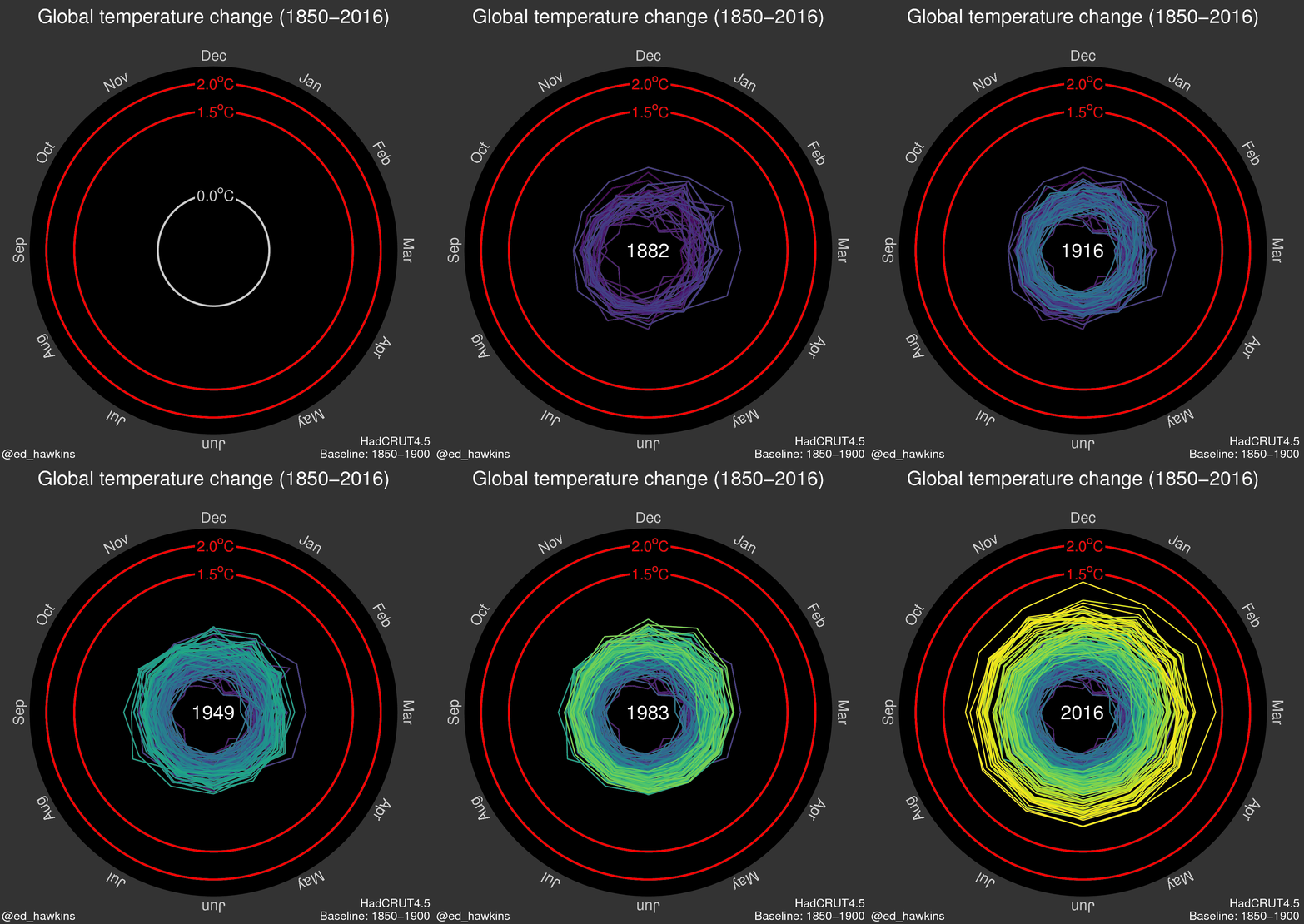
spiral_2016_large
Spiralling global temperatures from 1850-2016 (full animation) Ed Hawkins

The fact is, undoing Barack Obama’s 2015 Clean Power Plan, as Trump has recently done with the swipe of a pen, will produce only a limited environmental effect. Reactivating coal plants can be detrimental in the long run but coal is no longer competitive, so the move is impracticable and short-sighted.
But it sends a very negative signal to the world. The US is the world’s second-biggest producer of greenhouse gasses, and it had previously exercised decisive leadership in the COP process along with top-producer China. Considering the importance of American financial contributions to international bodies such as the secretariat of the UN climate action branch, the Green Climate Fund and the Inter-governmental Panel on Climate Change, American disengagement threatens to undermine this fragile and too-timid dynamic.
Coal will sink this ship. Stephan Schmidt
The individual commitments of states are insufficient to achieve the objectives they have collectively set themselves. The Paris Agreement contains the tools needed to push countries to progressively up the ante on their national contributions, but without political will they will likely go unheeded. And it is precisely this that the US is now undermining.
For the American economy and for the world, for environmental, health and economic reasons, for present and future generations, we must immediately repudiate coal. History will frown on you for doing otherwise, President Trump!

Joice Ferreira - Brazil alone cannot save the Amazon
The Brazilian Amazon – the largest rainforest in the world and a region of national, regional and global importance – already faces an existential threat from raging wildfires and extreme flooding engendered by climate change.
Further global warming may push the forest’s biome beyond the point of no return.
Given the importance of the 6.9 million km² the Amazon for biodiversity and ecosystem services, that would bring unprecedented problems not just to Brazil or the Amazon region but the entire world.
Deforestation has long threatened the Brazilian Amazon, now climate change-related flooding, fire and drought do too. Nacho Doce/Reuters
In the last decade, the Amazon has experienced three intense droughts (2005, 2010 and 2015), interspersed with extreme flooding events. The droughts saw rivers run dry, killing millions of fish and isolating rural communities that rely on rivers to get around.
On land, huge tracts of forests burned as never before. In 2015 alone, fire ravaged some 9,500 km² – an area the size of the US state of Vermont. Millions of people suffered severe impacts from those events, as they saw their livelihoods and health endangered, crops ruined, transportation imperilled, hydropower disabled. All this affects the wider general economy, of course.
Such changes can trigger cascading effects on the region. Droughts, for example, render the forest more vulnerable to fire; lack of rainfall also leads to a massive loss of carbon absorption capacity due to reduced plant growth and tree death. After the 2005 drought, for example, about five billion extra tonnes of carbon dioxide were emitted into the atmosphere.
A mural of the Amazon’s indigenous defenders. Nacho Doce/Reuters
The end of the seasonal monsoon rains that the Amazon generates across the region would spell disaster for South American breadbaskets such as Argentina and Brazil.
Brazil cannot deal with this global threat alone. We need strong action from developed countries in reducing greenhouse gas emissions, particularly from the United States.
Governments must take immediate measures to avoid further degradation of this delicate, critical biome. If the US reneges on its leadership and refuses to enforce environmental regulations and international agreements to curb climate change, the world will pay the price.

Links

Coral-Bleaching Database Puts Australia Second Worst In The World

ABC News - Annie Guest

Bleached and unbleached coral from Fiji (Supplied: Simon Donner)
Key points:
  • New database includes 80 per cent more reports of coral bleaching than existing databank
  • Links higher water temperatures to an eight-fold increase in the likelihood of bleaching
  • Before the 1990s there were few coral bleaching events
Scientists have compiled a new global database of coral reef mass-bleaching events that shows the likelihood of bleaching increased eight-fold from the late 1990s.
The new database includes 80 per cent more reports of coral bleaching than the existing databank, with Australia having the second-worst record.
It also demonstrates the relationship between higher water temperatures and bleaching.
The database was put together by three researchers from Canada and Australia who personally contacted scientists and divers from around the world, and trawled thousands of research papers to bring it together.
Simon Donner, climate scientist from the University of British Columbia and the lead author, said they had created the "most comprehensive historical database of reports of coral bleaching from around the world".
"The largest number of reports actually comes from the Caribbean, and part of that is due to the extensive bleaching event that happened in 2005 and then again in 2010," he said.
"After that the largest number of reports comes from Australia and the Great Barrier Reef."
Simon Donner, the lead author of the new global database. (Supplied)
The scientists' work, published in the journal Plos One, has almost doubled the existing database of mass coral-bleaching events around the world.
It has linked higher water temperatures to an eight-fold increase in the likelihood of bleaching from the late 1990s.
"There's so few records before even 1990 and that's not because there were no scientists studying reefs or that people weren't diving, it's because bleaching events were not happening very often," Professor Donner said.
"We have this database from time zero up to 1990 [and] there's only about 250 records — then after that there's another 7,000-plus."

Once vibrant reefs 'now graveyards'
The new database has been welcomed by the Australian Research Council Laureate Fellow, Professor Ove Hoegh-Guldberg from the University of Queensland.
"I'm personally very interested in that because it's an ability to get baseline and the amount of change," he said.
"And then hopefully identify areas that might be more robust than others to the climate change coming along.
"If we can identify those, we can then really focus our attention on making sure that they get through to the Paris agreement conditions — stabilise temperatures by mid-century.
"It's really important that we get this sort of information."
Professor Hoegh-Guldberg recently examined reefs around the Maldives Islands, after doing a baseline survey two years ago and said what he found was shocking.
"The amount of coral that's been lost across vast parts of that archipelago system — reefs that were vibrant, full of fish, full of coral, are now graveyards," he said.
"And, it's not just in one or two places, it's across most of the archipelago.
"It's a really serious indicator of this new climate regime that we seem to have entered."

Links

Saturday, April 29, 2017

CSIRO, Energy Networks Australia Lay Out Roadmap For Emissions-Free Future

ABC News - Louise Yaxley

The roadmap comes after two years of analysing Australia's electricity system. (Reuters: Jason Lee)
Key points:
  • Australia will need "stable and enduring carbon policy" to reach energy goals, Energy Networks Australia says
  • Roadmap says 25 new large-scale solar or wind farms will be needed in the next five years
  • Rooftop solar and battery storage will play key roles
Federal and state governments have been told Australia could generate electricity with no carbon emissions by 2050, but a carbon price will be needed to achieve that.
Energy Networks Australia and the CSIRO have spent two years analysing the future of the electricity system.
Their roadmap says a national energy plan with an emissions intensity scheme starting by 2020 should be part of a successful energy transition.
Energy Networks Australia's chief executive John Bradley said it would send the signals needed to drive a smooth shift to a reliable, low-cost and low-carbon energy.
"The carbon price and the certainty around carbon policy is certainly one of the things that has been identified in this process," Mr Bradley said.
"If we have stable and enduring carbon policy, which doesn't change at every election cycle, then we will see a lower cost of investment, whether that is large-scale renewables or … small-scale systems that households are investing in.
"We will see a more stable transition that keeps energy security at this critical time."
The report predicts about 25 new large-scale solar or wind farms will be needed in a five-year time frame to replace coal-fired power stations.
Mr Bradley said rooftop solar would also be a big contributor. He identified Queensland as a huge growth area.
"By 2030, there would be as much rooftop solar capacity on the system as there currently is coal-fired generation capacity," he said.
"Similarly, in New South Wales there's likely to be more rooftop solar capacity by 2030 than there is coal-fired generation in New South Wales today."

Batteries to play key role in transition
The report found part of the solution to the reliability problems with renewables would be to manage peak demand.
CSIRO chief economist Paul Graham said that could include rewarding people for using their batteries during times of peak demand.
"If you could turn your battery on at that time, that might save the grid some costs. That is the sort of signal we need," he said.
He pointed out it would also require new high-tech meters, "so the customer knows when their power demand is getting higher and they can pull that back".
Mr Bradley said batteries would also play a key role in eventually replacing coal-fired power generators.
"You could see very large-scale, grid-connected batteries playing a role as we are looking at in some parts of South Australia," he said.
"But you will also see this mass-market, take-up of residential and small customer battery storage."
He predicted there would be 760,000 residential batteries in Queensland by 2030 and over 2 million by 2050.
"So that is going to be a major integration challenge for the grid, but also a huge opportunity to avoid investment in other parts of the system," he said.

Links

Lethal Heating is a citizens' initiative