Monday, May 29, 2017

Scoop: Trump Tells Confidants U.S. Will Quit Paris Climate Deal

AXIOS - Jonathan Swan | Amy Harder

Evan Vucci / AP
President Trump has privately told multiple people, including EPA Administrator Scott Pruitt, that he plans to leave the Paris agreement on climate change, according to three sources with direct knowledge.
Publicly, Trump's position is that he has not made up his mind and when we asked the White House about these private comments, Director of Strategic Communications Hope Hicks said, "I think his tweet was clear. He will make a decision this week."

Why this matters
Pulling out of Paris is the biggest thing Trump could to do unravel Obama's climate policies. It also sends a stark and combative signal to the rest of the world that working with other nations on climate change isn't a priority to the Trump administration. And pulling out threatens to unravel the ambition of the entire deal, given how integral former President Obama was in making it come together in the first place.

Caveat
Although Trump made it clear during the campaign and in multiple conversations before his overseas trip that he favored withdrawal, he has been known to abruptly change his mind — and often floats notions to gauge the reaction of friends and aides. On the trip, he spent many hours with Ivanka Trump and Jared Kushner, powerful advisers who back the deal.

Behind-the-scenes
The mood inside the EPA this week has been one of nervous optimism. In a senior staff meeting earlier this week, Pruitt told aides he wanted them to pump the brakes on publicly lobbying for withdrawal from Paris.
  • Instead, the EPA staff are quietly working with outside supporters to place op eds favoring withdrawal from Paris.
  • The White House has told Pruitt to lay off doing TV appearances until Trump announces his decision on Paris. (In past weeks, the EPA Administrator has gone on TV to say the U.S. needs to quit Paris, but Pruitt told aides he'll be keeping a lower profile. He doesn't want a Paris withdrawal to be seen as his victory. "It needs to be the President's victory," one source said, paraphrasing what Pruitt has told aides.)
  • Pruitt's aides have told associates in recent days that they remain confident the President will withdraw from Paris but they've been worried about him being overseas and exposed to pressure from European leaders and the environmentalist views of his top aides like Ivanka and economic adviser Gary Cohn. Top EPA staff were relieved when Trump refused to join the other six nations of the G7 in reaffirming "strong commitment" to the Paris agreement.
One level deeper
If Trump follows through and announces publicly he plans to withdraw from the Paris deal, an administration official laid out three ways he could do that:
  1. Trump could announce he is pulling the U.S. from the deal, which would trigger a withdrawal process that wouldn't conclude until November 2020 at the earliest. Under the deal's terms, any country can't send notice of its intent to withdraw until three years after the deal entered into force, which was Nov. 4, 2016. The actual process of withdrawal would then take one year. In this time, it's feasible Trump could change his mind, the administration source said.
  2. Trump could declare that the Paris deal is actually a legal treaty that requires Senate approval. Such a vote would fail, and then Trump would have Senate backing to not abide by the deal, which he deems a treaty. A letter that 22 Senate Republicans, including Senate Majority Leader Mitch McConnell, sent to Trump this week urging him to withdraw from the deal, increases the odds of this happening, the source said. Trump could also call for a Senate vote in combination with either the first or third option.
  3. Trump could withdraw the U.S. from the treaty that underpins the Paris deal, which is called the United Nations Framework Convention on Climate Change. This would be the most extreme option because it would take the U.S. out of all global climate diplomacy. This process would take just one year.
Will we always have Paris?
All of these scenarios take more time and maneuvering than a simple announcement, which ensures the debate about what to do with the climate deal won't be over with any time soon.

Climate Change: Trump Keeps World Waiting On Paris Deal

BBC

Antonio Guterres: "The agreement doesn't collapse if a country leaves the agreement"

Donald Trump has said he will decide whether to pull out of a key climate change deal in the next week, having apparently shrugged off pressure from US allies in recent days.
The US president tweeted he would make his "final decision" on the Paris accord after his return to Washington.
Mr Trump left the G7 summit in Sicily on Saturday without reaffirming his commitment to the accord, unlike the other six world leaders in attendance.
He previously threatened to pull out.
Mr Trump, who has called climate change "a hoax" on occasion, has reportedly indicated this is still his position to key members of his inner circle.
The uncertainty over his position on the Paris agreement puts him at odds with other members of the G7.

What is the Paris accord?
The Paris deal is the world's first comprehensive climate agreement, set out in 2015, with the aim of keeping the global average rise in temperatures below 2C.
In order to do that, countries pledged to reduce their carbon emissions.
Barack Obama, pictured with Chinese President Xi Jinping during the Paris summit, signed the agreement in 2016. Reuters
But it came into force only after being ratified by 55 countries, which between them produce 55% of global carbon emissions.
Barack Obama signed the US up in September 2016, and members of the G7 are keen for the US to continue to back it, not least because the country is the second largest emitter of greenhouse gasses after China.

Why doesn't Donald Trump like the agreement?
Mr Trump told voters on the campaign trail he wanted to scrap agreements "contrary to the national interest", while repeatedly promising to strengthen the coal industry.
Coal power is a major contributor to carbon emissions. However, Mr Trump wants to boost coal production to create more jobs.
He has also expressed doubt about the causes of climate change, saying it is a "hoax" made up by China.

Will the US withdraw?
The Axios news site suggests Mr Trump is leaning that way currently, citing three sources who say his mind is made up, and that the wheels are quietly being put in motion behind the scenes.
This is despite US defence secretary James Mattis saying in an interview to air on Sunday that the president is now "wide open" on the issue.
Withdrawal would risk making Mr Trump unpopular not only with his allies abroad, but also with activists at home.
Mr Trump's attitude to climate change made discussions at the G7 "very difficult". AFP
It was noted his attitude to climate change was one of the major hurdles during the summit in Sicily - the first time he has met his fellow G7 leaders as a group.
His stance left him isolated, with Mr Trump's reluctance to reaffirm his commitment clearly annoying German chancellor Angela Merkel, who told reporters: "The entire discussion about climate was very difficult, if not to say very dissatisfying."

What would be the effect?
There are fears the US pulling out may lead to other, smaller countries following suit.
Even if they do not, as the US has such a large carbon footprint, it will mean the impact of the agreement will likely be lessened significantly.
Whatever the US chooses, the EU, India and China say they will stick to their pledges made in Paris.
And what's more, some of Mr Trump's own country is likely to ignore his scepticism.
New York and California have already pledged to combat climate change without the Trump administration's support.

Links

Scientists Explain What Will Happen If Donald Trump Pulls Out Of Paris Climate Change Agreement

The Independent - Seth Borenstein (Associated Press)

The Earth will get dangerously warm even sooner if the U.S pulls out of pledge to cut carbon dioxide pollution

Earth is likely to hit more dangerous levels of warming even sooner if the US pulls back from its pledge to cut carbon dioxide pollution, scientists said. That's because America contributes so much to rising temperatures.
President Donald Trump, who once proclaimed global warming a Chinese hoax, will soon decide whether the United States stays in or leaves a 2015 Paris climate change accord in which nearly every nation agreed to curb its greenhouse gas emissions.
Other global leaders have been urging him to stay during high level security and economic meetings in Italy that began Friday. Pope Francis already made the case with a gift of his papal encyclical on the environment when Trump visited the Vatican earlier this week.
In an attempt to understand what could happen to the planet if the U.S. pulls out of Paris, The Associated Press consulted with more than two dozen climate scientists and analysed a special computer model scenario designed to calculate potential effects.
Scientists said it would worsen an already bad problem, and make it far more difficult to prevent crossing a dangerous global temperature threshold.
Calculations suggest it could result in emissions of up to 3 billion tonnes of additional carbon dioxide in the air a year. When it adds up year after year, scientists said that is enough to melt ice sheets faster, raise seas higher and trigger more extreme weather.
"If we lag, the noose tightens," said Princeton University climate scientist Michael Oppenheimer, co-editor of the peer-reviewed journal Climatic Change.
Mr Trump has said he needs more to time to decide whether to pull out of the Paris climate change agreement (Evan Vucci/AP)
One expert group ran a worst-case computer simulation of what would happen if the U.S. does not curb emissions, but other nations do meet their targets. It found that America would add as much as half a degree of warming (0.3 degrees Celsius) to the globe by the end of century.
Scientists are split on how reasonable and likely that scenario is.
Many said because of cheap natural gas that displaces coal and growing adoption of renewable energy sources, it is unlikely that the U.S. would stop reducing its carbon pollution even if it abandoned the accord, so the effect would likely be smaller.
But others say it could be worse because other countries might follow a U.S. exit, leading to more emissions from both the U.S. and the rest.
Another computer simulation team put the effect of the U.S. pulling out somewhere between 0.1 to 0.2 degrees Celsius (.18 to .36 degrees Fahrenheit).
While scientists may disagree on the computer simulations they overwhelmingly agreed that the warming the planet is undergoing now would be faster and more intense.
The world without U.S. efforts would have a far more difficult time avoiding a dangerous threshold: keeping the planet from warming more than 2 degrees Celsius (3.6 degrees Fahrenheit) above pre-industrial levels.
The world has already warmed by just over half that amount — with about one-fifth of the past heat-trapping carbon dioxide emissions coming from the United States, usually from the burning of coal, oil and gas.
So the efforts are really about preventing another 1.6 degrees Fahrenheit (0.9 degrees Celsius) from now.
"Developed nations — particularly the U.S. and Europe — are responsible for the lion's share of past emissions, with China now playing a major role," said Rutgers University climate scientist Jennifer Francis. "This means Americans have caused a large fraction of the warming."
Even with the U.S. doing what it promised under the Paris agreement, the world is likely to pass that 2 degree mark, many scientists said.
But the fractions of additional degrees that the U.S. would contribute could mean passing the threshold faster, which could in turn mean "ecosystems being out of whack with the climate, trouble farming current crops and increasing shortages of food and water," said National Center for Atmospheric Research's Kevin Trenberth.
Climate Interactive, a team of scientists and computer modellers who track global emissions and pledges, simulated global emissions if every country but the U.S. reaches their individualised goals to curb carbon pollution. And then they calculated what that would mean in global temperature, sea level rise and ocean acidification using scientifically-accepted computer models.
By the year 2030, it would mean an extra 3 billion tonnes of carbon dioxide in the air a year, according to the Climate Interactive models, and by the end of the century 0.3 degrees Celsius of warming.
"The U.S. matters a great deal," said Climate Interactive co-director Andrew Jones. "That amount could make the difference between meeting the Paris limit of two degrees and missing it."
Climate Action Tracker, a competing computer simulation team, put the effect of the U.S. pulling out somewhere between 0.1 to 0.2 degrees Celsius (.18 to .36 Fahrenheit) by 2100. It uses a scenario where U.S. emissions flatten through the century, while Climate Interactive has them rising.
One of the few scientists who downplay the harm of the U.S. possibly leaving the agreement is John Schellnhuber, the director of the Potsdam Institute for Climate Impact Research and the scientist credited with coming up with the 2 degree goal.
"Ten years ago (a U.S. exit) would have shocked the planet," Schellnhuber said. "Today if the U.S. really chooses to leave the Paris agreement, the world will move on with building a clean and secure future."
Not so, said Texas Tech climate scientist Katharine Hayhoe: "There will be ripple effects from the United States' choices across the world."

Links

Sunday, May 28, 2017

Scientists Say The Pace Of Sea Level Rise Has Nearly Tripled Since 1990

Washington Post - Chris Mooney

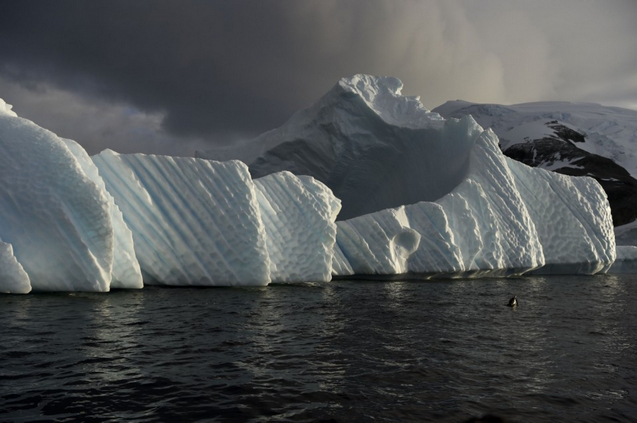
An iceberg is pictured in the western Antarctic peninsula in March 2016. (Eitan Abramovich/AFP/Getty Images)
A new scientific analysis finds that the Earth’s oceans are rising nearly three times as rapidly as they were throughout most of the 20th century, one of the strongest indications yet that a much feared trend of not just sea level rise, but its acceleration, is now underway.
“We have a much stronger acceleration in sea level rise than formerly thought,” said Sönke Dangendorf, a researcher with the University of Siegen in Germany who led the study along with scientists at institutions in Spain, France, Norway and the Netherlands.
Their paper, just out in the Proceedings of the National Academy of Sciences, isn’t the first to find that the rate of rising seas is itself increasing — but it finds a bigger rate of increase than in past studies. The new paper concludes that before 1990, oceans were rising at about 1.1 millimeters per year, or just 0.43 inches per decade. From 1993 through 2012, though, it finds that they rose at 3.1 millimeters per year, or 1.22 inches per decade.
The cause, said Dangendorf, is that sea level rise throughout much of the 20th century was driven by the melting of land-based glaciers and the expansion of seawater as it warms, but sea level rise in the 21st century has now, on top of that, added in major contributions from the ice sheets of Greenland and Antarctica.
“The sea level rise is now three times as fast as before 1990,” Dangendorf said.
Studying the changing rate of sea level rise is complicated by the fact that scientists only have a precise satellite record of its rate going back to the early 1990s. Before that, the records rely on tide gauges spread around the world in various locations.
But sea level rise varies widely in different places, due to the rising and sinking of land, large-scale gravitational effects on the waters of the globe and other local factors. So scientists have struggled to piece together a longer record that merges together what we know from satellites with these older sources of information.
The new study takes a crack at this problem by trying to piece together a sea level record for the 20th century, before the beginning of the satellite record, by adjusting the results of local tide gauges based on an understanding of the factors affecting sea level rise in a given region, and then also weighting different regions differently in the final analysis. That’s how it came up with a relatively small rate of sea level rise from 1900 through 1990, followed by a much faster one afterward.
Robert Kopp, a Rutgers University sea level researcher who has also published research showing a sharp acceleration of sea level rise, called the new study a “nice analysis” in an email to The Washington Post.
“Their final estimate of 20th century (particularly pre-1990) global mean sea level rise is in good agreement with the results of the two different analyses presented by [our] 2015 paper, and less than those of most other reconstructions,” Kopp said.
That 2015 study found that from 1901 to 1990, sea level rose at a rate of 1.2 millimeters per year, very close to the current study’s estimate. But other researchers have found figures more in the range of 1.6 to 1.9 millimeters.
These differences matter a great deal because the larger sea level rise was during the 20th century, the less of an increase there has been since then — and vice-versa.
Overall, though, the disparities between different studies — many of which point to an acceleration, but which vary upon its size — suggests that scientists have converged on the big picture but are still debating its details.
An acceleration of sea level rise, after all, is an expected consequence of ongoing global warming, and there are projections that it could rise as high as 5 to 15 millimeters per year (1.97 to 5.9 inches per decade) in extreme climate warming scenarios, according to Dangendorf.
Kopp added that in the past five years, there is some indication that sea level rise could already be even higher than the 3.1 millimeter annual rate seen from 1993 through 2012. He cautioned, though, that “those higher rates over a short period of time probably include some level of natural variability as well as continued, human-caused acceleration.”
Just how much control we are able to exert over the rate of sea level rise will critically depend on how rapidly global greenhouse gas emissions come down in coming years — making the entire outlook closely tied to whether the United States sticks with the rest of the world in honoring the Paris climate agreement.
“Sea levels will continue to rise over the coming century, no matter whether we will adapt or not, but I think we can limit at least a part of the sea level rise. It will further accelerate, but how much is related to how we act as humans,” Dangendorf said.

Links

Donald Trump Isolated On Climate Change In 'Intense' Exchange At G7 Summit

Fairfax - Arne Delfs | Margaret Talev (Bloomberg)

German Chancellor Angela Merkel said Donald Trump was isolated on climate change at the Group of Seven meeting on Friday, as the US president said he's in no rush to decide whether to scrap his country's involvement in the Paris Agreement.
A closed-door session on the first day of the G7 summit in Sicily found unity on stepping up efforts to combat terrorism, but entered stormier waters on trade and on climate, Mrs Merkel said. At that stage it was six against one as leaders pressed Trump to hold to US agreements made under the landmark Paris climate accord.

G7 summit braces for clash on trade, climate
US President Donald Trump's views on climate change are "evolving" following discussions with European leaders who are pushing for him to stay in the Paris climate accord.


"We made it clear that we want the US to stick to its commitments," Mrs Merkel told reporters after the meeting on Friday. "There were very different arguments from us all urging the president to hold to the climate accord." She said the discussion was conducted in a very "honest" atmosphere, leading to a "very intense exchange."
After deriding climate change as a hoax and pledging to pull out of the Paris deal during his election campaign, Mr Trump has sidestepped the issue and passed up an number of opportunities to outline his international stance toward global warming. Members of his administration are deadlocked about whether the US should uphold the pact.
Mrs Merkel said that the US side made clear that it hasn't yet taken a decision on whether to scrap Paris "and won't make a decision here" at the G7.

Taking time
In the meeting, G7 leaders asked Mr Trump his timeframe for making a decision, according to a briefing by his top economic adviser, Gary Cohn. Mr Trump said, "I'd rather take my time" and get to the right decision, Mr Cohn told reporters travelling with Mr Trump in Sicily.
Mr Trump also expressed concerns that other countries that had tried to dial back their climate emissions like China and India had seen job growth suffer - and made clear he was not prepared to live with that trade-off, Mr Cohn said.
Mr Trump told the leaders, "he didn't want to be in second place," Mr Cohn said, especially because he ran on a platform of job creation and improving working-and middle-class opportunities and is committed to keeping that promise, Mr Cohn said.
G7 leaders, from left, Canadian Prime Minister Justin Trudeau, German Chancellor Angela Merkel, President Donald Trump, and Italian Prime Minister Paolo Gentiloni. Photo: AP
Italian Prime Minister Paolo Gentiloni, the summit's host, said separately that there was "no agreement" on the Paris accord.
"President Trump will take time to reflect on it, and the other countries are taking note of that," Mr Gentiloni said.
G7 leaders met in Sicily on Friday to discuss trade, climate change, refugees and other issues.  Photo: Getty Images
"His views are evolving," Mr Cohn said, but Mr Trump's decision will be based on what's best for the United States. The president "is thinking about what his options are." Mr Trump "feels much more knowledgeable on the topic now," said Mr Cohn.

Pared down statement expected
Group of Seven leaders are preparing to sign off on a substantially pared-down statement at the close of their meeting, an indication of persisting divisions on climate change and trade.
Mr Trump and First Lady Melania, talk with Mr Trudeau as they arrive for a concert in the Sicilian citadel of Taormina. Photo: AP
The final communique - 32 pages last year - traditionally outlines the common positions of G7 leaders on the economy and other global issues requiring joint action by the world's leading powers. This year's statement is on pace to be one-third the length of last year's in Japan, according to three officials from delegations involved in the preparation.
Drafts of the communique as of Friday were due to address topics such as migration and gender equality. The "ongoing large-scale movement" of migrants and refugees calls for "coordinated efforts," according to a draft of the communique seen by Bloomberg News.
"We reaffirm the sovereign rights of states to control their own borders and set clear limits on net migration levels, as key elements of their national security and economic well-being," according to the draft.
The nations are also set to say gender equality is fundamental for human rights. The leaders also issued a separate statement on counter-terrorism efforts that called on social media companies to do more in the fight against terrorism.

Links

Governments Sued Over Climate Change, With Banks And Firms Next

New Scientist - Alice Klein

Climate-related cases are on the rise. Luke Sharrett/Bloomberg via Getty Images
If you can’t beat them, sue them. Citizens are increasingly taking governments to court over climate change inaction, with financial lenders – and possibly big firms – next in the firing line.
Some 894 climate change cases have now been filed in 24 countries, according to a report published last week by the United Nations Environment Programme and Columbia Law School’s Sabin Center for Climate Change Law in New York.
By some distance, most – 654 – have been in the US. Australia sits in second place, with 80 cases, and the UK third, with 49. The number of countries with climate cases has tripled since 2014.
Citizens have filed the vast majority of these cases against governments, with a handful lodged against fossil fuel companies.
Separately, campaign group ClientEarth has written to energy giants BP and Glencore warning them of the risk of investor lawsuits based on over-optimistic statements about future fossil fuel demand in their reporting.

Wins and losses
Recent years have seen significant wins for climate change cases. Environmental group Urgenda, for example, won a landmark case in 2015 that forced the Dutch government to commit to bigger emissions cuts. And in 2015, a Pakistani farmer successfully sued his government for failing to implement adequate climate change action.
Others have not had the same success. Last year, the Australian Conservation Foundation lost a legal battle over the Australian government’s approval of the Adani Carmichael coal megamine. And in the UK, fracking activists recently lost a case against a shale gas operation.
However, the success rate of climate cases is likely to grow following the Paris agreement, says the report. Under the accord, which was ratified late last year, each country is committed to specific emissions targets.
Although these commitments are not legally binding, they make it “possible for constituents to articulate more precisely and forcefully concerns about the gaps between current policy and the policy needed to achieve mitigation and adaptation objectives”, say the authors.
This is already starting to take effect. In March, EarthLife Africa successfully challenged the South African government’s approval of a new coal-fired power station. The high court decision was based partly on the country’s commitment to the Paris agreement.

Getting creative
Legal teams are also finding innovative ways to hold governments to account over climate change, says Brendan Sydes at Environmental Justice Australia. “There’s a whole international effort – a lot of energy and intellect is being poured into developing new legal remedies,” he says.
One example is in the US, where 21 youths have filed a case against the government for failing to safeguard their futures from dangerous climate change. Instead of appealing to environmental laws, the youths have invoked the “public trust doctrine” – an ancient principle holding that certain natural resources belong to everyone and must be protected by the state.
Banks and other financial institutions that lend money to fossil fuel projects may also find themselves the subject of legal action, Sydes says. There is an increasing recognition that directors who fail to consider climate risks could be liable for breaching their duty of due care and diligence, he says.
This is already causing some businesses to distance themselves from carbon-heavy investments, he adds. For example, Australia’s four major banks have all recently ruled out providing loans for construction of the Adani Carmichael mine. And worldwide, almost 700 institutions in 76 countries have committed to ending their investment in fossil fuel companies.
The growth of such litigation worldwide shows that many citizens hope courts can force governments and corporations to act on climate change, says Sydes. “People are increasingly turning to the courts to find duties and obligations of governments and corporations who are currently not acting sufficiently on climate change,” he says. “This trend is likely to continue.”

Links

Saturday, May 27, 2017

Great Barrier Reef 2050 Plan No Longer Achievable Due To Climate Change, Experts Say

The Guardian - 

Environmental lawyers say advice means reef might finally be listed as a ‘world heritage site in danger’

Coral bleaching: ‘We need to tell the truth without scaring reef tourists away’

The central aim of the government’s plan to protect the Great Barrier Reef is no longer achievable due to the dramatic impacts of climate change, experts have told the government’s advisory committees for the plan.
Environmental lawyers said the revelation could mean the Great Barrier Reef might finally be listed as a “world heritage site in danger”, a move the federal and Queensland governments have strenuously fought.
The federal and Queensland government’s Reef 2050 Long Term Sustainability Plan was released in 2015, with it’s central vision to “ensure the Great Barrier Reef continues to improve on its outstanding universal values”. The plan was created to satisfy the Unesco World Heritage Centre, which was considering adding the Great Barrier Reef to its list of world heritage sites in danger, that its condition could be improved.
But in a meeting of the Reef 2050 advisory committee, whose role is to provide advice to state and federal environment ministers on implementing the plan, two experts from government science agencies said improving the natural heritage values of the reef was no longer possible.
With climate change causing unprecedented back-to-back mass bleaching events in 2016 and 2017, killing almost half of the coral, and with the risk of those events set to increase in the coming years, loss of coral cover and biodiversity was virtually assured.
The experts told the meeting the plan should be revised to aim for something more achievable, suggesting it could aim to “maintain the ecological function” of the reef, while accepting that its overall health would inevitably decline.
The Great Barrier Reef serves many “ecological functions”. For example, the coral provides shelter and food for fish, it provides fish for humans, the various ecosystems provide experiences for tourists, and the reef structure itself provides protection to the coast from waves.
A spokeswoman for the Great Barrier Reef Marine Park Authority, where one of the presenters was based, said: “The concept of ‘maintaining ecological function’ refers to the balance of ecological processes necessary for the reef ecosystem as a whole to persist, but perhaps in a different form, noting the composition and structure may differ from what is currently seen today.”
Members of the advisory committee would only speak on the condition of anonymity, but several told the Guardian about the details of the discussion.
The view presented reflects that previously expressed by a group of scientists who called themselves the Great Barrier Reef Independent Review Group, some of whom sit on Reef 2050 advisory committees. In their review of the plan’s implementation, published in February, they said improving the heritage values of the reef, as it aimed to, was “no longer attainable for at least the next two decades”. That assessment was made before the latest mass bleaching.
The language was echoed in a communique from the Independent Expert Panel – another body advising on the implementation of the Reef 2050 plan – dated 5 May. The communique said: “There is great concern about the future of the reef, and the communities and businesses that depend on it, but hope still remains for maintaining ecological function over the coming decades.”
It continued: “Members agreed that in our lifetime and on our watch, substantial areas of the Great Barrier Reef and the surrounding ecosystems are experiencing major long-term damage which may be irreversible unless action is taken now.”
Both advisory bodies have recommended that the Reef 2050 plan must address climate change, the biggest threat to the reef, which it does not.
Brendan Sydes, a lawyer and CEO at Environmental Justice Australia, said the news should be a wake-up call, and could result in the reef being considered again by Unesco for inclusion on the in-danger list.
“There’s a real risk that this new information will cause a renewed scrutiny for what Australia is or is not doing to protect the reef – particularly around climate change,” Sydes said, adding that if the outstanding universal values continued to degrade, the very listing of the reef as a world heritage site at all could come into question. “That would be a tragic situation.”
Ove Hoegh-Guldberg, who sits on the Independent Expert Panel, declined to comment on discussions in the meetings. But he said the shock of what had happened in the past two years had made people reassess what was possible.
“We’re managing reefs in a rapidly changing world,” Hoegh-Guldberg said. “So managing to restore the reefs of the past – the way they were prior to the big insults of the 80s, 90s and 2000s ... maybe we need to be looking at this in a different sense. What are the key ecological functions? Essentially, what roles do they play that are important to humans?”
Decline of coral cover on the Great Barrier Reef
The decline of coral cover on the Great Barrier Reef due to crown-of- thorns starfish, cyclones, and bleaching
Guardian graphic | Source: De’ath et al. 2012
He said that idea had a similar “cold hard light of day” feel to his own “50 reefs” project, which aims to identify 50 reefs around the world that have the best chance of being saved – and which could one day potentially help repopulate other reefs.
Despite the advice, the federal environment minister, Josh Frydenberg, and the Queensland environment minister, Steven Miles, told the Guardian they remained committed to the aims of the Reef 2050 plan.
Frydenberg said: “The Turnbull government is firmly committed to protecting the Great Barrier Reef for future generations and delivering the Reef 2050 plan.
“The government has been clear from the outset that the Paris Climate Agreement is the place to deal with climate change.”
Miles said the purpose of the Reef 2050 plan was to “boost the health and resilience of the Great Barrier Reef, including in the face of climate change”.
Miles said the plan was intended to be reviewed, and the opportunity to do that would come in 2018.
But he also criticised the lack of action from the federal action on climate change. “Australia doesn’t currently have a policy to reduce greenhouse gas emissions and we need one,” he said. “For the sake of our reef, it’s time Malcolm Turnbull took his commitments from Paris seriously and introduced a real plan that will cap and reduce carbon pollution.”
Imogen Zethoven from the Australian Marine Conservation Society said: “Two years after the World Heritage Committee endorsed the Reef 2050 plan, the federal government appears to have conceded that the plan’s vision is unachievable.
“Climate change is the single biggest threat to our reef. Yet the government is aggressively backing the reef-wrecking Adani coalmine and its climate policies are shameful.”
Richard Leck, a campaigner at WWF, said the recent bleaching events, as well as Cyclone Debbie, showed that “the Great Barrier Reef is a system in crisis”.
“And the elephant in the room, that is not included in the plan, and Australia is not performing well on, is climate change,” Leck said. “Until Australia gets serious about playing its part in limiting emissions to 1.5C temperature rise, we are not taking saving the reef seriously.”

How did the Great Barrier Reef reach ‘terminal stage’?

Links

Lethal Heating is a citizens' initiative