Thursday, June 01, 2017

Climate Change Could Make Cities 8c Hotter – Scientists

The Guardian - Agence France-Presse

Combination of carbon emissions and 'urban heat island' effect of concrete and asphalt gives rise to worst-case scenario by end of 21st century
The median city stands to lose between 1.4 and 1.7% of GDP per year by 2050 due to climate change. Photograph: Anadolu Agency/Getty Images
Under a dual onslaught of global warming and localised urban heating, some of the world's cities may be as much as 8C (14.4F) warmer by 2100, researchers have warned.
Such a temperature spike would have dire consequences for the health of city-dwellers, rob companies and industries of able workers, and put pressure on already strained natural resources such as water.
The projection is based on the worst-case scenario assumption that emissions of greenhouse gases continue to rise throughout the 21st century.
The top quarter of most populated cities, in this scenario, could see temperatures rise 7C or more by century's end, said a study in the journal Nature Climate Change.
For some nearly 5C of the total would be attributed to average global warming.
The rest would be due to the so-called "urban heat island" effect, which occurs when parks, dams and lakes, which have a cooling effect, are replaced by concrete and asphalt – making cities warmer than their surrounds, the researchers said.
"The top 5% [of cities by population] could see increases in temperatures of about 8C and larger," study co-author Francisco Estrada of the Institute for Environmental Studies in the Netherlands said.
Estrada and a team used different projections of average planetary warming, combined with the UHI effect and potential harms, to estimate the future costs of warming on cities.
The median city, right in the middle of the range, stands to lose between 1.4% and 1.7% of GDP per year by 2050 and between 2.3% and 5.6% by 2100, they conclude.
"For the worst-off city, losses could reach up to 10.9% of GDP by 2100," wrote the team.
UHI "significantly" increased city temperatures and economic losses from global warming, they added.
This meant that local actions to reduce UHI – such as planting more trees or cooling roofs and pavements – could make a big difference in limiting warming and minimising costs.
Cities cover only about 1% of earth's surface but produce about 80% of gross world product and account for around 78% of energy consumed worldwide, say the researchers.
They produce more than 60% of global carbon dioxide emissions from burning coal, oil and gas for fuel.
The world's nations agreed in Paris in 2015 to the goal of limiting average global warming to two degrees centigrade over pre-industrial revolution levels by curbing greenhouse gas levels in the Earth's atmosphere.
For the latest study researchers used data from the world's 1,692 largest cities for the period 1950 to 2015.

Links

Climate Change: $4 Trillion Carbon Tax Is Needed To Save Humanity From Global Warming, Say Economists

The Independent - Ian Johnston

World Bank-backed report says revenue could be used in a number of ways, such as paying out household rebates, alleviating poverty and fostering low-carbon infrastructure
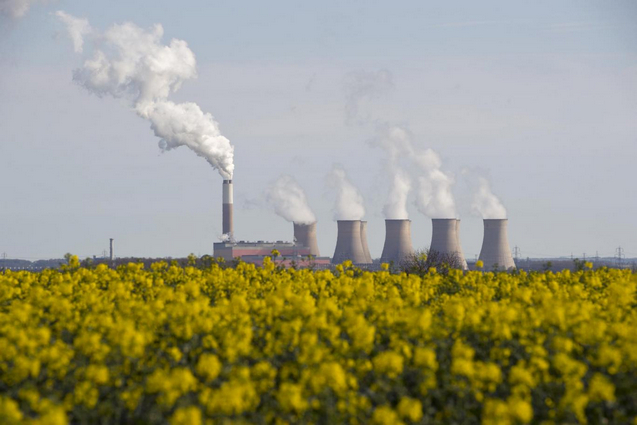
Cottam coal-fired power station in Nottinghamshire. AFP/Getty
A global carbon tax that would raise trillions of dollars if applied across the world should be introduced if the world is to avoid dangerous climate change, 13 leading economists have said in a new report.
Led by Professor Nicholas Stern, who produced the groundbreaking Stern Report in 2006, and Professor Joseph Stiglitz, who won the Nobel Prize for economics in 2001, the experts suggested a price for a tonne of carbon dioxide of $50 to $100 (£39-78) by 2030.
If implemented all over the world, the top price would raise about $4 trillion – more than the UK’s and Germany’s gross domestic products, but less than Japan’s – although the report suggested poorer countries might charge less.
Currently about 85 per cent of carbon dioxide emissions are not subject to a tax – while the fossil fuel sector receives subsidies of up to an estimated $5.3 trillion. The world’s largest carbon pricing scheme is in the EU, but it only charges about $6.70.
The High-Level Commission on Carbon Prices’ report, which was supported by the World Bank and France, said the money raised could be used in a variety of ways – such as making payments directly to citizens.
“The revenue can be used to foster growth in an equitable way, by returning the revenue as household rebates, supporting poorer sections of the population, managing transitional changes, investing in low-carbon infrastructure, and fostering technological change,” they said.
“Ensuring revenue neutrality via transfers and reductions in other taxes could be a policy option.”
And the benefits would not simply come from reducing the risk of global warming hitting two degrees Celsius above pre-industrial levels – the point at which scientists believe it will get particularly dangerous – with the economists highlighting the benefits of cleaner air, reduced congestion and healthier ecosystems.
The report described climate change as “an urgent and fundamental challenge”.
“The goal of stabilising the temperature increase well under 2C is largely motivated by concerns over the immense potential scale of economic, social, and ecological damages that could result from the failure to manage climate change effectively,” it said.
This would require the “large-scale transformation” of human activities, affecting electricity generation, industrial processes, heating and cooling, transportation, agriculture and the way we live in general.
“However, climate policies, if well designed and implemented, are consistent with growth, development, and poverty reduction,” the economists added.
“The transition to a low-carbon economy is potentially a powerful, attractive, and sustainable growth story, marked by higher resilience, more innovation, more liveable cities, robust agriculture, and stronger ecosystems.”
The report called for the world to start cutting state subsidies for oil, coal and gas.
“Reducing fossil fuel subsidies is another essential step toward carbon pricing – in effect, these subsidies are similar to a negative emissions price,” it said.
Amid a flood in Islampur, Jamalpur, Bangladesh, a woman on a raft searches for somewhere dry to take shelter. Bangladesh is one of the most vulnerable places in the world to sea level rise, which is expected to make tens of millions of people homeless by 2050. Probal Rashid
And the economists stressed the urgency of implementing their recommendations.
“As carbon-pricing mechanisms take time to develop, countries should begin doing so immediately,” they wrote.

Links

Federal Government Could Finance Coal-Fired Power Stations With Clean Energy Funding

ABC News - Tom Lowrey


Josh Frydenberg announced plans to amend the CEFC Act. (ABC News: Nick Haggarty)

New coal-fired power stations using 'clean coal' technology could be funded by the Clean Energy Finance Corporation (CEFC), under plans announced by the Federal Government. Energy Minister Josh Frydenberg has announced plans to amend the CEFC Act to allow investment in carbon capture and storage (CCS).
The technology involves capturing carbon dioxide from a power plant and burying it underground in a bid to reduce emissions.
The move has been met with immediate opposition from the Greens and a number of environment groups.
The CEFC was established to fund renewable energy, energy efficiency and low emissions technologies, and is not currently allowed to fund such projects.
Mr Frydenberg said CCS is "proven technology" than can help reduce Australia's emissions.
"Carbon capture and storage can reduce emissions by up to 90 per cent," he said.
"It will ensure that the Clean Energy Finance Corporation is technology neutral."

How does CCS work?
  • Carbon capture and storage (CCS) traps up to 90 per cent of carbon dioxide emissions produced from the use of fossil fuels
  • The carbon dioxide is then transported by pipeline or ship for storage
  • It is usually stored in an underground geological rock formation
  • The aim is to prevent large quantities of carbon dioxide entering the atmosphere
Source: The Carbon Capture and Storage Association

Mr Frydenberg said the rule change could potentially see the CEFC funding new coal-fired power stations.
"If you were to build a high-efficiency, low-emission coal-fired power station combined with CCS, that would absolutely be a project that could be funded," he said.
Mr Frydenberg said carbon capture and storage can help reduce Australia's emissions. (ABC News: William Rollo)
Government 'devising ways to get rid of CEFC'

Govt may fund coal power
Treasurer Scott Morrison says the Clean Energy Finance Corporation could be used to fund new clean coal power stations.

Rod Campbell from the Australia Institute said the move was simply an attempt to re-model the CEFC in the Government's desired image.
"After the Government couldn't get rid of the CEFC through the Senate, they've now slowly and quietly devised a bunch of other ways to get rid of the CEFC and turn it into a body that can invest in and promote fossil fuel use," he said.
"And here's one of the way that they're trying to do that."
Greens MP Adam Bandt said the party planned to fight the move.
"The Liberals are taking money out of renewable energy, and giving it to coal," he said.
"Only the Liberals would think that coal counts as a clean energy source."
Frydenberg optimistic on pushing changes through Senate

Why emissions reductions from
'clean coal' remain a pipe dream
There have been massive efforts to attain the holy grail of "clean coal", but the current reality is that it remains a dirty way to produce energy, writes Stephen Long.

The change will require the Government to negotiate an amendment through the Senate, but Mr Frydenberg said he was hopeful Labor will get behind it.
"I'm confident that the Labor Party, when they look themselves in the mirror, and say 'are we serious about reducing emissions', they will come to support our changes to the CEFC legislation to encourage CCS," he said.
"Because to not do that would be a betrayal of their former position on this issue."
Labor has previously indicated it is not the kind of legislation it would support.
Industry groups have welcomed the announcement, arguing the CEFC should be supporting all forms of emerging low-emission technologies, not just renewables.
Brad Page from the Global CCS Institute said it was a welcome development.
"One of the significant impediments to the adoption of CCS in Australia has been the difficulty in financing projects," he said.
"To put it onto a more level playing field with renewables is a sensible initiative."
Mr Page said it is important carbon capture and storage is not seen as solely coal technology.
"The potential to retrofit coal power stations is certainly there, but with increasing uptake of gas-fired power stations — we're going to need CCS on those, if we're going to meet our Paris and beyond climate change targets."

Links

Wednesday, May 31, 2017

Sky High Carbon Tax Needed To Avoid Catastrophic Global Warming, Say Experts

The Guardian - 

Leading economists, including Joseph Stiglitz and Nicholas Stern say taxes of $100 per metric ton could be needed by 2030
The aim of a steep tax on carbon would be essential to meet the targets set by the Cop21 Paris Agreement in 2015, the experts said. Photograph: Jasper Juinen/Bloomberg/Getty
A group of leading economists warned on Monday that the world risked catastrophic global warming in just 13 years unless countries ramped up taxes on carbon emissions to as much as $100 (£77) per metric ton.
Experts including Nobel Laureate Joseph Stiglitz and former World Bank chief economist Nicholas Stern said governments needed to move quickly to tackle polluting industries with a tax on carbon dioxide at $40-$80 per ton by 2020.
A tax of $100 a ton would be needed by 2030 as one of a series of measures to prevent a rise in global temperatures of 2C.
In a report by the High Level Commission on Carbon Prices, which is backed by the World Bank and the International Monetary Fund, they suggest poor countries could aim for a lower tax since their economies are more vulnerable.
The aim of a tax on carbon would be essential to meet the targets set by the Cop21 Paris Agreement in 2015, they said.
The call for action will sting European leaders, who have presided over a carbon trading scheme since 2005 that currently charges major polluters just €6 (£5.20) for every tonne of carbon they release into the atmosphere.
The European scheme, which issues carbon credits to firms that can be traded on a central exchange, has come under fire for allowing heavy energy users to avoid investments in new technology to cut their emissions.
Critics accuse officials of issuing too many credits and allowing the price to fall to a level that makes it cheaper to pollute than for companies to change their behaviour.
Stiglitz and Stern said prices should rise to $50-$100 by 2030 to give businesses and governments an incentive to lower emissions even when fossil fuels are cheap.
The Trump administration has rejected calls to introduce a carbon tax in the United States, saying it would cost jobs. Washington’s refusal to adopt a tax has deterred Brussels from moving to a more substantial charge on emissions, which would have the effect of increasing energy costs, at least in the short term, and imposing higher costs on European manufacturers.
The European Union’s Emissions Trading System (ETS) is the world’s biggest scheme for trading greenhouse gas emissions allowances. It covers some 11,000 power stations and industrial plants in 30 countries, whose carbon emissions make up almost 50% of Europe’s total.

Links

Queensland Says It Won't Play Any Role In Funding For Adani Project

The Guardian -  and AAP

Annastacia Palaszczuk says the Indian mining group will have to pay ‘every dollar’ of state royalties for the proposed mine
Queensland premier Annastacia Palaszczuk has announced that there will be no royalty holiday for the Adani Carmichael mine. Photograph: Dave Hunt/AAP
The Queensland government has announced it will not act as a “middle man” to funnel federal infrastructure funding to support the Adani Group’s proposed coalmine.
The premier, Annastacia Palaszczuk, has also confirmed the Indian mining group would have to pay “every dollar” of state royalties for the proposed mine, a significant departure from a previous deal to give the company a “royalties holiday”.
The state government on Saturday provided further detail on its financial support for the $16bn Carmichael coalmine in the Galilee basin.
Palaszczuk said her government would play no role in helping to facilitate a $1bn loan to Adani from the Northern Australian Infrastructure Facility – a federal government agency that hands out concessional loans for infrastructure development.
Adani is seeking the loan to build the rail link between its proposed mine site and the Abbot Point coal port.
The NAIF traditionally relies on state governments to administer such loans to the project proponents
The deputy premier, Jackie Trad, said the funding would now have to be provided and administered directly by the commonwealth.
“Our position is that the federal government should be funding Adani from the NAIF directly and not using Queensland as a middle man,” she said.
The new royalties scheme will allow the company to defer a proportion of its payments to the state government until the fifth year of the mine’s operation. But any deferred royalties would need to be paid back with interest, Palaszczuk said.
Palaszczuk and Trad would not give further details of the amount of royalties that could be deferred, or the rate of interest that Adani would be subject to, saying the details would be central to the government’s commercial negotiations with the company in coming days.
“But let me make it very clear, I am not going to budge from the decision that I have made, that we have made as a cabinet, because this is the best decision for Queenslanders,” Palaszczuk said.
“All royalties will be paid, and they will be paid with interest. That is our principle and that is the bottom line.”
Asked whether Adani was aware of the government’s new position, she responded: “They are now.”
The Queensland Conservation Council coordinator, Tim Seelig, welcomed the decisions by the state government.
“While we do not believe any new coal mines, including the Adani mine, should proceed given global warming trends and the imperative of carbon emissions reduction, we still welcome these announcements,” Seelig said.
“These are big, important decisions, consistent with previous election commitments.”
The announcement represents a significant departure from a previous deal reportedly struck with the company to cap its royalty payments, meaning Adani would only pay $2m annually over the first seven years of the mine’s operation, giving the miner a $320m loan.
That proposal had sparked internal tensions within the Labor party, led chiefly by Trad and the left faction, who argued the deal broke an election promise.
A cabinet meeting on Friday resolved to move away from any royalty holiday deal.
The Lock the Gate Alliance, an anti-mining group, has warned that the government, through its deferral of royalties, is still allowing Adani incentives using taxpayers’ money.
Its spokeswoman Carmel Flint told Guardian Australia on Saturday that the state government still appeared to be offering Adani a huge loan using taxpayers’ money.
The group has previously warned that the Adani and Glencore mines would be a “recipe for disaster” for food production and put 110,000 hectares of farmland at risk on the Western Downs.
“As far as we can see, there’s still a deferral, so they’ve changed their language, they’re calling it a deferral in royalties,” Flint said.
“It’s still a massive loan to Adani using taxpayers’ money,” she said.
Flint wanted to see the full detail of any deal with Adani on royalties, demanding that the government does not strike something in secret with the company.
The Australia Institute said, regardless of the announcement, the state government was still supporting new coalmines at a time of climate change and mass bleaching of the Great Barrier Reef.
“I think that’s the big picture, that a Labor government in a time of climate change is subsidising new coal,” Rod Campbell, the institute’s research director, told Guardian Australia.
“I’m just concerned that people will see this as some sort of win, or some sort of compromise, when in it’s not,” Campbell said.
Adani released a statement on Friday night saying it would “pay every cent of royalties”.
“Adani confirms again that it will pay every cent of royalties to the state as was always the case,” the company said.
It was quick to defer a decision on its final investment, set down for a board meeting on Monday, when the cabinet failed to follow through on the so-called “royalties holiday” deal this week.
Palaszczuk on Saturday denied there had been any backflip on the state government’s deal with Adani or that she had broken a promise to the company.
The Queensland Resources Council chief executive, Ian Macfarlane, told a Mackay audience earlier on Friday previous governments had burdened the industry through significant increases in royalties.
“It is vital that any changes to the state’s royalty system improve the competitiveness of the resources sector,” he said.
“Queensland’s royalty regime is uncompetitive by global standards so we look forward to seeing the government’s proposal.”
A ReachTel poll released on Friday showed significant opposition to the state government’s financial support for Adani.
A majority – 58.8 per cent – of the 1618 Queenslanders polled were either opposed or strongly opposed to such support.
The LNP leader, Tim Nicholls, criticised the government for delaying the mine’s go-ahead with its infighting, saying the last week had been marked by “crazy leaking” from all factions, and he doubted the hardline stance would stick next week.
“[It’s] a party that’s at war with itself, a government that can’t come up with a policy on Friday and stick to it by Monday,” he said.

Links

Australians Say Climate Change Is Catastrophic Risk, Even As Government Turns Blind Eye

RenewEconomy -  (Climate Code Red)

Three in four Australians understand that climate warming poses a “catastrophic risk,” even as the Australian government turns a blind eye. That was the clear result from a new survey for the Global Challenges Forum (GCF), and the publications of its 2017 Global Catastrophic Risk report.
84% of 8000 people surveyed in eight countries for the GCF consider climate change a “global catastrophic risk”. The figure for the Australian sample was 75%.
Question were asked about a number of risks, including nuclear war, pandemics, biological weapons, climate change and environmental collapse. The climate question asked how much participants agreed or disagreed that “climate change, resulting in environmental damage, such as rising sea levels or melting of icecaps” could be considered as a global catastrophic risk”? A global catastrophic risk was described as “a future event that has the potential to affect 10% of the global population”.
For Australia, the results were: 39% “strongly agree” and 36% “tend to agree” (for total agree of 75%), whilst “tend to disagree” was 15%, “strongly disagree” was 6% and “don’t know” was 4%.
The  2017 Global Catastrophic Risk report summarises the the evidence for catastrophic climate change risk as:
Discussions of climate change usually focus on limiting temperature rises to 1-3˚C above pre-industrial levels. A rise of 3ºC would have major impacts, with most of Bangladesh and Florida under water, major coastal cities – Shanghai, Lagos, Mumbai – swamped, and potentially large flows of climate refugees. While the 2015 Paris Agreement on climate change sought to keep global temperature rises below a threshold of 1.5–2 º C, national pledges have fallen short and set the world on a 3.6°C temperature rise track. There is also now scientific consensus that, when warming rises above a certain level, self-reinforcing feedback loops are likely to set in, triggered by the pushing of the Earth’s systems – ocean circulation, permafrost, ice sheets, rainforests and atmospheric circulation – across certain tipping points. The latest science shows that tipping points with potential to cause catastrophic climate change could be triggered at 2ºC global warming. These include the risk of losing all coral reef systems on Earth and irreversible melting of inland glaciers, Arctic sea ice and potentially the Greenland ice sheet. As well as the immediate risk to human societies, the fear is that crossing these tipping points would have major impacts on the pace of global warming itself. Although climate change action has now become part of mainstream economic and social strategies, too little emphasis is put on the risk of catastrophic climate change.
The same survey found 81% of the 1000 Australian participants in the poll agreed with the proposition: “Do you think we should try to prevent climate catastrophes, which might not occur for several decades or centuries, even if it requires making considerable changes that impact on our current living standards?” The figure across the 8000 people polled in eight countries (Australia, China, India, Brazil, South Africa, UK, Germany and USA) was 88%.
This shows a much strongly level of support for action that may impact on future living standards or have a personal material  cost that many other polls. This may be in part due to the framing of climate as a possibly catastrophic risk, which may provides a stronger basis for concern.
The GCF report found that many people now see climate change as a bigger threat than other concerns such as epidemics, population growth, use of weapons of mass destruction and the rise of artificial intelligence threats. GCF vice-president Mats Andersson says “there’s certainly a huge gap between what people expect from politicians and what politicians are doing”.
The report says that:
For the first time in human history, we have reached a level of scientific knowledge that allows us to develop an enlightened relationship to risks of catastrophic magnitude. Not only can we foresee many of the challenges ahead, but we are in a position to identify what needs to be done in order to mitigate or even eliminate some of those risks. Our enlightened status, however, also requires that we consider our own role in creating those risks, and collectively commit to reducing them.
However, “the institutions we rely on to ensure peace, security, development and environmental integrity are woefully inadequate for the scale of the challenges at hand”.
The dissonance between what Australian’s understand and what government is doing is remarkable. Australia is failing in its responsibility to safeguard its people and protect their way of life. It is also failing as a world citizen, by downplaying the profound global impacts of climate change and shirking its responsibility to act.
Australia’s per capita greenhouse emissions are in the highest rank in the world, and its commitment to reduce emissions are rated as inadequate by Climate Action Tracker, which says that “Australia’s current policies will fall well short of meeting” its Paris Agreement target, that the Emissions Reduction Fund “does not set Australia on a path that would meet its targets” and “without accelerating climate action and additional policies, Australia will miss its 2030 target by a large margin”.
Australia’s biggest corporations are no better. The S&P/ASX All Australian 50 has the “highest embedded carbon” of any group in the S&P Global 1200, according to the S&P Dow Jones Carbon Scorecard report, which assesses global companies’ carbon footprint, fossil fuel reserve emissions, coal revenue exposure, energy transition and green-brown revenue strain (Investor Daily 2017). At the 2017 Santos annual general meeting, chairman Peter Coates asserted that it is “sensible” and “consistent with good value” to assume for planning purposes a 4°C-warmer world.
AAP Image/Dean Lewins, File
Former senior fossil fuel industry executive Ian Dunlop has recently noted that the most dangerous aspect of fossil-fuel investments made today is that their impacts do not manifest themselves for decades to come. If we wait for catastrophe to happen — as we are doing — it will be too late to act. Time is the most important commodity; to avoid catastrophic outcomes requires emergency action to force the pace of change. In these circumstances, opening up a major new coal province is nothing less than a crime against humanity.

Links

Tuesday, May 30, 2017

Loan Bodies’ Adani Conflicts: Answers Needed

Environmental Justice Australia


Environmental Justice Australia lawyers have written to the Northern Australian Infrastructure Facility (NAIF) – the body that is considering giving a $1 billion loan for a coal-carting rail line to service Adani’s Carmichael mine – seeking answers about board members’ conflict of interests.

The letter, on behalf of the Australian Conservation Foundation, raises concerns about:
  • Ms Karla Way-McPhail, a NAIF board member who is also the CEO of Undamine and Coal Train Australia – companies that profit by hiring labour and machinery to coal mining operations 
  • Ms Annabelle Chaplain, a director of the Export Finance and Insurance Corporation (EFIC), which advises NAIF, is an independent non-executive director of Downer EDI, a company that has an existing commercial relationship with Adani Enterprises, the ultimate proponent of the mine
In July 2016 Downer EDI signed a Technical Services Agreement with Adani Enterprises Ltd for the provision of mine planning, design and project execution services for Adani coal mines in India.
“While it is not uncommon for directors to hold more than one directorship, if a perceived or actual conflict of interests arises, directors must act to avoid conflict,” said EJA lawyer David Barnden.
“Ms Karla Way-McPhail is on the NAIF board and is the CEO of two companies involved in the Queensland coal industry.
“Ms Annabelle Chaplain, an EFIC Board member who advises NAIF, is also a non-executive director of Downer EDI, a company with a significant existing commercial relationship with Adani.
“In our view Ms Way-McPhail and Ms Chaplain each have material personal interests that could give rise to a conflict of interests, making it inappropriate for them to be involved in the consideration of a huge public subsidy to a coal-rail project.”
The Australian Conservation Foundation’s Dirty Deeds report last week exposed links between the fossil fuel industry, the government, NAIF and EFIC.
“EFIC has a track record of investing in large fossil fuel projects, backing fossil fuels over renewables at a rate of more than 100:1 over the past 11 years,” said ACF CEO Kelly O’Shanassy.
“NAIF’s board is skewed toward the mining industry and lacks experience with industries such as communications and renewable energy which are critical to the development of Northern Australia.
“Australians want public money to support industries that will create a positive future for Northern Australia – like renewable energy and tourism – not destructive, reef-wrecking coal mines,” she said.

Links

Lethal Heating is a citizens' initiative