Friday, July 14, 2017

'The Island Is Being Eaten': How Climate Change Is Threatening The Torres Strait

The Guardian -  |

In Boigu, part of Australia but just six kilometres from Papua New Guinea, roads are being washed into the sea
Joseph Billy says his community is losing land to climate change every year. Photograph: Brian Cassey/Oxfam Australia
Torres Strait residents face being forced from their homes by climate change, as their islands are lost to rising seas.
On Boigu Island, the most northerly inhabited island in Australia, just six kilometres from Papua New Guinea, the community's cemetery faces inundation and roads are being washed into the sea. A seawall installed to protect the community is already failing.
Boigu elder Dennis Gibuma says the situation is worsening every season.
Every year I have moved my shed back from the beach another few metres.
Fisherman Joseph Billy
"Our seawall is no longer any good," he says. "When the high tide and strong winds come together, it breaks. We pray we don't lose our homes. We don't want to leave this place."
Masig Island, to the south-east of Boigu, is less than three kilometres long, and just 800m across at its widest point. Also known as Yorke Island, the low-lying coral cay is steadily being lost to the waves.
"The island is being eaten," says Songhi Billy, an engineering officer on Masig. "This is a big issue. I kind of feel hopeless in a sense. Our land is part of us.
"In the short term, we can do what we can. We can't stop the erosion, our hope is to slow it down."
But he says he has to face the possibility that his people may have to abandon their ancestral home.
"Long term, we may have to evacuate the island," he says. "But I am not going. Slowly, I see Masig Island getting out of something I can control."
Fisherman Joseph Billy says his community is losing land every year.
"Last five year, every year, I have moved my shed back from the beach another few metres. We used to have a road that went all around the island but now it is broken. We will lose our land eventually."
Sea levels around the world are expected to rise between 75cm and 1.5m by the end of the century, depending on greenhouse gas emissions. According to the Australian Department of Environment and Energy, a rise of just 50cm would increase the risk of flooding around Australia by 300 times – making a once a century flood likely to occur several times a year. In some areas of Australia, flooding risk would rise much more – up to 10,000 times.
The precise sea level rise around the Torres Strait, and the projected inundation, has not been calculated but low-lying islands are expected to experience a much greater flooding risk than mainland Australia. The department identifies the remote islands of the Torres Strait as some of the most vulnerable, as does the Intergovernmental Panel on Climate Change (IPCC), which warns communities they may be forced to relocate.
Boigu Island, where the community's cemetery faces inundation and a seawall installed to protect the community is already failing. Photograph: Brian Cassey/Oxfam Australia
The chief executive of Oxfam Australia, Helen Szoke, who visited the Torres Strait at the invitation of the Torres council mayor, Vonda Malone, says the people of the strait have contributed almost nothing to the causes of climate change but are being "hit first and hardest by its impacts".
"The islands face a combination of risks including coastal erosion and inundation from rising seas, damage to the critical marine ecosystems on which their livelihoods depend, higher temperatures and shifting rainfall. Roads are being washed away and seawalls cannot protect communities from flooding."
The "strong, flourishing communities" of the Torres Strait have a powerful connection to their land and sea country, Szoke says.
"The gravest fear among community members is the loss of their connection to land and culture if they are faced with the last resort – being forced to leave their islands. The longer-term challenges, including the threat of eventually being forced from their land, are complex and extremely confronting for communities with such a deep connection to their islands."
We have been advocating for years but it just does not seem to get enough attention.
Vonda Malone, Torres Strait mayor
Malone says leaving the islands is a last resort and the people of the Torres Strait want to do everything possible to remain.
"These communities are facing ongoing challenges in retaining their foreshore and their gathering places – this is their land and the land of their ancestors. These communities are seeing their land washed away. We have been advocating for years but it just does not seem to get enough attention."
Malone says while some funding for climate change adaptation is filtering through, there were few resources to address the social impacts of potential dislocation.
"There is a feeling of hopelessness as communities do not know where this is going to lead to," Malone says.
Displacement caused by climate change is forecast to be a driver of massive forced migration movements in the 21st century.
Low-lying islands in the Pacific – and Torres Strait islands like Masig and Boigu – are likely to be at the forefront of forced displacement but large and densely populated countries such as Bangladesh also face widespread inundation.
Some forecasts have predicted up to 150 million people could be forcibly displaced by climate change by 2040 – larger than the record number of people already forced from their homes globally.
The US and other militaries have said that climate change poses the greatest security threat to the Asia-Pacific.
But the global legal framework for resettling people displaced from their homes lost to natural disasters or climate change is unclear. The refugee convention – established in 1951 to regularise the resettlement of those displaced by the second world war – does not recognise someone forced from their home by rising seas, or natural disaster, as requiring protection.
Already, more than a dozen Pacific Islanders have attempted to claim refugee status in New Zealand on the grounds that their homes are uninhabitable because of rising seas or climate-related disaster. All have had their claims rejected.
On Masig Island, Hilda Mosby says climate change is already affecting the marine ecosystems on which communities depend for their livelihoods. Climate change is already affecting her community "big time", she says.
But the greater existential threat for her home lies ahead.
"When we talk about relocation, it is clear this is very much a last resort," Mosby says. "This is our home. No one is willing to leave, to lose their cultural ties, the loved ones they have laid to rest here. We want to try everything to keep our community here."

Links

I’ve Studied Larsen C And Its Giant Iceberg For Years – It’s Not A Simple Story Of Climate Change

The Conversation - 

NASA / John Sonntag
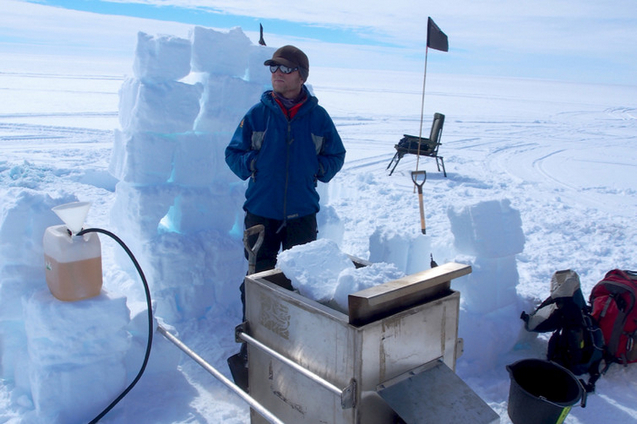
One of the largest icebergs ever recorded has just broken away from the Larsen C Ice Shelf in Antarctica. Over the past few years I’ve led a team that has been studying this ice shelf and monitoring change. We spent many weeks camped on the ice investigating melt ponds and their impact – and struggling to avoid sunburn thanks to the thin ozone layer. Our main approach, however, is to use satellites to keep an eye on things.

The iceberg would barely fit inside Wales. Adrian Luckman / MIDAS, Author provided
The ice shelves of the Antarctic peninsula. Note Larsen A and B have largely disappeared. AJ Cook & DG Vaughan, 2014, CC BY-SA
We’ve been surprised by the level of interest in what may simply be a rare but natural occurrence. Because, despite the media and public fascination, the Larsen C rift and iceberg “calving” is not a warning of imminent sea level rise, and any link to climate change is far from straightforward. This event is, however, a spectacular episode in the recent history of Antarctica’s ice shelves, involving forces beyond the human scale, in a place where few of us have been, and one which will fundamentally change the geography of this region.
Ice shelves are found where glaciers meet the ocean and the climate is cold enough to sustain the ice as it goes afloat. Located mostly around Antarctica, these floating platforms of ice a few hundred meters thick form natural barriers which slow the flow of glaciers into the ocean and thereby regulate sea level rise. In a warming world, ice shelves are of particular scientific interest because they are susceptible both to atmospheric warming from above and ocean warming from below.
Back in the 1890s, a Norwegian explorer named Carl Anton Larsen sailed south down the Antarctic Peninsula, a 1,000km long branch of the continent that points towards South America. Along the east coast he discovered the huge ice shelf which took his name.
For the following century, the shelf, or what we now know to be a set of distinct shelves – Larsen A, B, C and D – remained fairly stable. However the sudden disintegrations of Larsen A and B in 1995 and 2002 respectively, and the ongoing speed-up of glaciers which fed them, focused scientific interest on their much larger neighbour, Larsen C, the fourth biggest ice shelf in Antarctica.
The author prepares to assist his colleague, Bryn Hubbard from Aberystwyth University, in drilling a borehole in Larsen C using pressurised hot water. MIDAS, Author provided
This is why colleagues and I set out in 2014 to study the role of surface melt on the stability of this ice shelf. Not long into the project, the discovery by our colleague, Daniela Jansen, of a rift growing rapidly through Larsen C, immediately gave us something equally significant to investigate.

Nature at work
The development of rifts and the calving of icebergs is part of the natural cycle of an ice shelf. What makes this iceberg unusual is its size – at around 5,800 km² it’s the size of a small US state. There is also the concern that what remains of Larsen C will be susceptible to the same fate as Larsen B, and collapse almost entirely.
Larsen B once extended hundreds of kilometres over the ocean. Today, one of its glaciers runs straight into the sea. Armin Rose / shutterstock
Our work has highlighted significant similarities between the previous behaviour of Larsen B and current developments at Larsen C, and we have shown that stability may be compromised. Others, however, are confident that Larsen C will remain stable.
What is not disputed by scientists is that it will take many years to know what will happen to the remainder of Larsen C as it begins to adapt to its new shape, and as the iceberg gradually drifts away and breaks up. There will certainly be no imminent collapse, and unquestionably no direct effect on sea level because the iceberg is already afloat and displacing its own weight in seawater.
VIDEO LINK
This means that, despite much speculation, we would have to look years into the future for ice from Larsen C to contribute significantly to sea level rise. In 1995 Larsen B underwent a similar calving event. However, it took a further seven years of gradual erosion of the ice-front before the ice shelf became unstable enough to collapse, and glaciers held back by it were able to speed up, and even then the collapse process may have depended on the presence of surface melt ponds.
VIDEO LINK
Even if the remaining part of Larsen C were to eventually collapse, many years into the future, the potential sea level rise is quite modest. Taking into account only the catchments of glaciers flowing into Larsen C, the total, even after decades, will probably be less than a centimetre.

Is this a climate change signal?
This event has also been widely but over-simplistically linked to climate change. This is not surprising because notable changes in the earth’s glaciers and ice sheets are normally associated with rising environmental temperatures. The collapses of Larsen A and B have previously been linked to regional warming, and the iceberg calving will leave Larsen C at its most retreated position in records going back over a hundred years.
However, in satellite images from the 1980s, the rift was already clearly a long-established feature, and there is no direct evidence to link its recent growth to either atmospheric warming, which is not felt deep enough within the ice shelf, or ocean warming, which is an unlikely source of change given that most of Larsen C has recently been thickening. It is probably too early to blame this event directly on human-generated climate change.

Links

Iceberg Twice Size Of Luxembourg Breaks Off Antarctic Ice Shelf

The Guardian - 

Satellite data confirms 'calving' of trillion-tonne, 5,800 sq km iceberg from the Larsen C ice shelf, dramatically altering the landscape

Vast iceberg splits from Antarctic ice shelf

A giant iceberg twice the size of Luxembourg has broken off an ice shelf on the Antarctic peninsula and is now adrift in the Weddell Sea.
Reported to be "hanging by a thread" last month, the trillion-tonne iceberg was found to have split off from the Larsen C segment of the Larsen ice shelf on Wednesday morning after scientists examined the latest satellite data from the area.
The Larsen C ice shelf is more than 12% smaller in area than before the iceberg broke off – or "calved" – an event that researchers say has changed the landscape of the Antarctic peninsula and left the Larsen C ice shelf at its lowest extent ever recorded.

The Larsen C ice shelf has released an enormous iceberg
Guardian graphic | Image: Earth Observatory, 17 June 2017, data: Adrian Luckman (Swansea University), modified Copernicus Sentinel data
"It is a really major event in terms of the size of the ice tablet that we've got now drifting away," said Anna Hogg, an expert in satellite observations of glaciers from the University of Leeds.
At 5,800 sq km the new iceberg, expected to be dubbed A68, is half as big as the record-holding iceberg B-15 which split off from the Ross ice shelf in the year 2000, but it is nonetheless believed to be among the 10 largest icebergs ever recorded.
The huge crack that spawned the new iceberg grew over a period of years, but between 25 May and 31 May alone, the rift grew by 17km – the largest increase since January. Between the 24 June and 27 June the movement of the ice sped up, reaching a rate of more than 10 metres per day for the already-severed section.
But in the end it wasn't a simple break – data collected just days before the iceberg calved revealed that the rift had branched multiple times. "We see one large [iceberg] for now. It is likely that this will break into smaller pieces as time goes by," said Adrian Luckman, professor of glaciology at Swansea University and leader of the UK's Midas project which is focused on the state of the ice shelf.
Unlike thin layers of sea ice, ice shelves are floating masses of ice, hundreds of metres thick, which are attached to huge, grounded ice sheets. These ice shelves act like buttresses, holding back and slowing down the movement into the sea of the glaciers that feed them.
"There is enough ice in Antarctica that if it all melted, or even just flowed into the ocean, sea levels [would] rise by 60 metres," said Martin Siegert, professor of geosciences at Imperial College London and co-director of the Grantham Institute for Climate Change & Environment. But while the birth of the huge iceberg might look dramatic, experts say it will not itself result in sea level rises. "It's like your ice cube in your gin and tonic – it is already floating and if it melts it doesn't change the volume of water in the glass by very much at all," said Hogg.
Following the collapse of the more northerly Larsen A ice shelf in 1995 and Larsen B in 2002, all eyes have turned to Larsen C.
But Siegert is quick to point out that the calving of the new iceberg is not a sign that the ice shelf is about to disintegrate, stressing that ice shelves naturally break up as they extend further out into the ocean. "I am not unduly concerned about it – it is not the first mega iceberg ever to have formed," he said.
Andrew Shepherd, professor of Earth Observation at the University of Leeds, agreed. "Everyone loves a good iceberg, and this one is a corker," he said. "But despite keeping us waiting for so long, I'm pretty sure that Antarctica won't be shedding a tear when it's gone because the continent loses plenty of its ice this way each year, and so it's really just business as usual!"
Luckman said that while the Larsen C ice shelf might continue to shed icebergs, it might regrow. Nevertheless previous research by the team has suggested that the remaining ice shelf is likely less stable now that the iceberg has calved, although it is unlikely the event would have any short-term effects. "We will have to wait years or decades to know what will happen to the remainder of Larsen C," he said, pointing out that it took seven years after the release of a large iceberg from Larsen B before the ice shelf became unstable and disintegrated.
What's more, Luckman stressed that while large melt ponds were seen on Larsen B prior to its collapse - features which are thought to have affected the structure of the ice shelf - those seen on Larsen C are far smaller and are not even present at this time of year.
And while climate change is accepted to have played a role in the wholesale disintegration of the Larsen A and Larsen B ice shelves, Luckman emphasised that there is no evidence that the calving of the giant iceberg is linked to such processes.
Twila Moon, a glacier expert at the US National Ice and Snow Data Center agrees but, she said, climate change could have made the situation more likely.
"Certainly the changes that we see on ice shelves, such as thinning because of warmer ocean waters, are the sort [of changes] that are going to make it easier for these events to happen," she said.
Luckman is not convinced. "It is a possibility, but recent data from the Scripps Institute of Oceanography actually show most of the shelf thickening," he said.
The progress of the rift, and the loss of the iceberg, has been carefully followed by analysis of radar images from the European Space Agency's Sentinel-1 mission, which provides data from the region every six days.
"Before we would have been lucky if we had got one satellite image a year of an event like this, so we would not have been able to watch it unfold," said Hogg, pointing out that the radar system allows data to be collected whatever the weather and in the dark, while technological advances mean more data that can be downloaded than for previous satellites.
IMAGE
The news of the giant iceberg comes after US president Donald Trump announced that the US will be withdrawing from the 2015 Paris climate accord – an agreement signed by more than 190 countries to tackle global warming. "Truly I am dismayed," said Moon of the move.
Now at the mercy of the ocean currents, the newly calved iceberg could last for decades, depending on whether it enters warmer waters or bumps into other icebergs or ice shelves.

Links

Thursday, July 13, 2017

How Environmentalists Can Regroup For The Trump Era

The Conversation - *

Environmentalists are not fans of EPA chief Scott Pruitt. Reuters/Mike Theiler
Since taking office, President Donald Trump has launched an all-out assault on regulations that protect the environment. In addition to retreating from the Paris climate accord, he wants to slash the Environmental Protection Agency’s budget by more than 30 percent and he has issued executive orders instructing EPA Administrator Scott Pruitt to roll back or bypass clean air and clean water rules.
Pruitt has enthusiastically championed these initiatives by seeking to suspend and eventually repeal many Obama-era regulations. Six states and several nonprofits are suing the EPA over its choice to backtrack on a decision to ban chlorpyrifos, a pesticide.
EPA chief Scott Pruitt is following in the footsteps of Anne Gorsuch, one of the people who held that job during the Reagan administration. AP Photo/John Duricka
As an environmental law professor who has worked for the federal government and a leading green nonprofit group, I believe there are lessons to draw on from similar anti-environmental initiatives during the administrations of Ronald Reagan and George W. Bush.

Enforce speed limits
First, environmentalists must ensure that Trump’s agencies follow proper legal procedures before suspending or revoking these regulations. Although federal agencies have considerable discretion to make regulatory changes, rules that were the product of years of careful study and deliberation cannot legally be suspended overnight.
When Reagan’s EPA announced indefinite suspensions of environmental regulations, the courts ruled in the Environmental Defense Fund, Inc. v. Gorsuch case that it was illegal to do so without first providing notice and an opportunity for public comment. (The Gorsuch in question was then-EPA Administrator Anne Gorsuch, the newest Supreme Court justice’s late mother.)
Citing this decision, a federal court has ruled that Scott Pruitt acted illegally when, apparently at the behest of the industries with the most at stake, he suspended a regulation requiring new oil and gas operations to monitor for leaks of methane, a potent greenhouse gas. The U.S. Court of Appeals for the District of Columbia found that Pruitt’s action was “unauthorized” by the Clean Air Act, “unreasonable,” “arbitrary, capricious” and “in excess of statutory authority.”
Although Pruitt claims to champion states’ rights, his concerns seem to extend only to giving states the right to weaken environmental standards. He has threatened to block California’s program to adopt stronger environmental protections than required by federal law (but apparently has backed down).

Ensure that agencies follow the law
Second, whenever the government changes regulations, the courts must ensure that the new or revised rules still comply with all underlying environmental laws. And the nation’s environmental laws, enacted by overwhelming bipartisan majorities in Congress, mandate the protection of public health and the environment – by the EPA.
When George W. Bush’s administration claimed that the Clean Air Act couldn’t be used to regulate greenhouse gas emissions, the Supreme Court disagreed. In its landmark Massachusetts v. EPA decision, the court found that EPA not only had that authority but that it had a duty to regulate emissions that contribute to climate change.
The Obama administration tried to curb natural gas flaring because scientists say the practice stokes climate change. AP Photo/Matthew Brown
The Massachusetts ruling later served as the legal basis for the Obama administration’s efforts to combat climate change. If Trump’s team tries to repeal climate-related regulations, the Clean Air Act mandates that it replace them with new ways to fight climate change.

Reject alternative facts
Third, regulatory decisions must be supported by facts – no matter what the White House wants to believe. Consider what happened when the EPA proposed repealing the limits on lead additives in gasoline during the Reagan administration. Upon taking stock of the damage lead can do to human health, the agency chose to instead phase out leaded gasoline entirely. Ending the use of lead in gasoline has proven to be a huge environmental success story in the United States and virtually every country in the world.
The Trump administration could run into similar trouble with its efforts to downplay climate change. For example, it has deleted climate change information from the EPA website, and Pruitt wants to debate the overwhelming scientific consensus concerning human contributions to climate change, such as burning fossil fuels.
Any EPA effort to deny the established facts about climate change is unlikely to survive judicial review. Trump and members of his administration are entitled to their own opinions. But they may not write regulations rooted in make-believe “alternative facts.”

Fill the leadership vacuum
Environmentalists and environmentally minded state governments are pushing back. Donations to green nonprofits have surged since he won the presidency. These groups – along with numerous state attorneys general – are joining forces to fight efforts to rescind environmental protections.
As the Trump administration abdicates federal leadership on environmental protection, others are filling that void. For example, in response to the White House’s decision to reject the Paris climate accord, many states, local governments, corporations and universities have pledged to redouble their efforts to shrink their carbon footprints.
California Gov. Jerry Brown is planning a climate summit that he’ll host in 2018. Former New York City Mayor Michael Bloomberg, the billionaire philanthropist who serves as the U.N. secretary-general’s special envoy for cities and climate change, is coordinating a nonfederal effort to meet the Paris targets.

Heed the Australian experience
U.S.-based green groups should also should reach out to lay the groundwork for long-range, bipartisan efforts to improve environmental policies. They can find an apt model in Australia.
Three years ago, when former Australian prime minister Tony Abbott was making similar attacks on environmental law, Australian environmental law specialists banded together to lay the groundwork for strengthening their future environmental laws. This effort by the Australian Panel on Experts on Environmental Law, for which I serve as an adviser, has generated a set of intriguing recommendations, supported by technical papers.
President Trump often promises to roll back coal regulations but there may be limits to how many he can rescind. Evan El-Amin/Shutterstock.com
The panel recommends measures to strengthen the government’s role in environmental policy and to place a price on carbon as a means of reining in climate change. In the United States, this is an approach with bipartisan potential. The Climate Leadership Council, a group of prominent Republicans, has proposed a “Conservative Case for Carbon Dividends” – a blueprint for carbon-pricing that deserves consideration across the political spectrum.
What’s more, I have seen that U.S. environmental law remains the envy of the world through my extensive contact with environmental law professors from scores of countries. Our independent and unbiased judiciary ensures that regulatory decisions are supported by law and facts – blunting the impact of the Trump administration’s efforts to undercut the environmental protections its predecessors established.
Ultimately, I believe that the nation’s environmental laws will survive Trump’s assault – and may even become stronger in response to it.

*Robert Percival is the co-executive director of the IUCN Academy of Environmental Law, a consortium of environmental law professors from 200 academic institutions in 60 countries. He also was an adviser for the Australian Panel on Experts on Environmental Law.

Links

Kiribati Confronts Climate Upheaval By Preparing For ‘Migration With Dignity’

Mongabay - 

The Republic of Kiribati pushes for 'Migration with Dignity' as a way of adapting to climate change and overpopulation.
Kiribati is made up of 33 atolls, formed from a volcano that sunk into the sea and left behind a ring of coral. South Tarawa, pictured above, is the most populated island, home to about half the population, with more people per square foot than Tokyo, Japan. Photo: Wikimedia commons.
Summary
  • Climate change impacts and overpopulation are pushing Kiribati citizens to plan for a potential future migration en-masse.
  • Still, many I-Kiribati fear losing cultural identity in the projected exodus of their people to higher land.
  • To make the transition easier, some Kiribati citizens are receiving vocational training to qualify them for employment abroad.
High tide keeps getting higher on the islands of the Republic of Kiribati – 33 coral atolls in the Pacific Ocean that rest only a few feet above sea level. In Kiribati culture, Nareau the Creator scattered stones to the north and south to create this mosaic of coral and rock. But, today, the effects of climate change are closing in and there's no higher land to move to. Even as the atolls shrink, Kiribati's population grows. The country is experiencing baki-aba: "land hunger." In 2014, Kiribati president, Anote Tong purchased 20 square kilometers on Vanua Levu, a Fiji island making this the first international land purchase intended for climate refugees.
For Kiribati, adapting to climate change might mean relocating entirely.
Pacific islanders' identities are very much tied to their ancestral land, the physical islands on which they live. Migration may mean a national and cultural loss, especially when most traditions are preserved orally.
"They worry about the new country and if the people of that country will accept them," Anterea Claire Anterea, co-founder of Kiri-CAN (Kiribati Climate Action Network International) and well-known climate activist in the country, said.
Pacific island nations are some of the most vulnerable spots on Earth from climate change. According to the latest Intergovernmental Panel on Climate Change (IPCC) report, small islands emit less than one percent of global greenhouse gas emissions, but they disproportionately suffer the effects of rising tides, drought, and extreme storms.
Today, small island states are often allocating their scarce resources away from economic development towards more immediate climate adaptation measures.
For example, sandbags line the shores of Kiribati and causeways are raised to the stop waves from breaking over the Kiribati's only road. Kiribati also faces more frequent droughts that ruin crops and destroy farmer's livelihoods. As sea levels rise, citizens worry about saltwater contamination of their freshwater lens – a rain-filled bubble of freshwater that rests below Kiribati's soil, but still above the ocean water. Exacerbating climate issues, overcrowding in Kirbati's largest cities has led to poor sanitation and public health problems.
Anote Tong, former president of Kiribati, advocates for "migrating with dignity." This policy was designed to give citizens the tools to relocate legally, finding work in other nations like Australia and New Zealand. Tong prefers this slow and methodical transition to the alternative – moving tens of thousands of citizens at once in response to a catastrophic flood or drought.
A planned migration means that I-Kiribati (Kiribati citizens) can move on their own accord, instead of becoming climate refugees – victims of climate change left stateless with questionable legal rights and potentially perceived as burdens on any host country. Colloquially, the term "climate refugee" is used to describe any person leaving their home due to the effects of climate change, i.e. drought, flooding, or extreme weather.
Trans-nationally, the term "climate refugee" has no legal clout. That means climate refugees might not have human rights when they migrate to a new nation. In order to be a refugee – by current, global legal standards – a person must be facing political persecution.
In 2012, Ioane Teitiota, a Kiribati native, applied for asylum in New Zealand on the grounds that he was unable to grow food or find potable water in Kiribati. The courts eventually rejected the case and Teitiota and his family were deported. Teitiota could not prove persecution.
The court conceded that Teitiota met a "sociological" definition of a refugee, but not a legal one. Teitiota has appealed to the United Nations High Commissioner for Human Rights.
"First and foremost – let it be known we do not want to [migrate] and become refugees!" Linda Uan said. Uan is a household name in Kiribati, known for co-founding the broadcasting and media production company Nei Tabera Ni Kai Video Unit (NTNK) which shares over 400 stories on climate change and social justice.
"To an I-Kiribati mind – it is important to be self-reliant and we've been raised that way," added Uan.
"Migration to a new country will not be possible without the means to support oneself."
World Water Day outreach with communities of South Tarawa, who are rapidly losing their freshwater reserves due to salt water intrusion in their freshwater lens. Photo: Claire Anterea.
Gaining employable skills will make I-Kiribati (Kiribati citizens) useful contributors to any host country.
"If we train our people and they become skilled, then they would migrate with dignity and on merit, they would not be people running away from something," Tong told Vice News. "They would be migrating, relocating as people with skills as members of communities they go into, even leaders, I hope."
A 2014 Poverty Assessment says that about 2,000 young persons enter the labor force each year in Kiribati. Many seek jobs in other countries. The total unemployment rate in 2010 was 31 percent. In 2011, the government began a program at the Kiribati Institute of Technology for Technical and Vocational Education and Training to "upskill" young persons through carpentry, plumbing, nursing, accounting, and other marketable trades. Over half of young employees are out of work and many are migrating to South Tarawa, Kiribati's capital, where life is perceived as 'easier' than on the outer islands. Others are seafarers or seek seasonal employment as fruit-pickers in Australia or New Zealand.
South Tarawa is now home to over half the Kiribati's 113,000 people and exemplifies how climate change exacerbates poverty in a negative feedback loop. Water security for this overcrowded city is a major concern. I-Kiribati worry that the next drought and salinization will exhaust their supply in the freshwater lens.
With limited space and resources, the latest survey, a Household Income and Expenditure Survey in 2006, estimates that almost 22 percent of I-Kiribati live in poverty.
And yet, I-Kiribati have no word for "poverty."
"We live simply and happily by what we have," said Anterea.
Kiribati is only one example of how Pacific Island Countries (PICs) disproportionately suffer the consequences of climate change. According to a 2015 World Bank analysis, climate events like rising sea levels and severe weather events cost Pacific Island nations an average of US $284 million every year, making it nearly impossible for them to rise out of poverty.
At the International Climate Talks in Paris in December, 2015, Tong brought Kiribati's climate conundrum to center stage when he stressed that just a 1.5 degree Celsius temperature increase would be catastrophic for Kiribati and other small island developing states (SIDS) – the current Paris Climate Accord has set a goal to keep warming under 2 degrees Celsius from pre-industrial levels. Tong and other leaders also called for compensation from developed nations to help fund climate adaptation measures, but in the end, the Paris Climate Agreement did not contain any basis for liability or compensation.
Claire Anterea, climate activist with Kiri-CAN with current president of Kiribati, Taneti Mamau, planting mangrove trees to improve shoreline health and climate resiliency. Photo: Claire Anterea.
"Our culture is very strong in helping each other through our family [and] community. If the Developed States have that value in life…then you know that they are real people," said Anterea. "We need them to start saving our country [by] cutting their emissions."
Kiribati is one of the least developed nations in the world with one of the lowest GDPs and per capita income. Foreign aid – mostly from Taiwan, Japan, Australia, and New Zealand – makes up about a quarter of the country's GDP and goes towards infrastructure development and public health initiatives.
Part of Australia's aid program is dedicated to giving young I-Kiribati the skills they need to succeed in national or international labor markets. Australia's Pacific seasonal workers program connects Pacific Islanders with jobs in Australia, typically in rural and remote areas.
"Australia understands the potential challenge climate change presents to habitation in the Pacific. We are committed to working on these issues," a spokesperson for Australia's Department of Foreign Affairs and Trade spokesperson wrote.
To that end, AusAID funded the Kiribati-Australia Nurses Initiative (KANI), which began in 2004 and was canceled in 2014. This $20.8 million dollar investment gave sixty full scholarships for I-Kiribati students to attend school in Brisbane Australia to gain vocational training and employable skills to Australian qualifications. After completion of the program, students were able to stay and work. But most chose to go home afterwards.
"Weekly, we're sending off more people to work on fruit picking, the hospitality industry, seafarers, fishermen etc. Interestingly enough, they're all very happy to return home after they completed their contracts," Uan said, speaking of all Kiribati's labor migrants. "They talked about greener pastures abroad – very good soil, fertile, lots of room for more houses, quality goods, but that was there – not home. Home is good where our loved ones are, where we belong!"
Anterea has visited many outer islands to ask them if they would ever migrate because of climate change. Most don't want to leave their country. She says that both young and old generations worry about losing their traditions.
"Our culture is that oral culture that [is] shared from generation to generation. And therefore our local knowledge is passed on from generation to generation by word of mouth. The challenge for preserving [it] will be not easy," she says.
Overcoming cultural and social differences have made it difficult for KANI students to adapt to life in Australia. Many reported homesickness. Students spent three months or more with Australian host families in order to adapt to Australian culture and practice speaking English. However, this assimilation strategy mostly made students feel isolated from one another. I-Kiribati live in bustling households with extended family. To move to an Australian home where they received their own quiet bedroom often exacerbated loneliness.
To counter culture shock, a group called the Queensland Kiribati Community Youth took shape In Brisbane. KANI students and a small community of I-Kiribati who married Australians organize cultural events. This community celebrates Kiribati holidays together, performs traditional songs and dances at special events, campaigns for climate justice for I-Kiribati, and alleviates one another's homesickness by maintaining a comfortable cultural backdrop.
Maintaining these cultural practices helps KANI students cling to their identities. Three different waves of students have swept through the program, 87 overall. Some students are still finishing up their schooling. However, the pilot program was discontinued in 2014 due to low completion rates.
Sixty-eight students are expected to graduate in total – 64 as registered nurses, 3 as social workers and 1 with a Bachelor's in Human Services. Sixteen students did not complete schooling to become registered nurses and five students quit before receiving any qualification at all.
Researcher Lara K. O'Brien interviewed KANI students for her published review of the initiative. All participants said climate change motivated their decision to join KANI.
"Everyone back on the islands is aware of the fact that sea level is rising and that climate is changing, but I don't know why they don't have that sort of urge, you know, to panic or to start looking for something to do before the future," one student told O'Brien. "They just, they're relaxing and they tell you, 'Oh, we'd rather die here.'"
AusAid is expected to spend $30.9 million to Kiribati in Official Development Assistance in 2017-2018 and they are a major contributor to Kiribati's Official Developmental Aid. Providing holding tanks for fresh water alleviates concerns over freshwater availability and protects public health. Photo: Wikimedia Commons.
Critics say that KANI was not a cost-effective program since it cost on average $237,318 for one student to receive their Bachelor of Nursing. Others tout its successes as a way to send remittances to families on the homeland and prepare I-Kiribati youth for what's seen as an inevitable migration.
Despite the criticisms and its cancellation, KANI is still cited as a model for planned labor migration – the kind that may make for a smoother transition for I-Kiribati.
"I believe that the KANI program is effective…because we witness that we have young people from our country that [are] working in Australia and allow them to stay as permanent resident[s]. We also see that they send good money back to help their family and that them young family settle and send their children to good schools in Australia," said Anterea.
The KANI initiative arises from a recent history of Australia-Kiribati cooperation. In 2009, the two countries signed the Kiribati-Australia Partnership for Development, agreeing to work in tandem to raise the standard of living for I-Kiribati by improving basic education and work skills.
Australia plans to give $30.9 million to Kiribati in Official Development Assistance in 2017-2018 to increase quality of education, build a healthier population, and implement economic reforms. Other priorities include infrastructure improvements such as road, water, and sanitation projects.
KANI was not the first instance of labor migration in Kiribati. In the 1820s, several residents of Gilbert Island (a Kiribati island) were forced into slavery for plantations and agricultural labor in Australia, Fiji, Tahiti, and even as far away as Peru. Some 1,400 Gilbertese were sent to the Solomon Islands. This time, though, I-Kirbatis are determined that the decision to leave Kiribati will be just that – a decision.

Links

When It Comes To Climate Change, Honesty Is Going Up In Smoke

Huffington Post - Sophie Trevitt

We live in a time where it is not considered essential to have a climate scientist on the Climate Change Authority.
Steam billows from the cooling towers of the Loy Yang coal-fired power station operated by AGL Energy Ltd. in the Latrobe Valley, Australia, on Wednesday, April 29, 2015. Bloomberg via Getty Images
Late last week news broke that the Turnbull Government has been sitting on a year's worth of data on Australia's polluting emissions.
Documents obtained by the Australian Conservation Foundation through a Freedom of Information inquiry revealed that emissions are up by 1.4 percent with big leaps in emissions from electricity use and gas consumption. This is hardly surprising given the Turnbull Government's relentless undermining of clean energy, obsession with coal and public backing of gas.
This information should have been released early this year. Instead, it was buried by the Turnbull Government in a move that is sadly -- and frighteningly -- becoming the new norm of government double talk.
The most stark example of secrecy in recent times has been the Abbott-Turnbull Government's attempt to 'stop the boats' by refusing to discuss them. 'On-water matters' has become the catch cry of a government determined not to talk about intercepting boats at sea, and to evade public scrutiny for its conduct and casualties.
And the Labor Party has been more than complicit. It built the detention centres offshore -- out of sight of the Australian people and away from the lawyers, the advocates, the community members and the families who could provide support to the people the government was determined to lock up, and who could raise public opposition by exposing the cruelty of these policies.
The Labor Party supported the Government's decision to silence teachers, doctors, nurses and social workers reporting on the conditions on Manus Island and Nauru, and the Labor Party stood with the Government and threatened journalists with jail time for reporting on matters of national security.
As clean energy policy analyst Michael Mazengarb tweeted on Friday:
IMAGE
 While the secrecy shrouding 'on-water matters' has received the most public attention, this same secrecy has subtly but pervasively infiltrated into other areas of government policy -- the highly secretive negotiations surrounding the proposed Trans-Pacific Partnership trade deal, for example.
But perhaps the second biggest area of government secrecy, and deliberate attempt to silence dissent and critique, is climate change.
Under Tony Abbott's prime ministership the Climate Commission was disbanded -- a direct and unequivocal attack on the public's right to information about climate change and its impacts.
Then came the attacks on the Climate Change Authority. Unlike the Climate Commission, the CCA is a statutory body and cannot just be disbanded. Instead, Prime Minister Turnbull stacked the CCA Board with former government advisers and MPs.
Last week, the CCA lost its last climate scientist, as Professor David Karoly stepped down at the end of his five-year term. He is the only climate scientist to last the full term, and if government comments are anything to go by -- he may very well be the last climate scientist on the CCA.
It's extraordinary to think that we live in a time where it is not considered essential to have a climate scientist on the Climate Change Authority.

Links

Wednesday, July 12, 2017

The Uninhabitable Earth

New York - 

Famine, economic collapse, a sun that cooks us: What climate change could wreak — sooner than you think.
Fossils by Heartless Machine
In the jungles of Costa Rica, where humidity routinely tops 90 percent, simply moving around outside when it’s over 105 degrees Fahrenheit would be lethal. And the effect would be fast: Within a few hours, a human body would be cooked to death from both inside and out.
I. ‘Doomsday’
Peering beyond scientific reticence.
It is, I promise, worse than you think. If your anxiety about global warming is dominated by fears of sea-level rise, you are barely scratching the surface of what terrors are possible, even within the lifetime of a teenager today. And yet the swelling seas — and the cities they will drown — have so dominated the picture of global warming, and so overwhelmed our capacity for climate panic, that they have occluded our perception of other threats, many much closer at hand. Rising oceans are bad, in fact very bad; but fleeing the coastline will not be enough.
Indeed, absent a significant adjustment to how billions of humans conduct their lives, parts of the Earth will likely become close to uninhabitable, and other parts horrifically inhospitable, as soon as the end of this century.
Even when we train our eyes on climate change, we are unable to comprehend its scope. This past winter, a string of days 60 and 70 degrees warmer than normal baked the North Pole, melting the permafrost that encased Norway’s Svalbard seed vault — a global food bank nicknamed “Doomsday,” designed to ensure that our agriculture survives any catastrophe, and which appeared to have been flooded by climate change less than ten years after being built.
The Doomsday vault is fine, for now: The structure has been secured and the seeds are safe. But treating the episode as a parable of impending flooding missed the more important news. Until recently, permafrost was not a major concern of climate scientists, because, as the name suggests, it was soil that stayed permanently frozen. But Arctic permafrost contains 1.8 trillion tons of carbon, more than twice as much as is currently suspended in the Earth’s atmosphere. When it thaws and is released, that carbon may evaporate as methane, which is 34 times as powerful a greenhouse-gas warming blanket as carbon dioxide when judged on the timescale of a century; when judged on the timescale of two decades, it is 86 times as powerful. In other words, we have, trapped in Arctic permafrost, twice as much carbon as is currently wrecking the atmosphere of the planet, all of it scheduled to be released at a date that keeps getting moved up, partially in the form of a gas that multiplies its warming power 86 times over.
Maybe you know that already — there are alarming stories every day, like last month’s satellite data showing the globe warming, since 1998, more than twice as fast as scientists had thought. Or the news from Antarctica this past May, when a crack in an ice shelf grew 11 miles in six days, then kept going; the break now has just three miles to go — by the time you read this, it may already have met the open water, where it will drop into the sea one of the biggest icebergs ever, a process known poetically as “calving.”
But no matter how well-informed you are, you are surely not alarmed enough. Over the past decades, our culture has gone apocalyptic with zombie movies and Mad Max dystopias, perhaps the collective result of displaced climate anxiety, and yet when it comes to contemplating real-world warming dangers, we suffer from an incredible failure of imagination. The reasons for that are many: the timid language of scientific probabilities, which the climatologist James Hansen once called “scientific reticence” in a paper chastising scientists for editing their own observations so conscientiously that they failed to communicate how dire the threat really was; the fact that the country is dominated by a group of technocrats who believe any problem can be solved and an opposing culture that doesn’t even see warming as a problem worth addressing; the way that climate denialism has made scientists even more cautious in offering speculative warnings; the simple speed of change and, also, its slowness, such that we are only seeing effects now of warming from decades past; our uncertainty about uncertainty, which the climate writer Naomi Oreskes in particular has suggested stops us from preparing as though anything worse than a median outcome were even possible; the way we assume climate change will hit hardest elsewhere, not everywhere; the smallness (two degrees) and largeness (1.8 trillion tons) and abstractness (400 parts per million) of the numbers; the discomfort of considering a problem that is very difficult, if not impossible, to solve; the altogether incomprehensible scale of that problem, which amounts to the prospect of our own annihilation; simple fear. But aversion arising from fear is a form of denial, too.
In between scientific reticence and science fiction is science itself. This article is the result of dozens of interviews and exchanges with climatologists and researchers in related fields and reflects hundreds of scientific papers on the subject of climate change. What follows is not a series of predictions of what will happen — that will be determined in large part by the much-less-certain science of human response. Instead, it is a portrait of our best understanding of where the planet is heading absent aggressive action. It is unlikely that all of these warming scenarios will be fully realized, largely because the devastation along the way will shake our complacency. But those scenarios, and not the present climate, are the baseline. In fact, they are our schedule.
The present tense of climate change — the destruction we’ve already baked into our future — is horrifying enough. Most people talk as if Miami and Bangladesh still have a chance of surviving; most of the scientists I spoke with assume we’ll lose them within the century, even if we stop burning fossil fuel in the next decade. Two degrees of warming used to be considered the threshold of catastrophe: tens of millions of climate refugees unleashed upon an unprepared world. Now two degrees is our goal, per the Paris climate accords, and experts give us only slim odds of hitting it. The U.N. Intergovernmental Panel on Climate Change issues serial reports, often called the “gold standard” of climate research; the most recent one projects us to hit four degrees of warming by the beginning of the next century, should we stay the present course. But that’s just a median projection. The upper end of the probability curve runs as high as eight degrees — and the authors still haven’t figured out how to deal with that permafrost melt. The IPCC reports also don’t fully account for the albedo effect (less ice means less reflected and more absorbed sunlight, hence more warming); more cloud cover (which traps heat); or the dieback of forests and other flora (which extract carbon from the atmosphere). Each of these promises to accelerate warming, and the geological record shows that temperature can shift as much as ten degrees or more in a single decade. The last time the planet was even four degrees warmer, Peter Brannen points out in The Ends of the World, his new history of the planet’s major extinction events, the oceans were hundreds of feet higher.*
The Earth has experienced five mass extinctions before the one we are living through now, each so complete a slate-wiping of the evolutionary record it functioned as a resetting of the planetary clock, and many climate scientists will tell you they are the best analog for the ecological future we are diving headlong into. Unless you are a teenager, you probably read in your high-school textbooks that these extinctions were the result of asteroids. In fact, all but the one that killed the dinosaurs were caused by climate change produced by greenhouse gas. The most notorious was 252 million years ago; it began when carbon warmed the planet by five degrees, accelerated when that warming triggered the release of methane in the Arctic, and ended with 97 percent of all life on Earth dead. We are currently adding carbon to the atmosphere at a considerably faster rate; by most estimates, at least ten times faster. The rate is accelerating. This is what Stephen Hawking had in mind when he said, this spring, that the species needs to colonize other planets in the next century to survive, and what drove Elon Musk, last month, to unveil his plans to build a Mars habitat in 40 to 100 years. These are nonspecialists, of course, and probably as inclined to irrational panic as you or I. But the many sober-minded scientists I interviewed over the past several months — the most credentialed and tenured in the field, few of them inclined to alarmism and many advisers to the IPCC who nevertheless criticize its conservatism — have quietly reached an apocalyptic conclusion, too: No plausible program of emissions reductions alone can prevent climate disaster.
Over the past few decades, the term “Anthropocene” has climbed out of academic discourse and into the popular imagination — a name given to the geologic era we live in now, and a way to signal that it is a new era, defined on the wall chart of deep history by human intervention. One problem with the term is that it implies a conquest of nature (and even echoes the biblical “dominion”). And however sanguine you might be about the proposition that we have already ravaged the natural world, which we surely have, it is another thing entirely to consider the possibility that we have only provoked it, engineering first in ignorance and then in denial a climate system that will now go to war with us for many centuries, perhaps until it destroys us. That is what Wallace Smith Broecker, the avuncular oceanographer who coined the term “global warming,” means when he calls the planet an “angry beast.” You could also go with “war machine.” Each day we arm it more.

II. Heat Death
The bahraining of New York.
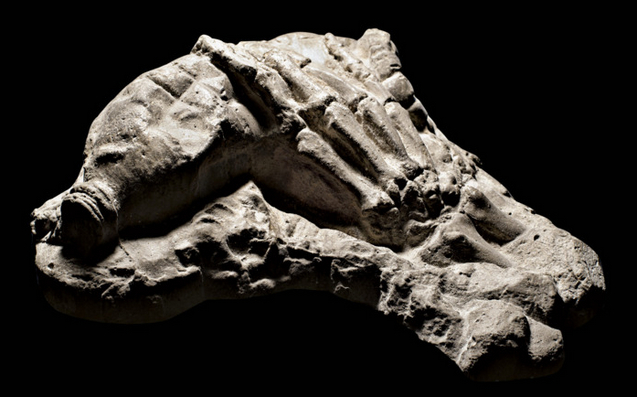
In the sugar­cane region of El Salvador, as much as one-fifth of the population has chronic kidney disease, the presumed result of dehydration from working the fields they were able to comfortably harvest as recently as two decades ago. Photo: Heartless Machine
Humans, like all mammals, are heat engines; surviving means having to continually cool off, like panting dogs. For that, the temperature needs to be low enough for the air to act as a kind of refrigerant, drawing heat off the skin so the engine can keep pumping. At seven degrees of warming, that would become impossible for large portions of the planet’s equatorial band, and especially the tropics, where humidity adds to the problem; in the jungles of Costa Rica, for instance, where humidity routinely tops 90 percent, simply moving around outside when it’s over 105 degrees Fahrenheit would be lethal. And the effect would be fast: Within a few hours, a human body would be cooked to death from both inside and out.
Climate-change skeptics point out that the planet has warmed and cooled many times before, but the climate window that has allowed for human life is very narrow, even by the standards of planetary history. At 11 or 12 degrees of warming, more than half the world’s population, as distributed today, would die of direct heat. Things almost certainly won’t get that hot this century, though models of unabated emissions do bring us that far eventually. This century, and especially in the tropics, the pain points will pinch much more quickly even than an increase of seven degrees. The key factor is something called wet-bulb temperature, which is a term of measurement as home-laboratory-kit as it sounds: the heat registered on a thermometer wrapped in a damp sock as it’s swung around in the air (since the moisture evaporates from a sock more quickly in dry air, this single number reflects both heat and humidity). At present, most regions reach a wet-bulb maximum of 26 or 27 degrees Celsius; the true red line for habitability is 35 degrees. What is called heat stress comes much sooner.
Actually, we’re about there already. Since 1980, the planet has experienced a 50-fold increase in the number of places experiencing dangerous or extreme heat; a bigger increase is to come. The five warmest summers in Europe since 1500 have all occurred since 2002, and soon, the IPCC warns, simply being outdoors that time of year will be unhealthy for much of the globe. Even if we meet the Paris goals of two degrees warming, cities like Karachi and Kolkata will become close to uninhabitable, annually encountering deadly heat waves like those that crippled them in 2015. At four degrees, the deadly European heat wave of 2003, which killed as many as 2,000 people a day, will be a normal summer. At six, according to an assessment focused only on effects within the U.S. from the National Oceanic and Atmospheric Administration, summer labor of any kind would become impossible in the lower Mississippi Valley, and everybody in the country east of the Rockies would be under more heat stress than anyone, anywhere, in the world today. As Joseph Romm has put it in his authoritative primer Climate Change: What Everyone Needs to Know, heat stress in New York City would exceed that of present-day Bahrain, one of the planet’s hottest spots, and the temperature in Bahrain “would induce hyperthermia in even sleeping humans.” The high-end IPCC estimate, remember, is two degrees warmer still. By the end of the century, the World Bank has estimated, the coolest months in tropical South America, Africa, and the Pacific are likely to be warmer than the warmest months at the end of the 20th century. Air-conditioning can help but will ultimately only add to the carbon problem; plus, the climate-controlled malls of the Arab emirates aside, it is not remotely plausible to wholesale air-condition all the hottest parts of the world, many of them also the poorest. And indeed, the crisis will be most dramatic across the Middle East and Persian Gulf, where in 2015 the heat index registered temperatures as high as 163 degrees Fahrenheit. As soon as several decades from now, the hajj will become physically impossible for the 2 million Muslims who make the pilgrimage each year.
It is not just the hajj, and it is not just Mecca; heat is already killing us. In the sugarcane region of El Salvador, as much as one-fifth of the population has chronic kidney disease, including over a quarter of the men, the presumed result of dehydration from working the fields they were able to comfortably harvest as recently as two decades ago. With dialysis, which is expensive, those with kidney failure can expect to live five years; without it, life expectancy is in the weeks. Of course, heat stress promises to pummel us in places other than our kidneys, too. As I type that sentence, in the California desert in mid-June, it is 121 degrees outside my door. It is not a record high.

III. The End of Food
Praying for cornfields in the tundra.
Climates differ and plants vary, but the basic rule for staple cereal crops grown at optimal temperature is that for every degree of warming, yields decline by 10 percent. Some estimates run as high as 15 or even 17 percent. Which means that if the planet is five degrees warmer at the end of the century, we may have as many as 50 percent more people to feed and 50 percent less grain to give them. And proteins are worse: It takes 16 calories of grain to produce just a single calorie of hamburger meat, butchered from a cow that spent its life polluting the climate with methane farts.
Pollyannaish plant physiologists will point out that the cereal-crop math applies only to those regions already at peak growing temperature, and they are right — theoretically, a warmer climate will make it easier to grow corn in Greenland. But as the pathbreaking work by Rosamond Naylor and David Battisti has shown, the tropics are already too hot to efficiently grow grain, and those places where grain is produced today are already at optimal growing temperature — which means even a small warming will push them down the slope of declining productivity. And you can’t easily move croplands north a few hundred miles, because yields in places like remote Canada and Russia are limited by the quality of soil there; it takes many centuries for the planet to produce optimally fertile dirt.
Drought might be an even bigger problem than heat, with some of the world’s most arable land turning quickly to desert. Precipitation is notoriously hard to model, yet predictions for later this century are basically unanimous: unprecedented droughts nearly everywhere food is today produced. By 2080, without dramatic reductions in emissions, southern Europe will be in permanent extreme drought, much worse than the American dust bowl ever was. The same will be true in Iraq and Syria and much of the rest of the Middle East; some of the most densely populated parts of Australia, Africa, and South America; and the breadbasket regions of China. None of these places, which today supply much of the world’s food, will be reliable sources of any. As for the original dust bowl: The droughts in the American plains and Southwest would not just be worse than in the 1930s, a 2015 NASA study predicted, but worse than any droughts in a thousand years — and that includes those that struck between 1100 and 1300, which “dried up all the rivers East of the Sierra Nevada mountains” and may have been responsible for the death of the Anasazi civilization.
Remember, we do not live in a world without hunger as it is. Far from it: Most estimates put the number of undernourished at 800 million globally. In case you haven’t heard, this spring has already brought an unprecedented quadruple famine to Africa and the Middle East; the U.N. has warned that separate starvation events in Somalia, South Sudan, Nigeria, and Yemen could kill 20 million this year alone.

IV. Climate Plagues
What happens when the bubonic ice melts?
Rock, in the right spot, is a record of planetary history, eras as long as millions of years flattened by the forces of geological time into strata with amplitudes of just inches, or just an inch, or even less. Ice works that way, too, as a climate ledger, but it is also frozen history, some of which can be reanimated when unfrozen. There are now, trapped in Arctic ice, diseases that have not circulated in the air for millions of years — in some cases, since before humans were around to encounter them. Which means our immune systems would have no idea how to fight back when those prehistoric plagues emerge from the ice.
The Arctic also stores terrifying bugs from more recent times. In Alaska, already, researchers have discovered remnants of the 1918 flu that infected as many as 500 million and killed as many as 100 million — about 5 percent of the world’s population and almost six times as many as had died in the world war for which the pandemic served as a kind of gruesome capstone. As the BBC reported in May, scientists suspect smallpox and the bubonic plague are trapped in Siberian ice, too — an abridged history of devastating human sickness, left out like egg salad in the Arctic sun.
Experts caution that many of these organisms won’t actually survive the thaw and point to the fastidious lab conditions under which they have already reanimated several of them — the 32,000-year-old “extremophile” bacteria revived in 2005, an 8 million-year-old bug brought back to life in 2007, the 3.5 million–year–old one a Russian scientist self-injected just out of curiosity — to suggest that those are necessary conditions for the return of such ancient plagues. But already last year, a boy was killed and 20 others infected by anthrax released when retreating permafrost exposed the frozen carcass of a reindeer killed by the bacteria at least 75 years earlier; 2,000 present-day reindeer were infected, too, carrying and spreading the disease beyond the tundra.
What concerns epidemiologists more than ancient diseases are existing scourges relocated, rewired, or even re-evolved by warming. The first effect is geographical. Before the early-modern period, when adventuring sailboats accelerated the mixing of peoples and their bugs, human provinciality was a guard against pandemic. Today, even with globalization and the enormous intermingling of human populations, our ecosystems are mostly stable, and this functions as another limit, but global warming will scramble those ecosystems and help disease trespass those limits as surely as Cortés did. You don’t worry much about dengue or malaria if you are living in Maine or France. But as the tropics creep northward and mosquitoes migrate with them, you will. You didn’t much worry about Zika a couple of years ago, either.
As it happens, Zika may also be a good model of the second worrying effect — disease mutation. One reason you hadn’t heard about Zika until recently is that it had been trapped in Uganda; another is that it did not, until recently, appear to cause birth defects. Scientists still don’t entirely understand what happened, or what they missed. But there are things we do know for sure about how climate affects some diseases: Malaria, for instance, thrives in hotter regions not just because the mosquitoes that carry it do, too, but because for every degree increase in temperature, the parasite reproduces ten times faster. Which is one reason that the World Bank estimates that by 2050, 5.2 billion people will be reckoning with it.

V. Unbreathable Air
A rolling death smog that suffocates millions.
By the end of the century, the coolest months in tropical South America, Africa, and the Pacific are likely to be warmer than the warmest months at the end of the 20th century. Photo: Heartless Machine
Our lungs need oxygen, but that is only a fraction of what we breathe. The fraction of carbon dioxide is growing: It just crossed 400 parts per million, and high-end estimates extrapolating from current trends suggest it will hit 1,000 ppm by 2100. At that concentration, compared to the air we breathe now, human cognitive ability declines by 21 percent.
Other stuff in the hotter air is even scarier, with small increases in pollution capable of shortening life spans by ten years. The warmer the planet gets, the more ozone forms, and by mid-century, Americans will likely suffer a 70 percent increase in unhealthy ozone smog, the National Center for Atmospheric Research has projected. By 2090, as many as 2 billion people globally will be breathing air above the WHO “safe” level; one paper last month showed that, among other effects, a pregnant mother’s exposure to ozone raises the child’s risk of autism (as much as tenfold, combined with other environmental factors). Which does make you think again about the autism epidemic in West Hollywood.
Already, more than 10,000 people die each day from the small particles emitted from fossil-fuel burning; each year, 339,000 people die from wildfire smoke, in part because climate change has extended forest-fire season (in the U.S., it’s increased by 78 days since 1970). By 2050, according to the U.S. Forest Service, wildfires will be twice as destructive as they are today; in some places, the area burned could grow fivefold. What worries people even more is the effect that would have on emissions, especially when the fires ravage forests arising out of peat. Peatland fires in Indonesia in 1997, for instance, added to the global CO2 release by up to 40 percent, and more burning only means more warming only means more burning. There is also the terrifying possibility that rain forests like the Amazon, which in 2010 suffered its second “hundred-year drought” in the space of five years, could dry out enough to become vulnerable to these kinds of devastating, rolling forest fires — which would not only expel enormous amounts of carbon into the atmosphere but also shrink the size of the forest. That is especially bad because the Amazon alone provides 20 percent of our oxygen.
Then there are the more familiar forms of pollution. In 2013, melting Arctic ice remodeled Asian weather patterns, depriving industrial China of the natural ventilation systems it had come to depend on, which blanketed much of the country’s north in an unbreathable smog. Literally unbreathable. A metric called the Air Quality Index categorizes the risks and tops out at the 301-to-500 range, warning of “serious aggravation of heart or lung disease and premature mortality in persons with cardiopulmonary disease and the elderly” and, for all others, “serious risk of respiratory effects”; at that level, “everyone should avoid all outdoor exertion.” The Chinese “airpocalypse” of 2013 peaked at what would have been an Air Quality Index of over 800. That year, smog was responsible for a third of all deaths in the country.

VI. Perpetual War
The violence baked into heat.
Climatologists are very careful when talking about Syria. They want you to know that while climate change did produce a drought that contributed to civil war, it is not exactly fair to saythat the conflict is the result of warming; next door, for instance, Lebanon suffered the same crop failures. But researchers like Marshall Burke and Solomon Hsiang have managed to quantify some of the non-obvious relationships between temperature and violence: For every half-degree of warming, they say, societies will see between a 10 and 20 percent increase in the likelihood of armed conflict. In climate science, nothing is simple, but the arithmetic is harrowing: A planet five degrees warmer would have at least half again as many wars as we do today. Overall, social conflict could more than double this century.
This is one reason that, as nearly every climate scientist I spoke to pointed out, the U.S. military is obsessed with climate change: The drowning of all American Navy bases by sea-level rise is trouble enough, but being the world’s policeman is quite a bit harder when the crime rate doubles. Of course, it’s not just Syria where climate has contributed to conflict. Some speculate that the elevated level of strife across the Middle East over the past generation reflects the pressures of global warming — a hypothesis all the more cruel considering that warming began accelerating when the industrialized world extracted and then burned the region’s oil.
What accounts for the relationship between climate and conflict? Some of it comes down to agriculture and economics; a lot has to do with forced migration, already at a record high, with at least 65 million displaced people wandering the planet right now. But there is also the simple fact of individual irritability. Heat increases municipal crime rates, and swearing on social media, and the likelihood that a major-league pitcher, coming to the mound after his teammate has been hit by a pitch, will hit an opposing batter in retaliation. And the arrival of air-conditioning in the developed world, in the middle of the past century, did little to solve the problem of the summer crime wave.

VII. Permanent Economic Collapse
Dismal capitalism in a half-poorer world.
The murmuring mantra of global neoliberalism, which prevailed between the end of the Cold War and the onset of the Great Recession, is that economic growth would save us from anything and everything.
But in the aftermath of the 2008 crash, a growing number of historians studying what they call “fossil capitalism” have begun to suggest that the entire history of swift economic growth, which began somewhat suddenly in the 18th century, is not the result of innovation or trade or the dynamics of global capitalism but simply our discovery of fossil fuels and all their raw power — a onetime injection of new “value” into a system that had previously been characterized by global subsistence living. Before fossil fuels, nobody lived better than their parents or grandparents or ancestors from 500 years before, except in the immediate aftermath of a great plague like the Black Death, which allowed the lucky survivors to gobble up the resources liberated by mass graves. After we’ve burned all the fossil fuels, these scholars suggest, perhaps we will return to a “steady state” global economy. Of course, that onetime injection has a devastating long-term cost: climate change.
The most exciting research on the economics of warming has also come from Hsiang and his colleagues, who are not historians of fossil capitalism but who offer some very bleak analysis of their own: Every degree Celsius of warming costs, on average, 1.2 percent of GDP (an enormous number, considering we count growth in the low single digits as “strong”). This is the sterling work in the field, and their median projection is for a 23 percent loss in per capita earning globally by the end of this century (resulting from changes in agriculture, crime, storms, energy, mortality, and labor).
Tracing the shape of the probability curve is even scarier: There is a 12 percent chance that climate change will reduce global output by more than 50 percent by 2100, they say, and a 51 percent chance that it lowers per capita GDP by 20 percent or more by then, unless emissions decline. By comparison, the Great Recession lowered global GDP by about 6 percent, in a onetime shock; Hsiang and his colleagues estimate a one-in-eight chance of an ongoing and irreversible effect by the end of the century that is eight times worse.
The scale of that economic devastation is hard to comprehend, but you can start by imagining what the world would look like today with an economy half as big, which would produce only half as much value, generating only half as much to offer the workers of the world. It makes the grounding of flights out of heat-stricken Phoenix last month seem like pathetically small economic potatoes. And, among other things, it makes the idea of postponing government action on reducing emissions and relying solely on growth and technology to solve the problem an absurd business calculation.
Every round-trip ticket on flights from New York to London, keep in mind, costs the Arctic three more square meters of ice.

VIII. Poisoned Oceans
Sulfide burps off the skeleton coast.
That the sea will become a killer is a given. Barring a radical reduction of emissions, we will see at least four feet of sea-level rise and possibly ten by the end of the century. A third of the world’s major cities are on the coast, not to mention its power plants, ports, navy bases, farmlands, fisheries, river deltas, marshlands, and rice-paddy empires, and even those above ten feet will flood much more easily, and much more regularly, if the water gets that high. At least 600 million people live within ten meters of sea level today.
But the drowning of those homelands is just the start. At present, more than a third of the world’s carbon is sucked up by the oceans — thank God, or else we’d have that much more warming already. But the result is what’s called “ocean acidification,” which, on its own, may add a half a degree to warming this century. It is also already burning through the planet’s water basins — you may remember these as the place where life arose in the first place. You have probably heard of “coral bleaching” — that is, coral dying — which is very bad news, because reefs support as much as a quarter of all marine life and supply food for half a billion people. Ocean acidification will fry fish populations directly, too, though scientists aren’t yet sure how to predict the effects on the stuff we haul out of the ocean to eat; they do know that in acid waters, oysters and mussels will struggle to grow their shells, and that when the pH of human blood drops as much as the oceans’ pH has over the past generation, it induces seizures, comas, and sudden death.
That isn’t all that ocean acidification can do. Carbon absorption can initiate a feedback loop in which underoxygenated waters breed different kinds of microbes that turn the water still more “anoxic,” first in deep ocean “dead zones,” then gradually up toward the surface. There, the small fish die out, unable to breathe, which means oxygen-eating bacteria thrive, and the feedback loop doubles back. This process, in which dead zones grow like cancers, choking off marine life and wiping out fisheries, is already quite advanced in parts of the Gulf of Mexico and just off Namibia, where hydrogen sulfide is bubbling out of the sea along a thousand-mile stretch of land known as the “Skeleton Coast.” The name originally referred to the detritus of the whaling industry, but today it’s more apt than ever. Hydrogen sulfide is so toxic that evolution has trained us to recognize the tiniest, safest traces of it, which is why our noses are so exquisitely skilled at registering flatulence. Hydrogen sulfide is also the thing that finally did us in that time 97 percent of all life on Earth died, once all the feedback loops had been triggered and the circulating jet streams of a warmed ocean ground to a halt — it’s the planet’s preferred gas for a natural holocaust. Gradually, the ocean’s dead zones spread, killing off marine species that had dominated the oceans for hundreds of millions of years, and the gas the inert waters gave off into the atmosphere poisoned everything on land. Plants, too. It was millions of years before the oceans recovered.

IX. The Great Filter
Our present eeriness cannot last.
So why can’t we see it? In his recent book-length essay The Great Derangement, the Indian novelist Amitav Ghosh wonders why global warming and natural disaster haven’t become major subjects of contemporary fiction — why we don’t seem able to imagine climate catastrophe, and why we haven’t yet had a spate of novels in the genre he basically imagines into half-existence and names “the environmental uncanny.” “Consider, for example, the stories that congeal around questions like, ‘Where were you when the Berlin Wall fell?’ or ‘Where were you on 9/11?’ ” he writes. “Will it ever be possible to ask, in the same vein, ‘Where were you at 400 ppm?’ or ‘Where were you when the Larsen B ice shelf broke up?’ ” His answer: Probably not, because the dilemmas and dramas of climate change are simply incompatible with the kinds of stories we tell ourselves about ourselves, especially in novels, which tend to emphasize the journey of an individual conscience rather than the poisonous miasma of social fate.
Surely this blindness will not last — the world we are about to inhabit will not permit it. In a six-degree-warmer world, the Earth’s ecosystem will boil with so many natural disasters that we will just start calling them “weather”: a constant swarm of out-of-control typhoons and tornadoes and floods and droughts, the planet assaulted regularly with climate events that not so long ago destroyed whole civilizations. The strongest hurricanes will come more often, and we’ll have to invent new categories with which to describe them; tornadoes will grow longer and wider and strike much more frequently, and hail rocks will quadruple in size. Humans used to watch the weather to prophesy the future; going forward, we will see in its wrath the vengeance of the past. Early naturalists talked often about “deep time” — the perception they had, contemplating the grandeur of this valley or that rock basin, of the profound slowness of nature. What lies in store for us is more like what the Victorian anthropologists identified as “dreamtime,” or “everywhen”: the semi-mythical experience, described by Aboriginal Australians, of encountering, in the present moment, an out-of-time past, when ancestors, heroes, and demigods crowded an epic stage. You can find it already watching footage of an iceberg collapsing into the sea — a feeling of history happening all at once.
It is. Many people perceive climate change as a sort of moral and economic debt, accumulated since the beginning of the Industrial Revolution and now come due after several centuries — a helpful perspective, in a way, since it is the carbon-burning processes that began in 18th-century England that lit the fuse of everything that followed. But more than half of the carbon humanity has exhaled into the atmosphere in its entire history has been emitted in just the past three decades; since the end of World War II, the figure is 85 percent. Which means that, in the length of a single generation, global warming has brought us to the brink of planetary catastrophe, and that the story of the industrial world’s kamikaze mission is also the story of a single lifetime. My father’s, for instance: born in 1938, among his first memories the news of Pearl Harbor and the mythic Air Force of the propaganda films that followed, films that doubled as advertisements for imperial-American industrial might; and among his last memories the coverage of the desperate signing of the Paris climate accords on cable news, ten weeks before he died of lung cancer last July. Or my mother’s: born in 1945, to German Jews fleeing the smokestacks through which their relatives were incinerated, now enjoying her 72nd year in an American commodity paradise, a paradise supported by the supply chains of an industrialized developing world. She has been smoking for 57 of those years, unfiltered.
Or the scientists’. Some of the men who first identified a changing climate (and given the generation, those who became famous were men) are still alive; a few are even still working. Wally Broecker is 84 years old and drives to work at the Lamont-Doherty observatory across the Hudson every day from the Upper West Side. Like most of those who first raised the alarm, he believes that no amount of emissions reduction alone can meaningfully help avoid disaster. Instead, he puts his faith in carbon capture — untested technology to extract carbon dioxide from the atmosphere, which Broecker estimates will cost at least several trillion dollars — and various forms of “geoengineering,” the catchall name for a variety of moon-shot technologies far-fetched enough that many climate scientists prefer to regard them as dreams, or nightmares, from science fiction. He is especially focused on what’s called the aerosol approach — dispersing so much sulfur dioxide into the atmosphere that when it converts to sulfuric acid, it will cloud a fifth of the horizon and reflect back 2 percent of the sun’s rays, buying the planet at least a little wiggle room, heat-wise. “Of course, that would make our sunsets very red, would bleach the sky, would make more acid rain,” he says. “But you have to look at the magnitude of the problem. You got to watch that you don’t say the giant problem shouldn’t be solved because the solution causes some smaller problems.” He won’t be around to see that, he told me. “But in your lifetime …”
Jim Hansen is another member of this godfather generation. Born in 1941, he became a climatologist at the University of Iowa, developed the groundbreaking “Zero Model” for projecting climate change, and later became the head of climate research at NASA, only to leave under pressure when, while still a federal employee, he filed a lawsuit against the federal government charging inaction on warming (along the way he got arrested a few times for protesting, too). The lawsuit, which is brought by a collective called Our Children’s Trust and is often described as “kids versus climate change,” is built on an appeal to the equal-protection clause, namely, that in failing to take action on warming, the government is violating it by imposing massive costs on future generations; it is scheduled to be heard this winter in Oregon district court. Hansen has recently given up on solving the climate problem with a carbon tax, which had been his preferred approach, and has set about calculating the total cost of extracting carbon from the atmosphere instead.
Hansen began his career studying Venus, which was once a very Earth-like planet with plenty of life-supporting water before runaway climate change rapidly transformed it into an arid and uninhabitable sphere enveloped in an unbreathable gas; he switched to studying our planet by 30, wondering why he should be squinting across the solar system to explore rapid environmental change when he could see it all around him on the planet he was standing on. “When we wrote our first paper on this, in 1981,” he told me, “I remember saying to one of my co-authors, ‘This is going to be very interesting. Sometime during our careers, we’re going to see these things beginning to happen.’ ”
Several of the scientists I spoke with proposed global warming as the solution to Fermi’s famous paradox, which asks, If the universe is so big, then why haven’t we encountered any other intelligent life in it? The answer, they suggested, is that the natural life span of a civilization may be only several thousand years, and the life span of an industrial civilization perhaps only several hundred. In a universe that is many billions of years old, with star systems separated as much by time as by space, civilizations might emerge and develop and burn themselves up simply too fast to ever find one another. Peter Ward, a charismatic paleontologist among those responsible for discovering that the planet’s mass extinctions were caused by greenhouse gas, calls this the “Great Filter”: “Civilizations rise, but there’s an environmental filter that causes them to die off again and disappear fairly quickly,” he told me. “If you look at planet Earth, the filtering we’ve had in the past has been in these mass extinctions.” The mass extinction we are now living through has only just begun; so much more dying is coming.
And yet, improbably, Ward is an optimist. So are Broecker and Hansen and many of the other scientists I spoke to. We have not developed much of a religion of meaning around climate change that might comfort us, or give us purpose, in the face of possible annihilation. But climate scientists have a strange kind of faith: We will find a way to forestall radical warming, they say, because we must.
It is not easy to know how much to be reassured by that bleak certainty, and how much to wonder whether it is another form of delusion; for global warming to work as parable, of course, someone needs to survive to tell the story. The scientists know that to even meet the Paris goals, by 2050, carbon emissions from energy and industry, which are still rising, will have to fall by half each decade; emissions from land use (deforestation, cow farts, etc.) will have to zero out; and we will need to have invented technologies to extract, annually, twice as much carbon from the atmosphere as the entire planet’s plants now do. Nevertheless, by and large, the scientists have an enormous confidence in the ingenuity of humans — a confidence perhaps bolstered by their appreciation for climate change, which is, after all, a human invention, too. They point to the Apollo project, the hole in the ozone we patched in the 1980s, the passing of the fear of mutually assured destruction. Now we’ve found a way to engineer our own doomsday, and surely we will find a way to engineer our way out of it, one way or another. The planet is not used to being provoked like this, and climate systems designed to give feedback over centuries or millennia prevent us — even those who may be watching closely — from fully imagining the damage done already to the planet. But when we do truly see the world we’ve made, they say, we will also find a way to make it livable. For them, the alternative is simply unimaginable.

Links

Lethal Heating is a citizens' initiative