27/08/2017

Scientists Hope To Farm The Biofuel Of The Future In The Pacific Ocean

NPR -  | 

Kelp plants grow on a 30-foot-long, white PVC pole suspended in the water. If this is successful, instead of just one row, there would be a whole platform, hundreds of meters across and hundreds of meters deep, full of kelp plants. Courtesy of David Ginsburg/Wrigley Institute
The push for renewable energy in the U.S. often focuses on well-established sources of electricity: solar, wind and hydropower. Off the coast of California, a team of researchers is working on what they hope will become an energy source of the future — macroalgae, otherwise known as kelp.
Diane Kim is the associate director of special projects and the director of undergraduate programs at The Wrigley Institute for Environmental Studies. She is one of the researchers who runs the kelp elevator project. Monika Evstatieva/NPR
The Pacific Coast is known for its vast kelp forests. It's one of the fastest-growing plants on Earth, and farming it requires no fertilizer, fresh water, pesticides, or arable land. "It can grow 2 to 3 feet per day," says Diane Kim, one of the scientists running the kelp research project at the University of Southern California.
Kelp is transformed into biofuel by a process called thermochemical liquefaction. The kelp is dried out, and the salt is washed away. Then it's turned into bio-oil through a high-temperature, high-pressure conversion process.
Some small companies are growing kelp as a substitute for kale in the U.S., but that's exactly the problem – very, very few are doing it. Thus, the infrastructure and investment isn't in place to make other products from kelp, like biofuel.
"We're testing out a concept that would enable large-scale, open-ocean farming," she says. "And what that would essentially do is grow enough kelp to make it economically feasible to make it cost competitive and maybe one day, provide a source of clean, sustainable, non-polluting source of energy to compete with fossil fuels."
Twenty-five miles from downtown Los Angeles, on sunny Catalina Island, Kim and her colleagues operate a center called the Wrigley Institute of Environmental Studies. The clean, deep waters off the island provide a great environment for research.
The Wrigley Marine Science Center is located 20 miles off the coast of Los Angeles, on Santa Catalina Island. Monika Evstatieva/NPR
Harvesting kelp in California for commercial purposes is not unprecedented. "They did have these large boats that gave the kelp a haircut, harvesting kelp along the California coast," Kim explains. During World War I, kelp was used to make gunpowder. By the 1960s, a company in San Diego harvested kelp to make products like alginate, which is a solidifying agent in ice cream and cosmetics.
Here on Catalina Island, Kim and her colleagues are trying to build a machine that would raise and lower kelp beds to get sunlight in the shallow water and nutrients in the deep water. This would allow them to farm miles from shore. They call the device a "kelp elevator."
There are real obstacles to creating large-scale kelp farms in the U.S., though.
"At the moment, they're way behind the curve," says University of Hawaii tenured researcher Michael Cooney of the Hawaii Natural Energy Institute. He says countries in Asia and Scandinavia are much farther along than the U.S.
One of the main reasons for this discrepancy is that these countries have been growing kelp for food for many years. "They already have a pre-existing infrastructure that's pretty sophisticated for growing and harvesting," Cooney explains. "It's harvesting for food and other products, but a lot of that capital's already in place. And that's a much better starting point than small companies in the U.S. that try to go from ground zero to a transportation fuel."
In Sweden, people have been farming seaweed for a long time. "The first thing we do with the high-quality kelp, we do it for food, actually, "says Fredrik Grondahl of the Royal Institute of Technology in Stockholm. He says selling kelp for food is very profitable.
The researchers don't use the natural populations of kelp on Catalina Island, but grow their own in a nursery starting from spores, like this one at the research facility. Anjuli Sastry/NPR
"The next part is to make feed ingredients," Grondahl adds. "And then we are also extracting polymers from the kelp to do bioplastics and adhesives and maybe also textiles." The leftover kelp is turned into biofuel, so the clean energy aspect is just one of many uses for kelp in Scandinavia.
The Wrigley Institute scientists don't use natural populations of kelp, but grow their own in a nursery, starting from spores. They tie the juvenile kelp to long, white PVC pipes and drop them into the water. Eventually they hope to create sheets of kelp plants hundreds of yards across.
Ken Nealson, director of the Wrigley Institute, takes us out onto the water in a boat to see the test site where they've already dropped a pipe 30 feet below the surface, with small kelp plants sprouting off of it. Nealson straps on scuba gear and dives down to inspect the project, while bass and other marine life circle around him.
"What you see here is the beginning of something that can really revolutionize bio-fuel production, if it works on a large scale," he explains. "You can imagine growing enough kelp to supply a percentage of the bioenergy that's needed in this country."
"Imagine" is the key word here. This experiment is in its earliest stages. By September, the researchers hope to put a full-scale kelp elevator in the water. And if that works, then someday years from now, endless miles of ocean could one day become farmland.

Links

Where's The Kelp? Warm Ocean Takes Toll On Undersea Forests

Associated Press - Michael Casey

In this June 15, 2017, photo, research technician Kristen Mello shows a sample of a red shrub-like seaweed collected in the waters off Appledore Island, Maine. Kelp forests are critical to the fishing industry but are disappearing around the world. The Gulf of Maine is the latest global hotspot to lose kelp. Scientists say the likely culprits are climate change and invasive species. (AP Photo/Charles Krupa)
When diving in the Gulf of Maine a few years back, Jennifer Dijkstra expected to be swimming through a flowing kelp forest that had long served as a nursery and food for juvenile fish and lobster.
But Dijkstra, a University of New Hampshire marine biologist, saw only a patchy seafloor before her. The sugar kelp had declined dramatically and been replaced by invasive, shrub-like seaweed that looked like a giant shag rug.
"I remember going to some dive sites and honestly being shocked at how few kelp blades we saw," she said.
The Gulf of Maine, stretching from Cape Cod to Nova Scotia, is the latest in a growing list of global hotspots losing their kelp, including hundreds of miles in the Mediterranean Sea, off southern Japan and Australia, and parts of the California coast.
Among the world's most diverse marine ecosystems, kelp forests are found on all continental coastlines except for Antarctica and provide critical food and shelter to myriad fish and other creatures. Kelp also is critical to coastal economies, providing billions of dollars in tourism and fishing.
The likely culprit for the loss of kelp, according to several scientific studies, is warming oceans from climate change, coupled with the arrival of invasive species.
In Maine, the invaders are other seaweeds.
In Australia, the Mediterranean and Japan, tropical fish are feasting on the kelp.
Most kelp are replaced by small, tightly packed, bushy seaweeds that collect sediment and prevent kelp from growing back, said the University of Western Australia's Thomas Wernberg.
"Collectively these changes are part of a recent and increasing global trend of flattening of the world's kelp forests," said Wernberg, co-author of a 2016 study in the Proceedings of the National Academy of Sciences, which found that 38 percent of kelp forest declined over the past 50 years in regions that had data.
Kelp losses on Australia's Great Southern Reef threaten tourism and fishing industries worth $10 billion. Die-offs contributed to a 60 percent drop in species richness in the Mediterranean and were blamed for the collapse of the abalone fishery in Japan.
"You are losing habitat. You are losing food. You are losing shoreline protection," said University of Massachusetts Boston's Jarrett Byrnes, who leads a working group on kelp and climate change. "They provide real value to humans."
The Pacific Coast from northern California to the Oregon border is one place that suffered dramatic kelp loss, according to Cynthia Catton, a research associate at the Bodega Marine Laboratory at the University of California, Davis. Since 2014, aerial surveys have shown that bull kelp declined by over 90 percent, something Catton blamed on a marine heat wave along with a rapid increase in kelp-eating sea urchins.
Without the kelp to eat, Northern California's abalone fishery has been harmed.
"It's pretty devastating to the ecosystem as a whole," Catton said. "It's like a redwood forest that has been completely clear-cut. If you lose the trees, you don't have a forest."
Kelp is incredibly resilient and has been known to bounce back from storms and heat waves.
But in Maine, it has struggled to recover following an explosion of voracious sea urchins in the 1980s that wiped out many kelp beds. Now, it must survive in waters that are warming faster than the vast majority of the world's oceans — most likely forcing kelp to migrate northward or into deeper waters.
"What the future holds is more complicated," Byrnes said. "If the Gulf of Maine warms sufficiently, we know kelp will have a hard time holding on."
On their dives around Maine's Appledore Island, a craggy island off New Hampshire that's home to nesting seagulls, Dijkstra and colleague Larry Harris have witnessed dramatic changes.
Their study, published by the Journal of Ecology in April, examined photos of seaweed populations and dive logs going back 30 years in the Gulf of Maine. They found introduced species from as far away as Asia, such as the filamentous red seaweed, had increased by as much 90 percent and were covering 50 to 90 percent of the gulf's seafloor.
They are seeing far fewer ocean pout, wolf eel and pollock that once were commonplace in these kelp beds. But they also are finding that the half-dozen invasive seaweeds replacing kelp are harboring up to three times more tiny shrimp, snails and other invertebrates.
"We're not really sure how this new seascape will affect higher species in the food web, especially commercially important ones like fish, crabs and lobster," said Dijkstra, following a dive in which bags of invasive seaweed were collected and the invertebrates painstakingly counted. "What we do think is that fish are using these seascapes differently."

Links

Worldwide 100% Renewable Energy Possible By 2050, Claims Detailed New Plan

Cosmos - Ketan Joshi

A detailed roadmap for 139 countries outlines a path to a future powered entirely by wind, water and solar energy.
Is a renewable-powered world by 2050 really possible? Paul Kennedy / Getty
Everybody wants to change the world. Few of us publish research detailing exactly how to do it.
Stanford’s Mark Z. Jacobson, who led a 2015 effort to create a state-by-state plan for a US transition to 100% renewable energy, has published similar research on a much larger scale, examining scenarios in which 139 countries could be powered purely by wind, water and solar (WWS) by the year 2050.
In scope and scale, the paper – published in the new energy journal Joule – is a significant expansion on Jacobson’s prior work. It isn’t limited to each country’s electricity sector – it examines the electrification and decarbonisation of transportation, heating, cooling, industry, agriculture, forestry and fishing. The authors chose the 139 countries, which between them cover 99% of the world’s carbon emissions, because the necessary energy data about them were available through the International Energy Agency (IEA).
The study also examines reductions in total power demand resulting from efficiencies found in electrification, net changes to electricity sector jobs, reductions in air pollution deaths and costs, reductions in climate change deaths and costs and the benefits of the decentralisation of energy technology. The authors are careful to place this herculean effort and the resulting roadmap in context.
“Both individuals and governments can lead this change. Policymakers don’t usually want to commit to doing something unless there is some reasonable science that can show it is possible, and that is what we are trying to do,” says Jacobson. “We are not saying that there is only one way we can do this, but having a scenario gives people direction.”
His ideal policy outcome would see “governments in many countries of the world commit to 100% clean, renewable energy in all sectors by 2050 with 80% by 2030”.
Few attempts to map out a potential route for total decarbonisation attempt to do it on this scale, and as such, this is likely to turn the heads of policymakers. But modelling is a double-edged sword: forecasting the future invariably draws attempts at rebuttal and interrogation of the complexities, uncertainties and assumptions that are a necessary part of the exercise.

The devil in the detail
Jacobson’s prior US-focused paper highlighted a tense contradiction within the intermeshed spaces of policy, academia and analysis that span the renewable energy sector. The paper was criticised in a follow-up published in the same journal, Proceedings of the National Academy of Sciences, which stated that Jacobson’s work “involves errors, inappropriate methods, and implausible assumptions” – triggering a back-and-forth through social and academic channels that lasted many weeks.
The key gripe focused on assumed increases in the discharge rate of US hydro power stations – considered, by respondents, to be unviable.
In the new global study, Jacobson has addressed this criticism by assuming dispatchable output is sourced from concentrating solar power with thermal storage, batteries and other dedicated storage.
The study also models the interplay between supply and demand in the electricity grids of these countries by using a model to simulate estimated resource availability (wind, water and sunlight), adding constraints (such as competition among wind turbines), and load data for each country simulated at a 30-second resolution for 50 years into the future. The authors specifically exclude bioenergy, nuclear, fossil fuels with carbon capture and natural gas from their models. These exclusions are likely to be a driving element of subsequent debates, with critics regularly citing the need for a bigger ‘toolbox’ to address climate change.

Australia’s findings
The supplemental information attached to Jacobson’s paper provides data about Jacobson’s Australia-specific modelling, some of which is illustrated below.
Jacobson’s projected mix of energy sources in 2050 in a 100% renewable scenario. Ketan Joshi based on data from Jacobson et al., Joule (2017)  LARGE IMAGE
Jacobson estimates that his proposed shift to 100% WWS power would achieve savings of $11,393 per person per year by the year 2050.
“That number is broken down into direct energy cost savings (~$500 per person per year), health cost savings (~$800 per person per year), and avoided 2050 global climate cost savings (~$10,100)”, Jacobson told Cosmos. “Given that a complete melting of all the ice worldwide would raise sea levels 70 meters, flooding 7% of the world's land, I believe the $10,000 per person is probably an underestimate.”
A recent review authored by Australia’s chief scientist Alan Finkel, elaborating on a blueprint for Australia’s electricity system, embarked on a similar (and far narrower) future-modelling exercise. A key difference was the continued presence of coal and gas in the system modelled by Finkel.
Chart from the Finkel report shows projected mix of energy sources up to 2050 with a clean energy target. From Finkel et al., Blueprint for the Future: Independent Review into the Future Security of the National Electricity Market LARGE IMAGE
Jacobson contends that this rate of change is not sufficient. “To avoid 1.5 C global warming, we need 80% reduction of everything by 2030 and 100% by 2050. We think a faster acceleration is possible at reasonable to low cost.”
Jacobson’s paper is designed to serve as a vision for future, but even Finkel’s proposal for a far less ambitious emissions reduction target has not been adopted several months after it was proposed.

The hazards of the future
Mark Dyson, of the Rocky Mountain Institute, grapples with the hazards of forecasting the future in an accompanying commentary on the paper. “Different authors with different assumptions and technique will understandably find different ‘answers’ for long-term decarbonisation. Yet most debate about particular conclusions misses the massive uncertainty of the inputs that drive those answers.”
Detailed modelling of 100% renewable scenarios are designed as tools for inspiring policy action rather than strict instructions for altering energy systems, and they are often successful to some degree. The study is also likely inspire discussion and debate about the exclusion of technologies like nuclear power and carbon capture and storage, about specific responses to the technical nuances of modelling systems on this scale, and of course about the perceived blending of boundaries between academia and activism.

Links

26/08/2017

Federal Court Rejects Latest Bids To Stop Adani

Fairfax - Shae McDonald AAP

The Federal Court of Australia has thrown out two other bids to stop the controversial Adani coal mine going ahead in central Queensland.
The full bench dismissed appeals by the Australian Conservation Foundation and traditional land owner Adrian Burragubba on Friday.
Traditional land owner Adrian Burragubba has failed in his bid to stop the Adani Carmichael mine in central Queensland. Photo: Jessica Hromas
The ACF had sought to successfully argue a legal technicality that Environment Minister Josh Frydenberg had not considered the effect of the mine's emissions on the Great Barrier Reef under the Environmental Protection and Biodiversity Act.
Mr Burragubba had appealed against a decision by the National Native Title Tribunal that allowed the Queensland government to issue a mining lease for the proposed Galilee Basin site.
ACF campaign director Paul Sinclair said the Federal Court's decision to dismiss its appeal showed Australia's environmental laws were broken.
"Our national environmental laws don't require our environment minister to properly evaluate the impact of 4.6 billion tonnes of pollution on the Great Barrier Reef and other world heritage areas," he said on Friday.
"It's like approving a mine for asbestos without having to consider the impact of that asbestos on the health of human people"
Mr Sinclair said the only way the project in Queensland's Galilee Basin could now be halted was through the "passion, commitment and determination of the Australian people".
But Environmental Defenders Office Queensland chief executive Jo Bragg said it could appeal over this latest ruling in the High Court of Australia.
"That's an option only to be exercised rarely and which is never exercised without very careful consideration," she said on Friday.
Ms Bragg could not confirm if this was the last legal option open to opponents of the Adani coal mine, which would be the largest in Australia.
"We're still very much examining all aspects of the project and its lawfulness," she said.
Adani Australia chief executive Jeyakumar Janakaraj welcomed the Federal Court's two rulings against two "dissenting" minorities in a statement on Friday.
Mr Janakaraj said the $22 billion project would create "10,000 direct and indirect jobs", with a minimum 7.5 per cent of those going to traditional land owners.

Links

Coal In Decline: Adani In Question And Australia Out Of Step

The Guardian - 

Special report: India and China are shifting away from coal imports and coal-fired power while a mega-mine is planned for Queensland. Where does this leave coal in Australia?

The Paris-based International Energy Agency was born in a crisis. In the wake of the 1973 oil shock, as Arab petroleum producers withheld supply from countries that supported Israel in the Yom Kippur war, the then US secretary of state, Henry Kissinger, called on the OECD to set up a new body to ensure its members would always have the reliable and affordable energy they needed.
Over time, as the agency has expanded its focus to map broader energy trends, it has sometimes faced accusations of conservatism – that it has underestimated the uptake of renewable energy, and has been overly bullish about the future of fossil fuels. But last month it released a report that pointed to a rupture more far reaching than the 70s oil embargo.
It suggested investment in new coal power across the globe has peaked and is on the verge of a steep decline. In a coinciding media briefing, the IEA chief economist, Laszlo Varro, declared the “century of coal” that started in 2000 – evident in the extraordinary wave of investment by emerging Asian nations – may already be over.
“It is becoming clear that Chinese coal demand has peaked,” he went on. “The outlook for imports [to] India and other countries is uncertain.”
What does this mean for Australia, producer of about 30% of the world’s coal, as it plans a vast expansion in production in outback Queensland?
The future of coalmining is really two separate questions, with their own answers. Neither is clear-cut, but thermal coal – burned in power stations to provide electricity – is on a different trajectory to higher-quality metallurgical coal, mainly used in producing steel.
About 55% of the coal Australia exports is thermal, but the 45% metallurgical coal is more lucrative, reaping nearly two-thirds of the revenue. The bulk of the thermal coal is exported from the Hunter Valley of New South Wales; most of the metallurgical product comes from Queensland. Combined, coal exports were worth $55bn last financial year. Only iron ore brings in more.
Until last year, coal prices had been on a steep downward trajectory since 2011. The surge in demand last decade prompted investment in mines across the globe but demand had slowed by the time they became operational, resulting in oversupply. By 2014, global coal use had stopped growing. In 2015, it started to decline.

Coal demand, 2001 to 2021
Guardian graphic | Source: IEA LARGE IMAGE
Several factors were at play, many of them long-term trends. China stopped growing as rapidly, took steps to limit choking air pollution, and began to shift its economy from relying on industrial exports to a greater emphasis on services and consumption. Climate change policies began to cut into coal’s market share in developed countries. In the US, the rapid development of cheap shale gas projects made coal uneconomic before the introduction of Barack Obama’s emissions policies.
By early 2016, the IEA was reporting that 80% of Chinese coalmining operations were losing money and the companies responsible for about half of US coal production were bankrupt.
It triggered a reaction. The Communist party forced the closure of some mines, restricted operation at others, to cut Chinese production by more than 10%. The global thermal coal price quickly doubled. The price of metallurgical coal surged further, tripling in April this year after Cyclone Debbie ravaged large parts of Queensland, reducing supply from some mines. Australia’s export revenue from coal exports soared 57% in a year. Both events illustrated the potential for volatility in coal markets owing to the weather or government fiat. But the bounce was brief.
Market analysts at Citi Research last month warned investors that the outlook for coal stocks was pessimistic: major banks were financing fewer projects; Donald Trump’s much-vaunted pro-coal and anti-climate change stance was having little impact in the US.
Chinese workers ride in a boat through a large floating solar farm project, billed as the largest in the world, under construction on a lake in collapsed and flooded coalmine in Huainan, Anhui province. Photograph: Kevin Frayer/Getty Images
In a report for the Australian Conservation Foundation, consultants ACIL Allen agreed. “At present, there is considerable pessimism regarding the long-term outlook for prices of thermal coal in international markets,” it said. “This is reflected in forecasts by credible Australian and international agencies.”
Citi forecasts modest growth in Australian thermal coal exports in the near term, including the potential expansion of a couple of mines. But with prices expected to fall to US$60 a tonne by the end of the decade, down from a US$110 peak late last year, it sees no incentive for investment in new major projects – especially given public opposition and investor apathy towards coal.
It makes for an unlikely environment in which to develop a mega-mine backed by public money. But that is what Australia is considering.
The Indian billionaire Gautam Adani’s $21bn proposal to build a giant mine in the Galilee basin, about 340km south-west of Townsville, dates back to 2010. It has outlasted three Australian prime ministers and survived the signing of a global deal to combat climate change. Unsuccessful court battles have been waged and lost by opponents, promised imminent start dates have come and gone, and government support has steadily increased.
Though known as the Carmichael mine, if fully developed it will actually be 11 mines: six of them open-cut and five underground, spread over a length of 50km. Eventually, the company says, it could yield up to 60m tonnes a year to be shipped to burn in Indian coal plants. The rail and port infrastructure necessary would open up the possibility of reviving some of the dormant coalmining plans in the basin, with a total potential additional output of about 150m tonnes of coal a year.
Greenpeace activists unveil a giant banner on Newcastle coal stockpiles, calling on the Commonwealth Bank to stop investing in coal. Photograph: Dean Sewell
To put that into context, Australia now exports about 200m tonnes. It is, by any measure, a massive expansion that could push the world measurably closer to breaching the goals of the Paris climate agreement.
The details of the Adani proposal have moved over time. It was initially proposed to run for 150 years but that has been scaled back to 60. The company promised it would create 10,000 jobs; an ACIL Allen Consulting economist contracted by the company later conceded in court a more likely figure was 1,464. And the project is promised to initially start on a smaller scale, producing 25m tonnes a year.
It has environmental approval, has been granted access to groundwater from the Great Artesian Basin, and won a four-year deferment before it has to start paying royalties to the state. In June Adani announced it had made a final investment decision and was ready to go ahead. In truth, this was spin – it was still yet to secure finance for the project (Australian banks have not been willing) – but it was ramping up pressure on the Australian government to approve a $900m low-cost loan through its Northern Australia Infrastructure Facility to help to fund a railway that Adani would own and operate for itself and other potential Galilee basin miners.
Adani’s biggest champion has been the recently resigned resources minister Matt Canavan, who argued the mine should go ahead on economic, humanitarian and, most audaciously, environmental grounds. Specifically: bring jobs and growth to struggling north Queensland; help improve the lives of the 240 million Indians living without electricity; and be better for the planet given that India is building coal plants anyway, and Australian coal is a cleaner product than what is dug up in other parts of the world.
All three points have been contested. There has been significant pushback against the idea that, in a world where the demand for coal is flat at best, existing Australian mines would not lose out if the Galilee basin were developed. The coal consultancy Wood Mackenzie was commissioned to look at the issue by the $2bn Infrastructure Fund, which owns a stake in the coal-reliant Port of Newcastle, and found existing mines in southern Queensland and NSW would be hit. “Put simply, either the $1bn loan to Adani will have a significant impact on coal production and jobs in the Hunter Valley, Bowen basin and Surat basin, or the business case for the Adani rail line is deeply flawed and the promised jobs for north Queensland unlikely to materialise,” it reported.
Testing the humanitarian and environment arguments requires a closer look at the changes under way in the Indian electricity market. India is the world’s second largest importer of thermal coal. It doesn’t want to be. Its coal minister, Piyush Goyal, has repeatedly said he wants to cut imports completely. It won’t happen in the short term – some of the country’s plants were built to run using higher-quality coal, which is not available domestically – but a shift is under way. Reuters reported that demand for imported thermal coal in India fell 13% in the first seven months of this year.
Galilee Blockade protesters gather outside Bill Shorten’s office in Moonee Ponds, Melbourne. Photograph: James Ross/AAP
Meanwhile, the country is seeing extraordinary reductions in the cost of large-scale solar power – 40% in a year – to the point where it is cheaper than domestic coal for the first time. There are questions over whether this is sustainable, but India has set an ambitious solar target of 100 gigawatts within five years. A draft national electricity plan released in December found no new coal-fired plants would be needed for a decade, and proposed coal plants with a capacity of 13.7GW – more than half Australia’s total coal fleet – were cancelled in May alone.
What does this mean for the Carmichael mine? Goyal says India does not need it, but will use the coal. Tim Buckley, of the Institute for Energy Economics and Financial Analysis, says a two-week trip he took to India to meet energy executives and government officials suggested a different story. “There was almost zero discussion on Carmichael,” he says. “The project is not on the radar, not expected to happen, immaterial for India’s energy plans given the progressive move away from imported thermal coal and just unbankable for Indian banks given excessive Adani group debt.”
India is not the only country rethinking the scale of its coal commitment. China has not cut imports – it is more focused on closing inefficient domestic mines – but its coal consumption peaked three years ago. It has an incredibly large fleet of generators likely to operate for decades to come, but they are running at less than 50% capacity. It cancelled 103GW of proposed coal-fired plants (more than twice the capacity of Australia’s east coast grid) this year.
Government officials note what is happening – the chief scientist Alan Finkel’s independent review of Australia’s electricity security noted that China is diversifying its energy mix, India limiting imports and South Korea cutting coal power to reduce pollution – but this shift receives little clean air in the Australian political debate, where the Minerals Council is an influential player and the major parties are supportive of a long-term source of jobs and revenue.
Misinformation is rife. Peter Freyberg, the head of coal at the mining giant Glencore, claimed that the IEA had projected that fossil fuels would provide almost 70% of energy in 2030, even if the world got its act together to limit global warming to an increase of less than 2C. He was making a point about coal’s longevity but, in reality, the IEA paints a different picture.
Yes, it estimates 64% of energy would come from fossil fuels in 2030 under this scenario – if you count electricity generation, industrial processes, transport, heating and cooking, and if you assume carbon capture and storage suddenly becomes viable. Even then, the biggest chunk would be expected to come from natural gas, which is considered a cleaner transitional fuel. The IEA found burning coal to generate electricity would decline sharply, with wind and solar providing more than half the world’s needs within 13 years. Traditional coal-fired power would be gone by mid-century.
Metallurgical coal is not expected to decline as quickly – in simple terms, there is not the readymade alternative to coal in steel manufacturing that there is in electricity generation. The IEA has forecast only a 15% drop in global trade of metallurgical coal by 2040 should the world deliver on the headline Paris agreement goals. Australia has about a fifth of the global market, and higher quality coal than many competitors, suggesting its market share should more or less hold up.
As the government points out, Australia also offers higher quality thermal coal than its competitors. But Tony Wood, energy program director at the Grattan Institute, says the numbers are compelling even once this is factored in.
“Malcolm Turnbull says coal will be part of the energy mix for the next several decades, and this is true, but it is a declining part of that mix,” Wood says.
“We may have a bigger share, but it is still a bigger share of a declining market. Unless someone does something with carbon capture and storage – or the world turns away from acting on climate change, which doesn’t seem likely – this is not an industry with a long-term future.”

Links

Coal In Decline: An Energy Industry On Life Support

The Guardian - 

Special report: The pace of coal plants shutting down in Australia could mean the country’s fleet could be gone before 2040. The transformation is enormous – and seems inevitable

For a glimpse into the future of coal power in Australia, go west. The country’s last major investment in coal-fired electricity was in Western Australia in 2009, when Colin Barnett’s state government announced a major refurbishment of the Muja AB station about 200km south of Perth, far from the gaze of the east coast political-media class.
The plant was 43 years old and mothballed. Reviving it was meant to cost $150m, paid for by private investors who would reap the benefits for years to come. But costs and timeframes blew out. An old corroded boiler exploded. The joint venture financing the project collapsed; a wall followed suit. The bill ultimately pushed beyond $300m, much of it to be stumped up by taxpayers – and once completed, the plant was beset with operational problems. It ran only 20% of the time.
By April 2016, the government acknowledged it was subsidising more generation capacity than it needed and predicted demand for coal power would fall over the coming decade. In May this year the new Labor administration confirmed Muja AB would shut early next year.
The coal-fired power sector is in free fall, and wind and solar are competing on cost with fossil fuels
Simon Holmes à Court, Energy Transition Hub
This spectacular failure had unique elements but underpinning it was a faith in the longevity of coal-fired electricity. Though it rated little mention in the east – mainly because WA is out of sight and has its own grid separate to the mislabelled national electricity market – it is a pointer to what lies ahead.
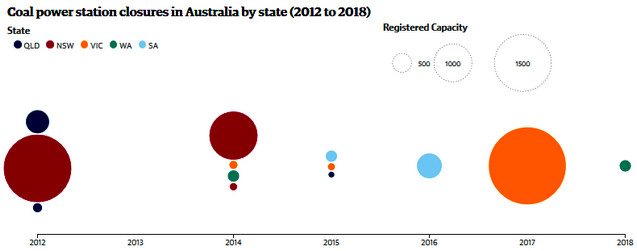
About a fifth of the country’s coal capacity has disappeared since 2012; Muja AB will be the 13th station to shut in that period; no new ones have opened this decade. For all the talk of new coal-fired power plants, none are in development.
If closures continued at the current rate, the nation’s coal fleet would be gone before 2040. It’s a pace that could put Australia within striking distance of what scientists say is necessary in the electricity sector for the country to play its part in combating climate change. It is far beyond what the government believes possible if the country is to maintain a reliable and affordable electricity supply, and slower than what some energy analysts think could happen given the extraordinary advances in renewable energy cost and technology.
Source: Australian Energy Council LARGE IMAGE
“The coal-fired power sector is in free fall, and wind and solar are competing on cost with fossil fuels,” says Simon Holmes à Court, senior adviser at the federally funded Energy Transition Hub at the University of Melbourne. “Every single panel and turbine installed reduces the market size for inflexible baseload plants.”
Industry insiders stress the scale of the transformation being discussed shouldn’t be downplayed. Coal still provides about three-quarters of our electricity. In the short term, its withdrawal is likely to slow. Demand for power unexpectedly fell at the start of the decade, leading to an oversupply that suppressed the wholesale price of electricity. But with competition reduced and expensive natural gas-fired plants being called on to carry more of the load, the price is now as much as eight times the cost of generation. The remaining coal plants are making hay.
That will inevitably change. After an investment strike a couple of years ago, wind turbines and solar panels are going up in a rush to meet the national 2020 renewable energy target. Once they come online by mid-2019 competition will increase and, for a while at least, the skyward rush of wholesale electricity prices should ease. What happens to existing coal power plants at that point is an open question.
Workers finish their last shift at Hazelwood power station on 31 March. Photograph: Scott Barbour/Getty Images
Here is what we do know: coal generators usually operate for about half a century and most Australian plants are pushing that age. Yallourn, in Victoria’s Latrobe Valley, turns 50 in 2021. AGL has already announced Liddell power station in New South Wales will close in 2022. A brace of others will hit their expected use-by dates in the decade after 2025.
Analysis by Holmes à Court suggests 15.1 gigawatts – nearly 10 times the capacity of Hazelwood, the failing, old Victoria plant that shut in March – could retire in that period. It would leave just 11 coal plants with a maximum capacity less than a third of what was in place five years ago. Most of those would be in Queensland, near the end of the grid.
Meanwhile, between eight and 22 gigawatts of wind and large-scale solar farms may have been built and 20 gigawatts of solar panels installed on roofs, according to Australian Energy Market Operator projections. It’s possible generation capacity equivalent to Australia’s entire east coast grid could have been built using variable clean energy technology in just a couple of decades.
I don’t think the banking sector and the industry are looking to build coal-fired power stations
Matthew Warren, Australian Energy Council
In a report on investment trends, analysts at Bloomberg New Energy Finance projected that by 2040 small-scale solar power will have replaced coal as Australia’s largest source of energy. They found 45% of electricity capacity would be “behind the meter”, rather than from the traditional grid. Photovoltaic panels, battery packs and demand response programs – cash incentives offer to those who volunteer to cut use at peak times – would take over.
As Bloomberg New Energy Finance’s Australian chief, Kobad Bhavnagri, acknowledges, modelling in this area will inevitably be wrong – but it indicates the direction. Holmes à Court believes the system is at a turning point that few have appreciated.
Here is what else we know: there is little to no interest in the business community in building new coal plants to replace those that shut. The 2015 Paris climate agreement triggered a step change in thinking about the long-term viability of fossil-fuel investments. Action towards meeting the Paris goals is fitful but financiers are operating on the assumption policies will escalate, including a probable eventual return to some form of carbon pricing. They are in no mood to make a decades-long bet against it.
The Australian Energy Council chief, Matthew Warren, representing most generators, summarised: “I don’t think the banking sector and the industry are looking to build coal-fired power stations for the foreseeable future.”
Catherine Tanna, the managing director of Energy Australia. Photograph: Nikki Short/AAP
Coal is on the outer in other ways. As more variable renewable generation is introduced into electricity grids, market operators are increasingly favouring flexibility over the traditional baseload model. They see the future in generators that can swing in quickly on demand, rather than run all the time. The government has agreed new wind and solar photovoltaic farms will need to have “dispatchable” backup that can be called on at any time, but coal is not as nimble as batteries, gas, demand response or concentrated solar thermal with storage.
It has been slow to filter through to some corners of the political debate, but some business leaders have been stressing these points for months. The specifics demanded vary but most want a bipartisan policy that would provide the confidence to build new plants to replace closing coal. The Business Council of Australia, representing more than 100 corporate leaders, has become increasingly bolshy. In a round table with the Australian Financial Review last month the council’s board pressed the government to adopt the chief scientist Alan Finkel’s recommendation to introduce a clean energy target, which would offer incentives on a sliding scale, favouring plants with the lowest emissions.
Asked where coal fitted within that, the board member and Energy Australia managing director Catherine Tanna described it as a “legacy technology” that was “very, very unlikely to find a market participant” willing to pay for it. Tanna also called out as myth the idea that a coal-fired power station using new technology would be cheap and lead to a cut in electricity prices. “I just don’t think it’s borne out by the economics,” she said.
The most regular argument made in response to this is: other countries are building new coal stations and if the new technology is good enough for China, Japan and Germany, why not Australia? The Minerals Council of Australia is pushing hard for government funding for next-generation technology, known as ultra-supercritical coal which, according to a 2016 World Coal Association report, creates emissions that are 23% lower than the black coal plants of NSW and Queensland but is also 40% more expensive to build. Few fossil-fuel proponents still use the term “clean coal” – mockery has stolen its promotional punch, “clean coal” is a mirage – but when deployed it is applied to new technology that reduces emissions.

What is 'clean coal' technology?
The term “clean coal” applies to two different technologies:
  • Carbon capture and storage, in which emissions from fossil fuel projects can be trapped and pumped underground.
  • Coal plants that still emit plenty of carbon dioxide, but less than the generators built decades ago. They are now marketed as high efficiency, low emissions plants - HELE for short.
Despite billions in research dollars being made available, carbon capture and storage has yielded only two commercial-scale projects - in Canada’s Saskatchewan province and Texas. Both are small, were expensive to build and catch only a fraction of total emissions.
HELE plants have a more significant track-record. They operate at higher temperatures than older models and emit about 10% less. The next generation of HELE plants is known as ultra-supercritical coal plants and emissions are 23% lower, but they are 40 % more expensive to build.

While it’s true that new generation “clean coal” plants are being built elsewhere, it is not a straightforward story of bold investment. The overwhelming majority are in China, where they make up nearly 20% of its huge coal fleet (and the fleet is massive – 20 times the capacity of Australia’s national grid). China’s extraordinary growth as it developed this century spurred unprecedented spending on all energy technologies, but its coal consumption has been in decline for three years. The Institute for Energy Economics and Financial Analysis found the Asian giant’s coal plants last year ran at only 47.5% of their capacity, and estimated it could have US$200bn in stranded coal assets.
Japan faced a unique challenge after the 2011 Fukushima disaster. It abandoned nuclear generation and backed new coal to help fill the gap. But while it has been reported the country is building more than 40 high-efficiency, low-emissions plants, the Global Coal Plant Tracker database suggests this is an inflated figure. At time of writing, it lists 12 coal plants as under construction, some of them small by Australian standards. Only five are listed as HELE; others are the sort of old, dirty technology plants that no one has argued should be built here. A further 28 are listed as being assessed or in early planning. Four proposed plants with a promised capacity of 2.3 gigawatts have been cancelled this year.
Germany is a more straightforward case. It approved some coal plants about a decade ago during a European drive to replace dirty old stations with newer models, and some of them took years to build, but no new coal proposal has been given a permit since 2009. Depending on the day, about 40% of the country’s electricity is renewably generated.
The Minerals Council released a report in July making the case that HELE coal is the cheapest form of new electricity plant available, but its findings differed markedly from other experts who have looked at the issue – not least Finkel’s government-commissioned review into the electricity grid security. Critics say it was based on some brave assumptions: that new coal would not face additional construction and legal costs, that government would underwrite the risk of future carbon pricing, and that wind and solar owners would have to pay to have two to three days backup on hand.
It was a far cry from February, when the treasurer brandished a piece of coal in parliament
The business community wasn’t persuaded. (One energy industry leader summarised: “We don’t understand what they are trying to do.”) Increasingly, it seems, nor are key members of Malcolm’s Turnbull cabinet. In a speech to the Australian Industry Group in Adelaide, the treasurer, Scott Morrison, spelt out the scepticism. He stressed the Coalition’s “resource and technology-agnostic” energy policy and said the government would welcome investment in HELE coal plants but added: “Let’s also be real about it.”
“These new HELE plans would produce energy at an estimated two and a half times the cost of our existing coal-fired power stations,” Morrison said. “They would also take up to around seven years to set up. While welcome where the economics and engineering stack up, we shouldn’t kid ourselves a new HELE plant would bring down electricity prices anytime soon.”
It was a far cry from February, when the treasurer brandished a piece of coal in parliament, and it puts him at odds with Tony Abbott and other backbench MPs who argue the government should use taxpayers’ money to back new coal. But it was in step with messages from Turnbull, who said decisions on whether to build coal plants were best left to the market, and the energy minister, Josh Frydenberg, who has stressed that the government was not planning to build a coal plant itself.
Source: ABS LARGE IMAGE
The second half of the parliamentary year is likely to be dominated – again – by energy and climate policy. It will be fraught within the government, and predictions about where it will land are courageous. Options being considered include pairing a clean energy target with a second program that could help fund a HELE coal plant if it proved cheaper than other comparable forms of power, or creatively designing the clean energy target (and the definition of “clean”) so that it offers new coal the same incentive as, say, a solar farm.
There is no guarantee coal would succeed under either model. But, the reasoning goes, giving coal an opportunity to compete might help navigate a vexed issue through a riven party room.
Morrison’s speech offered little hope that for those wanting new coal plants. He spelt out a different vision: “When it comes to coal, the best thing we can do is simply ensure the power stations we currently have – Liddell, Bayswater etc – stay open, remain economic and work longer into the future. We need to sweat these existing coal-fired assets for longer.
Steam billows from the cooling towers of the Yallourn coal-fired power station. Photograph: Bloomberg via Getty Images
“Not only does this provide critical baseload for our economy in the decades to come, but it also buys important time as other energy technologies are developed and can be evolved to match the stability of more traditional power sources.”
The reference to Liddell should be telling. When Sydney was pushed to the edge of blackout during a heatwave in February, it was operating at just 50% capacity owing to ongoing equipment problems.
A few weeks later, Abbott made a spirited 11th–hour call for Victoria to step in to keep Hazelwood going despite the plant facing WorkSafe notices for failures that would have cost $400m to fix. He was widely mocked given the generator’s decrepit state but he wasn’t without support. If the government does head down this path – propping up creaking old coal plants because it is not yet convinced by renewable energy – it might want to brush up on the case of Muja AB.

Links

25/08/2017

'Urgent' Need For Rich World To Help Poor Prepare For Climate Extremes: WMO Head

Fairfax - Peter Hannam

Weather agencies including Australia's must step up co-operation to close a "widening gap in capacity" with developing nations, with the urgency of action increasing as the planet heats up, David Grimes, president of the World Meteorological Organisation (WMO), says.
The increasing frequency of severe heatwaves, heavy rain events and droughts means it is even more important richer nations such as Australia shared their expertise in forecasting and early warning.
The sun is obscured by smoke from wildfires in the distance behind burnt trees in Williams Lake, British Columbia, last month.  Photo: Darryl Dyck, via AP
"It's becoming more urgent. The reality in the developing world is they lack a lot of tools," said Mr Grimes, ahead of a two-day Australian Meteorological and Oceanographic Society symposium in Melbourne starting on Tuesday. "You've got countries that can barely keep their monitoring systems functioning."
The potential benefits of early warning have been on show this month as heavy monsoonal rains hit many parts of South Asia, while a deluge near Freetown in Sierra Leone triggered a landslide that killed more than 500 people.
The WMO is hoping to develop a "cascading forecasting system" spanning 12 or more centres to "provide the best information we can to all parts of the world", Mr Grimes said.
Sharing such work would help "to get people out of harm's way or to inform decision making in those countries so they can build up their adaptation and resilience".
Australia's Bureau of Meteorology was one of the three original world centres – along with Moscow and Washington – given the nation's relative strength in southern hemisphere research. It is likely to continue to play a prominent role, he said.
Developing nations have typically contributed little to the greenhouse gas emissions that are driving temperatures higher, and yet are among the most exposed to the effects of severe weather.
A torrent of water flows through a flooded neighbourhood in Regent, east of Freetown, Sierra Leone, earlier this month. Photo: AP
Aside from the humanitarian issues, richer nations have an interest in ensuring fragile states are not pushed to breaking point. "If you think about global security and the stability of human settlements and civil society – it's an important strategic objective of most countries," Mr Grimes said. 2017 is on course to be the second hottest year on record globally, trailing only 2016. Even without the temperature boost that last year had from a big El Nino in the Pacific, last month was the hottest July on record for land temperatures. (See National Oceanic and Atmospheric Administration chart below.)

Volunteers handle coffins during a mass funeral for victims of heavy flooding and mudslides in Regent at a cemetery in Freetown, Sierra Leone. Churches across Sierra Leone held special services in memory of the hundreds killed. Photo: AP
Britain's European Centre for Medium-Range Weather Forecasts was recently named by WMO as one of its global centres along with a centre in Montreal, Canada, while France and Germany are among those vying to take on similar roles.
"I expect by next year or so, we'll probably have most of those centres established," Mr Grimes said.The Trump administration's pledge to roll back America's climate research is so far barely having an effect, he said.
That's despite reports in the US that the government was disbanding a federal advisory panel for the National Climate Assessment, a group that applies climate analysis to public and corporate planning.
"I don't see the evidence [of a pullback] on the weather side," Mr Grimes said. "You can still accomplish quite a lot without getting into the whole conversation about climate change."
A summer heatwave across southern Europe earlier this month sent the mercury into the low 40s. Photo: AP
Understanding how the warming climate will affect different parts of the world requires more research, with the poles and mountain tops among the areas where data is most deficient.
Higher latitude nations, such as Canada, have seen regions warm four to five times the global average.
For Antarctica, with a similar warming rate, the stability of ice sheets particularly on West Antarctica is also "a cause for concern", Mr Grimes said. One threat is the potentially rapid global sea-level rise should the land-based sheets collapse.

Links

Lethal Heating is a citizens' initiative