11/09/2017

This Is How Your World Could End

The Guardian - 

In an extract from his book Ends of the World, Peter Brannen examines mass extinction events and the catastrophic outcome of rising temperatures for all the world’s population
The 2014 El Portal fire burning near Yosemite National Park, California. Scientists have warned that rising global temperatures will lead to more wildfires in Yosemite and elsewhere. Photograph: Stuart Palley/EPA
Many of us share some dim apprehension that the world is flying out of control, that the centre cannot hold. Raging wildfires, once-in-1,000-years storms and lethal heatwaves have become fixtures of the evening news – and all this after the planet has warmed by less than 1C above preindustrial temperatures. But here’s where it gets really scary.
If humanity burns through all its fossil fuel reserves, there is the potential to warm the planet by as much as 18C and raise sea levels by hundreds of feet. This is a warming spike of an even greater magnitude than that so far measured for the end-Permian mass extinction. If the worst-case scenarios come to pass, today’s modestly menacing ocean-climate system will seem quaint. Even warming to one-fourth of that amount would create a planet that would have nothing to do with the one on which humans evolved or on which civilisation has been built. The last time it was 4C warmer there was no ice at either pole and sea level was 80 metres higher than it is today.
The modern world will be much more of a killing field
Matthew Huber, paleoclimatologist
I met University of New Hampshire paleoclimatologist Matthew Huber at a diner near his campus in Durham, New Hampshire. Huber has spent a sizable portion of his research career studying the hothouse of the early mammals and he thinks that in the coming centuries we might be heading back to the Eocene climate of 50 million years ago, when there were Alaskan palm trees and alligators splashed in the Arctic Circle.
“The modern world will be much more of a killing field,” he said. “Habitat fragmentation today will make it much more difficult to migrate. But if we limit it below 10C of warming, at least you don’t have widespread heat death.”
In 2010, Huber and his co-author, Steven Sherwood, published one of the most ominous science papers in recent memory, An Adaptability Limit to Climate Change Due to Heat Stress.
“Lizards will be fine, birds will be fine,” Huber said, noting that life has thrived in hotter climates than even the most catastrophic projections for anthropogenic global warming. This is one reason to suspect that the collapse of civilisation might come long before we reach a proper biological mass extinction. Life has endured conditions that would be unthinkable for a highly networked global society partitioned by political borders. Of course we’re understandably concerned about the fate of civilisation and Huber says that, mass extinction or not, it’s our tenuous reliance on an ageing and inadequate infrastructure, perhaps, most ominously, on power grids, coupled with the limits of human physiology that may well bring down our world.
In 1977, when power went out for only one summer day in New York, swaths of the city devolved into something like Hobbes’s man in a state of nature. Riots swept across the city, thousands of businesses were destroyed by looters and arsonists lit more than 1,000 fires.
Sami village, Gujurat, western India in August 2012. Villagers were forced to migrate due to lack of water after the monsoon failed. Photograph: Ahmad Masood/Reuters
In 2012, when the monsoon failed in India (as it’s expected to do in a warmer world), 670 million people – that is, 10% of the global population – lost access to power when the grid was crippled by unusually high demand from farmers struggling to irrigate their fields, while the high temperatures sent many Indians seeking kilowatt-chugging air-conditioning.
“The problem is that humans can’t even handle a hot week today without the power grid failing on a regular basis,” he said, noting that the ageing patchwork power grid in the United States is built with components that are allowed to languish for more than a century before being replaced. “What makes people think it’s going to be any better when the average summer temperature will be what, today, is the hottest week of the year in a five-year period and the hottest temperatures will be in the range that no one has ever experienced before in the United States? That’s 2050.”
By 2050, according to a 2014 MIT study, there will also be five billion people living in water-stressed areas.
“Thirty to 50 years from now, more or less, the water wars are going to start,” Huber said.
If people don’t have economic hope and they’re displaced, they tend to get mad and blow things up
Matthew Huber
In their book Dire Predictions, Penn State’s Lee Kump and Michael Mann describe just one local example of how drought, sea level rise and overpopulation may combine to pop the rivets of civilisation:
“Increasingly severe drought in West Africa will generate a mass migration from the highly populous interior of Nigeria to its coastal mega-city, Lagos. Already threatened by rising sea levels, Lagos will be unable to accommodate this massive influx of people. Squabbling over the dwindling oil reserves in the Niger river delta, combined with potential for state corruption, will add to the factors contributing to massive social unrest.”
“Massive social unrest” here being a rather bloodless phrase masking the utter chaos coming to a country already riven by corruption and religious violence.
“It’s sort of the nightmare scenario,” said Huber. “None of the economists is modelling what happens to a country’s GDP if 10% of the population is refugees sitting in refugee camps. But look at the real world. What happens if one person who was doing labour in China has to move to Kazakhstan, where they aren’t working? In an economic model, they’d be immediately put to work. But in the real world, they’d just sit there and get pissed. If people don’t have economic hope and they’re displaced, they tend to get mad and blow things up. It’s the kind of world in which the major institutions, including nations as a whole, have their existence threatened by mass migration. That’s where I see things heading by mid-century.”
And it doesn’t get any better after 2050. But forecasts about the disintegration of society are social and political speculations and have nothing to do with mass extinctions. Huber is more interested in the hard limits of biology. He wants to know when humans themselves will actually start to disintegrate. His 2010 paper on the subject was inspired by a chance meeting with a colleague.
“I presented a paper at a conference about how hot tropical temperatures were in the geological past and [University of New South Wales climate scientist] Steve Sherwood was in the audience. He heard my talk and he started asking himself the very basic question: ‘How hot and humid can it get before things start dying?’ It was literally just an order of magnitude kind of question. I guess he thought about it and realised that he didn’t know the answer and wasn’t sure anyone else did either… Our paper really wasn’t motivated by the future climate per se, because when we started we didn’t know if there was any kind of realistic future climate state that would fall within this habitability limit. When we started, it was just like, ‘We don’t know. Maybe you have to go to, like, 50C global mean temperature.’ Then we ran a whole set of model results and it was rather alarming to us.”
Sherwood and Huber calculated their temperature thresholds using the so-called wet-bulb temperature, which basically measures how much you can cool off at a given temperature. If humidity is high, for instance, things like sweat and wind are less effective at cooling you down and the wet-bulb temperature accounts for this.
“If you take a meteorology class, the wet-bulb temperature is calculated by basically taking a glass thermometer, putting it in a tight wet sock and swinging it around your head,” he said. “So when you assume that this temperature limit applies to a human, you’re really kind of imagining a gale force wind, blowing on a naked human being, who’s doused in water, and there’s no sunlight, and they’re immobile and actually not doing anything other than basal metabolism.”
Today, the most common maximums for wet-bulb temperatures around the world are 26C to 27C. Wet-bulb temperatures of 35C or higher are lethal to humanity. Above this limit, it is impossible for humans to dissipate the heat they generate indefinitely and they die of overheating in a matter of hours, no matter how hard they try to cool off.
“So we were trying to get across the point that physiology and adaptation and these other things will have nothing to do with this limit. It’s the easy-bake oven limit,” he said. “You cook yourself, very slowly.”
What that means is that this limit is likely far too generous for human survivability.
“When you do real modelling, you hit a limit much sooner, because human beings aren’t wet socks,” he said. According to Huber and Sherwood’s modelling, 7C of warming would begin to render large parts of the globe lethally hot to mammals. Continue warming past that and truly huge swaths of the planet currently inhabited by humans would exceed 35C wet-bulb temperatures and would have to be abandoned. Otherwise, the people who live there would be literally cooked to death.
“People are always like, ‘Oh, well, can’t we adapt?’ and you can, up to a point,” he said. “It’s just after that point that I’m talking about.”
Already in today’s world, heated less than 1C above preindustrial times, heatwaves have assumed a new deadly demeanour. In 2003, two hot weeks killed 30,000 people in Europe. It was called a once-in-500-year event. It happened again three years later (497 years ahead of schedule). In 2010, a heatwave killed 15,000 people in Russia. In 2015, nearly 700 people died in Karachi alone from a heatwave that struck Pakistan while many were fasting for Ramadan. But these tragic episodes are barely a shade of what’s projected.
Bodies in a morgue in Karachi, June 2015, during a heatwave in which almost 700 people died. Photograph: Rizwan Tabassum/AFP/Getty Images
“In the near term – 2050 or 2070 – the US Midwest is going to be one of the hardest hit,” said Huber. “There’s a plume of warm, moist air that heads up through the central interior of the US during just the right season and, man, is it hot and sticky. You just add a couple of degrees and it gets really hot and sticky. These are thresholds, right? These aren’t just like smooth functions. It gets above a certain number and you hurt yourself very badly.”
China, Brazil, and Africa face similarly infernal forecasts, while the already sweltering Middle East has what Huber calls “existential problems”. The first flickers of this slow-motion catastrophe might be familiar to Europeans struggling to accommodate the tens of thousands of refugees at their borders: the collapse and mass migration of Syrian society came after a punishing four-year drought. Still others have noted that the Hajj, which brings two million religious pilgrims to Mecca each year, will be a physically impossible religious obligation to fulfil due to the limits of heat stress in the region in just a few decades.
But for the very worst-case emissions scenarios, heatwaves would not merely be a public health crisis or a “threat multiplier”, as the Pentagon calls global warming. Humanity would have to abandon most of the Earth it now inhabits. In their paper, Huber and Sherwood write: “If warmings of 10C were really to occur in the next three centuries, the area of land likely rendered uninhabitable by heat stress would dwarf that affected by rising sea level.”
Huber said: “If you ask any schoolchild, ‘What were mammals doing in the age of the dinosaurs?’ they’d say they were living underground and coming out at night. Why? Well, heat stress is a very simple explanation. Interestingly, birds have a higher set-point temperature – ours is 37C, birds’ is more like 41C. So I actually think that’s a very deep evolutionary relic right there. Because that wet-bulb temperature was probably maxing out around 41C in the Cretaceous, not 37C.”
Back at the diner in New Hampshire, Huber told me about his “favourite story”: the US Army’s real-life parable of the so-called Motivated Point Man. In 1996, a platoon of light infantry spent days in the Puerto Rican jungle acclimatising to stifling heat and humidity, cautiously monitoring their water intake before simulating a night-time raid. The platoon included “some of the most fit and motivated soldiers in the battalion”. When the evening of the raid came, the platoon leader began leading his troops through the jungle, machete-ing a path through the brush. Before long, he was felled by fatigue and delegated his leadership to an underling. When the second private failed to advance the platoon quickly enough, the platoon leader demanded to lead again. But soon he found himself hyperthermic and unable to walk. His soldiers had to douse him in cold water and supply him with intravenous infusions. Eventually, four soldiers had to carry him. Before long, the extra demands vitiated the entire platoon, all of whom began to fall prey to heat stress. The exercise had to be called off before it became a massacre.
“So I look at that as, if it’s night-time and acclimatised, fit people can just disintegrate into a pool of useless people on stretchers. That’s what I see happening to society, to cultures,” Huber said. “If you want to know how mass extinctions happen, that’s how. So when people talk about the Pleistocene megafauna extinctions and Clovis people, sometimes they act like it’s a mystery how these things happen. But it happens in exactly the same way. You have something tearing apart the strongest members, the weaker ones try to fill in the gaps, they’re really not strong enough to take it and the whole thing collapses.
“You want to know how societies collapse?” Huber said. “That’s how.”

What dies when as the temperatures rise
0.6C higher
As temperatures increase beyond preindustrial levels, widespread extinction of amphibians begins.
1.0C higher
As warming causes ice sheets to melt, krill populations suffer, threatening the penguins’ main food source.
1.6C higher
About half of wooded tundra is lost, putting pressure on its inhabitants such as moose, lynx and brown bears.
Emperor penguins on Snow Hill Island, Antarctica. Photograph: Alamy
2.2C higher
At warming just over the +2C limit agreed in Paris 25% of large mammals in Africa are extinct.
2.6C higher
Major loss of tropical rainforests and the species that depend on them for habitat, including orangutans, sloths and jaguars.
More than 4C higher
At these temperatures, up to 70% of species would be extinct, coral reefs would be dead and deserts would expand across the globe.

Links

It Is A Time To Talk About Climate Change

The Atlantic - 

A note on the false dichotomy between prevention and treatment
NOAA / AP


In an interview with CNN on Thursday, Environmental Protection Agency Administrator Scott Pruitt said that now is not the time to talk about climate change.
“Here’s the issue,” he said. “To have any kind of focus on the cause and effect of the storm, versus helping people, or actually facing the effect of the storm, is misplaced.”
Fortunately this is not a choice that need be made. There is vulgarity in politicizing tragedies for the sake of gaining power, and crassness in pointing fingers and placing blame instead of mourning a tragedy. But of course these aren’t the only options. In the interest of minimizing harm to people, it’s always an important time to talk about climate change. We don’t have to choose between helping current victims and working to prevent the next tragedy.
This is a false dichotomy of the sort that’s commonly used to silence talk of prevention and public health that implicates powerful industries. In the wake of mass shootings, for example, the supposed choice is between mourning loss of life and talking about the instruments of violence. In this case the choice is supposedly between rescuing people and talking about climate change.Pruitt doesn’t seem to favor talking about climate change much at all. Even before arriving at the EPA, as attorney general of Oklahoma, he led the fight against the Obama administration’s Clean Power Plan. And already, his EPA appears to be limiting study of the subject. The agency now reportedly has a Trump campaign aide monitoring research-grant applications for “the double-C word.”
Those who want to lend a hand stand to do much good by acknowledging that climate change is occurring.
In exiting the Paris Climate Accord, the president, too, has removed the United States from a position of leading climate discourse to undermining it. While claiming to be focused firstly on American economic prosperity, Trump has denied the scientific premise that will shape the future of the global energy economy. His administration is undoing policies that would keep sustainable energy a priority for the economic future of the country, not to mention the well-being of its citizens.
At the same time, this week Congress authorized $7.9 billion in disaster-relief funds for Harvey. Billions more could soon be needed, as hurricanes Irma and Jose now represent the first time two Atlantic systems have simultaneously exceeded 150 miles per hour.
Even amid this unprecedented sequence of hurricanes and destruction, most Americans are not in the path of danger. Those who want to lend a hand—to save lives and minimize harm and do something—stand to do much good by using this moment of awareness to prepare for a severe-weather event that does eventually affect their community.
Doing so does not require litigating the exact degree to which carbon emissions contributed or didn’t contribute to these exact hurricanes. It only means acknowledging that climate change is occurring, and it increases the likelihood of severe weather that will harm people.
In addition to preparing homes and communities accordingly, we make daily and hourly decisions about how much we contribute to that risk, and how much we do to mitigate it. It’s more than possible to talk simultaneously about prevention and treatment; it’s irresponsible not to.

Links

Eight Low-Lying Pacific Islands Swallowed Whole By Rising Seas

New Scientist - Alice Klein

Seas are rising. Patrick Nunn, University of the Sunshine Coast
At least eight low-lying islands in the Pacific Ocean have disappeared under rising seas.
Sea levels are currently climbing by an average of 3 millimetres per year around the world due to climate change. But they are creeping up even faster in the western Pacific, where a natural trade wind cycle has caused an extra build-up of water over the last half-century.
In Micronesia and the Solomon Islands, which lie in the western Pacific, sea levels have risen by up to 12 millimetres per year since the early 1990s.
In 2016, a study led by Simon Albert at the University of Queensland in Australia found that five of the Solomon Islands had been lost since the mid-20th century.
Now, Patrick Nunn at the University of the Sunshine Coast in Australia has observed a similar phenomenon in Micronesia.

Miniature Atlantises
His team conducted coastal surveys, spoke to local people and reviewed satellite images for the island of Pohnpei and several low-lying islands scattered throughout the surrounding reef.
Pohnpei shows surprisingly little coastal erosion, probably because it is relatively high above sea level and ringed by mangrove forest, says Nunn. “Mangroves provide a buffer by absorbing wave energy and trapping sediment,” he says.
Three small islands on the west side are also well-preserved, possibly because they are sheltered from strong winds and waves by the main island, says Nunn. A nearby coral atoll – Ant Atoll – also has very little erosion, which is probably because an adjacent lagoon acts like a sediment trap.
However, several of the other low-lying reef islands – mostly to the south of the main island – have shrunk considerably or disappeared entirely.

Lost to the waves
And some islands have disappeared entirely. Local people told the researchers about two former islands called Kepidau en Pehleng and Nahlapenlohd – the latter of which was famous for hosting a great battle between warring chiefdoms in 1850. Both appear to have vanished within the last century.
Aerial images revealed that another six low-lying islands – in the unpopulated Laiap, Nahtik and Ros island chains – became submerged between 2007 and 2014. Each was about 100 square metres.
These changes in Micronesia are a preview for other low-lying nations around the world, says Nunn. As sea levels continue to rise, many inhabitants will be forced to move to higher ground, he says. This is already happening in the low-lying Carteret Islands of Papua New Guinea, where a resettlement scheme is underway to move the population to Bougainville – a higher island 90 kilometres away.
However, one positive finding from the Micronesia study and others is that not all low-lying islands are destroyed by rising seas, says Albert. Islands that are sheltered, or have mangrove forests or lagoons for trapping sediment, appear to have good resilience, he says.
“These are the first places on Earth to experience really high rates of sea level rise, so they give great insights into what can happen,” says Albert. “But we’re finding there’s a large diversity of responses – not every island will erode.”
Understanding why will help us plan our response as seas rise around the world.

Links

10/09/2017

CleanTech Leading The Energy Transition

Below2°C - Rolly Montpellier

CleanTech has arrived. The phenomenal rise of clean technology is revolutionizing the energy industry all around the globe. Both the private sector and governments are pointing the way and leading the transition away from fossil fuels.

CleanTech – Battery Costs Dropping to $100/KWH by 2019
A Better Battery

The cost of lithium-ion battery storage could be on track to fall from $10,000 per kilowatt-hour in the early 1990s to $100/kWh in 2019 reports The Energy Mix. This dizzying cost reduction would make wind, solar and storage projects cost-competitive with coal and natural gas.
The Energy Mix refers to a University of California/TU Munich study published in the journal Nature Energy which claims that the evolution of battery technologies is still in its infancy. “There may be room for a number of different battery chemistries that all provide different services on an evolving grid, some providing voltage regulation and frequency control, and others serving long duration outages and providing back-up for buildings and communities,” the study stated.
Battery research and development is struggling to keep up to the dizzying growth of cleantech. But in a recent announcement, Bill Joy of Ionic Materials (a battery-tech company) claims to have found the “Jesus” battery that “combines the advantages of the familiar alkaline batteries we buy at the drugstore (cheap, safe, and reliable) with those of the more expensive, fire-prone lithium batteries in our computers and phones (powerful, rechargeable, and more earth-friendly).”
Ionic’s new approach is a big step to cheaper, safer, and more efficient batteries that will not only power our devices and vehicles, but also enable an “energy internet” based on renewable sources ~ Bill Joy.
Clean Tech – Electric Vehicles (EVs)
Photo source: Pixabay, CCO Public Domain
The growth trend for electric vehicles in Europe is remarkable, up 41 percent in July compared to the same month in 2016. The upturn is being led by the Renault Zoe, the Nissan Leaf and the BMWi3.
Zachary Shahan, writing for CleanTechnica, traces the evolution of the EV to its final stage – the mass market stage. Other ground-breaking technologies such as large screen televisions, cellular phones, washing machines went through the “come on, get real”, “it could never be a practical option” and “costs will never come down” phases on their way to take over the market. With the Tesla Model 3 now being rolled out, “you can get a Porsche-like car at an average car price… while cutting any guilt about pollution, global warming and oil dependence,” says Shahan.

CleanTech – India Goes Viral on Solar
Image source : AdobeStock, Below2°C
The Indian government plans to reach 100 gigawatts of installed solar capacity by March 2022. To date, more than 67 gigawatts of solar power projects have been announced. This year alone (2017), the country will see an addition of 10.5 gigawatts of solar energy.
Worldwide, the solar sector continues its spectacular surge which will reach a global installed capacity of 390 gigawatts by the end of 2017 reports The Energy Mix. “At that point, writes Greentech Media, “solar PV capacity will rival nuclear. By 2022, it could more than double nuclear capacity. ”
India is in the midst of the “largest energy transformation project in the world” organizers of the Vienna Energy Forum declared, while introducing the keynote speaker, India’s Energy Minister Piyush Goyal, reports Stephen Leahy in his May 22 National Geographic article.
India’s solar and wind boom has pushed costs off a cliff, falling from 12 cents a kW/hr to just 4 cents a kW/hr…This is cheaper than coal ~ Stephen Leahy.
Links

Systemic Change Driven By Moral Awakening Is Our Only Hope

EcoWatch - 

Our core ecological problem is not climate change. It is overshoot, of which global warming is a symptom. Overshoot is a systemic issue. Over the past century-and-a-half, enormous amounts of cheap energy from fossil fuels enabled the rapid growth of resource extraction, manufacturing and consumption; and these in turn led to population increase, pollution and loss of natural habitat and hence biodiversity.
The human system expanded dramatically, overshooting Earth's long-term carrying capacity for humans while upsetting the ecological systems we depend on for our survival. Until we understand and address this systemic imbalance, symptomatic treatment (doing what we can to reverse pollution dilemmas like climate change, trying to save threatened species and hoping to feed a burgeoning population with genetically modified crops) will constitute an endlessly frustrating round of stopgap measures that are ultimately destined to fail.
The ecology movement in the 1970s benefitted from a strong infusion of systems thinking, which was in vogue at the time (ecology—the study of the relationships between organisms and their environments—is an inherently systemic discipline, as opposed to studies like chemistry that focus on reducing complex phenomena to their components). As a result, many of the best environmental writers of the era framed the modern human predicament in terms that revealed the deep linkages between environmental symptoms and the way human society operates. Limits to Growth (1972), an outgrowth of the systems research of Jay Forrester, investigated the interactions between population growth, industrial production, food production, resource depletion and pollution. Overshoot (1982), by William Catton, named our systemic problem and described its origins and development in a style any literate person could appreciate. Many more excellent books from the era could be cited.
However, in recent decades, as climate change has come to dominate environmental concerns, there has been a significant shift in the discussion. Today, most environmental reporting is focused laser-like on climate change, and systemic links between it and other worsening ecological dilemmas (such as overpopulation, species extinctions, water and air pollution, and loss of topsoil and fresh water) are seldom highlighted. It's not that climate change isn't a big deal. As a symptom, it's a real doozy. There's never been anything quite like it, and climate scientists and climate-response advocacy groups are right to ring the loudest of alarm bells. But our failure to see climate change in context may be our undoing.
Why have environmental writers and advocacy organizations succumbed to tunnel vision? Perhaps it's simply that they assume systems thinking is beyond the capacity of policy makers. It's true: If climate scientists were to approach world leaders with the message, "We have to change everything, including our entire economic system—and fast," they might be shown the door rather rudely. A more acceptable message is, "We have identified a serious pollution problem, for which there are technical solutions." Perhaps many of the scientists who did recognize the systemic nature of our ecological crisis concluded that if we can successfully address this one make-or-break environmental crisis, we'll be able to buy time to deal with others waiting in the wings (overpopulation, species extinctions, resource depletion and on and on).
If climate change can be framed as an isolated problem for which there is a technological solution, the minds of economists and policy makers can continue to graze in familiar pastures. Technology—in this case, solar, wind and nuclear power generators, as well as batteries, electric cars, heat pumps and, if all else fails, solar radiation management via atmospheric aerosols—centers our thinking on subjects like financial investment and industrial production. Discussion participants don't have to develop the ability to think systemically, nor do they need to understand the Earth system and how human systems fit into it. All they need trouble themselves with is the prospect of shifting some investments, setting tasks for engineers and managing the resulting industrial-economic transformation so as to ensure that new jobs in green industries compensate for jobs lost in coal mines.
The strategy of buying time with a techno-fix presumes either that we will be able to institute systemic change at some unspecified point in the future even though we can't do it just now (a weak argument on its face), or that climate change and all of our other symptomatic crises will in fact be amenable to technological fixes. The latter thought-path is again a comfortable one for managers and investors. After all, everybody loves technology. It already does nearly everything for us. During the last century it solved a host of problems: it cured diseases, expanded food production, sped up transportation and provided us with information and entertainment in quantities and varieties no one could previously have imagined. Why shouldn't it be able to solve climate change and all the rest of our problems?


Hello Humanity, it's me, Technology. We need to talk.

Of course, ignoring the systemic nature of our dilemma just means that as soon as we get one symptom corralled, another is likely to break loose. But, crucially, is climate change, taken as an isolated problem, fully treatable with technology? Color me doubtful. I say this having spent many months poring over the relevant data with David Fridley of the energy analysis program at Lawrence Berkeley National Laboratory. Our resulting book, Our Renewable Future, concluded that nuclear power is too expensive and risky; meanwhile, solar and wind power both suffer from intermittency, which (once these sources begin to provide a large percentage of total electrical power) will require a combination of three strategies on a grand scale: energy storage, redundant production capacity and demand adaptation. At the same time, we in industrial nations will have to adapt most of our current energy usage (which occurs in industrial processes, building heating and transportation) to electricity. Altogether, the energy transition promises to be an enormous undertaking, unprecedented in its requirements for investment and substitution. When David and I stepped back to assess the enormity of the task, we could see no way to maintain current quantities of global energy production during the transition, much less to increase energy supplies so as to power ongoing economic growth. The biggest transitional hurdle is scale: the world uses an enormous amount of energy currently; only if that quantity can be reduced significantly, especially in industrial nations, could we imagine a credible pathway toward a post-carbon future.
Downsizing the world's energy supplies would, effectively, also downsize industrial processes of resource extraction, manufacturing, transportation, and waste management. That's a systemic intervention, of exactly the kind called for by the ecologists of the 1970s who coined the mantra, "Reduce, reuse and recycle." It gets to the heart of the overshoot dilemma—as does population stabilization and reduction, another necessary strategy. But it's also a notion to which technocrats, industrialists, and investors are virulently allergic.
The ecological argument is, at its core, a moral one—as I explain in more detail in a just-released manifesto replete with sidebars and graphics ("There's No App for That: Technology and Morality in the Age of Climate Change, Overpopulation, and Biodiversity Loss"). Any systems thinker who understands overshoot and prescribes powerdown as a treatment is effectively engaging in an intervention with an addictive behavior. Society is addicted to growth, and that's having terrible consequences for the planet and, increasingly, for us as well. We have to change our collective and individual behavior and give up something we depend on—power over our environment. We must restrain ourselves, like an alcoholic foreswearing booze. That requires honesty and soul-searching.
In its early years the environmental movement made that moral argument, and it worked up to a point. Concern over rapid population growth led to family planning efforts around the world. Concern over biodiversity declines led to habitat protection. Concern over air and water pollution led to a slew of regulations. These efforts weren't sufficient, but they showed that framing our systemic problem in moral terms could get at least some traction.
Why didn't the environmental movement fully succeed? Some theorists now calling themselves "bright greens" or "eco-modernists" have abandoned the moral fight altogether. Their justification for doing so is that people want a vision of the future that's cheery and that doesn't require sacrifice. Now, they say, only a technological fix offers any hope. The essential point of this essay (and my manifesto) is simply that, even if the moral argument fails, a techno-fix won't work either. A gargantuan investment in technology (whether next-generation nuclear power or solar radiation geo-engineering) is being billed as our last hope. But in reality it's no hope at all.
The reason for the failure thus far of the environmental movement wasn't that it appealed to humanity's moral sentiments—that was in fact the movement's great strength. The effort fell short because it wasn't able to alter industrial society's central organizing principle, which is also its fatal flaw: its dogged pursuit of growth at all cost. Now we're at the point where we must finally either succeed in overcoming growthism or face the failure not just of the environmental movement, but of civilization itself.
The good news is that systemic change is fractal in nature: it implies, indeed it requires, action at every level of society. We can start with our own individual choices and behavior; we can work within our communities. We needn't wait for a cathartic global or national sea change. And even if our efforts cannot "save" consumerist industrial civilization, they could still succeed in planting the seeds of a regenerative human culture worthy of survival.
There's more good news: Once we humans choose to restrain our numbers and our rates of consumption, technology can assist our efforts. Machines can help us monitor our progress, and there are relatively simple technologies that can help deliver needed services with less energy usage and environmental damage. Some ways of deploying technology could even help us clean up the atmosphere and restore ecosystems.
But machines can't make the key choices that will set us on a sustainable path. Systemic change driven by moral awakening: it's not just our last hope; it's the only real hope we've ever had.

Links

Record Drop In Electricity Emissions Cancelled Out By Rises In Other Sectors

The Guardian - 

Australia’s overall greenhouse gas emissions last financial year were the highest since 2011, despite the closure of the Hazelwood coal-fired power plant
Australia’s most polluting generator, the Hazelwood power station in Victoria, may have closed, but overall emissions in 2016-17 were the highest since 2011. Photograph: Scott Barbour/Getty Images 
Emissions from the electricity sector in the three months to June dropped by the biggest amount on record, as the effect of the Hazelwood coal-fired power station closure is seen for the first time in quarterly projections produced exclusively for the Guardian.
But even that drop wasn’t enough to stop Australia’s overall greenhouse gas emissions from continuing to rise. Emissions from almost every other sector – industrial energy, transport, industrial heat and agriculture – all rose. They are the highest levels seen since before the carbon tax was repealed, according to projections by consultants at Ndevr Environmental.
The results mean Australia has now consumed 24% of its carbon budget set by the government’s Climate Change Authority – the total amount of carbon it can release from 2013 while doing its fair share to keep global warming under 2C. Once a certain amount of carbon goes into the atmosphere, warming over 2C will be inevitable.
The report replicates the government’s methodology for its National Greenhouse Gas Inventory quarterly reports, which the government traditionally delays releasing for up to nine months, and has in the past saved up and released quietly in a batch just before Christmas.
Australia’s overall greenhouse gas emissions over the year to June 2017 were the highest since 2011, with emissions rising steadily since the carbon tax was repealed in 2014.
The most recent quarter – the three months to June 2017 – also had the highest emissions for any June quarter since 2011, rising to 3m tonnes more than the same quarter last year.
However, emissions from electricity dropped significantly, by about 4.3m tonnes compared with the previous quarter, or about 2m tonnes compared with the June quarter last year. The drop was mostly due to the closure on 1 April of the Hazelwood power station, which was Australia’s most polluting generator.
Increased generation from Snowy Hydro in the quarter also contributed to the lower emissions from the electricity sector, said Stephen Christos from Ndevr Environmental.
But that reduction was overwhelmed by other sectors, which all increased or stayed stable.
The most notable increase was in the “stationary energy” sector, which includes fuel burned for heat and energy in industry other than electricity. Emissions for stationary energy were the second-highest on record in the most recent quarter’s projections, having risen steeply over the past year.
Among the significant factors pushing up the emissions in stationary energy are the three huge LNG production and export facilities in Queensland, which are also responsible for Australia’s tight and expensive domestic gas market. The liquefying and exporting of huge volumes of Australia’s gas has left the domestic market with relatively little gas, pushing up costs for consumers.
The drop in emissions from electricity over the past 12 months was cancelled out by the increase in emissions from stationary energy, with electricity dropping by 5.3m tonnes and stationary energy growing by 5.8m tonnes.
Transport emissions also rose significantly – by more than 2.2m tonnes above the same quarter last year.
The results are drawing Australia further from its carbon reduction targets made after the Paris climate agreement, which was adopted in December 2015.
Compared with a hypothetical situation where Australia cut its emissions linearly from when they were made according to its commitment, Australia’s most recent quarterly emissions are now exceeding its Paris commitments by 5.53m tonnes, and exceeding the science-based cuts recommended by the Climate Change Authority by 14.74m tonnes.

Links

09/09/2017

This Solar-Powered RV Runs Without Fuel Or Charging Stations

GreenMatters - Nicole Caldwell

Dethleffs
The cross-country road trip is as American as apple pie. Which is why it’s so ironic that the latest motorhome innovation comes from overseas in Germany, where a new, electric motorhome has been unveiled by RV company Dethleffs.
This motorhome is built for the open road, with a sleek design and head-to-toe solar panels so you never have to worry about finding the next charging station.
That's right: The open road is officially calling.
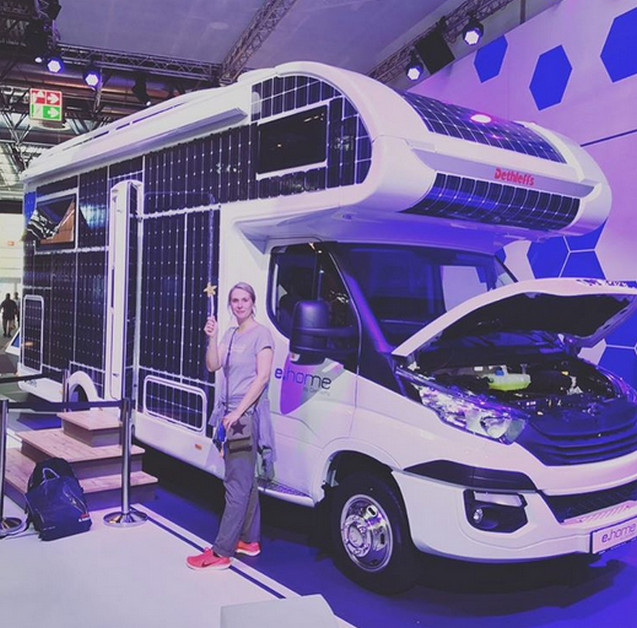
Dethleffs with solar cells everywhere. It is a prototype.
Where we’re going, we don’t need charging stations
The transportation industry is being flipped on its head by taking two of the most basic essentials—the driving experience and fuel—out of the equation entirely.
Self-driving vehicles and rechargeable technology is changing the landscape of driving.
That market has been expanding beyond everyday vehicles with advances in things like electric-powered semi trucks.
And we’ve seen the rise (and possible peak) of the tiny home market, where solar panels and other green technology is often utilized.
But motorhomes have been largely left out of this discussion.
That’s for understandable reasons.
A vehicle synonymous with the wide-open road (and, inherently at odds with the idea of frequent EV charging stations) has no obvious place in the electric market.
Until now.
Perhaps not in the real form, but definitely the future!
This is not just any electric vehicle
The popular RV company Dethleffs has its new “e.home” on display at this year’s Caravan Salon Düsseldorf 2017 through Sept. 3.
The unveiling comes just in time to steal the thunder from Volkswagen’s Kombi van announcement.
Keeping a motorhome and all its components powered up requires an extensive amount of energy.
To meet that requirement, Dethleffs has covered virtually every inch of the e.home with solar panels, similar to the European school with solar panels slathered on all its exterior walls.
The RV is built on the company’s Iveco Daily Electric chassis with a 107-horsepower electric motor.
The motorhome would have a range just shy of 100 miles if it wasn’t covered in solar panels, but it is.
Those babies can make up to 3,000 watts of electricity for its 228-Ah battery.
In other words, you’re all good to just keep on going.

The e.home is covered in solar panels and stars
The e.home utilizes Victron Energy products for the solar kit, including solar charge controllers, an inverter/charger for AC electricity and to charge the lithium batteries, ancillaries, and a DC-DC converter to supply charge stations for phones, laptops and the like.
The motorhome also features a sleek and modern design; circular wireless charging station; infrared heating panels on interior floors, furniture and walls; windows with darkening film between the panes; and a heating system that captures outside air on days warmer then 79 degrees, then sends it into the main cabin when the evening’s cooler air sets in.
Oh yeah—and a starlight projection system over the alcove bed.
“Dethleffs know this means a lot more than just putting bodywork on an electrically driven chassis,” Dethleffs Managing Director, Alexander Leopold, said in a Victron Energy release.
“By implementing a fully electric powertrain there are many challenges and equally opportunities for the entire vehicle.
“One significant opportunity is to do without any additional type of energy sources for the vehicle.
“This means that a motorhome with electric drive will also supply all the onboard services with electricity for the living area instead of gas, for example – and that is why solar power production becomes very important.”
No word yet on pre-orders or estimated cost, but this is absolutely an exciting step in the right direction.

Links

Lethal Heating is a citizens' initiative