Sunday, September 17, 2017

Turnbull Government Is Working On A Major Redesign Of The Clean Energy Target

Fairfax - James Massola

The Turnbull government is working on a major redesign of the clean energy target that will likely fall short of the plan for almost half of Australia's electricity to be generated by renewables by 2030.
Internal discussions have commenced about a revised target that would set a higher emissions baseline than the 0.6 tonnes of carbon per megawatt hour suggested by the Finkel review. The revised scheme would allow high-efficency, low-emission coal-fired power plants that emit about 0.7 tonnes of carbon to receive partial certificates, or credits.

Is the government conceding to the Nats?
The Turnbull government is working on redesigning the clean energy target with the Nationals preference to keep coal power plants operating.

Political hard-heads in the Coalition believe that if the government were to adopt the 42 per cent target proposed by Chief Scientist Alan Finkel, which is not far short of Labor's 50 per cent target, the government will not be able to win a fight that frames the opposition as the party of higher power prices at the next election.
As one MP put it, "if we were going to do Finkel's CET, it would be done already".
More broadly, a shift is now underway on energy policy within the government to fight Labor on the need for affordable, reliable base load power – a theme the prime minister regularly returns to – and appeal directly to households struggling with higher energy prices.
There are hopes the revised energy plan will be agreed to by the end of the year.
Meanwhile, Australian Energy Market Commission chairman John Pierce said the lack of a credible, long-term mechanism to achieve Australia's emissions reduction commitments has created uncertainty and deterred investment in the sector.
Labor attacked the government over power price rises under the Coalition's watch on Tuesday, while Opposition Leader Bill Shorten asked Mr Turnbull in Parliament on Tuesday "whatever happened to the clean energy target?"
Josh Frydenberg and Malcolm Turnbull in Parliament on Tuesday. Photo: Alex Ellinghausen
In comments that were widely noted by Coalition MPs, the Prime Minister said Dr Finkel's recommendation for a clean energy target was "under consideration" but that "we need to make sure that we get the energy market right this time".
"We need to ensure that the energy market design provides a suitable framework for investment that doesn't simply get new generation, but gets generation of the right kind," he said.
Clean energy target: Chief Scientist Alan Finkel. Photo: Daniel Munoz
This comment was interpreted as a sign that opposition to Dr Finkel's target from National Party and the conservative wing of the Liberal Party, which has hardened in recent weeks, will be heeded by Mr Turnbull and Energy and Environment Minister Josh Frydenberg.
Earlier on Tuesday during a meeting of the Coalition party room, former prime minister Tony Abbott congratulated Mr Turnbull and deputy Liberal leader Julie Bishop for their focus on cheaper power prices.
Andy Vesey from AGL in Canberra on Monday. Photo: Andrew Meares
But he added a rider backed by other Coalition MPs that "if we graft a clean energy target on top of the Renewable Energy Target, that will be a difficult position to sustain".
As a second MP put it, "Malcolm is saying he is only interested in outcomes. It's not that we won't have a CET, it's just secondary to having affordable, reliable power".
Mr Frydenberg has argued an Australian Energy Market Operator report released last week – which warned of a major shortfall in base load power triggered by the scheduled Liddell power plant closure in 2022 – has "reset the debate".
Following that report, the government ramped up pressure on AGL chief executive Andy Vesey to keep Liddell open beyond 2022, or sell it to a competitor – proposals Mr Vesey agreed on Monday to take to his board, along with a replacement renewables plan, in 90 days.
Mr Turnbull kept up the pressure on AGL, arguing the "most obvious" solution was to prolong the life of Liddell.
Deputy Prime Minister Barnaby Joyce, meanwhile, taunted the company to sell the Liddell plant – "if it's such a bad asset" – to one of its competitors during an interview on Sky News.
Mr Joyce said estimates of $500 million to $1 billion to keep Liddell going beyond 2022 were "in a good range" and added he knew of two parties who wanted to buy it, though he would not say who. Delta Electricity has already indicated a willingness to kick the tyres on the plant, which is Australia's oldest coal-fired plant.

Links

Revealing The Dark Side Of Liddell, From Power Failures To Distorted Debate

Fairfax - Peter Hannam

When AGL gives journalists a tour of its ailing Liddell power station next week, they can expect the reverse of your typical corporate junket.
Rather than showcasing the engineering marvels of the Hunter Valley coal-fired plant, the energy giant will likely highlight why the station is among the most unreliable generators in the country.
AGL Energy's Liddell power plant, with Lake Liddell in the foreground, and Bayswater power plant behind. Photo: Simone De Peak
That's despite AGL planning to spend another $160 million to keep the 46-year-old plant running until its planned closure in 2022.
It has already outlayed $120 million since buying it and its neighbour Bayswater power plant from the NSW government in 2014.
Each of Liddell's four units has been downgraded by almost one-fifth from their original 500-megawatt capacity.
Two of them were unhelpfully offline with equipment failures during this February's record-breaking heatwave that pushed NSW to the brink of blackouts.
Tuesday's visitors may get to see the tricky welding jobs needed to repair the hundreds of kilometres of boiler pipes, or to inspect one of the transmission units that has blown up. Or see a demonstration of "creep time" measurements that show the many valves or pumps edging ever closer to costly replacement.
Would that a few members of the federal Coalition demanding AGL extend the plant's life out to 2027 – led by Prime Minister Malcolm Turnbull or his deputy Barnaby Joyce – tag along on a tour that could include a peek at Lake Liddell.
Back to the future: AGL's pilot solar thermal plant on the Liddell site with the power station in the background.. Photo: Supplied
The lake, which substitutes for cooling towers that are absent at the power station, is now off limits to the public after the discovery of a brain-eating amoeba, naegleria fowleri, thought to be nurtured by artificially warmed waters.
What's transpired in the past week is what one senior energy industry executive describes as "mind numbing": government attempts to bully an ASX-listed company into selling an asset it bought from the state just three years ago if it would not commit to running it for another 10 years.

'Playing by the rules'
On Monday, as AGL chief Andy Vesey prepared to explain why it made no sense to keep the plant going, the Turnbull government announced it had sicked the Australian Energy Regulator on to AGL and other big NSW power firms to "make sure electricity generators are playing by the rules".
Environment and Energy Minister Josh Frydenberg later defended the move, saying the request was "an extension of the work already under way" as part of AER's review of the National Electricity Market (NEM) following the abrupt closure of Victoria's Hazelwood power station in March.
But the AER itself later confirmed to Fairfax Media the request arrived on Friday – after Vesey was summoned.
The Berejiklian government, which should have the most interest in any rorting of NSW consumers, is understood not to have been consulted about the sudden AER interest in NSW generators.
"This was not our idea," one staffer said. "It was a shot across the bows [of AGL]."
Vesey's encounters with politicians haven't gone well of late. In March, a media event in Adelaide descended into farce when South Australian Premier Jay Weatherill gatecrashed to confront Frydenberg over the Coalition's incessant attacks on his state's energy policies.
And it was at a Turnbull-ordered summit in Canberra last month that Vesey said Liddell might be sold to "a responsible owner", even the government.
Vesey would come to rue those words when a month later Turnbull flung himself into the fray, personally calling the chief and micro-managing the push to keep Liddell going.

Huge extension, rehab costs
Monday's gathering was described by one of those present as two meetings over 90 minutes: each side making their case and ignoring the other's in turn.
Despite initial government spin, AGL stood its ground, committing to deliver a plan within 90 days on how it would make up a market shortfall "once the Liddell coal-fired power station retires in 2022".
It is understood that AGL estimates the cost of keeping Liddell going for another five years at as much as half a billion dollars – money that could be better spent elsewhere. Rehabilitation costs for the site are roughly another $450 million.
AGL has said it wants to create a so-called synthetic baseload plant on the site combining gas and renewables. It already operates a pilot concentrated solar power plant there.
The energy executive noted the period is less than the government has had to consider Alan Finkel's review of energy security.
The independent study by Australia's Chief Scientist laid out 50 recommendations, 49 of which were readily endorsed by Turnbull. These included a demand operators give at least three years' notice before closing a plant; AGL gave seven.
While criticised for its low emissions target for the electricity sector, the report released in June at least offered the possibility of a so-called Clean Energy Target – the 50th recommendation– that might close the bipartisan gap on climate and energy policy.
Three months on, though, there are increasing signs the government will baulk at a target high enough to align energy policy with Australia's Paris climate commitments to cut 2005-level emissions 26-28 per cent by 2030.

'Prophetic'
Dr Finkel is understood to be growing more and more exasperated by the direction of debate.
Business groups, too, know that, without a policy that can withstand the election cycles, investors are going to hold off on the long-term investments needed to provide the more reliable, cheaper and cleaner energy Australia needs.
Joyce fuelled those concerns this week by declaring on ABC's 7.30 on Wednesday, that subsequent reports by the Australian Energy Market Operator (AEMO) had superseded Finkel.
"Without trying to be too prophetic, I was quoting John Maynard Keynes this morning who said, 'When I get new information I change my mind, what do you do?'" Joyce said, adding that AEMO had warned "we're going to be, you know 1000 megawatts short" this summer.
Turnbull chimed in during question time, too, saying that AEMO's reports "shocked many people".
Well, perhaps, those who wanted to be shocked.
One report was AEMO's latest "statement of opportunities", which as usual identified potential shortfalls that it hopes will jolt extra supply. There was also a special report on risks from the exit of Australia's ageing thermal power plants.
The latter was seized on by those mistaking "dispatchable" to always mean "fossil-fuelled baseload power".
Dylan McConnell, an energy researcher at Melbourne University, notes how fast-response batteries are far more instantly dispatchable than a coal-fired power plant.
The unplanned loss of a large unit at, for instance, Liddell during a late summer heatwave in February 2016, can also suddenly strip out a huge slab of supply - more abruptly than a drop in wind for a windfarm or a cloud passing over a solar farm. (See chart of Liddell's power supply on February 29, 2016.)

Conservative
AEMO's energy statement, meanwhile, raised the issue of the risk of Victoria and South Australia having outages this summer.
Its conservative estimates, though, exclude many of the measures already being undertaken by both states, agencies such as ARENA's trial paying consumers to power off during peak times, and most of the extra renewable energy coming on stream during the second half of the year.
Solar panels are going up at the rate of about 100MW a month, and will probably set an annual record of about 1300MW including plants this year, said Ric Brazzale from Green Energy Markets.
Notably, the prediction that NSW might suffer shortages in 2024-25 was used by many to call for Liddell's extension. But that AEMO alert was based on the "loss of an additional major power plant in NSW after Liddell withdraws" – not just Liddell itself.
And how big a risk of outages? A 29-46 per cent risk that "could last for two to six hours, depending on demand and supply conditions".
"It's so far out and so small," McConnell said, adding: "AEMO was not telling you anything you didn't know."

Climate factor
Just as lost in the squabble was AEMO's clarion call in the very first paragraph of its report: "The overall responsiveness and resilience of the system is at risk from increased vulnerability to climate events, such as extended periods of high temperatures, and the risk of loss of, or reduction in output of, major generation units."
That's worth keeping in mind when one considers how the owners of Delta Electricity - the only company to make even a vague offer of interest in taking over Liddell - fared during this year's February heat wave.
As AEMO noted in its incident report, Vales Point units came "within one degree of reaching their absolute outlet temperature limit".
Two gas-fired plants in NSW failed that hot February afternoon too. Keep that in mind when politicians necessarily equate fossil-fuel plants - particularly if nearing the end of their design life - to baseload reliability.

Links

Environmentalists Get Win In US Coal-Climate Change Lawsuit

ABC News America - Mead Gruver (Associated Press)

The Associated Press
Handing a major victory to environmentalists, a court cast doubt Friday on a longstanding U.S. government argument that blocking federal coal leasing won't affect climate change because the coal could simply be mined elsewhere.
Environmentalists have been trying for years to block federal coal leases on climate-change grounds with limited success.
The ruling by the 10th U.S. Circuit Court of Appeals will require the U.S. Bureau of Land Management to provide more data to support its argument that coal makes no net contribution to climate change after it's burned in power plants.
The BLM oversees leasing of vast Western tracts that supply much of the nation's coal.
"This is big. And we're certainly going to be wielding this and using it to confront other mining approvals both in the Powder River Basin and beyond," said Jeremy Nichols with WildEarth Guardians.
The Sierra Club and WildEarth Guardians sued to block four leases that would allow mining to continue at the Black Thunder and North Antelope Rochelle mine, the two biggest in the U.S. by production.
Both are in the Powder River Basin, where vast, open-pit mines supply around 40 percent of the nation's coal.
In analyzing the leases, the BLM found that burning the coal deposits would result in 382 million tons of carbon dioxide emissions annually, or about 6 percent of the U.S. total in 2008.
But the BLM argued that because utilities could simply get their coal from mines that don't lease federal deposits, blocking the leases would have no net effect on climate change.
The appeals court wasn't persuaded, ruling that the BLM didn't provide sufficient data to back up that argument. It told a lower court to seek more analysis from the agency.
In the meantime, mining will continue at three of the contested leases the BLM sold to Peabody Energy and Arch Coal, the St. Louis-based companies that own the two mines. A fourth contested lease near Black Thunder hasn't sold yet.
BLM officials didn't immediately return a message seeking comment. Wyoming Gov. Matt Mead, a staunch supporter of the coal industry, said he was disappointed in the ruling but pleased that mining could continue.
Wyoming Mining Association Director Travis Deti also called the ruling disappointing.
Wyoming's coal industry has rebounded somewhat since competition from cheaper natural gas made 2016 its worst year in decades.
Around 500 miners were laid off in the state's coal patch, and the state continues to face an inability to build new schools, which are funded by coal leasing.
"Wyoming can continue to cling to the past or get out ahead of these changes by producing the clean power that consumers are demanding," said Sierra Club Wyoming Director Connie Wilbert in a release.
The various times President Trump has touted 'clean coal'

Links

Saturday, September 16, 2017

How Antarctic Ice Melt Can Be A Tipping Point For The Whole Planet’s Climate

The Conversation - Chris Turney | Jonathan Palmer | Peter Kershaw | Steven Phipps | Zoë Thomas

Melting Antarctic ice can trigger effects on the other side of the globe. NASA/Jane Peterson
Melting of Antarctica’s ice can trigger rapid warming on the other side of the planet, according to our new research which details how just such an abrupt climate event happened 30,000 years ago, in which the North Atlantic region warmed dramatically.
This idea of “tipping points” in Earth’s system has had something of a bad rap ever since the 2004 blockbuster The Day After Tomorrow purportedly showed how melting polar ice can trigger all manner of global changes.
But while the movie certainly exaggerated the speed and severity of abrupt climate change, we do know that many natural systems are vulnerable to being pushed into different modes of operation. The melting of Greenland’s ice sheet, the retreat of Arctic summer sea ice, and the collapse of the global ocean circulation are all examples of potential vulnerability in a future, warmer world.
Of course it is notoriously hard to predict when and where elements of Earth’s system will abruptly tip into a different state. A key limitation is that historical climate records are often too short to test the skill of our computer models used to predict future environmental change, hampering our ability to plan for potential abrupt changes.
Fortunately, however, nature preserves a wealth of evidence in the landscape that allows us to understand how longer time-scale shifts can happen.

Core values
One of the most important sources of information on past climate tipping points are the kilometre-long cores of ice drilled from the Greenland and Antarctic ice sheets, which preserve exquisitely detailed information stretching back up to 800,000 years.
The Greenland ice cores record massive, millennial-scale swings in temperature that have occurred across the North Atlantic region over the past 90,000 years. The scale of these swings is staggering: in some cases temperatures rose by 16℃ in just a few decades or even years.
Twenty-five of these major so-called Dansgaard–Oeschger (D-O) warming events have been identified. These abrupt swings in temperature happened too quickly to have been caused by Earth’s slowly changing orbit around the Sun. Fascinatingly, when ice cores from Antarctica are compared with those from Greenland, we see a “seesaw” relationship: when it warms in the north, the south cools, and vice versa.
Attempts to explain the cause of this bipolar seesaw have traditionally focused on the North Atlantic region, and include melting ice sheets, changes in ocean circulation or wind patterns.
But as our new research shows, these might not be the only cause of D-O events.
Our new paper, published today in Nature Communications, suggests that another mechanism, with its origins in Antarctica, has also contributed to these rapid seesaws in global temperature.

Tree of knowledge
The 30,000-year-old key to climate secrets. Chris Turney, Author provided
We know that there have been major collapses of the Antarctic ice sheet in the past, raising the possibility that these may have tipped one or more parts of the Earth system into a different state. To investigate this idea, we analysed an ancient New Zealand kauri tree that was extracted from a peat swamp near Dargaville, Northland, and which lived between 29,000 and 31,000 years ago.
Through accurate dating, we know that this tree lived through a short D-O event, during which (as explained above) temperatures in the Northern Hemisphere would have risen. Importantly, the unique pattern of atmospheric radioactive carbon (or carbon-14) found in the tree rings allowed us to identify similar changes preserved in climate records from ocean and ice cores (the latter using beryllium-10, an isotope formed by similar processes to carbon-14). This tree thus allows us to compare directly what the climate was doing during a D-O event beyond the polar regions, providing a global picture.
The extraordinary thing we discovered is that the warm D-O event coincided with a 400-year period of surface cooling in the south and a major retreat of Antarctic ice.
When we searched through other climate records for more information about what was happening at the time, we found no evidence of a change in ocean circulation. Instead we found a collapse in the rain-bearing Pacific trade winds over tropical northeast Australia that was coincident with the 400-year southern cooling.
To explore how melting Antarctic ice might cause such dramatic change in the global climate, we used a climate model to simulate the release of large volumes of freshwater into the Southern Ocean. The model simulations all showed the same response, in agreement with our climate reconstructions: regardless of the amount of freshwater released into the Southern Ocean, the surface waters of the tropical Pacific nevertheless warmed, causing changes to wind patterns that in turn triggered the North Atlantic to warm too.
Future work is now focusing on what caused the Antarctic ice sheets to retreat so dramatically. Regardless of how it happened, it looks like melting ice in the south can drive abrupt global change, something of which we should be aware in a future warmer world.

Links

Massive Jump In Solar Energy Roll-Out Means Scarcity Fears Unfounded: Council

Fairfax - Peter Hannam

Official estimates of the risk of an electricity shortfall this summer are exaggerated because much more solar energy - as much as six times current large-scale capacity - is ready to be built, the Australian Solar Council says.
Completed large-scale plants total 310.8 megawatts,which will be dwarfed by the 2054 MW of large-scale solar photovoltaics (PV) plants that have secured finance and/or a power purchase agreement, the council says.
The Nyngan solar plant near Dubbo, NSW, built by AGL with government help, got the ball rolling on large-scale solar plants. Photo: Supplied
However, the project pipeline would put even that increase in the shade, with 10,266 MW in some part of the approval process.
"You have a massive build and development under way," John Grimes, the council's chief executive, said.
Solar PV plants are rolling out faster than regulators have forecast. Photo: Supplied
The short construction time for solar PV plants compared with other generation capacity - particularly coal - means the electricity market is unlikely to have the supply squeeze that the Australian Energy Market Operator (AEMO) identified in a report this month.
"You don't have an energy scarcity problem," Mr Grimes said. "What discussions you should be having is how you can have the infrastructure needed to bring the additional supply from areas such as north Queensland to major markets."
The Turnbull government this month seized on the AEMO report that indicated there was a risk Victoria and South Australia could face electricity shortages this summer.
AEMO also cited the planned closure of AGL's 1680 MW coal-fire power plant in the Hunter Valley as potentially bringing supply shortages to NSW in 2024-25 if other generation capacity were to close by then.
Critics of the AEMO forecast, though, have pointed out the shortage predictions exclude actions taken by all three states - and others - to meet electricity demand.
They also highlight that AEMO has failed to include clean energy supplies that are under construction or have financial close that will be added to the market.
Mr Grimes said economic forecasters had been wildly wrong, particularly when it came to estimating the falling cost and rising efficiency of solar PV.
For instance, the Bureau of Resources and Energy Economics forecast in 2009 that solar use would rise to 231 MW by 2017.
Instead, including rooftop PV on homes and businesses, it had reached about 6000 MW, Mr Grimes said.
Solar energy's advantages include plunging prices that make it the cheapest new capacity available, Australia's world-envied solar resource and now the support of states such as Queensland, Mr Grimes said.
The forecast failures are "a pattern that we see from our energy planners, and in the discussions in the parliamentary debate that seek to lock in coal", he said.
Walking away from renewables, as the Turnbull government seems to be doing, "is so far removed from reality",  Mr Grimes said.
Fairfax Media sought comment from AEMO.
Kane Thornton, chief executive of the Clean Energy Council, said solar's share of the renewable energy market is advancing faster than expected.
Just a couple of years ago, when the Renewable Energy Target was reset at a goal of 33,000 gigawatt-hours a year by 2020, the expected split between wind and solar was forecast at 75:25 for the 6000 MW of new capacity expected to be needed.
"But now it's looking like 50:50, and over time that spilt will just continue to grow" in solar's favour, Mr Thornton said.
"The reality is there is a real track record of this industry delivering more than forecast, more quickly," he said.

Links

China’s Renewable-Energy Revolution

Project Syndicate -  

Kevin Frayer/Getty Images
BEIJING – At the start of 2017, China announced that it would invest $360 billion in renewable energy by 2020 and scrap plans to build 85 coal-fired power plants. In March, Chinese authorities reported that the country was already exceeding official targets for energy efficiency, carbon intensity, and the share of clean energy sources. And just last month, China’s energy regulator, the National Energy Administration, rolled out new measures to reduce the country’s dependence on coal.
These are just the latest indicators that China is at the center of a global energy transformation, which is being driven by technological change and the falling cost of renewables. But China is not just investing in renewables and phasing out coal. It also accounts for a growing share of global energy demand, meaning that its economy’s continuing shift toward service- and consumption-led growth will reshape the resource sector worldwide.
At the same time, various other factors are reducing global resource consumption, including increased energy efficiency in residential, industrial, and commercial buildings, and lower demand for energy in transportation, owing to the proliferation of autonomous vehicles and ride sharing.
According to Beyond the Supercycle: How Technology Is Reshaping Resources, a new report from the McKinsey Global Institute (MGI), these trends are slowing the growth of primary energy demand. If rapid adoption of new technologies continues, that demand could peak in 2025. And with less intensive energy use and increased efficiency, energy productivity in the global economy could increase by 40-70% over the next two decades.
While global growth in energy demand is slowing, China’s share of that demand is increasing. By 2035, China may account for 28% of the world’s primary energy demand, up from 23% today, whereas the United States could account for just 12% by 2035, down from 16% today.
China has already made significant progress in reducing its resource intensity: between 1980 and 2010, its economy grew 18-fold, but its energy consumption grew only fivefold. According to World Bank data, that reflects a 70% decline in energy intensity per unit of GDP.
In its 13th Five-Year Plan, the Chinese government aims to reduce energy intensity by a total of 15% between 2016 and 2020. It is already well on its way toward achieving that goal. At China's National People’s Congress earlier this year, Chinese Premier Li Keqiang reported that China’s energy intensity fell by 5% last year alone.
Renewables are one reason for China’s declining resource intensity. Hoping to become a world leader in the field, China is already investing more than $100 billion in domestic renewables every year. That is twice the level of US investment in domestic renewable energy and more than the combined annual investment of the US and the European Union.
In addition, China is investing $32 billion – more than any other country – in renewables overseas, with top-tier Chinese companies increasingly taking the lead in global renewable-energy value chains. China’s State Grid Corporation has plans to develop an energy grid that draws on wind turbines and solar panels from around the world. Chinese solar-panel manufacturers are estimated to have a 20% cost advantage over their US peers, owing to economies of scale and more advanced supply-chain development. And Chinese wind-turbine manufacturers, having gradually closed technology gaps, now account for more than 90% of the Chinese domestic market, up from just 25% in 2002.
These trends suggest that China will be a major source of both energy demand and cutting-edge technology, implying that it will have a unique opportunity to provide global leadership. Its experience in reducing energy intensity can serve as a roadmap for developing countries. And its investments in renewables at home and abroad can lead to additional technological breakthroughs that drive down costs for consumers everywhere.
But China will also face challenges as it moves from fossil fuels to renewables within a changing global resource sector. Its economy is still highly dependent on coal, implying sizeable costs as it shifts capacity to other resources such as natural gas and renewables.
Moreover, the construction of solar panels and wind farms in China has outpaced upgrades to its electrical grid, creating a great deal of waste. And Chinese producers, like most others, are feeling increasing pressure to reduce costs and improve efficiency to make up for slower demand growth worldwide.
Despite these hurdles, technological innovation should help Chinese producers realize productivity gains and deliver savings to consumers. According to MGI, by 2035, changes in the supply and demand for major commodities could result in total cost savings of $900 billion to $1.6 trillion worldwide.
The scale of these savings will depend not only on how quickly new technology is adopted, but also on how policymakers and companies adapt to their new environment. But, above all, it will depend on China.

Links

Friday, September 15, 2017

Almost Every Country In The World Can Power Themselves With Renewable Energy

Popular Science - Kendra Pierre-Louis

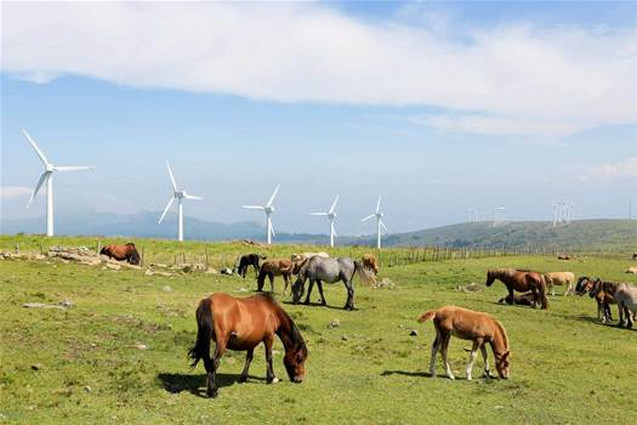
One of these horses is named Rocinante. DEPOSIT PHOTOS
Like in Australia, the USA's energy mix is under scrutiny. A report commissioned by US Energy Secretary Rick "I Once Said I Wanted to Abolish the Agency I Now Run" Perry acknowledges that low natural gas prices—not renewables—are behind the recent closure of coal energy plants, and that the grid has managed to withstand the increasing presence of renewable energy. According to an unrelated study published this week in the journal Joule, the world is poised to give up fossil fuels altogether.
The research lays out renewable energy roadmaps—the mix of resources a given country would need to transition away from fossil fuels to renewable energy—for 139 countries collectively responsible for more than 99 percent of the global carbon emissions. According to the resulting analysis, the planet is pretty much ready to go 100 percent renewable by 2050.
Fossil fuels like coal, natural gas, and oil are not renewable resources. It took an extremely long time for the Earth to produce them, and they're going to run out. And now that we know them to be significant contributors to human-caused climate change, trying to replace them is basically a no-brainer. Still, many regard renewable energy as the flighty, less dependable sibling of our go-to fossils. But according to the United States Energy Information Administration (EIA), renewable energy sources accounted for roughly 15 percent of total electricity generation and 10 percent of total U.S. energy consumption in 2016. Some of that investment in renewable energy is being led by places that we tend to associate with petroleum, like Texas, where wind energy provided more than 12 percent of that state's electricity in 2016.
Even the United States military has vowed to get 25 percent of its energy from renewable sources. And this is more practical than environmental: A hybrid electric tank uses less gas, and doesn't need to refuel as often. Also: solar panels don't explode the same way a gas tank does.But could the world really give up on fossil fuels entirely? Jacobson and his colleagues used available data to assess how much wind, geothermal, and solar energy each of the 139 countries they studied has at its disposal, and how much of that it would take to achieve 80 percent renewable energy usage by 2030 and 100 percent by 2050.
“Like anything, you don't want to change—and it's hard to change if something is working right now. But right now things are working with humongous side effects.”
“I was surprised by how many countries we found had sufficient resources to power themselves with 100 percent wind, water, and solar power,” says Jacobson. The countries could all function using the renewable energy potential contained within their own borders, and most could do it while relying mainly on technologies that already exist.
For small nation-states, like Singapore, the task of going totally renewable would be hard—but doable. Most countries could manage by mixing energy generation into existing landscapes—putting solar panels on rooftops, for example, or placing wind turbines on ranch land—while also creating dedicated renewable energy power plants like solar farms.
And according to the researchers, this process would actually decrease the amount of land dedicated to energy production overall.
“The entire renewable energy footprint [...] is on order of 1.15 to 1.2 percent of the world's land,” says Jacobson. “But keep in mind that 20 percent of the world's land is used for agriculture. In the United States, if you just look at oil and gas, there are 1.7 million active oil and gas wells and 2.3 million inactive wells. Collectively they take up somewhere between one to two percent of the U.S. land area. And that's not counting the refineries, the pipelines, or coal and nuclear infrastructure.”
And then there's the fact that we wouldn't have the oil spills and chemical leaks associated with transporting and refining fossil fuels. Renewable energies involve a relatively fixed amount of land use; wind and solar energy doesn't run out, so a solar farm erected today will still be pumping out electricity in a few decades. And even as those panels wear out, new ones can be erected on the same site. Coal seams run out and oil wells run dry, so we're constantly pressing new locations into service. Tens of thousands of new oil wells are drilled annually.
“We would reduce, we think, the footprint on the land,” says Jacobson.
The study builds on earlier research by Jacobson that analyzed the technological feasibility—and the socio-economic benefits—of switching to renewable energy. That research suggested that the gradual shift to 100 percent renewable energy would lower the social cost of energy, especially deaths associated with fossil fuel pollution.
“With oil and gas, you have to keep drilling and mining, and pollution keeps going on forever,” says Jacobson. “Worldwide, we have more than 4 million air pollution deaths from it. Things have to change—they're not sustainable as they are.”
He calculated that renewable energy could prevent 4.6 million premature deaths a year by 2050, simultaneously adding 24.3 million jobs to the economy. It would also save more than $50 trillion dollars a year in climate- and pollution-related costs.
The Solutions Project
The first major step is (literally) electrifying: if all energy sectors (including transportation, heating/cooling, industry, and agriculture) start running on electricity instead of gas and oil, a nation's overall energy usage goes down.
“When you're driving a car, only 17 to 20 percent of the energy in the gasoline goes to move the car. The rest is waste heat,” says Jacobson. “Whereas in an electric car, 80 to 86 percent of the electricity goes to move a car. You need one-fourth to one-fifth of the energy to drive an electric car than to drive a gasoline car.”
That's one reason why both France and Britain are pushing to ban all non-electric cars by 2040. Germany is working toward a ban on internal combustion engines by 2020.
“By electrifying everything, just doing that, the power demand will go down because of the efficiency of electricity,” says Jacobson. Averaged across sectors, there's a 23 percent reduction in energy demand just by switching to electricity. And when that electricity comes directly from renewable sources like solar and wind instead of coal, the savings keep getting better. According to Jacobson, 12.6 percent of global electric energy use goes toward mining, refining, and transporting fossil fuels (and uranium for nuclear power). Electrification plus a switch to renewables leads to a 36 percent reduction in demand—with no significant change in quality of life.
“We think a transition is possible and its beneficial in multiple ways, and there's little downside to a transition,” says Jacobson. “Like anything, you don't want to change—and it's hard to change if something is working right now. But right now things are working with humongous side effects.”

Links

Lethal Heating is a citizens' initiative