08/10/2017

Australia's Politics Only Barrier To Clean Energy System, Report Finds

The Guardian

Climate Council finds agreement among experts and authorities that there are no technological or economic obstacles to a grid powered by renewables
Only ‘political will’ is stopping Australia’s switch to a grid powered by renewable energy. Photograph: Owen Humphreys/PA
Politics is the only barrier to modernising Australia’s ageing electricity system, according to a synthesis report by the Climate Council.
The council found there was agreement among a series of major independent reports that there were no technological or economic barriers to a clean, secure, affordable and reliable grid.
The Climate Council report coincides with international law firm Pinsent Masons’ release of research findings that 90% of energy utility companies around the world are actively seeking acquisitions or joint ventures with companies that implement smart energy technologies like batteries, vehicle-to-grid technology and smart meters, but policy uncertainty is limiting investment in Australia.
Within a decade, more than one-third of Australia’s coal plants in the national electricity market will be more than 50 years old – after which the vast majority of coal plants fail to operate.
Reports by the independent operator of the grid, Aemo, CSIRO and the chief scientist, Alan Finkel, found there were no technical barriers to modernising the grid, the Climate Council report found.
“Combining low-cost wind and solar PV [photovoltaic] with other renewable energy technologies, such as solar thermal, hydro and biomass plants, can provide round-the-clock or on-demand power, as well as meeting technical requirements for grid stability,” said the report, authored by Andrew Stock, a Climate Council councillor who previously spent four decades in the energy industry.
The report said combining those technologies with grid-scale batteries, pumped hydro and heat storage would would increase the reliability of the system, as well as add competition to the market.
There was also a large degree of consensus among the surveyed reports that modernising the system in that way would increase reliability in the face of climate change and increased extreme weather.
Relying on a large number of smaller distributed renewable generators, rather than a small number of massive fossil-fuel generators, meant single outages in the system caused by wild weather would be less disruptive.
“Generating and storing power closer to where it is needed – for example, using solar and storage technologies – can reduce risks of grid failure for critical infrastructure,” the Climate Council report said.
The surveyed reports also found renewable energy would push down energy prices for consumers. One CSIRO report this year concluded a zero-emissions grid by 2050 would save the average household $414 a year compared with a business-as-usual approach.
“There’s no disputing it – fossil-fuel technology is obsolete, expensive and unreliable,” Stock said. “It’s time to look to the future with an energy system fit for the 21st century.”
The prime minister, Malcolm Turnbull, and the minister for the environment and energy, Josh Frydenberg, have been unable to get a climate and energy policy through the party room, leaving the industry in limbo.
This means businesses have been discouraged from investing in new electricity generation because the federal government can give them no confidence about future policy that would affect their investments.
The Climate Council chief executive, Amanda McKenzie, said the lack of a bipartisan policy was the only barrier remaining.
“The nation’s leading energy experts, scientists and major authorities are all in agreement – Australia is ready to switch to a modern grid, powered by renewables and storage,” she said. “However, the only thing stopping this is political will.”
The vast majority of large energy companies globally also appear keen to invest millions in smart-grid technologies that would enable the transition. Pinsent Masons surveyed 250 senior-level executives from 200 energy generation and distribution companies (and investors in those markets) with revenues over US$1bn across Europe, the Middle East, Africa and the Asia Pacific.
The firm found 90% of the utility companies in the survey were planning a joint venture with, or an acquisition of, a smart-grid technology company.
Australia was among the top five countries that the surveyed businesses were targeting for investment, but was being limited by lack of policy clarity.
Uncertainty and lack of legislation were highlighted as the biggest investment blockers for 13% of utilities in the survey.
Nordic countries took the top place for attractiveness for investment, partly because energy policies there were clear.
“The Nordics are not only ahead in the technology bit, but their policies are also the best,” said one investor quoted in the report. “They have gradually changed their energy consumption and have successfully achieved their transformation targets, which are just increasing year-on-year as their policies are in favour of consumers. Businesses are benefiting either way with growth and rising interests of new consumers.”
A chief financial officer of an Australian utility was quoted as saying: “Countries without a cohesive energy policy are usually in turmoil when it comes to issues around energy distribution and management. For an investor looking to enter that market with smart energy solutions, it means a lot of uncertainty.”

Links

Protect Indigenous People To Help Fight Climate Change, Says UN Rapporteur

The Guardian

World leaders must do more to defend custodians of natural world whose lives are at risk from big business, says UN rapporteur Victoria Tauli-Corpuz
Native Americans march to a sacred burial ground disturbed by bulldozers building the Dakota Access Pipeline. Protesters were attacked by dogs and sprayed with a respiratory irritant when they arrived at the site. Photograph: Robyn Beck/AFP/Getty Images
Global leaders must do more to protect indigenous people fighting to protect their land and way of life if the world is to limit climate change, according to the UN special rapporteur Victoria Tauli-Corpuz.
Speaking ahead of key climate talks in Bonn next month she urged politicians to recognise that indigenous communities around the world were the most effective custodians of millions of hectares of forest “which act as the world’s lungs”.
“Indigenous people’s rights need to be protected in the best way possible, not just for them but because they are also able to provide solutions to many of the world’s problems from climate change to biological diversity.
“It is in the self interest of states and even corporations in the medium and long term to protect and listen to these people – the question is, will they realise this in time?” said Tauli-Corpuz.
A recent study found that a quarter of the carbon stored above ground in the world’s tropical forests is found in the collectively managed territories of indigenous peoples and local communities.
In Brazil, deforestation in indigenous community forests from 2000 to 2012 was less than 1%, compared to 7% outside those areas.
“They are the most effective stewards of these key areas,” said Tauli-Corpuz. “The needs of these indigenous people are converging with the wider environmental needs to protect these areas.”
Indigenous people are locked in fierce conflicts with mining, logging and agricultural companies and their private security firms in hundreds of places from Indonesia to Brazil. 2016 was the deadliest year on record for land rights defenders with about 200 people killed in conflicts in Latin America, Africa and Asia. In addition, thousands more community activists were threatened or harassed. A Guardian project working with Global Witness is highlighting the pressure many of these groups face and has identified at least 134 people who have been killed so far this year.
Tauli-Corpuz, who was speaking at the launch of a new global institution dedicated to securing the land rights of tens of millions of indigenous people, said there was an atmosphere of fear and intimidation in many of these communities.
The event in Stockholm was the official launch of the International Land and Forest Tenure Facility which aims to help communities protect their land resources as well as combat climate change.
Funded by Sweden, Norway and the Ford Foundation, a US charity, the Tenure Facility, has already provided grants and guidance for pilot projects in six nations.
The Ford Foundation president Darren Walker said it was an important development in the fight against climate change and inequality. “Creating mechanisms that allow indigenous peoples and local communities to gain tenure over their land or forests is a way to tackle both these problems.”
Rukka Sombolinggi represents 17 million people in Indonesia: “Our houses are being burnt down, people are being killed, tortured, and sent to jail .” Photograph: Roberto Cenciarelli/FAO
The Ford Foundation has pledged $5m, and Norway has announced a grant of $20m over the coming years. Sweden pitched in $10m during the pilot phase and will fund future projects. Walker said he expects donations to rise to $100m overall within a year.
The project aims to boost forestland properly titled to indigenous peoples by 40m hectares, an area twice the size of Spain, within a decade. Organisers say this would prevent deforestation of 1m hectares and the release of 500m tonnes of CO2, more than the annual emissions of Britain or Brazil.
Indigenous leaders representing tens of millions of people involved in land disputes in Asia, Africa and South America attended the conference. They said the tenure programme was an important step towards stopping the persecution of indigenous communities – but warned more needs to be done.
Rukka Sombolinggi, the first female secretary-general of the world’s largest indigenous organisation, Aman, which represents 17 million people in Indonesia, said: “Our houses are being burnt down, people are being killed, tortured, and sent to jail as we speak.”
Sombolinggi said some progress had been made, with much of the forests where indigenous communities live in Indonesia mapped for the first time. And she said “dominant communities” would benefit, not only environmentally from more rights for indigenous people, but argued they could also learn important lessons from the way many of these groups lived.
“If we want to see the beautiful centuries ahead … we need to shift our paradigm of what constitutes wealth or prosperity because too many people see happiness only in terms of material goods and achievements and it is having a devastating impact. Many of us have lost our ability to connect with natural things and no longer seem able to live in harmony with the simple happiness around us.”

Links

Most Australians Oppose Adani Mine, Poll Shows, Amid National Protests

The Guardian - Michael Slezak

Thousands of people gather at 40 locations across the country on Saturday as part of the Stop Adani Alliance
People form a sign at Nobby’s Beach in Newcastle as part of the Stop Adani protest. Photograph: Ryan Jago
New polling shows the majority of Australians oppose Adani’s proposed Carmichael coalmine going ahead, and an even bigger number are against Queensland allowing the company to receive a $1bn federal loan.
The polling, commissioned by the Stop Adani Alliance, was released on Saturday as thousands of people are expected to attend rallies at dozens of locations around the country, expressing their opposition to the project.
The ReachTel survey of almost 2,200 people across Australia found 55.6% of respondents opposed the mine going ahead. That was more than twice the number who supported the mine, with 18.4% of respondents saying they were “undecided”.
Support for Adani coalmine going ahead
Question: “Indian mining company Adani wants to build a new coal mine in Queensland, which it argues will create local employment opportunities, but concerns have been raised about the company’s corporate track record and the impact of the mine on the environment. Do you support or oppose the Adani coal mine going ahead?”
Guardian graphic | Source: ReachTEL
When told that the Queensland premier, Annastacia Palaszczuk, had made an election commitment not to spend public funds on Adani’s project, 65.8% of those polled said she should use her power to veto the possible $1bn loan the federal government might give the project through the Northern Australian Infrastructure Facility (Naif).
That view was unanimous across voters of all persuasions – respondents who said they voted Liberal, National, Labor, Green, One Nation, Australian Conservatives, as well as those who were undecided, were all more likely to think Palaszczuk should veto the loan.

Should the Queensland government veto any $1bn federal loan to Adani?
Question: “The Queensland Premier made an election commitment that her Labor government would not spend public funds on Adani’s private rail line for their coal mine. Should the Queensland government keep its promise and use the power is has to veto the federal government loan of $1 billion to Adani for the rail line?”
Guardian graphic | Source: ReachTEL
Support for the mine to go ahead was extremely divided among backers of different political parties.
Australian Conservative voters were the only group with clear support for the mine, with 57% saying they backed it.
Liberal voters were almost split down the middle – 39.3% backed the mine and 34.1% opposed it, while 25.7% were undecided.
A clear majority of most other voters opposed the mine proceeding – 69% of Labor, 58% of National and 90% of Greens voters. Among the One Nation voters, more opposed the mine going ahead (44.9%) than supported it (37.7%).
The polling follows earlier surveys showing similar numbers, including one commissioned by GetUp in January, finding that three-quarters of respondents believed a loan to Adani was not a good use of public money. And polling by The Australia Institute in May found 59% of Queensland voters were opposed to any state or federal assistance for the mine.
Federal Labor has had some divisions over the question of whether to support the mine and the Greens have sought to push them to say they will review any commonwealth funding for it.
The Greens are launching their Queensland state election campaign today, which will focus on opposition to the Adani mine, and place the heat on Queensland Labor for its strong support to the mine.
Protesters wearing masks depicting Malcolm Turnbull and Gautam Adani at Sydney’s Bondi beach. Photograph: Dan Himbrechts/AAP
Members of the Stop Adani Alliance – which comprises more than 30 environment groups – began to gather at 40 protests around the country on Saturday.
They plan to spell out “Stop Adani” in “human signs” at beaches and other prominent locations around the country.
“While the Queensland and federal governments remain staunch supporters of this dirty mine, new polling shows the Australian community is angry that $1bn of public money could be handed to Adani for a mine which will wreck the climate and the Reef,” said Blair Palese, chief executive of 350.org Australia.
“Voters are clear. They believe the Queensland government should stick to its promise and block the $1bn loan to billionaire Adani for his private rail line.”

Links

07/10/2017

Australians Endured ‘Exceptional Heat’ During September

NEWS.com.au - Benedict Brook and AAP

IT’S not often you see brown on the weather map, but it’s not often you get weather like this either. The Bureau of Meteorology says it’s really not good.

New climate study warns of 50 degree days

IT WAS almost two weeks ago, but you may remember Friday September 22. Weather-wise it has now gone down in history.
The 22nd was the hottest-ever September day, with more than a fifth of the country setting new highs.
The mean maximum temperature on September 22 was 33.47C — more than six degrees warmer than the month’s average, the Bureau of Meteorology said in a special climate statement published on Thursday.
A map of climate anomalies on 22 September 2017. Areas coloured red or brown is at least 8C above the average temperature. Picture: Bureau of Meteorology special climate statement. Source:Supplied
It broke the previous record set on the last day of September in 1998 of 33.39C and was the warmest since records began in 1911.
The Bureau said the heat during September was “exceptional” and much of it was caused by a high-pressure system centred over New South Wales and the Tasman Sea that kept large parts of eastern and northern Australia mostly cloud free.
Low rainfall and parched soil led the sunny weather to rapidly heat the land surface and overlying air.
NSW on September 23 showing the maximum temperature difference from the long-term average. Picture: Bureau of Meteorology special climate statement maps. Source:Supplied
NSW and Queensland experienced their hottest September days on record the following week, while South Australia, Victoria and the Northern Territory each had days in their top 10 warmest for September.
“More than 20 per cent of Australia by area recorded its hottest September day on record during 22-29 September,” the Bureau said.
NSW as a whole experienced its hottest September day on record on September 23, with a mean maximum temperature of 35.81C — more than 1.5C above the previous mark and nearly 15C warmer than the long-term average.
The Bureau noted that spring has warmed by around one degree since 1910 across Australia, consistent with what’s been observed around the world. “Studies undertaken by the Bureau and other scientific institutions have shown that climate change has contributed to the severity and frequency of recent heat events, including spring warmth,” it said.

Links

A Lack Of Action On Climate Change Is Putting People's Lives At Risk

The Guardian*

In the 2014 Melbourne heatwave, 167 people died. Emergency departments can’t deal with this problem alone
‘What we also know from the heatwaves we have seen in Australia thus far is that we can expect a very significant impact on our public health system.’ Photograph: Torsten Blackwood/AFP/Getty Images
A new study warning Australia’s major cities are likely to reach highs of 50C by 2040 – even if the world meets its target of limiting warming to 2C above pre-industrial levels – is yet more evidence that without immediate and urgent action we are facing a looming public health crisis during heatwaves and other extreme weather events.
The study follows recent unseasonable heat across New South Wales, with Sydney experiencing its hottest ever September day, as well as the doubling of record-breaking summer temperatures in Australia in the past 50 years. This new normal has hospital health professionals particularly bracing for the coming summer.
Public Australian emergency departments are tough places to both work and be a patient. They are hectic, often overwhelmed, not infrequently threatening environments that are emotionally demanding for everyone. And, with ever increasing demand and an ageing population, along with a politically-sensitive health budget, the emergency department is increasingly the public face of a stressed health system.
Every day, sometime around 11am, the ambulances roll in. This is when we see the presentation rate suddenly increase, commonly bringing a new patient every three to four minutes, a rate that will continue until 10-11pm every evening. Generally during this 11 to 12 hour period we see two-thirds of our presentations. This is the time that the department heaves.
During this period, on any given day, the resuscitation area will be full. A delirious elderly patient with septicaemia will be lying alongside someone with chest pain who may be next to a psychotic methamphetamine-intoxicated patient screaming abuse as they are restrained by security and clinical staff, while a full resuscitation of an out of hospital cardiac arrest or a major trauma takes place in a nearby bay.
Monitor alarms will be going off continuously, the sounds broken by an ambulance priority-one call coming through, while medical and nursing staff will be moving from one patient to the next as quickly as possible, trying to keep on top of the deteriorating patients around them. And soon enough ambulances will be banking up outside the front door as the department exceeds its capacity to deal with the influx, kept from being on the road responding to emergencies as they wait to offload their patients.
While all this is going on, the inpatient units are being pushed to discharge as many patients, as early as possible in the day, to make capacity for the admissions that will come, both as emergency and elective surgical patients. All of this has to happen, has to work to an optimal level to deal with the demand of any usual day in our public health system.
Are we going to take the health of our population and our ecosystem seriously ...?
Now let us add to this day three of a heatwave (defined as three or more days of high maximum temperatures). With climate change causing a gradual increase in average temperatures, we know that heatwaves are more frequent and of increasing severity.
What we also know from the heatwaves we have seen in Australia thus far is that we can expect a very significant impact on our public health system. Increases of up to 25% for ambulance emergency call outs; up to 60% increase in emergency department resuscitation cases, often in the elderly and vulnerable members of our society; an overall increase in presentations to our already overstretched emergency departments; and an increase in overall deaths ranging from 13% to 24%. In the 2014 Melbourne heatwave, that equated to 167 excess deaths.
One hundred and sixty seven deaths. If that had been a fire, or explosion, or heaven forbid a terrorist attack, it would be a national disaster that would be in the public eye for days. Yet it will happen reliably with every major heatwave event, and we barely bat an eyelid.
These issues are discussed in an article in the current edition of the Medical Journal of Australia, which I co-authored with former Australian of the Year, Professor Fiona Stanley, and public health physician, Dr Marion Carey.
And it is not just these direct consequences that are significant. There is always a huge demand on public hospital beds, many hospitals running at or beyond a level of occupancy that allows for efficient systems. What this means is that even without additional burdens such as heatwaves, it is a constant struggle to create capacity for those who need admission. Events such as heatwaves only exacerbate this pressure, resulting in reduced access for all patients, not just those affected by heat-related illness.
So, with the prospect of increasing extreme weather along with the so many other challenges of climate change we have some serious questions to address.
Are we going to take the health of our population and our ecosystem seriously and do everything we can to mitigate the inevitable increase in ambient temperature? How do we minimise the completely unacceptable mortality rates that we are already seeing, and what do we do to invest in our health systems to cope with what will be an ever increasing burden?
These are challenges that require immediate, mid and long-term solutions, challenges that we need to see taken seriously by the government of the day.

*Dr Mark Monaghan is an emergency physician and a member of Doctors for the Environment Australia

Links

Time To Shine: Solar Power Is Fastest-Growing Source Of New Energy

The Guardian

Renewables accounted for two-thirds of new power added to world’s grids last year, says International Energy Agency
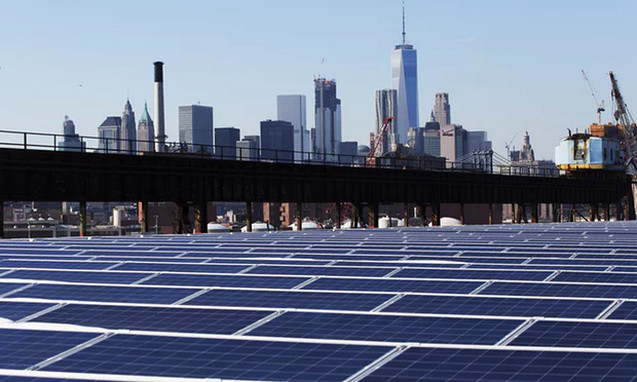
A rooftop covered with solar panels at the Brooklyn Navy Yard in New York. The US is still the second fastest-growing market for renewables despite Donald Trump’s pledge to revive coal. Photograph: Mark Lennihan/AP
Solar power was the fastest-growing source of new energy worldwide last year, outstripping the growth in all other forms of power generation for the first time and leading experts to hail a “new era”.
Renewable energy accounted for two-thirds of new power added to the world’s grids in 2016, the International Energy Agency said, but the group found solar was the technology that shone brightest.
New solar capacity even overtook the net growth in coal, previously the biggest new source of power generation. The shift was driven by falling prices and government policies, particularly in China, which accounted for almost half the solar panels installed.
The Paris-based IEA predicted that solar would dominate future growth, with global capacity in five years’ time expected to be greater than the current combined total power capacity of India and Japan.
Dr Fatih Birol, the executive director of the IEA, said: “What we are witnessing is the birth of a new era in solar photovoltaics [PV]. We expect that solar PV capacity growth will be higher than any other renewable technology up to 2022.”
The authority, which is funded by 28 member governments, admitted it had previously underestimated the speed at which green energy was growing.
The amount of renewable energy capacity forecast globally in 2022 has been revised upwards on last year’s forecast, driven by the IEA expecting a third more solar in China and India.
Wind turbines and solar panels in Yancheng, Jiangsu province of China. The China is the world’s fastest-growing market for renewables. Photograph: VCG via Getty Images
While China dominates the expansion of renewables, the US is still the second fastest-growing market despite Donald Trump’s pledge to revive coal and the uncertainties he has brought at a federal level.
Paolo Frankl, head of the renewable energy division at the IEA, said that solar and wind subsidies and other fundamentals meant the president’s impact would probably be limited.
However, that could change if there were reforms that retrospectively hit the subsidies or if the US International Trade Commission imposes tariffs on imports of Chinese solar panels. “There is a risk, but at the moment our forecast remains strong,” said Frankl.
India is set for a solar boom over the next five years, as bottlenecks such as integrating solar farms with the grid are overcome. The country’s renewable energy capacity is forecast to double by 2022, overtaking the EU on growth.
The picture for the UK is a “mixed message,” said Frankl. The IEA has revised downward its forecast for the amount of green energy to be built in the UK between 2017 and 2022, with offshore windfarms expected to account for most of the growth.
Despite the recent opening of the UK’s first subsidy-free solar farm, the prospects for British solar are fairly gloomy: the amount of solar forecast to be installed by 2022 is a fifth of the amount installed over the last five years.
The report found that renewables are becoming increasingly comparable to fossil fuels on price, with wind and solar projects setting record low prices in government auctions.
“Renewables may well become even cheaper than fossil fuel alternatives [over the next five years]. However, be careful because this does not automatically mean they are competitive and investment will flow. That depends on the risk of investment and whether remuneration flows make a project bankable or not,” said Frankl.
The growth in renewable power will be twice as large as gas and coal combined over the next five years, the IEA said. While that will take renewables’ share of electricity generation from 24% last year to 30% in 2022, coal will still be the biggest source of power.
The increasing scale of wind and solar power, and their intermittent nature at a local level, means that integrating them with power grids has become critical, the IEA said. Countries will need to bring forward policies that make grids more flexible, such as batteries and managing demand at peak times, it suggested.
One energy expert said that the IEA report was, if anything, underestimating the speed of renewables’ growth and the impact of them becoming so cheap.
Tim Buckley, director of energy finance studies at Australia-based analysts IEEFA, said: “2016 was another record high year of renewable installs and unexpectedly large renewable energy cost deflation, again highlighting the IEA’s continued underestimation of both these two trends driving the increasingly global market transformation.”

Links

06/10/2017

Trump Takes A First Step Toward Scrapping Obama’s Global Warming Policy

New York Times -

A power plant in Homer City, Pa. President Trump has vowed since the campaign to repeal the Clean Power Plan, which was designed to reduce emissions from the power sector. Credit Keith Srakocic/Associated Press 
WASHINGTON — The Trump administration will repeal the Clean Power Plan, the centerpiece of President Obama’s effort to fight climate change, and will ask the public to recommend ways it could be replaced, according to an internal E.P.A. document.
The draft proposal represents the administration’s first substantive step toward rolling back the plan, which was designed to curb greenhouse gas emissions from the power sector, after months of presidential tweets and condemnations of Mr. Obama’s efforts to reduce climate-warming pollution.
But it also lays the groundwork for new, presumably weaker, regulations by asking for the public and industry to offer ideas for a replacement.
The E.P.A. document, “October 2017 Tiering List,” lays out upcoming policy issues of high priority for the agency’s office of air and radiation, which oversees air pollution policies.
“The agency is issuing a proposal to repeal the rule,” the document states. It says the agency will issue a formal notice of its intention to develop a new rule “similarly intended to reduce carbon dioxide emissions from existing fossil-fueled electric utility generating units and to solicit information for the agency to consider in developing such a rule.”
The document does not explain how the Environmental Protection Agency will justify to the courts the decision to eliminate the regulation. Several industry attorneys familiar with the agency’s plans said they expected Mr. Pruitt to argue that the Obama administration relied on an overly-broad reading of federal clean air laws in writing the Clean Power Plan.
President Trump has vowed since the campaign to “get rid” of the Obama-era environmental regulations. He has called the Clean Power Plan “stupid” and “job killing,” and in an executive order issued in March he directed Scott Pruitt, the E.P.A. administrator, to dismantle the rules. Last month, Mr. Trump appeared to claim he had already done so, telling a crowd in Alabama, “Did you see what I did to that? Boom, gone.”
Killing the regulation also has been a high priority for Mr. Pruitt, who as attorney general of Oklahoma sued to overturn it in court.
But in recent weeks industry groups have pressed the Trump administration to fashion a new, narrower measure in its stead. Many have argued that creating such a replacement, rather than simply repealing the Clean Power Plan, is necessary to avoid lawsuits. Under a landmark agency determination known as the endangerment finding, the E.P.A. is required to regulate carbon emissions.
Mr. Pruitt has been under pressure from interest groups that deny the scientific consensus on climate change — that it is occurring and caused by human emissions — to overturn that determination. The E.P.A. document does not indicate Mr. Pruitt’s plans, but creating a new regulation implicitly accepts that the federal government has a role in addressing the reduction of carbon dioxide.
It remains unclear when the agency will formally repeal the rule. Liz Bowman, an E.P.A. spokeswoman, declined to comment on the document or plans for the rule.
The Clean Power Plan, which required states to cut greenhouse gas emissions from existing power plants by 32 percent by 2030 relative to 2005 has been tied up in litigation. The United States Court of Appeals for the District of Columbia had set an Oct. 7 deadline for the E.P.A. to show progress in its decision-making.
Brian Deese, who served as a senior adviser on climate change to Mr. Obama, said the E.P.A. was buying time. Asking the public for ideas, he said, is what an agency does when it is uncertain about how to proceed. Consideration of a new regulation could take months or even years, he said.
“They’re trying to walk this tightrope,” Mr. Deese said.

Links

Lethal Heating is a citizens' initiative