10/01/2018

BOM Annual Climate Statement Shows 2017 Was Australia's Third-Warmest Year On Record“

ABC NewsKate Doyle

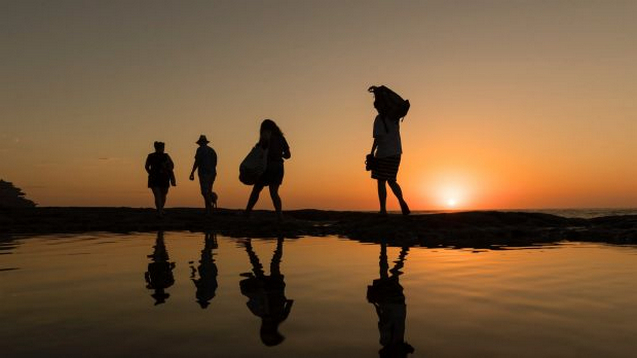
A wet beginning and end of the year bookended a warm, dry winter in 2017. (ABC Open contributor FrancesJones)
 Key Points
  • Third warmest year on record despite no El Nino
  • Seven of the 10 hottest years have occurred since 2005
  • Rainfall 8 per cent above the 1961 to 1990 average, but dry over winter
The Bureau of Meteorology (BOM) has confirmed 2017 was Australia's third-warmest year on record, with temperatures almost a degree above the 1961 to 1990 average.
With a rundown of the year's temperatures, rainfall, climate drivers, major weather events and enough maps to make an atlas, the Annual Climate Statement is a late Christmas present for weather lovers.
In 2017 the main climate drivers, the Indian Ocean Dipole and the El Nino Southern Oscillation, were in neutral for much of the year.
But despite there being no El Nino, usually associated with warm temperatures, 2017 was still the third-warmest national mean temperature on record, at 0.95 degrees above the 1961 to 1990 average.
Karl Braganza, BOM's head of climate monitoring, said the figures showed how much Australia had warmed.
The average daily maximums over 2017 were above the 1961 to 1990 average for most of Australia, especially in south-west Queensland and north-west New South Wales. (Supplied: Bureau of Meteorology)
"We have seen that warming across the land surface temperatures and in the ocean surrounding Australia, so they have both warmed by a similar amount and that's consistent with global warming as well," he said.
Seven of the 10 warmest years on record have been recorded since 2005 and only one year was below the 1961 to 1990 average in the past decade.
"Odds [now] favour warmer-than-average temperatures more often than in the past," Dr Braganza said.


Links

Exxon Prepares To Sue California Cities, Says They Contradict Themselves On Climate Change

Forbes - John O'Brien

ExxonMobil is apparently planning to sue the California cities and counties that have sued it over climate change, alleging they must be lying in their lawsuits or misleading potential investors in bond offerings. (AP Photo/Matthew Brown)
Some government officials in California are hypocrites pushing a political agenda that involves using private lawyers to sue and demonize ExxonMobil, the company is now arguing in a Texas state court.
On Jan. 8, Exxon took the first step towards suing those who orchestrated climate change lawsuits in California by asking the Tarrant County District Court to allow it to question an assortment of government officials and a Hagens Berman lawyer. The company says those local officials are talking out of both sides of their mouths – blaming Exxon for an impending flooding disaster while not disclosing that alleged threat to possible investors in their bond offerings.
In 2017, the counties of Marin, Santa Cruz and San Mateo and the cities of San Francisco, Oakland, Santa Cruz and Imperial Beach filed suit against dozens of energy companies, including Exxon and 17 other Texas-based businesses, over climate change. The company has previously been targeted by the attorneys general of Massachusetts and New York.
“It is reasonable to infer that the municipalities brought these lawsuits not because of a bona fide belief in any tortious conduct by the defendants or actual damage to their jurisdictions, but instead to coerce ExxonMobil and others operating in the Texas energy sector to adopt policies aligned with those favored by local politicians in California,” attorneys for the company wrote.
In doing so, they must have lied to potential investors in their respective bond offerings, the company claims.
Statements made to potential investors contradict allegations made by the municipalities when they sued the energy industry, the filing says. For example:
  • San Mateo County’s complaint says it is “particularly vulnerable to sea level rise” and that there is a 93% chance the county experiences a “devastating” flood before 2050. However, bond offerings in 2014 and 2016 noted that the county “is unable to predict whether sea-level rise or other impacts of climate change or flooding from a major storm will occur.”
  • Imperial Beach alleged a similar danger from sea level rise, claiming coastal flooding will cause more than $38 million in damages and its economic vulnerability is valued at more than $106 million. However, Exxon says, the city has never warned investors that such disasters await.
  • Marin County alleges a 99% risk it will experience a devastating flood before 2050 in its lawsuit but has not disclosed that to investors in bond offerings, Exxon says.
The company makes similar claims about the lawsuits filed by San Francisco, Santa Cruz city and county and Oakland.
“In 2014 and 2017, San Francisco circulated bond offerings for its Municipal Transportation Agency that do not even contain the words ‘global warming’ or ‘climate change,’” Exxon’s petition says.
“The word ‘flood’ appears only once in these bond offerings – to disclose the absence of ‘insurance policies covering earthquake, flood, environmental pollution or other, similar risks.’”
Exxon goes on to call the municipalities “eager consumers of energy” that emit substantial amounts of greenhouse gases.
Exxon believes 16 individuals possess evidence that would allow it to file a lawsuit that would likely contain a claim for civil conspiracy.
Notable among the group is Matt Pawa, a Hagens Berman attorney instrumental in creating a “playbook” discussed at a conference in La Jolla, CA, and carried out by the AGs of New York and Massachusetts and the California local governments, Exxon says. He represents San Francisco and Oakland in their lawsuits.
Exxon has also been locked in a dispute with New York AG Eric Schneiderman and Massachusetts AG Maura Healey. Those AGs have issued subpoenas to the company as they investigate whether it misled investors about its impact on climate change.
A recent Times Union article showed that Schneiderman invested between $50,000 to $75,000 in Vanguard Energy ETF. That fund’s biggest holding is Exxon.
“A collection of special interests and opportunistic politicians are abusing law enforcement authority and legal process to impose their viewpoint on climate change,” Exxon says.
“This conspiracy emerged out of frustration in New York, Massachusetts and California with voters in other parts of the country and with the federal government for failing to adopt their preferred policies on climate change.
“But rather than focusing their efforts in the marketplace of ideas and adopting a strategy of persuasion, the members of this conspiracy chose to advance their political objectives by imposing unlawful burdens on perceived political opponents.”
Exxon filed suit in Texas federal court in response to the subpoenas issued by Schneiderman and Healey. It has since been transferred to New York and remains pending.
“The Court is uncertain if it is common practice for attorneys general to begin to investigate a company after reading an article that accuses a company of possibly committing wrongdoing decades ago,” U.S. District Judge Ed Kinkeade wrote when he sent the suit to New York because that’s where Schneiderman held a press conference to announce his investigation.
“What the Court does know is that Exxon has publicly acknowledged since 2006 the possible significant risks to society and ecosystems from rising greenhouse gas emissions, yet the attorneys general have only recently felt compelled to look further into Exxon’s documents from the last 40 years to see if Exxon knew more than it shared with the public and investors about climate change.”
In addition to Pawa, Exxon seeks to depose: John Beiers, San Mateo County Counsel; John Maltbie, San Mateo County Manager; Jennifer Lyon, city attorney for Imperial Beach; Andy Hall, city manager of Imperial Beach; Serge Dedina, mayor of Imperial Beach; Brian Washington, county counsel of Marin County; Matthew Hymel, county administrator of Marin County; Barbara Parker, city attorney of Oakland; Sabrina Landreth, city administrator of Oakland; Dennis Herrera, city attorney of San Francisco; Edward Reiskin, director of transportation of San Francisco’s MTA; Dana McRae, county counsel for Santa Cruz; Carlos Palacios, assistant county administrative officer of Santa Cruz; Anthony Condotti, city attorney for Santa Cruz; and Martin Bernal, city manager of Santa Cruz.

Links

09/01/2018

Antarctica Is Melting From Below—And It's Getting Worse

Newsweek - 


Antarctica’s ice shelves are melting from warming ocean waters below—even during seasons when snowfall on top of them is increasing. This strange paradox could worsen from the natural climate phenomenon El Niño, according to a study published Monday in Nature Geoscience. Based on 23 years of satellite data from the West Antarctic ice shelves, the study revealed that a strong El Niño event causes the shelves to lose more ice from melting beneath than they gain back from snowfall on top of it.
Sea ice floats as seen from NASA's Operation IceBridge research aircraft in the Antarctic Peninsula region, on November 4, 2017, above Antarctica. Getty
“I was expecting to see an overall reduction in height as a consequence of mass loss, but it turns out that height increases,” Fernando Paolo, the study’s lead author, said in a statement. Paolo conducted the study while he was a graduate student and postdoc at Scripps Institution of Oceanography at the University of California San Diego.
El Niño causes snowfall to increase, especially in the Amundsen Sea sector. Though the snowfall increases the actual height of this ice shelf, El Niño events cause wind patterns in Antarctica to push warmer ocean waters towards the ice shelf, which results in the basal melting.
The satellite data from 1994 to 2017 revealed the height of the ice decreased by eight inches per year overall from ocean melting, according to the study. But during the El Niño event in 1997 and 1998, the height increased by 10 inches. The fresh snowfall, however, is much less dense than the solid ice that makes up most of the shelf. The mass, which is the most important measurement in terms of sea level rise, was decreasing although the height increased during the event. The extra snowpack was minimal compared to how much solid ice melted from below. Ice shelves lost five times more ice from below than they gained back from fresh snowfall.
Sea ice is viewed aboard NASA's research aircraft in the Antarctic Peninsula region, on November 3, 2017, above Antarctica. Getty 
El Niño events are expected to worsen and intensify in the wake of climate change, according to Paolo, now a postdoctoral scholar at NASA’s Jet Propulsion Laboratory. El Niño could affect how quickly ice shelves melt, this study reveals. That factor needs to be integrated into sea level rise models. “All that should be taken into account when we run our models to predict future behaviors of the ice shelf and the ice sheet as well,” Paolo told Newsweek.
El Niño and La Niña are the two phases of the climate cycle called El Niño—Southern Oscillation (ENSO). The cycle is influenced by the tropical Pacific waters’ temperatures, which alternate between warmer-than-average during El Niño and cooler-than-average during La Niña.
Satellite records over two decades allowed researchers to look at the processes that affect ice shelves, which helps scientists better understand how ice sheets may melt in the future. Understanding the processes behind the melting of ice shelves could help pinpoint how soon and how much sea levels will rise. Ice shelves don’t cause sea level rise on their own. Rather, the ice sheets they hold back from slipping and melting into ocean water hold the fate of coastal communities around the world in their icy grip. Ice shelves, Paolo described, function like an ice cube.
Ice floats near the coast of west Antarctica as viewed from a window of a NASA Operation IceBridge airplane on October 28, 2016, in-flight over Antarctica. Getty 
The ice shelves are "already floating in the ocean, therefore the mass that is lost by the ice shelf does not contribute to sea level rise,” he said. “It’s like having an ice cube [in] a drink. If you let the ice cube melt, the level of the drink will not change.” The ice shelf, rather, plays an “important role in controlling the speed at which these glaciers discharge ice.”
Ice shelves are already vulnerable to calving off large ice chunks. Last July, an iceberg the size of Delaware broke off the Larsen C ice shelf. How those ice shelves work with the ice sheets and glaciers are what directly relates to making more precise sea level projections. Helen Fricker, Paolo's Ph.D. adviser at the time of the study and glaciologist at Scripps, said in a statement: "The holy grail of all of this work is improving sea level rise projections."

Links

Global Warming’s Toll On Coral Reefs: As If They’re ‘Ravaged By War’

New York Times - Kendra Pierre-Louis | Brad Plumer

A researcher examined bleached coral at Zenith Reef, in the northern section of the Great Barrier Reef, in November 2016. Credit Andreas Dietzel/ARC Centre of Excellence for Coral Reef Studies
Before we call rockfish, shrimp and crab “dinner,” some of these species call coral reefs “home.” But those reefs, home to a quarter of all marine fish species, are now increasingly threatened as rising ocean temperatures accelerate a phenomenon known as coral bleaching.
Large-scale coral bleaching events, in which reefs become extremely fragile, were virtually unheard-of before the 1980s. But in the years since, according to a study published Thursday in the journal Science, the frequency of coral bleaching has increased to the point that reefs no longer have sufficient recovery time between severe episodes.
Jelle Atema, a professor of biology at the Boston University Marine Program who was not involved in the study, said the effects of more frequent bleaching events were very difficult to predict because of the complex networks of dependencies within reefs. But he said they could be devastating.
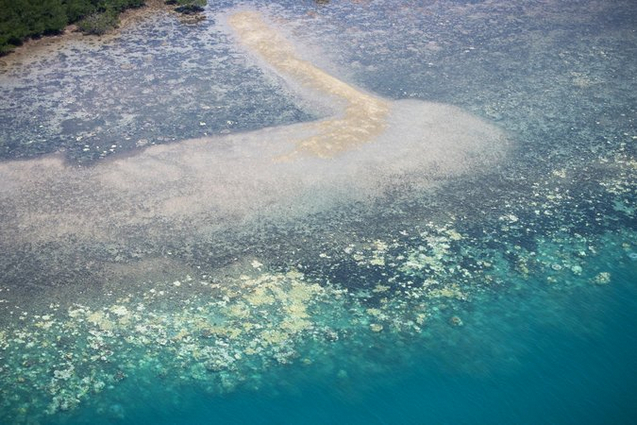
An aerial view of bleaching coral off the Australian coast in March 2016. Credit Terry Hughes/ARC Centre of Excellence for Coral Reef Studies
“When coral dies, it affects the shelter and food that sustain fish, lobsters, shellfish, worms, etc. The same happens in a rain forest. When the trees die, the animals and plants that have developed over millennia die with them,” he said, before adding an analogy. “When a country is ravaged by war, people die and migrate.”
During bleaching events, overheated seawater causes corals to part ways with symbiotic plantlike organisms called zooxanthella that live inside of them. In addition to giving coral reefs their bright colors, zooxanthella also provide corals with oxygen, waste filtration, and up to 90 percent of their energy. Absent zooxanthella, corals not only take on a ghostly pallor, hence the term bleaching, but they are also more susceptible to death.
In theory, coral reefs can recover from even a severe bleaching event. Some of the coral will die off from increased disease susceptibility, but once ocean temperatures drop again, many of the corals will start growing back.
But that’s only if they’re given enough time.
Typically, it takes 10 to 15 years for the fastest-growing corals to recover after a severe bleaching event. Larger corals that provide shelter for bigger fish can take even longer to grow back.
As bleaching events become more frequent, reefs are unlikely to get that needed reprieve. Earth’s average temperature has increased 1 degree Celsius, or 1.8 degrees Fahrenheit, above preindustrial levels, and the median time between severe bleaching events is now just six years, the Science study found.
Case in point: The Scott Reef, 180 miles off the coast of Northwestern Australia, had over the past few years finally begun recovering from a major bleaching event in 1998, with the fastest-growing corals inhabiting much of their earlier territory. But the area was hit by bleaching again in 2016, causing widespread mortality.
Before 1982-3, mass bleaching events across wide areas were nonexistent. That year, reefs across the Tropical Eastern Pacific exposed to warm El Niño year waters bleached. Coral reefs in Costa Rica, Panama and Colombia experienced 70 to 90 percent mortality. Most reefs in the Galápagos Islands, the cradle of Darwin’s theory of evolution, experienced 95 percent mortality.
While many mass bleachings were prompted by El Niño events, which tends to warm Pacific Ocean temperatures, the bleaching event that hit the Great Barrier Reef in 2017 — the reef’s first back-to-back bleaching — occurred at the beginning of a La Niña event, when ocean waters should have been cooler. It’s a sign that global warming is steadily pushing up ocean temperatures even in cooler years.
A blenny on bleached coral. Reefs are home to about a quarter of all marine species. Credit Greg Torda/ARC Centre of Excellence for Coral Reef Studies
“La Niña periods today are actually warmer than El Niño periods were 40 years ago,” said Terry Hughes, a senior researcher who specializes in coral reefs at James Cook University in Australia and the lead author of the Science study.
“Coral bleaching is caused by global warming full stop,” Dr. Hughes said. “It’s not due to El Niño. We’ve had thousands of El Niño prior to 1983, none of them caused bleaching. Bleaching is caused by the rising baseline temperatures due to anthropogenic global warming.”
Scientists have long warned that the effects of climate change will not necessarily progress in a linear way as the planet warms. As Earth crosses certain key temperature thresholds, severe and far-reaching changes can unfold relatively rapidly, such as the collapse of ice sheets or the die-off of key ecosystems.
All evidence suggests that bleaching will only get more and more frequent as the Earth continues to warm. By midcentury, climate models suggest, most reefs will experience the sort of heat associated with severe bleaching every year.
If corals can’t adapt quickly enough, “we could be looking at the effective loss of most of the world’s coral reefs,” said Mark Eakin, an oceanographer who is coordinator of the Coral Reef Watch project at the United States National Oceanographic and Atmospheric Administration.
The Great Barrier Reef had two back-to-back bleaching events that killed just about half of the corals along the length of the barrier reef. This means half are still alive. Those corals are the source of larvae that spawn future generations, which means that the reef moving forward will have a distinctly different character than it had two years before the bleaching event.
“The ecological effect of more and more bleachings is that it’s changing the mix of species in favor of the tougher corals that can survive bleaching events and in terms of the corals that bounce back the quickest,” said Dr. Hughes. “It’s changing the whole ecology of the reefs.”
There are a few things that can help make reefs more resilient to bleaching. Humans can limit fertilizer and sewage runoff that damage coral. They can avoid overfishing key herbivores like the rabbitfish that nurture the reefs by clearing away excessive algae.
A sea turtle in the Indian Ocean amid coral that succumbed to a 2016 bleaching event. Credit Kristen Brown/ARC Centre of Excellence for Coral Reef Studies
Some researchers are experimenting with even more radical techniques, such as trying to breed coral that can thrive in warmer temperatures, or looking at ways to pump cooler water into reefs to protect the coral from overheating, or even placing giant “shade cloths” over reefs.
Some of these ideas are admittedly wild, Dr. Eakin said, and none of them can ever be a substitute for reducing greenhouse gas emissions. “We can’t act as if we can keep emitting carbon dioxide into the atmosphere and just by tinkering around with corals in a lab we’re going to solve the problem,” he said.
But given that frequent bleaching is already underway, and given that at least half a degree of additional global warming appears inevitable, coral researchers are desperate for new ideas.
“We’ve got to start taking steps that we haven’t thought about before — even if they sound absolutely crazy,” Dr. Eakin said. “Because the stuff we thought made sense will no longer work.”

Links

'Quite Surprising': Near-Record Hot 2017, Heat Burst Point To Warming World

Fairfax - Peter Hannam

Another year of near-record global temperatures and the recent heat spike in major Australian cities should serve as warning of the vulnerability of populations to global warming, a leading climate researcher said.
The first complete datasets of land and sea surface temperatures worldwide, compiled by Europe's Copernicus Climate Change Service, indicate 2017 notched a fourth consecutive year of "exceptionally warm" conditions.

Heatwave grips NSW
New South Wales and the ACT were in the grip of a heatwave, with some temperatures exceeding the 40 mark.

One set, by the European Centre for Medium-Range Weather Forecasts, placed last year just 0.1 degrees cooler than 2016, the hottest year on record.
2017 was warmer than 2015 and 2014 – two years that had previously set the high mark for global heat in successive years, the preliminary set showed.
The average air temperature at the surface exceeded 14.7 degrees, the Copernicus service said. The most above-average temperatures for the year were in the Arctic, with few land regions below average. (See chart below.)
A slew of agencies will release their findings on January 18, but the ranking for 2017 is "very likely to be in the top three", Blair Trewin, senior climatologist at the Bureau of Meteorology, said.

Hottest non-El Nino year
Andy Pitman, director the new ARC Centre of Excellence for Climate Extremes based at the University of NSW, said global temperatures shouldn't be close to records since last year did not have an El Nino to give them a boost.
Even without an El Nino to bump up temperatures, 2017 was one of the hottest couple of years globally on record. Photo: Katherine Griffiths
"Normally El Ninos add three-tenths of a degree or so to the global mean, and we're not in one," Professor Pitman said.
"Climatologically, it's really quite surprising" 2017 was so warm, and the record for a non-El Nino year, he said.
Rising averages amply demonstrate extreme temperatures, as Australians are being reminded this summer. Photo: Brook Mitchell
The implications, though, are unclear.
One more favourable view is temperature increases linked to rising greenhouse gas emissions may be catching up to trend after a relatively slow stint of increases at the start of the century, he said.
Penrith residents in western Sydney on Sunday were in the hottest place on the planet. Photo: Brook Mitchell
A less promising outcome, however, might be the climate is more sensitive to warming than the Intergovernmental Panel on Climate Change has estimated. The current range is about 2-4.5 degrees warming for each doubling of carbon dioxide in the atmosphere.
"It's optimistic to think that the climate sensitivity is at the lower end of the range," Professor Pitman said. "It's likely to be on the mid- to high-end of the range – which isn't good."
The recent annual warming spurt implies the Paris climate goal of keeping warming to between 1.5 and 2 degrees of pre-industrial era levels "is virtually impossible", he said.

From averages to extremes
The weekend burst of heat across south-eastern Australia – including 47.3 degrees on Sunday in Penrith, the second hottest ever recorded in the Sydney Basin – underscores the risk of worse extremes when average temperatures rise.
While 2 degrees average global warming may not sound like a huge change, it implies land temperatures will rise about 3 degrees.
Those land regions in the mid-latitudes – where many Australian cities lie – may rise 4-5 degrees or more before extremes are taken into account, Professor Pitman said.
"If western Sydney warms by 4-5 degrees on the average in the summer, you're looking at extremes being 5-10 degrees higher than they currently are," he said.
A study published last October found Melbourne and Sydney could cop 50-degree days within decades if carbon emissions continued to rise.
The toll on the health of the population would mount as, if models predict, the length, frequency and intensity of heatwaves increase.
"What a few degrees increase in the average means is a dramatic escalation in the risk of extremely hot temperatures, lasting for longer periods of time," Professor Pitman said. "That places immense stress on emergency services, health services, the electrical grid, et cetera."
While western Sydney had posted one hotter day – 47.8 degrees back in January 1939 – the population was not highly reliant on air-conditioners with houses much  better adapted to passive cooling back then.
"We are now adapting to the pleasure of air-conditioning – and it's totally dependent on the power grid surviving," he said.

IMAGE


Links

Great Barrier Reef: Rising Temperatures Turning Green Sea Turtles Female

The Guardian

‘Complete feminisation’ of northern population is possible in near future, researchers find
Females in a Great Barrier Reef population of green sea turtles were found to make up 99.1% of juveniles, 99.8% of subadults and 86.8% of adults. Photograph: Christine Hof / WWF-Aus
Rising temperatures are turning almost all green sea turtles in a Great Barrier Reef population female, new research has found.
The scientific paper warned the skewed ratio could threaten the population’s future.
Sea turtles are among species with temperature dependent sex-determination and the proportion of female hatchlings increases when nests are in warmer sands.
Tuesday’s paper, from the National Oceanic and Atmospheric Administration, California State University and Worldwide Fund for Nature Australia, is published in Current Biology. It examined two genetically distinct populations of turtles on the reef, finding the northern group of about 200,000 animals was overwhelmingly female.
While the southern population was 65%-69% female, females in the northern group accounted for 99.1% of juveniles, 99.8% of subadults and 86.8% of adults.
“Combining our results with temperature data show that the northern GBR green turtle rookeries have been producing primarily females for more than two decades and that the complete feminisation of this population is possible in the near future,” the paper said.
The temperature at which the turtles will produce male or female hatchlings is heritable, the paper said, but tipped to produce 100% male or 100% female hatchlings within a range of just a few degrees.
“Furthermore, extreme incubation temperatures not only produce female-only hatchlings but also cause high mortality of developing clutches,” it said. “With warming global temperatures and most sea turtle populations naturally producing offspring above the pivotal temperature, it is clear that climate change poses a serious threat to the persistence of these populations.”
The lead author, Dr Michael Jensen from the National Oceanic and Atmospheric Administration, said the research provided a new understanding of what the turtle populations were dealing with.
Green sea turtles are among species with temperature dependent sex-determination. Photograph: Alamy
He said the findings were surprising and “a bit alarming”, with significant conservation implications.
“While we can hope there might be some cooler years to produce a few more males, overall we can expect the temperatures to increase,” he said.
Jensen said the researchers worked around “ethical implications” of past studies that required sacrificing some hatchlings to accurately determine sex ratios and pivotal temperature ranges.
This team instead studied more than 400 turtles at foraging grounds, gathering information on the sex of turtles from multiple generations.
“Knowing what the sex ratios in the adult breeding population are today, and what they might look like five, 10 and 20 years from now when these young turtles grow up and become adults, is going to be incredibly valuable,” Jensen said.
The research was facilitated through the Great Barrier Reef Rivers to Reef to Turtles project by the World Wildlife Fund Australia.
The chief executive of WWF Australia, Dermot O’Gorman, said it was yet another sign of the impact of climate change, following recent research that coral bleaching events were occurring far more frequently.
“We’ve had two years where we’ve had mass bleaching events on the Great Barrier Reef,” he told Guardian Australia. “That’s a very visible sign of the impact of climate change. But this is an invisible change. We can’t see the impact it’s having on a turtle population until a study like this shows some long-term trends.”
O’Gorman said more urgent action on climate change was clearly needed but conservationists were taking some practical measures, including trialling the use of shadecloth on known nesting beaches to lower the sand temperature, and reducing bycatch in the fishing industry.
“[Shadecloths] can be done in certain places but there’s a limit to the scale you can do that,” he said.
The green turtle is one of the most populous species of turtle in the world but the Great Barrier Reef settlement was significant and turtles were under enormous pressure outside Australian waters, O’Gorman said.
“An additional threat to them really does sound alarm bells,” he said. “Now every large reproductive male is going to be even more important.”

Links

08/01/2018

Sydney Hits Its Highest Temperature Recorded Since 1939 With Penrith Reaching 47.3c

ABC News


Across the greater Sydney area, people are swimming, cycling, and cooking over a hot stove as temperatures soar. (ABC News)

Penrith in Sydney's west has reached a top of 47.3 degrees Celsius, the highest temperature recorded by a weather station in the Sydney metropolitan area in 79 years.
The temperature hit 47.3C at Penrith just after 3:00pm on Sunday.
The Bureau of Meteorology (BOM) early Sunday said it had confirmed preliminary data and declared it was the highest temperature ever recorded by a weather station in the Sydney metropolitan area.
However, the NSW BOM tweeted just after 4:00pm that they had missed a temperature in the north-western Sydney suburb of Richmond, at a now closed recording station.
The 1939 high was 47.8C.
A weak south-easterly change forecast to come through later on Sunday offering some relief to the coast.
Sydneysiders flocked to the beach to cope with the heat. (AAP: Glenn Campbell)
"That may just trickle into the western suburbs this evening, however the west is still expected to remain very hot for the rest of the day," said Andrew Haigh from BOM.
"Tomorrow will be another hot day in the west, a little bit less so than today in the east."
Total fire bans and severe fire danger warnings were issued by the NSW Rural Fire Service for the Hunter and Greater Sydney, with the bans continuing into the start of the working week.
Sydney's heatwave caused problems at the Sydney International tennis, with fifth seed Kristina Mladenovic retiring after being badly affected by the heat.
Extreme, severe and low-intensity heatwave ratings have been given to most of NSW over the next few days. (Supplied: Bureau of Meteorology)
The competition was out at Sydney Olympic Park, which had a top recorded temperature of 44.5C just after 1:00pm.
Bahar and Amir Kashefi were beaming bright on their wedding day despite the heat. (ABC News: David Spicer)
Bahar and Amir Kashefi were still smiling despite the heat scorching their wedding day.
"I'm sweating, my bridesmaid is sweating. The wind was not too bad around here but otherwise it was scorching hot," the bride said.
"I think I am going to cut the wedding short, go straight back to the hotel and jump in the pool."
Homeless man Charles Orchard, 43, receives water from Missionbeat van driver Patrick Crawford near Central Station. (ABC News: Emily Laurence)
Mission Australia's homeless transport service Missionbeat were out in force to keep people cool.
They organised for two heat-affected homeless people to get to the hospital and transferred several others to refuges and hostels.
Animals at Taronga Zoo on Sydney's north shore were fed a variety of iced foods to keep them cool, with Fergus the Hippo feasting on some carrot ice blocks.
IMAGE

Links

Lethal Heating is a citizens' initiative