09/02/2018

Revolving Doors: How The Fossil Fuel Lobby Has Governments Ensnared

MW - 


The polls are compelling. The wind has been sniffed. Federal Opposition leader Bill Shorten is finally making noises about pulling Labor support for Adani’s Carmichael coal project. Even surpassing the environmental madness of building the world’s biggest new thermal coal mine, the project is unbankable. It does not stack up financially. The price of generating renewable energy has plunged 50 per cent in two years and is now cheaper to deliver than new coal. Shorten is on firm ground electorally.
How did it even get this far? That such a white elephant is still staggering about, not quite dead yet, and still hopeful of more taxpayer subsidies, is testament to the power of the coal lobby in Australia. It is testament to the prolific connections between the resources lobby and government, the “revolving doors” between industry, the major political parties and the bureaucracy.
Adam Lucas and Joel Rosenzweig Holland have built a database of this network of fossil fuel influence: the people, the insiders.
Here, they discuss the major players as they unpack the web of self-interest which undermines democracy and favours corporate agendas above the welfare of ordinary Australians.


Adam Lucas* | Joel Rosenzweig Holland*

If the fossil fuel industry had a motto, it might be, “Never let the facts get in the way of our profits.” Despite receiving advice from their own scientists since the late 1970s that there was a causal link between fossil fuel consumption and dangerous anthropogenic climate change, the fossil fuel industry has for decades sought to undermine the science, and has expended considerable financial and political capital to block any efforts to make the necessary transition to less polluting alternatives.
The industry’s role in sowing doubt and confusion over the science of climate change is by now well-known and widely documented. What is less well-known is its preoccupation with infiltrating democratic governments by providing financial, logistical and personnel support to those political parties, governments and individuals which are most likely to serve its interests. Indeed, as public awareness of fossil-fuel driven climate change and the need for action has grown, the fossil fuel lobby appears to have ramped up its efforts to gain control over government policy and favourably influence public opinion.

The great gas con:
How Australia got sucked dry

Whistleblower Simone Marsh unpacks the startling evidence of how the Australian public was shortchanged by both Big Gas and Queensland Inc. The result is the present gas crisis and the recent, unprecedented move by the Federal Government to intervene in the market. This is a story of “revolving doors” between industry and government and influence peddling, … Continue reading

Concerned at the hollowing-out of democracy, which these trends clearly demonstrate, we began last year to consolidate and extend the work of journalists and researchers who had chronicled some of this revolving-door activity in an attempt to determine just how extensive the influence of the fossil fuel industry has been on the nation’s policy-makers.

“So far, we have managed to compile a list of well over 150 former and current politicians, political advisors and bureaucrats who have either moved from the fossil fuel and mining industries into public office or vice-versa over the past decade”

We admit to being shocked at the extent of this influence at multiple levels of government. So far, we have managed to compile a list of well over 150 former and current politicians, political advisors and bureaucrats who have either moved from the fossil fuel and mining industries into public office or vice-versa over the past decade. These constitute a veritable army of lobbyists, senior executives, spin doctors and consultants acting with a single aim in mind: political and policy support for the fossil fuel industry and its allies in business and industry.
We have also found that senior politicians in relevant ministerial portfolios continue to hire people who have come straight from the mining industry, and who return to work in mining straight after leaving government.
Martin Ferguson
In early 2013, for example, Federal Resources Minister Martin Ferguson resigned from his portfolio, which was subsequently filled by former Woodside executive and WA Member for Brand, Gary Gray. Ferguson retired from politics after Labor’s election defeat in September 2013, taking on a senior role at industry lobbyists the Australian Petroleum Production and Exploration Association (APPEA) only six months later.
Ferguson was also made a board member of British Gas, an appointment which could reasonably be interpreted as a reward for services rendered while in public office, given his facilitation (of the sale of Queensland’s gas before State or Commonwealth assessment and approvals) of BG’s $20 billion Curtis LNG/CSG export project in Queensland while resources minister. Unsurprisingly, Gray followed in his predecessor’s footsteps, joining Mineral Resources Ltd as general manager of external affairs just days after his 2016 retirement from politics.
Commonly known in the US as “the revolving door”, these activities have long been the focus of investigations by journalists, academics and activists concerned about their potentially toxic effects on democratic process, and their distortion of public policy in the service of more narrow interests.
These researchers have understandably raised questions about the probity and ethics of those concerned, including the companies and industry bodies that seek to employ them in whatever capacity. In some countries, most notably Canada and Ireland, there are strict laws governing such behaviour. Unfortunately for Australians, the best the major parties have come up with are “guidelines” which are frequently and flagrantly ignored.
Our disquiet with the ethics of this situation is that these individuals had, or acquired, detailed inside knowledge of public policy on issues which directly affected the future ability of those industries to maintain their market dominance, and which afforded their industries significant political and economic advantage.

This week’s budget papers show the government spending A$33 billion on education this year, nearly the same amount that Australia’s five new offshore gas fields will make in sales each year when they are running at full capacity. Unless prices spike higher, however, these five monster projects may never pay a cent in royalties or … Continue reading

One arena of such corporate advantage is tax, where the lobbying muscle of oil giants Chevron, Exxon Mobil, BP, Shell and others have saved them from paying billions of dollars in income tax and PRRT as successive governments dithered over reform and enforcement.
Given the recent political controversies over support for the Adani coal mine in Queensland, and the opposition of certain elements within the Federal Coalition to urgently needed reforms of the country’s energy sector, the relationships between industry and the political classes should be of concern to all Australians. The previously cited example of Martin Ferguson’s elevation to executive positions within the industry is only one in a long list of dubious concessions made by the Labor, Liberal and National parties to the siren song of fossil fuel advocacy. Other prominent examples in recent times include:
Ian Macfarlane
Perhaps the most notorious of revolving door incidents in recent times is Ian Macfarlane, former Federal Minister for Energy and Resources and self-confessed member of John Howard’s “Greenhouse Mafia”, who took up the role of CEO of the Queensland Resources Council within weeks of leaving his ministerial position, reportedly because Malcolm [Turnbull] was cool about it.
We have found even more egregious examples of senior bureaucrats and policy advisors moving backwards and forwards between government positions and industry. In 2009, for example, Brad Burke left his role as senior strategist to then-Opposition Leader Malcolm Turnbull to become Director of Corporate Affairs at Santos, before returning to Prime Minister Turnbull’s office in 2015 as his Deputy Chief of Staff; Burke now works for Shell Australia. Similarly, in 2012, Mitch Grayson worked as Senior Media Advisor to then-Queensland Premier Campbell Newman, before spending roughly a year as a senior advisor on the Santos GLNG project, during which time it signed a major cooperation deal with Pacific LNG. Less than a month after this deal was inked, Grayson was back at Premier Newman’s office, where he remained until the Newman Government’s defeat in 2015.

CSG lobbyists:
Untangling the web of influence peddlers

A Vote Compass survey taken during the 2016 federal election reported two-thirds of Australians opposed easing restrictions on CSG exploration, compared with just over half during the previous election. CSG is unpopular with both farmers, environmentalists and, increasingly, most other voters. Following her investigation into Barnaby’s gas bonanza, whistleblower Simone Marsh untangles the web of influence … Continue reading

Some the most alarming examples of industry influence we have uncovered relate to several members of Martin Ferguson’s ministerial staff, several of whom took up highly paid positions in the same industry over which they had previously exercised oversight immediately after leaving public office between the middle of 2010 and 2013. These include:
  • Ferguson’s secretary, John Pierce, who became chairman of the Australian Energy Market Commission,
  • Ferguson’s policy advisor between March 2008 and May 2010, Michael Bradley, who took up the position of Director of External Affairs in APPEA from May 2010 to May 2015;
  • another Ferguson policy advisor between August 2010 and March 2013, James Sorahan, who immediately took up a position as Director of Taxation for the Minerals Council of Australia, a position which he retains to this day;
  •  Tracey Winters
  • Ferguson’s Principal Policy Advisor and Chief of Staff between 2003 and 2010, Tracey Winters, who had previously worked for Chevron and Woodside Energy, took up senior positions in Queensland Gas Company/BG Group between 2011 and 2015, and since 2016 has been working as an advisor for Caltex.
Winters worked for Martin Ferguson when he was Shadow Minister for four years before Labor won office federally in 2007.
According to Greens MLC Jeremy Buckingham, Winters is the partner of Craig Emerson, who was Federal Trade Minister in late 2010; that is, the couple both held influential positions at the time of the Commonwealth approval of the first East Coast CSG-LNG projects: Santos GLNG and QGC’s QCLNG projects.
To demonstrate the fossil fuel industry’s bipartisan commitment to influence peddling, even more members of Ian Macfarlane’s ministerial staff have made the transition to or from industry employment prior to entering, or shortly after leaving, public office.
These include:
 Stephen Galilee
  • Macfarlane’s chief of staff between 2001 and 2004, Stephen Galilee, who went on to become NSW Shadow Treasurer Mike Baird’s chief of staff between 2004 and 2011, prior to becoming CEO of the NSW Minerals Council from the year he left Baird’s office to the present;
  • Macfarlane’s chief of staff in 2006 and 2007, Malcolm Roberts, who was Executive Director of the National Generators Forum between 2009 and 2011, then Chief Executive Officer for the Energy Networks Association between 2011 and 2013, before re-entering government as a policy advisor to Queensland Premier Campbell Newman between 2013 and 2015, and who is now CEO of APPEA;
  • Macfarlane’s chief of staff in 2015, Sarah McNamara, who had previously worked for Prime Minister Tony Abbott and Federal Minister Helen Coonan, who did a five year stint as Head of Government Affairs with AGL Energy between 2008 and 2013, before returning to AGL in 2016 as General Manager of Corporate Affairs;
  • Macfarlane’s policy advisor between September 2013 and August 2015, Linday Hermes, who was Media and Communications Manager for the NSW Minerals Council between August 2010 and August 2013;
  • Robert Underdown, a senior advisor to Macfarlane while still Shadow Minister between 2007 and 2009, who immediately took up senior positions with Santos between 2009 and 2015, and now works as Head of Government Affairs for Caltex;
  • Claire Wilkinson, who was Senior Media Advisor to Macfarlane as Minister for Resources between November 2006 and December 2007, who immediately took up a position as Senior External Affairs Advisor to Royal Dutch Shell until May 2012, and External Affairs Manager for Total Australia between May 2012 and June 2016.
  • Clearly, the fossil fuel industries hire these people because they are convinced their connections enhance  access to and influence over government policy, and there is convincing evidence that industry has ramped up its efforts over the last ten years to infiltrate government at the highest levels.

Corporate lobbying:
A billion dollar business

The influencing of politicians, bureaucrats and the course of government policy is a billion-dollar business which is subsidised by taxpayers. An analysis of the financial statements of 20 of Australia’s major business lobbies found almost $2 billion in funding by corporations over the past three years. This level of peak body funding indicates the substantial … Continue reading 

Australia desperately needs laws at the state and federal level which prevent politicians, bureaucrats and policy advisors from taking positions in the private sector directly related to their portfolio responsibilities while in government immediately, or soon after, leaving public office. In Canada, the cooling off period was set at two years, though we would argue that the relevant period should be at least five years.
It also remains the case that not all Australian jurisdictions publicly disclose or even retain records of lobbyist visits to ministers and senior bureaucrats. And even in those jurisdictions that do keep public registers, there are arguably glaring omissions and inconsistencies in the kinds of records that are kept which are neither easy to access or search.
It is clear from our research that a federal anti-corruption body must be created. Australia also needs much stronger disclosure laws in relation to campaign financing and political party donations along the lines of those suggested by the Australian Greens, Victorian Labor (to have the strictest and most transparent in the country), Queensland Labor  and Federal Labor.  However, we would argue that all institutional funding should be excluded from Australian politics, including funding of the Labor Party and Australian Greens by the union movement.
Foreign donations should be banned, and all donations over $1000 should be disclosed in real time, with caps placed on donations from individuals and the quantum of public funding provided to political parties on the basis of their electoral support during elections significantly increased to minimise the need for fundraising.

The truth about political donations:
What we don’t know
The big story about the Australian Electoral Commission’s annual release of political donations disclosures is how little they really tell us. Over the last decade, the major parties have routinely only transparently disclosed 10-20 per cent of their incomes as donations. Dr Lindy Edwards from the UNSW reports. There is another 20-35 per cent of party incomes that … Continue reading 

Truth in political advertising and stronger laws holding mainstream media to account for misreporting and factual inaccuracies should also be implemented to preclude the kind of fake news that has recently begun to proliferate across multiple media platforms. It is one thing to allow these stories to circulate on the fringes of the internet, and quite another to repeat and amplify them through mainstream media outlets, which, after all, are given social licences to broadcast on the basis that they serve some minimum public interest criteria.
It may sound like hyperbole to argue that the future of our democracy is currently at stake, but we argue that it is even more serious than that. Climate scientists have been sounding increasingly dire warnings about planetary boundaries being breached over the next few decades: an inevitability if the fossil fuel industry is allowed to continue to have a free hand in determining our energy future. It is not just democracy at stake.

*Dr Adam Lucas is a senior lecturer in the School of Humanities and Social Inquiry at the University of Wollongong. Adam’s research focusses on energy policy responses to anthropogenic climate change and the peaking of world oil, coal and gas production.
*Joel Rosenzweig Holland is a Sydney-based researcher interested in democratic renewal, emergent economic structures and environmental justice. He is midway through a Masters in Political Economy at the University of Sydney, and works part-time as a bicycle mechanic. 

Links

How To Use Critical Thinking To Spot False Climate Claims

The Conversation - 

Arguments against climate change tend to share the same flaws. gillian maniscalco/Flickr, CC BY-ND
Much of the public discussion about climate science consists of a stream of assertions. The climate is changing or it isn’t; carbon dioxide causes global warming or it doesn’t; humans are partly responsible or they are not; scientists have a rigorous process of peer review or they don’t, and so on.
Despite scientists’ best efforts at communicating with the public, not everyone knows enough about the underlying science to make a call one way or the other. Not only is climate science very complex, but it has also been targeted by deliberate obfuscation campaigns.
If we lack the expertise to evaluate the detail behind a claim, we typically substitute judgment about something complex (like climate science) with judgment about something simple (the character of people who speak about climate science).
But there are ways to analyse the strength of an argument without needing specialist knowledge. My colleagues, Dave Kinkead from the University of Queensland Critical Thinking Project and John Cook from George Mason University in the US, and I published a paper yesterday in Environmental Research Letters on a critical thinking approach to climate change denial.
We applied this simple method to 42 common climate-contrarian arguments, and found that all of them contained errors in reasoning that are independent of the science itself.
In the video abstract for the paper, we outline an example of our approach, which can be described in six simple steps.


The authors discuss the myth that climate change is natural.

Six steps to evaluate contrarian climate claims

Identify the claim
First, identify as simply as possible what the actual claim is. In this case, the argument is:
The climate is currently changing as a result of natural processes.
Construct the supporting argument
An argument requires premises (those things we take to be true for the purposes of the argument) and a conclusion (effectively the claim being made). The premises together give us reason to accept the conclusion. The argument structure is something like this:
  • Premise one: The climate has changed in the past through natural processes
  • Premise two: The climate is currently changing
  • Conclusion: The climate is currently changing through natural processes.

Determine the intended strength of the claim
Determining the exact kind of argument requires a quick detour into the difference between deductive and inductive reasoning. Bear with me!
In our paper we examined arguments against climate change that are framed as definitive claims. A claim is definitive when it says something is definitely the case, rather than being probable or possible.
Definitive claims must be supported by deductive reasoning. Essentially, this means that if the premises are true, the conclusion is inevitably true.This might sound like an obvious point, but many of our arguments are not like this. In inductive reasoning, the premises might support a conclusion but the conclusion need not be inevitable.
An example of inductive reasoning is:
  • Premise one: Every time I’ve had a chocolate-covered oyster I’ve been sick
  • Premise two: I’ve just had a chocolate-covered oyster
  • Conclusion: I’m going to be sick.
This is not a bad argument – I’ll probably get sick – but it’s not inevitable. It’s possible that every time I’ve had a chocolate-covered oyster I’ve coincidentally got sick from something else. Perhaps previous oysters have been kept in the cupboard, but the most recent one was kept in the fridge.
Because climate-contrarian arguments are often definitive, the reasoning used to support them must be deductive. That is, the premises must inevitably lead to the conclusion.

Check the logical structure
We can see that in the argument from step two – that the climate change is changing because of natural processes – the truth of the conclusion is not guaranteed by the truth of the premises.
In the spirit of honesty and charity, we take this invalid argument and attempt to make it valid through the addition of another (previously hidden) premise.
  • Premise one: The climate has changed in the past through natural processes
  • Premise two: The climate is currently changing
  • Premise three: If something was the cause of an event in the past, it must be the cause of the event now
  • Conclusion: The climate is currently changing through natural processes.
Adding the third premise makes the argument valid, but validity is not the same thing as truth. Validity is a necessary condition for accepting the conclusion, but it is not sufficient. There are a couple of hurdles that still need to be cleared.

Check for ambiguity
The argument mentions climate change in its premises and conclusion. But the climate can change in many ways, and the phrase itself can have a variety of meanings. The problem with this argument is that the phrase is used to describe two different kinds of change.
Current climate change is much more rapid than previous climate change – they are not the same phenomenon. The syntax conveys the impression that the argument is valid, but it is not. To clear up the ambiguity, the argument can be presented more accurately by changing the second premise:
  • Premise one: The climate has changed in the past through natural processes
  • Premise two: The climate is currently changing at a more rapid rate than can be explained by natural processes
  • Conclusion: The climate is currently changing through natural processes.
This correction for ambiguity has resulted in a conclusion that clearly does not follow from the premises. The argument has become invalid once again.
We can restore validity by considering what conclusion would follow from the premises. This leads us to the conclusion:
  • Conclusion: Human (non-natural) activity is necessary to explain current climate change.
Importantly, this conclusion has not been reached arbitrarily. It has become necessary as a result of restoring validity.
Note also that in the process of correcting for ambiguity and the consequent restoring of validity, the attempted refutation of human-induced climate science has demonstrably failed.

Check premises for truth or plausibility
Even if there were no ambiguity about the term “climate change”, the argument would still fail when the premises were tested. In step four, the third premise, “If something was the cause of an event in the past, it must be the cause of the event now”, is clearly false.
Applying the same logic to another context, we would arrive at conclusions like: people have died of natural causes in the past; therefore any particular death must be from natural causes.
Restoring validity by identifying the “hidden” premises often produces such glaringly false claims. Recognising this as a false premise does not always require knowledge of climate science.

Flow chart for argument analysis and evaluation. LARGE IMAGE
When determining the truth of a premise does require deep knowledge in a particular area of science, we may defer to experts. But there are many arguments that do not, and in these circumstances this method has optimal value.

Inoculating against poor arguments
Previous work by Cook and others has focused on the ability to inoculate people against climate science misinformation. By pre-emptively exposing people to misinformation with explanation they become “vaccinated” against it, showing “resistance” to developing beliefs based on misinformation.
This reason-based approach extends inoculation theory to argument analysis, providing a practical and transferable method of evaluating claims that does not require expertise in climate science.
Fake news may be hard to spot, but fake arguments don’t have to be.

Links

Humans Need To Become Smarter Thinkers To Beat Climate Denial

The Guardian - 

A new paper shows that climate myths consistently fail critical thinking tests
President Donald Trump points skyward before donning protective glasses to view the solar eclipse, 21 August 2017, at the White House in Washington. Photograph: Andrew Harnik/AP
Climate myths are often contradictory – it’s not warming, though it’s warming because of the sun, and really it’s all just an ocean cycle – but they all seem to share one thing in common: logical fallacies and reasoning errors.
John Cook, Peter Ellerton, and David Kinkead have just published a paper in Environmental Research Letters in which they examined 42 common climate myths and found that every single one demonstrates fallacious reasoning. For example, the authors made a video breaking down the logical flaws in the myth ‘climate changed naturally in the past so current climate change is natural.’


Video abstract for paper “Deconstructing climate misinformation to identify reasoning errors” published in Environmental Research Letters by John Cook, Peter Ellerton, and David Kinkead.

Beating myths with critical thinking
Cook has previously published research on using ‘misconception-based learning’ to dislodge climate myths from peoples’ brains and replace them with facts, and beating denial by inoculating people against misinformers’ tricks. The idea is that when people are faced with a myth and a competing fact, the fact will more easily win out if the fallacy underpinning the myth is revealed. In fact, these concepts of misconception-based learning and inoculation against myths were the basis of the free online Denial101x course developed by Cook and colleagues.

 Denial101x lecture on inoculation theory by John Cook. 

The new paper published today suggests an even more proactive approach to defeating myths. If people can learn to implement a simple six-step critical thinking process, they’ll be able to evaluate whether climate-related claims are valid.
Step 1: Identify the claim being made. For example, the most popular contrarian argument: “Earth’s climate has changed naturally in the past, so current climate change is natural.”Step 2: Construct the argument by identifying the premises leading to that conclusion. In this case, the first premise is that Earth’s climate has changed in the past through natural processes, and the second premise is that the climate is currently changing. So far, so good.
Step 3: Determine whether the argument is deductive, meaning that it starts out with a general statement and reaches a definitive conclusion. In our case, ‘current climate change is natural’ qualifies as a definitive conclusion.
Step 4: Check the argument for validity; does the conclusion follow from the premises? In our example, it doesn’t follow that current climate change must be natural because climate changed naturally in the past. However, we can fix that by weakening the conclusion to “the current climate change may not be the result of human activity.” But in its weakened state, the conclusion no longer refutes human-caused global warming.
Step 4a: Identify hidden premises. By adding an extra premise to make an invalid argument valid, we can gain a deeper understanding of why the argument is flawed. In this example, the hidden assumption is “if nature caused climate change in the past, it must always be the cause of climate change.” Adding this premise makes the argument logically valid, but makes it clear why the argument is false - it commits single cause fallacy, assuming that only one thing can cause climate change.
Step 5: Check to see if the argument relies on ambiguity. For example, the argument that human activity is not necessary to explain current climate change because natural and human factors can both cause climate change is ambiguous about the ‘climate change’ in question. Not all climate change is equal, and the rate of current change is more than 20 times faster than natural climate changes. Therefore, human activity is necessary to explain current climate change.
Step 6: If the argument hasn’t yet been ruled out, determine the truth of its premises. For example, the argument that “if something was the cause in the past, it will be the cause in the future” is invalid if the effect has multiple plausible causes or mechanisms (as with climate change). In our example, this is where the myth most obviously falls apart (although it had already failed in Step 4).
Flowchart for evaluating contrarian claims. Circles indicate possible fallacies to be detected at each stage. Illustration: Cook et al. (2018), Environmental Research Letters
LARGE IMAGE
Deployment via social media and schools
The authors suggest that their six-step critical thinking process can be deployed via social media through ‘technocognition,’ and in the classroom. Co-author David Kinkead from the University of Queensland said.
We hope our work will act as a building block for developing educational and social media resources, which teach and encourage critical thinking through the examination of both misinformation and fallacious reasoning.
Lead author John Cook envisions that educators and others can use this approach to neutralize climate myths themselves:
Our critical thinking process is a useful tool that scientists, educators, and communicators can employ to identify fallacies in misinformation, which they can use to create inoculating messages that neutralize the myths. This approach is practical, achievable and potentially impactful in both the short-term (e.g., in social media applications) and long-term (incorporating this kind of content into curriculum). Misinformation needs short, sharp, immediate inoculation. Our paper provides a blueprint into how to write these inoculations.
Climate denial suffers badly from a lack of critical thinking, which has spread all the way to the White House. Teaching people to think critically can help prevent it from spreading even further.

Links

08/02/2018

'Everything Is Made Into A Political Issue': Rethinking Australia's Environmental Laws

The Guardian - 

Public should be given a greater say on development plans, experts say
Pelicans rest on a small island near The Entrance, in NSW. Photograph: Arterra/UIG via Getty Images
Environmental lawyers and academics have called for a comprehensive rethink on how Australia’s natural landscapes are protected, warning that short-term politics is infecting decision-making and suggesting that the public be given a greater say on development plans.
The Australian Panel of Experts on Environmental Law has launched a blueprint for a new generation of environment laws and the creation of independent agencies with the power and authority to ensure they are enforced. The panel of 14 senior legal figures says this is motivated by the need to systematically address ecological challenges including falling biodiversity, the degradation of productive rural land, the intensification of coastal and city development and the threat of climate change.
Murray Wilcox QC, a former federal court judge, said the blueprint was a serious attempt to improve a system that was shutting the public out of the decision-making process and failing to properly assess the impact of large-scale development proposals.
“We found the standard of management of the environment is poor because everything is made into a political issue,” Wilcox said. “Nothing happens until it becomes desperate.
“We need a non-political body of significant prestige to report on what is happening and have the discretion to act.”
The legal review, developed over several years and quietly released in 2017, resulted in 57 recommendations. It was suggested by the Places You Love alliance, a collection of about 40 environmental groups that was created to counter a failed bid to set up a “one-stop shop” for environmental approvals by leaving it to the states. The panel undertook the work on the understanding it would be independent and not a piece of activism.
Its work helped inform a motion passed by 250 Labor branches calling on the Labor leader, Bill Shorten, to put stronger national environmental laws and the introduction of an independent watchdog at the centre of his election pitch.
The Australian Panel of Experts on Environmental Law convener, Rob Fowler, an environmental lawyer for more than 40 years and adjunct professor at the University of South Australia, said a key finding was that cooperative federalism – different tiers of government working together to solve common problems – had not worked in protecting the environment.
“It’s slow-moving, unwieldy and leads to compromised outcomes,” he said.
Fowler said devolving responsibility for environmental protection to the states had been popular with politicians, having been proposed by both the Gillard Labor government and the Coalition under Tony Abbott, but not the public. The 2014 constitutional values survey conducted by Griffith University found nearly 45% of respondents believed Canberra should be solely responsible for protecting the environment. Just 16% said it should be left to the states.
He said the body of expert opinion was strongly in favour of the commonwealth taking responsibility. The panel believed a future government should introduce a mechanism that required states to act in line with plans and strategies developed by a commonwealth environment commission. If they failed to comply, they could be overridden.
Wilcox, who before becoming a judge was president of the Australian Conservation Foundation from 1979 to 1984, said creating an environment commission was the panel’s most important recommendation, likening it to the Reserve Bank. “It hopefully would involve people of considerable ability and achievement,” he said.
It would develop both national strategies and regional plans to protect biodiversity, and oversee a system of environmental data monitoring, collection, auditing and reporting. Where it did not do the monitoring itself, it would be required to ensure the work was done to a higher standard than currently, backed by federal funding.
Wilcox said the national Environment Protection and Biodiversity Conservation Act, which was introduced by the Howard government in 1999, was an advance at the time but now “well and truly out of date”.
The environment minister, Josh Frydenberg, has said the existing act continues to be the best mechanism for the federal government to protect the most important and sensitive matters. The opposition environment spokesman, Tony Burke, said the push to introduce national laws would be considered at ALP conference this year, and he was consulting about updating the act.
Wilcox said the public should have a greater say in response to developments. He said state planning systems were good at handling small neighbourhood development problems but larger proposals tended to be “waved through by governments mesmerised by the corporate dollars”.
He cited the hotel and casino complex being developed at Barangaroo in Sydney. “Anything that did come out about that was released for political reasons. That story just applies again and again and again.
“If you believe in a democracy, then you believe ordinary people should be encouraged to get in and have a say, and that’s not the case at the moment. If anything the opposite is the case.”

Links

Tourism Is The Australian Industry Least Prepared For Climate Change, Report Says

The Guardian - 

Beaches, wildlife, the Great Barrier Reef, unspoilt natural wilderness and national parks all considered threatened
A Climate Council report says not enough is being done to prepare for damage to Australia’s greatest tourism drawcards. Photograph: Greg Torda/Arc Centre Coral Reef Studies/EPA
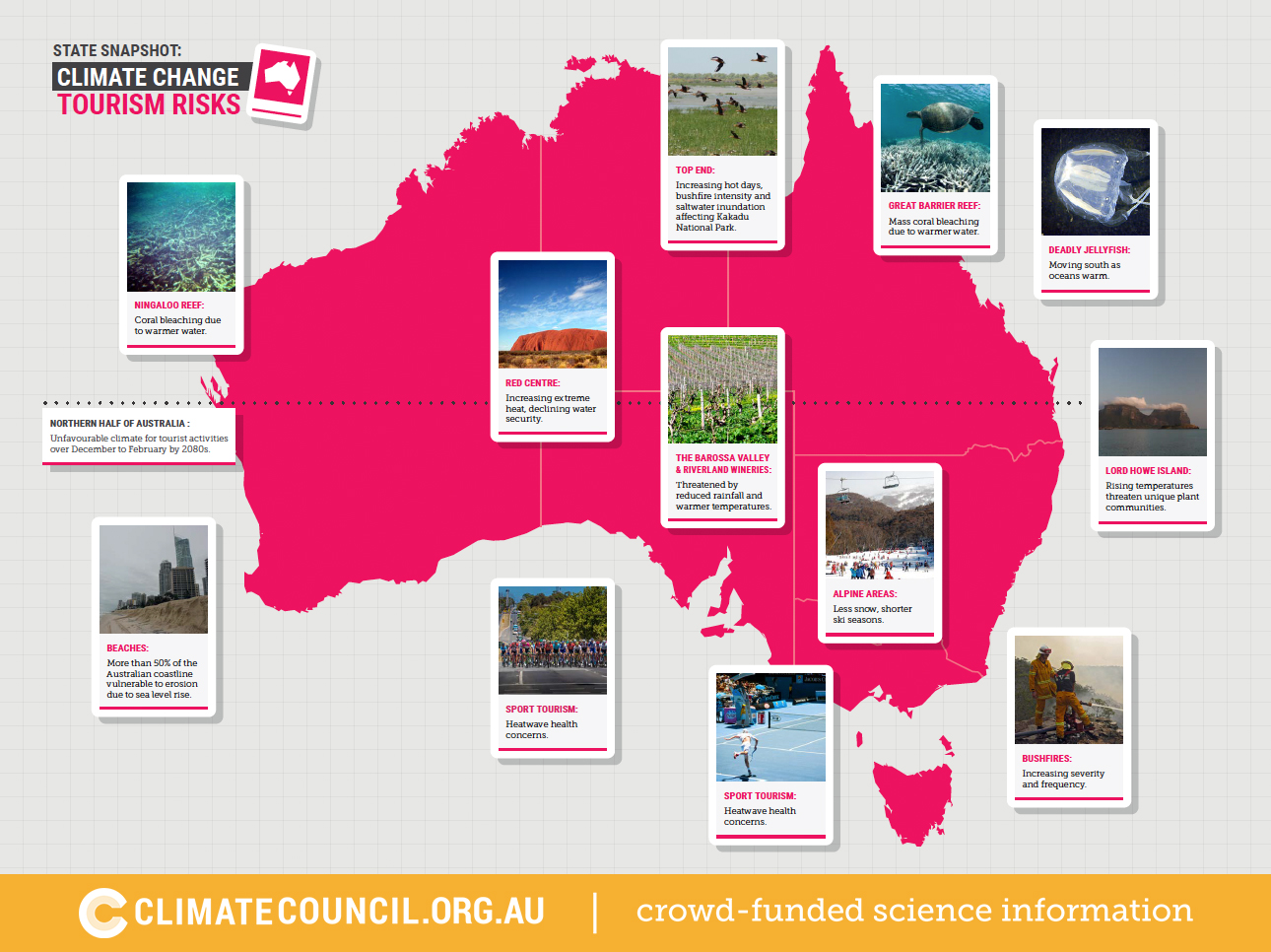
 Tourism is Australia’s most vulnerable and least prepared industry to deal with climate change despite the fact it is already feeling its effects, according to an advocacy group report.
The report by the Climate Council, based on 200 source documents and articles, says while tourism is growing at an extraordinary pace – an 8% jump in visitors last financial year – not enough is being done to prepare for damage to the country’s greatest drawcards.
The five biggest attractions as reported by Tourism Australia – in order: beaches, wildlife, the Great Barrier Reef, unspoilt natural wilderness, national parks including rainforests and other forests – are all considered threatened by climate change.
The report says federal and state governments have mostly underplayed or ignored the risk to tourism. The government’s national Tourism 2020 plan makes no mention of the need to cut greenhouse gas emissions or improve sustainability in the industry.
Last month, the head of Queensland’s Association of Marine Park Tourism Operators, Col McKenzie, called climate scientist Terry Hughes “a dick” and urged the federal government to cut research funding due to his public comments about rising water temperatures harming the reef. McKenzie said it had turned tourists away.
Ecologist and report co-author Prof Lesley Hughes said it should not be controversial to discuss the threat climate change posed to the industry.
Beyond the often cited back-to-back years of bleaching on the reef in 2016 and 2017, she cited as examples beach erosion due to rising sea levels and a projected accelerating growth in extremely hot days in the red centre and the Top End across this century.
“Most government and industry plans on tourism are focused on growth but they don’t also look at the other side of the coin, which is the risks,” she said. “When people come here they might do other things – cultural things such as visiting the Sydney Opera House – but really the overwhelming attractions are natural icons and it’s very clear they are all already being affected.”
Government data cited in the report underlines the extent of the tourism boom. International visitors spent $40.6bn last financial year and were served by a tourism industry that employs 580,200 people, 5% of the country’s total workforce. The government estimates that, for every dollar generated by the tourism industry, a further 90c is spent elsewhere in the economy.
New Zealand provided the most visitors, though Austrade expects it will be overtaken by second-placed China this year. Britain, the United States and Singapore round out the top five. Tourism Australia this week launched a major advertising campaign in the US during the Super Bowl based on the Crocodile Dundee movie franchise. Starring actors Chris Hemsworth and Danny McBride, the campaign emphasises Australia’s natural beauty.
The industry’s growth has made tourism Australia’s second-largest export after iron ore. It is a significantly larger employer than coalmining or oil and gas extraction, which in 2014-15 employed 39,000 and 22,000 people respectively.
Hughes said, despite this, the future of fossil fuel industries and jobs received far more attention in the national conversation. “It’s cognitive dissonance at its most extreme,” she said.
Examples of industries already being affected by global warming include ski tourism, which has seen a trend of increasing reliance on artificial snow as seasons she shortened over the past 25 years.
“That’s a classic illustration that tourism industries will need to adapt and diversify to find other ways to bring people to those regions,” Hughes said.
The report highlights some hotels, resorts, airlines and zoos have taken steps to cut pollution but says a national plan is lacking. Hughes called on more tourism operators to lobby governments to help the industry adapt and diversify.
“I would also like to see operators be part of the lobby for better climate and energy policy,” she said.

Links

Icons at Risk: Climate Change Threatening Australian Tourism

Climate Council

AUSTRALIA’S MOST POPULAR tourist destinations are in the firing line, with intensifying climate change posing a significant threat to the nation’s iconic natural wonders.
The Climate Council’s ‘Icons at Risk: Climate Change Threatening Australian Tourism’ report shows Australia’s top five natural tourist attractions could be hit by extreme heatwaves, increasing temperatures, rising sea-levels, coastal flooding and catastrophic coral bleaching.
Australia’s iconic beaches, wilderness areas, national parks and the Great Barrier Reef are the most vulnerable hotspots, while our unique native wildlife is also at risk, as climate change accelerates.

View large image

Key findings include:
Download the report
  • Australia’s top five natural tourist attractions (beaches, wildlife, the Great Barrier Reef, wilderness and national parks) are all at risk of climate change.
  • Beaches are Australia’s #1 tourist destination and are threatened by rising sea levels.
  • Sydney, Melbourne, Hobart, Cairns, Darwin, Fremantle and Adelaide are projected to have a least a 100 fold increase in the frequency of coastal flooding events (with a 0.5m sea level rise).
  • The Red Centre could experience more than 100 days above 35ºC annually, by 2030. By 2090, there could be more than 160 days per year over 35ºC.
  • The Top End could see an increase in hot days (temperatures above 35ºC) from 11 (1981-2010 average) to 43 by 2030, and up to 265 by 2090.
  • Ski tourism: Declines of maximum snow depth and decreasing season length at Australian ski resorts have been reported for over 25 years, increasing the need for artificial snow-making.
  • Tourism is Australia’s second most valuable export earner, employing a workforce of more than 580,000 people, over 15 times more people than coal mining in Australia.
Links

07/02/2018

The Science Of Global Warming And The Causes & Prevention Of Climate Change (Part 2)

CleanTechnica - 


Introduction
In Part 1 of this article, I introduced the problem of climate change and the history of the science behind it. I then went on to discuss greenhouse gases, noting that greenhouse gas emissions are still increasing and that the need for our intervention is very urgent, and our action needs to be immediate, robust, and extensive. I looked at what we need to do in general terms, so I said, “Every nation needs to introduce new legislation today, which will ensure and encourage investment in, and development of, renewable sources of energy, and which will expedite the installation of whatever renewable energy plant is currently available.”

Encourage Investment in and Development of Renewable Sources of Energy
I now cover that in more detail. Where I mention particulars, this will be for the UK, but readers from other nations will no doubt recognize parallels with their situations in their home countries.

Government Subsidies
What has worked very well has been government subsidies to either help with installation costs or to lower the price of the energy produced, in order to make it more competitive against less desirable fossil fuel-generated power. Most fossil-fueled generation is being heavily subsidized both in the unpaid costs to society of the pollution it causes (also true of nuclear power), and in government tax breaks to the fossil-fuel industry to artificially lower the price and ensure a plentiful supply. The UK government allows around £6billion per year in such tax breaks.
Renewable energy, such as wind and solar, are becoming cheaper and more efficient year after year, so that very little subsidy is needed. On-shore wind is now becoming so cheap it might eventually not need any subsidy.

Planning
Installations also need planning permission, and though planning control is needed, the approach could be adopted of allowing installations as much as possible. Solar and wind farms are generally built on less productive land not required for agriculture. Land owners could be given financial incentives for either building or allowing such energy systems to be built on their land. Central planning could be set up to identify suitable sites where new plants are most needed, and to actively identify the existing players in the industry and co-operate with them to build the energy systems there. For solar, installations can also be added to existing infrastructure such as railway lines and roads as well as on buildings. Even productive agricultural land can be used for wind farms, and even for solar, where the panels are mounted on pylons high enough to allow all normal agricultural activity to continue underneath.

Perverse UK Government Energy Policies
UK Government energy policies are unfathomable. It announced its 25-year green plan, and before that a ban on the sale of new internal combustion engine cars by 2040, but both of these have no real substance. By 2040, most new vehicles will be EVs in any case, without any grand government announcement. The 25-year plan seems mainly a way of doing nothing for 25 years, as it contains vague aims and no measures to achieve them other than to appeal to big business to play along, which is something they are not well known for. That is the thin PR veneer, but what are they are actually doing? In the UK we have energy auctions, where green-energy providers can bid for contracts to provide subsidized energy for the National Grid. The awarding of contracts is based on price, except that for some perverse inexplicable reason, since 2015, onshore wind companies are not allowed to enter into the auction. Even though their prices per megawatt hour are the cheapest thing going, they are not being allowed to compete. Also, the government has, firstly, tried to remove planning decisions from local authorities, where they normally sit, in order to turn down every onshore wind-farm proposed. Having drawn much criticism for that antidemocratic process, they then returned these decisions to local authorities, but altered the planning laws to ensure that any vociferous “NIMBY” (not in my back yard) person, not wanting the nice view from their home diminished by the installation of wind generators, could block these plans quite easily. At the same time, they corrupted the planning laws in a different way by designating fracking installations as being “nationally significant infrastructure projects,” so that even though local authorities and hundreds of local protesters have been entirely against these fracking operations, the Tory government has forced them through. As far as can be understood, the only reason for the policy against on-shore wind farms is that the NIMBY objectors are Tory voters in rural areas, where such rural constituencies tend to be safe Tory parliamentary seats.
A further general blow to renewable energy has been the freezing of a carbon tax in the 2017 budget that the government had imposed not long ago. The carbon tax added to the overall cost of energy and increased domestic energy bills, but provided better prices for renewable energy, allowing it to be commercially viable. By freezing the tax, many renewable energy projects that had relied on the price increasing have been left high and dry, causing a shutdown of renewable energy investment. The UK government talks about being green and having “green plans,” but does just the opposite in the most perverse and deceitful way possible.

Solar
Solar, unlike wind, which requires large-scale installations to be efficient, can be installed by individual households and businesses for their own independent supply. Information, encouragement, and plentiful cheap supplies and installation are what is needed there. Currently there are too many commercial organizations involved who see solar installation as yet another way of making a fast buck at the public’s expense. Non-profit installers and suppliers need setting up with central or local government endorsements and licensing, in order to give the public the lowest possible costs and guaranteed standards. At the very least, we need a licensing system for current suppliers and installers, and a centralized information website where people can get lists of licensed suppliers and clear comparisons for price and service. None of this is likely with our present Tory government.

R&D
For R&D, we used to have some government research centers in the UK responsible for the development of many new technologies before they became mainstream, but under the Tory privatization policies, these have been converted into privately-run “science parks” spending time only on projects most likely to turn an immediate profit. Universities are perhaps the only places left for pure research, and grants could be given to those already engaged in promising new developments to ease the way for them. Scotland has a special fund for green development, but Scotland does not have a Tory government, as is our misfortune in England.

Improvements to The Grid
To make better use of renewable energy systems, we need more storage on the grid. The latest wind turbines have storage built in, so that they can be self buffering for short periods, but large-scale storage, using batteries, flywheels, pumped hydro, or whatever the inventive mind can develop, needs to be added to the grid. The EU is developing an EU-wide smart grid, so that power can be distributed all across Europe from where it is being generated to where it is needed. The foolish Tory “Brexiters” in the UK might make participation in that more difficult.
All other methods of energy harvesting, such as hydro, wave, tidal, and geothermal, need to be developed and utilized as soon as possible in the UK.

Phasing-out of all Fossil Fuel Burning
We need definite plans for the phasing out of all fossil fuel burning as alternatives become available, and to make every effort to make those alternatives available as soon as possible. This would include fossil fuel burning in power stations, transport, and for domestic and industrial space heating.

Alternatives
The key phrase here is “as alternatives become available.” We cannot simply turn off the valve at the oil well, leaving people with nothing, and there is no point at all in replacing one fossil fuel, such as coal or oil, with another, such as gas, which is only slightly less damaging to the environment. When the gas is shale gas, obtained by hydraulic fracturing (or “fracking,” as it has come to be known), where the product might be slightly less damaging, the process represents huge additional risks to the environment. These risks are mainly poisoning the water table and the release of large quantities of methane into the atmosphere. Similarly, although nuclear power stations might score a point by generating electricity without the release of CO2 or methane, we ask how many more nuclear disasters will it take before people consider that this is not such a good idea after all? Also, the cost of decommissioning and dealing with nuclear waste adds enormously to the very high cost of building and maintaining these stations. The 2017 forecast is that future clean-up across the UK will cost around £119 billion spread across the next 120 years or so. See the government report. This is just for the 17 oldest sites, and does not include newer sites still operating, and those yet (if ever) to be built, such as Hinkley Point C.

Biofuels
One obvious choice is to replace fossil fuels with biofuels where they cannot yet be replaced by renewable energy sources, but there is some level of controversy about that. Biofuels release CO2 into the atmosphere, but this is CO2 that was in the atmosphere during the lifecycle of whichever plant source is being used. This could be a few weeks, in the case of algae, or months, with fast-growing grasses, or perhaps a year or two, in the case of fast-growing shrubs like willow, or even 20 years or so in the case of a tree. Fossil fuels, on the other hand, release CO2 into today’s atmosphere from the atmosphere of millions of years ago, when the organic material from which they are formed was living. Biofuels, therefore, are cycling CO2, and so are carbon neutral, whereas fossil fuels positively add to the CO2 levels in the atmosphere.
However, we rely on plants of all kinds in all places on the planet to absorb carbon dioxide and provide us with oxygen, so that biofuel production would have to be very carefully managed so as to increase, rather than reduce, the total capability of plant life to absorb carbon dioxide across the planet. Also, any process of burning produces pollutants in addition to CO2, such as carbon monoxide, particulates, and nitrous oxides such as nitrogen dioxide, so it’s not an ideal solution. Though not ideal, it would still be better to use biofuels where fuel has to be used, rather than continuing to burn fossil fuels. There are many areas, such as aviation, shipping, and heavy haulage, where currently there are no easy alternatives. Alternatives need to be developed, and are being developed right now.

Aviation
In aviation, the low energy density of batteries when compared with aviation fuel makes a straight swap between 10 tons of aviation fuel and 10 tons of batteries one that would leave an aircraft short of range. Jet engines are a mature technology, but electric propulsion systems are in their infancy. There is also a technical difficulty, in that the maximum take-off weight of an aircraft is more than the maximum landing weight. This is because the aircraft is lifting away from the ground on take-off, but falling towards the ground on landing, and so has a downward momentum which has to be absorbed in the landing gear at the point of impact. During a jet-fueled flight, many tons of aviation fuel will be burnt in the engines, but a battery-powered aircraft is exactly the same weight during both take-off and landing.
Plans for electric short-haul aircraft are already being developed, and 1- to 5-seat electric aircraft already exist, but long-distance aircraft will still need to use aviation fuel unless some as yet unknown technology is developed. Biofuels are the only current solution.

Shipping
Shipping, on the other hand, seems ripe for electrification as weight is less of an impediment, and ships have dead-weight above the keel, known as ballast, to keep the ship upright in the water, so batteries would make just as good of a ballast as concrete or lead. The old sailing clippers could do around 20 knots, which is faster than most modern cargo ships. There will not be a return to sail, however, because it was a very labor-intensive and dangerous operation. A modern version, with rigid, vertical, wing-like “sails” which are entirely motor-controlled, can be used as a supplementary power source, even on an unmanned autonomous ship. Ships are also ideally suited to take advantage of solar power out on the open ocean. It seems to me that shipping could very easily be developed toward a fossil-fuel-free fleet.

Land Vehicles
For heavy haulage, we now have the Tesla semi-truck and other contenders soon coming into the market, and smaller trucks and vans are already available as electric vehicles. Electric buses are very available and are being deployed, especially in China, where they exist in the thousands. For private cars, we are now at the stage of having, in the UK at least, good charging infrastructure and perfectly acceptable EVs for people to buy — both new and used, and to lease. We also have a reasonably good grant scheme for buying the cars, at £4,500 for a new EV. Home charging units are only £150 or so with a government grant. However, the government has not raised the fuel tax in the 2017 budget, which would have been a good way of forcing the pace of change, especially away from polluting diesel, It would not only make drivers think more urgently about changing to an EV, but would also reduce unnecessary car journeys and make walking, cycling, and public transport more appealing. It did increase the annual vehicle tax (Vehicle Excise Duty, or VED) for all diesel vehicles by moving them all up into the next tax-band, where EVs still have a VED of £0. As I mentioned earlier, the government also continues to give £6 billion in tax breaks annually to fossil fuel corporations, which somewhat dwarfs the one-off 2017 budget commitment of £500 million to encourage electric vehicle take-up. That £500 million includes the cost of the electric vehicle grant scheme which already exists, and so is not new money, and they have also said, mysteriously, that £400 million is for the encouragement and development of charging infrastructure. I say “mysteriously” because they already have the grants for home charging, and the UK already has the most comprehensive charging infrastructure on our motorways of any country in Europe, courtesy of Ecotricity. Chargers are sparse in some areas of the country, and certainly some central government planning is essential to ensure good coverage across the UK, but this requires liaison with all of the main players, rather than any new money. Like many Tory government announcements, the 2017 budget commitment of £500 million is something of a PR stunt to make a good impression, rather than doing what is needed to achieve their stated aim.

Other Considerations
In Part 1 of this article, I have already gone into sufficient detail about space heating, methane, and food production, and the production of gas from bio-materials from otherwise non-productive land. See this CleanTechnica article where Dale Vince of Ecotricity says they have the system for meeting all of the UK’s gas needs using un-productive land, if they had access to it.
I also said:
“In general, it must be made illegal to seek out any new sources of fossil fuels, or to drill any exploratory well or mine to test for the existence of fossil fuel deposits. All current fossil fuel production must cease, and wells and mines decommissioned as soon as alternative energy sources become available. To put it more simply, all fossil fuels must be left in the ground as soon and as much as is practically possible.”
I cannot see Republicans or Tories doing any such thing. In the UK, the main player in the fight against fossil fuel pollution has been Sadiq Kahn, the London Mayor, who is quite aggressively and rapidly imposing expanding zones where polluters have to pay a high premium to drive their vehicles. This has already resulted in air quality improvements, but soon the zone is to be expanded to the North and South Circular Roads, which means nearly all of London. The central UK government is doing nothing of that kind, but this needs to be adopted in all major cities. As long as people are allowed to drive their polluting vehicles where ever they want, they have no incentive beyond their own conscience to change to zero-carbon transport. They will continue to burn fossil fuels with disastrous consequences.

Energy Efficiency
I also mentioned energy efficiency, and could say more about that. It is extraordinary to me that we in the UK are mainly constructing buildings using materials and techniques which have changed little since Elizabeth I was on the throne. We now use double glazing, and double walls with an insulated cavity, and we do have insulation in the roof space, but we are still building with bricks and mortar, wood, and tiles, just as then. Buildings can and should be built in factories and erected on-site, using highly-insulating materials and designs, which eliminate the need for space heating and cooling. The buildings would have an energy-harvesting surface and an energy-retentive surface, and be positioned in relation to the direction of the Sun, which is south in the UK. The government could introduce radical new building regulations to ensure that all new houses are energy neutral, generating all the energy they will use. This could massively reduce the amount of energy required for domestic houses. It could also set up schemes to bring older houses up to standard, and although that is happening to some extent, it is hardly sufficient to make much impact. The EU has introduced some regulations for domestic appliances to encourage greater efficiency and less energy usage, such as a limit on the wattage of vacuum cleaner motors and a ban on incandescent lightbulbs. Every appliance has a label on it showing the level of efficiency represented by letters A to E, which helps consumers to make the right choices. All of these are good but could be better, and one of the worries about “Brexit” is that away from the good influence of the EU, our Tory government will not adhere even to these mild measures.

Conclusion
So in conclusion, while it is easy to note down all that could and should be done, it is not happening, and governments, especially those with a Neoliberal ideology, just seem to be pursuing a “business-as-usual” fossil fuel-loving policy with a thin veneer of PR, otherwise known in more honest circles as lies and deceit, in order to give the appearance of concern for the environment. Unless these governments change their ways, or are removed at the ballot box, there is little hope for the future of this planet for future generations. We all need to do everything in our power to wake the collective human mind from its slumber, before we sleepwalk off the cliff.

Links

Lethal Heating is a citizens' initiative