Thursday, March 08, 2018

Climate Change 'Impacts Women More Than Men'

BBC - Mary Halton

Over 70% of those displaced by flooding in Pakistan in 2010 were women and children. Getty Images
Women are more likely than men to be affected by climate change, studies show.
UN figures indicate that 80% of people displaced by climate change are women.
Roles as primary caregivers and providers of food and fuel make them more vulnerable when flooding and drought occur.
The 2015 Paris Agreement has made specific provision for the empowerment of women, recognising that they are disproportionately impacted.
Millions in Nigeria, Cameroon, Chad, Niger and the Central African Republic rely on Lake Chad. Getty Images
In central Africa, where up to 90% of Lake Chad has disappeared, nomadic indigenous groups are particularly at risk. As the lake's shoreline recedes, women have to walk much further to collect water.
"In the dry season, men go to the towns... leaving women to look after the community," explains Hindou Oumarou Ibrahim, coordinator of the Association of Indigenous Women and People of Chad (AFPAT).
With dry seasons now becoming longer, women are working harder to feed and care for their families without support. "They become more vulnerable... it's very hard work," Ibrahim recently told the BBC's 100 Women initiative.

A global problem
It is not just women in rural areas who are affected. Globally, women are more likely to experience poverty, and to have less socioeconomic power than men. This makes it difficult to recover from disasters which affect infrastructure, jobs and housing.
Shanika Reaux with her baby Tatiana were displaced by Hurricane Katrina. Getty Images
After Hurricane Katrina in 2005, African American women were among the worst affected by flooding in Louisiana. As sea levels rise, low-lying cities like New Orleans will be increasingly at risk.
"In New Orleans, there was much higher poverty among the African American population before Katrina," says Jacquelyn Litt, professor of women's and gender studies at Rutgers University.
"More than half the poor families in the city were headed by single mothers," she told BBC News.
"[They] are reliant on interdependent community networks for their everyday survival and resources. The displacement that happened after Katrina essentially eroded those networks. It places women and their children at much greater risk."
In the immediate aftermath of extreme events, emergency shelters can be inadequately equipped to support women. The Superdome, in which evacuees were temporarily housed after Hurricane Katrina, didn't have enough sanitary products for the women accommodated there.
Katrina impact: Women and children waiting to be evacuated outside the New Orleans Superdome. Getty Images
Increased incidences of violence against women, including sexual assault and rape, have also been documented in the wake of disasters.

'Natural' disasters?
Much as climate change is accelerated by human behaviours, the impact of weather and climate events is influenced by societal structures. Disasters do not affect all people equally.
In the wake of the 2004 tsunami, an Oxfam report found that surviving men outnumbered women by almost 3:1 in Sri Lanka, Indonesia and India.
While no one cause was clear, there were similar patterns across the region. Men were more likely to be able to swim, and women lost precious evacuation time trying to look after children and other relatives.
Another study spanning 20 years noted that catastrophic events lowered women's life expectancy more than men; more women were being killed, or they were being killed younger. In countries where women had greater socioeconomic power, the difference reduced.

Half the world
In recognition of this vast disparity, governments and organisations working on climate change are gradually moving to include women's voices in policy and planning.
Women farmers in Durban protesting the impact of climate change on their livelihoods. Getty Images
The UN has highlighted the need for gender sensitive responses to the impacts of climate change, yet the average representation of women in national and global climate negotiating bodies is below 30%.
The numbers don't improve at the local level.
"Women are often not involved in the decisions made about the responses to climate change, so the money ends up going to the men rather than the women," environmental scientist Diana Liverman told the BBC's Science in Action programme on the World Service this week.
As an author for the Intergovernmental Panel on Climate Change (IPCC), whose reports influence climate change policy, Liverman has been monitoring the numbers of women involved.
Twenty-five percent of those nominated to participate in the next report are women. "IPCC has been very receptive to this and is actually discussing how they can support women better," explains Liverman.
"Women are half the world. It's important they participate in all major decisions,"
"Climate change is not a fight for power," points out Hindou Oumarou Ibrahim, "it's a fight for survival."

Links

US Government Can Be Sued By Children Over Climate Change: Court

Fairfax - Jonathan Stempel (Reuters)

New York: A US federal appeals court has rejected the American government's bid to halt a lawsuit by young people claiming that President Donald Trump and his administration are violating their constitutional rights by ignoring the harms caused by climate change.
Students at a climate rally in San Francisco last week. Photo: AP
By a 3-0 vote, the 9th US Circuit Court of Appeals in San Francisco said the administration had not met the "high bar" under federal law to dismiss the Oregon lawsuit, which was originally brought in 2015 against the administration of Barack Obama.
The lawsuit started during the Obama administration. Photo: AP
The potentially far-reaching case is one of a handful seeking to have courts address global warming and its causes.
Twenty-one plaintiffs, now aged 10 to 21, accused federal officials and oil industry executives of knowing for decades that carbon dioxide emissions from the burning of fossil fuels destabilise the climate, but refusing to do anything about it.
They said this has deprived them of their due process rights to life, liberty and property, including to live in a habitable climate.
Students at a rally for clean energy in San Francisco last week. California opposes a Trump administration plan to scrap a policy slashing climate-changing emissions from power plants. Photo: AP
US District Judge Ann Aiken in Eugene, Oregon in November 2016 refused to dismiss the lawsuit, saying a quick dismissal without addressing the merits could sanction the government's alleged "knowing decision to poison the air."
In seeking to overturn that ruling, the government said letting the case proceed could lead to burdensome litigation, and provoke a "constitutional crisis" by pitting courts against Trump and the many other Executive Branch officials named as defendants.
A South Korean environmental activist protests against the US withdrawal from the Paris climate accord last year. Photo: AP
But in Wednesday's decision, Chief Judge Sidney Thomas said the dismissal request was premature, and deciding whether the plaintiffs' claims were too broad could be addressed through the normal legal process.
"Litigation burdens are part of our legal system, and the defendants still have the usual remedies before the district court for non-meritorious litigation," Thomas wrote. "Claims and remedies often are vastly narrowed as litigation proceeds; we have no reason to assume this case will be any different."
The US Department of Justice, which handled the government appeal, did not immediately respond to requests for comment.
Julia Olson, who represented the plaintiffs and is executive director of Our Children's Trust, which advocates for improving the climate, in an interview welcomed the decision.
"It's very exciting," she said. "It will be the first time that climate science and the federal government's role in creating its dangers will go on trial in a US court."
The lawsuit was returned to Aiken for further proceedings.

Links

New Scenarios Show How The World Could Limit Warming To 1.5c In 2100

Carbon Brief - Zeke Hausfather

Civil Society 1.5C protest at COP21. Credit: Takver.
In the 2015 Paris Agreement on climate change, nearly every country on Earth pledged to keeping global temperatures “well below” 2C above pre-industrial levels and to “pursue efforts to limit the temperature increase even further to 1.5C”.
However, at the time, scientists had only modelled energy system and carbon mitigation pathways to achieve the 2C target. Few studies had examined how the world might limit warming to 1.5C.
Now a paper in Nature Climate Change presents the results from a new modelling exercise using six different “integrated assessment models” (IAMs) to limit global temperatures in 2100 to below 1.5C.
The results suggest that 1.5C is achievable if global emissions peak in the next few years and massive amounts of carbon are sucked out of the atmosphere in the second half of the century through a proposed technology known as bioenergy with carbon capture and storage (BECCS).

Defining the 1.5C target
One challenge with the goal of limiting warming to 1.5C above pre-industrial levels is that it was not clearly defined in the text of the Paris Agreement. For example, scientists disagree on what, exactly, pre-industrial temperatures were and how best to define them, as well as what dataset to use.
There is also not a clear consensus if the target should be to aim to have even odds of the world reaching 1.5C warming by 2100, or seek to try and avoid having temperatures exceed 1.5C by aiming for an even lower warming amount. Because uncertainties in climate sensitivity mean that we could have anything between 1.5C and 4.5C warming per doubling of CO2 emissions, scientists tend to plan to avoid the worst case where climate sensitivity ends up being on the higher end of the range.
In the case of the 2C target, the Paris Agreement’s “well below” language has been interpreted as ensuring that there is no more than a 33% chance of exceeding 2C – and, therefore, a 66% chance of staying below it. But the 1.5C target could be interpreted as either aiming for a 50% chance of staying below 1.5C, or a 66% chance similar to the 2C target. This may sound like a small distinction, but it has large impacts on the resulting carbon budget and ease of meeting the target.
In their new paper, a team of 23 energy researchers choose the stricter interpretation of the target, aiming for a 66% chance of avoiding more than 1.5C warming in the year 2100. However, they allow for temperatures to exceed 1.5C over the course of the century as long as they fall back down to below 1.5C by the year 2100. This is known as an “overshoot” scenario.

1.5C only possible in some future pathways
To assess viable pathways to limit warming to 1.5C, the researchers use the new Shared Socioeconomic Pathways (SSPs) developed in preparation for the next Intergovernmental Panel on Climate Change (IPCC) assessment report due early next decade. These SSPs – which Carbon Brief will explore in more depth in the coming weeks – present five possible future worlds that differ in their population, economic growth, energy demand, equality and other factors.
Each world could have multiple different climate trajectories, though some will have a much easier time reducing emissions than others. The new climate trajectory associated with avoiding more than 1.5C warming in 2100 is called Representative Concentration Pathway 1.9 (“RCP1.9”), which is a world where the radiative forcing from greenhouse gases is limited to no more than 1.9 watts per meter squared (W/m2) above pre-industrial levels. This is lower than the range of RCPs previously used by climate modellers, which went from 2.6 up to 8.5W/m2.
The six IAMs all find viable 1.5C scenarios in SSP1, which is a pathway that focuses on “inclusive and sustainable development”. Four of the six models find pathways in SSP2, which is a middle of the road scenario where trends largely follow historical patterns. No models show viable 1.5C pathways in SSP3, which is a world of “regional rivalry” and “resurgent nationalism” with little international cooperation.
Finally, only one of the models has a 1.5C pathway in SSP4, which is a world of “high inequality”, while two models have viable pathways in SSP5, a world of “rapid economic growth” and “energy intensive lifestyles”.

Emissions must peak quickly
To limit warming to below 1.5C, all the models that the researchers examined require that global emissions peak by 2020 and decline precipitously thereafter. After 2050, the world must reduce net CO2 emissions to zero and emissions must be increasingly negative throughout the second half of the 21st century.
Even with these rapid reductions, all the scenarios considered still overshoot 1.5C warming in the 2040s, before declining to around 1.3-1.4C above pre-industrial levels by 2100. Models with more rapid reductions – generally associated with SSP1 – have less temperature overshoot than those with more gradual reductions.
The figure below shows both CO2 emissions (left) and global warming above pre-industrial (right) across all the 1.5C models examined. The lines are coloured based on the SSP used.
CO2 emissions in gigatons (Gt) CO2 (left) and global mean surface temperature relative to preindustrial (right) across all RCP1.9/1.5C scenarios included in Rogelj et al 2018. Data available in the IIASA SSP database. Chart by Carbon Brief using Highcharts.

The models show a remaining 1.5C “carbon budget” from 2018 to 2100 of between -175 and 400 gigatonnes of CO2 (GtCO2). This range is consistent with estimates from the IPCC’s 5th Assessment Report.
The wide range is largely a result of differences in emissions of non-CO2 greenhouse gases, such as methane and nitrous oxide, which vary by a factor of between two and three across the models by 2100. Some models with higher non-CO2 emissions have a remaining carbon budget of less than zero, requiring more CO2 to be removed from the atmosphere than added by the end of the century. In these simulations, the carbon budget for 1.5C has already been used up.
The central estimate across the models is that the remaining 2018-2100 carbon budget is around 230 GtCO2. At the current rate of emissions, this would allow roughly six years until the entire 1.5C budget is exhausted, with a range of zero to 11 years across all the models.

Replacing fossil fuels with renewables
The study explores the different ways that global energy needs can be met, while also cutting GHG emissions in order to meet the 1.5C goal. Limiting warming to below 1.5C requires that the world rapidly phase out all types of fossil fuels – or at least those without accompanying carbon capture and storage (CCS). At the same time, the world need to quickly ramp up the use of zero and net-negative carbon energy sources – things such as BECCS that generate energy while actually removing CO2 from the atmosphere.
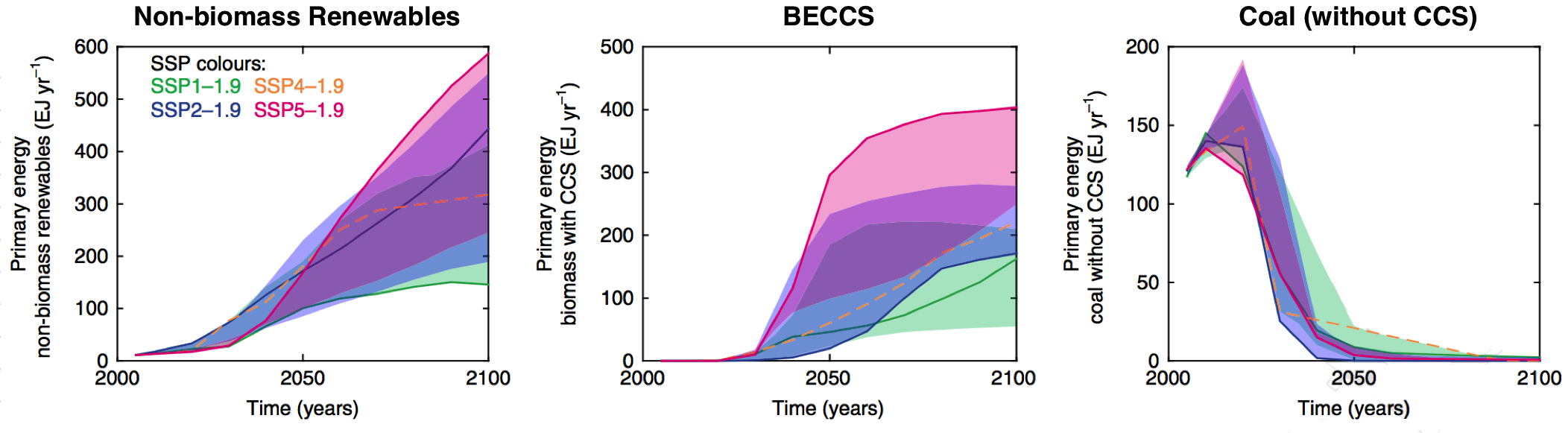
The figure below shows the use of renewables (left), net-negative BECCS (centre) and coal without CCS (right) across all the 1.5C models. The colours show which SSPs the model simulations use.
Global primary energy use in exajoules (EJ) for non-renewable biomass (left), BECCS (center), and coal without CCS (right) across all RCP1.9/1.5C scenarios. Adapted from Figure 2 in Rogelj et al 2018. LARGE IMAGE
In most models, overall energy use actually increases between 2018 and 2100, by between -22% and +83%, with a central increase of 22%.
However, the models also show that energy efficiency is quite important in the short term – at least, while most energy comes from fossil fuels. This is particularly important in the transportation and building sectors, where rapid decarbonisation is more difficult than in power generation.
The models show an estimated 60-80% of all energy coming from renewables globally by 2050. Some models also show a much larger role for nuclear power, though others do not.
To limit warming to 1.5C, coal use without carbon capture declines by around 80% by 2040, with oil similarly mostly phased out by 2060. This would require most petrol or diesel vehicles to be phased out by 2060, with electric or other low-carbon alternative fuel vehicles making up the vast majority of sales well before that date. Future natural gas use is more mixed in the models, with some showing increases and some decreases by mid-century.

Emissions must go negative
Negative emissions are needed in the latter half of the century to pull the extra CO2 out of the atmosphere. This is because emissions cannot fall fast enough in the models to avoid exceeding the allowable carbon budget to avoid 1.5C warming.
Most of the models emit roughly 50-200% more CO2 than the allowable carbon budget over the course of the century, before pulling the extra CO2 back out.
The models assume widespread adoption of BECCS starting between 2030 and 2040 and then rapidly scaling up. By 2050, many models have BECCS producing more than 100 exajoules (EJ), roughly the same amount of energy globally as coal provides today. By 2100, BECCS will be around 200EJ compared to 300EJ for all non-biomass renewable energy.
The figure below shows the amount of CO2 sequestered by CCS (both from BECCS and fossil fuels) across all the models. Carbon capture ramps up after 2020 and could be 20 GtCO2 or higher by the end of the century, which is around half of global CO2 emissions in 2018.
Annual CO2 sequestered by carbon capture and storage in gigatons (Gt) CO2 by year and SSP across all RCP1.9/1.5C scenarios. Adapted from Figure 3 in Rogelj et al 2018.
The models produce estimates of global forest cover changes between -2% and 26% between today and 2100, with most models showing significant increases in forest cover. Both BECCS and afforestation require a lot of land. Most models show a decline in global cropland scenarios roughly equal to the area currently used for agriculture across the entire European Union.
However, most of the models used in the study do not include afforestation as an explicit mitigation option, so afforestation and other “natural” negative emissions technologies could potentially play a larger role in the future. The specific technologies used for future negative emissions may be different and somewhat less reliant on BECCS, but non-BECCS approaches are largely excluded from the models due to remaining uncertainties in cost and effectiveness at scale.
Similarly, the amount of BECCS used differs quite a bit between models and across SSPs, with SSP1 requiring the least negative emissions and SSP5 requiring the most due to its slower emissions reductions and higher overall energy use.
Dr Joeri Rogelj, the paper’s lead author from the International Institute for Applied Systems Analysis (IIASA) in Austria, tells Carbon Brief:
“This indicates that a focus on sustainable lifestyles that limit energy demand can strongly reduce the reliance on BECCS.”
One interesting consequence of the 1.5C target is a reduced use of fossil fuels combined with CCS, compared to what is found in 2C scenarios. This is because fossil fuels with CCS still results in methane emissions from coal mining or gas handling, as well as CO2 emissions due to imperfect capture and leakage. These extra emissions can become too important to allow at a large scale in a 1.5C world.

Much more difficult to reach 1.5C than 2C
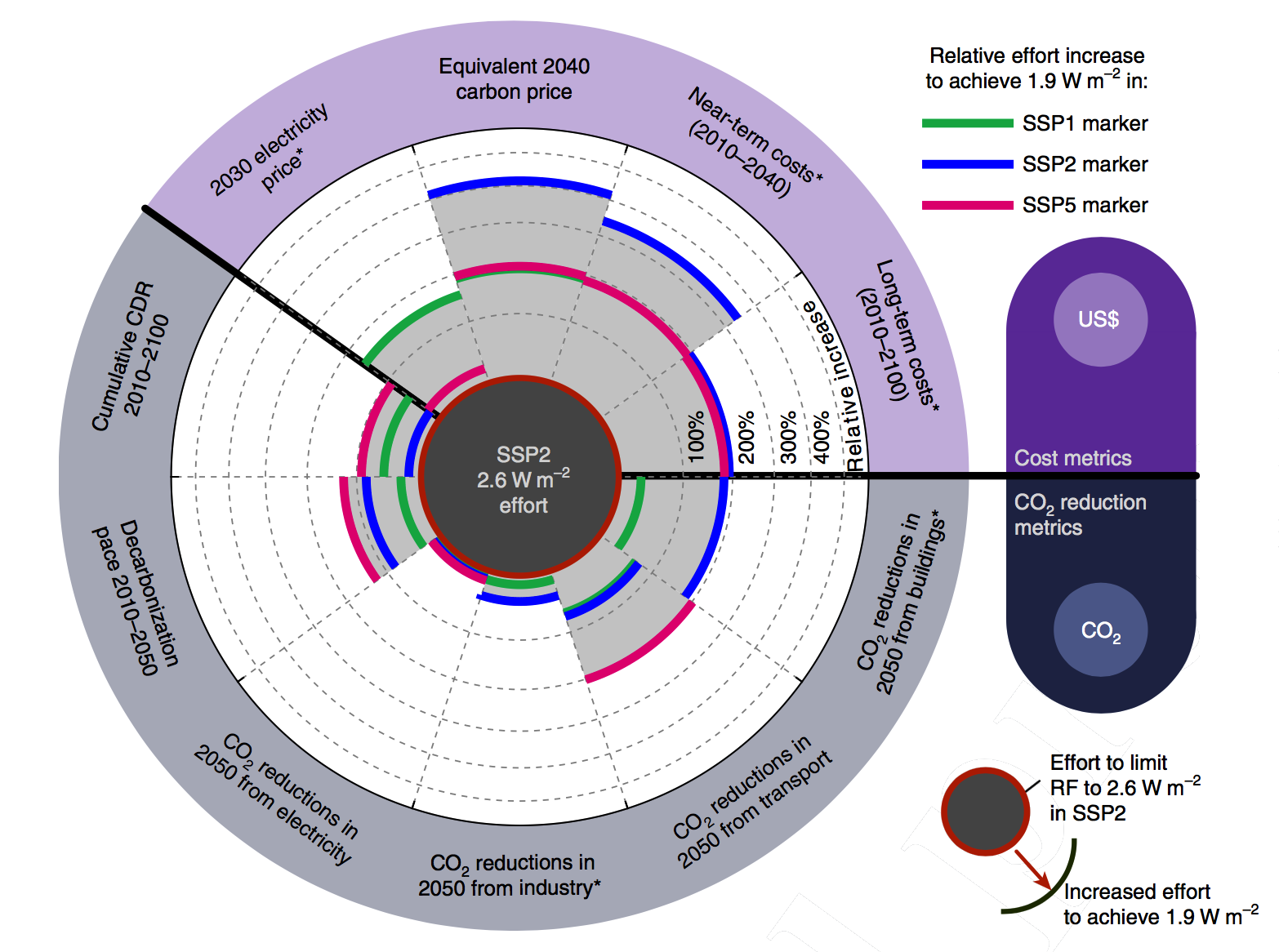
In addition to exploring the details of what it would take to limit warming to 1.5C, the paper also compares it to existing 2C scenarios across a number of different categories. The figure below shows the difference between 1.5C and 2C scenarios across both economic and CO2 reduction metrics. Each dashed line represents a 100% increase in cost or effort in a 1.5C world compared to a 2C world.
Relative increases in cost and CO2 reduction metrics for 1.5C scenarios compared to 2C scenarios for various SSPs. Each dashed line represents a 100% increase in cost or reduction amount, up to a 500% increase. Taken from figure 4 in Rogelj et al 2018. LARGE IMAGE
The largest increases are in carbon prices, which must be between 200% and 400% higher, and in near-term costs, which are 200% to over 300% higher. These increases in short-term costs are driven by the more severe near-term emission reductions needed. Long-term costs are also expected to be around 200% higher.
For CO2 reduction metrics, a 1.5C world requires approximately two to three times larger reductions in CO2 from buildings and transport than in a 2C world. These sectors are more difficult to decarbonise than power generation as they involve the direct combustion of fossil fuels that are less easily replaced.

Difficult, but possible?
The new scenarios in this study are important because they show that there are possible trajectories and technological pathways that can limit warming to below 1.5C in 2100. However, all of the models included overshoot 1.5C of warming in the middle of the century. Most also rely on massive amounts of still-unproven negative emissions later in the century to allow a more feasibly gradual reduction in emissions in the near-term.As Dr Glen Peters, a senior researcher at the CICERO Center for International Climate Research in Norway who was not involved in the study, tells Carbon Brief:
“Limiting temperature to 1.5C is getting close to what models can deliver, with only certain socioeconomic, technological and resource assumptions amenable to 1.5C pathways. How to transform the model results into a viable society transformation remains the elephant in the room. The 1.5C scenarios require radical reductions in unabated fossil fuel use, rapid expansion of non-fossil energy sources and planetary-scale carbon dioxide removal. Failing to meet any of those core building blocks will make 1.5C quickly infeasible.”

Note: Accompanying the publication of the study is a newly updated SSP emissions and scenario database, which includes data for all SSP scenarios.

Links

Wednesday, March 07, 2018

Properties Could Become Harder To Insure And Prices Could Fall As Climate Change Takes Hold, Experts Warn

Domain - 

Houses at Collaroy Beach took the brunt of the June 2016 storm. Photo: Peter Rae
Weighing up the risks of rising sea levels will become a key factor for house hunters as it becomes harder to insure property in the face of climate change, experts say.
Homeowners are currently being left in the dark about the risks of flooding and rising water levels, Karl Mallon, science and systems director at Climate Risk, warned on ABC’s Four Corners on Monday night.
“At the moment you get more consumer protection buying a bottle of shampoo than you get buying a house,” he said.  “No-one is telling homeowners what they really need to know.”
The Insurance Council of Australia believes insurance for properties vulnerable to rising sea levels and other climate change risks will become more expensive and harder to get. Photo: Sarah Keayes
Dr Mallon runs a software company that builds statistical models that assess the risk that rising sea levels pose to infrastructure. It is one of several companies now modelling these risks in the real estate market.
He thinks homeowners in areas under threat from rising sea levels could start finding it harder to sell as buyers become more aware of the effects of climate change.
At the moment you get more consumer protection buying a bottle of shampoo than you get buying a house.
Karl Mallon, Climate Risk
“If you own a home in one of those areas and you try to sell it, you may find that the buyer is saying, ‘Well, I’m not going to be able to insure it’. Or, ‘It’s going to be very expensive’. Or, ‘I don’t want to buy a house that’s going to decline in value'”, Dr Mallon said.
Kayakers float down Pittwater Road, Narrabeen, during the storm in June 2016. Photo: James Alcock
Just getting a mortgage could prove difficult if banks decided they did not want high-risk properties on their lending books, he said.
Even if only the most conservative predictions for sea level rises are correct, the Insurance Council of Australia agreed that vulnerable properties would become more expensive and harder to insure.
Some properties exposed to more frequent and severe flooding were already “far more expensive” to insure, Karl Sullivan, general manager of policy risk and disaster, told Four Corners.
Dr Karl Mallon thinks property buyers need to start factoring climate-change risk into their decision-making process. Photo: supplied
“If those scenarios are going to get worse, then you will find that insurance prices will rise to match them,” he said on the program.
A string of houses on Sydney’s northern beaches made headlines back in 2016, after being partially washed away in violent storms that battered the New South Wales coastline.
Waterfront land in Collaroy was washed away, a swimming pool was swept onto the beach and several multimillion-dollar homes where left hanging on the edge of sand cliffs.
Some residents were left battling their insurers for cover for their damaged properties. They were far from the first homeowners to be surprised by how their cover changed depending on whether the water came from the sky, the sea or a nearby lake.
When thousands of Brisbane policyholders were left uncovered after the 2011 floods, the federal government put pressure on the insurance industry to develop a standard flood clause, and broaden access to flood policies to all households or face government intervention on the issue.
While more than 90 per cent of new home insurance policies now include cover for flooding, neither ‘actions of the sea’ or the effects of gradual sea level rises are covered under the standard definition.
With tens of thousands of homes located within 110 metres of soft, erodible shorelines and flooding events in Australia expected to increase 300-fold off the back of rising sea levels, this is set to become an increasing issue.
But it’s not just property owners with beachfront properties who should be concerned. Low-lying inland areas and properties near rivers or estuaries could also be at risk. Dr Mallon noted that the low-lying streets of Woolloomooloo in Sydney also faced flooding risk.
“[What a lot of people] probably don’t realise, and no one’s telling them, is that there are coastal inundation risks,” Dr Mallon said. “These properties could be flooded. And, they’re not covered by standard insurance, so most standard insurance will exclude actions of the sea.”
Better thought needed to be put into the planning and mitigation process to ensure we never arrive at a situation where something becomes uninsurable, Mr Sullivan said.
“Insurance is very much the canary in the coal mine; you don’t want that price signal to be the first indication that you’ve got a problem,” he said.
“We know well in advance where these problems will occur and so we have got the luxury of time to start thinking about how to deal with it now.”

Links

Women Key To Fight Against Climate Change

Deutsche Welle

Growing up in a South African township, Ndivile Mokoena realized early that women, children and society's poorest are hit hardest by environmental issues. Now she works for gender equality and climate justice globally.


A film by Stefan Möhl

Women are more likely to die as a consequence of drought, flooding or heat waves. And — as long as political and economic power lies with men — they will continue to find it more difficult adapt to dramatic changes in their environment resulting from climate change, says climate and gender activist, Ndivile Mokoena.
Mokoena works for GenderCC, an organization that promotes gender equality in climate protection worldwide. The South African engages internationally and in her home country to get women involved in climate policy and projects.
In Johannesburg, Mokoena helps educate women in urban farming practises, which she hopes will not only help them adapt to climate change but will also increase their independence.

GenderCC Project goal
Empowering women and integrating gender as well as social aspects into urban climate policies in several pilot cities around the world.
Climate Impact
An equal society has better prospects of protecting their environment. By integrating social issues such as poverty alleviation and gender equality into urban climate policy, cities are presented with an opportunity to enhance their response to climate issues.
Project countries
South Africa, Indonesia and India.

Links

When Environmental Crises Hit Homes, Women Suffer The Most

Inter Press Service News Agency - 

This article is part of a series of stories and op-eds launched by Inter Press Service on the occasion of this year’s International Women’s Day on March 8. 
Women from the Mishing community in Dhemaji district are shocked by the siltation caused by the floods. Credit: Priyanka Borpujari/IPS
NAIROBI, Kenya - When Mandelena became a mother, she was only 16. During the prolonged dry season in Gwor County, South Sudan, her community saw crops failing and cattle dying. Children stopped going to school because of hunger and women and girls had to walk up to five hours every day to collect water.
When resources for families further dwindled as the drought prolonged, young girls were married off for a dowry as soon as they reached puberty. Mandelena’s situation was no different. Indirectly, the course of her life had been forever changed by the environmental crisis that crippled her country.

All hands on deck
While environmental changes affect everyone, due to existing gender inequalities, women often bear the bulk of the burden. In patriarchal societies, cultural, legal and political restrictions often undermine women’s adaptability and resilience to climate change.
When cyclones and floods, droughts and extreme heat rip through the social fabric, communities need all hands on deck to deal with the repercussions. Lack of access to land and financial credit make it especially hard for women to bounce back from the onslaught.
When the effects of climate change don’t present themselves as emergencies that grab our attention on the evening news, but rather as slow-onset changes in landscapes and livelihoods, the most severe social consequences are for women and girls first.
• Being in charge of domestic fuel and water provision, women and girls have to walk farther to find these threatened resources. More and more unpaid hours are spent, which could otherwise have been spent on remunerative tasks or in school.
• Every year, indoor air pollution kills 4.3 million people, most of them women and children, because three billion people rely on inefficient cooking technology, such as wood, charcoal or animal waste.
The struggles of women and girls are only part of the picture, as gender equality concerns both men and women. In Mandelena’s community in South Sudan, cattle raiding is common and intimately linked with men’s needs to pay a good dowry for a young bride. This practice is upheld even as resources are becoming scarcer.
The result is a culture of violence, including sexual violence, to the backdrop of climate change and environmental degradation, which intensifies hunger, reduces water availability and kills cattle.

Holistic approach to a sustainable world
More than ever, the world is realizing that the sustainable development goals we set for ourselves aren’t standalone targets but rather a holistic approach to a more inclusive world. We need to recognize the key role women play in taking care of our communities, as they bear the brunt of environmental changes.
When we empower women – by supporting equal access to land, agricultural extension services, financial inclusion and education – we give them the tools to become true custodians of our biodiversity.
Some of the world’s most passionate environmentalists have shown the world that women could be powerful guardians of our planet and agents of change. We can capitalize on their knowledge and experiences.
As we increasingly become aware of the existential climate risks and repercussions of environmental degradation, governments and the private sector are pledging to take action in order to ensure a livable future for all, it is time to consider the role that women are already playing in the sustainable future of our world.
Who will lead our green revolution? Who will take the green jobs? And where will the science and innovations that facilitate our sustainable future come from?
If we want to make a real difference in our future, we have to empower every woman and man to be custodians of our earth. Because the legacy of our environment is the legacy of Mandelena’s daughters as much as her sons.

*Victor Tsang is UN Environment gender expert
*Shari Nijman, UN Environment communication officer


Links

Tuesday, March 06, 2018

Revealed: The Extent Of Job-Swapping Between Public Servants And Fossil Fuel Lobbyists

The Conversation - 

A building full of revolving doors? Ben McCarthy/Wikimedia Commons
Last month Australia slipped further down the rankings in the international corruption index. Among a wide range of factors cited by Transparency International was Australia’s “inappropriate industry lobbying in large-scale projects such as mining”, as well as “revolving doors and a culture of mateship”.
As several high-profile cases have recently revealed, the close ties that continue to exist between senior politicians, former political staffers, and the big end of town have had a real and lasting impact on the perception of political transparency in Australia.
Two examples from 2016 and 2017 clearly illustrate the extent to which such relationships can have a toxic effect on democracy.
During last year’s Queensland election campaign, the ABC revealed that Cameron Milner, former Queensland secretary of the ALP and chief of staff to federal Opposition Leader Bill Shorten, had been the main lobbyist and go-between for Indian mining giant Adani.
Earlier in the year, it was reported that former federal trade minister Andrew Robb walked straight out of his ministerial position in July 2016 to take up a lucrative position as a “high-level consultant” for Chinese-owned company Landbridge. This was the same firm that Robb had publicly defended when it controversially acquired a 99-year lease for the Port of Darwin in 2015.
The cases of Milner and Robb not only suggest that such influence-peddling is politically bipartisan in nature, but that it can happen both during and after the relevant parties have left their positions in the public sector.

Revolving door or golden escalator?
Much has been made in recent weeks of the provisions contained in the federal parliamentary code of conduct. Among other things, the code bans former ministers from lobbying the federal government for 18 months after leaving office. But given the fact that no current or former minister has been deemed to be non-compliant (including Robb), one could be forgiven for concluding that the code is simply a cover for business as usual.
Several prominent public figures and NGOs, including The Australia Institute and urban planner Julie Walton, have argued that the mining, energy, property and gaming industries enjoy favourable treatment in exchange for their generous political donations, or at least are perceived to. There’s also widespread public acceptance that the resources industry was instrumental in removing Kevin Rudd from the prime ministership in 2010.
What is less well known is the extent to which big business has sought to bend the will of the body politic by directly influencing the formation of government policy.
This is not just done through lobbying. All of these industries have been proactive in courting individuals who hold public office in relevant portfolios as potential allies and future employees. Some are employed as lobbyists, some as advisors, some as consultants, and others as board members and company directors. This allows these industries to shape tax and regulatory regimes in their favour, and to drive major government and private sector investments in their own infrastructure.
The phenomenon we seek to highlight has previously been referred to as the “revolving door” between the political and corporate realms. But although there is ample evidence for these kinds of arrangements, on closer inspection they look more like a golden escalator. The financial rewards on offer in the private sector can dwarf anything received by senior politicians and public servants while in office.
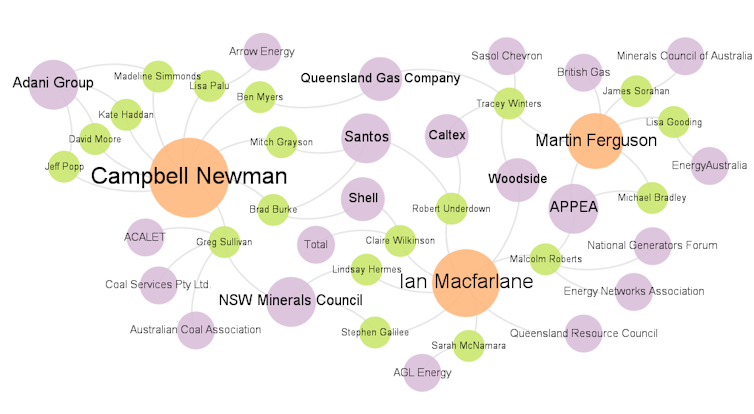
For evidence of this dynamic, we need only to look to former resource ministers Martin Ferguson and Ian Macfarlane. Ferguson took up a position as a non-executive director of British Gas just weeks after leaving federal politics in September 2013, having already become chair of an advisory board for Australia’s oil and gas peak body, APPEA in October. Macfarlane, meanwhile, was appointed chief executive of the Queensland Resources Council only four months after leaving federal politics.
Current and past resource industry employment of former staffers of Ian Macfarlane (Federal Minister for Resources and Energy, Sep 2013 - Sep 2015), Martin Ferguson (Federal Minister for Resources and Energy, Nov 2007 - Mar 2013) and Campbell Newman (Queensland Premier, Mar 2012 - Feb 2015) over the past decade, and employment for Macfarlane and Ferguson since leaving office. Corporate entities are shown in purple, staffers in green, and politicians in orange. LARGE IMAGE
The ‘service elevator’
There is another strategy that has also been used to great effect by the fossil fuel and mining industries in recent years. It is also used by powerful corporations in other economic sectors such as agribusiness, pharmaceuticals, gaming, and construction.
The industries in question either hire former ministerial staffers and policy analysts with relevant knowledge and expertise to advise them, or they encourage their own former staffers to take on positions as government advisers while maintaining close links with them. When acting as staffers, these individuals are free to operate outside of public scrutiny and regulatory reach. This allows them to move seamlessly between the offices of powerful political figures and some of Australia’s largest resource companies and industry bodies.
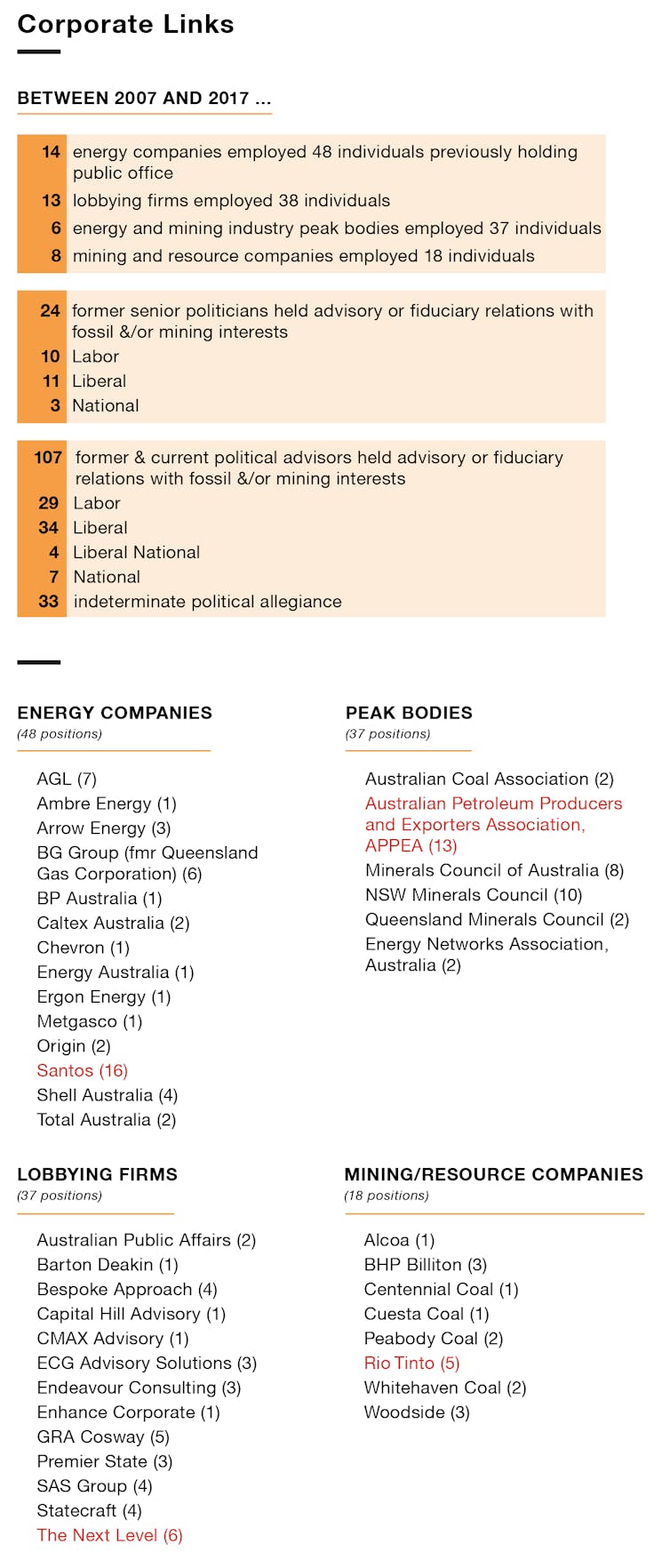
We have compiled a database of more than 180 individuals who have moved between positions in the fossil fuel and/or mining industries and senior positions in government, or vice versa, over the past decade. This includes senior political staffers working for prime ministers and state premiers. We have also found examples of key ministers hiring individuals straight from the fossil fuel and mining industries, who then return to those industries straight after leaving government. This revolving door might be better dubbed a “service elevator”, ensuring that “delivery of the goods” happens away from public scrutiny.
Organisations highlighted in red have the most former public sector employees in their company. Mai Lam/The Conversation NY-BD-CC, CC BY-ND
LARGE IMAGE
Questions of influence
Australian governments clearly need to enact laws at the state and federal levels to prevent these kinds of activities.
We know that such legislation is not without precedent, and is therefore politically feasible. For example, in Ireland, the cooling-off period was recently set at one year, whereas in Canada it is two years and in the United States, five years.
But it is not just the rules around political lobbying that require reform. Many other areas of political activity are also in dire need of attention, including much stronger disclosure laws in relation to campaign financing and political party donations, and a significant increase in public funding for political parties, apportioned on the basis of electoral support.
Most significant, however, is the need for a federal anti-corruption body with independent investigative powers. While there has been resistance from the major political parties to the creation of a federal anti-corruption watchdog, it would appear that the tide is turning. Prime Minister Malcolm Turnbull recently countenanced such a move, as did Bill Shorten.
If our political leaders are not prepared to provide more transparency and accountability with respect to government decision-making, then we can only assume the resource extraction industries will continue to call the shots on Australia’s transport and energy policies.
Our collective failure to deal with these issues will ensure that the increasingly dire predictions about planetary boundaries being breached over the next few decades will indeed be realised.

Links

Lethal Heating is a citizens' initiative