28/06/2018

Judge Tosses City Climate Change Lawsuits Against Big Oil

Bloomberg -  | 
  • San Francisco jurist says solution needed on ‘more vast scale’
  • BP, Exxon, Chevron backed by President Trump on dismissal bid

Fighting Climate Change, Without the U.S.

BP Plc, Exxon Mobil Corp. and Chevron Corp. escaped blame for the public costs of global warming when a U.S. judge ruled that lawsuits by cities against oil companies aren’t the answer to climate change.
“The problem deserves a solution on a more vast scale than can be supplied by a district judge or jury in a public nuisance case,” U.S. District Judge William Alsup wrote Monday in dismissing complaints by the cities of San Francisco and Oakland, California.
Litigation by local governments in the U.S. including New York City, Boulder, Colorado, and eight California cities and counties is a new front in the global fight against climate change. The suits thrown out Monday sought to recover the cost of infrastructure needed to protect against rising sea levels. ConocoPhillips and Royal Dutch Shell Plc were also among the defendants.
The judge said it’s “true” that carbon dioxide released from fossil fuels has contributed to global warming, but on the other hand, “development of our modern world has literally been fueled by oil and coal.”

Fossil Fuels
"All of us have benefited,” Alsup wrote. “Having reaped the benefit of that historic progress, would it really be fair to now ignore our own responsibility in the use of fossil fuels and place the blame for global warming on those who supplied what we demanded?"
The judge concluded in his 16-page ruling that the issue is best addressed by the government’s legislative and executive branches. The Trump administration made that argument in urging the judge to toss the suits, even while the administration has opposed efforts worldwide to fight climate change.
“While it remains true that our federal courts have authority to fashion common law remedies for claims based on global warming, courts must also respect and defer to the other co-equal branches of government when the problem at hand clearly deserves a solution best addressed by those branches,” Alsup wrote.
A spokesman for the San Francisco city attorney said the office is reviewing the judge’s order and will decide next steps shortly.
“We’re pleased that the court recognized that the science of global warming is
no longer in dispute,” John Cote said in an emailed statement. “Our litigation forced a public court proceeding on climate science, and now these companies can no longer deny it is real and valid.”
Oakland City Attorney Barbara Parker said the city is weighing whether to appeal.
“Our lawsuit presents valid claims and these defendants must be held accountable for misleading the American people about the catastrophic risks to human beings and all forms of life on this planet caused by fossil fuel-driven global warming and sea level rise,” she said in an email.
A request by the oil companies for dismissal of the New York City case is pending in Manhattan federal court.
The cases are People of the State of California v. BP P.L.C. 17-cv-06011 and 17-cv-06012, U.S. District Court, Northern District of California (San Francisco).

Links

Here’s Why The Bay Area Lost Its Lawsuit Against Big Oil

Grist - 

REUTERS / Joshua Lott
The judge who famously convened a climate tutorial threw out a case against Big Oil on Tuesday. San Francisco and Oakland had sued BP, Chevron, ConocoPhillips, ExxonMobil, and Shell to help pay for the costs of building seawalls and other projects to adapt to climate change.
This decision dims hopes for those pursuing lawsuits against companies for damages tied to climate change. At least nine other cities and counties have brought similar lawsuits, including New York City, Boulder, Colorado, and King County, Washington.
From the beginning, U.S. District Court Judge William Alsup took an expansive approach. He had each side fly in experts to give him a personal masterclass on climate change in his San Francisco courtroom. During that tutorial, he seemed sympathetic to the argument that oil companies have done real harm. You can glimpse that sympathy in his 16-page decision : “[T]his order accepts the science behind global warming. So do both sides. The dangers raised in the complaints are very real.”
So why throw out the lawsuit?
Well, Alsup sees a danger that worries him more than climate change — the danger of a single unelected judge deciding that countries around the world are better off without oil.
Alsup wrote that a ruling against Big Oil would trigger a cascade of other lawsuits, and eventually put petroleum producers out of business. And this, he argued, would trample on the policies of countries that are actively encouraging oil production. While the harms of fossil fuels are clear, so are the benefits, Alsup argued. “Without those fuels, virtually all of our monumental progress would have been impossible,” he wrote. “All of us have benefitted.”
San Francisco and Oakland’s lawsuit, Alsup wrote, is effectively asking the court to “conduct and control energy policy on foreign soil.” If any branch of government is going to do something as big as shutting down global oil production, Alsup reasons, it needs to be done by elected representatives, not one judge and jury making a decision for the entire world.
This isn’t the first time a lawsuit seeking climate-change damages has run afoul of the courts. In fact, Alsup wrote, “No plaintiff has ever succeeded” in this kind of case. The California cities could appeal to a higher court. But for the moment, their lawyers are taking heart in the fact that this case set a non-legal precedent, said John Cote, a spokesman for the San Francisco city attorney, in a statement. “Our litigation forced a public court proceeding on climate science, and now these companies can no longer deny it is real and valid.”
After hearing from all sides, Alsup concluded: “The issue is not over science. All parties agree that fossil fuels have led to global warming and ocean rise and will continue to do so.”
Now that we’ve got that sorted out, we can all move on to the most reasonable solutions, right? Right?

Links

27/06/2018

4 Ways You Can Make A Difference On Climate

EcoWatch - Jaime Nack

Pixabay
"Where do I start?"
Whatever the forum, whatever the audience, it's always the first question I hear when I talk to people about sustainability and personal impact.
We all want to make a difference on climate change, but many of us don't know how we can or where to begin. It can seem overwhelming.
The good news is that even on a challenge as huge as global climate change, everyday people can make a real difference in their everyday lives. We'll be talking a lot about this at the upcoming Climate Reality Leadership Corps training in Los Angeles from Aug. 28—30 and you should be there.
Join Climate Reality for the training in LA and learn more about all the ways you can have a real impact on your local and global community with the decisions you make daily. As a preview, here are four ways to start.

Individual Impact: Start the Conversation
Do you ever think about how many decisions you make on a daily basis? Research shows that the average person makes around 35,000 decisions every single day.
For all of us, these decisions are opportunities to have a powerful impact on our climate. Some may be inconsequential (like which shoe to put on first or what to listen to on your way to work). However, the majority can have a tremendous positive impact if we're intentional about them. Decisions like:
  • What should I eat for lunch?
  • How should I commute to work today?
  • Should I work for an organization aligned with my values?
  • Should I work for a large company where I can help drive change from the inside out?
Your individual decisions as a consumer not only signal demand for certain products to companies, they show your friends, family members and colleagues what kind of world you support. And your example goes a long way.

Community Impact: Your Neighborhood
What communities do to fight climate change comes down to the people who live there. So whether you're living in a town already committed to renewable electricity or a city yet to start recycling, you can help push your hometown forward.
If your community is already moving in the right direction, show your support. Use social media and write a letter to the editor of the local paper to show that people in the neighborhood are behind climate action.
Plus, many communities have advisory groups where residents can give feedback and advice on initiatives from electric vehicle charging stations to restaurant composting programs to green home educational programs for residents. It's your chance to help shape local policies that directly affect you and the planet.
If your community is still just getting started, you can push for sustainability programs that encourage broad participation and buy-in across sectors. One example would be the creation of an environmental task force or advisory committee to help develop local environmental policies and programs.
The business community can be a powerful ally. In some cases, including the chamber of commerce or leaders in the local business community may be an easier lift than working directly with city departments. Chambers across the globe have seen the benefits of creating "Green Business Programs," which educate businesses about how to go green and promote those that have sustainable practices.


Climate Reality: How We Empower Communities to Fight Climate Change

Industry Impact: Your Workplace
No matter where you work, from corporations to nonprofits to government agencies to universities, there are lots of ways to help create change within your workplace.
As a first step, research whether there are environmental standards, certifications or industry organizations for your field. If you found some, great! Start talking to decision-makers at your organization to find out how you can engage them. If not, find others in your field who are passionate about sustainability and develop your own.
For instance, the events industry has developed green event standards (ISO 20121 and APEX/ASTM), green event certifications, and industry organizations (Green Meeting Industry Council, Sustainable Event Alliance, Green Sports Alliance).
These standards have pushed all industry stakeholders, like venues, event producers, caterers and suppliers of event products, to up their sustainability game—with huge results.
Why are industry standards such a big deal? Consider that the Olympics is essentially one large $5 billion event. The importance of the International Olympic Committee embracing the ISO 20121 standard as a requirement for all Olympic Games from 2012 onward is massive in terms of the carbon emissions, pollutants and waste it prevents.

Global Impact: Your World
Yes, the climate crisis is a global challenge. Yes, it's big. Too big for any one person to solve on their own. But together with thousands and thousands of other committed activists spread across every time zone? Now that's a different story.That story is the Climate Reality Leadership Corps, nearly 14,500 (and growing) everyday people of all ages who all decided that our climate and our planet are too important to leave in the hands of others.
They all believed they had to do something themselves. So they came to train with former Vice President Al Gore and others. They learned how to organize their communities and create pressure for action that policymakers couldn't ignore.
Together, they've become a powerful force for change, helping push cities and universities to go 100 percent renewable and making business more sustainable all around the world.
You can train as a Climate Reality Leader and join them. You can be part of this global movement that is reshaping the world we live in. After all, these Leaders are working for solutions in ways that ripple across the planet, but they all started off as someone just like you. Someone asking, "What can I do?"

Ready for Action?
If you're ready to learn how you can make a difference in your community and for the planet, join a host of incredible speakers like former Vice President Al Gore at the Climate Reality Leadership Corps training in LA Aug. 28—30.It's three days of inspiring sessions on climate science and solutions. Three days of conversations with other world-changers just like you. Three days that point the way forward to a sustainable future. Three days that will change your life.
Applications are open and the training is free to attend, so apply today.

Links

How Australia Will Get To 33% Renewable Electricity By 2020

RenewEconomy - Giles Parkinson

Remember just a few years ago when the then Abbott government tried to kill the renewable energy target, declaring that – horror of horrors – that Australia might over-achieve on renewable and end up with more than a 20 per cent share.
They are still complaining, along with some vested interests in the big business lobby groups. But despite their best attempts, it seems that Australia will end up with 33 per cent renewables by 2020, will likely get to 40 per cent by 2030, and has enough in the pipeline to reach 85 per cent.
These estimates were released by Green Energy Markets in their latest Renewable Energy Index, and analyst Tristan Edis points out that it means there is enough renewables being built to meet the targets of the proposed National Energy Guarantee, even before it is put in place.
“Even if contracting and construction commitments to solar farms and wind farms halted from today, ongoing installations of rooftop solar should see renewables share reaching 39% by 2030,” Edis says.
“Given a range of corporate procurement tenders are also underway it is now reasonably likely renewables will exceed 40% share by 2030.
“This substantially exceeds the emission reduction ambition within the National Energy Guarantee (NEG). Modelling for the Energy Security Board estimated the emission target would be achieved with 36% renewables’ share.”

Edis says that the expected level of 33.3 per cent in 2020 represents almost a doubling in renewables share compared to 2015, when it met 17.3 per cent of annual electricity consumption.
Queensland currently leads the country in terms of large scale installations, with more than 2GW under construction, followed by Victoria, which has around 1.75GW under construction.
The most populous state, NSW, has less than half the construction in terms of capacity of Victoria, not surprising given its lack of state-based support. Across the country, wind still outstrips solar by a ratio of around 3:2.

Just in the last month, renewables contributed 19.9 per cent of electricity in May, with about half coming fro hydro and biomass, and the other half coming from wind and large scale solar, as well as rooftop solar.

Links

26/06/2018

Federal Judge Dismisses Cities’ Suit Against Oil Companies Over Costs Of Climate Change

New York TimesJohn Schwartz

Students in San Francisco rallied for clean energy outside City Hall in February. Credit Jeff Chiu/Associated Press
A federal judge on Monday threw out a closely watched lawsuit brought by two California cities against fossil fuel companies over the costs of dealing with climate change.
The decision is a stinging defeat for the plaintiffs, San Francisco and Oakland, and raises warning flags for other local governments around the United States that have filed similar suits, including New York City.
The judge, William Alsup of Federal District Court in San Francisco, acknowledged the science of global warming and the great risks to the planet, as did the oil and gas companies being sued. But in his ruling, Judge Alsup said the courts were not the proper place to deal with such global issues, and he rejected the legal theory put forth by the cities.
“The problem deserves a solution on a more vast scale than can be supplied by a district judge or jury in a public nuisance case,” Judge Alsup wrote in a 16-page opinion.
The cities wanted the defendants — including BP, Chevron, ConocoPhillips, Exxon Mobil and Royal Dutch Shell — to help pay for projects like protecting coastlines from flooding.
But Judge Alsup said the issues would more properly be handled by the other two branches of government. “The court will stay its hand in favor of solutions by the legislative and executive branches,” he wrote.
The Chevron oil refinery in Richmond, Calif. Chevron was among the defendants in the suit. Credit Paul Sakuma/Associated Press
A business group that has been highly critical of the lawsuits, the National Association of Manufacturers, expressed satisfaction with the dismissal of the case. “From the moment these baseless lawsuits were filed, we have argued that the courtroom was not the proper venue to address this global challenge,” said the group’s chief executive, Jay Timmons.
Judge Alsup said that climate change was an issue of global importance but that the companies were not solely at fault. “Our industrial revolution and the development of our modern world has literally been fueled by oil and coal,” he wrote. “Without those fuels, virtually all of our monumental progress would have been impossible.”
In light of that, he asked: “Would it really be fair to now ignore our own responsibility in the use of fossil fuels and place the blame for global warming on those who supplied what we demanded? Is it really fair, in light of those benefits, to say that the sale of fossil fuels was unreasonable?”
A Chevron executive sounded a similar note in response to the decision. “Reliable, affordable energy is not a public nuisance but a public necessity,” said R. Hewitt Pate, vice president and general counsel for Chevron.
The cities had relied on the area of public nuisance under state common law, which allows courts to hold parties responsible for actions that interfere with the use of property.
Earlier attempts use nuisance claims in lawsuits about climate change have been heard under federal law in cases such as American Electric Power v. Connecticut, but none have succeeded. In a unanimous 2011 decision, the Supreme Court said that the Clean Air Act displaced the federal common law of nuisance, leaving enforcement and regulation to the Environmental Protection Agency.
The cases brought by San Francisco, Oakland and other cities and counties have attempted to use the nuisance doctrine at the state level, working from the theory that state common law has not been similarly displaced. The fossil fuel companies have tried to move the cases to the federal courts under federal law.
Judge Alsup, in previous stages of the litigation, suggested that the federal courts could still hear such cases. He kept the suits filed by San Francisco and Oakland before him, and ordered an unusual “tutorial” on climate change to familiarize himself with the scientific issues.
But in a different courtroom in the same building, Judge Vince Chhabria — also of Federal District Court in San Francisco — sent similar cases involving San Mateo and Marin Counties and the City of Imperial Beach to state court. That litigation is pending.
Michael Burger, executive director of the Sabin Center for Climate Change Law at Columbia University, said that in deciding the courts were an improper venue for the case, Judge Alsup “focused on the need to balance the benefits of energy production against the harms of climate change, a balancing act carried out not only by the U.S. government but also by governments all around the world.” He said it was too early to tell whether the decision would persuade other judges hearing similar cases around the country.
John Coté, a spokesman for the San Francisco city attorney, said the city was considering its options. “This is obviously not the ruling we wanted, but this doesn’t mean the case is over,” he said. “We’re reviewing the order and will decide on our next steps shortly.”
Mr. Coté added that the city agreed with Judge Alsup on one important point. “We’re pleased that the court recognized that the science of global warming is no longer in dispute,” he said.
“Our litigation forced a public court proceeding on climate science, and now these companies can no longer deny it is real and valid. Our belief remains that these companies are liable for the harm they’ve caused.”

Links

More Than 20 Nations Seek Lead In Setting Tougher Climate Goals

Reuters - Alister Doyle

  • Germany, France, Britain among nations exploring tougher goals
  • Want to 'lead from the front'
  • Welcome U.N. plan for summit in 2019
An electric Bluecar is reflected on an Autolib' car-sharing enrollment kiosk in Paris, France, June 21, 2018. REUTERS/Benoit Tessier
OSLO - More than 20 nations ranging from Germany, France and Britain to Pacific island states said on Thursday they planned to "lead from the front" in setting new, tougher goals by 2020 to cut greenhouse gas emissions under the Paris climate agreement.
They welcomed a decision by U.N. Secretary-General Antonio Guterres to host a summit in September 2019 to review the fight against global warming since almost 200 governments signed up in 2015 for the Paris accord.
"We commit to exploring the possibilities for stepping up our own ambition," the 23 nations said in a statement, issued by the Marshall Islands in the Pacific, about goals for stepping up action by 2020.
"We call on other countries to join us in expressing their desire to lead from the front."
The governments also said in a "Declaration for Ambition" that they would encourage long-term strategies for low emissions and new funds and investment in projects to help goals of the Paris Agreement.
Signatories were Argentina, Britain, Canada, Chile, Colombia, Costa Rica, Denmark, Ethiopia, Fiji, Finland, France, Germany, Maldives, Marshall Islands, Mexico, Monaco, the Netherlands, New Zealand, Norway, Rwanda, Saint Lucia, Spain and Sweden, a statement said.
"This declaration shows that countries understand the urgency of climate action and are actively looking into making bigger, bolder commitments," David Waskow of the World Resources Institute think-tank, wrote in a statement.
The Paris climate agreement obliges countries to set new climate goals every five years as part of a goal of phasing out polluting fossil fuels this century.
The nations said they would work in the light of a U.N. report by leading climate scientists, due for publication in October, about ways to limit a creeping rise in global average temperatures that is causing heat waves, downpours and droughts.
A leaked draft of that report says warming is set to exceed 1.5 degrees Celsius (2.7°F) above pre-industrial times, the strictest goal under the Paris Agreement, by around 2040 unless governments take "rapid and far-reaching" measures.
China, the European Union, India and Russia, the top emitters of greenhouse gases which support the Paris accord, were not among nations signing the declaration. It is preliminary with other nations welcome to sign up.
The landmark Paris agreement has been weakened by a decision by President Donald Trump to pull the United States, the number two emitter, out of the accord. Trump doubts mainstream scientific findings that man-made greenhouse gases are the prime cause of warming and wants to promote the coal industry.
By contrast, small island states say that a thaw of ice worldwide will raise sea levels and swamp their nations.
"If we do not raise global ambition by 2020, it will be too late for my island nation," Hilda Heine, President of the Marshall Islands, said in a statement.

Links

Assessing The Global Climate In May 2018

NOAA

Courtesy of Pixabay.com
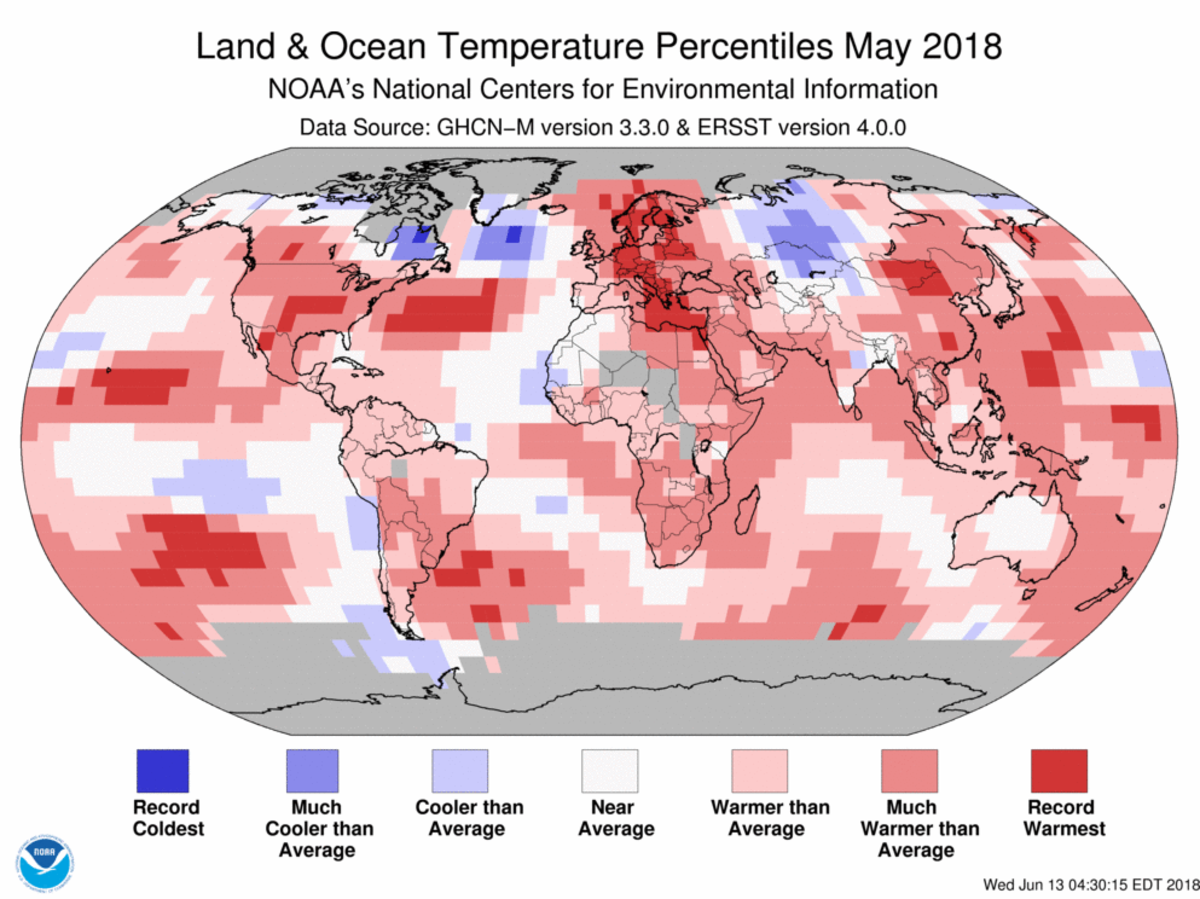
The global land and ocean temperature departure from average for May 2018 was the fourth highest for the month of May in the NOAA global temperature dataset record, which dates back to 1880.
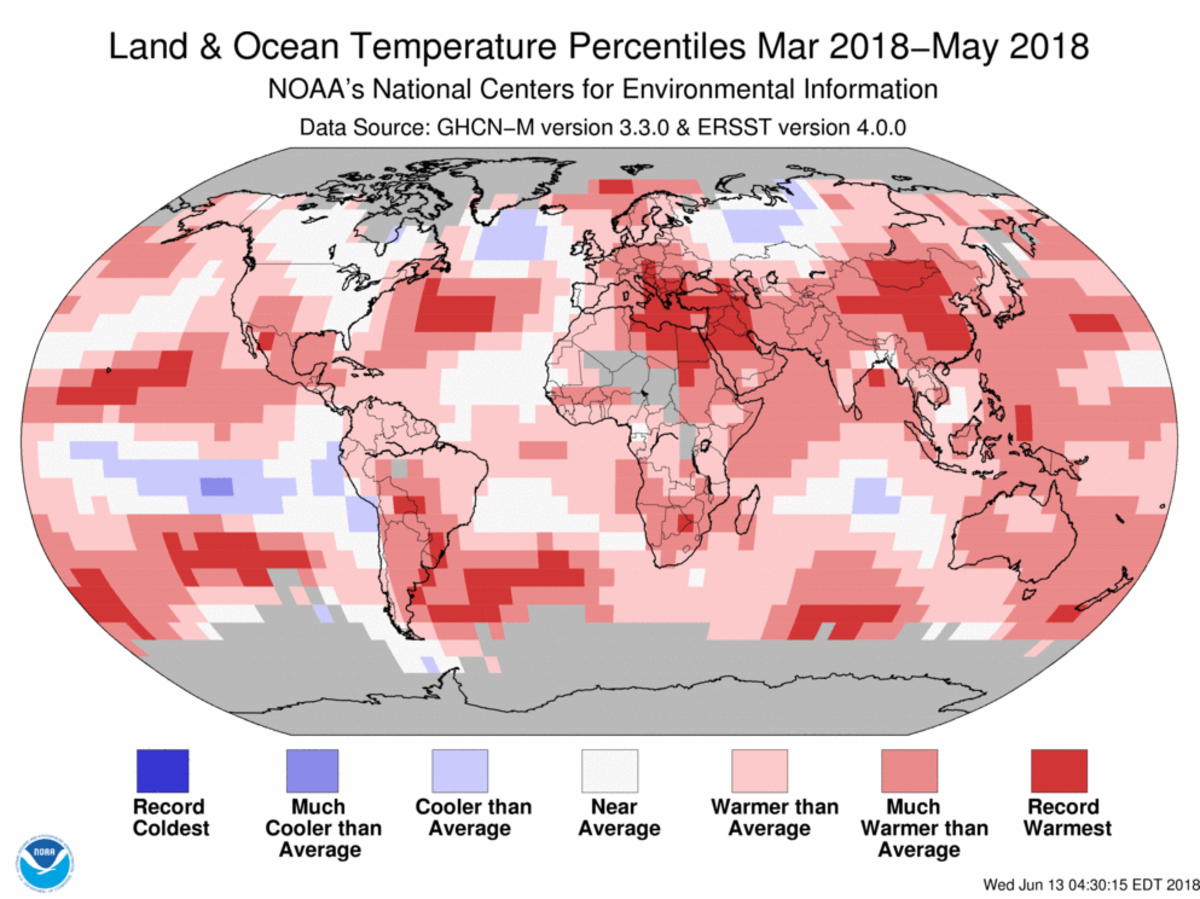
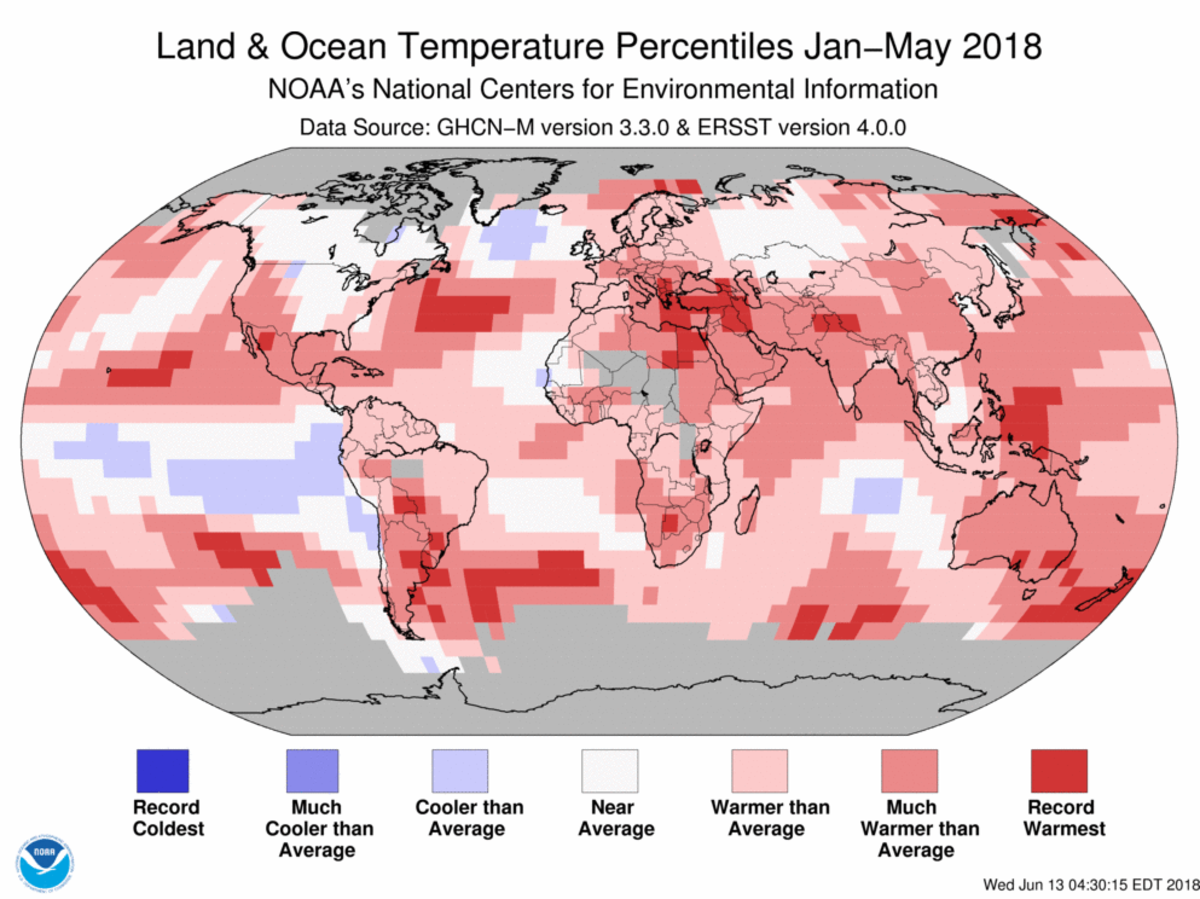
The March-May and year-to-date global temperatures were also the fourth warmest such periods on record.
LARGE IMAGE
This monthly summary, developed by scientists at NOAA's National Centers for Environmental Information, is part of the suite of climate services NOAA provides to government, business, academia and the public to support informed decision-making.
LARGE IMAGE
  • The May temperature across global land and ocean surfaces was 1.44°F above the 20th century average of 58.6°F and the fourth highest for May in the 1880-2018 record. The years 2014-2018 rank among the five warmest Mays on record, with 2016 the warmest May at 1.58°F above average. May 2018 also marks the 42nd consecutive May and the 401st consecutive month with temperatures, at least nominally, above the 20th century average.
    • Record warmth was observed across parts of North America., Europe and Asia as well as the Atlantic, Pacific and Indian Oceans. Record cold May temperatures were limited to northeastern Canada and the northern Atlantic Ocean, off the southern coast of Greenland.
  • The May globally averaged land surface temperature was 2.05°F above the 20th century average of 52.0°F. This value was the smallest May temperature departure from average since 2011 and tied with 2013 as the seventh highest May land temperature in the 139-year record.
    • The most notable warm land temperature departures from average during May 2018 were present across much of the contiguous U.S. and Europe, where temperatures were 5.4°F above average or higher. In contrast, the most notable cool land temperature departures from average were present across northeastern Canada and central Russia where temperatures were 5.4°F below average or lower.
    • Europe had its warmest May since continental records began in 1910 at 4.97°F above average, surpassing the previous record set in 2003 by 1.66°F. May 2018 marked the first time in May that the continental temperature departure from average was 3.6°F (2.0°C) or higher. Several European countries had a record or near-record warm May temperature.
    • Asia had its smallest May temperature departure from average since 2009.
  • The May globally averaged sea surface temperature was 1.19°F above the 20th century monthly average of 61.3°F – also the fourth highest global ocean temperature for May in the record. The years 2014-2018 rank among the five warmest Mays on record, with 2016 the warmest May at 1.39°F above average.
May 2018 Sea Ice
LARGE IMAGE
  • The May average Arctic sea ice extent was the second smallest in the 40-year record at 420,000 square miles (8.1 percent) below the 1981-2010 average, according to an analysis by the National Snow and Ice Data Center (link is external) using data from NOAA and NASA. Only the May Arctic sea ice extent in 2016 was smaller. The near-record low Arctic sea ice extent was mostly due to much-below-average sea ice in the Bering and Chukchi Seas.
  • Antarctic sea ice extent during May was 330,000 square miles (8.6 percent) below the 1981-2010 average, the third smallest May extent on record. Antarctic sea ice expanded at a rate faster than average during May, with below-average ice coverage continuing for parts of the Weddell Sea.
Seasonal (March-May 2018)
LARGE IMAGE
  • The March-May average temperature across global land and ocean surfaces was 1.48°F above the 20th century average of 56.7°F and the fourth highest for March-May in the 1880-2018 record. This value was 0.45°F cooler than the record high set in 2016 and was the smallest March-May temperature departure from average since 2014.
    • Record warm temperatures during the three-month period were present across parts of southern Europe, the Middle East, northeastern Africa, China, Mongolia, South America and the Atlantic, Indian and Pacific Oceans. No land or ocean areas had record cold temperatures during March-May 2018.
  • The globally averaged land surface temperature for March-May was 2.34°F above the 20th century average of 46.4°F. This value was the the fifth highest for March-May in the 139-year record.
    • Five continents had a March-May 2018 temperature that ranked among the nine warmest such period since continental records began in 1910. Of note, Europe and South America had their third warmest March-May on record.
  • The March-May globally averaged sea surface temperature was 1.15°F above the 20th century average of 61.0°F – also the fourth highest for March-May in the record.
Year-to-Date (January-May 2018)
LARGE IMAGE
  • The year-to-date temperature across global land and ocean surfaces was 1.39°F above the 20th century average of 55.5°F – tying with 2010 as the fourth highest for January-May in the 139-year record. The 2018 year-to-date value was 0.59°F lower than the record high set in 2016.
  • The year-to-date globally averaged land surface temperature was 2.18°F above the 20th century average of 42.8°F. This value tied with 2002 as the fifth highest for January-May in the record.
  • The year-to-date globally averaged sea surface temperature was 1.08°F above the 20th century average of 60.8°F. This was also the fifth highest for January-May in the 1880-2018 record.
For a more complete summary of climate conditions and events, see our May 2018 Global Climate Report.

Links

Lethal Heating is a citizens' initiative