Tuesday, October 09, 2018

Mining Sector, Morrison Government On The Defensive Over IPCC Report

Fairfax - Peter Hannam | Cole Latimer

Australia's mining industry and the Morrison government have rejected an international climate report that demands nations phase out all coal-fired power by mid-century and leave most fossil fuel reserves untapped to avoid dangerous global warming.
The Intergovernmental Panel on Climate Change's special report, released on Monday, said average temperature increases could still be kept to 1.5 degrees but would require a "global transformation" of all sectors of the economy.
Sunset for coal and other fossil fuels? Not yet, says the Morrison government. Credit: Nic Walker
Prime Minister Scott Morrison led his government's defence of miners, saying the IPCC report did not "provide recommendations to Australia" and that his government's focus would be "to ensure that electricity prices are lower" for households and businesses, alike.
Resources companies, though, fell on the Australian Stock Exchange, led by South32, the mainly coal miner spun-off from BHP. Its price sank 5.4 per cent or more than triple the overall market's slide of 1.4 per cent.
Industry groups, such as the Queensland Resources Council, dismissed the prospect of an early demise for the country's coal sector, saying Australian coal boasted relatively low emissions.
"There is a role for high-quality Australian coal and it's compatible with meeting Paris emissions reductions targets," Ian Macfarlane, council chief executive and a former Coalition energy minister.
"Our economy depends on the coal industry, and we can have both a strong coal industry and reduce carbon emissions."
The NSW Minerals Council likewise said coal had "very positive" future in the state, with strong demand from traditional and emerging export markets, a spokesman said.
"There are positive signs that these good conditions will continue in coming decades," he said, citing a recent industry forecast that annual Asian demand for coal burnt in power plants would jump by half from about 740 million tonnes to 1.147 billion tonnes by 2030.

Carbon budgets
However, the IPCC report's authors said the world would face severe consequences if the great bulk of fossil fuels including coal, oil and gas, weren't left in the ground.
At 1.5 degrees of warming, compared with pre-industrial levels, as much as 90 per cent of the world's coral reefs will die, and virtually all would be lost if temperatures rose two degrees, or about twice the increase so far.
Mark Howden, head of the Australian National University's Climate Change Institute, said emitting the equivalent of about 420 billions of carbon dioxide would exhaust the remaining carbon budget to cap warming at 1.5 degrees. Current annual emissions are about 42 billion tonnes, implying about a decade of pollution before "the need to go vertical" to zero emissions to keep within the temperature limit.


Emissions will need to fall 45 per cent from 2010 levels - or 58 per cent from 2015 totals - by 2030, the IPCC said.
Melissa Price, the federal Environment Minister, said the government would consider the IPCC report, saying the government "is committed to the Paris Agreement and takes its international obligations seriously".
"We’re particularly concerned about the implications for coral reefs, with the report finding climate
change will impact reefs across the world, including Australia," she said.
The Paris accord was signed three years ago by almost 200 nations, who pledged to keep warming to 1.5-2 degrees. Australia's pledge is to cut 2005-level emissions 26-28 per cent by 2030, a target environmental groups such as the Climate Action Tracker describe as "insufficient".

Labor, Greens
Both Labor and the Greens attacked the Coalition government, signalling the likelihood that climate change will become a major issue at the next federal poll due by mid-2019.
"At 1.5 degrees, we will see the consequences of climate-related risks to our health, our livelihoods, our food security, water supply, human security, and economic growth," Penny Wong, Labor's acting spokeswoman for climate change, said.
Senator Wong said "the government’s own data shows they will fail to meet their already inadequate Paris targets with pollution rising all the way to 2030".
Labor has pledged to increase Australia's carbon reduction effort to 45 per cent from 2005 levels and roughly triple the current share of renewable energy to 50 per cent by 2030.

Adam Bandt, the Greens climate spokesman, said the IPCC report showed it was "time to hit the climate emergency button", and that neither major party was prepared to take the necessary steps.
"If we don’t quit coal, we are screwed," said Mr Bandt. "Business as usual under Liberal and Labor is a death sentence."

Shutting down
Market forces, at least in Australia, indicate an exit from coal in the electricity sector is likely for all major plants by 2050 - unless governments intervene to extend their lives.


Origin Energy, for instance, plans to shut the Eraring coal-fired power station in NSW - Australia's largest - by 2032.
"We believe that net-zero emissions for the electricity sector by 2050 or earlier is achievable," Origin chief executive Frank Calabria said in the company’s 2018 Sustainability report.
One industry hoping to benefit from any shift towards low emissions in the carbon capture and storage (CCS) industry, a sector singled out by the IPCC as necessary if global temperatures are to avoid "overshooting" the targets.
"It’s obviously very pleasing the panel is endorsing the necessity for CCS," Global Carbon Capture and Storage Institute spokesman Antonios Papaspiropoulos told Fairfax Media.
"This is a pivotal part of turning back the climate change siege," he said. "We’re starting to see a wider acceptance that more needs to be done to fight climate change, and CCS is part of this 'more'."

Links

Major Climate Report Describes A Strong Risk Of Crisis As Early As 2040

New York Times - Coral Davenport

Harry Taylor, 6, played with the bones of dead livestock on his family’s farm in New South Wales, Australia, an area that has faced severe drought. Credit Brook Mitchell/Getty Images
INCHEON, South Korea — A landmark report from the United Nations’ scientific panel on climate change paints a far more dire picture of the immediate consequences of climate change than previously thought and says that avoiding the damage requires transforming the world economy at a speed and scale that has “no documented historic precedent.”
The report, issued on Monday by the Intergovernmental Panel on Climate Change, a group of scientists convened by the United Nations to guide world leaders, describes a world of worsening food shortages and wildfires, and a mass die-off of coral reefs as soon as 2040 — a period well within the lifetime of much of the global population.
The report “is quite a shock, and quite concerning,” said Bill Hare, an author of previous I.P.C.C. reports and a physicist with Climate Analytics, a nonprofit organization. “We were not aware of this just a few years ago.” The report was the first to be commissioned by world leaders under the Paris agreement, the 2015 pact by nations to fight global warming.
The authors found that if greenhouse gas emissions continue at the current rate, the atmosphere will warm up by as much as 2.7 degrees Fahrenheit (1.5 degrees Celsius) above preindustrial levels by 2040, inundating coastlines and intensifying droughts and poverty. Previous work had focused on estimating the damage if average temperatures were to rise by a larger number, 3.6 degrees Fahrenheit (2 degrees Celsius), because that was the threshold scientists previously considered for the most severe effects of climate change.
The new report, however, shows that many of those effects will come much sooner, at the 2.7-degree mark.

Why Half a Degree of Global Warming
Is a Big Deal
It may sound small, but a half-degree of temperature change could lead to more dire consequences in a warming world, according to a sweeping new scientific assessment.

Avoiding the most serious damage requires transforming the world economy within just a few years, said the authors, who estimate that the damage would come at a cost of $54 trillion. But while they conclude that it is technically possible to achieve the rapid changes required to avoid 2.7 degrees of warming, they concede that it may be politically unlikely.
For instance, the report says that heavy taxes or prices on carbon dioxide emissions — perhaps as high as $27,000 per ton by 2100 — would be required. But such a move would be almost politically impossible in the United States, the world’s largest economy and second-largest greenhouse gas emitter behind China. Lawmakers around the world, including in China, the European Union and California, have enacted carbon pricing programs.
People on a smog-clouded street in Hebei Province, China, in 2016. China is the largest emitter of greenhouse gases, followed by the United States. Credit Damir Sagolj/Reuters
President Trump, who has mocked the science of human-caused climate change, has vowed to increase the burning of coal and said he intends to withdraw from the Paris agreement. And on Sunday in Brazil, the world’s seventh-largest emitter of greenhouse gas, voters appeared on track to elect a new president, Jair Bolsonaro, who has said he also plans to withdraw from the accord.
The report was written and edited by 91 scientists from 40 countries who analyzed more than 6,000 scientific studies. The Paris agreement set out to prevent warming of more than 3.6 degrees above preindustrial levels — long considered a threshold for the most severe social and economic damage from climate change. But the heads of small island nations, fearful of rising sea levels, had also asked scientists to examine the effects of 2.7 degrees of warming.
Absent aggressive action, many effects once expected only several decades in the future will arrive by 2040, and at the lower temperature, the report shows. “It’s telling us we need to reverse emissions trends and turn the world economy on a dime,” said Myles Allen, an Oxford University climate scientist and an author of the report.
To prevent 2.7 degrees of warming, the report said, greenhouse pollution must be reduced by 45 percent from 2010 levels by 2030, and 100 percent by 2050. It also found that, by 2050, use of coal as an electricity source would have to drop from nearly 40 percent today to between 1 and 7 percent. Renewable energy such as wind and solar, which make up about 20 percent of the electricity mix today, would have to increase to as much as 67 percent.
“This report makes it clear: There is no way to mitigate climate change without getting rid of coal,” said Drew Shindell, a climate scientist at Duke University and an author of the report.
President Trump has vowed to increase the burning of coal and said he intends to withdraw from the Paris agreement. Credit Doug Mills/The New York Times
The World Coal Association disputed the conclusion that stopping global warming calls for an end of coal use. In a statement, Katie Warrick, its interim chief executive, noted that forecasts from the International Energy Agency, a global analysis organization, “continue to see a role for coal for the foreseeable future.”
Ms. Warrick said her organization intends to campaign for governments to invest in carbon capture technology. Such technology, which is currently too expensive for commercial use, could allow coal to continue to be widely used.
Despite the controversial policy implications, the United States delegation joined more than 180 countries on Saturday in accepting the report’s summary for policymakers, while walking a delicate diplomatic line. A State Department statement said that “acceptance of this report by the panel does not imply endorsement by the United States of the specific findings or underlying contents of the report.”

Climate Change Is Complex.
We’ve Got Answers to Your Questions.

The State Department delegation faced a conundrum. Refusing to approve the document would place the United States at odds with many nations and show it rejecting established academic science on the world stage. However, the delegation also represents a president who has rejected climate science and climate policy.
“We reiterate that the United States intends to withdraw from the Paris agreement at the earliest opportunity absent the identification of terms that are better for the American people,” the statement said.
The report attempts to put a price tag on the effects of climate change. The estimated $54 trillion in damage from 2.7 degrees of warming would grow to $69 trillion if the world continues to warm by 3.6 degrees and beyond, the report found, although it does not specify the length of time represented by those costs.
The report concludes that the world is already more than halfway to the 2.7-degree mark. Human activities have caused warming of about 1.8 degrees since about the 1850s, the beginning of large-scale industrial coal burning, the report found.
The United States is not alone in failing to reduce emissions enough to prevent the worst effects of climate change. The report concluded that the greenhouse gas reduction pledges put forth under the Paris agreement will not be enough to avoid 3.6 degrees of warming.
The report emphasizes the potential role of a tax on carbon dioxide emissions. “A price on carbon is central to prompt mitigation,” the report concludes. It estimates that to be effective, such a price would have to range from $135 to $5,500 per ton of carbon dioxide pollution in 2030, and from $690 to $27,000 per ton by 2100.
By comparison, under the Obama administration, government economists estimated that an appropriate price on carbon would be in the range of $50 per ton. Under the Trump administration, that figure was lowered to about $7 per ton.
The World Coal Association disputed the conclusion that stopping global warming calls for an end of coal use. Credit Kevin Frayer/Getty Images
Americans for Prosperity, the political advocacy group funded by the libertarian billionaires Charles and David Koch, has made a point of campaigning against politicians who support a carbon tax.
“Carbon taxes are political poison because they increase gas prices and electric rates,” said Myron Ebell, who heads the energy program at the Competitive Enterprise Institute, an industry-funded Washington research organization, and who led the Trump administration’s transition at the Environmental Protection Agency.
The report details the economic damage expected should governments fail to enact policies to reduce emissions. The United States, it said, could lose roughly 1.2 percent of gross domestic product for every 1.8 degrees of warming.
A wildfire in Shasta-Trinity National Forest in California last month. The new I.P.C.C. research found that wildfires are likely to worsen if steps are not taken to tame climate change. Credit Noah Berger/Associated Press


In addition, it said, the United States along with Bangladesh, China, Egypt, India, Indonesia, Japan, the Philippines and Vietnam are home to 50 million people who will be exposed to the effects of increased coastal flooding by 2040, if 2.7 degrees of warming occur.
At 3.6 degrees of warming, the report predicts a “disproportionately rapid evacuation” of people from the tropics. “In some parts of the world, national borders will become irrelevant,” said Aromar Revi, director of the Indian Institute for Human Settlements and an author of the report. “You can set up a wall to try to contain 10,000 and 20,000 and one million people, but not 10 million.”
The report also finds that, in the likelihood that governments fail to avert 2.7 degrees of warming, another scenario is possible: The world could overshoot that target, heat up by more than 3.6 degrees, and then through a combination of lowering emissions and deploying carbon capture technology, bring the temperature back down below the 2.7-degree threshold.
In that scenario, some damage would be irreversible, the report found. All coral reefs would die. However, the sea ice that would disappear in the hotter scenario would return once temperatures had cooled off.
“For governments, the idea of overshooting the target but then coming back to it is attractive because then they don’t have to make such rapid changes,” Dr. Shindell said. “But it has a lot of disadvantages.”

Links

The Political Will To Prevent Climate Change Is Lacking, Even As The Cost Climbs

Fairfax - David Crowe

Australians are being presented with another startling contrast between colossal risk and paltry action over climate change.
The latest scientific advice is that human activity has already caused an increase of 1 degree in world temperatures, with global warming estimated to reach 1.5 degrees by 2052 on current trends.
The cost is astronomical. The damage over the years to 2100 would reach $US54 trillion in today’s dollars if warming was kept to 1.5 degrees. The cost would climb to $US69 trillion if warming reached 2 degrees.
Prime Minister Scott Morrison.Credit:Alex Ellinghausen

The obvious message from the report is to stop the 2 degree scenario. The scientists say this means halting the use of coal by 2050, accelerating the use of renewables and making mammoth investments to change the economy.
This cost is just as draw-dropping. The report says the investment would need to be $US2.4 trillion a year by 2034 across the global economy. There is no country-by-country analysis of what this means but Australia makes up about 1 per cent of global emissions, so it may have the same share of the expense.
Can Australia invest $US24 billion a year to avert dangerous climate change? That is more than the federal government spends on public hospitals.
Island life. Credit: Matt Golding
The answer from the Greens is to shut down coal-fired power stations and stop coal exports, but only about 10 per cent of Australian voters supported this position at the last election by giving the Greens their primary vote.
The two major parties will not rush the closure of coal-fired power stations.
The answer from the government is to ask for more time to come up with a policy. The leadership turmoil in August left the Liberals and Nationals without a plan to reduce emissions.
Prime Minister Scott Morrison insisted on Monday that Australia would meet its emission targets "in a canter" but this is disputed by climate experts. It is a laughable message – nothing more than saying "trust us" – when the demise of the National Energy Guarantee proved again that the Coalition party room is incapable of reaching a consensus and then holding its nerve on energy and climate policy.
Labor has a 50 per cent target for renewable energy by 2030 but is yet to spell out how it would reduce emissions in government. One approach is to rebuild a policy from the wreckage of the NEG but this is easier said than done.
It is telling that Opposition Leader Bill Shorten signalled it was too risky to be too ambitious. "We are not saying that there won't be fossil fuel as part of our energy mix going forward," he said on Monday.
Political leaders are making a pragmatic assessment of the will of the Australian people.
The dismal assessment from the scientists is that even a political success on energy would not save the Great Barrier Reef as we know it today. The trend towards 1.5 degrees means damaging 70 to 90 per cent of the world's coral reefs.
It is hard to see an agreement in Canberra, let alone the world, that is strong enough to stop that happening.

Links

Monday, October 08, 2018

Coal Must Go To Save Great Barrier Reef, IPCC Says In Dire Climate Warning

ABC Science - Michael Slezak | Nick Kilvert

Key points
  • Greenhouse gas pollution must reach zero by about 2050 to stop global warming at 1.5 degrees Celsius, a report by the UN climate body warns
  • A 1.5C coral reefs are expected to decline by a further 70 to 90 per cent, the report says
  • Experts say coal power needs to drop to between 0 and 2 per cent of existing usage 
Australia and the rest of the world must virtually eliminate the use of coal for electricity within 22 years if there is to be a chance to save even some of the Great Barrier Reef, the world's most authoritative climate science body has warned.
In a report authored by more than 90 scientists, and pulling together thousands of pieces of climate research, the UN's Intergovernmental Panel on Climate Change (IPCC) said global emissions of greenhouse gas pollution must reach zero by about 2050 in order to stop global warming at 1.5 degrees Celsius.
At current rates, they said 1.5C would be breached as early as 2040, and 2C would be breached in the 2060s.
If that happens, temperatures over many land regions would increase by double that amount. And at 2C of warming, experts said the world would risk hitting "tipping points", setting the world to uncontrollable temperatures.
With the world already 1C warmer than pre-industrial times, experts said this report, released by the IPCC in Incheon, Korea, was likely the last warning before it would be impossible to keep warming at 1.5C.
"We're not on track, we're currently heading for about 3 degrees to 4 degrees of warming by 2100," report contributor Professor Mark Howden from ANU said.
"To limit temperature change to 1.5 degrees we have to strongly reduce carbon dioxide emissions. They have to decline about 45 per cent by 2030 and they have to reach zero by 2050.
"On a global basis, coal will have to drop between 0 and 2 per cent of existing usage."
Coral reefs are expected to decline by a further 70 to 90 per cent under 1.5C, but that rises to more than 99 per cent reef loss as temperature rises hit 2C.
In Australia, that means the vast majority of the Great Barrier Reef will undergo significant upheaval or collapse.
Combined with increased ocean acidification due to higher carbon dioxide concentrations, this is expected to heavily affect fish stocks and diversity.
A rise of 2C would mean three times as much of the earth's terrestrial ecosystems would undergo transformations compared to a rise of 1.5C, significantly increasing species extinctions.
Modern humans have never seen an ice-free Arctic, but at 2C that would happen once a decade, compared to once a century at 1.5C.
A 2C rise would mean an extra 10 centimetres of sea-level rise by the end of the century, affecting an extra 10 million people. And it would double the number of people experiencing water scarcity.
And we would be hit with more extreme hot weather events in every part of the world, more floods in most, and more drought in some.
Those extreme events would be "far worse" as temperature increases go beyond 1.5C, according to Will Steffen from ANU's Climate Change Institute.
"Loss of the Amazon forests, melting of the permafrost, loss of ice in West Antarctic and Greenland, they are much riskier at 2 degrees than they are at 1.5," Professor Steffen said.
"They could lead to a tipping cascade where the system will get hotter and hotter even if we bring our emissions down."

Coal use needs to drop to '0 to 2 per cent': expert
In 2015, almost every country agreed to stop global warming at "well below" 2C under the Paris Agreement, and to try to limit it to just 1.5C.
But 1.5C is a global average, which is dampened by ocean temperatures and doesn't represent regional extremes, according to report contributor Jatin Kala from Murdoch University.
"Even some world leaders seem to think that 1.5 degrees is a small number, why do we care?" Dr Kala said.
"Warming over the land is at a higher level of magnitude. We care because when the global average is 1.5 degrees warmer, that means that several regions of the world are warming at much higher magnitudes — they'll be a lot warmer than 1.5."
To limit warming to 1.5C, there needed to be "deep changes in all aspects of society", according to Professor Howden.
"It does actually require major transformations in many aspects of society and to do those transitions, the next 10 years is critical," Professor Howden said.
"Electricity will have to be supplied by renewables on a global basis by the tune of about 70 to 85 per cent of electricity supply.
"Coal would have to drop to within 0 and 2 per cent of existing usage, and gas down to about 8 per cent of existing usage, and only if there was carbon dioxide capture and storage associated."
Although renewables like solar and wind are rapidly disrupting energy systems around the world, freight, aviation, shipping and industry are lagging behind in emissions reduction.
LNG processing is contributing significant greenhouse gas emissions and carbon sequestration is "virtually not happening", according to contributor Peter Newman from Curtin University.
But Professor Newman said there was some movement in the right direction.
"Electric vehicles are rapidly happening around the world," he said.
"[In Australia], the industrial systems are not good, but the land systems however are a good sign. There has been significant reforesting of the landscape."

'No easy way' to avoid reaching tipping point
There is a limit to the amount of carbon we can pump into the atmosphere, after which point restricting the temperature rise to 1.5C becomes impossible.
Researchers say at current emissions rates the world will hit that point between 10 and 14 years from now. Overshooting that mark means that our only option may be to employ "experimental and untested" carbon removal technologies.
These technologies are yet to be proven at scale, and critics say they have been used to fuel "magical thinking".
"There isn't an easy way to do this," said Associate Professor Bronwyn Hayward from the University of Canterbury.
"If we don't make these really difficult, unprecedented cuts now, there's fewer options for sustainable development. We'll be forced to rely more on these unproven, risky and potentially socially undesirable forms of carbon removal."
Minister for the Environment Melissa Price released a statement in response to the report, in which she said the Government was "particularly concerned" about the implications for coral reefs.
"More than ever this report shows the necessity of the Morrison Government's $444 million investment in the Great Barrier Reef's management," the Minister said.
"While Australia only contributes about 1 per cent of global emissions, we will deliver on our commitment to reduce emissions by 26 to 28 per cent of 2005 levels by 2030."
Labor has vowed to take back the Government's $444 million Great Barrier Reef Foundation funding — which was granted without a competitive tender process and without the foundation asking for it — if it wins the next federal election.
Ms Price's statement also said that Australia's emissions intensity is at its lowest level for 28 years. But according to the Government's own data, Australia's overall emissions have increased for the third year in a row.
The Government was criticised for sitting on that data for nearly two months, before releasing it on a Friday afternoon on the eve of football grand finals and a long weekend.

Links

8 Things You Need To Know About The IPCC 1.5˚C Report

World Resources Institute - 


While all countries committed under the Paris Agreement to limit global temperature rise to 1.5˚C-2˚C (2.7-3.6˚ F), major questions remained: How can the world achieve this temperature goal? And what happens if it doesn’t?
The world’s leading climate scientists, the Intergovernmental Panel on Climate Change (IPCC), answered these questions and more in their latest report released today. Nearly 100 scientists analyzed how the world can achieve the 1.5˚C goal, as well as impacts associated with this rise in temperature.
The world is way off track from its agreed-upon goal of limiting warming to 1.5˚C-2˚C (2.7-3.6˚ F). Photo by Chistopher Michel/Wikimedia Commons
 
Here are eight findings:

1. Limiting warming to 1.5˚C requires major and immediate transformation.
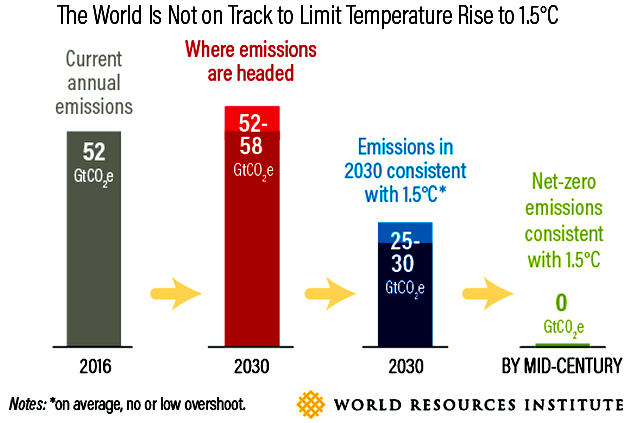
Global emissions were roughly 52 GtCO2e in 2016, and are projected to be 52-58 GtCO2e by 2030. Annual emissions need to be about half that (25-30 GtCO2e/yr on average) by 2030 to limit warming to 1.5˚C (with no or low overshoot). While it’s still technically feasible to avoid a 1.5˚C rise in temperature, behavior and technologies will need to shift across the board in order to achieve these emissions reductions. For example, by 2050, renewables are projected to supply 70-85 percent of electricity in 1.5˚C pathways. Energy efficiency and fuel-switching measures will be critical for the transportation sector.  Reducing energy demand and improving the efficiency of food production, changing dietary choices and reducing food loss and waste also have significant potential to reduce emissions.

The report also highlights how ambitious climate action brings many benefits for shared prosperity and economic stability — more jobs, increased energy access, access to sustainable transportation and health improvements, to name a few. There are also important trade-offs in the case of poorly designed policy.
And while not cited in the IPCC report, new analysis by the New Climate Economy found that bold climate action can deliver $26 trillion in economic benefits through 2030 (compared with business-as-usual) while generating more than 65 million jobs and avoiding more than 700,000 premature deaths from air pollution in 2030.

2. The scale of the required low-carbon transition is unprecedented
While there have been examples of rapid change in specific technologies or sectors in the past, there is no precedent in our documented history for the rate of change at the scale required for limiting warming to 1.5˚C.
In other words, we have never before witnessed such widespread, rapid transitions, and they will need to be made across energy, land, industrial, urban and other systems, as well as across technologies and geographies.
Making this monumental shift will require substantial new investments in low-carbon technologies and efficiency. The report finds that if the 1.5˚C goal is to be met, investments in low-carbon energy technology and energy efficiency will need increase by roughly a factor of five by 2050 compared to 2015 levels.

3. “Limiting warming to 1.5˚C” can mean different things—with different results.
The majority (81 out of 90) of the modeling scenarios for limiting warming to 1.5˚C exceed this temperature threshold before dropping back down.
The results of these scenarios are very different from those that never overshoot 1.5˚C. For example, consider the impacts of warming on a fragile ecosystem: If the 1.5˚C goal is exceeded for many years at a significantly higher temperature, irreversible impacts, such as species extinction, may result even if warming is eventually brought down to 1.5˚C.
The impacts of 1.5˚C of warming will also depend on the chosen emissions-reduction activities. For example, a more rapid reduction of black carbon can help stem the loss of snow and ice in the Arctic.
Furthermore, it is important to note that the 1.5˚C goal is for global average temperature increase. Temperature increase at any one location, as well as its resultant impacts, will vary.

4. A 1.5˚C limit to warming is not safe for all…
The report finds that significant climate impacts already occur at 1.5˚C, especially in regards to low-lying areas, human health and oceans. The impacts will hit the poor and most vulnerable the hardest due to loss of livelihoods, food insecurity, population displacement, health effects and more.

5. …but risks associated with warming are substantially lower at 1.5˚C than 2˚C
Because the Paris Agreement specifies that countries should “limit warming to well below 2˚C, and pursue efforts to limit it to 1.5˚C,” the IPCC report takes stock of how much higher the risks of a 2˚C world are than 1.5˚C.  For example, under 1.5°C of warming, the report finds it is very likely to have one sea-ice-free summer every 100 years; at 2°C, the frequency increases to at least one every 10 years. (Read more in our accompanying blog comparing the impacts of 1.5˚C vs 2˚C.)


6. Emissions will need to reach net-zero around mid-century.
In addition to large emissions cuts in the next decade, net CO2 emissions will on average need to be reduced to zero by mid-century.  If the date of reaching net-zero emissions is brought forward one decade to 2040—fewer than 15 years away—the chance of limiting warming to 1.5˚C is considerably higher. The sooner emissions peak before 2030 and the lower the level at which they do so, the less daunting the challenges will be.
All pollutants leading to climate change must be addressed. The report notes the critical role of short-lived but highly potent climate pollutants, such as methane and hydrofluorocarbons (HFCs). While carbon dioxide dominates long-term warming, reduction of other pollutants can contribute to the 1.5˚C goal in the short term, with substantial co-benefits, such as reducing air pollution.

7. All 1.5˚C emissions pathways rely upon carbon removal to some extent.
The report shows clearly that we will need to focus efforts not only on reducing emissions, but also removing and storing carbon from the atmosphere. Carbon removal is necessary for both moving to net-zero emissions and for producing net-negative emissions to compensate for any overshoot of 1.5˚C. The pathways studied in the report rely on different levels of carbon removal (ranging from 100-1,000 GtCO2 over the 21st century for scenarios with limited or no overshoot), but all rely on it to some extent. The report notes that carbon removal deployed at such a scale is unproven, and is a major risk to our ability to limit warming to 1.5˚C.The report also notes that feasibility and sustainability of carbon removal could be enhanced if a portfolio of carbon-removal approaches is pursued.

8. Everyone – countries, cities, the private sector, individuals — will need to strengthen their action, without delay.
Without transformation in society and rapid implementation of ambitious emissions cuts, limiting warming to 1.5˚C while achieving sustainable development will be exceedingly difficult, if not impossible. Even if countries fulfill their current national climate goals and make deep emissions cuts after 2030, warming would still very likely exceed 1.5˚C given the challenges associated with dropping emissions to net-zero in less than 15 years’ time. Therefore, all countries and non-state actors will need to strengthen their contributions without delay. The COP decision at Paris requested countries to submit a next set of climate commitments by 2020, so this is an important opportunity to take bolder action. At the Global Climate Action Summit last month, leaders from states and regions, cities, businesses and civil society reinforced that messaging, calling on countries to “step up ambition” and commit to strengthening their national climate plans during the UN climate summit this December in Katowice, Poland.

Turning Evidence into Action
There’s no sugarcoating it: Keeping warming to 1.5˚C will be hard. Really hard. But the IPCC report also makes it clear that the world has the scientific understanding, the technological capacity and the financial means to tackle climate change. Now what we need is the political will to precipitate the unprecedented concerted actions necessary to stabilize temperature rise below 1.5 C.
There are substantial economic and development benefits from bold climate action. And even more importantly, limiting global warming to 1.5˚ is imperative. Falling short would lock in climate impacts so catastrophic our world would be unrecognizable. Governments, businesses and others have the clarity they need. Now it’s time for them to step up to the challenge.

Links

Coal Power Finished By 2050 If Temperature Increase Kept To 1.5 Degrees: IPCC

AFR - Ben Potter

The special report by the International Panel on Climate Change lays out a stark challenge to the coal industry if the world is to limit global temperature increases to 1.5 degrees. Fairfax Media
Coal power would have to be eliminated or reduced to negligible levels and agriculture and land use changed dramatically for the world to limit temperature increases to 1.5 degrees Celsius above pre-industrial levels, a landmark report says.
The special report by the International Panel on Climate Change lays out a stark challenge to the coal industry if the world is to limit global temperature increases to 1.5 degrees - the aspirational level that nations agreed to pursue in addition to their individual national targets in the Paris climate agreement.
Australian pure coal exporters such as Whitehaven Coal, Yancoal and New Hope Corporation base their outlooks on International Energy Agency "New Policies" scenarios which allow for modest increases in global coal exports out to 2040, with larger increases in their primary Asian markets.
The Morrison government embraces these projections which make for a bullish outlook for the Australian coal export industry, and has abandoned carbon emissions reduction as a goal of energy policy. Coal companies are enjoying bumper profits and surging share prices off the back of high prices and strong demand from Asia.
Prime Minister Scott Morrison said on Monday that Australia would stick with its primary Paris commitment - to reduce carbon emissions by 26-28 per cent from 2005 levels by 2030 - but would not give any more money to a global climate fund that aims to help the world's poorest countries cope with the effects of climate change.

Pressure mounts
But the government is about to come under increasing international pressure to take more effective action to limit climate change and the IPCC report is a key step leading up to the United Nations climate conference in Poland in December at which Australia and other laggard countries will be pressed to raise the level of their ambition.
The benign scenarios for coal exports that the government and the coal industry prefer are associated with higher temperature increases that scientists say would bring more frequent instances of dangerous heat, droughts, floods and tropical cyclones and irreversible damage to coral reefs such as the Great Barrier Reef.
Forerunners were seen in the northern hemisphere summer with wildfires in the Arctic, Europe and California and near-50 degree temperatures in southern Europe and California.
Extreme weather and coral bleaching would occur more frequently under 2 degrees Celsius of global warming compared to 1.5 degrees Celsius. ACF et al. 
By contrast, the IPCC report says that in order to limit temperature increases to 1.5 degrees - a level scientists say would bring fewer dangerous climate changes and events - "the use of coal shows a steep reduction in all pathways and would be reduced to close to 0% (0-2%) of electricity". It notes this finding is one in which it has "high confidence".
Carbon emissions would need to be reduced by 45 per cent from 2010 levels by 2030 and to around net zero by 2050. These are much more ambitious than the government's target and more in line with the policy federal Labor took to the 2016 election but is yet to confirm as 2019 election policy.

Gas would need CCS
Renewable energy would supply 70-85 per cent of electricity and gas - another strong export industry for Australia - would supply 8 per cent of electricity when coupled with carbon capture and storage (CCS). CCS has been demonstrated technically but its cost is prohibitive and no commercial rollouts on existing thermal power stations have resulted from trials conducted in the US, Canada, Australia and China.
Limiting temeperature increases to 1.5 degrees Celsius will cause less damage to the Great Barrier Reef. Pictured: Green sea turtle (Chelonia mydas) resting on sandy seabed, Great Barrier Reef, UNESCO World Heritage Site, Pacific, Australia Alamy
Agriculture would be challenged by increasing competition for land for biofuels and reafforestation, which would need to be part of the global effort to reduce carbon emissions to net zero by 2050. "Such large transitions pose profound challenges for sustainable management of the various demands on land for human settlements," the IPCC report says.
Transport would have to move from 5 per cent low emissions fuel in 2020 to 35-65 per cent - a particular challenge for Australia which lags other rich countries in electric vehicle takeup.
Limiting temeperature increases to 1.5 degrees Celsius would require much steeper reductions in carbon emissions. Climate Analytics

Links

Sunday, October 07, 2018

Scientists Champion Forests As 'Unsung Hero' Of Climate Action

Reuters - Megan Rowling

BARCELONA - Scientists from around the world called for stepped-up efforts to use forests to keep global warming to the lowest limit agreed by governments in 2015, as a key report on how to meet that goal is finalised in South Korea this week.
“Forests really are the unsung hero of our struggle to address climate change,” said Deborah Lawrence, a University of Virginia professor and one of 40 scientists who backed a statement emphasizing how the Earth’s climate depends on forests.
The natural processes by which forests suck in and store carbon help reduce levels of planet-warming carbon dioxide in the atmosphere - and forests also underpin key parts of the world’s economy, the scientists said.
"Our planet's future climate is inextricably tied to the future of its forests," the international panel said. Credit: Fairfax Media
Yet humans have let forests become degraded, even as the resulting risks of disaster and the costs of repairing the damage rise, they added.
“We must protect and maintain healthy forests to avoid dangerous climate change and to ensure the world’s forests continue to provide services critical for the well-being of the planet and ourselves,” said the statement, signed by researchers mainly from the United States, Brazil and Europe.
“Our planet’s future climate is inextricably tied to the future of its forests,” they concluded.
The flagship report from the Intergovernmental Panel on Climate Change (IPCC), due to be published on Monday, will outline ways of limiting global temperature rise to 1.5 degrees Celsius (2.7 degrees Fahrenheit) compared with pre-industrial times, the most ambitious goal in the Paris climate pact.
One key route is to protect virgin forests, restore those that have suffered logging, fires or other harm, and expand the amount of land covered by trees, the report is expected to say.
In this week’s statement, scientists noted that forests remove about a quarter of the carbon dioxide humans add to the atmosphere, keeping climate change from getting even worse.
Destroying forests not only releases the carbon they contain but also eliminates their ability to take carbon dioxide out of the atmosphere, the statement said.
It noted that the world’s forests contain more carbon than exploitable oil, gas and coal deposits.
But deforestation rates are rising again in most of the tropics, due to expanded production of commodities such as palm oil, beef and grains, said Carlos Nobre, a University of Sao Paulo professor and member of the Brazilian Academy of Sciences.
Forests produce water vapor, boost rainfall and cool down local temperatures by as much as 3 degrees Celsius, Nobre noted.
“This is a critical element for growing food,” he said. “By keeping a wetter climate throughout the year, (forests) also mitigate the impacts of drought and are less vulnerable to fires.”

Diets matter
Scientists and environmental campaigners said policy makers often overlook the importance of forests in regulating the climate, meaning forest protection had received far too little funding.
But as the urgency of curbing rising temperatures increases, that is starting to change, they added, with attention shifting not just to forests but also to how land is deployed to produce crops for food and energy.
“There is a greater recognition in society as a whole that the land-use sector makes a difference - and the way that happens in people’s everyday lives is what they eat,” said Jennifer Morgan, executive director of Greenpeace International.
More people now understand the need to consume less meat and dairy products, she told reporters.
That is one strategy recommended in a separate report to be published in mid-October by the Climate, Land, Ambition and Rights Alliance (CLARA), a coalition of environment and development groups.
Its main findings, released this week, show greater efforts to move to more sustainable food systems, restore forests and secure land rights for local people can help limit global warming to 1.5 degrees Celsius.
The measures proposed - ranging from planting more trees on farms to feeding animals with agricultural leftovers and restoring major areas of forest - would cut emissions by 21 gigatonnes of carbon dioxide-equivalent per year by 2050, or about two-fifths of total greenhouse gas emissions in 2016.
The alliance said that would eliminate the need for largely untested technologies to remove carbon from the atmosphere.
Those methods include growing trees and crops to produce energy and then capturing and storing underground the carbon dioxide they release when harvested, an approach known as BECCS.
Kate Dooley of the University of Melbourne’s Climate and Energy College, and the main author of the CLARA report, said scientific models show BECCS would require a huge amount of land to be effective in meeting temperature limits, which would be “problematic”.
Opponents of BECCS argue it would take away land and water needed to end hunger and meet other global development goals, and could lead to abuses of indigenous land rights, among other risks.
“We can achieve the 1.5C pathways in the IPCC report - the safest pathways - through natural (land) sink enhancement,” Dooley told the Thomson Reuters Foundation.

Links

Lethal Heating is a citizens' initiative