18/11/2018

Dozens Arrested After Climate Protest Blocks Five London Bridges

The Guardian | 

Thousands of protesters occupied bridges across the Thames over extinction crisis in huge act of peaceful civil disobedience

Thousands block five London bridges to protest over climate crisis.

Eighty-five people have been arrested as thousands of demonstrators occupied five bridges in central London to voice their concern over the looming climate crisis.Protesters, including families and pensioners, began massing on five of London’s main bridges from 10am on Saturday. An hour later, all the crossings had been blocked in one of the biggest acts of peaceful civil disobedience in the UK in decades. Some people locked themselves together, while others linked arms and sang songs.
By 2pm the blockade of Southwark Bridge had been abandoned and protesters moved from there to Blackfriars Bridge, where organisers said they were soon to move west towards Westminster Bridge.
Demonstrators occupied Southwark, Blackfriars, Waterloo, Westminster and Lambeth bridges.
The Metropolitan police said all the bridges had since reopened and that most of the arrests had been for obstruction under the Highways Act.
Afterwards, demonstrators gathered in Parliament Square to hear speeches. Roger Hallam, one of the strategists behind the actions, told the Guardian he felt the protest had been fantastic.“This is total prediction stuff, mass participation civil disobedience,” he said. “They can’t do anything about it unless they start shooting people, and presumably they won’t do that.”
The day was due to end with an interfaith ceremony outside Westminster Abbey.
The move is part of a campaign of mass civil disobedience organised by a new group, Extinction Rebellion, which wants to force governments to treat the threats of climate breakdown and extinction as a crisis.
“The ‘social contract’ has been broken … [and] it is therefore not only our right but our moral duty to bypass the government’s inaction and flagrant dereliction of duty and to rebel to defend life itself,” said Gail Bradbrook, one of the organisers.
Alice, 19, from Bristol was one of those blocking Westminster Bridge.
“I took the coach at 3am to make sure I didn’t miss it,” she said, “and I’m so glad that I did. It’s a tiny personal inconvenience and, having made it, I get to be part of a rebellion.
“This moment will be remembered in the history books, when we finally stopped allowing our leaders to take us over the cliff.”
Jenny Jones, the Green party peer, joined the protest on Westminster Bridge. She backed the nonviolent direct action taken by demonstrators.
“We are at the point where if we don’t start acting and acting fast we are just going to wipe out our life support system,” she said.
“It’s fine to think we are a rich country, the sixth biggest economy in the world, but actually we won’t do any better than anywhere else because climate change will massively affect us too.
“Basically, conventional politics has failed us – it’s even failed me and I’m part of the system – so people have no other choice.”


Jenny Jones: "If we don't act fast, we're going to wipe out our life support system."

Father Martin Newell said on Blackfriars Bridge: “What brought me here is the climate emergency, the extinction emergency and my faith in God who created all this and whose creation we’re destroying and crucifying … I’m called as a Christian to protect our neighbour who’s being abused.”
In the past two weeks more than 60 people have been arrested for taking part in acts of civil disobedience organised by Extinction Rebellion ranging from gluing themselves to government buildings to blocking major roads in the capital.
However, those disruptions were eclipsed on Saturday, when organisers say 6,000 people took part in protests.
“It is not a step we take lightly,” said Tiana Jacout, one of those involved. “If things continue as is, we face an extinction greater than the one that killed the dinosaurs. I don’t know about you, but I’d rather be a worthy ancestor.”
Extinction Rebellion, which cites the civil rights movement, suffragettes and Mahatma Gandhi as inspirations, said smaller events took place in other UK cities as well as overseas on Saturday.
Organisers say they are planning to escalate the campaigns from Wednesday, when small teams of activists will “swarm” around central London blocking roads and bridges, bringing widespread disruption to the capital.
“Given the scale of the ecological crisis we are facing this is the appropriate scale of expansion,” said Bradbrook. “Occupying the streets to bring about change as our ancestors have done before us. Only this kind of large-scale economic disruption can rapidly bring the government to the table to discuss our demands. We are prepared to risk it all for our futures.”
Extinction Rebellion demonstrators on Westminster Bridge in London. Photograph: John Stillwell/PA
The group is calling on the government to reduce carbon emissions to zero by 2025 and establish a “citizens assembly” to devise an emergency plan of action similar to that seen during the second world war.
On top of the specific demands, organisers say they hope the campaign of “respectful disruption” will change the debate around climate breakdown and signal to those in power that the present course of action will lead to disaster.
The group, which was established only a couple of months ago, has raised around £50k in small-scale donations in the past weeks.
It now has offices in central London and over the past few months has been holding meetings across the country, outlining the scale of the climate crisis and urging people to get involved in direct action this weekend.
“Local groups are setting up across the country and even new groups are seeing around 100 people come to meetings, and we have coaches coming, from Newcastle to Plymouth,” said Rupert Read, a philosophy academic at the University of East Anglia.
The campaign hit the headlines a couple of weeks ago when the former archbishop of Canterbury Rowan Williams was one of almost 100 academics to come out in favour of it.
In a letter published in the Guardian they said: “While our academic perspectives and expertise may differ, we are united on this one point: we will not tolerate the failure of this or any other government to take robust and emergency action in respect of the worsening ecological crisis. The science is clear, the facts are incontrovertible, and it is unconscionable to us that our children and grandchildren should have to bear the terrifying brunt of an unprecedented disaster of our own making.”
The civil disobedience comes amid growing evidence of looming climate breakdown and follows warnings from the UN that there are only 12 years left to prevent global ecological disaster.
The group is also making international contacts, with 11 events planned in seven countries so far, including the US, Canada, Germany, Australia and France.
“To properly challenge the system that is sending us to an early grave we have to be bold and ambitious,” said Read. “Forging new connections across the world and learning from each other.”

Links

Who’s Running Late For The Paris Agreement?

University of Melbourne - Dr Daryl Holland

In order to limit global warming to 2°C above pre-industrial levels, should countries lower their emissions’ target to meet their climate change commitments?

You’re having a party on Saturday night.
You’ve timed everything perfectly, starting with canapés and cocktails at 7:30pm. Except there’s one problem – your friends are always ‘fashionably late’. So, on the invitation, you put the starting time as 7pm.
That way you know most guests will have arrived by the time the party really kicks off.
More than 150 world leaders pose for a family photo during the COP21, United Nations Climate Change Conference. Picture: Getty Images
Now, what if your friends are the nations of the world, the party is the Paris Agreement on climate change mitigation, and everyone is running late to lower their emissions fast enough to stop catastrophic climate change? Can we change the time on the invitation?
Attempts to tackle the growing threat of climate change seem to be continually hampered by the self-interest of people, corporations, and countries - who say they want to do their fair share but in reality do the minimum they can justify.
Because of this, the world is on track to overshoot its goal of limiting global warming to well below 2°C above pre-industrial levels.
Researchers from the University of Melbourne and University of Potsdam have quantified the self-interest of countries that have signed up to the Paris Agreement on climate change, proposing a radical solution that allows countries to act with self-interest, but still achieve the goals of the Agreement.

Not so ‘fair and ambitious’
The goal of the Paris Agreement is to limit global temperature rise to “well below 2°C above pre-industrial levels and to pursue efforts to limit the temperature increase even further to 1.5°C”.
Dr Yann Robiou du Pont from the University of Melbourne’s Australian-German Climate and Energy College says the agreement is considered a landmark framework for countries to work together to avoid the dangerous impact of climate change, but there is problem with how each country’s contribution is calculated.
President Trump announcing he will pull out of the Paris Climate Agreement in 2017. Picture: Getty Images
“Each country proposes its Nationally Determined Contribution (NDC), that has to be of the highest possible ambition, according to the Paris Agreement,” he says.
“Each NDC has a section describing how it is fair and ambitious, but our research, and other international reports, say these are collectively insufficient to achieve 2°C.”
Why is this? When each country has pledged to set its contribution in a way that is ‘fair and ambitious’?
“Each country justifies how it is fair and ambitious, and according to that definition of fair and ambitious,” says Dr Robiou du Pont.
This bottom-up approach can lead to self-interest, where countries pick the vision of equity that means they can make the least possible contribution.
In fact, the team built a simulation to see what global warming would be if the world followed the ambition of a single country. For example, if countries around the world made the same commitment to a Nationally Determined Contribution as Australia - the global temperature would increase by 4.5°C.

The consequences of self-interest
To test this idea, Dr Robiou du Pont and Professor Malte Meinshausen, who has a shared appointment with the Universities of Melbourne and Potsdam, created a hypothetical situation where each country acts to maximise its self-interest.
“We modelled the situation where each country can individually pick the least stringent of the categories of equity,” says Dr Robiou du Pont.
“So, in their narrative, they can say they are doing something fair, but collectively, because of that self-interested vision of equity it would be insufficient.”
The research team used five categories of equity, broadly defined as: capability, equality, responsibility-capability-need, equal cumulative per capita and staged approaches.
The Pledged Warming Map provides an assessment of global warming when all countries follow the ambition of a given one. The scale goes from 1 degree (green) to 5 degrees (dark red). Picture: Supplied
The result of this modelling, unsurprisingly, is that the world will overshoot its global warming target.
“If we aim for 2°C, we get to 2.5°C,” says Dr Robiou du Pont.
The catch is, this isn’t just hypothetical, it’s happening. When the researchers calculated each country’s NDC, they got the same result as their self-interest model, a likely increase of up to 2.5°C of warming by 2100.
“Collectively, it is as if the world is self-interested – keeping in mind that some countries are doing better than just being self-interested, and there are also some countries doing less than could be considered equitable, even in a self-interested manner,” says Dr Robiou du Pont.
So, in other words, some of your friends arrive early, but most are late, and a few RSVP but don’t even show up to the party.
The team published their research in Nature Communications, and in the paper they suggest a radical solution – rather than forcing nations to be more fair, why not ‘change the time on the invitation’.
In other words, set a lower goal.
“If we disagree on what is equitable and let each country pick the least stringent approach, then we have to be more stringent on the collective goal,” says Dr Robiou du Pont.
They calculated new aspirational goals that would allow for collective self-interest while still reaching the goals agreed in the Paris Agreement.
In fact, these results can be used in climate litigation cases against countries. Dr Robiou du Pont’s previous work has been used in a case against the EU’s institutions for failing to adequately protect them against climate change.
The goal of the Paris Agreement is to limit global temperature rise to “well below 2°C above pre-industrial levels”. Picture: Arnaud BOUISSOU/Flickr
To keep warming below 2°C, they calculated that the world needs to agree on a 1.4°C target. To hit the more stringent 1.5°C target would require a revised 1.1°C target.
“Overall, it is very unlikely that this sharing will be adopted. Fairness is often more used as a justification for action (or inaction) than a driver,” says Dr Robiou du Pont.
“The novelty of this metric is that it can still tell which country is making a sufficiently ambitious contribution in the absence of a universal agreement of what is fair and ambitious.”
And then maybe everyone can enjoy the party.

Links

17/11/2018

Greens Policy Would Outlaw Thermal Coal As It Is 'No Longer Compatible' With Human Life

The Guardian

Under Greens policy, it would no longer be legal to dig, burn or ship thermal coal by 2030
The Greens policy proposing a phase-out of coal exports includes maximum penalties of seven years imprisonment and hefty fines. Photograph: David Gray/Reuters
The Australian Greens will propose a phase-out of thermal coal exports by 2030 in a significant strengthening of the party’s existing policy, which has focused on banning new mines.
The Greens’ climate change spokesman, Adam Bandt, will outline the shift on Friday in a speech to the United Firefighters Union in Hobart. The speech focuses on the growing risk of wildfires as a consequence of climate change.
Against the backdrop of catastrophic destruction in California, Bandt will tell his audience Australia’s biggest chance of avoiding climate catastrophe is by ceasing coal exports.
Under the reworked Greens policy, by 2030, it will no longer be legal to dig, burn or ship thermal coal. The proposal includes maximum penalties for breaches of the prohibition of seven years imprisonment, and hefty fines.
According to the speech circulated in advance, Bandt notes Australia’s current status as the world’s largest coal exporter and the likelihood that demand will remain high “for some time”.
Australia’s economy relies heavily on coal exports, which in 2017 were valued at $56.5bn, and governments rely on revenue from royalties and tax collections.
The latest World Energy Outlook, released this week, suggests coal has enjoyed a mini resurgence over the past two years because of demand from developing economies in Asia. That report also points out Australia is the only export-oriented country projected to ramp up coal production significantly over the next 20 years.
Bandt will say on Friday the current outlook indicates Australia “will continue to export hundreds of millions of tonnes of coal every year which, when burnt, produces about twice as much global warming pollution than Australia’s domestic economy”.
“The reality is every tonne of coal that is burnt makes the bushfire threat worse, and every tonne of coal burnt brings us closer to climate catastrophe – in other words the burning of coal is no longer compatible with the protection of human life.”
Bandt will flag bringing forward legislation, based on laws regulating the use of asbestos, to ban thermal coal exports in January 2030, and impose quotas in the interim so exports scale down between now and the proposed cut-off.
The policy proposal would see export permits auctioned annually, with the revenue raised supporting a transition fund for displaced coal workers to assist with structural adjustment.
Bandt says the science is clear – the world needs to shut down two-thirds of the coal fleet in the next 12 years, and the rest shortly after. He says Australia should take the opportunity of the coal phase-out to develop the clean energy economy and pursue renewable hydrogen exports, with burgeoning demand in Asia.
He will also acknowledge his proposed coal ban isn’t absolute. Bandt says there will continue to be a role in the short term for coking coal, which is used for the manufacture of steel.
With the Morrison government strongly supportive of the coal industry, and Labor flagging a managed transition, the bill Bandt proposes has no prospect of passing the parliament.
Labor is currently finalising the energy policy it will take to the next federal election. It is mulling a package of measures to guide the transition away from coal that will be triggered because of a more ambitious emissions reduction target.
The Labor package, expected to be outlined in coming weeks, is likely to include the creation of a new statutory authority to oversee the transition and the programs intended to ameliorate it; specific industrial relations arrangements to ensure workers are managed through the process; and programs to drive economic diversification.
Bandt on Friday will compare coal to tobacco and asbestos. “When we found out tobacco companies knew their product killed but kept on selling it anyway, they got sued and they got regulated.
“We once used asbestos in our buildings because we thought it was safe. But we now know better, so we have banned it. Now it is coal’s turn.
“Coal is a product that kills people when used according to the seller’s instructions.”

Links

Turnbull Says Climate Change Has Become A 'Third Rail' For Liberal Party

The Guardian - Guardian staff

Former PM tells Bar Association that policy remains evasive as long as group of Coalition MPs believes climate change is a fraud
Malcolm Turnbull: ‘The Liberal Party and the Coalition is not capable of dealing with climate change.’ Photograph: Mike Bowers for the Guardian 
The former prime minister Malcolm Turnbull says a “constituency” of Coalition MPs believes climate change is a fraud, and that the issue has become a “third rail” for the Liberal party.
Speaking at the Australia Bar Association’s annual conference in Sydney on Friday night, Turnbull, the guest of honour at the event, said a climate-sceptic group within his own party held the line that “if you don’t do what we want, we will blow the show up,” the Australian reported.
“And that is essentially what you’ve seen — and so the problem is that everybody loses”.
Turnbull, who was replaced as prime minister by Scott Morrison in August and subsequently retired from politics, was asked at the event about his personal commitment to act on climate change. He famously crossed the floor in opposition to vote with Labor in support of an emissions trading scheme, but as prime minister led a government with little resolve to reduce emissions.
“The truth is … the Liberal Party and the Coalition is not capable of dealing with climate change,” Turnbull told the conference.
“It is just a fact I regret to say. It is like a third rail. We have at the present time in the Coalition, a group of, a constituency, that is the best way to describe it, who believe we should get out of [the Paris Agreement], that climate change is a fraud, the more you have the better, and are literally on another plane.
“They are not prepared to play ball with everybody else.”
Turnbull has previously conceded that any policy on climate change would be extremely difficult for the Liberal-National Coalition because it was treated as an ideological matter within the party.
“The emissions issue and climate policy issues have the same problem within the Coalition of ... bitterly entrenched views that are actually sort of more ideological views than views based,” he had said while being forced out as prime minister.
During an appearance on the ABC’s Q&A program this month, he described his removal from the prime ministership as an act of unexplained madness, and accused leading conservatives of “blowing up” the government.

Links

Scientists Acknowledge Key Errors In Study Of How Fast The Oceans Are Warming

Washington PostChris Mooney | Brady Dennis

A major study claimed the oceans were warming much faster than previously thought. But researchers now say they can’t necessarily make that claim.
The sun sets over sea ice floating on the Victoria Strait along the Northwest Passage in the Canadian Arctic Archipelago during the summer of 2017. (AP Photo/David Goldman)
Scientists behind a major study that claimed the Earth’s oceans are warming faster than previously thought now say their work contained inadvertent errors that made their conclusions seem more certain than they actually are.
Two weeks after the high-profile study was published in the journal Nature, its authors have submitted corrections to the publication. The Scripps Institution of Oceanography, home to several of the researchers involved, also noted the problems in the scientists' work and corrected a news release on its website, which previously had asserted that the study detailed how the Earth’s oceans “have absorbed 60 percent more heat than previously thought.”
“Unfortunately, we made mistakes here,” said Ralph Keeling, a climate scientist at Scripps, who was a co-author of the study. “I think the main lesson is that you work as fast as you can to fix mistakes when you find them.”
The central problem, according to Keeling, came in how the researchers dealt with the uncertainty in their measurements. As a result, the findings suffer from too much doubt to definitively support the paper’s conclusion about how much heat the oceans have absorbed over time.
The central conclusion of the study — that oceans are retaining ever more energy as more heat is being trapped within Earth’s climate system each year — is in line with other studies that have drawn similar conclusions. And it hasn’t changed much despite the errors. But Keeling said the authors' miscalculations mean there is a much larger margin of error in the findings, which means researchers can weigh in with less certainty than they thought.
“I accept responsibility for what happened because it’s my role to make sure that those kind of details got conveyed,” Keeling said. (He has published a more detailed explanation of what happened here.)
The study’s lead author was Laure Resplandy of Princeton University. Other researchers were with institutions in China, Paris, Germany and the U.S. National Center for Atmospheric Research and Geophysical Fluid Dynamics Laboratory.
“Maintaining the accuracy of the scientific record is of primary importance to us as publishers and we recognize our responsibility to correct errors in papers that we have published,” Nature said in a statement to The Washington Post. “Issues relating to this paper have been brought to Nature’s attention and we are looking into them carefully. We take all concerns related to papers we have published very seriously and will issue an update once further information is available.”
The original study, which appeared Oct. 31, derived a new method for measuring how much heat is being absorbed by the oceans. Essentially, the authors measured the volume of gases, specifically oxygen and carbon dioxide, that have escaped the ocean in recent decades and headed into the atmosphere as it heats up. They found that the warming “is at the high end of previous estimates” and suggested that as a result, the rate of global warming itself could be more accelerated.
The results, wrote the authors, may suggest there is less time than previously thought to curb greenhouse gas emissions. The study drew considerable media attention, including from The Post.
However, not long after publication, an independent Britain-based researcher named Nicholas Lewis published a lengthy blog post saying he had found a “major problem” with the research.
“So far as I can see, their method vastly underestimates the uncertainty,” Lewis said in an interview Tuesday, “as well as biasing up significantly, nearly 30 percent, the central estimate.”
Lewis added that he tends “to read a large number of papers, and, having a mathematics as well as a physics background, I tend to look at them quite carefully, and see if they make sense. And where they don’t make sense — with this one, it’s fairly obvious it didn’t make sense — I look into them more deeply.”
Lewis has argued in past studies and commentaries that climate scientists are predicting too much warming because of their reliance on computer simulations, and that current data from the planet itself suggests global warming will be less severe than feared.
It isn’t clear whether the authors agree with all of Lewis’s criticisms, but Keeling said “we agree there were problems along the lines he identified.”
Paul Durack, a research scientist at the Lawrence Livermore National Laboratory in California, said that promptly acknowledging the errors in the study “is the right approach in the interests of transparency.”
But he added in an email, “This study, although there are additional questions that are arising now, confirms the long known result that the oceans have been warming over the observed record, and the rate of warming has been increasing,” he said.
Gavin Schmidt, head of the NASA Goddard Institute for Space Studies, followed the growing debate over the study closely on Twitter and said that measurements about the uptake of heat in the oceans have been bedeviled with data problems for some time — and that debuting new research in this area is hard.
“Obviously you rely on your co-authors and the reviewers to catch most problems, but things still sometimes slip through,” Schmidt wrote in an email.
Schmidt and Keeling agreed that other studies also support a higher level of ocean heat content than the Intergovernmental Panel on Climate Change, or IPCC, saw in a landmark 2013 report.
Overall, Schmidt said, the episode can be seen as a positive one.
“The key is not whether mistakes are made, but how they are dealt with — and the response from Laure and Ralph here is exemplary. No panic, but a careful reexamination of their working — despite a somewhat hostile environment,” he wrote.
“So, plus one for some post-publication review, and plus one to the authors for reexamining the whole calculation in a constructive way. We will all end up wiser.”

Links

Climate Change Policy Can Be Overwhelming. Here’s A Guide To The Policies That Work.

VoxDavid Roberts

A new book from veteran energy analyst Hal Harvey simplifies decarbonization.


Climate change is such a large and sprawling problem — there are so many forces involved, so many decision makers at so many levels — that solving it can seem hopelessly complex. There are so many options available to policymakers, each with their own fierce constituencies. Where to begin? Which clean-energy policies actually work?
That is the question Hal Harvey, long-time energy analyst and CEO of the energy policy firm Energy Innovation, set out to answer with a new tool.
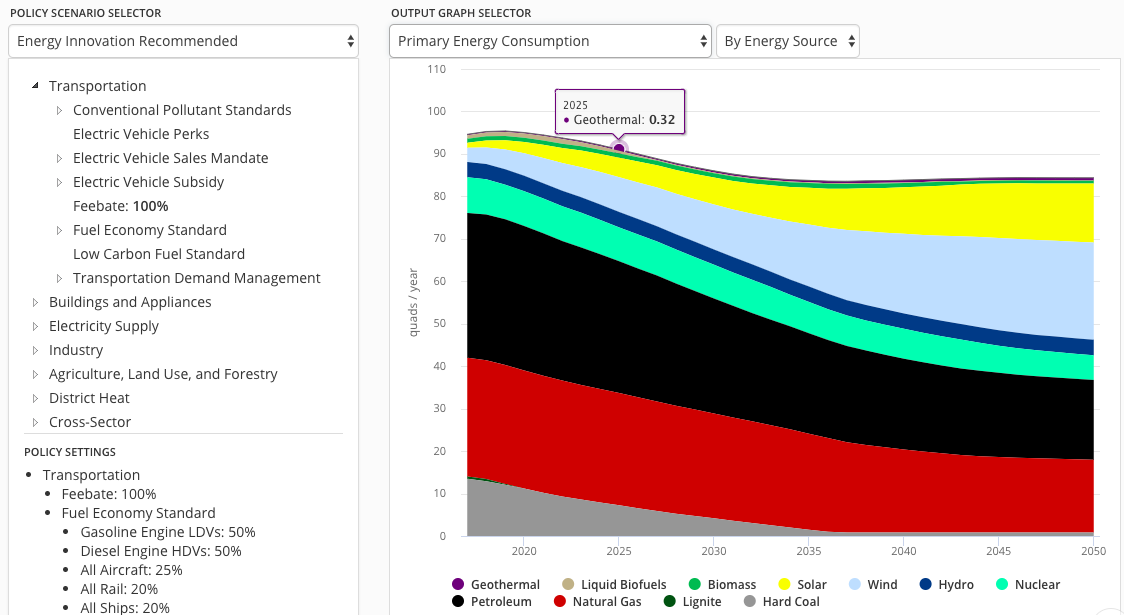
The tool is the Energy Policy Simulator, which allows anyone to choose a package of energy policies and immediately see the impact on carbon emissions and other pollutants. (It’s like a video game for energy nerds.) It’s based on a model that attempts to replicate the physical economy, with detailed information about real-world assets.
Using that tool, Harvey and his team narrowed in on the policies that work, the places they work best, and the best way to design them. Their conclusions are summarized in a new book, Designing Climate Solutions: A Policy Guide for Low-Carbon Energy. It’s a compact but detailed how-to guide for developing energy policies that have real impact. (A fairly extensive miniature version of the book is online here, if you want to flip through.)
The results are oddly heartening, or at least clarifying.
For instance: The top 20 carbon emitting countries in the world are responsible for 80 percent of global emissions. Just seven countries emit more than a gigaton annually.


Energy Innovation


It’s daunting to lure the world’s nearly 200 countries into a globally unanimous agreement, like the United Nations Framework Convention on Climate Change (UNFCCC) is forever attempting to do. (Witness the heroic work necessary to secure the Paris climate agreement, which isn’t even legally binding.) But 20 countries? Surely the world can get decent policies in place in 20 countries.
Just as they are geographically clustered, emissions are also clustered in a relatively small number of sectors.
Here is a graph from the book showing, in light blue, the total emissions currently projected for 2050 (it includes the effects of current policies). The colored squares are the sectors where additional policy-driven efforts can reduce emissions enough through 2050 to offer a 50 percent chance of avoiding more than 2 degrees Celsius of global temperature rise. (That is, you will recall, the commonly agreed international target, though many advocate shooting lower, for 1.5 degrees.)


Energy Innovation


Putting land use aside (it’s important, but the book focuses on energy policy), that’s five sectors. Well, technically it’s four sectors and one cross-sectoral policy, namely carbon pricing.
Four sectors + carbon pricing. That’s manageable! And it turns out, within those four sectors (+ carbon pricing), a total of just 10 types of policies can do the job.
The overall message is that climate policy doesn’t have to mean doing everything possible, everywhere possible. It’s mainly about applying a toolbox of 10 energy policies to four economic sectors in the 20 top-emitting countries, plus a bunch of carbon pricing and land-use reform. That will get us most of the way there, and it’s a tractable task. (Not easy. But tractable.)
Policymakers at every level — perhaps even some of those newly elected Democratic governors — will find the book a practical help. It tailors recommendations to different geographies and levels of economic development and gets into nitty-gritty design issues for each policy.
And it reminds them again and again: focus. There are about a dozen policies that work, but “there’s a fast fall-off after that dozen,” Harvey says. “There’s tons of things that sound good but just don’t make much of a difference.”
I chatted with Harvey by phone about policy design, the role of carbon pricing, and the kind of R&D America really needs, among other things. Our conversation has been edited for length and clarity.


Hal Harvey
Energy Innovation

David Roberts
Tell us a little bit about the tool you created to compare policies.
Hal Harvey
We’ve developed this [Energy Policy Simulator] now for eight countries, which together represent more than half the world’s carbon emissions.
The model is essentially a replica of the physical economy. For example, it knows how many cars there are in the United States. It knows how many miles they drive and what kind of fuel they use, and therefore the carbon emissions they emit. It knows how many retire each year, and what they’re replaced with.
By keeping track of all those cars over all those years, we can determine quite precisely what effect an incremental fuel efficiency standard will have. That’s just one of many options in the transportation sphere. You could have a gas tax, congestion pricing, feebates, or a carbon tax with an EV rebate. We measure well over 50 different policies.
The model also handles interactions among policies. It knows which policy is controlling at any given time. (You can’t just add them all up; it doesn’t work that way.)
The upshot is, the user can take any one of these policies and slide it up and down from zero to very strong and instantly see the effects on CO2, on a dozen other pollutants, and on cash flow.


A snapshot from the Energy Policy Simulator. 
LARGE IMAGE

Energy Innovation


David Roberts
One thing you stress in the book is timing. It’s important to get policies in place early, so technologies have time to develop.
Hal Harvey
There’s this naïve idea that the way technology works is, people sit in labs and think and worry and work on an idea, and then it pops into the world and becomes ubiquitous. The reality is, a very large fraction of progress on technologies happens through deployment.
One of the things we try to do is unpack the learning curves.
So there’s stuff that’s crazy out there and requires science — that might be algae, or carbon sequestration, or advanced nuclear power.
Then there’s stuff that’s pretty cool, seems to work, but requires a lot of engineering to get there — the solar field went through this phase during the late ’70s to the mid ’80s.
And then there’s the last stage on that learning curve, which comes from deployment, learning by doing. For that, you need very large volumes of sales, continued over time. The dramatic price reductions in wind and solar — and more recently in offshore wind — reflect this last part of the learning curve.
But this, somewhat ironically, is what Bill Gates doesn’t get. He thinks we need breakthroughs, when in fact the biggest breakthroughs we’ve had have been by incrementally making, e.g., batteries cheaper, cheaper, cheaper. We’re doing it with LEDs, by increasing scale, by deploying and deploying.


Technology learning curves and policy — a representative chart.
Energy Innovation


David Roberts

Throughout the book, you focus on policy design. It’s not enough to pass these policies, they have to work right. You extract a few design principles. Give me an example of one of those principles.
Hal Harvey
I’ll start with performance standards.
Performance standards — by that I mean C02-per-kWh, or fractions of renewables on the grid, or miles per gallon per car, or minimum energy standards for your building codes — have been the killer app in energy policy.


Performance standards have completely transformed refrigerators.
Energy Innovation


They have a bad rep from an age-old and completely upside-down debate about “command-and-control” policy. But we use performance standards all the time, and they work really well. Our buildings don’t burn down very much; they used to burn down all the time. Our meat’s not poisoned; it used to be poisoned, or you couldn’t tell. And so forth. If you just tell somebody, this is the minimum performance required, guess what? Engineers are really good at meeting it cost-effectively.
When you design performance standards, there are a few characteristics that make them work really well. The first, which I emphasize again and again, is continuous improvement. Don’t set a quantitative target, set a rate of improvement.
It’s the gift that keeps on giving. It tells manufacturers, you gotta get better and better and better. It helps them structure their R&D. Maybe most importantly, it uses political bandwidth once and delivers the goods forever.
California’s building code gets tighter every three years. It only took one law, in the 1970s, to make that happen. That bill, Title 24, was signed when Jerry Brown was the youngest governor in California’s history. He’s now the oldest governor in California’s history. In between, Republicans and Democrats alike saw the building code get stronger and stronger. It didn’t require cashing in political capital, going back to the legislature, debating it — it just happens.
I’ll give a counter-example. [President] Gerald Ford doubled fuel efficiency in cars between 1975 and 1985 with a fuel efficiency standard. And then we went to sleep for 25 years. For 25 years, we didn’t increase fuel efficiency. We took all the technological improvement that was coming down the pike and devoted it to mass and power — cars doubled power and increased weight by 40 percent.


Energy Innovation


We pay two kinds of tax for that: first, enormous amounts of carbon dioxide; second, if we had had continuous improvement, we would have saved a trillion dollars that we sent to countries that hate us.
And we let our auto companies become uncompetitive, because the Germans and the Japanese were improving all the while. So we have the auto companies go bankrupt — two out of the three.
Again, if Gerald Ford had simply said “4 percent a year” instead of “26 miles per gallon,” we would have avoided all that.

David Roberts
These days, people across the political spectrum are talking about carbon pricing. How does it fit into the larger effort?
Hal Harvey
The thing about carbon pricing is, it’s helpful, but it’s not dispositive. There are a number of sectors that are impervious to a carbon price, or close to impervious.
A carbon price works when it’s part of a package that includes R&D and performance standards. It does not work in isolation. It helps, but it doesn’t do nearly as much as is required.
Also, it has to be a real number. Twenty bucks a ton doesn’t affect much at all.


Energy Innovation


David Roberts
What is the lowest real number?
Hal Harvey
First of all, it’s okay to start at a low number, as long as you have a steady ramp — it’s back to continuous improvement. That’s actually a smart way to do it, so you don’t shock the system.
I think you need to push it to 50 bucks a ton — which is what’s going to happen in Canada over the next four years — in order to have a meaningful impact on carbon emissions.
A carbon price is good at reaching (this is just gonna roll off the tongue, ready?) price-sensitive, heterogeneous industries. What I mean by that is, it’s hard to set a performance standard that works for glass, pulp and paper, steel, chemicals, and so forth. So in those realms, setting a price is a nice way to handle it. Then businesses can simply internalize the costs and make better decisions.
Here’s where [a price on carbon] doesn’t work.
It doesn’t work in buildings, at all. The people who design and build buildings never pay the utility bills, and in much of America, people who own the buildings don’t pay the bills either. So the poor renter is stuck with a leaky building, but has no ability to put capital into the building and fix it, or to get it right in the first place. The only policy that’s ever worked at scale in buildings is a strong building code.
It doesn’t do much in transportation, because fuel is a relatively small part of driving a vehicle, and the more efficient the vehicle, the less the fuel price matters. For proof of this, look at the European Union, where [fuel] taxes are [the equivalent of] over 400 dollars a ton [of carbon]. They still need a fuel efficiency standard to get fuel efficiency where it needs to go — even at 400 bucks a ton, which I don’t think we’re talking about on the US Senate floor these days.


The policies that work and how much they contribute.
Energy Innovation


David Roberts
Tell me about the hybrid carbon pricing system you describe in the book. You try to capture the best parts of a cap-and-trade system and a tax.
Hal Harvey
The debate between a carbon tax and a carbon cap has to be one of the sillier ways to waste electrical energy.
David Roberts
Years of my life.
Hal Harvey
Dude, you got off easy. There are some poor souls at RFF who are still wracking their brains against this one.
For most reasonable ranges of either, they’re the same.
What you’re worried about with the carbon cap is the price might be really high or really low. If it’s really high, it’ll cause economic shock, if it’s really low, it won’t do anything.
But the answer to that is to put a price floor and a price ceiling on those permits, as we do in California. If the price is too low, you just don’t auction off as many. And if it’s too high, you just release more permits, because you really don’t want to tank the economy as part of your climate solution.
Same with the carbon tax. You can adjust it too, if you want. If you put in a 10-dollar carbon tax and you discover it has no effect on anything except cement production, then you can raise it up a little bit. Then it’s looking more and more like a cap.
By putting reasonable boundaries on either of these systems, they start to look a lot alike; they start to behave a lot alike.


A hybrid carbon-pricing system.
Energy Innovation


David Roberts
I was a little surprised by the prominent role of the industrial sector in emission reductions.
Hal Harvey
There are about 10 industries that dominate energy consumption in industry. They’re the ones you’d expect: steel, concrete, pulp and paper, chemicals, non-ferrous metals, fertilizers, and so forth.
What you have to do is think hard about how to get each of these quite different businesses, with different constraints and opportunities, on to a decarbonizing path.
As I said, the best policy with them is a significant, steadily rising, long-term carbon price — whether it’s a cap or a tax. That will induce them to see what they can electrify. There are cements, for example, that are half the carbon or less of normal cement. And cement is 5 percent of global carbon — it’s a big number.
But it’s not easy to break into that business. It’s very low-margin and it’s got a lot of sunk capital costs. So without a pretty serious price signal, you’re not going to get there. There are some things you can do with performance standards, but fundamentally pricing is what matters — plus serious R&D.
It’s a different kind of R&D than America likes to do. Our R&D ever since World War II has focused on fundamental truths: the meaning of life; what’s inside a quark; stuff like that. We don’t really have that many institutions that focus on new ways to run a mini-mill for steel. Or new chemical reactions that require a lot less energy and have a lot less waste. Or ways to use waste heat from industry.
The Germans have a really interesting set of institutions called the Fraunhofer Institutes. There are 70 of them — one for every problem you can think about. Their job is exactly to figure out this kind of thing. I think it would behoove America to think more about that part of learning, which I call the engineering part of the learning curve. You’re doing really gritty work. It’s not theoretical stuff. It’s not breakthrough stuff either, but it’s where we have to go with industry.


Cement production is no joke!
Energy Innovation


David Roberts
Your modeling does not include any carbon sequestration through 2050. You frame it as a post-2050 technology. How did you come to that conclusion? What’s the role of negative emissions in the big picture?
Hal Harvey
This gets back to an absolutely fundamental strategic question that everybody who cares about this stuff needs to ask at the beginning, which is: What policies or technologies are going to get the most tons [of carbon reductions] the fastest? That’s the carbon imperative.
If you delay, if you don’t do the really big stuff now, then your future has to be unfathomably heroic. In fact, even if you had free negative emissions that were infinite, you might not solve the problem, because we’re going to spin some natural systems into an unrecoverable runaway. We defrost the tundra and it releases soil carbon and methane. Or the melting lubricates more melting, and so forth.
If you start with this fundamental strategic question — most tons fastest — then you realize that carbon sequestration is perhaps something you should think about [with regard to] path dependency, but as a major focus today, while we’re not rapidly shutting down every coal plant and every natural gas facility, not converting the auto fleet, not launching building codes ... it’s crazy. It really is an abnegation of responsibility to focus on the last five percent while you ignore the first 95 percent.
That doesn’t mean you shouldn’t do R&D. We argue for R&D. We need more options in the future. But the logic — that, well, all the IPCC scenarios show that we have to go negative, therefore that’s where we’re gonna put our attention — completely misapprehends the nature of carbon math.
Let me add one more thing to that. Right now, solar is coming in at negative dollars per ton, because it’s cheaper than what it is replacing, and it offers benefits, in the form of electricity. Then you contrast it with carbon capture, which is coming in at hundreds of dollars per ton and offers no benefits. It’s a pure tax on society to build these direct-air capture machines, or grow a bunch of biomass and build a bunch of gas pipelines and pump everything underground.
If you have one technology that is always gonna be dead weight on the economy, and the other one levitates the economy, and one’s not available, and one is available ... what the hell.


Carbon sucking machines: maybe not the top priority?
Carbon Engineering


David Roberts
The book also has nothing about behavior change — no turning off lights or going vegetarian. Do you find that lever unrealistic?
Hal Harvey
It’s a policy design book, and there aren’t many policies that have people change their diet. Michael Bloomberg taxed sugar, so there’s one. But we’re not gonna have the tons-of-barbecue-per-capita tax in North Carolina. (I probably shouldn’t use the word “tons” there, but you get the point.)
We have limited political bandwidth. If you’re serious about change, you have to identify the decision makers that can innovate the most tons the fastest. Then you have to a develop a strategy to influence them. There are 7.5 billion decision makers on diet. There are 250 utility commissioners in America — and utility commissioners control half the carbon in America.
If you made everybody do meatless Mondays or taco-free Tuesdays or whatever’s next, you’re still nibbling away at less than 1 percent, unless you can get billions of people to do it.
Trying to invoke behavior change on something as personal as eating en masse is morally sound, it’s ecologically a good idea, but as a carbon strategy, it doesn’t scratch the surface.
David Roberts
What can cities do on carbon?
Hal Harvey
This is gonna make me more enemies, but ... cities have almost no power over carbon. Some cities have building codes tougher than the state’s, but that’s rare. They control traffic patterns, kinda, but since we have so many municipalities, it tends to be a metropolitan planning organization within the state agency that does that.
David Roberts
What about zoning?
Hal Harvey
Well ... what about zoning? You can do an urban growth boundary, but that’s a state policy. You could do mixed-use zoning. That’s a great idea.
David Roberts
I gotta say, the urban mobility piece of your little dot graph seems sadly small to me.
Hal Harvey
That’s a huge element in an aborning country, like China, or the big cities in Africa, or the Middle East. In a mature economy, with all the infrastructure in place, the time constants are just slower. I’m still completely in favor of it: urban growth boundaries, really functional mass transit, bike lanes, mixed use. And that is emphatically city or regional policy.
David Roberts
Paul Hawken’s Drawdown Project looked at options for reducing greenhouse gases and found that educating girls and family planning were the two most potent.


Carbon abatement in action.
(Drawdown)


Hal Harvey
When I was at the Hewlett Foundation, we sponsored a study by the National Center for Atmospheric Research that asked the question: Globally, if you met unmet need for contraceptives — that is to say, no coercion whatsoever — what would it cost and what would the carbon impact be?
We found large-scale abatement at less than a dollar a ton. So I’m completely in favor of that.Here’s the thing about the Drawdown book: It’s a technology book, not a policy book. And it’s geographically indifferent — it doesn’t say you have to do this in the top 20 countries, or anywhere. It doesn’t mention policy, it doesn’t mention geography — and without those two things, it’s not a plan. I think it’s a good contribution to the world, but it doesn’t tell anyone what to do on Monday morning.
David Roberts
And that’s your book. The Monday-morning book.
Hal Harvey
If you’re an energy person — if you’re the aide to the governor of Wyoming, say, or Georgia or Colorado — this book tells you very clearly not only what to do, but how to do it.

Links

16/11/2018

Fossil Fuels On Trial: Where The Major Climate Change Lawsuits Stand Today

InsideClimate NewsDavid Hasemyer

Some of the biggest oil and gas companies are embroiled in legal disputes with cities, states and children over the industry's role in global warming.
Richmond, California, home to a Chevron refinery near San Francisco Bay, is one of several cities suing fossil fuel companies over climate change. Credit: Justin Sullivan/Getty Images
A wave of legal challenges that is washing over the oil and gas industry, demanding accountability for climate change, started as a ripple after revelations that ExxonMobil had long recognized the threat fossil fuels pose to the world.Over the past few years: Two states launched fraud investigations into Exxon over climate change, and one has followed with a lawsuit. Nine cities and counties, from New York to San Francisco, have sued major fossil fuel companies, seeking compensation for climate change damages. And determined children have filed lawsuits against the federal government and various state governments, claiming the governments have an obligation to safeguard the environment.
The litigation, reinforced by science, has the potential to reshape the way the world thinks about energy production and the consequences of global warming. It advocates a shift from fossil fuels to sustainable energy and draws attention to the vulnerability of coastal communities and infrastructure to extreme weather and sea level rise.
From a trove of internal Exxon documents, a narrative emerged in 2015 that put a spotlight on the conduct of the fossil fuel industry. An investigative series of stories by InsideClimate News, and later the Los Angeles Times, disclosed that the oil company understood the science of global warming, predicted its catastrophic consequences, and then spent millions to promote misinformation.
That evidence ignited a legal clamor that included calls for a federal criminal investigation of Exxon. The challenges gained momentum when attorneys general in New York and Massachusetts subpoenaed the oil giant for internal climate change-related documents. Then some of the country's largest cities entered the fray, seeking billions of dollars to fortify against climate change.
The storm of litigation could have a broad impact if it succeeds in holding fossil fuel companies accountable for the kinds of damages they foresaw decades ago, said Harold Koh, a professor of international law at Yale Law School who served as senior legal adviser to former Secretary of State Hillary Clinton.
"The industry has profited from the manufacture of fossil fuels but has not had to absorb the economic costs of the consequences," Koh said. "The industry had the science 30 years ago and knew what was going to happen but made no warning so that preemptive steps could have been taken.
"The taxpayers have been bearing the cost for what they should have been warned of 30 years ago," Koh added. "The companies are now being called to account for their conduct and the damages from that conduct."
Following is a summary of the major legal battles pitting Exxon and the oil and gas industry against American states and cities, and environmentally inspired young people against the government.
This timeline will be updated as events unfold.
Massachusetts Attorney General Maura Healey and then-New York Attorney General Eric Schneiderman, who has since resigned, launched multi-year investigations into whether Exxon misled investors and the public about climate change risks. New York has sued the oil giant. Credit: Drew Angerer/Getty Images
State Attorneys General Investigate Exxon
The attorneys general of New York, Massachusetts and the U.S. Virgin Islands launched investigations of Exxon in 2015 and 2016. Prosecutors want to see if the company lied to the public about the risks of climate change or to investors about how such risks might hurt the oil business.
The investigations drew a quick, fierce response from Exxon. The company went on the legal offensive to try to shut down the probes, employing an army of aggressive, high-priced lawyers and a strategy of massive resistance. The attorney general of the Virgin Islands capitulated and ended his investigation just three months after issuing subpoenas.
Since then, Exxon has been waging a relentless fight though state and federal courts to impede the continuing investigations by New York and Massachusetts. It sued Massachusetts Attorney General Maura Healey and then-Attorney General of New York Eric Schneiderman in federal court to block the investigations, but the judge rejected Exxon's claims that the investigations are politically motivated. Legal battles also spilled into the courts of both states; all the way up to the supreme courts of New York and Massachusetts.
In October 2018, New York Attorney General Barbara Underwood sued Exxon, stating in the lawsuit that the oil giant engaged in "a longstanding fraudulent scheme" to deceive investors by providing false and misleading assurances that it was effectively managing the economic risks posed by policies and regulations it anticipated being adopted to address climate change. The lawsuit said the alleged fraud reached the highest levels of Exxon, including former Chairman and CEO Rex Tillerson, who it said had known about the misrepresentations for years.

Key Events
Along parts of the California coast, homes and cities are right at the ocean's edge and vulnerable to sea level rise and coastal erosion. Credit: Frank Schulenburg/CC-BY-SA-4.0
Cities Sue Over Climate Costs
Faced with the possibility of devastating consequences brought by rising sea levels, eight cities and counties in California, along with New York City and municipalities in Colorado and Washington state, have filed civil lawsuits against several oil and gas companies. Rhode Island became the first state to join them its own lawsuit seeking to fossil fuel companies accountable for the impacts of climate change.
The lawsuits make a public nuisance claim and, in some cases, allege negligence. Essentially the lawsuits say the oil and gas companies have known for decades that burning fossil fuels is one of the biggest contributors to global warming. Instead of acting to reduce harm, the cities charge, companies attempted to undermine climate science and mislead the public by downplaying the risk posed by fossil fuels.
In California, where the lawsuits seek billions of dollars to pay for mitigation measures, such as sea walls to protect coastal property, the oil and gas companies responded by seeking to move the cases to federal courts, where nuisance claims are less likely to succeed. That jurisdictional battle rages on. Two California cases that were moved to federal court were dismissed by a judge who said the dangers of climate change are "very real" but that the issue should be handled by Congress.

Key Events
Young plaintiffs in the Children's Trust climate lawsuit head into court. Credit: Robyn Loznak
The Children's Climate Lawsuits
The next generation will likely have to manage the physical, ecological and economic fallout of climate change. And some of those young people are at the forefront of lawsuits that claim the federal government, and several state governments, are responsible for preventing and addressing the consequences of climate change.
The litigation, ignited by Our Children's Trust in 2015, relies on the public trust doctrine—a legal canon that stresses the government's hold on resources such as land, water or fisheries as treasure for the people. The children's lawsuits extend that principle by asserting the government also is a trustee of the atmosphere.
Nine similar children's lawsuits supported by Our Children's Trust have been filed in state courts from Alaska to Florida. Judges in Alaska and Washington state have dismissed two of the state-level cases.
The federal case demands sweeping changes in federal climate efforts and in government programs that subsidize or foster development of fossil fuels. Both the Obama and Trump administrations, and the fossil fuel industry, repeatedly sought to have the case dismissed. The case had been scheduled for trial in federal court starting Oct. 29, 2018, but it was briefly put on hold by the Supreme Court after the federal government appealed.

Key Events
Links

Lethal Heating is a citizens' initiative