25/05/2019

'We're Worried The Planet Is Dying': Thousands Of Climate Protesters Bring CBD To Standstill

The AgeZach Hope | Michael Fowler | Hunter Thompson

Part of the protesting crowd in Melbourne's CBD. Credit: Luis Enrique Ascui 
Thousands of climate activists took over the streets of Melbourne and staged a "die-in" in the middle of Bourke Street on Friday in a bid to pressure the federal government to take stronger action on the environment.
Chants of "stand up, fight back" were heard as a mass of people organised by Extinction Rebellion – the same global network which protested for more than a week in London, leading to 1065 arrests – rallied in the heart of Melbourne.
Organisers were expecting up to 5000 demonstrators to take part in the rally, which caused major disruptions to commuters across the city from about 12pm.
The protesters marched from Parliament House to the intersection of Bourke and Swanston streets, where they laid down as if "dead" to represent extinction. The mass of protesters on their backs – and on wet bitumen – stretched about 100 metres towards Russell Street.
After about five minutes of silence, a gong brought on a round of applause and signalled the protest's resurrection. The crowd, again in full voice, moved to Carlton Gardens.
Father Bob Macquire earlier delivered a speech, followed by activists from the organising group that said it was “acting independently in solidarity with the "global event” by Extinction Rebellion.

Gallery
Climate Emergency rally brings city to a standstill
10 images

Member of the group, Alex R, who did not want his last name identified, said he was “very pleased” with the turnout in spite of the earlier wet weather.Sisters Elizabeth, 10, and Florence, 8, painted signs and joined the protest "because we're worried the planet is dying".
Zoe, Jai, Ebony and Charlotte said they skipped school to attend the protest.
“What’s the point going to school on a Friday if we’re going to have nothing left in a few years? Giving up one day to make a difference is not much,” Ebony said.
Jai said he believed a protest such as this was the only way to deliver politicians a message on climate change.
“If they’re not going to listen, at least this gets the message across.”
Police at the scene. Credit: Luis Ascui

Artist and writer Abbie Harman, 43, said she had been left devastated by the federal election results and was driven to march to protect her children's future.
"I have two children under 10 and I just see an environment that isn’t suitable for them to grow up in," she said.
The Fitzroy North resident said Australians needed "decency in politics" and it was important that people marched to express how they felt. “It’s important. But we need much more people, support and action.”
Victoria Police Commander Tim Hansen told 3AW's Neil Mitchell that the force's main worry in Melbourne was about "fringe groups" which may try to attach themselves to the protest.
He said police had planned for a rise in political activism in the wake of the federal Coalition's election victory.
In a statement, police warned it would take action against anyone breaking the law.
"Victoria Police is well equipped and prepared to deploy resources, respond and intervene when needed," it said.
The protesters want the federal government to declare a climate and ecological emergency, and reduce greenhouse gas emissions to net zero by 2025.
"The climate emergency is not a political issue, it is a scientific fact," organisers said in a statement.
A group under the Facebook banner 'No Mandate 4 Refugee Racism: Bring Them Here, Free Priya & Nades' will stage another, unrelated protest from 5.30pm at the State Library.
Some protesters wore make-up or masks. Credit: Luis Ascui
The protests come about six weeks after vegan activists caused afternoon peak-hour chaos in Melbourne with a sit-in at the corner of Flinders and Swanston streets.
The activists, who did not alert police in advance, chained themselves to three Thrifty rental vans in the middle of the intersection, causing traffic chaos and affecting 11 tram lines. It also forced ambulances to take different routes to five major hospitals.
Police arrested 39 people at the vegan protest.

Links

2040: Hope And Action In The Climate Crisis

The Conversation

Optimism is an essential part of our climate solution. GoodThing Productions
It was framed as “the climate election”, but last week Australia returned a government with climate policies that make the task of building a zero-emissions, safe climate Australia even harder.
This result comes at a time when international studies are raising the real and imminent spectre of a mass extinction crisis and many communities are already struggling with the consequences of the climate emergency now unfolding around us.
Amid the growing strength of movements like Extinction Rebellion and climate activist Greta Thunberg’s advice to “act as you would in a crisis”, Australian film-maker Damon Gameau’s new climate change solutions film 2040 focuses on highlighting the huge range of climate action opportunities being explored and accelerated, not just in Australia but around the world.
Structured as a visual letter to Gameau’s four-year-old daughter, 2040 takes us on an engaging, upbeat journey, introducing us to a wide array of climate and energy solutions already underway. The film then fast-forwards 20 years to help us imagine how a zero-emissions world might unfold.
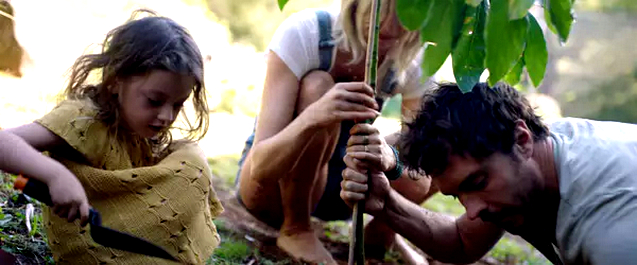
2040 is a letter to Damon Gameau’s four-year-old daughter. GoodThing Productions
The film and accompanying book showcase a rich tapestry of climate action stories from around the world, from renewable energy microgrids in Bangladesh, to autonomous electric vehicles in Singapore and regenerative agriculture in Shepparton, Victoria.
Economist Kate Raworth speaks eloquently about the urgent need for a new “doughnut economics” approach, which grows jobs and health and well-being rather than consumerism, pollution and inequality.
Paul Hawken, founder of the Drawdown project reminds us we already have the tools required to build a just and resilient zero-carbon economy. Our key task now is to mobilise the resources and harness the creativity required to bring this work to scale at emergency speed.
Importantly, the 2040 project also includes the Whats Your 2040 website, where audiences can explore their own personal climate action plans.
I have had the privilege to contribute ideas and advice to the 2040 film project, drawing on research I’ve undertaken over the last ten years on strategies for accelerating the creation of post-carbon economies. Its also been exciting to see such enthusiasm and determination from audiences watching 2040, particularly among students and young people.

From fear to hope and action
While 2040 doesn’t avoid hard truths about the rapidly escalating risks and dangers of the climate emergency, Gameau has made a clear choice to focus his narrative of “fact based dreaming” on stories of hope and action rather than just chaos and catastrophe.
The goal is to offer viewers a refreshing and energising change from yet more images of burning forests and melting glaciers.
Of course, some will also bear in mind the cautionary warning of Greta Thunberg:
I don’t want you to be hopeful…I want you to feel the fear I feel every day…I want you to act as you would in a crisis. I want you to act as if the house is on fire. Because it is.
US author Rebecca Solnit provides another valuable perspective. “Hope”, she argues “is not about what we expect. It’s an embrace of the essential unknowability of the world. Hope is not a door but a sense that there might be a door.”
In my work with climate scientists, activists and policy makers over the last ten years I’ve had many challenging conversations about finding the right balance between fear and hope; threat and opportunity; naive optimism and paralysing despair.

Emergency response
One useful source of wisdom in navigating this tension is research on effective and timely responses to more immediate natural disasters, like fast-moving storms, floods and fires.
Successfully dealing with an emergency requires recognising that decisive action is urgently necessary, possible in the time available, and desirable. Broken down, this means understanding:
  1. the emergency is real and heading our way, but
  2. there is a clear course of action that will significantly reduce the danger, and
  3. the benefits of decisive collective action clearly outweigh the costs and risks of inaction.
There is certainly no shortage of scientific and experiential evidence about the scale and speed of the climate emergency which has now arrived at our door. But the case for radical hope, defiant courage and decisive collective action also continues to strengthen.
We can see this in the remarkable rise and global impact of the School Climate Strike, Green New Deal, Extinction Rebellion, and fossil fuel divestment initiatives like Market Forces.
2040 trawls the world for innovative solutions to climate problems. GoodThing Productions

This challenge is also being taken up by some sections of the business world. (See, for example, Ross Garnaut’s recent lecture series outlining Australia’s great potential as a renewable energy superpower.)
Ideas like this are particularly important in developing a convincing and compelling narrative about a future post-fossil fuel economy that creates high-quality secure jobs and leaves no Australian worker or community behind.
The election outcome is clearly a significant setback for those who had hoped that there might now be clearer air for a more mature conversation in Australia about the necessity, urgency and desirability of accelerating the transition to a just and resilient zero-carbon economy.
None of us know exactly how our journey into a harsh climate future will evolve. We can however be sure that the journey will be far tougher if we close our eyes and fail to act with honesty and imagination; wisdom and courage. 2040 makes an important contribution to this urgent and essential work.

Links

The Heat Is On Over The Climate Crisis. Only Radical Measures Will Work

The Guardian

Experts agree that global heating of 4C by 2100 is a real possibility. The effects of such a rise will be extreme and require a drastic shift in the way we live
Crosses topple in the cemetery at Quinhagak in the Yukon delta, Alaska. Permafrost in the region is thawing. Photograph: Mark Ralston/AFP/Getty Images
Drowned cities; stagnant seas; intolerable heatwaves; entire nations uninhabitable… and more than 11 billion humans. A four-degree-warmer world is the stuff of nightmares and yet that’s where we’re heading in just decades.
While governments mull various carbon targets aimed at keeping human-induced global heating within safe levels – including new ambitions to reach net-zero emissions by 2050 – it’s worth looking ahead pragmatically at what happens if we fail. After all, many scientists think it’s highly unlikely that we will stay below 2C (above pre-industrial levels) by the end of the century, let alone 1.5C. Most countries are not making anywhere near enough progress to meet these internationally agreed targets.
Climate models predict we’re currently on track for a heating of somewhere between 3C and 4C for 2100, although bear in mind that these are global average temperatures – at the poles and over land (where people live), the increase may be double that. Predictions are tricky, however, as temperatures depend on how sensitive the climate is to carbon dioxide (CO2). Most models assume that it is not very sensitive – that’s where the lower 3C comes from – but a whole new set of models to be published in 2021 finds much greater sensitivity. They put heating at around 5C by the end of the century, meaning people could be experiencing as much as 10C of heating over land.
Such uncertainty isn’t ideal, but for our purposes let’s plump for an entirely feasible planetary heating of 4C by the end of the century. If that seems a long time away, consider that plenty of people you know will be around then. My children will be in their 80s, perhaps with middle-aged children and grandchildren. We are making their world and it will be a very different place.
Four degrees may not sound like much – after all, it is less than a typical temperature change between night and day. It might even sound pleasant, like retiring from the UK to southern Spain. However, an average heating of the entire globe by 4C would render the planet unrecognisable from anything humans have ever experienced. The last time the world was this hot was 15m years ago during the miocene, when intense volcanic eruptions in western North America emitted vast quantities of CO2. Sea levels rose some 40 metres higher than today and lush forests grew in Antarctica and the Arctic. However, that global heating took place over many thousands of years. Even at its most rapid, the rise in CO2 emissions occurred at a rate 1,000 times slower than ours has since the start of the Industrial Revolution. That gave animals and plants time to adapt to new conditions and, crucially, ecosystems had not been degraded by humans.
A 4C rise in global average temperatures would
force humans away from equatorial regions

Guardian graphic
Things look considerably bleaker for our 2100 world. Over the past decade, scientists have been able to produce a far more nuanced picture of how temperature rise affects the complexities of cloud cover and atmospheric and oceanic circulation patterns and ecology. We’re looking at vast dead zones in the oceans as nutrients from fertiliser runoff combine with warmer waters to produce an explosion in algae that starve marine life of oxygen. This will be exacerbated by the acidity from dissolved CO2, which will cause a mass die-off, particularly of shellfish, plankton and coral. “We will have lost all the reefs decades before 2100 – at somewhere between 2C and 4C,” says Johan Rockström, director of the Potsdam Institute for Climate Impact Research in Germany.
Sea levels will be perhaps two metres higher and, more worryingly, we will be well on our way to an ice-free world, having passed the tipping points for the Greenland and west Antarctic ice sheets, committing us to at least 10 metres of sea-level rise in coming centuries. That’s because as ice sheets melt, their surface drops to a lower altitude where it is warmer, speeding up melting in a runaway feedback loop. Eventually, dark, heat-absorbing land is exposed, speeding the melting process even more. By 2100, we will also have lost most low-latitude glaciers, including two-thirds of the so called third pole of the Hindu Kush-Karakoram-Himalayan mountains and Tibetan plateau that feeds many of Asia’s important rivers.
However, most rivers, especially in Asia, will flood more often, according to research by Richard Betts, head of climate impacts at the Met Office Hadley Centre, because the hotter atmosphere will produce more intense monsoons, violent storms and extreme rainfall. His studies predict a wide equatorial belt of high humidity that will cause intolerable heat stress across most of tropical Asia, Africa, Australia and the Americas, rendering them uninhabitable for much of the year. Tropical forests of heat-tolerant species may well thrive in this wet zone with the high CO2 concentrations, especially with the disappearance of human infrastructure and agriculture, although the conditions will probably favour lianas (vines) over slower-growing trees, Betts says. To the south and north of this humid zone, bands of expansive desert will also rule out agriculture and human habitation. Some models predict that desert conditions will stretch from the Sahara right up through south and central Europe, drying rivers including the Danube and the Rhine.
Our best hope lies in cooperating as never before: decoupling the political map from geography
In South America, the picture is more complicated: increased precipitation could enhance the Amazon rainforest, leading to mightier river flow. Other models predict a weakening of the easterlies over the Atlantic, drying the Amazon, increasing fires and turning it from forest to grassland. The tipping point for the Amazon could well be triggered by deforestation; while the intact forest could cope with some drought because it generates and maintains its own moist ecosystem, areas that have been opened up through degradation allow moisture to escape. “A combination of climate change and deforestation could push it into a savannah state,” Rockström says.
All of nature will be affected by the change in climate, ecosystems and hydrology and there will be plenty of extinctions as species struggle to migrate and adapt to an utterly changed world. Daniel Rothman, co-director of MIT’s Lorenz Center, calculates that 2100 will herald the beginning of Earth’s sixth mass extinction event. But what about us? This is undoubtedly a more hostile, dangerous world for humanity, which by 2100 will number around 11 billion, all of whom will need food, water, power and somewhere to live. It will be, in a giant understatement, problematic.
The good news is that humans won’t become extinct – the species can survive with just a few hundred individuals; the bad news is, we risk great loss of life and perhaps the end of our civilisations. Many of the places where people live and grow food will no longer be suitable for either. Higher sea levels will make today’s low-lying islands and many coastal regions, where nearly half the global population live, uninhabitable, generating an estimated 2 billion refugees by 2100. Bangladesh alone will lose one-third of its land area, including its main breadbasket.
From 2030, more than half the population will live in the tropics, an area that makes up a third of the planet and already struggles with climate impacts. Yet by 2100, most of the high and mid latitudes will be uninhabitable because of heat stress or drought; despite stronger precipitation, the hotter soils will lead to faster evaporation and most populations will struggle for fresh water. We will have to live on a smaller land surface with a larger population.
Indeed, the consequences of a 4C warmer world are so terrifying that most scientists would rather not contemplate them, let alone work out a survival strategy.
Rockström doesn’t like our chances. “It’s difficult to see how we could accommodate a billion people or even half of that,” he says. “There will be a rich minority of people who survive with modern lifestyles, no doubt, but it will be a turbulent, conflict-ridden world.”
Children paddle rafts through the streets in Kurigram District, Bangladesh, September 2015. Photograph: Zakir Hossain Chowdhury/Barcro
He points out that we already use nearly half the world’s ice-free surface to produce food for 7 billion people and thinks meeting the needs of 11 billion in such hostile conditions would be impossible. “The reason is primarily making enough food, but also we would have lost the biodiversity we’re dependent on and be facing a cocktail of negative shocks all the time, from fires to droughts.”
Others are more sanguine. “I don’t think that humans as a species or even industrial civilisation is seriously threatened,” says Ken Caldeira, climatologist at the Carnegie Institution for Science in California. “People live in Houston, Miami and Atlanta because they live in air conditioning through the hot summers. If people are rich enough to air-condition their lives, they can watch whatever is the successor to Game of Thrones on TV, as the natural world decays around them,” he says. But he points out that while richer people risk a loss to their quality of life, the poorer risk their actual lives.
So how might we give all of humanity the best chance?
Our best hope lies in cooperating as never before to radically reorganise our world: decoupling the political map from geography. However unrealistic it sounds, we’d need to look at the world afresh and see it in terms of where the resources are and then plan the population, food and energy production around that. It would mean abandoning huge tracts of the globe and moving Earth’s human population to the high latitudes: Canada, Siberia, Scandinavia, parts of Greenland, Patagonia, Tasmania, New Zealand and perhaps newly ice-free parts of the western Antarctic coast. If we allow 20 sq m of space per person – more than double the minimum habitable space allowed per person under English planning regulations – 11 billion people would need 220,000 sq km of land to live on. The area of Canada alone is 9.9m sq km and, combined with all the other high-latitude areas, such as Alaska, Britain, Russia and Scandinavia, there should be plenty of room for everyone.
Food production will need to be more intensive. This will be a mostly vegetarian world, devoid of fish and livestock
These precious lands, with tolerable temperatures and access to water, would also be valuable food-growing areas, as well as the last oases for many species, so people would need to be housed in compact, efficient high-rise cities with reflective roofs and resource-recycling systems. That risks raising local temperatures to intolerable levels, because compact cities function as heat islands, so solar-powered cooling or even artificial winds would be needed to counteract this. There is also an increased risk of epidemics in such densely populated spaces.
Peter Cox, a climatologist at the University of Exeter, thinks this is viable, but would require a massive programme of infrastructure to manage waste, air quality and water needs. City-scale underground reservoirs could supply domestic needs and efficient recycling would keep water – and other resources – circulating in the population for years rather than hours. Post-fossil fuels, we will require unprecedented electricity production. This could come from vast arrays of solar- and wind-power plants in a belt across the uninhabitable desert regions. High-voltage direct current transmission lines could relay this power to the cities or it could be stored as thermal energy in molten salts and transported in hydrogen – after solar energy is used to split water to provide hydrogen for fuel cells.
Hydrogen production will be on an industrial scale and it could be used for nonelectric transport, for instance. Wave farms, nuclear fission (and potentially fusion) and solar power will help meet our electricity needs. In the meantime, the effective capture from the air of today’s carbon emissions will with luck be a reality; they can be stored or used in the manufacture of materials.
Food production will need to be more intensive, efficient and industrial. This will be a mostly vegetarian world, largely devoid of fish and without the grazing area or resources for livestock. Poultry may be viable on the edges of farmland and synthetic meats and other foods will meet some of the demand. Heat-tolerant, drought-resistant crop varieties, such as cassava and millet, will replace many of our current unmodified staples such as rice and wheat and they will grow faster and with greater water efficiency because of the high CO2 levels.
One problem is that almost all of our agriculture will need to be at higher latitudes, because the tropics will be too dry or too hot for farmworkers. And that means less land and less sunlight in winter. “Global agriculture could be limited by the geometry of Earth’s orbit around the sun,” Cox says. “However, studies have shown that crops thrive with artificial light delivered by LEDs at exactly the right frequencies for photosynthesis. This means we could grow crops through the winter months, hydroponically in smaller spaces, stacked up in warehouses or even underground, leaving valuable land surfaces for other uses.”
Cultivation of algal mats and crops grown on floating platforms and in marshland could also contribute, while crops could potentially be grown in uninhabitable regions, farmed and processed remotely by artificial farmers. Either way, we would need to use far more precise nutrient and irrigation systems to avoid polluting more fertile ecosystems and reduce food loss and waste.
A 4C warmer world may well be survivable, but it would be eminently poorer than the one we currently enjoy. Rockström believes it takes us beyond our adaptation capabilities. Delivering our children to such a deadly home is a horrifying proposition.
Given what’s at stake, it may be worth deploying geoengineering tools, which reflect the sun’s heat away from Earth, and so keep global heating to safe levels. This wouldn’t address the problem of dissolved carbon killing oceanic life, but it could buy us more time to decarbonise and achieve negative emissions. Crucially, keeping Earth cooler for longer would help the poorest people to adapt. “We have come to a point where different forms of geoengineering cannot be excluded,” admits Rockström, “but SRM [solar radiation management] is a very dangerous geopolitical tool to deploy: who decides which part of the globe to shade? How would we govern it?” he asks.
We’ve already warmed the world by 1.1C, and we’re experiencing the effects: the International Federation of the Red Cross estimates there are as many as 50 million climate refugees. Once we reach 4C, most models agree it will be impossible to return to today’s abundant world.
“For me, the issue is that we are transforming (and simplifying!) our world for many thousands of years into the future with millennia of rising sea [levels], acidified oceans and intolerable tropical temperatures, just because we weren’t willing to pay the small differential between fossil-fuelled prosperity and prosperity fuelled by non-greenhouse-gas-emitting energy systems,” says Caldeira.
We are now making the climate of 2100 and however hard it seems to meet our emissions targets, it’ll be far harder for our children if we don’t. With international cooperation and regulation, we can make it livable.

Links

24/05/2019

What Happened To The Climate Change Election?

FairfaxWaleed Aly

Perhaps we'll be surprised. Perhaps calls from Liberals like Arthur Sinodinos and Simon Birmingham to embrace renewables in its energy policy and dissolve the false binary between the environment and the economy will be heard within the party.
Perhaps Scott Morrison, a rare unifying figure in a party still enduring a civil war, will choose to make this shift. Perhaps the presence of independents like Zali Stegall in Warringah and Helen Haines in Indi will inspire Liberal moderates into action.
But let's be honest: as we sit here right now, the next parliament looks profoundly unlikely to generate any meaningful action on climate change.
The greatest predictor of a voter's attitude to climate action is their economic exposure to it. Credit: Jonathan Carroll


So much for the climate election, you say. And on one level, that's right. The swing away from Labor in the outer suburbs – especially pronounced in those seats experiencing heavy mortgage stress – seems emphatically economic. That's not the same as climate scepticism. It's to say it ranks as a third or fourth order issue behind things like the taxes and property prices. Climate change simply doesn't drive suburban votes.
But it's simply not true that climate change wasn't a major factor. It was. And it played out in wildly contradictory ways that reveal exactly where it sits in the Australian imagination.
Let's start with a significantly overlooked fact from Saturday. The Greens had a good night. This is obscured by the large swings against them in the seats in which they had hopes, like Wills and Cooper.
But look at the Senate. It's an important place to look because it is a house of proportional representation, unlike the lower house, where votes can be wasted in safe seats or on lost causes. Here, the Greens gained the largest swing of any party in the country: up around 2.6 per cent, taking its vote to near 13 per cent.
Greens leader Richard Di Natale had a good day in the end. Credit: AAP
That swing was almost double in Queensland, where it quietly outpolled One Nation. In South Australia the swing was 11.8 per cent. As a result, all Greens senators will likely be returned: a big result given most of their senators were up for election this year. It's fair to assume this was largely a climate change vote. No party was as exclusively focused on the issue as the Greens, and no other party's policy was remotely as ambitious
Far better publicised were the significant swings against the Coalition in wealthy, inner-city seats. Indeed, the overwhelming majority of the wealthiest seats in the country – most of them Liberal seats – swung progressive. The ones that didn't, barely swung at all. The one exception is Solomon in the Northern Territory, which is a volatile seat.
The most spectacular victim of this was Tony Abbott in Warringah, whose independent vanquisher Zali Stegall unabashedly emphasised climate change. But Wentworth came remarkably close to staying out of Liberal hands on similar grounds.
Elsewhere, it is hard to see what else could have inspired these swings, given Labor's platform was specifically designed to attack the economic interests of wealthy voters.
But then came mining. Almost every community that relies on resources smashed Labor. That is where Queensland came into its own, dishing out double digit anti-Labor swings with relish in places like Capricornia (centred on Rockhampton) and Dawson (which includes Mackay and parts of Townsville). But all the talk of the Coalition's domination of Queensland has missed that it only got 0.25 per cent of the swing. Overwhelmingly these votes flowed to One Nation and Clive Palmer, who then sent them the Coalition's way by preferences.
Perhaps the most pronounced example of this was in the NSW coal mining seat of Hunter, where Labor lost over 14 per cent of its primary vote. The Nationals lost 2.5 per cent of theirs. One Nation, meanwhile, clocked up its highest vote in the whole country: nearly 22 per cent. A couple of thousand more votes and it probably wins the seat.
This was very likely a pro-coal, pro-Adani vote. These are communities where opposition to coal on climate grounds sounds very much like a heartless desire to see them unemployed and impoverished. That's why there was so much rage when Bob Brown took his anti-Adani convoy into town, and so much delight on the faces of Nationals MPs. This, it seems, was not a time for nuance. No one much cared that Labor had no plans to phase out coal, or that it had still left the door open to Adani. Its climate change rhetoric made it sound coal-sceptical, driving these voters to the most anti-climate party they could find. That's my preliminary suspicion, anyway.
"When climate change is a moral issue we do quite badly. When it's an economic issue, we do very well." So said Tony Abbott in his concession speech on Saturday in perhaps the most succinct, piercingly insightful political analysis of the issue offered all night. What this patchwork of climate votes reveals is just how deeply, primarily economic this issue has become. The greatest predictor of your attitude to climate action is your economic exposure to it. Voting for climate change policies is now a luxury item.
The only people who frame it as a "moral issue" and vote accordingly are those who can afford to. If you think your job is on the line, you'll oppose it viscerally. If your job isn't directly affected but you're financially stretched, you'll either have no interest in it or fear the costs of action more than the consequences of inaction. And as long as that's the case, climate action is doomed to the margins because only a small minority will ever be able to afford it.


The Prime Minister says the Coalition's win is a miracle and a victory for the quiet Australians.

Perhaps that might have been different if, instead of hedging on Adani and coal, Labor had spent years talking directly to coal miners about what an economic transition would look like. By this, I don't mean broad strokes about how a switch to renewables will create new jobs, or slogans like "no jobs on a dead planet".
That sort of thing probably seems very abstract and distant if you think you're staring unemployment in the face here and now. No, I mean really specific detail about what jobs will exist for the very same people whose livelihoods are currently bound up in the coal industry, in the very same places they currently live.
This might be the most ignored aspect of our major parties' climate change discourse.
Or maybe I'm wrong. But if it's not that, it has to be something else that makes emissions reduction seem affordable to those who fear it isn't, because it's clear that climate change as a moral issue is dead, and will be for years to come.
The alternative is to expect communities to vote for what they fear will be their own death.

Links

We All Smell The Smoke, We All Feel The Heat. This Environmental Catastrophe Is Global

The Guardian

Governments of the world need to act. It’s time to speak to our planet with kindness before it’s too late
The writer Alexis Wright in Australia. Photograph: Meredith O'Shea/The Guardian
All the raspy-voice myna birds have come here, to this old swamp, where the ghost swans now dance the yellow dust song cycles of drought. Around and around the dry swamp they go with their webbed feet stomping up the earth in a cloud of dust, and all the bits and pieces of the past unravelled from parched soil. The Swan Book, by Alexis Wright.

A dense haze of smoke crawled over Melbourne and embraced us for a day in its lonely pilgrimage, inviting us to contemplate its mourning rite, its long prayer.
This smoke came from a cremation of the natural world - the bushfires from the Bunyip State Forest that had begun during days of a major heatwave running across the country. The forest lies 65kms east of Melbourne where Mountain Ash grow, Prickly Tea-trees, Stringy Barks and heathland swamps. In the Woiworung mythology of the Kulin Nation, the Bunyip is a spirit that punishes bad people who disturb its home in the swamps of the Bunyip River, and according to the Parks Victoria information sheet on the park, local Aboriginal people avoided the area.
Lightning strikes created the fires by igniting a tinder-dry forest that flared up into “insane” flames from out of control bushfires. The sky around the Bunyip bushfires quickly filled with ash-loaded clouds reaching up to 6km in height where it produced its own erratic weather system. This was another massive pyroconvection producing bushfire – a super cell thunderstorm that was perhaps similar to the cumulonimbus flammagenitus clouds associated with the 2003 Canberra bushfire, and the 2009 Victoria’s Black Saturday bushfires which created pyrocumulonimbus storms reaching heights of 15 kms and generated hundreds of lightning strokes. This is the new language of climate change. Words most of us have never heard before but we are now learning to understand from experiencing the extreme weather events affecting us more frequently.
Bushfires rage out of control in Victoria in 2009. Photograph: A Coppel/Newspix / Rex Features
There were two thousand firefighters risking their lives in fighting this “catastrophe” that had so far burnt 100,000 hectares of land. Homes were destroyed. The intensity of these forest fires was so great that many native animals perished, the beautiful birdlife including the lyrebird, and all the small animals – nothing caught in the way of the fires would have escaped. Most of these creatures were possibly still growing their populations after the 2009 bushfires where 40% of the Bunyip park was burnt. Nobody seemed to know when the fires would stop burning, and it was said it might continue burning for months.
The Climate Council, Australia’s leading climate change communications organisation, called the 2018-19 continental-wide heatwaves and record-breaking hot days, as well as other destructive extreme weather events such as bushfires throughout Australia and heavy rainfall and flooding in northern Queensland, the Angry Summer, and the forecast is that we can expect this worsening extreme weather to continue.
We have come to expect extreme weather events of the type that were previously considered as being a one in a hundred year event. We no longer think, Oh! that won’t happen again in a hurry, so there is nothing to worry about. There is not one among us in this country who is not feeling the heat of hotter and more extended summers. We smell the smoke of major environmental catastrophes and ask how safe we really feel in hotter summers, and we will become more anxious, as each extreme weather event comes by.
***
When a slow moving tropical low converged with a monsoon over the coast of North Queensland in February 2019, it dumped more than one metre of rain on Townsville within a week. So intense was the rain, it created horrendous flooding in this regional city, and it brought back memories of the 2011 flash flooding and lives lost in Toowoomba, Grantham and towns in the Queensland’s Lockyer Valley. In Townsville, it was said that some rainfall readings “were at levels probably recorded once every 2,000 years and the rain created flood levels in the Ross River “that were greater than a one in 500 years event”. Who knows if what happened will be a one-in-a-100-year flood, or 50 years, or less? How do we plan for the future? Many residents of Townsville thought that they lived in a flood-free area and were not insured for flooding.
After this slow-moving extreme weather cell caused massive flooding in Townsville, it then moved further inland, almost travelling to the Northern Territory border before it petered out, as did Cyclone Yasi in 2011, which reached into the NT.
There was so much rain dumped in this twelve day weather event in February 2019 that it created a vast inland sea stretching hundreds of kilometres over flat drought-stricken country stretching east of Cloncurry in North West Queensland, and as far up North as Normanton in the Gulf of Carpentaria.
Cattle killed by floodwaters in Queensland, February 2019. Photograph: Jacqueline Curley
The flooding was massive. Of approximately five million head of cattle grazed in the region, nearly half a million head of cattle perished. The local people say it was the biggest flood ever seen in the Cloncurry River, that nobody remembers it flooding like this, where creeks became a two kilometre-wide torrent. Many of the pastoralists who run cattle on this land have spent their whole lives taking the risks of gambling with climate. They love the land, and show great bravery for taking these things on, and the back-breaking hard work they do. They risk everything by gambling on the climate in virtually a life or death situation, and suffer enormous consequences of loss and hardship when the weather turns, as it did this time.
They see the consequences of climate change first hand, and are the victims of it, and there is a shift of understanding going on – that man-made climate change and global warming is real, and that their lives on the land will only get harder if nothing is done about it.
This was truly an unbelievable phenomenon that had horrific consequences. It looked like hell on earth. Among the media reports of the devastation, I saw a video clip of Brahman cattle standing in a sea of flooding waters almost up to their necks. Their eyes stared out to the world in horror, and I doubted that they would be saved.
One life-long cattleman who lost over 80% of his cattle vividly described what happened in his heart-breaking words that, “there wasn’t much life stuff, you’d just see dead stuff lying everywhere. All the kangaroos, and bloody little marsupial mice and birds they couldn’t handle it.” There was nowhere to hide, so they were wiped out. This great north country was silenced by the flooding.
I grew up in this country, and I learnt to swim with all the other kids in this river when it flooded, at a time when Cloncurry held the record as the hottest place in Australia. We learnt to wait for this fast-flowing brown water to flood the river a second time before swimming in it – after all the dead cattle and tree trunks and branches, etc had been carried away with the first flush. If you were a child who was afraid of drowning, or being carried downstream, you were considered by the other kids as not strong enough to run with them. You learnt by swimming out into the deeper, fast-moving waters until you caught hold of the slippery second or third pylon of the bridge, and I do remember fearing that I would never reach it, of being unable to see where it was, and of being sucked under the water.
Before my father died in the 1950s, he owned a cattle property that was around Mackinley, east of Cloncurry, and I know he struggled on this drought stricken property he loved until he died when I was a small child. I will never know, but it is quite possible that his cattle station was under water in this flood, part of the inland sea. Perhaps this land is now starting to bound with new life – all the grasses and pretty flowers bringing butterflies and birds on the breeze, something that he would never have seen in the droughts of the 1950s. I never saw his property. It is only a place of my imagining and did not give a lot of meaning to our childhood, but now, strangely, an imagining of its life under water, is similar to many of my dreams of marvellous watery wonderlands.
I imagine the land green as far as the eye can see, and the flood water pouring into the Lake Eyre basin in another inland sea for the pelicans and other birds that will flock to the area. There are thousands of ghost butterflies with pastel coloured iridescent wings that each span the size of a human hand now swarming in my dreams. They are being flown through a dry wind circling around decimated drought stricken fruit trees languishing in red earth dust. Was this an extinction flight? The last doomed emergence of an ancient butterfly from wetter times in this country thousands of years ago, before the climate changed?
***
How do you find the words to tell the story of the environmental emergency of our times? No one in this country escapes the realities of this manmade global warming catastrophe that is creating before our eyes unprecedented heatwaves, out-of-control fires, immense slow-moving rain systems, freakish cyclones, floods creating inland seas, warming seas, coral bleaching, and the fast pace of losing necessary ecosystems through the demise of native flora and fauna that cannot keep up with the changing environmental conditions. All in one year?
But it is not only Australia. This environmental catastrophe is global. The UN’s Intergovernmental Science-Policy Platform on Biodiversity and Ecosystem Services has just released a frightening 1,500-page official report on the state of biodiversity on Earth. The report, the UN’s first global assessment of the natural world in 15 years, was written by 145 authors from 50 countries and it sums up 15,000 scientific papers on the threats against life in the age of humans.
It is a chilling report warning us that as many as one million of Earth’s eight million species of all kind – mammals, birds, amphibians, insects, plants, marine life and terrestrial life – are at risk of extinction within decades, and will be disappearing at a rate tens or hundreds of times faster than in the past. The report lists five major threats to biodiversity, including conversion of forests and grasslands into farms and plantations where half a million species on land now have “insufficient habitat for long-term survival”. A third of the world’s fish stocks overfished, and the dumping of extreme amounts of waste into the world’s oceans and rivers and killing many parts of these water systems. Add this to the damage caused by climate change, pollution and the spread of invasive species. The risk of an “annihilation” of one eighth of the world’s biodiversity is due to human activity that risks putting the planet on the “tipping point” of no return.
All the governments of the world need to act now and act urgently to turn this planetary nightmare around before it is too late, because this warning of the magnitude and acceleration of biodiversity loss is a global crisis with dangerous implications not only for one million species but for human health and long-term survival.
***
In this country there are sacred places holding enormous powers throughout this continent and reaching far out in the seas. But most non-Aboriginal people do not understand the powerful nature of this country and the forces of nature, or how the ancient law stories associated with each of these sacred places contain vital knowledge about the deep history of this land and caring for it.
The Aboriginal caretakers of their traditional country have always understood its power, and why it is so important to care for the land through developing an important system of laws that created great responsibility for caring for the stories and powers of the ancestors. These narratives of great and old wisdom are the true constitution for this country, and urgently need to be upfront in the national narrative in understanding how to care for it.
After the manmade catastrophe of a million dead fish in the Darling River – which was all about horse-trading at the expense of the environment – the elders came from different parts of the river system to the Walgalu high country, the birth place of Australia’s major rivers high in the Kosciuszko National Park in New South Wales. There, they performed a water ceremony, a Narjong, “to invoke the sacred duty of caring for the river systems, a tribal responsibility for thousands of years”. Perhaps this ceremony has existed for more than 120,000 years since there is new scientific evidence in southern Victoria suggesting that we have existed in our country for as long as we have always known, since time immemorial. The elders called the rivers – their relative, their relation – by their traditional names. Dear broken rivers that may respond to their caretakers calling them, and speaking to them gently.
Hundreds of thousands of dead fish in the Darling River. Photograph: Graeme Mccrabb Handout/EPA
Just as we see our people work hard to take great care of country on our traditional lands, and much good work being done by people in this country, there are people across the world who are taking great ethical steps to care for their relatives - the rivers and mountains, the animals, birds and the natural world. In China, crops will be grown in the south-western province of Yunnan in a habitat area of Menghai county to feed the elephants, so that these animals might stop raiding the crops of local farmers. In Thailand and Cambodia, the monks find the oldest and largest trees in the forest to ordain and wrap in the traditional orange robes of a monk to save the trees from loggers who will not commit the taboo of harming a monk, even if that monk is a tree.
India’s courts in 2017 ruled “that the Ganges and Yamuna rivers have rights to exist, thrive, and evolve”. In New Zealand, the government granted the same legal rights as a living person in 2017 to the sacred Mount Taranaki, as it also did in 2018 for the sacred Whanganui River, and as well, in the 2014 granting of legal personhood to the Te Urewera forest, and giving the local Māori tribes shared guardianship with the government. In America, the people of Toledo recently granted the same rights as a person to Lake Erie, to recognize the rights of the lake and its watershed to have the right to a healthy environment. All of these ideas begun with Ecuador’s 2008 constitutional acknowledgment of the Rights of Nature to exist, persist, maintain and regenerate its vital cycles. And we – the people – have the legal authority to enforce these rights on behalf of ecosystems.
These are all special acts to protect holy places and creatures.
This is the only planet we know that supports life.
We would do well to see the world as a sacred site that is holy, speak to our planet with kindness, and protect it as such.

Links

Coal Catastrophe: Why Scott Morrison Can't Give In To Queensland Triumphalism

The Guardian

The government would be wrong to imagine all of Australia possesses the sensibilities of coal communities in Queensland
‘Scott Morrison would be smart to elevate a senior moderate to the environment portfolio who can carry the message – perhaps Simon Birmingham.’ Photograph: Mick Tsikas/AAP
It’s safe to observe the 2019 election was not a good election for the climate.
The basic facts speak for themselves. A government with a suboptimal policy was returned for another term, and Labor will now go through another, likely painful, round of recalibration of its climate offering. It’s unlikely Labor will stage a dramatic retreat from climate action, but there will certainly be an internal push to temper the current policy with an eye to regional sensibilities, and by regional sensibilities I mean the sensibilities of coal communities.
While Saturday night’s result isn’t what the country or the climate needs – a government, apparently without the will to tackle the problem, back in power for three years, and an opposition licking its wounds, wondering how long it can keep going to elections championing climate action, and losing – it would be a mistake to conclude the issue is now completely off the agenda.
Climate change in Canberra remains a movable feast.
Let’s examine the dynamics inside the government. It’s absolutely true that the pro-coal faction in Queensland will be emboldened, courtesy of Saturday’s positive election result, and will have zero interest in internal arguments in favour of strengthening the government’s existing climate policy framework.
By some accounts, the north Queensland triumphalism currently extends to the resources minister, Matt Canavan, making a play to combine the energy and resources portfolios in Scott Morrison’s upcoming ministerial reshuffle, expected on Sunday.
But Liberals in safe seats who suffered negative swings on Saturday night for two reasons – because of the government’s climate change policy, and because of concerns the party has pitched too far to the right – will want Morrison to use his authority to move the dial positively on climate change.
We’ve heard a lot about the Queensland swing since Saturday night, but the fact is two things happened in the recent election campaign for the Coalition. The first is the government’s support for the Adani coalmine helped shore up the Liberal National party in central Queensland (even though if you look closely at the results, voters didn’t swing en masse to the incumbents, they parked a protest vote with One Nation and Clive Palmer that flowed back to the Coalition); and the second is voter concern about climate change forced the Liberal party to spend significant resources defending safe seats that could have been better directed to contests elsewhere.
Morrison has to balance two political realities, not one, and some Liberals believe it would be a catastrophic mistake for the government post-election to imagine the whole of Australia possesses the resting sensibilities of coal communities in Queensland, when the campaign field evidence suggests otherwise.
MPs who favour rebalancing believe Morrison has been handed a significant opportunity during this term in government to try to neutralise climate change as an electoral negative for the Coalition. The view is if Morrison can use his authority to execute the necessary pivot, that potentially sets the Coalition up for a long stint in government.
Some colleagues say Morrison has the capacity to recalibrate not only because of his enhanced internal authority post-election but because he was not a frontline protagonist in the internal climate wars of the past decade. The spiritual leader of the internal opposition to climate action, Tony Abbott, is also out of the parliament, which improves the prospects of managing a shift; not immediately, but over the course of the coming term.
Notwithstanding his explicit commitment on the hop during the campaign to keep Melissa Price in the environment portfolio post-election, Morrison would be smart to elevate a senior moderate to the portfolio who can carry the message – perhaps Simon Birmingham. It would also be smart to project more positivity about the transition to low emissions energy sources, the positivity the Coalition has been reluctant to project for fear of offending Alan Jones or the reactionary right rump.
Some Liberals argue the government needs to reframe the transition to low emissions as an opportunity for Australia, not a cost – which was the negative territory Morrison prosecuted through much of the election in an effort to curb any momentum from the Labor campaign.
Of course all of this is just talk at the present time.
We are a distance short of any concrete action that would give anybody heart, and even if Morrison is inclined to see climate change as a frontline issue where the Liberal party can be seen to be pitching its tent in the political centre, or can be persuaded to that end – any movement on emissions reduction mechanisms would be heavily contested internally.
When we move from the point of generalities to specifics, supporters of better policy in the government are completely candid. They don’t know what the new policy mechanism should be.
It would be very hard to revive Malcolm Turnbull’s national energy guarantee, even though that would be sensible, given the implosion of 2017. It is also hard to propose more ambitious targets without all hell breaking loose internally.
But it is possible, some think, to build in review structures over the coming term which point to a ratcheting up of ambition.

Links

23/05/2019

The Royal Baby Is Cute And All, But Hello, The Planet Is On Fire

Grist* | *

Here’s a sign of how badly the big networks are blowing it: (U.S.) ABC’s World News Tonight spent more than seven minutes reporting on the birth of royal baby Archie in the week after he was born — more time than the program spent covering climate change during the entire year of 2018.
Other major TV news outlets in the U.S. have also severely underreported the climate crisis yet found plenty of time to note the arrival of Archie, son of Britain’s Prince Harry and Meghan, the Duchess of Sussex. He’s now seventh in line to the British throne, which means he probably won’t be a king but definitely will be a tabloid mainstay.
On May 6, the same day Archie was born, the United Nations released a summary of a major new report warning that human destruction of the natural world, including through climate change, now threatens up to a million species with extinction. That’s dire news for our species too, as it also threatens our water supplies, food security, and health. The destruction of ecosystems and species “means grave impacts on people around the world are now likely,” the report warned. Robert Watson, head of the group of scientists that produced the report, laid it on the line: “What’s at stake here is a liveable world.”
Yes, this extinction crisis is grim news, and many people need a little light fare mixed in with their misery — a report on a royal baby, if you’re into that kind of thing, or a sports recap, or a segment on disgruntled Game of Thrones fans. But when the light fare takes over and the real news is shut out, that’s beyond lopsided. We’ve got a problem.

U.S. broadcast news coverage of climate change and extinction vs royal baby
Minutes of coverage on nightly news shows from Nay 6 to May 12
Media Matters tracked broadcast news coverage on May 6 and found that ABC and NBC’s nightly news programs failed to even mention the U.N. biodiversity report. They did, however, air two segments each on Archie. CBS was the only national broadcast network that ran a segment on the biodiversity report that night, and of course it ran one on the baby, too.
The perverse priorities of TV newscasters became even more obvious in the following days. Archie stayed in the news. Biodiversity and climate change stayed out of it.
By May 12, the three networks’ nightly news shows had spent a total of 17 minutes and 56 seconds on baby Archie. The extinction report and climate change garnered a total of one minute and 21 seconds — all of it in that single CBS segment on May 6.
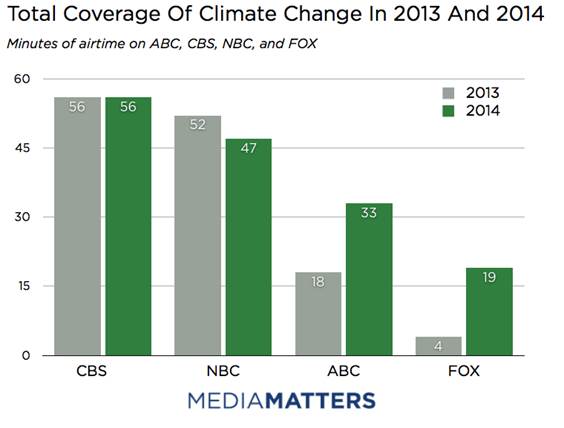
ABC’s World News Tonight devoted the most time to the royal baby: seven minutes and 14 seconds over the week. Compare that to the six minutes and three seconds the program spent on climate change over the entire course of 2018. ABC typically lags behind its competitors in time spent covering climate change, as Media Matters has previously documented. The network has devoted less airtime to the climate crisis than CBS and NBC every year since 2013 — even though CBS and NBC don’t have great track records themselves. Lest you think the old broadcast dinosaurs don’t matter anymore, their flagship nightly news programs still attract an average of 25 million viewers a night, including more than 5 million between the ages of 25 and 52.
Within hours of Archie’s birth, Vice’s Derek Mead published a post headlined “Who’s Going to Tell the Royal Baby That Our Planet Is Unequivocally Dying?” He concluded, “royal baby aside, the most important news of the day, the decade, our lives, is this: We have pushed the planet far past its limits, and we ignore that at our existential peril.”
Mead joins a small but growing group of journalists and citizens demanding that our media step it up and cover climate change like the looming existential crisis it is. As Mark Hertsgaard and Kyle Pope wrote last month for the Columbia Journalism Review, “If American journalism doesn’t get the climate story right — and soon — no other story will matter.” The Columbia Journalism Review, The Nation, and The Guardian are launching a #CoveringClimateNow project to spur the media into action. The disproportionate hullabaloo over the royal baby, juxtaposed with the near silence over the extinction crisis, shows exactly why we need it.
Imagine if mainstream media covered climate change with anything near the fervor of a royal wedding or a royal birth. Weeks of high-pitched pieces anticipating the release of new climate action plans. Minute-by-minute coverage dissecting every aspect of new scientific reports. Splashy, in-depth profiles of the people leading new climate movements. Homepages and front pages dominated by the climate crisis and climate solutions, day after day. If we can imagine it, can we make it happen?

*Lisa Hymas is director of the climate and energy program at Media Matters for America and was previously a senior editor at Grist.
*Ted MacDonald is a climate and energy researcher at Media Matters.

Links

Lethal Heating is a citizens' initiative