Monday, May 27, 2019

Morrison Sprints To Adani Approval

Saturday Paper - Mike Seccombe

The Queensland Labor government has taken the Coalition’s election victory as a warning it must fall in line and green-light the Carmichael coalmine.
Prime Minister Scott Morrison in Sydney on Wednesday. Credit: AAP Image / Joel Carrett
The sharemarket makes no moral judgements. Money is its only metric. And on the first trading day after the federal election, the market surged to heights not seen since before the global financial crisis, more than a decade ago.
Investors were clearly pleased with the Coalition’s win, seen as a victory for shareholders and the wealthy over the community at large. The finance sector jumped 5.6 per cent, with the Big Four banks doing particularly well, their shares up by between 6.3 and 9.2 per cent.
Analysts called it a “relief rally”, prompted by the fact Labor’s plans to limit negative gearing and lift capital gains tax would have cut the banks’ earnings. The property sector also bounced back, buoyed by the assumption that speculators might come back into the market for the same reason.
Health insurers did even better, on the understanding that – unlike Labor – a Coalition government would not prevent them from raising premiums for their customers. Medibank Private and NIB were both up, by 11.5 per cent and 15.8 per cent respectively.
Larger, though, than all those gains on the Australian market was that of one company listed on the National Stock Exchange of India – Adani Enterprises. On Sunday, the company saw its share price leap almost 30 per cent.
“The sharemarket is telling us the probability of the [Adani] Carmichael mine going ahead has just increased dramatically,” says Tim Buckley, the director of Energy Finance Studies, Australasia, at the Institute for Energy Economics and Financial Analysis.
It was not only the sharemarket telling us that. So was the behaviour of the federal minister for resources, Matt Canavan. On election night he tweeted, “START ADANI!” Canavan also celebrated the election win wearing a T-shirt bearing the same message.
In the days since, Canavan and his fellow pro-coal travellers in the Coalition have seized the political agenda.
Australia now is accelerating towards the Carmichael mine’s approval and, beyond that, the opening up of further coal projects in huge, previously unexploited reserves of Queensland’s Galilee Basin.
The Palaszczuk government has become suddenly, acutely sensitive to accusations that it has been stalling on the Adani approval process. “The community is sick of it, I’m sick of it, everyone is sick of the delays,” the Queensland premier said.
But Buckley says this is not only a consequence of the re-election of the Morrison government.
Last weekend also saw the release of exit polling showing Indian Prime Minister Narendra Modi and his Bharatiya Janata Party (BJP) were on track to repeat their landslide election victory of 2014. At time of writing, projections show Modi’s party will secure four times the number of seats won by the second-placed Congress Party.
It is the interaction of these two phenomena, Buckley says, that is driving events. “The No. 1 paid-up supporter of Modi is Gautam Adani. If – when – the BJP gets back for another five years, [Adani’s] sun will shine very brightly, as the first among industrialists who stand behind Modi.”
Over the past five years under Modi, Adani’s empire has already expanded in diverse areas – from real estate to plastics to frozen food to aerospace to defence to cornering the lentil market.
“Adani is into everything,” says Buckley. But energy is the big one.
“It has become India’s biggest private player in the gas business, the electricity transmission business, as well as the biggest renewable energy business,” he says.
Adani already is India’s largest private producer of thermal power, in substantial part because of the relationship the conglomerate has with the government. It continues to grow rapidly towards a goal of 20,000 megawatts of power-generating capacity by 2020.
“Last month, Modi gave Adani a $US1.5 billion loan from the State Bank of India to fund a coal plant at a place called Godda, in the eastern provinces,” says Buckley. “And he’s been given a $1 billion tax concession, through the establishment of a free-trade zone around the power plant.
“The new project will use imported coal and export power to Bangladesh. Seven million tonnes a year, which they could source from Carmichael.”
According to Buckley, Adani’s already extraordinary access to state capital and his political power will be “through the roof”, assuming Modi wins. In all likelihood, given Adani’s ambitious expansion plans, there will be more coal generation plants to come.
That would be an environmental and climate disaster, particularly for India. According to research published last month in the prestigious journal Proceedings of the National Academy of Sciences of the United States of America, air pollution from the burning of fossil fuels already kills at least 690,000 Indians each year. Science tells us India and Bangladesh are among the countries most threatened by climate change.
But Gautam Adani is a creature of the markets, and the markets make no moral judgements.
“Fossil fuels or renewables,” says Buckley, “it’s all about the money for Adani.”
***
Only a day before the Australian election, speaking to a voter in Townsville, Scott Morrison pronounced himself “always puzzled when any power source attracts such particular partisan attention”.
“Why do we get into any value judgement about any of these particular sources? Because at the end of the day, they are a practical thing, it’s a power source thing,” he said.
Coal, like petroleum and gas, was “just a power source”.
It came down to cost, said Morrison, and there was no “need to engage in a moral debate about it”.
Former prime minister and Warringah MP Tony Abbott touched on the same theme on Saturday night in his concession speech after losing his seat to the independent Zali Steggall, who campaigned strongly on the need to address climate change.
Abbott noted the Liberal Party had done relatively better in places where climate change was perceived as an “economic question”, and worse where voters saw it as a “moral question”.
There is a solid basis for that interpretation. A detailed analysis by Guardian Australia journalist Nick Evershed showed many of the largest swings towards the Coalition occurred in seats with coalmines. He also found the seats that swung harder to the Coalition were more likely to have higher unemployment, lower income and lower levels of education. And vice versa for those that swung towards Labor.
This was a political contest flagged as “the climate change election”, yet it has yielded a perverse result. Instead of pushing government towards greater action on climate change, it has pushed the other way. The pro-coal voices in the Coalition are more strident, and panicked members of the Labor Party, both federally and in Queensland, are preparing to retreat.
The prospect of Australia implementing credible measures to address climate change – Labor’s targets were for a 45 per cent reduction in greenhouse gas emissions and a 50 per cent renewable share of energy generation by 2030 – seems lost, at least for the next three years.
***
Of even greater concern is that approval of the Adani mine will open the way for other mine proponents, notably Clive Palmer, whose Waratah Coal has plans for an even bigger mine than Adani’s.
If the huge reserves of the Galilee Basin were fully exploited, according to an estimate by the Climate Council, it would result in the emission of an additional 705 million tonnes of carbon dioxide each year, equivalent to 1.3 times Australia’s current annual emissions. But it also would generate vast revenue.
The political pressures are obvious. After the election, Labor is left with just six of 30 seats in Queensland. Its primary vote in the state has fallen to just 27 per cent, far below its national support at 33 per cent.
When asked by Fran Kelly on RN Breakfast on Tuesday why Queenslanders voted as they did, Matt Canavan, a Queensland Nationals senator, summed it up in one word: “Coal.”
Canavan went on to note there had been huge swings away from Labor in other coal seats, such as the New South Wales electorate of Hunter, where the primary vote for the Labor member, Joel Fitzgibbon, fell 13.9 per cent, and 9.8 per cent after preferences.
But there was no Labor “attack on coal jobs”, no imminent threat from the opposition to existing employment in the mining industry.
A week before the federal election, the Queensland Labor government actually greenlit a new $1 billion mine, which will produce 15 million tonnes a year of high-grade coking coal – that is, the kind of coal used to make steel, rather than the low-grade coal Adani seeks to burn to generate electricity. Premier Annastacia Palaszczuk trumpeted an expected 500 new construction jobs and 1000 operational jobs from the Olive Downs mine.
While Labor was not offering the prospect of new government-underwritten coal power stations, as demanded by Canavan’s Queensland Nationals colleagues, a new coal power station was never on the cards – no matter who won the election. And Canavan knew that. Back in March, when Morrison announced a shortlist of 12 new generation projects, potentially eligible for government support, there was no new coal project on it.
Six proposals involved renewables with pumped hydro storage and five were gas. One related to an upgrade of an existing coal plant in NSW.
The only concession to Canavan, his fellow Nationals and the coal lobby was $10 million to study Queensland’s future power needs, including for a new coal generator in Queensland.
But this will never come to anything, barring an act of financial lunacy, for new coal is simply not cost competitive.
At the same time, renewables are already producing jobs around the country. In Victoria, in the two years since the closure of the dirtiest power station in the developed world, the giant Hazelwood brown coal plant, unemployment in that region has fallen from 8 per cent to 5.7 per cent. As energy transition specialist Simon Holmes à Court recently noted, this was “in no small part due to the efforts of the Latrobe Valley Authority, set up by the state government to help ensure a ‘just transition’ for the workers and local community”, and its various programs to retrain and redeploy people rendered jobless by the corporate decision.
Among federal Labor’s election promises was a similar independent Just Transition Authority, which would support “workers and communities affected by the inevitable closure of ageing coal-fired power stations” across the nation.
Canavan was able to twist the proposal into evidence that the opposition was intent on putting coal industry employees out of work.
***
But there is an argument to be made that the opening up of the Galilee poses a real threat to the jobs of miners in other parts of Australia, because it would bring more supply into a declining market.
In July last year, The Australia Institute produced a report claiming new, highly automated mines in the Galilee would reduce overall mining employment, particularly in Joel Fitzgibbon’s bailiwick of the Hunter, where 9000 jobs would be lost. The report found NSW would be most affected, because it mostly produces thermal coal, whereas most of Queensland’s existing production is coking coal, used for steel-making, for which there is greater demand.
It was just modelling, of course, from a left-leaning and anti-coal think tank. But big mining players such as Rio Tinto and BHP also forecast a declining coal market. And the laws of supply and demand are eternal.
In March, another Galilee mine proponent, the Chinese-owned MacMines Austasia, quietly withdrew from its proposed $7 billion China Stone development, a move seen by some as an indication that the basin was not commercially viable.
Regardless of reality, though, voters in coal seats turned strongly against Labor. The scare campaign worked, in part because Labor sent mixed messages. Bill Shorten variously indicated he personally did not “like” the Adani project, that it should not receive any government assistance, but that he supported coal jobs, was wary of the sovereign risk of canning the Carmichael mine, and would allow it to proceed if it “stacked up” environmentally and commercially.
In contrast, Labor’s shadow environment minister, Mark Butler, was strongly opposed, saying: “I don’t support Adani, Clive Palmer or anyone else opening up a brand-new thermal coal basin in the Galilee just at the same time the world is moving to renewable energy. It just doesn’t make sense!”
As Greens leader Richard Di Natale noted on ABC Radio this week, Labor suffered by saying different things to different parts of the country, “trying to walk both sides of the fence”.
And since the election debacle, a number of people on Labor’s Right, notably Fitzgibbon, have publicly flayed their own party for its “equivocation”.
The Coalition has its own divisions, too. They exist between the climate deniers and coal boosters of the hard right, and the moderates who would have the government make more show of embracing environmental issues. For example, emphasising its own commitment to renewable energy and expediting initiatives such as Snowy Hydro 2.0 and the so-called “battery of the nation” hydro storage proposal for Tasmania.
As the result in Warringah showed, Liberal MPs in affluent inner-urban seats face a threat from climate-focused competitors, which will no doubt grow as evidence of climate change mounts.
But it is Labor that has the more serious problem, particularly in Queensland, where the swings against the party were the largest. It was also where Rupert Murdoch’s News Corp, which owns most of the state’s newspapers, wasted no time after the federal election redoubling a virulent campaign against the state Labor government. On its front page on Monday, the Sunshine Coast Daily ran the headline “Anna, you’re next”, and a picture of Palaszczuk with the crosshairs of a gun sight superimposed on her head.
Consequently, the Palaszczuk government has become suddenly, acutely sensitive to accusations that it has been stalling on the Adani approval process. On Wednesday, wearing a hard hat and fluoro vest to give her words verisimilitude, Palaszczuk held a media conference at which she demanded her own bureaucrats pull their fingers out.
“The community is sick of it, I’m sick of it, everyone is sick of the delays,” the Queensland premier said.
“Everyone has had more than enough time to resolve these issues and for some reason that has not occurred. That all ends now.”
She publicly ordered the state coordinator-general to take a stronger role across the approval process, and to meet, pronto, with Adani to set out a time line.
The company responded with a belligerent media release, complaining that the state had taken two years to review its final management plans for the mine, and insisting on a short time line for approval.
“Any time frame for a decision on these outstanding management plans” longer than two weeks would be viewed as “nothing more than another delaying tactic by the Queensland Labor government designed to delay thousands of jobs for Queenslanders”.
At time of writing, a meeting had taken place between Adani, the coordinator-general and the Department of Environment and Science, and, according to the company, substantial progress had been made towards a time line. Further details to come, we’ll see how it goes, but the company seemed happy.
Tim Buckley suspects the Queensland government’s capitulation on an expedited review process will not be the end of it. Adani previously sought $1 billion from the federal government’s Northern Australia Infrastructure Facility (NAIF) to build a rail line to transport its coal. The Queensland government blocked it.
Given recent political developments, though, he sees the prospect of government involvement in a rail line now as being back on the cards.
Canavan has long championed it. Back in 2017, he said he would be “happy to see” the NAIF invest in rail as “a nation-building initiative”.
“But what I’d expect to see, with the federal government wanting to open the Galilee Basin, is that the rail line’s open access that other mines can use it…” Canavan said.
“I think the logic suggests Canavan now will push for the Commonwealth to fund common-user rail. It would be dressed up as a measure to prevent Adani having monopoly control of the railway line,” says Buckley.
“Then three or four other billionaires – including Palmer – are happy because they get the taxpayer to fund a railway line.”
Maybe, he suggests, that was Palmer’s endgame in spending more than $60 million during the federal election.
Palmer himself told media this week that the intent of his campaign was to “polarise the electorate” and thereby ensure a Coalition victory. In that he succeeded, and now he would be entitled to think the Coalition owes him.
Time will tell how the debt is repaid.

Links

Graphic Design Could Be Holding Back Action On Climate Change – Here’s How

The Conversation - 

The perceived authority is important in helping us determine how trustworthy a graphic is. WWF
Can the design of a climate change message change someone’s beliefs? Absolutely, and with a surprisingly powerful correlation.
My research found climate change messages that spark fear and disgust were more likely to be seen as trustworthy by some audiences, compared to a graphic perceived to come from a corporate source.
Digital technology has surged, and we are exposed to a much higher degree of designed visual messages than we used to be. But climate change is incredibly politicised – especially in Australia – and despite a wealth of literature on climate change communication strategies, little is understood about how visual communication contributes to uptake of the message.
My findings show critical components of visual communication, such as colour, imagery, logos and how they all work together, can convey unintended meanings and lead to distrust, even when the viewer believes climate change is real.
Images that enhance feelings of disgust are linked to promoting trust. Author provided
Interpreting ‘authority’
A CSIRO study from 2015 showed while 81% of Australians agree climate change was happening, more than half weren’t concerned about the implications. And less than half attributed climate change to human influence.
These statistics are alarming, so it’s important effective climate change communication is rolled out, with trustworthy designs.
And it matters who or what authority is perceived to be behind the climate change message: whether they are perceived as originating from a grassroots or a more corporate end of the spectrum.
Previous studies have suggested a clear understanding of which type of organisation is speaking can engender trust in a climate change message, particularly in an era when trust in corporate authorities has diminished.
However, my study showed the situation is more nuanced than this.
Even a grassroots message can be misinterpreted due to its visual design, leading to a loss of trust in what could otherwise be considered compelling evidence.

What makes a design trustworthy?
Over a month, I asked a group of participants from the UK and Australia to discuss examples of real-world visual messages on climate change.
These participants were chosen based on their relatively good exposure to media, and stated a range of attitudes towards climate change. I showed them a selection of climate change visuals and focused on how they interpreted its meaning.
Emotion was one of the conditions viewers used to judge the visuals.
Fear and disgust campaigns are typically thought to obstruct communication of more complex issues, prompting viewers to turn away and avoid the message. But this study highlighted that viewers have come to expect a level of emotion in climate change messages, using it to signify a more grassroots-based message than a corporate one.
Emotive imagery triggering disgust, like the image in “Keep Buying Shit” pictured above, actually promoted trust.
More importantly, imagery that wasn’t emotive indicated the message was from a corporate origin for some viewers, corresponding to distrust. This was shown in the image below, which actually came from a more grassroots, pro bono campaign (The Consensus Project).
A more ‘corporate’ appearance can reduce trust. Matt Birdoff, author provided
Another way the viewers judged the message was through the visual identity, or logo.
Where a logo was visible, the ability to judge trustworthiness was simple. Where there was no logo, or a logo they had not seen before, several viewers moved directly to a position of distrust.
Others relied on aesthetic style indicators like colour, typeface, or decorative elements to determine who the author of the message was.
One study participant, a climate change believer, lost trust in The Consensus Project message (above), even though it promoted compelling evidence.
She perceived the colours to be too “corporate”, and what was intended to be a decorative image of an oil well furthered the distrust. She said:
Well, it looks like a corporate website, so it could be a corporation who are trying to justify their position. I mean, it’s got the little oil wells down here, so to me that looks like it perhaps […] could be someone like Texaco or Shell
Understanding these findings is critical to tackling the most important issue of our time. Knowing our audiences better and being informed about how we deploy colour, imagery, logos and other elements in the graphic design of climate change communication helps boost our understanding and engagement.
Without that understanding, we all lose.

Links

What If We Covered The Climate Crisis Like We Did The Start Of The Second World War?

The Guardian - *

In the war, the purpose of journalism was to awaken the world to the catastrophe looming ahead of it. We must approach our climate crisis the same way
‘In the war, what was journalism for, except to awaken the world to the catastrophe looming ahead of it?’ Photograph: AP 

Preface
Today marks the official launch of Covering Climate Now, a project co-sponsored by The Columbia Journalism Review and The Nation.
Joined by The Guardian and others partners to be announced, Covering Climate Now will bring journalists and news outlets together to dramatically improve how the media as a whole covers the climate crisis and its solutions.
The following is an abridged version of the conference keynote speech by iconic TV newsman Bill Moyers, as prepared for delivery.
A video version of the speech is available here. See here for more about the Covering Climate Now project.
Bill Moyers:
I have been asked to bring this gathering to a close by summing up how we can do better at covering the possible “collapse of our civilizations and the extinction of much of the natural world,” to quote the noted environmentalist David Attenborough, speaking at the recent United Nations climate summit in Poland.
I don’t come with a silver bullet. And I’m no expert on the topic. Like you, I am just a journalist whose craft calls for us to explain things we don’t understand. There’s so much I don’t understand that journalism became my continuing course in adult education. The subjects were so fascinating, and the work so fulfilling, that I kept at it “full speed ahead” for half a century, until two years ago, at the age of 83, I yielded finally to the side effects of a long life and retired (more or less). This is the first opportunity I have had since then to be with so many kindred spirits of journalism, and the camaraderie reminds me how much I have missed your company.
Many of us have recognized that our coverage of global warming has fallen short. There’s been some excellent reporting by independent journalists and by enterprising reporters and photographers from legacy newspapers and other news outlets. But the Goliaths of the US news media, those with the biggest amplifiers—the corporate broadcast networks—have been shamelessly AWOL, despite their extraordinary profits. The combined coverage of climate change by the three major networks and Fox fell from just 260 minutes in 2017 to a mere 142 minutes in 2018—a drop of 45%, reported the watchdog group Media Matters.


Bill Moyer on covering climate change

Meanwhile, about 1,300 communities across the United States have totally lost news coverage, many from newspaper mergers and closures, according to the University of North Carolina School of Media and Journalism. Hundreds of others are still standing only as “ghost newspapers.” They no longer have resources for even local reporting, much less for climate change. “Online news sites, as well as some TV newsrooms, are working hard to keep local reporting alive, but these are taking root far more slowly than newspapers are dying,” observes Tom Stites of Poynter in a report about the study. And, alas, many of the news outlets that are still around have ignored or misreported the climate story and failed to counter the tsunami of deceptive propaganda unleashed by fossil-fuel companies and the mercenaries, ideologues, and politicians who do their bidding.
But events educate, experience instructs, and so much destructive behavior has been caused by climate disruption that more Americans today than ever seem hungry to know what’s causing it, what’s coming and what can be done about it. We journalists have perhaps our last chance to help people grasp the magnitude of the threat.
My friend and journalist-turned-citizen-activist Bill McKibben told me last week that because of the looming possibility of extinction, and in response to it from the emerging leadership among young people, we have reached a ‘climate moment’ with real momentum, and our challenge as we go forward is to dramatically change the zeitgeist—“to lock in and consolidate public opinion that’s finally beginning to come into focus.”
So, while I did not come with a silver bullet—there’s no such thing—I do want to share a couple of stories that might help us respond to this daunting task.
I’ll begin with how I first heard of global warming—before many of you in this room were born. It was 54 years ago, early in 1965, at the White House. Before I became President Lyndon Johnson’s press secretary (“over my dead body,” I might add,) I was his special assistant coordinating domestic policy. One day, two members of the president’s science-advisory committee came by the office. One of them was the famous oceanographer, Roger Revelle. Famous because only a few years earlier he had shaken up the prevailing consensus that the oceans were massive enough to soak up any amount of excess of carbon released on earth. Not so, Revelle discovered; the peculiar chemistry of sea water actually prevents this from happening.
Now, he said, humans have begun a “vast geophysical experiment.” We were about to burn, within a few generations, the fossil fuels that had slowly accumulated in the earth over the past 500 million years. Burning so much oil, gas, and coal would release massive amounts of carbon dioxide into the atmosphere, where it would trap heat that otherwise would escape into space. Earth’s temperature could rise, causing polar ice to melt and sea levels to rise, flooding the earth’s coastal regions.
President Johnson took scientists seriously; as vice president, he had been chosen by President Kennedy to chair the intergovernmental committee overseeing NASA’s charge to put a man on the moon. So Revelle and his colleagues got the green light, and by the fall of 1965 they produced the first official report to any government anywhere on the possible threat to humanity from rising CO2 levels. On November 6, Lyndon Johnson became the first president to mention the threat in a message to Congress.
President Johnson urged us to circulate the report widely throughout the government and to the public, despite its controversial emphasis on the need for “economic incentives” to discourage pollution, including—shudder!—taxes levied against polluters. (You can go online to Restoring the Quality of Our Environment—1965 and read the entire 23-page section, headlined Appendix Y4—Atmospheric Carbon Dioxide.)
This was in 1965! Nearly six decades ago! The future in plain sight.
But we failed the moment. One year later, largely preoccupied with the war in Vietnam, the president grew distracted, budgets for other priorities were squeezed, and the nation was fast polarizing. We flunked that first chance to confront global warming. Our failure to act—and the failure of administrations that followed us—metastasized into the crisis of today, the crisis journalists must figure out how to cover as if life on earth depends on it, which it does.
Which brings me to the second story I hope will be helpful in confronting this daunting challenge.
It’s about the Murrow Boys: Edward R. Murrow and the young men, none of them yet famous, Murrow hired to staff CBS Radio in Europe on the eve of the Second World War.
I was a kid of about six in Marshall, Texas, when my parents bought a used console radio so they could listen to Franklin Roosevelt’s speeches and I could follow the Saturday serials—especially “The Green Hornet,” my favorite masked vigilante. That’s how we discovered the Murrow Boys, by listening to the news every evening on CBS. Although I didn’t yet know what to make of the events being reported, I showed up faithfully to sit on the floor between my parents in their chairs, all of us listening together.
I can still hear the voices coming from that stained brown console in the corner of our living room; still see the pictures their words painted in my mind’s eye. Their names, hardly known when they started, became hallowed in the annals of journalism. Murrow of course, Eric Sevareid, William L Shirer, Larry LeSeuer, Charles Collingwood, Howard K Smith, William Randall Downs, Richard C. Hottelet, Winston Burdett, Cecil Brown, Thomas Grandin, and the one woman among them, Mary Marvin Breckinridge. You can read about them in The Murrow Boys: Pioneers on the Front Lines of Broadcast Journalism, a superb book by Stanley Cloud and Lynne Olson.
These reporters spread across Europe as the “phony war” of 1939–40 played out, much like the slow-motion catastrophe of global warming plays out in our time. They saw the threat posed by the Nazis, and they struggled to get the attention of an American public back home exhausted and drained by the Great Depression.
In September of 1939, with Europe hours away from going up in flames, the powers at CBS in New York ordered Murrow and Shirer to feature an entertainment broadcast spotlighting dance music from nightspots in London, Paris, and Hamburg. Here’s the account from Cloud and Olson:
“‘They say there’s so much bad news out of Europe, they want some good news,’ Murrow [in London] snapped to Shirer [in Berlin] over the phone. The show, scheduled to be broadcast just as Germany was about to rape Poland, would be called ‘Europe Dances’ … Finally, Murrow decreed, ‘The hell with those bastards in New York. It may cost us our jobs, but we’re just not going to do it’.”
And they didn’t. They defied the bosses—and gave CBS one of the biggest stories of the 20th century, the invasion of Poland.And still the powers in New York resisted. Through the rest of 1939 and into the spring of 1940, Hitler hunched on the borders of France and the Low Countries, his Panzers idling, poised to strike. Shirer fumed, “My God! Here was the old continent on the brink of war…and the network was most reluctant to provide five minutes a day from here to report it.” Just as the networks and cable channels provide practically no coverage today of global warming.
In time I would meet Ed Murrow and follow him as senior correspondent for the documentary series he created after the war with Fred Friendly. Eric Sevareid became a mentor, before and after I succeeded him as commentator on The CBS Evening News. Howard K. Smith and I frequently corresponded and traded books. And I had casual conversations with Charles Collingwood at the little French café he frequented near our office on West 57th street. These men rarely talked details of the past. But I will never forget my debt as a journalist to their work, or what they did for our country.
Never in my own long career have I been as tested as they were. Or as you will be. Our own global warming “phony war” is over. The hot war is here.
Illustration by Doug Chayka.
My colleague and co-writer, Glenn Scherer, compares global disruption to a repeat hit-and-run driver: anonymous, deadly, and requiring tireless investigation to identify the perpetrator. There are long stretches of nothing, then suddenly Houston is inundated and Paradise burns. San Juan blows away and salt water creeps into the subways of New York. The networks put their reporters out in raincoats or standing behind police barriers as flames consume far hills. Yet we rarely hear the words “global warming” or “climate disruption” in their reports. The big backstory of rising CO2 levels, escalating drought, collateral damage, cause and effect, and politicians on the take from fossil-fuel companies? Forget all that. Not good for ratings, say network executives.
But last October, the UN Intergovernmental Panel on Climate Change, a scientifically conservative body, gave us 12 years to make massive changes to reduce global greenhouse-gas emissions 45 percent below 2010 levels and to net zero by 2050. On his indispensable site, TomDispatch.com, Tom Engelhardt writes that humanity is now on a suicide watch.
Soon, some of you will be traveling to the ends of the earth to report on this Great Disruption. To Indonesia, where oil-palm growers and commodities companies are stripping away forests vital to carbon storage. To the Amazon, where President Bolsonaro’s government plans to open indigenous reserves to industrial exploitation, threatening the lungs of the Earth. To India, where President Modi pretends to be an environmentalist even as he embraces destructive development. To China, where President Xi’s Belt and Road initiative, the biggest transportation-infrastructure program in the history of the world, threatens disaster for earth systems. You will go to the Arctic and the Antarctic to report on melting ice, and to the shores of African cities, Pacific atolls, and poor Miami neighborhoods being swallowed by rising oceans. And to Nebraska, and Iowa, and Kansas, and Missouri, where this spring’s crop is despair as farmers and their families grieve their losses.
And some of you will go to Washington, to report on the madness—yes, I said madness—of a US government that scorns reality as fake news, denies the truths of nature, and embraces a theocratic theology that welcomes catastrophe as a sign of the returning Messiah.
Madness! Superstition! Destruction and death.
Can we get this story right? Can we tell it whole? Can we connect the dots and inspire people with the possibility of change?
What’s journalism for? Really, in the war, what was journalism for, except to awaken the world to the catastrophe looming ahead of it?
Here’s the good news: While describing David Wallace-Wells’s stunning new book The Uninhabitable Earth as a remorseless, near-unbearable account of what we are doing to our planet, The New York Times reports it also offers hope. Wallace-Wells says that “We have all the tools we need…to aggressively phase out dirty energy…”; [cut] global emissions…[and] scrub carbon from the atmosphere…. [There are] ‘obvious’ and ‘available,’ [if costly,] solutions.”
What we need, he adds, is the “acceptance of responsibility.”
Our responsibility as journalists is to tell the story so people get it.
I wish I could go there with you to tell it. This is a very exciting time for journalism, despite our beleaguered newsrooms, our diminished ranks, and the power arrayed against truth. And I really do think this project – Covering Climate Now – could be the beginning of our redemption.
Over my long life I’ve seen things change quickly. After the Birmingham bombing. After Selma. Vietnam. Nixon and Watergate. The Berlin Wall. The pendulum can swing suddenly. The public can change its mind.
Which brings us back to the Murrow Boys. Late 1940. The start of the Blitz, with bombs blasting London to bits. A Gallup poll that September found that a mere 16% of Americans supported sending US aid to beleaguered Britain. Olson and Cloud tell us that, “One month later, as bombs fell on London, and Murrow and the Boys brought the reality of it into American living rooms, 52% thought more aid should be sent.”
Americans had taken one step toward defeating fascism, and the Murrow Boys helped us take it. Of course, the journalists were only part of the cast, and I don’t want to overrate their importance. But they were there. On the right side. At the right time. In the right way—reporting on the biggest story of all, the fight for freedom. For life itself.
Reporting the truth is always the basis for any moral authority we can claim as journalists. Reporting the truth about climate disruption, and its solutions, could be contagious. Our gathering today could be a turning point for American journalism.
With no silver bullet, what do we do? We cooperate as kindred spirits on a mission of public service. We create partnerships to share resources. We challenge media owners and investors to act in the public interest. We keep the whole picture in our heads—how melting ice sheets in the Arctic can create devastation in the Midwest—and connect the dots for our readers, viewers, and listeners. We look every day at photographs of our children and grandchildren, to be reminded of the stakes. And we tell the liars, deniers, and do-nothings to shove off: There’s no future in naysaying.
As some of you know, I am president of the Schumann Media Center, a small nonprofit devoted to the support of independent journalism. The Center is the progeny of the Florence and John Schumann Foundation, founded in Montclair, NJ, in l961 by a civic-minded couple whose offspring were brought up with a strong commitment to democratic values. Their support of my journalism on public television led us to join forces, which is how I became president of the foundation and now of the center. The family resolved to give away their wealth in their lifetime, and we are just about there; our resources are modest now, and we’re almost done.
One of our last major gifts will be a million dollars to launch the Covering Climate Now project of The Columbia Journalism Review and The Nation and to get the project through the first year. Other foundations and individual philanthropists will then have to step up to the challenge, and I believe they will.
This has been a good day of talking and thinking—now must come action. My colleagues at the Schumann Media Center wish all of you and all of those you represent—in newspapers, radio stations, local news, and major corporations—we wish all of you, because it will take all of you, every success.

*Bill Moyers is a broadcast journalist. He has earned 37 Emmys, nine Peabodys, and the Lifetime Achievement Award from the National Academy of Television. He is president of the Schumann Media Center.

links

Sunday, May 26, 2019

Climate Change: ‘We’ve Created A Civilisation Hell Bent On Destroying Itself – I’m Terrified’, Writes Earth Scientist

The Conversation - 

shutterstock
The coffee tasted bad. Acrid and with a sweet, sickly smell. The sort of coffee that results from overfilling the filter machine and then leaving the brew to stew on the hot plate for several hours. The sort of coffee I would drink continually during the day to keep whatever gears left in my head turning.
Odours are powerfully connected to memories. And so it’s the smell of that bad coffee which has become entwined with the memory of my sudden realisation that we are facing utter ruin.
It was the spring of 2011, and I had managed to corner a very senior member of the Intergovernmental Panel on Climate Change (IPCC) during a coffee break at a workshop. The IPCC was established in 1988 as a response to increasing concern that the observed changes in the Earth’s climate are being largely caused by humans.
The IPCC reviews the vast amounts of science being generated around climate change and produces assessment reports every four years. Given the impact the IPPC’s findings can have on policy and industry, great care is made to carefully present and communicate its scientific findings. So I wasn’t expecting much when I straight out asked him how much warming he thought we were going to achieve before we manage to make the required cuts to greenhouse gas emissions.
“Oh, I think we’re heading towards 3°C at least,” he said.
“Ah, yes, but heading towards,” I countered: “We won’t get to 3°C, will we?” (Because whatever you think of the 2°C threshold that separates “safe” from “dangerous” climate change, 3°C is well beyond what much of the world could bear.)
“Not so,” he replied.
That wasn’t his hedge, but his best assessment of where, after all the political, economic, and social wrangling we will end up.
“But what about the many millions of people directly threatened,” I went on. “Those living in low-lying nations, the farmers affected by abrupt changes in weather, kids exposed to new diseases?”
He gave a sigh, paused for a few seconds, and a sad, resigned smile crept over his face. He then simply said: “They will die.”
Untold devastation awaits us if radical action is not taken.
Frans Delian/Shutterstock.com
That episode marked a clear boundary between two stages of my academic career. At the time, I was a new lecturer in the area of complex systems and Earth system science. Previously, I had worked as a research scientist on an international astrobiology project based in Germany.
In many ways, that had been my dream job. As a young boy, I had lain on the grass on clear summer evenings and looked up at one of the dots in the night sky and wondered if around that star a planet orbited with beings that could look up from the surface of their world and similarly wonder about the chances of life being found within the unremarkable solar system we call home in the universe. Years later, my research involves thinking about how surface life can affect the atmosphere, oceans and even rocks of the planet it lives on.
That’s certainly the case with life on Earth. At a global scale, the air we all breathe contains oxygen largely as a result of photosynthetic life, while an important part of the UK’s national identity for some – the white cliffs of Dover – are comprised of countless numbers of tiny marine organisms that lived more than 70m years ago.
The chalk is made up of ancient pulverised shells of tiny organisms called coccolithophore.
John Hemmings/Shutterstock.com
So it wasn’t a very large step from thinking about how life has radically altered the Earth over billions of years to my new research that considers how a particular species has wrought major changes within the most recent few centuries. Whatever other attributes Homo sapiens may have – and much is made of our opposable thumbs, upright walking and big brains – our capacity to impact the environment far and wide is perhaps unprecedented in all of life’s history. If nothing else, we humans can make an almighty mess.

Change within a lifetime
I was born in the early 1970s. This means in my lifetime the number of people on Earth has doubled, while the size of wild animal populations has been reduced by 60%. Humanity has swung a wrecking ball through the biosphere. We have chopped down over half of the world’s rainforests and by the middle of this century there may not be much more than a quarter left. This has been accompanied by a massive loss in biodiversity, such that the biosphere may be entering one of the great mass extinction events in the history of life on Earth.
What makes this even more disturbing, is that these impacts are as yet largely unaffected by climate change. Climate change is the ghosts of impacts future. It has the potential to ratchet up whatever humans have done to even higher levels. Credible assessments conclude that one in six species are threatened with extinction if climate change continues.
The scientific community has been sounding the alarm over climate change for decades. The political and economic response has been at best sluggish. We know that in order to avoid the worst impacts of climate change, we need to rapidly reduce emissions now.
Required emissions reductions to limit warming to 2°C.
Robbie Andrew
The sudden increase in media coverage of climate change as a result of the actions of Extinction Rebellion and school strike for climate pioneer Greta Thunburg, demonstrates that wider society is waking up to the need for urgent action. Why has it taken the occupation of Parliament Square in London or children across the world walking out of school to get this message heard?
Extinction Rebellion occupy Waterloo Bridge in London, April 2019. 
Victoria Jones/PA Wire/PA Images
There is another way of looking at how we have been responding to climate change and other environmental challenges. It’s both exhilarating and terrifying. Exhilarating because it offers a new perspective that could cut through inaction. Terrifying as it could, if we are not careful, lead to resignation and paralysis.
Because one explanation for our collective failure on climate change is that such collective action is perhaps impossible. It’s not that we don’t want to change, but that we can’t. We are locked into a planetary-scale system that while built by humans, is largely beyond our control. This system is called the technosphere.

The technosphere
Coined by US geoscientist Peter Haff in 2014, the technosphere is the system that consists of individual humans, human societies – and stuff. In terms of stuff, humans have produced an extraordinary 30 trillion metric tons of things. From skyscrapers to CDs, fountains to fondue sets. A good deal of this is infrastructure, such as roads and railways, which links humanity together.
Along with the physical transport of humans and the goods they consume is the transfer of information between humans and their machines. First through the spoken word, then parchment and paper-based documents, then radio waves converted to sound and pictures, and subsequently digital information sent via the internet. These networks facilitate human communities. From roving bands of hunter-gatherers and small farming tribes, right up to the inhabitants of a megacity that teams with over 10m inhabitants, Homo sapiens is a fundamentally social species.
The techno-planet.
Joshua Davenport/Shutterstock.com
Just as important, but much less tangible, is society and culture. The realm of ideas and beliefs, of habits and norms. Humans do a great many different things because in important ways they see the world in different ways. These differences are often held to be the root cause of our inability to take effective global action. There is no global government, for a start.
But as different as we all are, the vast majority of humanity is now behaving in fundamentally similar ways. Yes, there are still some nomads who roam tropical rainforests, still some roving sea gypsies. But more than half of the global population now lives in urban environments and nearly all are in some way connected to industrialised activities. Most of humanity is tightly enmeshed into a globalised, industrialised complex system – that of the technosphere.
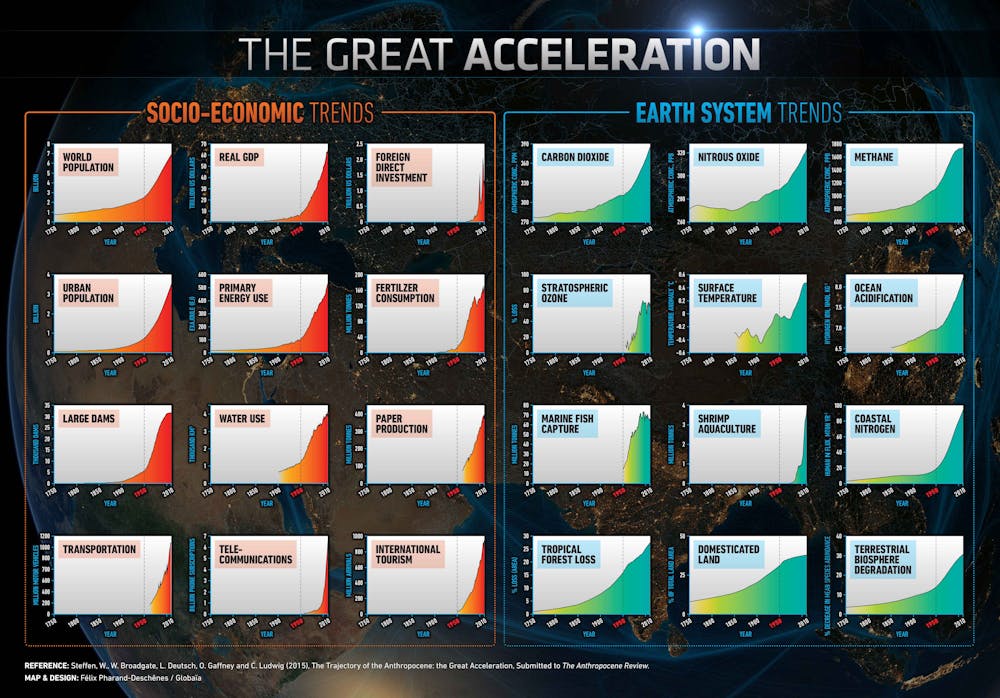
Importantly, the size, scale and power of the technosphere has dramatically grown since World War II. This tremendous increase in the number of humans, their energy and material consumption, food production and environmental impact has been dubbed the Great Acceleration.
The great acceleration of the technosphere. LARGE IMAGE
Felix Pharand-Deschenes Globaia
The tyranny of growth
It seems sensible to assume that the reason products and services are made is so that they can be bought and sold and so the makers can turn a profit. So the drive for innovation – for faster, smaller phones, for example – is driven by being able to make more money by selling more phones. In line with this, the environmental writer George Monbiot argued that the root cause of climate change and other environmental calamities is capitalism and consequently any attempt to reduce greenhouse gas emissions will ultimately fail if we allow capitalism to continue.
But zooming out from the toil of individual manufacturers, and even humanity, allows us to take a fundamentally different perspective, one that transcends critiques of capitalism and other forms of government.
Humans consume. In the first instance, we must eat and drink in order to maintain our metabolism, to stay alive. Beyond that, we need shelter and protection from physical elements.
There are also the things we need to perform our different jobs and activities and to travel to and from our jobs and activities. And beyond that is more discretional consumption: TVs, games consoles, jewellery, fashion.
The purpose of humans in this context is to consume products and services. The more we consume, the more materials will be extracted from the Earth, and the more energy resources consumed, the more factories and infrastructure built. And ultimately, the more the technosphere will grow.
The growth of the economy is based on the growth of consumption.
Roman Mikhailiuk/Shutterstock.com
The emergence and development of capitalism obviously lead to the growth of the technosphere: the application of markets and legal systems allows increased consumption and so growth. But other political systems may serve the same purpose, with varying degrees of success. Recall the industrial output and environmental pollution of the former Soviet Union. In the modern world, all that matters is growth.
The idea that growth is ultimately behind our unsustainable civilisation is not a new concept. Thomas Malthus famously argued there were limits to human population growth, while the Club of Rome’s 1972 book, Limits to Growth, presented simulation results that pointed to a collapse in global civilisation.
Today, alternative narratives to the growth agenda are, perhaps, getting political traction with an All Party Parliamentary Group convening meetings and activities that seriously consider de-growth policies. And curbing growth within environmental limits is central to the idea of a Green New Deal, which is now being discussed seriously in the US, UK, and other nations.
Alexandria Ocasio-Cortez, champion of the US Green New Deal.
Rachael Warriner/Shutterstock.com
If growth is the problem, then we just have to work at that, right? This won’t be easy, as growth is baked into every aspect of politics and economics. But we can at least imagine what a de-growth economy would look like.
My fear, however, is that we will not be able to slow down the growth of the technosphere even if we tried – because we are not actually in control.

Limits to freedom
It may seem nonsense that humans are unable to make important changes to the system they have built. But just how free are we? Rather than being masters of our own destiny, we may be very constrained in how we can act.
Like individual blood cells coursing through capillaries, humans are part of a global-scale system that provides for all their needs and so has led them to rely on it entirely.

Tokyo train commuters travelling to work.

If you jump in your car to get to a particular destination, you can’t travel in a straight line “as the crow flies”. You will use roads that in some instances are older than your car, you, or even your nation. A significant fraction of human effort and endeavour is devoted to maintaining this fabric of the technosphere: fixing roads, railways, and buildings, for example.
In that respect, any change must be incremental because it must use what current and previous generations have built. The channelling of people via road networks seems a trivial way to demonstrate that what happened far in the past can constrain the present, but humanity’s path to decarbonisation isn’t going to be direct. It has to start from here and at least in the beginning use existing routes of development.
This isn’t meant to excuse policymakers for their failure of ambition, or lack of bravery. But it indicates that there may be deeper reasons why carbon emissions are not decreasing even when there appears to be increasingly good news about alternatives to fossil fuels.
Think about it: at the global scale, we have witnessed a phenomenal rate of deployment of solar, wind, and other sources of renewable energy generation. But global greenhouse gas emissions continue to rise. This is because renewables promote growth – they simply represent another method of extracting energy, rather than replacing an existing one.
Renewable energy production has not led to a reduction in fossil fuel use.
Thongsuk Atiwannakul/Shutterstock.com
The relationship between the size of the global economy and carbon emissions is so robust that US physicist Tim Garret has proposed a very simple formula that links the two with startling accuracy. Using this method, an atmospheric scientist can predict the size of the global economy for the past 60 years with tremendous precision.
But correlation does not necessarily mean causation. That there has been a tight link between economic growth and carbon emissions does not mean that has to continue indefinitely. The tantalisingly simple explanation for this link is that the technosphere can be viewed like an engine: one that works to make cars, roads, clothes, and stuff – even people – using available energy.
The technosphere still has access to abundant supplies of high energy density fossil fuels. And so the absolute decoupling of global carbon emissions from economic growth will not happen until they either run out or the technosphere eventually transitions to alternative energy generation. That may be well beyond the danger zone for humans.

A repugnant conclusion
We have just come to appreciate that our impacts on the Earth system are so large that we have possibly ushered in a new geological epoch: the Anthropocene. The Earth’s rocks will bear witness to humans’ impacts long after we disappear. The technosphere can be seen as the engine of the Anthropocene. But that does not mean we are driving it. We may have created this system, but it is not built for our communal benefit. This runs completely counter to how we view our relationship with the Earth system.
Take the planetary boundaries concept, which has generated much interest scientifically, economically, and politically. This idea frames human development as impacting on nine planetary boundaries, including climate change, biodiversity loss, and ocean acidification. If we push past these boundaries, then the Earth system will change in ways that will make human civilisation very difficult, if not impossible, to maintain. The value of, say, the biosphere here is that it provides goods and services to us. This represents what we can literally get from the system.
The planetary boundaries that are intended to help define a safe operating space for humanity.
Steffen, W., et al, 2015. Planetary boundaries: Guiding human development on a changing planet. Science, 347(6223), p.1
This very human-centric approach should lead to more sustainable development. It should constrain growth. But the technological world system we have built is clever at getting around such constraints. It uses the ingenuity of humans to build new technologies – such as geoengineering – to reduce surface temperatures. That would not halt ocean acidification and so would lead to the potential collapse of ocean ecosystems. No matter. The climate constraint would have been avoided and the technosphere could then get to work overcoming any side effects of biodiversity loss. Fish stocks collapse? Shift to farmed fish or intensively grown algae.
As defined so far, there appears nothing to stop the technosphere liquidating most of the Earth’s biosphere to satisfy its growth. Just as long as goods and services are consumed, the technosphere can continue to grow.
And so those who fear the collapse of civilisation or those who have enduring faith in human innovation being able to solve all sustainability challenges may both be wrong.
After all, a much smaller and much richer population of the order of hundreds of millions could consume more than the current population of 7.6 billion or the projected population of nine billion by the middle of this century. While there would be widespread disruption, the technosphere may be able to weather climate change beyond 3°C. It does not care, cannot care, that billions of people would have died.
Fewer people would not necessarily mean a smaller technosphere.
Gunnerchu/Shutterstock.com
And at some point in the future, the technosphere could even function without humans. We worry about robots taking over human’s jobs. Perhaps we should be more concerned with them taking over our role as apex consumers.

Escape plan
The situation, then, may all seem rather hopeless. Whether or not my argument is an accurate representation of our civilisation, there is the risk it produces a self-fulfilling prophecy. Because if we believe we can’t slow down the growth of the technosphere, then why bother?
This goes beyond the question of “what difference could I make?” to “what difference can anyone make?” While flying less, cutting down on eating meat and dairy and cycling to work are all commendable steps to take, they do not constitute living outside the technosphere.
It’s not just that we give tacit consent to the technosphere by using its roads, computers, or intensively farmed food. It’s that by being a productive member of society, by earning and spending, above all by consuming, we further the technosphere’s growth.
Perhaps the way out from fatalism and disaster is an acceptance that humans may not actually be in control of our planet. This would be the vital first step that could lead to a broader outlook that encompasses more than humans.
For example, the mainstream economic attitude about trees, frogs, mountains, and lakes is that these things only have value if they provide something to us. This mindset sets them up as nothing more than resources to exploit and sinks for waste.
What if we thought of them as components or even our companions in the complex Earth system? Questions about sustainable development then become questions about how growth in the technosphere can be accommodated with their concerns, interests, and welfare as well as ours.
This may produce questions that seem absurd. What are the concerns or interests of a mountain? Of a flea? But if we continue to frame the situation in terms of “us against them”, of human well-being trumping everything else in the Earth system, then we may be effectively hacking away the best form of protection against a dangerously rampant technosphere.
And so the most effective guard against climate breakdown may not be technological solutions, but a more fundamental reimagining of what constitutes a good life on this particular planet. We may be critically constrained in our abilities to change and rework the technosphere, but we should be free to envisage alternative futures. So far our response to the challenge of climate change exposes a fundamental failure of our collective imagination.
We must start to see ourselves as a small part of a planetary natural system.
Ethan Daniels/Shutterstock.com
To understand you are in a prison, you must first be able to see the bars. That this prison was created by humans over many generations doesn’t change the conclusion that we are currently tightly bound up within a system that could, if we do not act, lead to the impoverishment, and even death of billions of people.
Eight years ago, I woke up to the real possibility that humanity is facing disaster. I can still smell that bad coffee, I can still recall the memory of scrabbling to make sense of the words I was hearing. Embracing the reality of the technosphere doesn’t mean giving up, of meekly returning to our cells. It means grabbing a vital new piece of the map and planning our escape.

Links

NSW Towns Including Dubbo And Tamworth Face Water Emergency Within Months

The Guardian - 

In some central and western areas on Murray-Darling no ground water can be accessed by bores, as dams run close to dry
NSW water authorities are carrying out emergency planning, as dams, including those servicing the towns of Menindee, Dubbo, Nyngan, Cobar and Tamworth run critically low. Photograph: Mike Bowers/The Guardian 
Towns in western and central New South Wales, including Dubbo, Nyngan, Cobar, Walgett and Tamworth, are facing a crisis in their water supplies within a few months unless it rains, prompting emergency planning by water authorities.
And on properties throughout the Murray-Darling basin, irrigators are bracing for their water entitlements to be reduced to around 10% of their usual allocations, which will severely constrain agricultural production.
A week before the election, the Murray–Darling Basin Authority issued a “sobering assessment” of the outlook for the Murray Darling river system in the communique from its monthly meeting.
“Since July 2018, inflows to the River Murray System have remained in the driest 7% of records, the head of River Management,” the executive director, Andrew Reynolds, told the board.
In other words, in the 114 years of record-keeping, this result is among the nine or 10 driest years. And it’s getting worse.
This will ignite new political challenges for the re-elected Morrison government, both in the bush and among city voters who, thanks to the mass fish kills at Menindee Lakes, have become aware that all is not well with the $13bn plan.
The NSW government this week sent a team to 13 of the state’s towns to discuss what to do about their water supplies and to assess the impact on businesses of what is unfolding as a prolonged and severe drought.
For some towns the crisis will hit within one to three months, depending on whether there is any rainfall. For others it will be little longer.
The Burrendong Dam which services towns like Dubbo, Cobar and Nyngan on the Macquarie river, is at 5.9% and even with stringent water restrictions, will be empty within 12 months on current trajectory. The problem is there is no ground water that can be accessed by bores, so authorities are exploring the option of building emergency pipelines.


In Tamworth, there might be water for the town from the Peel river, but if it stops flowing, the chicken-processing plant downstream has just three to four days of water in storage and will need to close.
Ditto the copper mining operation at Cobar.
In the Northern basin of the Murray Darling, irrigators can expect to get zero allocations for low-security water entitlements and around 10% of their high-security water holdings.
The allocations for the next water year will be announced on 1 July, though they can be upgraded if it rains.
But the authorities are worried.
Reynolds told the Guardian the MDBA was now planning towards a dry scenario for managing the river system though 2019/20.
Rainfall in the northern part of the Murray Darling basin typically comes between September and November, he said. But at this stage, there are ominous signs it will stay dry and this follows an extremely dry 12 months.
Department of Primary Industries workers install aerators in the Darling River around Menindee in January to try and avoid another mass fish kill. Photograph: The Guardian
The Bureau of Meteorology said its indicators “have been close to El Niño thresholds over the past several months” – signalling a prolonged dry weather pattern – but “signs have emerged of a weakening of these patterns”.
“As a result, the outlook has has been downgraded to “El Niño WATCH. This means the chance of El Niño developing in 2019 is approximately 50%, which is still double the normal likelihood,” the BOM said.
With little rainfall and very dry soils, almost no water is reaching the river system, and inland dams are falling. Unless spring rains fall, the Murray Darling basin will be in the grip of a crisis.
Allocations are a state function and are continually reviewed
Andrew Reynolds
The cotton industry in the north of New South Wales and southern Queensland is likely to plant about a quarter of the crop it planted in 2017 and will rely on ground water to survive, said the general manager of Cotton Australia, Michael Murray.
In the south, there is a real prospect of a crisis along the Murray as irrigators struggle to get the allocations they need to water permanent crops such as almonds, citrus and grapes.
The dam system in the Murray Darling overall is at 28% with just 6,385GL in storage. But this figure masks the problem. More than a third of the water is in the Dartmouth dam in north-east Victoria, which is currently 64% full.
Sheep stuck in the outfall channel at Lake Cawndilla near Menindee NSW. Photograph: Mike Bowers/The Guardian
On the Darling, many dams are effectively empty, such as the Keepit dam on the Namoi, with just 0.9%, the Burrendong dam on the Macquarie river at 6% and the Menindee Lakes at just 1.1%.
It means that if the prolonged dry continues, many towns will face the same sort of crisis as Walgett, which ran out of water last summer and was forced to truck in water or rely on bore water with high salinity levels.
Reynolds said the water available will be allocated to critical human water needs and stock watering first, followed by high security water entitlements, then lower security water.
“Allocations are a state function and are continually reviewed,” he said.
But he said lower security holders were likely to get zero allocations and high security will be low allocations or even zero.
For irrigators, the current scenario is for almost no water to be available from the Darling and limited water from the Murray. South Australia has warned that high security allocations could be as low as 14% of usual volume.
The MDBA was also briefed on the priorities for water for the environment during 2019/20.
During last summer, there were calls from both state and federal politicians for environmental water to be made available for agriculture, despite the legislation preventing sales of commonwealth environmental water except in very limited circumstances.
But there will be almost no water available for environmental flows, as environmental water allocations will be reduced in the same proportion as other water holders.
More mass fish kills will probably occur as the weather warms.The MDBA made note of “the critically important role of environmental water during drought”.
“This water can be used to preserve important habitats and refuges for the animals, plants and birds of the Basin. The priorities will be publicly released by the MDBA in the coming months,” it said.
It is likely that the agriculture and water minister, David Littleproud, a National party MP from Queensland, will keep the challenging portfolio. He has already signalled he will look at measures to improve transparency and the administration of the plan, as recommended by the Productivity Commission.

Links

Lethal Heating is a citizens' initiative