05/06/2019

Climate Change Doomsday Report Predicts End Of Human Civilisation

NEWS.com.au - Mike Cook

According to climate change scientists, we may only have 30 more years before complete environmental catastrophe.

Climate change doesn't seem complicated. Why is it such a divisive issue?

In the past week, the world has experienced chaotic weather phenomena, from deathly Indian heatwaves to snow inundating parts of Queensland. Now, the Breakthrough National Centre for Climate Change has issued a report predicting the end of human civilisation as we know it.
The report, terrifyingly entitled Existential climate-related security risk, glimpses 30 years into the future to the year 2050 — and the results are grim.
Authors David Spratt, a researcher into climate change, and Ian Dunlop, former chairman of the Australian Coal Association and chair of the Australian Greenhouse Office Experts Group on Emissions Trading, propose a scenario in which global emissions and climate threats are ignored, and the trajectory of environmental collapse goes unchecked.
Their conclusions spell out a dire warning.
Rising temperatures could result in the collapse of Arctic ecosystems. Source: istock
Using climate data, Spratt and Dunlop claim the Earth can expect at least a 3C rise in temperatures, which would trigger global decay and destruction of crucial ecosystems, including the Arctic, Amazon rainforests and coral reefs.
“More than a billion people may need to be relocated, and in high-end scenarios, the scale of destruction is beyond our capacity to model, with a high likelihood of human civilisation coming to an end,” Spratt and Dunlop warn.
By 2050, total ecological collapse would give way to massive social consequences ranging from “increased religious fervour to outright chaos”.
The report suggests the catastrophic chain of environmental disasters will climax with widespread pandemics, forced migration from inhabitable locations and a likely nuclear war due to skirmishing for limited resources.
“Planetary and human systems (reach) a ‘point of no return’ by mid-century in which the prospect of a largely uninhabitable Earth leads to the breakdown of nations and the international order,” the report predicts.
Spratt and Dunlop sum up our disastrous fate with a harrowing thought: “Climate change now represents a near-to-mid-term existential threat to human civilisation.”
If the current trajectory of climate change goes unchecked, humankind may face extinction in under a century. Source: AFP
The 2050 scenario analysis was heavily supported by former chief of the Australian Defence Force and Deputy Chief of the Australian Navy, Chris Barrie, who now works for the Climate Change Institute in Canberra. In the report’s foreword, Mr Barrie praised the research for expounding the threats to humankind.
“David Spratt and Ian Dunlop have laid bare the unvarnished truth about the desperate situation humans, and our planet, are in, painting a disturbing picture of the real possibility that human life on Earth may be on the way to extinction in the most horrible way,” Barrie writes.
The report goes on to analyse each decade, predicting humankind’s downfall on the way to an apocalyptic future.
According to the report, by 2030, policymakers will have failed to act in time to prevent growing greenhouse gas emissions. The current Paris Agreement path indicates failure to build a zero-emission economy that begins accelerated global warming to unprecedented temperatures.
By 2050, sea levels will have risen by 0.5 metres, and 55 per cent of the global population will be subjected to lethal heat conditions for more than 20 days each year. Weather extremes will amplify, including increases in wildfires, heatwaves, drought and the aridification of “more than 30 per cent of the world’s land surface”.
The reality could, however, be catastrophically worse; Spratt and Dunlop suggest the 2050 scenario is “far from an extreme scenario”.
The climate change report claims almost one third of the world could become an arid wasteland. Source: istock
The report comes as Greens Senator Sarah Hanson-Young heavily criticised Australia’s environment laws as “not fit for purpose”.
In an interview with ABC’s Radio National, Ms Hanson-Young highlighted the importance of circumventing international trade that caused environmental detriment.
“We know that a big part of what Australia is facing is a global problem,” she said. “We can’t deal with the escalation of climate change if we don’t stop making things worse.”
The Greens senator claimed Australian exports, if left unchecked, exacerbated current negative environmental conditions.
“The pollution in the atmosphere doesn’t stop at Australia’s borders. If we export this stuff overseas it’s going to make climate change worse,” she said.
Greens Senator Sarah Hanson-Young slams current environment laws. Source: Getty Images
To combat the rising threat of climate change, the Greens want to amend current legislation to include a “climate trigger”. The change to environmental laws would ensure proposed projects, including those concerning exported resources, would undergo a pollution assessment.
Ms Hanson-Young says this “should” also halt development of any new coal mine projects.
“We’ve got these federal environment laws but they’re so out of date and not fit for purpose that at the moment they don’t even consider the impact of carbon pollution,” she said.
The Greens senator is also pressuring the Federal Government to release emissions data, claiming the undisclosed information may prove pollution from Australia has continued to rise.

Links

ABC Says It Didn't Reject Adani Story Because Of Company Pressure

The Guardian

Radio story looking at economics of the Adani mine was killed off after call to news director, but ABC says it didn’t fit line-up
The ABC has denied that it blocked a story on Adani after a call from the company. Photograph: Tracey Nearmy/AAP 
The ABC says it did not broadcast a story about Adani for sound editorial reasons and not because the company spokeswoman telephoned its news director Gaven Morris.
Guardian Australia asked the ABC why a story by radio current affairs reporter Isobel Roe had not been broadcast and if it had anything to do with a direct call made by Adani spokeswoman Kate Campbell to Morris.
“There was no complaint,” an ABC spokeswoman told Guardian Australia.
“The only communication we received from Adani was a request for more time to respond to our questions. In light of the need to provide parties with a fair opportunity to respond and the strength of the other stories in the mix for Saturday AM, the decision was taken at an editorial level to not proceed with the story.”
ABC sources said Roe was preparing a report for Saturday AM on Friday 24 May which looked at the economics of Adani’s Carmichael mine.
But after calling Campbell for a response, the spokeswoman called Morris directly. Roe was later told by her managers not to proceed with her report.

The story Roe was following up was by Bloomberg reporter David Fickling, who argued in a series of tweets that the economics of the Carmichael mine “don’t stack up”. Fickling later had a piece published in the Australian Financial Review on the subject.
“Adjusting that for the cost of transporting the coal to port on third-party networks comes to about $US50 a ton of operating costs, or $US500 million for the whole project, enough to leave $US160m of gross profit,” Fickling wrote.

Several sources in the ABC raise concerns that the broadcaster
is being intimidated by mining company Adani

Aunty bows to Adani
Media Watch transcript

The heavy-handed tactics by Adani follow revelations in Guardian Australia the company lodged several Freedom of Information requests about ABC reporters who had covered Adani projects.
ABC investigative reporters Mark Willacy and Michael Slezak were asked for documents relating to news reports on allegations Adani was illegally drilling bore holes.
These requests were made by Adani lawyers AJ & Co, and follow revelations they planned to confront Adani critics including activists and journalists by acting like “a well-trained police dog”.
Most of the FOI requests were denied and the only documents that were released were Willacy and Slezak’s travel and accomodation costs and some heavily redacted phone logs.
The ABC’s Media Watch also investigated the spiking of Roe’s story and spoke to staff who overheard conversations about it in the ABC’s Sydney newsroom.
“Sorry. It’s nothing to do with you, but we’re not going to be able to run this,” was one conversation reported by Media Watch on Monday night.
“It’s not my decision, it’s come from on high,” was a second conversation reported by the program.
Despite the ABC’s claim there was “no complaint” Media Watch says Adani told them they did complain about Roe’s story before it was broadcast.
“… we raised concerns with ABC management when approached to comment on a story that contained inaccuracies and was potentially biased,” an Adani spokesperson told the ABC.
Media Watch host Paul Barry said the spiking of the story “sends a terrible message to ABC journalists trying to do their job and also to ABC viewers who trust the ABC to give frank and fearless coverage of matters of public importance”.

Links

Will Climate Change Cause Humans To Go Extinct?

The Conversation

Alas, poor all of us. Shutterstock.
I see a lot of resources talking about near-term human extinction, or the fact that thanks to climate change my generation will see the end of humanity. How likely is an outcome like this? Is there any hope for our futures?
Anonymous, aged 18. London, UK.
The claim that humanity only has just over a decade left due to climate change is based on a misunderstanding.
In 2018, a fairly difficult-to-read report by the Intergovernmental Panel on Climate Change (IPCC) warned that humanity needs to cut its carbon dioxide (CO₂) emissions in half by 2030, to avoid global warming of 1.5°C above the levels seen before the industrial revolution.
What this actually means is roughly, “We have about 12 years before fixing climate change becomes really expensive and tough.”
Humanity can still live in a world with climate change – it’s just going to be more work, and many lives and livelihoods are likely to be threatened.
But it’s complicated, because this century we are facing many problems at the same time, and we are more dependent on each other than ever.

Under pressure
To get our food, most of us humans depend on global transport, payment and logistics systems. These, in turn, require fuel, electricity, communications and a lot of other things to work properly.
All these systems are connected to each other, so if one starts crashing, the chaos may cause other systems to crash, and before we know it we’ll have massive shortages and conflicts.
It’s hard to calculate the exact risk of this happening, since it has never happened before.
Until recently, the world was split into separate regions that were largely independent of each other.
But we do know that climate change puts the whole world under pressure – everywhere, at the same time – making the risk of these systems collapsing more serious.
For example, it’s easier for businesses to handle cybersecurity and energy supply when they don’t also have to cope with natural hazards.
 Likewise, it’s difficult for governments to maintain infrastructure when politicians are busy dealing with the public’s reactions to food prices, refugees and ecological crises.

Building resilience
Geoengineering to reduce the impact of climate change – for example, by reducing CO₂ levels or pumping reflective particles into the Earth’s atmosphere to deflect the sun’s rays – might work. But if disaster strikes and those operations stop, the effects of climate change can return quickly.
The reasonable thing to do is to work on making our systems more resilient – and there are plenty of opportunities to do this.
In practice, this means more local energy production, better backup systems, work on reducing climate change, and being more willing to pay extra for safety.

Asteroids? Ideally not. Shutterstock.
Disasters and diseases
So what about the other threats humanity is facing? Though natural hazards such as earthquakes, tsunamis, volcanoes and hurricanes can be disastrous, they pose a comparatively small threat to the survival of the human race.
Hazards big enough to cause entire species to go extinct are relatively rare.
 The typical mammalian species survives for about a million years, so the risk is roughly one in a million per year.
Asteroid impacts and supervolcanos do happen, but they are rare enough that we do not have to worry about them.
Even so, planning for the day when we need to deflect an asteroid or make do without agriculture for a decade is a smart move.
Pandemics are worse. We know the 1918 flu killed tens of millions of people worldwide. New influenza viruses are popping up all the time, and we should expect to see a big pandemic at least once every 100 years.
Over the past century, we have become better at medicine (which lowers the risk from disease) but we also travel more (which increases the spread of diseases).
Natural pandemics are unlikely to wipe out the human race, since there is almost always somebody who is immune. But a bad pandemic might still wreck our global society.

Technology attacks
Bioweapons, which use bacteria, viruses or fungi to harm humans or agriculture, are another issue. Fortunately, they have rarely been used in war, but they might become more dangerous in the near future because advances in biotechnology are making it easier and cheaper to modify organisms and automate lab work.
As this technology becomes more accessible, there’s a growing risk it could be used as a “doomsday device” by nasty regimes, to deter other states from seeking to topple them.
 Right now, the risk is smallish, but it will surely become larger if we do not figure out better ways to detect pathogens early on, keep an eye on risky biotechnology and do diligent diplomacy to keep governments sane.
Perhaps the biggest risk to humanity right now is nuclear weapons.
I would personally guess the risk of a nuclear war (not necessarily world-ending but still horrifying) to be somewhere between one in 100 and one in 1,000 per year. This risk goes up or down, depending on tensions between countries and the competence of the people handling early warning systems.
At the Future of Humanity Institute at the University of Oxford, we do a lot of work on Artificial Intelligence (AI). As with biotechnology, the risk right now is pretty minimal, but it might grow in time as AI become better and smarter, and we think it’s better to be safe than sorry.
Developing tools to ensure AI stays safe and operates in a way that benefits humanity could save money in the long run, and it’s unlikely to make things worse. Again, the probability of an AI disaster is fairly undefined, since it changes depending on how well we prepare for it.
I can’t give a probability of a world-ending disaster that isn’t more or less guesswork.
But I do think there’s a big enough risk of such a disaster in our lifetimes that we should work hard to fix the world – whether by making sure governments and AI stay safe and sane, replacing fossil fuels, building backup systems and plans, decentralising key systems and so on.
These things are worthwhile, even if the risk is one in a million: the world is precious, and the future we are risking is vast.

Links

04/06/2019

Environment Leaders Reflect On Their Role In The 'Climate Election'

ABC NewsMichael Slezak

Many environmentalists believe the Stop Adani campaign was an own-goal for the green movement. (AAP: Rohan Thomson)
Like many Australians, green groups were surprised by the federal election result.
The Climate Council, Greenpeace, the Australian Conservation Foundation and the Wilderness Society all invested significant resources in the weeks leading up to the May 18 poll.
Underlying much of their campaigning was the belief that the majority of voters wanted stronger climate action.
But the results did not seem to bear that out.
Did environmental groups fail to read public sentiment? And did they, in fact, help the Coalition to victory?

'Lecturing people in the community'
Former Greens leader Bob Brown led the now-infamous Stop Adani Convoy from Hobart, through Melbourne and Sydney, right into Central Queensland.
It was the epitome of what some describe as trying to "drive change from out of town".
One of Australia's leading social researchers, Rebecca Huntley, said the Stop Adani Convoy strategy was bound to fail.
"People from outside the area coming in — that just pisses people off," said Dr Huntley, who heads up Vox Populi Research.
"Lecturing people in the community, I don't think it's ever going to work."
Paul Williams is a senior lecturer in politics at Griffith University in Queensland and is one of the country's foremost experts on elections in that state.
He said the Stop Adani Convoy probably cost Labor at least "tens of thousands of votes" in Queensland, if not "hundreds of thousands".
"That doesn't mean the Queenslanders are in love with Adani — they're not," said Dr Williams.
"Adani became totemic — it was a totem for development and for blue-collar job creation."
Verity Morgan-Schmidt is opposed to Adani's Carmichael mine.

Explainer: What we know about
Adani's Carmichael coal mine
The chief of Farmers for Climate Action grew up farming in Western Australia and now spends her time campaigning and organising all around the country, including in rural Queensland.
But she agreed the convoy was counterproductive.
"I think the polls would reflect how successful that strategy was," she said. "It's very hard to drive change from out of town."
Many in the Coalition have also credited the Stop Adani Convoy for helping them win seats in Queensland.
Dr Brown remained confident the strategy was the right one.
Ms Morgan-Schmidt said the strength of any social movement "comes from within and from being part of that community".
"We need to really talk and connect with people where they are," she said.
Kelly O'Shanassy, chief of the Australian Conservation Foundation, agreed one lesson from the election was that environmental groups needed to do more local organising.
"I think that change — when you're talking about change in a specific community — needs to be done within that community," said Ms O'Shanassy.
The Climate Council's Amanda McKenzie said the Stop Adani Convoy was a mistake, and her movement needed to convince people that their community could benefit from the change they were calling for.
"We are advocating for substantive changes across the economy in all sectors. So you need to do a lot of work in bringing people along," she said.
Ms O'Shanassy said environmental groups needed to do more local organising. (Supplied: Australian Conservation Foundation)
Green movement criticising Labor policy
Throughout the campaign, Labor walked an uncomfortable line on Adani. It tried not to openly support its proposed coal mine but also insisted it would not stand in its way.
But on many other issues, the environmental movement did not entirely embrace Labor's plans either.
Less than two weeks from polling day, Labor announced a radical plan to establish a new Environmental Protection Authority and rewrite federal environment laws.
These were in addition to its detailed climate policies and targets the party had already released, as well as the country's first federal land-clearing laws.
The reaction was mixed, with Greenpeace the least enthusiastic.
"While Scott Morrison and Bill Shorten lock horns over their policies, both are failing to address the climate emergency with credible plans," said the environmental group's media release on May 4.
This division was further exacerbated when Labor announced plans to subsidise the expansion of the gas industry in Queensland and the Northern Territory.
The move dismayed most in the environmental movement and led to a spray of media releases and news stories about the greenhouse gas emissions that expansion would inevitably create.
Dr Williams said Labor was trying to have it both ways on some environmental issues, and that meant they lost votes in regional Queensland without picking up as many as they could have in Brisbane, Melbourne and Sydney.
Chief of Greenpeace Australia David Ritter said if Labor had strengthened its environmental policies, the environmental movement would have been fully behind the party — a sentiment more-or-less echoed by all the environmental groups the ABC spoke to.
"I think it was open for the Labor Party to be more ambitious," said Mr Ritter.
"That would have enabled even greater energy from the community to get behind their campaign."
Mr Ritter said that like everyone involved in campaigning, their strategy was informed by the available data — and they thought Labor would win.
In that context, he said they figured it was important to strongly criticise the Coalition's policy, "and similarly to seek to encourage the Labor Party to have a more ambitious climate policy".
A sign outside a pub in Clermont. (ABC News: Rachel McGhee)
'Letting the perfect get in the way of the good'
There are those who believe the environmental movement did little to help the ALP's chances.
The ABC has been told senior figures within the party are angry at what they see as campaigning against Labor.
Although Ms McKenzie said the primary responsibility for success or failure lay with the parties themselves, she did lay some blame with environmental groups for expecting a party to be "perfect".
According to her, part of the environmental movement was so focused on Adani that it did not swing behind Labor, even though it was accepted by the movement as the better choice.
"We do need to push Labor on Adani. But also, where there is effective climate policy — and Labor did bring a strong domestic climate change platform — the environment movement could have done more to communicate that to its base."
Ms McKenzie alluded to the history of the Australian climate wars, where relatively ambitious policies — like Kevin Rudd's first emissions trading scheme — were scuttled by the Greens because they were not considered ambitious.
"I think that's the big lesson for the environmental movement is, as we've learned before: letting the perfect get in the way of the good."

Trusting politicians to deliver
But the environmental movement does not accept its actions were a major reason for Labor's loss.
Most people the ABC spoke to pointed to the money spent by coal miner Clive Palmer, utter distrust of mainstream politics and what they described as scare campaigns run by the Coalition.
Wilderness Society campaign director Lyndon Schneiders said trust was a big problem for parties promising anything ambitious, and that would always be an issue when it came to tackling climate change.
Dr Huntley agreed this was a problem for any party proposing something with an upfront cost, and environmental policy was a classic example of that.
"They don't necessarily think that our politicians are very good at thinking long term," she said.
Even if they did think long term, voters did not trust politicians to deliver, Dr Huntley said.
"You're going to get me to pay for this thing now, that you say you're going to do in the future? But you're so bad at even keeping the promises today!"
Mr Ritter said the environmental movement would have gotten fully behind Labor if they had better policies. (Supplied: Greenpeace)
But Dr Huntley and Dr Williams believe the election was not won or lost on the environment, as other immediate issues like tax reform appeared to be more important in people's minds.
Incoming Environment Minister Sussan Ley said she acknowledged Australians held strong views on caring for the environment, both locally and globally.
"I look forward to listening to the variety of perspectives and ideas that will be put forward, as well as implementing our Government's strong range of policy initiatives in this portfolio," she said.
The new Minister for Energy and Emissions Reduction, Angus Taylor, said the Government had a clear mandate for its climate policies.
"Our national target is achievable, balanced and responsible, and is part of coordinated global action to deliver a healthy environment for future generations, without wrecking our economy."

Some environmentalists still think they got it right
Some in the environmental movement are already working on local organisation and how to embrace policies they find less than perfect.
Despite this, there are some who would not change how they approached the pre-election campaigning.
According to Mr Schneiders, it just was not the right time for change — no matter what the opinion polls seemed to suggest before the election.
For him, the answer is to keep on the same track.
"People get too wrapped up in the tactics of this game, you know? And they play the politics too hard," he said.
"There is a problem and it needs a solution. But all we can do is articulate the problem and provide the solution. If we do that long enough, the community … will respond."
Ms McKenzie recalled her first major sense of defeat — the collapse of talks at the UN's conference on climate change in Copenhagen in 2009.
"After Copenhagen, basically everyone, all activists across the world, gave up and went on holiday."
She said that left a vacuum for those fighting to stall action on climate change to fill.
So Ms McKenzie said she was focusing on what she saw as a positive.
"I think there is a sense that climate change is a bigger issue than it was before.
"I think that the core message of hope from the election is that climate change was a central issue. It hasn't been a central issue to the election since 2007."

Links

Explaining Adani: Why Would A Billionaire Persist With A Mine That Will Probably Lose Money?

The Conversation

The road to Adani. There are more hurdles to overcome, and Gautam Adani might have to put up his own money. AAP
By mid-June, if everything goes as expected, Adani Australia will receive the final environmental approvals for its proposed Carmichael coal mine and rail line development.
Newspaper reports based on briefings from Adani suggest that, once the approvals are in place, the company could begin digging “within days”.
On Friday the Queensland government approved Adani’s plan to protect a rare bird, apparently leaving it with just final regulatory hurdle: approval for its plan to manage groundwater.
Its billboards in Brisbane read: “We can start tomorrow if we get the nod today”.
But several big obstacles remain. Even after governments are out of the way, it will have to deal with markets and companies that aren’t keen on the project.

Obstacles aplenty
First up, there’s the problem of access to Aurizon’s rail line. Adani originally planned to build its own 388km railway from the Galilee Basin to its coal terminal at Abbot Point.
However, in the scaled-down version of the project announced last year, Adani plans to build only 200km of track, before connecting to the existing Goonyella line owned by the rail freight company Aurizon.
That requires an agreement of access pricing and conditions. Aurizon is legally obliged to negotiate with Adani, but has shown itself to be in no hurry to reach a deal.
Then there’s insurance. Faced with rejection by every major bank in the world, Adani announced it would fund the project from its own resources. But now insurers, including nearly all the big European firms and Australia’s own QBE, are saying the same sort of thing as the financiers.
Without insurance the project can’t proceed, and the pool of potential insurers is shrinking all the time.

Not particularly financial


Adani Group founder Gautam Adani. Wikimedia, CC BY
But the most fundamental problem may lie within the Adani group itself. The A$2 billion required from the project will ultimately come, in large measure, from chairman Gautam Adani’s own pocket.
With an estimated wealth of A$7 billion, he can certainly afford to pay if he chooses to. But it would represent a huge bet on the long-term future of coal-fired electricity, at very bad odds.
In my analysis of the original Carmichael mine proposal in 2017 I concluded that the profit from operating the coal mine would be around A$15 per tonne.
A recent analysis of the revised project by David Fickling for Bloomberg yielded a marginally more favorable estimate of US$16 per tonne, or US$160 million a year for the initial output of 10 million tonnes a year.
That’s an 8% rate of return on $US2 billion, before considering overheads and depreciation.

It’d need a long life…
Such an investment could only be profitable on the basis of a mine with a long life and substantial potential for future expansion. How likely is that? When the start of construction was re-announced last November, it was suggested the coal might be shipped by 2021. With six months’ delay, and the insurance problem noted already, 2022 seems like the earliest possible date.
But by that time, the current construction pipeline for coal-fired plants in India will have been worked through, and very few new ones will be being commissioned. A mere 8 gigawatts of new coal-fired power was commissioned in 2017-18, partly offset by 3.6GW of coal-fired power stations that closed down.
The Indian government has stated that no new coal plants will be needed after 2022, or 2027 at the latest.

…which it might not get
In these circumstances, newly opened coal mines will be able to sell coal only if they can displace existing suppliers. This suggests prices will have to fall to a level sufficient to ensure further closures of existing mines. Such a fall would erode or eliminate Adani’s already thin margins.
By 2030, with the project still in its relatively early stages, most developed countries will have stopped using coal-fired power. The others will be moving fast in that direction. So far under President Trump, the United States has closed 50 coal-fired power stations, and will almost certainly never build another.
The only glimmer of hope for coal has been in less developed countries in Asia. But over the course of this year, even these hopes have dimmed. Major banks in Japan and Singapore have withdrawn from funding new coal projects, following the lead of the global banks based in Europe and the US.
That leaves South Korea and China as potential sources of funding. Korea is already phasing out coal-fired power domestically and its banks are being pressured to divest globally. The option of relying solely on China is problematic to say the least.
To sum up, unless current trends change dramatically, the economic life of the Carmichael mine is unlikely to be more than a decade – nowhere near enough to recover a A$2 billion investment.

Explaining Adani
So what could be going on? Perhaps Gautam Adani is willing to lose a large share of his wealth simply to show he can’t be pushed around. Alternatively, as on numerous previous occasions, his promises of an imminent start to work may prove to be baseless.
The third, and most worrying, possibility is that the political pressure to deliver the promised Adani jobs will lead to a large infusion of public money, all of which will be lost.
The A$900 million Adani sought from the Northern Australia Infrastructure Facility in 2017 would be enough to keep the project going for a couple of years, without the need for Mr Adani to risk his own money. It now appears that a similar sum might be sought from the Export Finance and Insurance Corporation.
All this is speculation. Assuming the approvals come through by the Queensland premier’s self-imposed deadline of June 13, we will find out soon enough whether something happens, or whether something else will stay in the way.

Links

Time To Flick Climate Emergency Switch: A Plea To Our New Parliament

Sydney Morning Herald - Ian Dunlop*

A year ago, there was little discussion of climate change as an existential threat, or the corresponding need for emergency action.
Today, in the face of rapidly accelerating climate impacts, “existential threat” and “climate emergency” are common currency globally, existential meaning the potential to destroy humanity as we know it.
Organisations representing 66 million people in 13 countries have adopted formal climate emergency resolutions.
A coal reckoning? Yallourn Power Station in the Latrobe Valley, Victoria. Credit: AAP
But Australia still has its head in the sand. We are among the most exposed to this threat, yet we return a government that has been incapable of delivering any credible climate or energy policy.As international climate impact specialist Stefan Ramstorf tweeted: "A country so vulnerable to drought and wildfire, to floods and tropical storms and sheer heat, voting for coal: that’s turkeys voting for Christmas."
In the new Morrison ministry, climate does not rate a mention, but henceforth it will dominate our lives. Industry continues to demand policy clarity, built around the fourth-rate compromise of the so-called National Energy Guarantee.
Energy Minister Angus Taylor is not even prepared to contemplate even that. Resources Minister Matt Canavan demands new coal-fired power and coal mines in the Galilee Basin. And the ALP shows every sign of walking away from its more ambitious, but still inadequate, climate policy.
Yet the newly elected members of this Parliament will, in time, be held accountable for their actions on climate – or their failure to act. As it stands, they will fail catastrophically in their duty of care to citizens, even as the Prime Minister commits his ministry to act in the interests of all Australians. Here, for the benefit of MPs, is a summary of the emergency that confronts them:
  • The 2015 Paris Climate Agreement is far from adequate.
    Its emission-reduction commitments, if implemented, would lead to a temperature increase of 3.5C by 2100 – described by global security experts at the US Centre for Strategic and International Studies as “outright social chaos”.
    We are currently on track for a 4.5C increase, a world “incompatible with any organised society”, according to a Royal Society paper, resulting in a substantial reduction in global population before 2100.
  • Dangerous climate change is already occurring at the 1C rise experienced so far.
    The 2C upper Paris limit is the boundary of extremely dangerous climate change.
  • To stay below 2C, global emissions must peak now and be rapidly reduced.
    The lower 1.5C Paris target requires even more rapid reduction. Instead, emissions are rising in line with worst-case scenarios.
  • The planet has only a 50 to 66 per cent chance of meeting these targets, the International Panel on Climate Change analysis assumes.
    Not good odds for the future of humanity.To have a sensible 90 per cent chance, there is no carbon budget left today to stay below 2C, let alone 1.5C. Thus all fossil fuel consumption should stop immediately. Obviously that is not going to happen, but new investment must stop now, and the existing industry should be wound down.
  • Emissions from continued fossil fuel investment lock in irreversible outcomes.
    By the time their impact becomes clear, it will be too late to take avoiding action.
  • Atmospheric aerosols produced by burning coal and oil are cooling the planet by about 0.5C.
    As aerosol concentrations reduce with the phase-out of fossil fuels, a commensurate one-off increase in temperature is likely, compounding the problem of staying below warming limits.
Proposed solutions to meet the emission targets rely heavily on carbon removal from the atmosphere using technology that does not exist today at sufficient scale. This creates a false and dangerous sense of security.
Three decades of dangerous delays mean it is now impossible to limit temperature increases to 1.5C, and probably to 2C, unless global leaders commit to emergency action. Australia is not exempt.
But there has been minimal discussion of what emergency action actually means.
Nation states will soon come to realise that it means action akin to wartime.  Business as usual must be suspended – politically, socially and corporately. It requires an all-encompassing commitment to reduce emissions and address the threat.
It will require a new modus operandi that dispenses with conventional right and left politics. The best leaders – not necessarily politicians – will need to be convened in a governance structure that  may resemble a government of national unity, supported by the best scientific, technical, economic, financial and social expertise.
This is way beyond anything yet contemplated in international negotiations, or in national policies,  but it is the inevitable outcome of the evolving climate threat.
The Parliament we have just elected needs to understand the emergency, and to address it. And yet it cannot even agree on the beginnings of an energy policy.

*Ian Dunlop is a former oil, gas and coal industry executive. He was chairman of the Australian Coal Association and CEO of the Australian Institute of Company Directors. He is co-author of the report What Lies Beneath: the understatement of existential climate risk, published by the Breakthrough Centre for Climate Restoration, and a member of the Club of Rome’s Climate Emergency Plan.

Links

03/06/2019

Climate Change: Australia's Election Has Far-Reaching Consequences

ForbesJames Ellsmoor

Scott Morrison, then Treasurer, brings a lump of coal to Parliament during question time, where he defended coal as a power source of the future, February 2017. Andrew Meares
Australia’s national anthem reflects upon the nation’s environmental wealth:
Our home is girt by sea,
Our land abounds in nature's gifts,
Of beauty, rich and rare.
However, despite boasting an incredibly biodiverse environment and having the world’s largest biogenic structure in the Great Barrier Reef defining the nation’s north-eastern coast, Australia is an environmental paradox.
Australia’s recent federal election was touted as the “climate change election” with many seeing it as a potential turning point that could change the nation’s environmental policies for the better.
In a surprising twist, Prime Minister Scott Morrison and his conservative coalition were re-elected. But how does this affect anyone outside of Australia, and what effects could it have on the environment?

Environmental Context
The Paris Agreement is an agreement within the United Nations Framework Convention on Climate Change (UNFCCC), dealing with greenhouse-gas-emissions mitigation, adaptation, and finance, adopted by consensus at the COP 21 conference in 2015. At its core, the Agreement outlined how nations would collaborate to reduce carbon emissions with the aim of keeping global warming below 2°C.
Data from the Intergovernmental Panel on Climate Change (IPCC) provided the scientific background for the Paris Agreement and was integral in helping form policy decisions to reduce carbon emissions. 196 nations took part in deliberations and as of May 2019, 195 are signatories. Each country committed to various changes in policy that would lead to emissions reduction and therefore help mitigate the damages from the upcoming climate crisis.
As part of its COP21 commitments, the Australian government pledged to reduce their carbon emissions by 26%-28% on 2005 levels by 2030 as well as invest in renewable technology. Although some experts believed the target to be low, pointing towards evidence that Australia could reach a 45% reduction, there was hope that Australia would become a leader in the fight against climate change. However, as watchdogs have pointed out, the country’s emissions have continued to rise with little to no change in their policies.
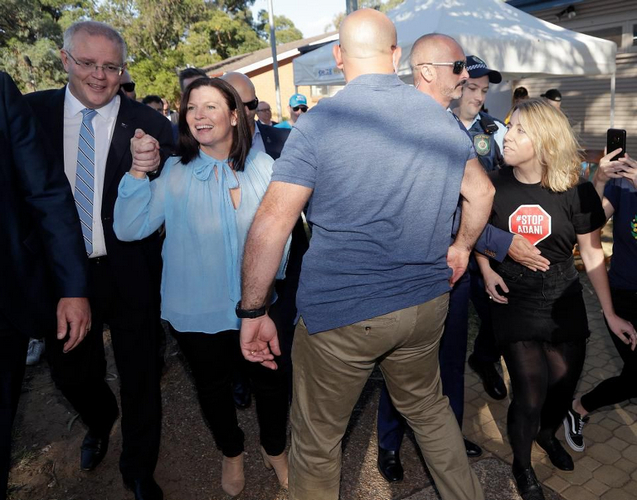
Australian Prime Minister Scott Morrison, left, holds his wife's, Jenny, hand as an anti-coal mining protester runs in from the right after Morrison voted in a federal election in Sydney. The parties have changed their rules to make the process of lawmakers replacing a prime minister more difficult. ASSOCIATED PRESS
A Tale Of Two Countries
Despite being condemned by both the United Nations and the IPCC for continued inaction, newly re-elected Prime Minister Scott Morrison has repeatedly told Australian media outlets that the country is set to reach their emissions reduction targets “in a canter”.
 Government reports continue to espouse the party line that Australia is on track to meet its targets, but a range of studies have shown that the country has continued to pollute and is therefore likely to miss their emissions target.
Closely aligned with the United States, Australia has joined them in pro-coal events and has backed up the Trump administration’s stance on “clean-coal”, referring to the use of coal power-plants in tandem with technology that mitigates the environmental damage they produce.
However, contrary to what the moniker implies “clean-coal” is anything but, as it still produces high levels of carbon emissions. Seen as a cost-inefficient option that goes against current energy trends, “clean-coal” has been dismissed as a viable option by nations looking to curb their carbon emissions as well as transition away from fossil fuels.
The US, which publicly withdrew from the Paris Agreement in 2017, has received considerable support from Australia. Both countries have continued to invest in coal power, with Australia looking to open the world’s largest open-air coal mine adjacent to the Great Barrier Reef.
During COP24 discussions held last year in Fiji, both countries reiterated their commitments to coal and explained that they had no plans to phase out their coal-fired power-plants despite calls from China and Fiji for greater accountability from developed nations and a marked reduction in coal power generation.
With an economy heavily invested in the mining industry, Australia has found itself at odds with a world looking to mitigate climate change. In recent years, the Australian government has found itself blurring the lines in the media as it attempts to protect its economic interests.
From holding back emissions data to censorship of international reports, the government has struggled to admit their own responsibility in causing environmental damage.

Controversial Policy Decisions
Australia’s policy decisions have indicated that the nation’s leaders are still in denial as to their non-compliance to the Paris Agreement and the effects of fossil fuels on the environment. In 2017, then Federal Energy Minister Josh Frydenburg announced changes to the country’s Clean Energy Finance Corporation (CEFC), a $10 billion AUD tax-funded loan facility which promoted investment in green technology.
Under new regulations, the CEFC would be allowed to invest in ventures that previously did not meet its emissions targets, allowing the fund to be used to research carbon-capture and clean coal technology as well as help finance the construction of new coal power-plants. Many expressed outrage over what was seen as a blatant attempt to prop up the coal and natural gas industries at the expense of more sustainable energy sources.
Open cut black coal min in Emu creek of Liddell part in Hunter Valley region, NSW, Australia. Huge fossil fuel extraction operation in NSW. Getty
The Renewable Energy Target (RET) has been a bright spot for the nation’s energy sector. By providing financial benefits for households and companies that installed renewable energy, the RET was created to promote investment in renewables and help reduce overall emissions.
A successful nationwide implementation led to noticeable drops in emissions and prices, with the Renewable Energy Target now being seen as the catalyst for a renewable energy transition.
However, with the RET’s end date looming, politicians looked to find it a suitable replacement that would ensure Australia continues to build upon renewables and cutting emissions at a rate compatible with the Paris Agreement.
The Morrison government revealed they have no plans to implement a new renewable energy policy and when queried about it, current Energy Minister and renewable energy and climate change skeptic Angus Taylor told Parliament: “The truth of the matter is the renewable energy target is going to wind down from 2020, it reaches its peak in 2020, and we won’t be replacing that with anything.”
The previous administration had already discussed implementing a National Energy Guarantee (NEG), to replace the Renewable Energy Target.
The NEG would merge energy reliability and a reduction in carbon emissions and could be used to help transition the nation away from fossil fuels and towards renewables. However, it was criticized for not being ambitious enough by energy experts and was seen as a government ploy to protect coal-fired power stations whilst flaunting an eco-friendly tag.
A study commissioned by Greenpeace Australia illustrated the issues with the NEG, showing that wholesale power prices would increase over time despite an initial drop and ensure no change in the share of renewable energy in the country’s energy portfolio.
In an interview with The Guardian, Oliver Yates, the former head of the CEFC expressed his disappointment: “It’s absolutely of no benefit to the national transition away from emissions. [The NEG] doesn’t do anything other than create a stable emissions profile for existing coal-fired power stations.”
Mr. Yates also pointed out the fact that under the NEG, polluting utility companies had a decade to reduce their emissions and that there was no mention of additional implementation of renewable energy projects.
Amidst criticism from all sides, the NEG was abandoned, leaving many worried that a transition away from fossil fuels may not happen. In August last year, the Energy Security Board warned that without the RET or the NEG, Australia was set to fall short of its emissions target.
Sheep drink imported water from a trough at a farm in Wandandian, New South Wales. In the world's driest inhabited continent, enduring a devastating drought that arrived in mid-winter, private action to prepare for climate change contrasts with years of division on energy and environmental policies. Australia's latest climate casualties are its farmers, who are being forced to slaughter livestock and watch crops wither amid one of the worst droughts on record. © 2018 Bloomberg Finance LP
An Inconvenient Truth
Despite successive governments assuring the Australian public that the country was doing its best to reduce emissions, the numbers have revealed an inconvenient truth.
A 2018 report by the Climate Action Tracker concluded that: “Australia’s emissions from fossil fuels and industry continue to rise and, based on the most recent quarterly inventory, are now 6% above 2005 levels and increasing at around 1% since 2014.
Under current policies, these emissions are headed for an increase of 9% above 2005 levels by 2030, rather than the 15–17% decrease in these emissions required to meet Australia’s Paris Agreement target. This means Australia’s emissions are set to far outpace its 'Insufficient' 2030 target.”
The “Climate Change Election” was meant to change Australia’s environmental future - and it certainly has.
Since being re-elected Prime Minister Scott Morrison has retained Angus Taylor as the nation’s Energy Minister, suggesting that his government does not intend to put forth any new strong environmental policies. A country itself already experiencing the worst impacts of climate change, suffering from drought, coral bleaching of an unprecedented scale, loss of biodiversity as well as poor environmental management, Australia has positioned itself at odds with global trends.
Where nations are cutting emissions and investing in cleaner futures, Australia has reduced funding for climate change solutions and refused to commit to additional emissions cutbacks.
Whilst politicians can continue to posture and engage in doublespeak, the impacts of climate change will continue to be felt.
The Australian government’s lack of interest in being part of a global solution regarding climate change should not be seen as a new development, but rather one of its many examples of hubris.

Links

Lethal Heating is a citizens' initiative