Saturday, July 06, 2019

Climate Change Could Be Paused By Planting Trees, Researchers Say, As They Map Out Available Land

ABC Science - Nick Kilvert

Key points:
  • Researchers identified 0.9 billion hectares of land that is available to be reforested
  • That could buy us a 20 year pause in climate warming
  • Coastal ecosystems are capable of storing carbon up to 40 times faster than forests and should also be considered, expert says
Planting trees to reduce the amount of carbon dioxide in the atmosphere seems like a no-brainer in the fight against climate change.
But until recently it's not been clear how much land we'd need to make a tangible difference to warming, and whether we'd need to reclaim farm and residential land to do it.
Now new research published today in Science estimates there's enough suitable unused land on the globe for reforestation to store around 205 gigatonnes of carbon.
That's enough to buy us about 20 years in the fight against climate change, according to researcher Jean-Francois Bastin from the Institute of Integrative Biology in Zurich.
"This would definitely help to keep us at that maximum of 1.5 degrees by 2050," Dr Bastin said.
The researchers started by modelling the amount of tree cover the earth could sustain under current environmental conditions, if there were no humans on the planet.
They considered local climate factors like rainfall and temperature in their modelling.
Then they worked backwards, subtracting existing tree cover, urban environments and agricultural land.
They were left with 0.9 billion hectares of degraded land, which could be returned to canopy cover ranging from open savannah to dense forest.
The land they identified had been affected by things like logging, slash-and-burn fire regimes, intensive ongoing burning and clearing for grazing.
Other technological methods for combatting climate change, such as injecting sulphate aerosols into the stratosphere, have been proposed but most carry significant risks or are yet to be proven at scale.
The beauty of reforestation, according to Dr Bastin, is that it's win-win.
"When you think about tree restoration, it's not only about fighting climate change it's also about maintaining ecosystems," he said.
"The forests of the world protect 80 per cent of the biodiversity that exists on land."

Reforestation needs to happen before 'tipping point'
The researchers also modelled the effect that climate change will have on how much of the earth's surface will be able to support trees in future.
Their findings suggest that reforestation needs to happen soon if it is to be effective.
Under current forecasts, they project that global tree canopy cover will shrink by up to 223 million hectares by 2050.
The impacts will be most significant at the tropics, according to Dr Bastin.
"The tropics will be under a lot more climatic stress. There will be more severe droughts," he said.
"Forests are a little bit resilient. But at some point we are afraid that it might shift, hit a tipping point and we are going to lose a lot."
An argument often espoused by climate-change sceptics is that more carbon in the atmosphere will equal more plant growth.
But David Ellsworth, an expert in the response of forests to climate change from the University of Western Sydney, said that wasn't the case.
Instead, tree growth is limited by a range of factors, including water availability and how nutrient-rich the soil is.
"What we know is that phosphorous is very limiting [in places like Australia]," Professor Ellsworth said.
He has conducted experiments where plants are exposed to the levels of CO2 predicted in the future, and observed no significant changes in growth rate.
While today's research points to exciting possibilities, he warned that the amount of CO2 that could be absorbed should be treated with some caution.
He said that by not factoring in soil nutrients or the full range of carbon densities of different vegetation types, there was room for error.

Most potential reforestation land in Australia and five other countries
More than half of the land available for what the researchers call "tree restoration potential" was identified in just six countries.
Australia ranked fourth on the list, behind Russia, the United States and Canada, and was followed by Brazil and China.
Twenty million trees are expected to be planted in Australia by 2020 under a federal government program.
But critics say any reforestation efforts in Australia are being undermined by land clearing.
Deforestation in Australia in recent years has spiked, drawing comparisons with tree-clearing hotspots like the Amazon rainforest in Brazil.
In 2017 around 1,000 football fields were being cleared each day in Queensland, and more than a million hectares were cleared in that state between 2012 and 2016.
The Nature Conservation Council (NCC) claims around one football field of bushland was cleared in New South Wales every 10 minutes, in 2017-18.
"We are in an extinction and climate emergency. We must stop destroying wildlife habitat if we are going to stop more species disappearing," NCC CEO Kate Smolski said in a statement last week.
A million species worldwide are now under threat of extinction, according to a UN-backed report published in May this year.
In Australia, 121 species are listed as critically endangered by the IUCN, with 41 species having gone extinct.
A further 239 are endangered.
Numerous critically endangered and endangered species, including Leadbeater's possum, swift parrots and bettong could benefit from forest restoration in Australia.

'Armpits of the ocean' can store carbon 40 times faster
But forests aren't the only ecosystems that can help fight climate change.
While trees are able to draw down carbon dioxide from the atmosphere and store it for the duration of their lives, blue carbon ecosystems can do it up to 40 times faster, and can potentially lock away carbon for 1,000 years or more.
Blue carbon is the term referring to stored carbon in coastal ecosystems like mangroves, seagrass and salt marshes.
But according to Peter Macreadie from the Blue Carbon Lab at Deakin University, these systems which he calls the "armpits of the ocean" have an image problem.
"That's a big, big problem," Dr Macreadie said.
"I'm working on a program in the Maldives where they're ripping out seagrass because people don't like the look of the dark patches in the water."
Getting public support to conserve and restore habitats that might be muddy and smelly and home to mosquitoes and sand flies is a difficult ask.
But in terms of a carbon sequestration investment, blue carbon is better value for money than tree planting, according to Dr Macreadie.
"If you're a carbon offset provider you're going to think, 'I can store the same amount of carbon in a fortieth of the land area'," he said.
Like planting trees, restoring coastal ecosystems has other benefits as well like boosting fish stocks and buffering coastlines from storm surges and sea-level rise.
While we focus on decarbonising our economies, restoring natural ecosystems may buy us precious time, according to Dr Bastin.
"We cannot be too picky. We need to use every good idea we can develop to fight climate change."

Links

Climate Change: Trees 'Most Effective Solution' For Warming

BBC - Matt McGrath

Sutthipong4222
Researchers say an area the size of the US is available for planting trees around the world, and this could have a dramatic impact on climate change.
The study shows that the space available for trees is far greater than previously thought, and would reduce CO2 in the atmosphere by 25%.
The authors say that this is the most effective climate change solution available to the world right now.
But other researchers say the new study is "too good to be true".
The ability of trees to soak up carbon dioxide has long made them a valuable weapon in the fight against rising temperatures.
The Intergovernmental Panel on Climate Change (IPCC) said that if the world wanted to limit the rise to 1.5C by 2050, an extra 1bn hectares (2.4bn acres) of trees would be needed.
The problem has been that accurate estimates of just how many trees the world can support have been hard to come by.
This new report aims to show not just how many trees can be grown, but where they could be planted and how much of an impact they would have on carbon emissions.
A map showing only the potential for restoring forests and excluding desert, agricultural and urban areas. Crowther 
The scientists from ETH-Zurich in Switzerland used a method called photo-interpretation to examine a global dataset of observations covering 78,000 forests.
Using the mapping software of the Google Earth engine they were able to develop a predictive model to map the global potential for tree cover.
They found that excluding existing trees, farmland and urban areas, the world could support an extra 0.9bn hectares (2.22bn acres) of tree cover.
Once these trees matured they could pull down around 200 gigatonnes of carbon dioxide, some two-thirds of extra carbon from human activities put into the atmosphere since the industrial revolution.
This is a quarter of the overall amount of CO2 in the air.
"Our study shows clearly that forest restoration is the best climate change solution available today and it provides hard evidence to justify investment," said Prof Tom Crowther, the senior author on the study.
"If we act now, this could cut carbon dioxide in the atmosphere by up to 25%, to levels last seen almost a century ago."
The researchers identify six countries where the bulk of the forest restoration could occur: Russia (151m hectares), US (103m), Canada (78m), Australia (58m), Brazil (50m) and China (40m).
Crowther Lab
But they say speed is of the essence because as the world continues to warm then the potential area for planting trees in the tropics would be reduced.
"It will take decades for new forests to mature and achieve this potential," said Prof Crowther.
"It is vitally important that we protect the forests that exist today, pursue other climate solutions, and continue to phase out fossil fuels from our economies."
The new study has been welcomed by Christiana Figueres, former UN climate chief, who was instrumental in delivering the Paris climate agreement in 2015.
"Finally an authoritative assessment of how much land we can and should cover with trees without impinging on food production or living areas," she said in a statement.
"A hugely important blueprint for governments and private sector."

What do the critics say?
However not everyone was as effusive about the new study.
Several researchers expressed reservations, taking issue with the idea that planting trees was the best climate solution available to the world right now.
"Restoration of trees may be 'among the most effective strategies', but it is very far indeed from 'the best climate change solution available,' and a long way behind reducing fossil fuel emissions to net zero," said Prof Myles Allen from the University of Oxford.
Planting trees is important say some scientists but cutting emissions is paramount. Getty Images
Others are critical of the estimates of carbon that could be stored if these trees were planted.
"The estimate that 900 million hectares restoration can store an addition 205 billion tonnes of carbon is too high and not supported by either previous studies or climate models," said Prof Simon Lewis from University College London.
"Planting trees to soak up two-thirds of the entire anthropogenic carbon burden to date sounds too good to be true. Probably because it is," said Prof Martin Lukac from the University of Reading.
"This far, humans have enhanced forest cover on a large scale only by shrinking their population size (Russia), increasing productivity of industrial agriculture (the West) or by direct order of an autocratic government (China). None of these activities look remotely feasible or sustainable at global scale."
The study has been published in the journal Science.

Links

Tree Planting 'Has Mind-Blowing Potential' To Tackle Climate Crisis

The Guardian - 

Research shows a trillion trees could be planted to capture huge amount of carbon dioxide
Redwood trees in Guerneville, California. Photograph: Gabrielle Lurie/The Guardian
Planting billions of trees across the world is by far the biggest and cheapest way to tackle the climate crisis, according to scientists, who have made the first calculation of how many more trees could be planted without encroaching on crop land or urban areas.
As trees grow, they absorb and store the carbon dioxide emissions that are driving global heating. New research estimates that a worldwide planting programme could remove two-thirds of all the emissions that have been pumped into the atmosphere by human activities, a figure the scientists describe as “mind-blowing”.
The analysis found there are 1.7bn hectares of treeless land on which 1.2tn native tree saplings would naturally grow. That area is about 11% of all land and equivalent to the size of the US and China combined. Tropical areas could have 100% tree cover, while others would be more sparsely covered, meaning that on average about half the area would be under tree canopy.
The scientists specifically excluded all fields used to grow crops and urban areas from their analysis. But they did include grazing land, on which the researchers say a few trees can also benefit sheep and cattle.
“This new quantitative evaluation shows [forest] restoration isn’t just one of our climate change solutions, it is overwhelmingly the top one,” said Prof Tom Crowther at the Swiss university ETH Zürich, who led the research. “What blows my mind is the scale. I thought restoration would be in the top 10, but it is overwhelmingly more powerful than all of the other climate change solutions proposed.”
Crowther emphasised that it remains vital to reverse the current trends of rising greenhouse gas emissions from fossil fuel burning and forest destruction, and bring them down to zero. He said this is needed to stop the climate crisis becoming even worse and because the forest restoration envisaged would take 50-100 years to have its full effect of removing 200bn tonnes of carbon.
Guardian graphic. Source: Bastin et al, Science, 2019
But tree planting is “a climate change solution that doesn’t require President Trump to immediately start believing in climate change, or scientists to come up with technological solutions to draw carbon dioxide out of the atmosphere”, Crowther said. “It is available now, it is the cheapest one possible and every one of us can get involved.” Individuals could make a tangible impact by growing trees themselves, donating to forest restoration organisations and avoiding irresponsible companies, he added.
Other scientists agree that carbon will need to be removed from the atmosphere to avoid catastrophic climate impacts and have warned that technological solutions will not work on the vast scale needed.
Jean-François Bastin, also at ETH Zürich, said action was urgently required: “Governments must now factor [tree restoration] into their national strategies.”
Christiana Figueres, former UN climate chief and founder of the Global Optimism group, said: “Finally we have an authoritative assessment of how much land we can and should cover with trees without impinging on food production or living areas. This is hugely important blueprint for governments and private sector.”
René Castro, assistant-director general at the UN Food and Agriculture Organisation, said: “We now have definitive evidence of the potential land area for re-growing forests, where they could exist and how much carbon they could store.”
The study, published in the journal Science, determines the potential for tree planting but does not address how a global tree planting programme would be paid for and delivered.
Crowther said: “The most effective projects are doing restoration for 30 US cents a tree. That means we could restore the 1tn trees for $300bn [£240bn], though obviously that means immense efficiency and effectiveness. But it is by far the cheapest solution that has ever been proposed.” He said financial incentives to land owners for tree planting are the only way he sees it happening, but he thinks $300bn would be within reach of a coalition of billionaire philanthropists and the public.
Effective tree-planting could take place across the world, Crowther said: “The potential is literally everywhere – the entire globe. In terms of carbon capture, you get by far your biggest bang for your buck in the tropics [where canopy cover is 100%] but every one of us can get involved.” The world’s six biggest nations, Russia, Canada, China, the US, Brazil and Australia, contain half the potential restoration sites.
Tree planting initiatives already exist, including the Bonn Challenge, backed by 48 nations, aimed at restoring 350m hectares of forest by 2030. But the study shows that many of these countries have committed to restore less than half the area that could support new forests. “This is a new opportunity for those countries to get it right,” said Crowther. “Personally, Brazil would be my dream hotspot to get it right – that would be spectacular.”
The research is based on the measurement of the tree cover by hundreds of people in 80,000 high-resolution satellite images from Google Earth. Artificial intelligence computing then combined this data with 10 key soil, topography and climate factors to create a global map of where trees could grow.
This showed that about two-thirds of all land – 8.7bn ha – could support forest, and that 5.5bn ha already has trees. Of the 3.2bn ha of treeless land, 1.5bn ha is used for growing food, leaving 1.7bn of potential forest land in areas that were previously degraded or sparsely vegetated.
“This research is excellent,” said Joseph Poore, an environmental researcher at the Queen’s College, University of Oxford. “It presents an ambitious but essential vision for climate and biodiversity.” But he said many of the reforestation areas identified are currently grazed by livestock including, for example, large parts of Ireland.
“Without freeing up the billions of hectares we use to produce meat and milk, this ambition is not realisable,” he said. Crowther said his work predicted just two to three trees per field for most pasture: “Restoring trees at [low] density is not mutually exclusive with grazing. In fact many studies suggest sheep and cattle do better if there are a few trees in the field.”
Crowther also said the potential to grow trees alongside crops such as coffee, cocoa and berries – called agro-forestry – had not been included in the calculation of tree restoration potential, and neither had hedgerows: “Our estimate of 0.9bn hectares [of canopy cover] is reasonably conservative.”
However, some scientists said the estimated amount of carbon that mass tree planting could suck from the air was too high. Prof Simon Lewis, at University College London, said the carbon already in the land before tree planting was not accounted for and that it takes hundreds of years to achieve maximum storage. He pointed to a scenario from the Intergovernmental Panel on Climate Change 1.5C report of 57bn tonnes of carbon sequestered by new forests this century.
Other scientists said avoiding monoculture plantation forests and respecting local and indigenous people were crucial to ensuring reforestation succeeds in cutting carbon and boosting wildlife.
Earlier research by Crowther’s team calculated that there are currently about 3tn trees in the world, which is about half the number that existed before the rise of human civilisation. “We still have a net loss of about 10bn trees a year,” Crowther said.

Links

Friday, July 05, 2019

Koalas On The Decline — Dangerous New Threats, Emerging Solutions

The Revelator - Gloria Dickie

The Australian icon could lose its fight against climate change, disease, habitat destruction and cars — but not if dedicated conservationists get the tools they need to protect the species.
Photo: University of Sydney
Ten years ago the shaky video of a dehydrated, wildfire-damaged koala captured headlines and the world’s attention.
Crouched next to a charred tree trunk, a volunteer firefighter named David Tree gingerly poured bottled water into the open mouth of the burned koala. A tiny gray paw rested in his own large, calloused hand, allowing the animal to remain upright as she drank.


The young koala, later nicknamed “Sam,” quickly became the iconic emblem of the fires — the first stages of what would be known as the Black Saturday bushfires that burned through the forests of southeastern Australia in February 2009. The fires occurred during a massive heatwave. They burned more than 1.1 million acres, killed 180 people, and caused more than 1 million animal fatalities.
Sam, who was lucky to survive, received treatment at a nearby wildlife center for second-degree burns.
Unfortunately she didn’t last long. Veterinarians soon discovered she was also suffering from severe cysts caused by inoperable chlamydia, one of a few diseases plaguing wild koalas. With no other options, Sam was euthanized that August.
Today her remains reside at the Melbourne Museum, where she serves as a symbol of not only the bushfires but the multitude of threats facing Australia’s wild koalas.
Those threats have taken a terrible toll on koalas (Phascolarctos cinereus), which once numbered in the millions. This May the nonprofit Australian Koala Foundation announced that the marsupials’ wild populations have fallen below 80,000 individuals and the species may now be “functionally extinct.”
In this case “functionally extinct” means that populations have been reduced so drastically that the animals no longer play a significant role in the ecosystem.
The news made headlines, but other biologists countered that while koalas have declined tremendously, the Australian endemics have not yet reached functional extinction. Regardless, koalas are indeed facing a whammy of threats in the country, and without serious and timely intervention it might not be long before the marsupial goes the way of another famous Australian animal, the extinct Tasmanian tiger.
But even as the koala’s decline continues, many people are stepping up to help — and what they’re learning may help the species survive the newest threat from climate change.

A History of Decline, an Uncertain Future
The koala was once ubiquitous in eastern Australia, ranging from tall eucalyptus forests to low woodlands and coastal islands.
Even today “they cover a huge geographic range,” says Christine Hosking, a koala biologist at the University of Queensland’s Global Change Institute. Indeed koalas can still be found in all four of the country’s six eastern states, although their remaining habitats have shrunk and become fragmented from each other, and many sites hold increasingly few animals.
“Population sizes vary from place to place,” Hosking says. “That’s why you can’t come up with a statement saying they’re all functionally extinct. However, some pockets aren’t doing so well.”
The decline was a long time coming. The fur trade was the first to decimate the koala population. Between 1890 and 1927, more than 8 million pelts were exported to England, according to research compiled by the Australian Koala Foundation.
Habitat loss followed. Eucalyptus groves were bulldozed for suburbs. People moved in. If the koalas weren’t killed by cars when crossing roads, they’d be found dangling in the jaws of pet dogs.
A koala injured by powerlines. Photo: Ausgrid (CC BY 2.0)
Then came chlamydia, thought to have crossed over to koalas from imported sheep and cattle. The marsupials are keenly susceptible to the sexually transmitted disease, especially when stressed by other factors. In some areas more than 50 percent of koalas exhibit symptoms, which can often prove fatal in its late stages. Climate change and heat stress, therefore, are only the latest in a series of unfortunate events for the vulnerable koala.
Hosking conducts scientific models to understand how climate change has and will affect the koala’s range. She’s found that koalas, already facing reduced and fragmented habitats, will likely now move eastward to the coast, which has a more moderate climate compared to the inland areas increasingly experiencing extreme heat and drought.
“The farther you go inland, there’s already evidence of koala populations crashing by as much as 80 percent,” she explains.
Koalas, it turns out, can’t handle the heat. “We did some modeling on the thermoregulation of koalas and found that over 37 degrees Celsius (98.6 degrees Fahrenheit) seems to be about their threshold.” As the climate changes, Australia frequently experiences 10 days in a row of 45 degrees Celsius (113 degrees Fahrenheit). “They’re not coping with that at all. There’s heat stress, lack of water, and their food trees are drying out,” says Hosking.
But moving east also means moving into more urbanized areas. That’s why scientists are hoping to mitigate this migration, using new tools to save the species.

Drink Up
Koalas get most of their moisture from eating juicy eucalyptus leaves, but they’re limited by how much they can eat.
“Not only are these leaves not particularly nutritious, they’re full of toxins,” explains Valentina Mella, a researcher at the University of Sydney. Koalas have developed a specialized intestinal tract to deal with the toxins, but, they have to wait until they’ve digested the toxins before eating more. “If you’re thirsty and there’s no water, it’s not as simple as, ‘I’ll just have another bunch of leaves.’ ”
Can human assistance help koalas get past that biological limitation? In 2016 Mella and her team placed 10 pairs of drinking stations across the Liverpool Plains in New South Wales, an area where koalas hadn’t been doing well. They wanted to see if the marsupials would supplement their all-leaf-diet with water found in tanks on the ground and in trees. To her surprise, when presented with the opportunity, the koalas were enthusiastic drinkers. Mella documented more than 600 visits by koalas during the course of a year. Other species such as sugar gliders, brushtail possums, kangaroos and echidnas also took advantage of the tanks. During hot and dry periods, the koalas chugged down even more.
This gives Mella hope that conservationists might be able to help the species by maintaining water stations in the wild for koalas — something that’s already done in rangeland for domestic cattle. Based on this research, the New South Wales government has already adopted water stations as a strategy to assist koalas during heatwaves and droughts
Dr. Valentina Mella with a koala joey during research fieldwork Gunnedah, NSW. Photo: University of Sydney
The next step, Mella says, will be to assess exactly how the water stations affect the overall health and survival of koalas.
“On the properties where we have these stations, we check on the ‘regular drinkers’ every six months. So far, they seem to be okay,” she says. But that’s just in terms of heat and dehydration. “When you add in the disease situation, then it’s a whole different story. Water is not a medicine. It can’t cure. But it probably helps in terms of making the animal more healthy to fight the infection.”

Medicine for Marsupials
To help koalas battling disease, dog bites, and automobile collisions, koala hospitals still play an essential role.
At the Port Macquarie Koala Hospital in New South Wales, about 200 koalas pass through the facility every year. That’s down from around 300 in previous years. “There are just fewer koalas now,” says Cheyne Flanagan, clinical director at the hospital.
Of the koalas that come in with chlamydia, about 40 percent are euthanized due to severe damage to their urogenital tracts. The other 60 percent can be treated with antibiotics or surgery. In addition to affecting internal organs, chlamydia also affects koalas’ eyes, causing infections or an overgrowth of tissue.
Recovering in a koala hospital. Photo: Tobias Spaltenberger (CC BY-SA 2.0)
“We’ve made progress,” says Flanagan. “It’s definitely better than it used to be because a lot of research is going on. We’ve learned what drugs are knocking chlamydia down. You can never cure chlamydia… but you can put it in remission and sometimes, if the koalas are healthy enough, their own immune system kicks in and keeps it under control.”
Antibiotic treatment has been problematic in the past because it often kills the gut microbes that allow koalas to eat eucalyptus leaves. But scientists have recently discovered one particular protective microbe that, if kept alive, allows the koala to survive the course of antibiotics. Researchers are also working on alternative treatments, such as fecal transplants, probiotics and a chlamydia vaccine.
Yet pressure on state and federal government from the international community, Flanagan says, is still critical. “Some of the laws for biodiversity in this country are disgusting.”

Australia’s Federal Failure, a Local Opportunity
Before the federal election in May, koala conservationists had hoped to turn the tide after decades of apparent governmental neglect.
In its press release ahead of the vote, the Australian Koala Foundation wrote that it had spent 31 years working with “13 environment ministers, many of which could be described as the ‘Who’s Who’ of the political elite and nothing has happened except dead koalas in the wild… No one has written anything to protect the koala in the last six years of government.” A national recovery plan, mandated by law, has never been established.  Notably, Australia’s Department of Environment and Energy web page for koalas still says, as of this writing, that the planned publication date of a recovery plan for the species “is expected to be late 2014.”
Further federal progress seems unlikely. On May 18 Australian citizens re-elected the Liberal-National Coalition, notorious for its refusal to sharply reduce carbon emissions and coal. Opposing parties had made far bolder promises on addressing climate change.
Though the federal election was a disappointment to most environmentalists, Hosking notes it’s now up to local and state governments to play the bigger roles in koala conservation.
“There’s a lot of lobbying going on with local government,” she says. “And we’re trying to engage more with state-level governments right now to come up with strategies to protect the koalas. It’s a matter of keeping populations viable, allowing them to move safely and stay healthy. It’s really difficult. It’s gloomy. But it’s certainly not over.”

Links

Climate Change Probably Added 4C To Europe's June Heatwave: Study

Reuters - Susanna Twidale

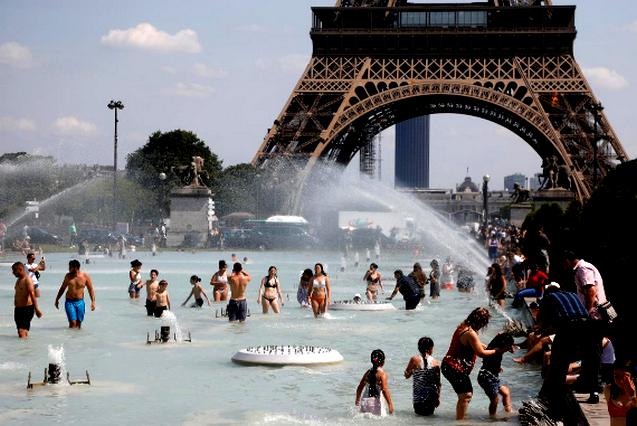
LONDON - Man-made climate change probably made last month’s European heatwave, in which southern France experienced a national record 45.9 degrees Celsius (114.6 Fahrenheit), 4C (7F) hotter than it would otherwise have been, scientists said on Tuesday.
People cool off in the Trocadero fountains across from the Eiffel Tower in Paris as a heatwave hit much of the country, France, June 25, 2019. REUTERS/Charles Platiau
“Climate change is no longer an abstract increase in global mean temperature, but a difference you can feel when you step outside in a heatwave,” said Geert Jan van Oldenborgh, Senior Researcher at the Royal Netherlands Meteorological Institute and one of the paper’s authors.
“The observations show ... similarly frequent heat waves would have likely been about 4C cooler a century ago,” said the report by the World Weather Attribution group of scientists.
It also said that climate change had made the record-breaking heatwave at least five times more likely.
“We experienced a heatwave whose intensity could become the norm in the middle of the century,” said Robert Vautard, senior scientist at France’s CNRS institute.
Climate scientists have long said that a warming of the earth’s surface caused mainly by industrial-era emissions of carbon-dioxide from fossil fuels will make weather events more extreme, and make those extremes - such as storms, drought and flooding - more frequent.
The World Weather Attribution group used computer models over three days from June 26-28 to calculate the temperatures they would otherwise have expected.
France’s new record modern-day temperature, registered in Gallargues-le-Montueux, in the southerly Provence region, was nearly two degrees above the previous high recorded in August 2003.
Meteorologists say a weakening of the high-level jet stream over Europe is increasingly causing weather systems to stall and leading summer temperatures to soar.
The World Meteorological Organization said on Friday that 2019 was on track to be among the world’s hottest years, and that 2015-2019 would then be the hottest five-year period on record.
It said the European heatwave was “absolutely consistent” with extremes linked to the impact of greenhouse gas emissions.

Links

Antarctic Sea Ice Declining ‘Precipitously’ Since 2014, Study Finds

Mongabay - 

Sea ice in Admiralty Bay, King George Island, Antarctica. Image by Acaro via Wikimedia Commons (CC BY-SA 3.0).

Key Points:
  • After decades of overall increase, Antarctica’s sea ice has been rapidly decreasing since 2014, according to a new study.
  • Between 2014 and 2017, Antarctica suffered a precipitous decline, losing more yearly average sea ice in just three years than that observed in the Arctic over a period of 33 years.
  • There was a small increase in the yearly average sea ice in Antarctica from 2017 to 2018, but there has been a decline in 2019 again. Whether the small uptick in 2018 is a blip in an otherwise long-term downward trend of Antarctic sea ice extent or the start of a rebound, is difficult to say, Claire Parkinson of NASA writes.
  • Whether the changes are because of climate change or something else also remains to be seen, researchers say.
For decades, sea ice in Antarctica has increased while that in the Arctic has declined drastically. But in a puzzling turn of events, Antarctic sea ice has been decreasing rapidly since 2014, a new study has found.
Whether the changes are because of climate change or something else remains to be seen, study author Claire Parkinson of NASA’s Goddard Space Flight Center says.
Parkinson, who analyzed satellite measurements of Antarctic sea ice over a 40-year period from 1979 to 2018, found that the yearly average sea ice extent peaked in 2014.
But over the next three years, from 2014 to 2017, the sea ice extent hit its lowest average annual levels.
Where the yearly average sea ice extent was a record-high at 12.8 million square kilometers (5 million square miles) in 2014, it reached 10.75 million square kilometers (4 million square miles) in 2017, with a record-low average monthly sea ice extent of 2.29 million square kilometers (0.88 million square miles) in February 2017.
In fact, between 2014 and 2017, Antarctica suffered a precipitous decline, Parkinson writes, losing more yearly average sea ice in just three years than that observed in the Arctic over a period of 33 years.
Is this downward trend going to continue? Researchers aren’t sure.
“But it raises the question of why, and are we going to see some huge acceleration in the rate of decrease in the Arctic? Only the continued record will let us know,” Parkinson told the Guardian.
Despite multiple hypotheses, researchers are yet to figure out why Antarctica’s sea ice extent has generally increased since 1979.
The cause of the recent decline, too, is a mystery.
The satellite measurements, for example, showed a small increase in the yearly average sea ice in Antarctica from 2017 to 2018, but there has been a decline in 2019 again. Whether the small uptick in
2018 is a blip in an otherwise long-term downward trend of Antarctic sea ice extent or the start of a rebound, is difficult to say, Parkinson writes in the paper.
Moreover, even during the decades of overall increase in Antarctic sea ice, there have been periods of declines followed by an increase.
“There was a period in the 1970s when the Antarctic also had a huge decrease in sea ice and then increased,” Parkinson told New Scientist.
“So it could be this huge decrease over a few years [2014 to 2017] is going to reverse.”
Parkinson had previously shown that the increases in Antarctic sea ice through 2014 did not compensate for the rapid loss of sea ice in the Arctic.
This was because “the decreases in Arctic sea ice far exceed the increases in Antarctic sea ice,” she told NOAA Climate.gov in March this year.

Sea ice extent in Antarctica has plunged since 2014
Annual average extent in square kilometres
Guardian graphic | Source: Parkinson, PNAS, 2019
The Antarctic represents a complex system, and Parkinson says she hopes the 40-year satellite data will spur more research.
“I hope that the 40-y record discussed in this paper will encourage further studies into the atmospheric and oceanic conditions that could have led to the extremely rapid 2014-2017 decline of the Antarctic sea ice cover, the comparably rapid decline in the mid-1970s, and the uneven but overall gradual increases in Antarctic sea ice coverage in the intervening decades,” she writes in the paper.


Antarctic sea ice plunges from record high to record lows

Links

Thursday, July 04, 2019

This Was The Hottest June In History, And Summer Is Just Getting Started

Grist - 

Mustafa Yalcin / Anadolu Agency / Getty Images   
If sometime during the past month you wiped sweat from your brow and thought, “Damn, it’s hot!” then congrats, your body knows what’s up. This past month was the hottest June ever recorded on planet Earth, according to the European Union’s Earth observation program, which announced the new record on Tuesday.
The unprecedented heat brought death, destruction, and misery to huge swaths of the planet. By the middle of June, more than 35 people had died as temperatures soared past 120 degrees Fahrenheit in India. France set a new national temperature record: 115 degrees. Multiple wildfires broke out in Spain, one of them, a 10,000-acre blaze, might have started when heat caused a pile of manure to burst into flames. One European heat map turned such a violent shade of red it looked like an open-mouthed skull in mid-scream (you have to see it to believe it). And, get this: Summer is just getting started.
In Europe, June temperatures were 3.6 degrees Fahrenheit higher than normal, according to the European program called Copernicus. Globally, temperatures were about a fifth of a degree higher than normal for the month, beating out the record set in 2016.
Here’s another worrisome finding from the report : If you compare the last several days of June to the average for the same several days between 1981 to 2010, temperatures this year were around 10 to 18 degrees F higher than normal over much of Western Europe — France, Germany, northern Spain, northern Italy, Switzerland, Austria, and the Czech Republic.
Super weird that temperatures just decided to spike like that. There’s no way humans have anything to do with it, right?
Heat waves like the one that just gripped Europe are not always directly linked to anthropogenic climate change, but extreme weather events are made worse by higher concentrations of greenhouse gases.
Another report released Tuesday from World Weather Attribution found that such heat waves are happening about 10 times more often now than they were a century ago. “Every heatwave occurring in Europe today is made more likely and more intense by human-induced climate change,” the report said.
Perhaps all this sweltering weather will spur governments to fulfill their commitments to slash carbon emissions. Barring that, it’s probably time to invest in a good air conditioner (and, yes, we know that comes with plenty of problems, too).

Links

Lethal Heating is a citizens' initiative