30/07/2019

Australia Must Help Protect Pacific From Climate Change, PNG Prime Minister Says

The Guardian

James Marape says Australia, with New Zealand and PNG, has a moral obligation to listen to the voices of smaller island nations
Papua New Guinea Prime Minister James Marape says a prosperous PNG is a ‘win-win’ for Australia. Photograph: Joel Carrett/AAP
Australia has a responsibility to protect the Pacific region from the impacts of climate change, PNG’s newly appointed prime minister has said.
James Marape told the Guardian Australia had “a moral responsibility … to the upkeep of the planet”, particularly given the extreme effect it was having on smaller Pacific nations.
“I don’t intend to speak from Canberra’s perspective, they have their own policy mindset, but as human beings I know they will respond to the moral obligation that is prevalent amidst us, that we are environmentally sensitive to the needs of others.”
He said the voices of smaller island nations must be listened to.
“As big countries in the Pacific – Papua New Guinea, Australia, New Zealand – we have a sense of responsibility to the smaller island countries, because displacement of these smaller communities will first and foremost be our neighbourhood responsibility,” Marape said.
In a wide-ranging interview, Marape outlined a vision for his country, to leave behind a history of wasted opportunities and squandered resources, and move towards a healthy and educated nation free of violence.
In May, after Scott Morrison led the Coalition to an election victory , Pacific leaders urged him to do more on climate change, saying Australia was “lagging behind”.
Marape, who is completing his first official visit to Australia this week, said he would “not be silenced” on environmental responsibility.
“We can have our resources but we must have it in an environmentally-friendly manner, so that we leave planet earth to the next generation not in the form we’ve inherited but a better form.
He said he believed Australia, New Zealand, and PNG should lead the Pacific as a “bloc” of nations reconstructing their economies to handle resource productions in a more environmentally and socially sensitive way.
On Thursday Marape warned foreign companies already in PNG that he intended to crack down on regulatory compliance, and also shake up revenue processing to ensure PNG drew at least 50% in taxes and royalties.
He also wanted to see a shift towards an agricultural exports economy, as a “food bowl for Asia” rather than the current dependence on mining.
“For the amount of wealth the lord has blessed us with ... the actual translation of this resource into improving peoples life hasn’t happened well in 44 years,” he told Guardian Australia.
“I don’t blame the past they lived at the time. They wrote the history, I’m going to write the future for our country.”
He said if his government didn’t get the balance right, future generations would blame them.
His comments followed an ambitious declaration on Thursday that the impoverished nation would be free of its dependence on Australian aid – more than half a billion dollars a year – within the decade.
He told Guardian Australia a prosperous PNG was a “win-win” for Australia.
“If we are independent economically, if we are solid and sustaining our own life, your taxes don’t need to come to us,” he said.
“We’ll keep the borders up north safe, we’ll have a better, friendly region up there, so the entire region is safe. If we disintegrate up there it affects Australia too.”
Marape won the leadership in May after several months of political chaos which ousted his predecessor, Peter O’Neill.
O’Neill’s legacy includes numerous crises and controversies, including allegations of corruption and mishandled public policies. In recent years a growing health crisis has been exacerbated by corruption scandals, medication shortages, mishandled medication contracts, and outbreaks of polio and drug-resistant TB.
Marape pledged investigations into corruption around the medication supply, and announcements by September of new health interventions. He said he and Morrison had negotiated Australia’s assistance in improving health care.
PNG also continues to have some of the world’s worst rates of family and sexual violence, and last week 18 people were massacred in the highlands village of Karida. The murders of mainly women and children were an escalation of worsening tribal violence which shocked the country.
Marape denied there was a cultural tolerance of violence in PNG, warningperpetrators they would face prosecution, and said revenge attacks and traditional systems of compensation as a response to violence had to end.
“I’ve made it absolutely clear on every occasion I’m asked this question, that whether it’s domestic violence or violence generally in society, culture and custom will not be a place to hide,” he said.
PNG police have historically been underresourced, with investigative officers and specialised family violence units effectively grounded because they can’t pay for petrol to attend a crime.
Marape said his government would target “hot spots” around the country to improve police resources where they are needed most.

Links

29/07/2019

Human-Caused Global Heating Breaks Clear From Nature, Studies Find

Sydney Morning HeraldPeter Hannam

Global heating in recent decades is of a pace and magnitude that's unique in at least the past two millennia, with human-caused climate change now "overwhelming" natural variability, new research has found.
According to three papers published in Nature and Nature Geoscience on Thursday, international teams of scientists used seven different statistical techniques to reconstruct global temperature during the so-called Common Era starting 2000 years ago.


A new report claims that Earth's rapid warming in the late 20th century was far more widespread than any temperature variations during the previous 2,000 years.

The scientists studied variability over decades and centuries, including well-known periods of shifting temperatures such as the Medieval Warming Period and the Little Ice Age. They found no era had the spatial extent or intensity of the heating over recent decades.
"Periods of warming and cooling have happened in the past but they were nowhere near the magnitude or the speed of the current warming," said Benjamin Henley, a University of Melbourne researcher and co-author of one of the papers. "The main, overwhelming impact on the climate has been in the recent decades, since about 1950."
The papers build on a major global effort to reconstruct past climate using a range of data sources, such as tree rings and coral cores, that was published in 2017.
Dr Henley said the new research revealed "incredible consistency" across different methods, adding to the confidence that current models can predict the future climate as greenhouse gas emissions continue to rise.
Global warming/cooling rates over the past 2,000 years
Source: Benjamin Henley/Nature
The work also further debunks the claims of climate change deniers who often point to periods such as the Little Ice Age as evidence the climate is in constant flux. Rather, unusual conditions were typically confined to regions.
For example, while north-western Europe experienced a cold spell in the 17th century - as widely depicted in paintings of frozen rivers such as England's Thames - the central and eastern Pacific experienced the chill in the 15th century.
"By contrast, we find that the warmest period of the past two millennia occurred during the 20th century for more than 98 per cent of the world," another of the papers said.
German police find a new use for their water cannons amid record-breaking heat in that country on Wednesday. Those heat records, though, may last just one day. Credit: DPA


Volcanic influence
Interestingly, volcanoes were found to be the dominant influence for most of the Common Era, potentially masking the start of the impact of the Industrial Revolution on global conditions.
Volcanic particles pumped high into the atmosphere typically cause widespread cooling followed by a warming rebound as they dispersed over time.
Several large tropical volcanic eruptions within three decades of the first half of the 19th century triggered "substantial drops of summer temperatures over the Northern Hemisphere land areas", the third paper found.
"Only after the 1850s did the transition into the period of anthropogenic warming start," it stated.
For Michael Mann, the director of Penn State University's Earth System Science Centre, the papers offer fresh vindication of work he led two decades ago in the so-called "Hockey Stick" studies. These revealed the relatively recent ramping up of global temperatures.
"We’re pleased that decades after our original work, independent, international teams of scientists using entirely different approaches, and more widespread now-available paleoclimate data, have come to virtually identical conclusions to those we offered in our original work," Professor Mann told the Herald and The Age.
These included that past climate episodes such as the Medieval Warm Period of about three centuries after 950 CE and the Little Ice Age "were far more regional in nature than the globally-pervasive warming of the past century", he said.
A second conclusion reaffirmed was that the current warmth at global and hemispheric scales "is unprecedented as far back as the estimates go - now more than 2000 years", Professor Mann said.
Heatwaves are just one of the extreme weather events that getting worse with climate change. Credit: Cole Bennetts

Heatwaves only part of the problem
The papers' release coincided recent heatwaves that have baked Europe - including setting records on Wednesday in several countries, with more expected on Thursday - and North America during their current summers.
Global temperatures in June were the hottest in more than a century of data, the US National Oceanic and Atmospheric Administration reported last month. July is on course to set global records too.
For Dr Henley, though, heatwaves are temporary and, while among the clearest signals of global warming, are still weather-related.
"The far bigger concern is the long term and the far bigger changes we are making to the climate system," he said, noting effects ranging from more severe flooding and droughts, and rising sea levels.
"It’s more the cumulative impacts on the human system and the natural system," Dr Henley said. "Many of the ecosystems we have on earth won’t be able to handle the pace of change."

Links

The Guardian Joins A Major Media Initiative To Combat The Climate Crisis

The Guardian

More than 60 news outlets worldwide have signed on to Covering Climate Now, a project to improve coverage of the emergency
Student protestors march during a ‘Fridays for Future’ demonstration against climate change in Berlin, Germany, 19 July 2019. Photograph: Felipe Trueba/EPA
For a week this September, dozens of news organizations in the US and around the world will join forces to devote their front pages and airwaves to a critical but under-covered story: the global climate emergency.
This unique media collaboration, timed to coincide with landmark UN Climate Action Summit in New York, is the first initiative of Covering Climate Now, a project co-founded by The Nation and the Columbia Journalism Review, in partnership with The Guardian, which aims to kickstart a conversation among journalists about how news outlets can improve their coverage of the climate crisis.
The project, which is still welcoming additional media partners, announced an initial list of more than 60 partners today, representing every corner of the media landscape, all of whom have pledged to dedicate resources to climate coverage for the week starting 16 September and leading up to the UN Summit on 23 September. The partners include major TV networks (CBS News) , digital players (HuffPost, Vox, the Intercept, Slate), local newspapers (the Philadelphia Inquirer, the Minneapolis Star Tribune), public radio programs (Marketplace, The World) and many others.
Covering Climate Now launched in May at an event at Columbia Journalism School with dozens of newsroom leaders, including the legendary TV journalist Bill Moyers, who delivered the keynote. At the time, the co-founders of Covering Climate Now, Mark Hertsgaard of the Nation and Kyle Pope, editor-in-chief of Columbia Journalism Review, wrote an impassioned oped calling for change in how the media covers the climate crisis.
“At a time when civilization is accelerating toward disaster, climate silence continues to reign across the bulk of the US news media,” Hertsgaard and Pope wrote. “Especially on television, where most Americans still get their news, the brutal demands of ratings and money work against adequate coverage of the biggest story of our time.”
Partners in the September week of coverage will make their own editorial decisions about what stories to feature. All that’s required is for each outlet to make a good faith effort to increase the amount and the visibility of its climate coverage – to make it clear to their audiences that climate change is not just one more story but the overriding story of our time. The point is to give the climate story the attention and prominence that scientists have long said it demands so that the public and policymakers can make wise choices.
You can read more about the initiative here.

Links

In Not At All Intimidating News: Adani Wants The Names Of Scientists Investigating It

The Guardian - First Dog On The Moon

In not at all intimidating news:
Adani wants the names of scientists investigating it 

Extreme Weather Caused By Climate Change Has Damaged 45% Of Australia’s Coastal Habitat

The ConversationRuss Babcock | Anthony Richardson | Beth Fulton | Eva Plaganyi | Rodrigo Bustamante
Bleached staghorn coral on the Great Barrier Reef. Many species are dependent on corals for food and shelter. Damian Thomson, Author provided
If you think climate change is only gradually affecting our natural systems, think again.
Our research, published yesterday in Frontiers in Marine Science, looked at the large-scale impacts of a series of extreme climate events on coastal marine habitats around Australia.
We found more than 45% of the coastline was already affected by extreme weather events caused by climate change. What’s more, these ecosystems are struggling to recover as extreme events are expected to get worse.
There is growing scientific evidence that heatwaves, floods, droughts and cyclones are increasing in frequency and intensity, and that this is caused by climate change.

Life on the coastline
Corals, seagrass, mangroves and kelp are some of the key habitat-forming species of our coastline, as they all support a host of marine invertebrates, fish, sea turtles and marine mammals.
Our team decided to look at the cumulative impacts of recently reported extreme climate events on marine habitats around Australia. We reviewed the period between 2011 and 2017 and found these events have had devastating impacts on key marine habitats.
Healthy kelp (left) in Western Australia is an important part of the food chain but it is vulnerable to even small changes in temperature and particularly slow to recover from disturbances such as the marine heatwave of 2011. Even small patches or gaps (right) where kelp has died can take many years to recover. Russ Babcock, Author provided


These include kelp and mangrove forests, seagrass meadows, and coral reefs, some of which have not yet recovered, and may never do so. These findings paint a bleak picture, underscoring the need for urgent action.
During this period, which spanned both El Niño and La Niña conditions, scientists around Australia reported the following events:

Extreme climate events impact on marine habitats in Australia

Heritage areas affected
Many of the impacted areas are globally significant for their size and biodiversity, and because until now they have been relatively undisturbed by climate change. Some of the areas affected are also World Heritage Areas (Great Barrier Reef, Shark Bay, Ningaloo Coast).
Seagrass meadows in Shark Bay are among the world’s most lush and extensive and help lock large amounts of carbon into sediments. The left image shows healthy seagrass but the right image shows damage from extreme climate events in 2011. Mat Vanderklift, Author provided


The habitats affected are “foundational”: they provide food and shelter to a huge range of species. Many of the animals affected – such as large fish and turtles – support commercial industries such as tourism and fishing, as well as being culturally important to Australians.
Recovery across these impacted habitats has begun, but it’s likely some areas will never return to their previous condition.
We have used ecosystem models to evaluate the likely long-term outcomes from extreme climate events predicted to become more frequent and more intense.
This work suggests that even in places where recovery starts, the average time for full recovery may be around 15 years. Large slow-growing species such as sharks and dugongs could take even longer, up to 60 years.
But extreme climate events are predicted to occur less than 15 years apart. This will result in a step-by-step decline in the condition of these ecosystems, as it leaves too little time between events for full recovery.
This already appears to be happening with the corals of the Great Barrier Reef.

Gradual decline as things get warmer
Damage from extreme climate events occurs on top of more gradual changes driven by increases in average temperature, such as loss of kelp forests on the southeast coasts of Australia due to the spread of sea urchins and tropical grazing fish species.
Ultimately, we need to slow down and stop the heating of our planet due to the release of greenhouse gases. But even with immediate and effective emissions reduction, the planet will remain warmer, and extreme climatic events more prevalent, for decades to come.
Recovery might still be possible, but we need to know more about recovery rates and what factors promote recovery. This information will allow us to give the ecosystems a helping hand through active restoration and rehabilitation efforts.
We will need new ways to help ecosystems function and to deliver the services that we all depend on. This will likely include decreasing (or ideally, stopping) direct human impacts, and actively assisting recovery and restoring damaged ecosystems.
Several such programs are active around Australia and internationally, attempting to boost the ability of corals, seagrass, mangroves and kelp to recover.
But they will need to be massively scaled up to be effective in the context of the large scale disturbances seen in this decade.
Mangroves at the Flinders River near Karumba in the Gulf of Carpentaria. The healthy mangrove forest (left) is near the river while the dead mangroves (right) are at higher levels where they were much more stressed by conditions in 2016. Some small surviving mangroves are seen beginning to recover by 2017. Robert Kenyon, Author provided


Links

'I’m Seeing It Disappear Before My Eyes': Crisis Point In Australia's Wet Tropics

Sydney Morning HeraldDeborah Snow

Last summer, in November, Queensland biologist Professor Stephen Williams was at a workshop in Vietnam when he received an urgent email from home. It was from a ranger he knew who worked for the World Heritage-listed wet tropics area around Cairns.
Something unprecedented was happening at the top of Mount Bartle Frere, North Queensland’s highest peak. At 1611 meters high, the mountain’s upper reaches are in what is meant to be a cool temperate zone.
Upland rainforest on Mount Windsor, part of the Wet Tropics World Heritage Area. Credit: Kerry Trapnell
But instead of normal summer readings at the peak, which rarely top 25, temperatures had soared past 35 degrees for six days in a row, culminating in one scorcher of 39.
“This is on a mountain where the average temperature for the year is usually 12 degrees, a nice warm day is around 18, and a hot day is 25,” Williams tells me, as we sit in a cafe high up on the nearby Atherton tableland. “I was shocked, and very worried about the impact. Temperatures like this were unheard of.
”Williams, 57, is Professor of Global Change Biology at James Cook University and a long-time expert on many of the unique animal species which inhabit the ancient rainforests of North Queensland. Along with the spectacular landscape, those animals together with the nearly 700 unique plant species growing in the forests are a fundamental reason why the 900,000 hectare area received much sought-after World Heritage listing in the late 1980s.
"Temperatures like this were unheard of”: Professor Stephen Williams. Credit: Kerry Trapnell
In March, worried about the impact of the November heat wave, Williams carried out a spot check on one of the area’s most iconic and vulnerable creatures, the lemuroid ringtail possum, which he’d been studying for nearly two decades. These creatures are endemic, meaning they live nowhere else except in these high wet tropics pockets. The results were another shock.
At sites where he used to reliably record some 20  individuals an hour, he was now finding only three or four. It was a similar story elsewhere on the mountain slopes and on the higher sections of the tableland. Williams alerted the Wet Tropics Management Authority (an agency jointly reporting to the federal and Queensland governments) which called an emergency board meeting a week later. Within days, in late April, the board had issued its most chilling warning yet about the impact of climate change on the iconic area.
“The Board … has now become aware that, following the hottest summer ever recorded, some of the key species for which the Wet Tropics World Heritage Area was listed are at imminent risk of extinction,” it warned.
“Professor Williams’ recent monitoring has identified that the declines in possum and bird species … are now reaching alarming levels. If the trends continue, populations at sites that previously had the highest density of lemuroid ringtail possums could become locally extinct as early as 2022.”

'The canary in the coal mine'
Searching for possums at Mount Hypipamee National Park. Credit: Kerry Trapnell
On a chilly Monday evening this week, the Herald and The Age accompanied Williams to a site at Mount Hypipamee National Park, 950 meters above sea level up behind Cairns, to track down some of the nocturnal creatures.
We tramped in darkness along a track lined with dense rainforest, swinging torches and spotlights up into the tracery of branches overhead, seeking the tell-tale reflection of possum eyes. In an hour or more of searching, Williams had picked out four lemuroids, two Herbert River ringtails and two Green ringtails (also highly vulnerable endemic species). At this site, the numbers were 50 per cent down on what he would expect to find. Elsewhere, he says, numbers are down closer to 70 per cent.
The ringtails, which have evolved to thrive in the cooler upland areas, cannot handle temperatures in excess of 29 or 30 degrees, so the species is drifting ever higher up the mountains, Williams explains. They are disappearing from an elevation of 800 metres which used to be the “sweet spot” for biodiversity. Now they are starting to decline even at 1000 metres. Once they reach the peaks there will be nowhere else for them to go.
Bird species unique to the region are being similarly affected. “It’s distressing,” he says. “This is what I have spent my life working on, and I’m seeing it disappear before my eyes.”
The Wet Tropics world heritage area runs for some 450 kilometres down the coast between Cooktown and Townsville and includes the oldest continuously surviving tropical rainforests on earth. They are, says Leslie Shirreffs, the chair of the Wet Tropics Management Authority, a “living museum”, containing plant ancestors of the great Gondwana forests that covered the continent and parts of Antarctica 50 to 100 million years ago, among them rare species that show how the earliest flowers evolved.
The Wet Tropics (which includes the Daintree in its northern reaches) abuts another globally famous world-heritage site, the Great Barrier Reef.
But while efforts to save the reef – ravaged in some sections by widespread coral bleaching - have drawn the bulk of the funding and the attention, the rainforest remains something of the poor cousin, Shirreffs says. “We had predicted that the loss [of the cool adapted mountain species] would happen on current trajectories by the end of the century. But we are seeing it now,” she says.
Williams says both the reef and the rainforest are being heavily impacted by climate change, but “my problem is that we don’t have such obvious signs that the rainforest is in trouble – we don’t have ‘canopy bleaching’.”
The Australian Conservation Foundation says that makes it harder to galvanise more action for wet tropics protection. “It looks like a beautiful place and it is a beautiful place, but that’s actually one of the problems. It hides pretty well the damage that's being done to it,” explains ACF’s chief executive, Kelly O’Shanassy, who accompanied a small group of journalists to the world heritage site.
The Wet Tropics Authority receives $2.7 million annually from the federal government for its baseline operating costs, but that figure has not increased since 2004 (though funding for specific projects has waxed and waned).
Williams had an extensive monitoring program set up over several years where he was tracking climate change impacts at some 40 sites, taking localised temperature readings. But then, he says, “the money stopped … we left the data loggers out there until they died. Especially in the rainforest that sort of instrument only lasts a few years. We kept them running as long as we could.”
O’Shanassy says people sometimes ask her why they should worry about the threatened disappearance of these highly specialised possum species. “They are the canary in the coal mine, just as much as the reef,” she says. “They are showing us what our future holds …. If we don’t move from burning coal to renewables in the next 10 years, we can’t stop runaway climate change and we will see this vast damage everywhere, including things we humans rely on. We lose the beauty - but we might also lose our life support systems.”

Temperatures soar, with devastating effect
More than 400 orphaned juvenile spectacled flying foxes were brought in for care over the space of just a few days. Credit: Kerry Trapnell
Jenny McLean at her bat hospital. Credit: Kerry Trapnell
Down near the coast, Cairns also suffered record temperatures in November, with a devastating effect on another creature which is iconic for the region: the spectacled flying fox. Thousands were discovered dead or dying as temperatures soared to 42 degrees.
At the bat hospital which Jenny McLean runs at Tolga, on the Atherton tableland above Cairns, more than 400 orphaned juveniles were brought in for care by volunteers over the space of just a few days.
McLean, a small, wiry woman whose been caring for injured bats since 1990 and runs the place on the lean earnings from a modest visitor’s centre, knows as much about the flying foxes as the scientists who regularly visit her. Those bats she can save she nurses back to health in a large enclosure where bright strings of apples hang beneath the open mesh roof like bunting, and nectar bottles hang invitingly for her patients to sip from.
“We are giving them another chance at life,” she says, as she cradles a tiny microbat weighing no more than 8 grams.
Among the scientists who are regular visitors to McLean’s bat refuge is the CSIRO’s flying fox expert, Dr David Westcott.
With McLean’s help, researchers have worked out how to place transmitters on the bats to locate the more remote flying fox camps in the forest, and thus ascertain their numbers more accurately. Westcott says a recent analysis of his data shows that the population has declined dramatically – by an order of around 70 per cent – over the last 14 years.
Dr David Westcott. Credit: Kerry Trapnell
“It looks like the initial declines were driven by cyclones and then the heat stress event [in November] has given them a good whack while they’re already down,” he says. “Our most recent estimate prior to that heat stress event was 80 to 90,000 animals. There is some debate about how many died but it's a significant proportion, 20-plus per cent of the known population.”
It was, he says, the first report of mass die-offs among the creatures because of heat stress. “At 42 degrees they cease to be able to thermo-regulate. They can’t shed the heat.”
The impact of climate change is also being noticed by Aboriginal groups that have traditional ties to the wet tropics.
Among them are the Djabugay people, who have native title over parts of the Barron Gorge National Park, north-west of Cairns. Barry Hunter, project officer for the local Aboriginal corporation, says he’s noticed many changes since he was a boy scrambling up and down the spectacular Barron Gorge waterfall.
“Over the last 20 years, I have seen distinct change, particularly in the birds, some of which have a totemic meaning for family groups.”
Barry Hunter says he’s noticed many changes over the last 20 years. Credit: Kerry Trapnell
Climate change is also disrupting his community’s traditional methods of fire management. “We have not had a dry season this year, which indicates changing weather patterns,” Hunter says. “We should be well and truly into our traditional burning season,” he adds, explaining that setting small mosaic fires helps minimise the risk of massive blazes in areas adjacent to the heritage-listed forests.
The ACF and the federal government remain at loggerheads over whether funding for environmental protection is anywhere near adequate. ACF’s O’Shanassy says since the Coalition came to office in 2013, the environment budget has been cut by nearly 40 per cent, to around $900 million a year.
A spokesman for Scott Morrison’s new Environment Minister, Sussan Ley, flatly rejects that claim, saying ACF ignores programs which are not directed through the department but are environmentally significant. He cites the $190 million National Landcare program, a $137.5 million "practical environment restoration package" and $250 million over the next five years to support management of federal environmental water holdings as examples. This week, a $1.9 million grant under the Landcare program was awarded to an NGO in the wet tropics area.
But the Wet Tropic Authority’s board said in April that investment was “not commensurate with the urgency for mitigating climate change impacts”.
One area where the two sides have reached agreement is over ridding the wet tropics and adjacent rich agricultural land of yellow crazy ants, an introduced species that wreaks devastation on local ecosystems and farmers alike.
This year’s budget set aside $9 million to keep eradication programs going, with the Wet Tropics Authority overseeing much of that spend. It’s painstaking work, as rangers and community volunteers fan out in grid patterns, laying down a paste to lure the ants (cat food mixed with apricot jam works a treat), then coming back to set poison baits at infestation hot spots.
A team works on the eradication of yellow crazy ants, an introduced species. Credit: Kerry Trapnell
Shirreffs says the success of the program is a model for what could be achieved in the bigger battle against climate change. “It has worked by bringing together industry, the community, science and government - they all have an interest in the survivability and integrity of the world heritage area, which is worth $5.2 billion a year to the local economy.”
O’Shanassy, speaking more bluntly, says ACF will try to work around Canberra and partner with business and state governments on climate change because “the Coalition government is not signalling that it’s going to be serious on climate action”.
“The government says we are going to reach our Paris [emissions reduction targets] in a canter? Every bit of evidence says we are not. There are flat-out lies being told which is very distressing because this is a fundamental issue that affects all Australians.”
In a week in which heat records have tumbled in Europe – a week when even mining giant BHP’s boss Andrew Mackenzie has declared climate change to be an “existential” threat – Williams says he wants to see Australia at the forefront of the issue globally.
“Fiddling around at the edges is not going to cut it. We have to tackle the root causes. What most people don’t understand is that this is not something that might happen in the future, it's already happening. All over the word. I’m talking about thousands of studies that demonstrate [the damage] in every ecosystem, from the Artic to the Antarctic.”

Links

28/07/2019

How Much Has Tasmania's Climate Changed In The 100 Years To Now?

ABC NewsErin Cooper

Scientists say sea levels in Tasmania are rising by 3mm a year. (Facebook: Discover Tasmania)
Key points:
  • Tasmania's average temperatures are now a degree warmer than a century ago
  • Rainfall has also decreased as climate change results in less low-pressure systems
  • Sea levels are rising by three millimetres a year
We have all heard how bad it is going to get: a million species at risk of extinction, entire island nations going under as sea levels rise and more severe weather events more often.
Scientists and international organisations have been issuing the climate change warnings for decades, saying the future of Earth as we know it is under threat.
Tasmania — renowned for its natural beauty — is not immune, suffering its fair share of natural disasters and slowly-eroding land, all attributed — at least in part — to the changing climate. But if we know a bit of how bad it is going to be, do we know how bad it already is?
The ABC investigated how much the island state's climate has changed in the past 100 years.
Usually wet rainforest wilderness areas have been scorched in the past few years. (Instagram: Fire Rescue Tasmania)
Feeling hot, hot, hot

Climate change 'unparalleled' on global scale
Scientists find global warming is being felt (almost) everywhere at the same time and the warming is unprecedented over the past 2,000 years.

Climatologist with the Bureau of Meteorology in Tasmania, Ian Barnes-Keoghan, said the bureau had been collecting temperature observations since the late 1800s — and the data paints a very clear picture.
"It doesn't matter how you cut it up, you still get the same message that temperatures over Tasmania have risen over the last century, particularly since the 1950s," he said.
"It's such a clear-cut story."
Averaged over the entire state, Mr Barnes-Keoghan said Tasmania is now about a degree warmer than it was a century ago.
But hot temperatures are also now more extreme than they used to be, with fewer very cold days.
"We're not saying that the temperature everyday is now a degree warmer than it was, but the average has moved up and we're seeing more of those extremely high temperatures, so your 35 and 40-degree days," Mr Barnes-Keoghan said.

Ian Barnes-Keoghan says a graph showing average temperatures shows the general increase of about a degree over the past 100 years, and especially since the 1950s. (Supplied: Bureau of Meteorology)

"Since 1910, there's been 12 days where somewhere in Tasmania has reported a temperature of 40 degrees or more. Four of those occurred in the first 93 years, the other eight only occurred in the last 17, and two of those were this year."
"It's often those extremes that people really notice."
As for the argument that the warming of the climate is cyclical, Mr Barnes-Keoghan said there was no reason why people should expect average temperatures will cool down again.
In fact, Scientists writing in the journal Nature this week said there was no evidence for "globally coherent warm and cold periods" over the past 2,000 years prior to industrialisation.
"We have a very good understanding of the mechanisms behind this warming, so the significant cause has been an increase in the concentration of greenhouse gasses in the atmosphere," Mr Barnes-Keoghan said.
"So just by simple physics that leads to an increase in the average temperature because more warmth is trapped close to the surface."

Tasmania is known for its freezing temperatures. (Supplied: Pat Fasnacht‎)
When it rains, it pours
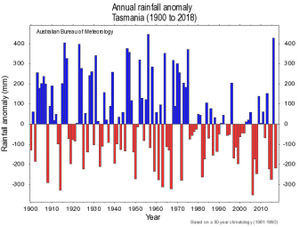
Perhaps unsurprisingly, it is now also drier in Tasmania, with average rainfall across the state decreasing.

Ian Barnes-Keoghan says since the 1970s there have been fewer "wet" years, but 2016 was the second wettest on record. (Supplied: Bureau of Meteorology )
"There is less rain, on average, now than there was 40, 50 years ago, but there's a couple of things mixed in there," Mr Barnes-Keoghan said.
"One is that we still get wet years, like it rained a lot in 2016 — but the wet years have become less common and the dry years have become more common," he said.
He said the decline is strongest in late Autumn, heading into early winter.
Mr Barnes-Keoghan explained rainfall now behaves differently than it did in the past.
"[In the past,] you'd get a couple of dry years, then a couple of wet years to make up for it," he said.
"But sometime around the mid-70s, that pattern seems to have changed.
"Instead of having a mixture, it went to getting several dry years in a row, then a wettish year but not really that exciting, then a couple of dry years and just not getting those recharge years."
But explaining why is a bit more complex.
"Rainfall is complicated, but one of the reasons there's been less rainfall is there are less rain-bearing systems," Mr Barnes-Keoghan said.
"That partly comes about because of an increase in high-pressure systems — that's a known and expected consequence of increasing greenhouse gases.
"Rainfall is hugely variable from year to year, much more variable than temperature, so picking out trends in rainfall is much harder."
Mr Barnes-Keoghan also said the warmer atmosphere holds more moisture, so when it does rain, it's now often in quicker and heavier bursts.

But what about wind and snow?
No data is kept on snowfall but many believe it's not as prevalent as in the past. (Supplied: Cam Blake Photography)
So if Tasmania's drier, is it also getting less snow?
Mr Barnes-Keoghan said while it certainly seemed that way, there was no available data to back that up.

Ian Barnes-Keoghan says average temperatures are not expected to cool down again. (ABC Radio Hobart: Carol Rääbus)

"The bureau does not have a good long-term collection of snow data," he said.
That's because it doesn't snow that often over most of Tasmania and in particular, it doesn't snow that often in populated areas.
Mr Barnes-Keoghan said a lot of the historical observations really relied on somebody being there to take the measurement, which didn't always happen.
"I've been here for a long time and I get the impression that snow is less common than it was, but that's completely an anecdote," he said.
Wind is also hard to measure, though Mr Barnes-Keoghan said average windspeeds were decreasing, albeit not by much.
He said the bureau had only really collected data on wind since the 1990s, and even then, it might be skewed because equipment had been positioned in locations known to be particularly windy.
"To measure rainfall you basically need a jam jar, I mean we have very sophisticated jam jars which are calibrated, but measuring wind speed is really difficult," he said.
"The instruments we've got now were really only developed during the 1950s and only became widespread in Australia during the 80s and 90s. [They] only became really important around the 90s so we've really only got measurements since then."
Is Tasmania going under (the sea)?
Not quite yet, but sea levels are estimated to be rising 3 millimetres each year.
Retired oceanographer and sea-level-rise expert John Hunter said sea levels had risen by about 16 centimetres since 1841 — when the first sea-level benchmark was put in place at Port Arthur, on Tasmania's south-east coast, adding levels had risen by about the same amount "pretty much everywhere".

John Hunter kneels next to the 1841 sea level gauge which is carved into rock at Port Arthur. (Supplied: Frederique Olivier)

He explained that was due to two factors: the warming climate heating up water, causing it to expand "like liquid in a thermometer", and melting ice on land.
Mr Hunter said that while 3 millimetres a year might not sound like much, it had big consequences.
"The rule of thumb I use is that if you have about 10 centimetres of sea-level rise, which we've already seen last century, [the] frequency of flooding events goes up by a factor of three. So 10 centimetres trebles the amount of flooding events."
He said people tended not to notice the changes because they occurred over decades and coastal infrastructure was built accordingly, so "people just build sea walls a bit higher".
But people may see shorelines receding, which is one of the results of rising seas.
"For every metre of sea-level rise, you lose between 100 and 200 metres of shoreline," he said.

Wet years such as 2016, which saw heavy flooding, are becoming less common, according to the Bureau of Meteorology. (Copyright Neil Hargreaves)

NOTE: The ABC investigated changes in the island state's climate as part of our Curious Climate seriesCurious Climate Tasmania is a public-powered science project, bridging the gap between experts and audiences with credible, relevant information about climate change. The project is a collaboration between ABC Hobart, UTAS Centre for Marine Socioecology, the Institute for Marine and Antarctic Studies (IMAS), the Tasmanian Institute of Agriculture (TIA), and the CSIRO.

Links

Lethal Heating is a citizens' initiative