16/08/2019

Dave Eggers: Why We Should Listen To Teenagers Speak About Climate Crisis

The GuardianDave Eggers

As the International Congress of Youth Voices kicks off in San Juan, Puerto Rico, the Guardian invited young delegates to write about their fight against the climate crisis
International Congress of Youth Voices, David Eggers interacting with students. Photograph: Isabel Talanehzar 
Dave Eggers
Dave Eggers is a writer, publisher and humanitarian campaigner.
He has written 14 books, including A Heartbreaking Work of Staggering Genius, What Is the What, The Circle and Heroes of the Frontier.
Dave Eggers is co-founder of the International Congress of Youth Voices, and co-founder of 826 National, a network of youth writing and tutoring centers around the United States.
Teenagers speak with a directness and a moral clarity that is desperately rare in our elected leaders, and perhaps in the adult species as a whole.
 That’s why we created the International Congress of Youth Voices. It’s an annual gathering of young writers and activists, ages 16 to 22, who speak and live with urgency.
The first conference was last summer in San Francisco, where almost a hundred delegates from twenty-six countries gathered, and were mentored by the likes of Chimamanda Ngozi Adichie, Khaled Hosseini, and congressman John Lewis.
One of our most inspiring young delegates in that first conference was 15-year-old Salvador Góomez-Colón from Puerto Rico, who created his own non-profit to help the island’s recovery after Hurricane Maria.
Eight months ago, we decided that we’d hold the second Congress in San Juan. We knew Puerto Rico would be a rich and inspiring location for the delegates to explore issues of colonialism and climate change, for starters, but we had no idea it would be, in August of 2019, the most exciting place on the planet to watch grassroots democratic change in action.
'I am growing up in a world whose life systems are unraveling'
Jamie Margolin
And this recent gubernatorial unseating began with our increasingly volatile climate, and how we react to it. Governor Ricardo Rosselló did not meet the reasonable expectations of his people, he denigrated them in their time of need, and now he’s gone. And the people who marched, who took to the streets and wouldn’t leave until he left, were overwhelmingly young.
This was a youth movement, and demonstrates what can happen when young people convert their outrage into action.
The delegates of the International Congress of Youth Voices are doing this every day. And one of the issues they’re most passionate about is – no surprise, given that they are inheriting our towering mess – climate change.
The following essays provide a sampling of their thoughts, plans and, to be sure, their justifiable exasperation.
“I am growing up in a world whose life systems are unraveling,” writes Jamie Margolin, in one of the most sobering examples of the psyches of young people growing up with the prospect of a climate apocalypse.
“In ten years I’ll be 28. My life will just be beginning when the world is ending.”
Dave Eggers talks with youth delegates, including Salvador Gómez-Colón, left, at the International Congress of Youth Voices in San Juan, Puerto Rico. Photograph: Isabel Talanehzar


What follows are short pieces
by student delegates to the
International Congress of Youth Voices

•••


Why I fight for climate change by Joshua Borokinni
Joshua, a 19-year-old delegate from Lagos, Nigeria, is a climate activist, social innovator, and journalist with a keen interest in sustainable and developmental reporting.
Losing a friend to a climate-induced flood in 2016 is the reason I committed myself to a cause bigger than myself – climate action. This quest for a better planet was a reaction to my friend’s death which saw me spend six hours daily for a month in the library – studying climate change – its etymology, science, politics, legal frameworks and projections.
Climate change is inarguably the biggest single threat to existence of lifewhich affects every constituent of the planet – humans, animals, oceans, deserts, atmosphere inter alia. We have seen an unprecedented increase in heatwaves, cyclones, food insecurity and drought in recent times.
In Nigeria, climate change is the underlying drive for the current Fulani Herdsmen - Farmers clashes which has seen the death of over 5,000 people in the past four years. The Chad basin is drying up and the Sahel savannah is experiencing immense drought and desert encroachment, forcing herdsmen to move down south in search for pastures. As the migration has increased, so too have violent clashes over grazing lands between local farmers in the south and pastoral herdsmen, whom the former accuse of wanton destruction of their crops and forceful appropriation of their lands.
Sadly, in the wake of these happenings, Nigerians have yet to see climate change as an important issue. Many international treaties are yet to be joined, climate action gets less than 1% of the budget, and the president has not focused on climate policy. This is attributed to the widespread poverty, unemployment, insecurity and bad governance leaving climate action as an URGENT but NOT IMPORTANT agenda on the scale of preference. Nonetheless, these problems are all interconnected and Nigeria has a low adaptive capacity towards the impact of climate change.
Governments need to do more! As the United States’ elections draw near, it is high time to put aside political differences and prioritize the safety and sustainability of all Americans by putting climate action at the top of the to-do list. The world needs to see aggressive and action-driven interventions across all levels of government and a responsible green-oriented populace to mitigate the scary projections of climate change, else, there will be nowhere to run.

•••


 A bad dystopian movie by Jamie Margolin
Jamie, 17, is a Colombian-American writer, community organizer, activist, and public speaker living in Seattle, Washington, who founded Zero Hour, an international youth climate justice movement.
If you were watching a movie, and all of the characters in it knew there were only 10 years left to save the world, but they continued going on with their lives as if nothing was happening you would yell at the screen right? I would.
We on planet Earth are living out that movie. Climate change and environmental destruction are quite literally ending the world – and the United Nations has made it crystal clear through years of extensive scientific research that we have a maximum of 10 years left in order to turn the tides on the climate crisis and save humanity and every creature we share this once-blue earth with.
Ten years left to save the world.
That means starting yesterday, we have to radically change our society – the way we live, the way we power our lives and fully make that just climate action transition in the span of 10 years in order for it to not be too late.
I’m 17 years old, going into my senior year in high school, and I am growing up in a world whose life systems are unraveling. In 10 years, I’ll be 28. My life will just be beginning when the world is ending. It is not fair to my entire generation that we are inheriting this monstrosity of a problem. It’s hard enough trying to grow up and live your life, let alone inherit this crisis that makes it so your future will be full of chaos and disaster.
That’s why I, along with 12 other young people and the help of the non-profit, Our Children’s Trust, recently sued the state of Washington. Why? Because the whole state government is screwing over my generation. Washington state’s elected officials love to talk about solving the climate crisis, but then turn around and issue permits for fossil fuel plants that poison communities, and destroy ecosystems, water, air and land that my generation and future generations need to survive.
What’s even crazier? The lack of necessity. They are destroying our life support systems with a fossil fuel energy system that is wholly unnecessary to provide for our basic energy needs. Experts across the planet say that we don’t need to power our planet with dirty life-threatening fuels.
I can’t risk not fighting. My future is on the line.

•••


 Why do I fight for climate change? by Matilde Bondo Dydenesborg
Matilde is a 15-year-old climate activist and writer from Denmark.
For years, I didn’t know the climate problems we were facing, but when I found out I kept asking myself: will I have a future? Why didn’t we do anything when we had the chance? Adults were condescending. I felt like the only thing I could do was trust the people who had the power to change. I was concerned that global warming wasn’t their first priority, and all I did was go to school every day, asking myself: what am I doing here when a world is disappearing outside my window?
Then I started researching. My teacher told us about the international movement School Strike 4 Climate. Students from around the world were deciding not to attend class, but rather take part in demonstrations demanding action and the changes they wanted to see. I thought this could be my opportunity, quickly asking my friends if they wanted to go. Though they agreed, I found out they were more interested in skipping class than demanding change from the powers that be. I was disappointed because I thought they cared as much as I did. I wanted them to care as much as I did.
While skipping class to insist upon action is valuable, education is foundational. That’s why I founded an environmental council at my school. I fight for my future, and I fight to inspire people to do the same. I fight for surviving.

Links

Making One Billion People Resilient To Climate Change By 2030

ForbesJoan Michelson

“World food security increasingly at risk due to ‘unprecedented’ climate change impact, new UN report warns.” That’s the official United Nations website announcing a new report from the U.N. Intergovernmental Panel on Climate Change (IPCC).Our food is at risk? That gets our attention!

Screen shot of UN webiste on food security report 8-2019
The soil across the globe is being depleted by current agricultural processes and climate change, the report says, adding hat the solution is to use “plant-based foods and fuels.”
The report emphasizes that scaling solutions is critical to drive results – fast. But how?
Many communities are tackling this issue, but one here, one there is not fast enough to combat the current pace of climate change.  A new center with powerful partners and resources has been formed to scale viable solutions at a record pace, that is, to reach one billion people on the planet with resilience solutions by 2030.  That’s only 10 years.
“So, the urgency couldn’t be greater,” Kathy Baughman McLeod, the inaugural Director of the Atlantic Council’s new Adrienne Arsht-Rockefeller Foundation Resilience Center told me recently. To do so, they are laser focused on scaling solutions that have proven to be effective based on hard evidence. It’s also about campaigns to educate the public about what they can do in their own homes, schools and communities.
Kathy Baughman McLeod, Atlantic Council Resilience Center, C40 Cities
photo Atlantic Council
Partnering with local communities and the Urban Institute and leveraging the solutions and plans developed by the Resilience 100, another Rockefeller Foundation initiative, the Resilience Center is focused on actionable, effective, results-focused, and measurable technologies and campaigns to reduce the risks of climate change and increase resilience and security.  “Our focus is adaptation,” McLeod said.
This is not another opportunity for startups to pilot their programs, nor is it planning. And, no, they do not give grants.  They work through partnerships and align with commitments cities and countries made in the Paris Climate Accord and with the Sustainable Development Goals.
McLeod said their key questions for whether or not they accept a project are, “Can we add value?... Are they asking for our help? Do we have something unique that others don’t? ... Where can we be effective and how can we get to a billion people in 10 years?”

Practical, Scalable, Community-Driven
McLeod emphasized that they have to be very practical and cost-effective, because, “We’re pure implementation.” Since they are focused on getting it done, being 100% convinced is not an option. If they are 80% sure it will work, it’s a “go.”
“We’re flying it and building it at the same time,” she explained. One strategy that are using to scale solutions is to test solutions across countries by leveraging “regional risks pools,” composed of several countries that are sharing the risks and reducing insurance costs.
The Center is helping cities and communities leverage the plans and strategies they have developed. “There’s a great pipeline,” McLeod said.  “They know what needs to be done, the financial aspects and specific risks to that community. They know the stakeholders to engage.”
Some solutions are communications tools, for example, to help residents with the threat of global heat, which is lethal in some areas. She described an app the city of Athens developed called “Extrema,” which helps citizens find out where they can go to cool off and what they can do to protect their health, based on their location, age, and health status.
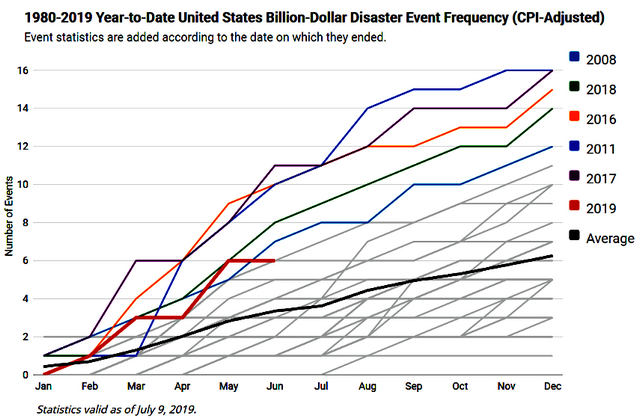
NOAA graphic on frequency of billion-dollar climate disasters 1980-2019
NOAA
“The Psychology of Resilience”
McLeod said they are “thinking about the psychology of resilience,” person by person, with families doing things differently, too. This is behavior modification, so they are also looking at how culture can help.
For example, video games that teach kids about climate change and being psychologically resilient (“such as a competition to beat the storm, beat the flood”), plays about it, and Batik art that inspires resilience.

Open Source
“Everything we do is going to be open source,” McLeod emphasized, because “one of the tenets of our work, is that we’re going to share how these projects are going early and often…as frequently as every 90 days,” because scaling fast is crucial.
This will create a huge collection of best practices for improving the resilience of communities and reducing the risks of climate change, including what has not worked for which communities and why, that anyone anywhere can access for free.

Links

Greta Thunberg Sets Sail For New York On Zero-Carbon Yacht

The Guardian

Climate activist begins voyage from Plymouth to Trump’s US with father and two-man crew
Greta Thunberg begins zero-carbon Atlantic voyage.

On white-crested swells under leaden skies, the teenage climate activist Greta Thunberg has set sail from Plymouth on arguably her most daunting challenge yet.
A two-week crossing of the Atlantic during hurricane season in a solar-powered yacht is the first obstacle, but it is unlikely to be the toughest in an odyssey through the Americas over many months.
This will be both the ultimate gap year and a journey into the heart of climate darkness: first to the United States of president Donald Trump, who has promised to pull out of the Paris climate agreement, and then down to South America, possibly including Brazil where president Jair Bolsonaro is overseeing a surge of Amazon deforestation.
In between, the 16-year-old Swede will add her increasingly influential voice to appeals for deeper emissions cuts at two crucial global gatherings: the Climate Action Summit in New York on 23 September and the the UN climate conference in Santiago in early December.
The reception awaiting her on the other side is likely to be mixed, with the climate issue a polarising point in US politics.


In a taste of the hostility that is likely to come from supporters of the fossil fuel industry, Steve Milloy, a Fox News contributor and former member of the Trump transition team, described Thunberg on Twitter earlier this week as “the ignorant teenage climate puppet”.
The young founder of the school climate strike movement appeared unfazed in a quayside press conference before she boarded the vessel. “There’ll always be people who don’t understand or accept the science. I’ll ignore them,” she said. “Climate delayers want to shift the focus from the climate crisis to something else. I won’t worry about that. I’ll do what I need.”
Speaking to a throng of several dozen reporters from around the world, she said her primary goal was to raise awareness among the public about the climate emergency. “People (need to) come together and put pressure on people in power so they have to do something,” she said.
Asked if she will meet Donald Trump, the teenager said it would be a waste of time because the US president hasn’t been persuaded by the experts he has already spoken to. “I’m not that special. I can’t convince everyone,” she said.
The voyage is a demonstration of her declared values, which revolve around reducing emissions. A flight to New York would have been much quicker, but it would pump close to 1,000kg of carbon dioxide into the atmosphere. Conventional cruise ships often have an even bigger footprint.
Instead, Thunberg – along with her father, a cameraman and a two-man crew – are taking a zero carbon option.
The Malizia II is an 18 metre (60ft) racing yacht that was built for round-the-world challenges and has just completed the annual Fastnet competition. It generates the power for lighting and communication through solar panels and underwater turbines. The racing team have removed sponsorship logos from the hull and emblazoned Greta’s slogan “Unite Behind the Science” on the mainsail.
The yacht is designed for speed rather than luxury so conditions will range from basic to difficult. There is no toilet or shower on the boat, only blue plastic buckets. Inside the cabins the lights are dim so Thunberg will need a headlamp or torch to read and keep her journal. Internet access is also likely to be patchy, so her 883,000 Twitter followers may have to wait longer than usual for updates via satellite phone. Her diet will be freeze-dried vegan meals – she has given up meat, which is a major source of emissions.
The young Swede is braced for sea sickness. Although the waves were small as she left Mayflower Marina in Plymouth, she will be fortunate if they remain that way. August is part of the hurricane season in the Atlantic. Even in moderate swells, the vessel is noisy and bumpy.
The experienced German captain, Boris Hermann, said the 3,500 nautical mile journey would demonstrate that it is possible to cope without fossil fuels and get closer to nature. “I want to show that this can be positive and exciting,” he said. “And that solidarity with Greta is not limited to eco-activists.”
Make America Greta Again placard seen as Climate change activist Greta Thunberg sets sail for New York in the 60ft Malizia II yacht. Photograph: Finnbarr Webster/Getty Images
The journey marks a new stage in the remarkable rise of the young Swede, who was unknown outside of her family and school until she started a climate strike last August. She has been diagnosed with Aspergers and has at various times experienced depression, anxiety and selective mutism. Today, however, she has become the spokesperson for the global climate movement and its most recognisable face.Her Fridays for Future campaign has now mobilised more than a million students across the globe. She has been invited to UN summits, feted at the World Economic Forum in Davos, nominated for the Nobel peace prize, collaborated on a song with the band the 1975, appeared on the cover of countless magazines and been credited with injecting new life into the climate movement.
Last month, the head of the trillion-dollar Organization of the Petroleum Exporting Countries (Opec) described the campaign by Greta and others as the greatest threat to the fossil fuel industry.
“Some things are actually changing, like the mindsets of people. It’s not fast enough, but it’s something,” she said.
Thunberg gets a hug before she begins her voyage. Photograph: Kirsty Wigglesworth/PA 


The scale of the movement will be tested on 20 September, when Thunberg and others have called for a global general strike for the climate.
By that time Thunberg should be in the US, where she plans to meet the UN secretary general, António Guterres, as well as US politicians. She has been promised a warm welcome from the congresswoman Alexandria Ocasio-Cortez, with whom she has already discussed strategies to raise climate ambitions and mobilise campaigners.
Supporters hope Thunberg’s 12 months off school will be a world-changing gap year. After the US, Thunberg will head south to the UN climate summit in Santiago. Asked if she would also visit Brazil, Thunberg was vague. “I’ll travel around the whole continent,” she said. “I’m taking it step by step … I’ll travel for I don’t know how long. I want it to be loose. Not a tight schedule so that it can change as time goes by.” That includes the return voyage. “I don’t know yet how I will get home.”
As she walked towards the yacht in her black waterproofs, there were cheers, applause and cries of “Safe journey.” By the time the vessel pulled into the harbour, the skies cleared, and better weather is forecast this evening and next week.
On Tuesday, Thunberg will pass the first-year anniversary of her campaign in the middle of the Atlantic. “I will see how I will celebrate. I don’t know yet. I will think about it,” she said. “I think it will be quite an adventure.”

Links

15/08/2019

New Zealand Caught In The Middle Of Australia's Climate Change Tussle With The Pacific

ABC NewsMelissa Clarke

New Zealand Prime Minister Jacinda Ardern speaks to journalists in Tuvalu. (Pool)
Key points:
  • Jacinda Ardern said every country must commit to greater cuts in carbon emissions
  • The world leaders are expected to come to a consensus on a statement on climate change
  • Mr Morrison has committed to talk about the future of the environment
New Zealand has become caught in the middle of the stoush brewing between Australia and Pacific leaders in Tuvalu over climate change.
Pacific countries want Australia to take stronger action on climate change domestically, a demand Australia's Prime Minister Scott Morrison has so far rebuffed.
As the leaders meet for the Pacific Islands Forum (PIF) in Tuvalu's capital, Funafuti, New Zealand Prime Minister Jacinda Ardern's position will be crucial to determining what the group of leaders can agree upon.
Mr Morrison yesterday announced a $500 million package of funding, redirected from aid spending, to help Pacific countries invest in renewable energy and become more resilient to climate and weather events.
But Tuvalu's Prime Minister, Enele Sopoaga, warned that the climate money should not be used by Australia as an excuse to avoid reducing emissions and phasing out coal-fired power generation.
Today, Ms Ardern has backed calls by the leaders of Tuvalu and Fiji that every country must commit to greater cuts in carbon emissions.
"Like our Pacific Island neighbours, we will continue that international call," she said.
"We will continue to say that New Zealand will do its bit and we have an expectation that everyone else will as well — we have to.
"New Zealand, relative to other nations, has a relatively small emissions profile, however, if we all took the perspective that if you're small it doesn't matter, we wouldn't see change.
"Every single little bit matters."
Ms Ardern would not give a direct answer when pressed on whether Australia's commitment under the Paris Agreement to cut emissions by 26 to 28 per cent was adequate, as other Pacific leaders have said.
"Australia has to answer to the Pacific [and] that's a matter for them," she said.
The 50th Pacific Islands Forum is being held in Tuvalu, a small Pacific country north-east of Australia. (ABC News: Melissa Clarke)
The leaders at the PIF meeting in Funafuti are expected to come to a consensus on a statement on climate change, which is being negotiated over the course of the week.
Australia is pushing back against plans to include in the statement a timeframe for phasing out the use of coal-fired power generation and committing more funding to the UN-backed Green Climate Fund that supports developing countries.

The Carteret Islands were the first place in the world to require population relocations due to climate change, with predictions they would be submerged by 2015.

Ms Ardern did not rule out New Zealand making future contributions to the Green Climate Fund, but echoed concerns Australia has raised about its efficacy.
"Some of our Pacific neighbours haven't been able to access climate finance," she said.
"That some of the direct funding that we're able to put in around protecting water supply, around costal hazards, that's equally important too.
"So you'll see from some our aid and development support, we've gone directly while also acknowledging the multilateral institutions and funds."
At a function with the leaders of Tuvalu and Nauru, Mr Morrison committed to "talk[ing] about the future of the environment".
"When families come together, they talk about the stuff that matters, what's most important to them," he said.
The 50th Pacific Islands Forum is being held in Tuvalu, a small Pacific country north-east of Australia. (ABC News: Melissa Clarke)
Mr Morrison is yet to directly address the Pacific leaders' climate change concerns, but has promised to talk about it.
"To step up, you have to show up and Australia is going to show up," he said.
"We're going to show up for the hard conversations, the good conversations, the family conversations."

Links

ASIC Issues Updated Guidance For Directors Seeking To Avoid Climate Lawsuits

RenewEconomy - 


Australia’s corporate regulator has released updated guidance reminding directors that they need to assess and disclose the risks of climate change to their businesses, or they could be found to be legally liable for a failure to act.
The Australian Securities and Investment Commission’s move follows a Senate inquiry on carbon risk disclosure, and it explains to companies  the type of information that should be included in company prospectus’ and regular reporting of company operations.
There are growing calls from various investor groups for companies to undertake comprehensive assessments of the risks posed by climate change to their operations, and for the development of plans for how those risks will be mitigated.
In particular, company directors have been spurred into action as a result of a growing body of legal advice that suggests directors face the risk of being sued by investors and the wider community if they fail to address the risks of climate change to their companies.
A survey of large banks, insurers and superannuation managers completed by the Australian Prudential Regulation Authority (APRA) found that just one third of respondents believed climate change was a material risk to the operations.
This includes notable advice from the former president of the NSW and Australian Bar Associations, Noel Hutley SC, who suggested that the risk of climate change related litigation is accelerating unless directors start proactively considering climate change risks.
Globally, recommendations to companies are being driven by the Taskforce on Climate-Related Financial Disclosures (TCFD), established by the G20’s Financial Security Board, and chaired by Bloomberg founder and former New York mayor Michael Bloomberg.
Companies have scrambled to understand the recommendations of the TCFD, and those of financial regulators, to mitigate the legal risks of ignoring climate change.
Financial regulators, including ASIC, have pointed to the different kinds of risks that may impact companies, including the physical risks to assets and property, as well as the transitional risks that are created through a shift away from activities that contribute to climate change, such as fossil fuel extraction.
While ASIC updated its guidance on the types of risks that companies should assess and disclose, it believes there are minimal risks that directors will face litigation, provided they follow the advice.
For example, ASIC has now provided updated guidance to companies about the kinds of climate change related financial risks that should be disclosed.
ASIC, along with other regulators, has pointed to two key kinds of risks that may impact companies, including the physical risks to assets and property through flooding and severe weather events, as well as the transitional risks that are created through a shift away from activities that contribute to climate change, such as policies seeking to reduce fossil fuel use.
“Transitioning to a lower-carbon economy may entail extensive policy, legal, technology and market changes to address mitigation and adaption requirements related to climate change,”  the ASIC guidance on prospectus disclosure now says.
“Depending on the nature, speed and focus of these changes, transition risks may pose varying levels of financial and reputational risk to companies (transitional risks of climate change).
“Physical risks resulting from climate change can be event driven (acute) or longer term shifts (chronic) in climate patterns. Physical risks may have financial implications for companies, such as direct damage to assets and indirect impacts from supply chain disruption.”
ASIC has also updated its guidance on ongoing risk disclosures for company directors, recommendation that companies continue to undertake assessments of climate change related risks, and such assessments should feature within regular operational reports for companies.
ASIC believes that provided directors are making such disclosure and that these disclosures are in line with the best available evidence at the time, directors can mitigate the risk of legal liability for making ‘misleading or deceptive’ forward-looking statements.
“While disclosure is critical, it is but one aspect of prudent corporate governance practices in connection with the mitigation of legal risks,” it says.
“Directors should be able to demonstrate that they have met their legal obligations in considering, managing and disclosing all material risks that may affect their companies. This includes any risks arising from climate change, be they physical or transitional risks.”
ASIC will undertake active assessment of the climate change risk disclosures by companies, to ensure they are complying with the disclosure expectations.
The announcement was welcomed by the Australian Greens, who were the original instigators of the Carbon Risk Disclosure enquiry that recommended ASIC update its guidance, but said the government needed to do more to ensure the reporting obligations were enforced.
“We’re pleased to see additional work from ASIC providing guidance to companies on carbon risk, following on from the Greens work in establishing a senate inquiry,” Greens spokesperson Adam Bandt told RenewEconomy.
“We’re also calling on ASIC and the government to go further to ensure Australian companies are adequately protected against carbon risk.  The Greens are calling for mandatory carbon risk disclosure requirements for large companies, climate-exposed companies and the financial sector. We also want to see explicit responsibilities introduced for company directors to manage climate risk.”
Alongside regulators, there are growing calls from various investor groups for companies to undertake comprehensive assessments of the risks posed by climate change to their operations, and for the development of plans for how those risks will be mitigated.
Major Australian companies have faced multiple calls from groups representing investors to better assess their contributions to climate change, and the risk it poses to the future of the company.
This has included shareholder resolutions put forward on behalf of shareholders by groups like Market Forces and the Australian Centre for Corporate Responsibility, targeting companies like BHP, AGL, Rio Tinto, Woodside and Santos which all have direct exposures to the fossil fuel industry.

Links

Wollongong Council Declares 'Climate Emergency'

Sydney Morning Herald - Desiree Savage

Environmental organisation Greenpeace has applauded Wollongong City Council's decision to declare a climate emergency, calling it "huge stuff".
Wollongong City Council's declaration brings the total number of NSW councils declaring or recognising climate emergencies to 16. The total was 17, with Wagga Wagga City Council also backing a motion, but this was later recinded amid community backlash against councillors.
Wollongong is the 32nd Australian council to declare climate emergency. Credit: Peter Rae
The City of Sydney council backed a similar motion in June to declare such an "emergency".
Wollongong Councillor Ann Martin moved the motion, which was debated for more than an hour at the council meeting on Monday evening, calling on the council to recognise the community is in a state of climate emergency.
The end result was a vote in favour to support the motion, and also called for a report to look at the best ways Wollongong can combat climate change.
Wollongong Mayor Gordon Bradbery. Credit: AAP
Councillor Leigh Colacino opposed the motion, arguing council was already doing a significant amount in the space.
Lord Mayor Gordon Bradbery offered his support over an issue he believed needed action.
"We can't change the world but we can do out bit," he said.
Wollongong is the 32nd Australian council to declare climate emergency, a move which is more to "stand in solidarity", Cr Bradbery said.
Cr Bradbery said the declaration identifies with "the concerns of people in the community".
"[The declaration] was to identity that there is a need for action, but it gave us a platform to highlight basically what we're achieving already," he said.
"We need to work with other agencies and groups in the city and to do our bit ameliorating global gas emissions."
Cr Bradbery said council would continue to improve and look at ways in which they could improve how the city affects climate change.
Environmentalist Susie Crick has also applauded the move, stating "one pebble dropped in the water creates many ripples".
The Australian councils are part of around 800 across the globe to have declared climate emergencies, encompassing more than 140 million people worldwide.

Links

14/08/2019

Australia Will Fund A $500m Climate Change Package For The Pacific, PM To Announce

The Guardian

Pacific leaders say they need more than money from Australia as they demand concrete actions to reduce emissions
Claire Anterea, co-founder of the Kiribati Climate Action Network, says the situation in the Pacific is ‘not about cash’. Photograph: Kate Lyons/The Guardian 
Scott Morrison will unveil a $500m climate change and oceans funding package for the Pacific region when he attends the Pacific Islands Forum leaders meeting in Tuvalu this week.
The funding package, which will use existing aid funds to help Pacific nations invest in renewable energy and climate and disaster resilience, will build on the $300m given by the government for that purpose in 2016-2020.
“The Pacific is our home, which we share as a family of nations. We’re here to work with our Pacific partners to confront the potential challenges they face in the years ahead,” said the prime minister.
The government also announced it had set aside $140m from the aid budget to encourage private sector investments in low-emission, climate-resilient projects for the Pacific and south-east Asia.
Morrison will face strong pressure from other Pacific leaders when he arrives in Tuvalu on Wednesday, many of whom have already issued warnings that they want commitments from Australia at this forum for concrete action to reduce emissions and to move away from coal-fired power.
On Monday, during a one-day climate conference hosted by the Tuvalu government, the Fijian prime minister, Frank Bainimarama, a global leader in the fight against climate change, issued a direct appeal to Australia to move away from coal-powered energy and asked its government “to more fully appreciate” the “existential threat” facing Pacific nations.
“Put simply, the case for coal as an energy source cannot continue to be made if every nation is to meet the net zero emission target by 2050 that has been set by the UN secretary general and every other responsible leader of the climate struggle,” said Bainimarama, who is a former president of the UN’s leading climate body COP (Conference of the Parties).
The forum is being hosted in Tuvalu, a country of 11,000 people located three hours north of Fiji, which is at serious risk from rising sea levels as a result of climate change. Climate change is at the heart of this year’s forum, from the moment leaders arrive at Funafuti airport and are greeted by the children of Tuvalu, who sit submerged in water, in a moat built around the model of an island, singing: “Save Tuvalu, save the world.”
Speaking to Guardian Australia ahead of the forum, the prime minister of Tuvalu, Enele Sopoaga, said he had concerns about Australia’s coal policy and its use of carryover credits as a means of reducing emissions. He said the positive relationship with Australia could change if the future of his people was not taken seriously.
“I hope we can be more understanding that the people of Tuvalu and small island countries are already submerged, are already going underwater,” Sopoaga said.
“If our friend Australia does not show them any regard, any respect, it is a different thing, we cannot be partner with that thinking. I certainly hope we do not come to that juncture to say we cannot go on talking about partnerships regardless of whether it is [the Australian government’s Pacific] Step-Up or [New Zealand’s Pacific] Reset, while you keep pouring your coal emissions into the atmosphere that is killing my people and drowning my people into the water.”
Simon Bradshaw, Oxfam Australia’s climate advocacy lead who is in Tuvalu for the forum, said that while this money would be welcomed by Pacific leaders, it would not mean the Australian government was off the hook when it came to reducing emissions.
“Australia couldn’t come here empty-handed, they were going to have to bring something, but a new commitment of climate finance ... that’s not enough,” said Bradshaw.
“It’s one part of the equation, it’s an important part, but really it carries no meaning if it’s not accompanied by new strong commitments from Australia to drive down its emissions, its carbon pollution, to move beyond coal, to play its part in limiting warming to one and a half degrees, which we’ve heard repeatedly is crucial to survival in the region.”
Bradshaw said that Pacific leaders had never been as strident in their calls for urgent action to reduce emissions and preserve their homes and islands as they have been in the lead-up to this forum.
“They’re absolutely clear that Australia’s rising emissions, our coal exports are threatening their very survival,” he said. “From all the talk we’ve heard this week, whereas this commitment will be welcomed, it’s certainly not going to quieten the concerns of Pacific leaders who have been very clear that they want Australia to look beyond coal, to move to 100% renewable energy and to really appreciate the sorts of challenges they face here.”
Claire Anterea, co-founder of the Kiribati Climate Action Network, an advocacy group based in Kiribati, which like Tuvalu, is one of the small island states most at risk due to rising sea levels, said: “Our situation in Kiribati and in the Pacific, it’s not about cash, it’s not about giving lots of money, if Australia doesn’t do actions within their own country,” she said.
“Australia needs to do more, not just give money to solve the problem. Money is not the solution for the impacts of climate change. Our Kiribati government is working toward adaptation, but my worry is how long are we going to adapt? Adapt forever? I don’t think that is a possible solution for us, there will be a time when adaptation is not going to work.”

Links

Lethal Heating is a citizens' initiative