17/08/2019

How Rising Sea Levels Erase Culture

Sydney Morning Herald - Nick Galvin

Of all the myriad, insidious impact of climate change, its corrosive effect on culture has received comparatively little attention.
But for the 1200 people living on the tiny, remote pacific island nation of Tokelau and the 10,000 or so Tokelauans in New Zealand and Australia, the climate crisis threatens not only their physical home but the very survival of their culture.
Te Molimau is a new production by Tokelauan-Samoan writer and actor Taofia Pelesasa. It is set in the year 2060, by which time it is estimated low-lying Tokelau will have disappeared entirely.
Director Emele Ugavule (left) with actors Lesina Ateli-Ugavule, Tommy Misa and Iya Ware. Credit: Dom Lorrimer
The play looks at the last hour of the nation through the eyes of the one remaining resident, a young woman called Vitolina.
"It imagines what it might look like for us Tokelauans to watch our island disappear because the rest of the world didn’t take action," says director Emele Ugavule.
As storms have worsened and seawater has encroached ever further onto the three atolls that make up Tokelau, residents have left in even greater numbers.
It imagines what it might look like for us Tokelauans to watch our island disappear because the rest of the world didn’t take action.
Director Emele Ugavule
Many have settled in New Zealand, where they have citizenship, while a significant proportion has moved to live around New South Wales' Mt Druitt area.
"That impacts our language and our culture," she says. "The current estimate is that only 30 per cent of Tokelauans living outside Tokelau speak our language fluently.
"Our understanding of how to care for the land and the ocean is embedded in our language.
"And our cultural practices like singing and dancing are embedded in our everyday life in the islands – how do we maintain that in a context where we have to make money to survive rather than grow fish or food to surive?"
Ugavule says the play is an important milsetone for her country.
"It’s a really big deal for us," she says. "We don’t know of any other work that has been about Tokelau ever."
And it is being staged at a particularly opportune time as leaders, including Prime Minister Scott Morrison, gather this week for the Pacific Islands Forum in Tuvalu, where climate change will once again be top of the agenda.
Ugavule hopes the play will encourage empathy among the audience and maybe inspire some to take action.
"It’s a very emotional experience for everyone involved," she says. "The entire play is our lived experience and our families’ lived experience."

Links

Revealed: 'Fierce' Pacific Forum Meeting Almost Collapsed Over Climate Crisis

The Guardian - 

Australia’s prime minister Scott Morrison came under fire from Tuvalu’s leader Enele Sopoaga
Australia’s prime minister, Scott Morrison, speaks after the Pacific Islands Forum. He clashed with Tuvalu’s leader, Enele Sopoaga, over Australia’s climate policy in 12-hour talks on Thursday. Photograph: Mick Tsikas/AAP
Critical talks at the Pacific Islands Forum almost collapsed twice amid “fierce” clashes between the Australian prime minister, Scott Morrison, and Tuvalu’s prime minister, Enele Sopoaga, over Australia’s “red lines” on climate change.
Ralph Regenvanu, Vanuatu’s foreign minister, who was part of the drafting committee of the forum communique and observed the leaders’ retreat, said there was heated discussion over the Australian delegation’s insistence on the removal of references to coal, setting a target of limiting global warming to below 1.5C and announcing a strategy for zero emissions by 2050.
He described the discussions as “frank, fierce at times, [with] very strong positions being held”.
“Negotiations almost broke down twice, [with leaders] saying ‘this is not going to happen, we’re not going to have a collective decision’,” he said. Leaders had to take a break from proceedings, which started about 9.30am local time and lasted for almost 12 hours.
“That’s why it took so long,” Regenvanu said. “When things break down, you know there’s a huge amount of frustration, luckily it didn’t break all the way down and the leaders were able to bring it back.”
Leaders had to cancel meetings and press conferences scheduled for the afternoon, as the retreat stretched through the afternoon and well into the night. An evening feast that was meant to mark the close of the forum, prepared by the community from one of Tuvalu’s atolls, complete with a traditional dance performance, began without the leaders.
The leaders of Papua New Guinea, Vanuatu, New Zealand, Fiji and Samoa talk before the group photo at the Pacific Island Forum. Photograph: Mick Tsikas/EPA
Regenvanu said one compromise proposed to resolve the impasse was to declare a climate crisis for the Pacific island states, which do not include Australia, rather than for the whole region. Regenvanu said Australia had agreed to that “in total blindness to what’s happening in their own country”.
“On emissions reduction and dealing with your own climate, Australia is out there, they’re not with us,” he said. “Pretty much on everything else we’re on the same team, in terms of mitigation, adaptation, making sure there’s resourcing for all this, it’s only in terms of domestic emissions strategy that Australia is way out.”
Asked whether the breakdowns came because of Australia’s refusal to budge on its positions on climate change, Regenvanu said “that would not be an incorrect assumption”. He said it was mostly Sopoaga who took the fight to Australia.
Speaking on Friday morning at a joint press conference with Morrison, Sopoaga said he had told the Australian prime minister during the retreat: “‘You are concerned about saving your economies, your situation in Australia, I’m concerned about saving my people in Tuvalu and likewise other leaders of small island countries.’”
“That was the tone of the discussion,” Sopoaga said. “Please don’t expect that [Australia] comes and we bow down or that ... we were exchanging flarey language, not swearing, but of course you know, expressing the concerns of leaders and I was very happy with the exchange of ideas, it was frank. Prime minister Morrison, of course, stated his position and I stated my position and [that of] other leaders: we need to save these people.”
Sopoaga said the discussions were so passionate that the prime minister of Tonga cried at the retreat while talking about two young women who had presented to leaders on Monday about the impacts of the climate crisis.
“The leader of Tonga actually shed tears in front of the leaders for the passion about referring to the presentation of the two young warriors of climate change the other day,” said Sopoaga. “That was the atmosphere.”
Tuvalu’s prime minister, Enele Sopoaga, had heated discussions with Scott Morrison. Photograph: Mick Tsikas/AAP 
Fiji’s prime minister, Frank Bainimarama, expressed unhappiness with the declarations on Thursday night. “We came together in a nation that risks disappearing to the seas, but, unfortunately we settled for the communique,” he said on Twitter. “Watered-down climate language has real consequences – like water-logged homes, schools, communities, and ancestral burial grounds.”
Despite the concessions to Australia throughout the communique and climate change statement, Sopoaga said he thought leaders had achieved “probably the best outcome given the context and circumstances”.
Regenvanu said that apart from the five red lines that “compromised” the documents, the resulting statement was a “stronger statement on climate change than the forum has ever made”.
“There was reference to 1.5 [degrees warming] throughout, reference to supporting the science of the IPCC report, supporting all the stuff the UN secretary general talked about, just transition away from fossil fuels, stopping inefficient fossil fuel subsidies.
“So most of the language that we wanted is in there and I think it’s a much stronger statement on climate change than the forum has ever made. That’s the positive,” he said.
“I think it’s a credit to [the leaders] what we ended up with something and that we all can live with it. We all can implement it, we all can own it, including Australia.”

Links

Pacific Leaders, Australia Agree To Disagree About Action On Climate Change

ABC News - Melissa Clarke

Mr Morrison said the views of smaller nations within the Pacific Islands Forum were not binding on the rest of the group. (AAP: Mick Tsikas)
Key points:
  • Australia expressed reservations about several sections, and New Zealand at least one
  • This means no country has fully committed to endorsing the Tuvalu Declaration
  • "I think we can say we should've done more work for our people," Tuvalu's Prime Minister said
Australia has stymied efforts by small island states to get Pacific-wide consensus on their declaration for stronger action on climate change.
Regional leaders, including Australia and New Zealand, held 12-hour talks in the tiny Pacific nation of Tuvalu for this year's Pacific Islands Forum (PIF), eventually reaching an agreement on a statement on climate change and a communique early this morning.
They could not reach agreement on the Tuvalu Declaration made by smaller Pacific countries, instead drafting a separate Kainaki II Declaration, with different terms on coal use and emissions reduction.
The finished communique comes with a qualification that means the leaders do not support all of the declaration from the smaller nations.
Earlier in the week, the Smaller Island States (SIS) group agreed to the Tuvalu Declaration, which acknowledges a climate change crisis, encourages countries to revise the emissions reductions targets and calls for a rapid phase out of coal use.

Introducing Tuvalu
Prime Minister Scott Morrison will arrive in Tuvalu, one of the smallest and least-visited nations on Earth, for the annual gathering of Pacific leaders, who have named climate change as their top issue.
They had hoped the leaders of the Pacific Islands Forum, which includes Australia and New Zealand, would endorse it.
But Australia expressed reservations about several sections, and New Zealand at least one, so the final communique endorses the Smaller Island States "with qualifications".
That means no country has fully committed to endorsing the Tuvalu Declaration.
Speaking after the marathon leaders meeting, Mr Morrison said he wanted the SIS group to be able to express its views "freely" but that its statement was not binding on the rest of the forum.
"The Pacific Island Forum has its leaders meeting and it agrees to the things that it agrees. And then the Small Island States have their own forum that sit within that," he said.
"And it's not incumbent on the leaders' forum to have to run a ruler over that."

'The Prime Minister of Tonga actually cried'
Tuvalu's Prime Minister Enele Sopoaga made climate change the central focus of the meeting. (AAP: Mick Tsikas)
That disappointed the PIF chair, Tuvalu's Prime Minister Enele Sopoaga, who said as he left the meeting: "We tried our best".
Mr Sopoaga had invested significant time and energy in making climate change the central focus of the meeting, and pushed for the Tuvalu Declaration to be adopted by Australia, but was resigned to the alternative outcome.
Negotiations were heated, particularly between Mr Sopoaga and Mr Morrison.

Pacific pivot undermined
Australia is being warned its return to its Pacific neighbours after years of neglect risks being undermined by the Government's intransigence on the region's main threat: climate change.
"We expressed very strongly during our exchange, between me and Scott [Morrison], I said: 'You are concerned about saving your economy in Australia … I am concerned about saving my people in Tuvalu,'" Mr Sopoaga said.
"That was the tone of the discussion. Please don't expect that we come and bow down … we were exchanging flaring language — not swearing — but of course expressing the concerns of leaders."
"The Prime Minister of Tonga actually cried in the meeting … shed tears in front of the leaders, such is the passion."
The outcome falls short of what Mr Sopoaga and some other Pacific leaders had hoped.
"It was a negotiated outcome, I think it still contains some references to the (UN) Secretary-General's message to accelerate actions against climate change and it's a way forward," he said.
"I think we can say we should've done more work for our people."

How do the declarations differ on key issues?
Pacific leaders called on Australia to do more to make a faster transition away from coal-generated power. (Supplied)
Emissions reductions
  • Tuvalu Declaration
    "Encourage all countries to revise their nationally determined contributions so as to rapidly reduce greenhouse gas emissions."
  • Kainaki II Declaration
    "Call for... all parties to the Paris Agreement to meet or exceed their nationally determined contributions."

Climate change and the ADF
Australia's Defence Department has spelled out clearly to a Senate inquiry that climate change will create "concurrency pressures" for the Defence Force as a rise in disaster relief operations continues.
Coal use
  • Tuvalu Declaration
    "We re-affirm the UN Secretary-General's call for an immediate global ban on the construction of new coal-fired power plants and coal mines and ... [call on them to] rapidly phase out their use of coal in the power sector."
  • Kainaki II Declaration
    "Invite all parties to the Paris Agreement to reflect" on the UN Secretary-General's remarks on "fossil fuel subsidies and just transition from fossil fuels."
    "[Call on] the members of the G7 and G20 to rapidly implement their commitment to phase out inefficient fossil fuel subsidies."
Green climate fund
  • Tuvalu Declaration
    "We call for a prompt, ambitious and successful replenishment of the Green Climate Fund."
  • Kainaki II Declaration
    The international community "continues efforts towards" meeting international funding commitments, "including the replenishment of the Green Climate Fund."
Links

16/08/2019

Dave Eggers: Why We Should Listen To Teenagers Speak About Climate Crisis

The Guardian - Dave Eggers

As the International Congress of Youth Voices kicks off in San Juan, Puerto Rico, the Guardian invited young delegates to write about their fight against the climate crisis
International Congress of Youth Voices, David Eggers interacting with students. Photograph: Isabel Talanehzar 
Dave Eggers
Dave Eggers is a writer, publisher and humanitarian campaigner.
He has written 14 books, including A Heartbreaking Work of Staggering Genius, What Is the What, The Circle and Heroes of the Frontier.
Dave Eggers is co-founder of the International Congress of Youth Voices, and co-founder of 826 National, a network of youth writing and tutoring centers around the United States.
Teenagers speak with a directness and a moral clarity that is desperately rare in our elected leaders, and perhaps in the adult species as a whole.
 That’s why we created the International Congress of Youth Voices. It’s an annual gathering of young writers and activists, ages 16 to 22, who speak and live with urgency.
The first conference was last summer in San Francisco, where almost a hundred delegates from twenty-six countries gathered, and were mentored by the likes of Chimamanda Ngozi Adichie, Khaled Hosseini, and congressman John Lewis.
One of our most inspiring young delegates in that first conference was 15-year-old Salvador Góomez-Colón from Puerto Rico, who created his own non-profit to help the island’s recovery after Hurricane Maria.
Eight months ago, we decided that we’d hold the second Congress in San Juan. We knew Puerto Rico would be a rich and inspiring location for the delegates to explore issues of colonialism and climate change, for starters, but we had no idea it would be, in August of 2019, the most exciting place on the planet to watch grassroots democratic change in action.
'I am growing up in a world whose life systems are unraveling'
Jamie Margolin
And this recent gubernatorial unseating began with our increasingly volatile climate, and how we react to it. Governor Ricardo Rosselló did not meet the reasonable expectations of his people, he denigrated them in their time of need, and now he’s gone. And the people who marched, who took to the streets and wouldn’t leave until he left, were overwhelmingly young.
This was a youth movement, and demonstrates what can happen when young people convert their outrage into action.
The delegates of the International Congress of Youth Voices are doing this every day. And one of the issues they’re most passionate about is – no surprise, given that they are inheriting our towering mess – climate change.
The following essays provide a sampling of their thoughts, plans and, to be sure, their justifiable exasperation.
“I am growing up in a world whose life systems are unraveling,” writes Jamie Margolin, in one of the most sobering examples of the psyches of young people growing up with the prospect of a climate apocalypse.
“In ten years I’ll be 28. My life will just be beginning when the world is ending.”
Dave Eggers talks with youth delegates, including Salvador Gómez-Colón, left, at the International Congress of Youth Voices in San Juan, Puerto Rico. Photograph: Isabel Talanehzar


What follows are short pieces
by student delegates to the
International Congress of Youth Voices

•••


♦ Why I fight for climate change by Joshua Borokinni
Joshua, a 19-year-old delegate from Lagos, Nigeria, is a climate activist, social innovator, and journalist with a keen interest in sustainable and developmental reporting.
Losing a friend to a climate-induced flood in 2016 is the reason I committed myself to a cause bigger than myself – climate action. This quest for a better planet was a reaction to my friend’s death which saw me spend six hours daily for a month in the library – studying climate change – its etymology, science, politics, legal frameworks and projections.
Climate change is inarguably the biggest single threat to existence of lifewhich affects every constituent of the planet – humans, animals, oceans, deserts, atmosphere inter alia. We have seen an unprecedented increase in heatwaves, cyclones, food insecurity and drought in recent times.
In Nigeria, climate change is the underlying drive for the current Fulani Herdsmen - Farmers clashes which has seen the death of over 5,000 people in the past four years. The Chad basin is drying up and the Sahel savannah is experiencing immense drought and desert encroachment, forcing herdsmen to move down south in search for pastures. As the migration has increased, so too have violent clashes over grazing lands between local farmers in the south and pastoral herdsmen, whom the former accuse of wanton destruction of their crops and forceful appropriation of their lands.
Sadly, in the wake of these happenings, Nigerians have yet to see climate change as an important issue. Many international treaties are yet to be joined, climate action gets less than 1% of the budget, and the president has not focused on climate policy. This is attributed to the widespread poverty, unemployment, insecurity and bad governance leaving climate action as an URGENT but NOT IMPORTANT agenda on the scale of preference. Nonetheless, these problems are all interconnected and Nigeria has a low adaptive capacity towards the impact of climate change.
Governments need to do more! As the United States’ elections draw near, it is high time to put aside political differences and prioritize the safety and sustainability of all Americans by putting climate action at the top of the to-do list. The world needs to see aggressive and action-driven interventions across all levels of government and a responsible green-oriented populace to mitigate the scary projections of climate change, else, there will be nowhere to run.

•••


♦ A bad dystopian movie by Jamie Margolin
Jamie, 17, is a Colombian-American writer, community organizer, activist, and public speaker living in Seattle, Washington, who founded Zero Hour, an international youth climate justice movement.
If you were watching a movie, and all of the characters in it knew there were only 10 years left to save the world, but they continued going on with their lives as if nothing was happening you would yell at the screen right? I would.
We on planet Earth are living out that movie. Climate change and environmental destruction are quite literally ending the world – and the United Nations has made it crystal clear through years of extensive scientific research that we have a maximum of 10 years left in order to turn the tides on the climate crisis and save humanity and every creature we share this once-blue earth with.
Ten years left to save the world.
That means starting yesterday, we have to radically change our society – the way we live, the way we power our lives and fully make that just climate action transition in the span of 10 years in order for it to not be too late.
I’m 17 years old, going into my senior year in high school, and I am growing up in a world whose life systems are unraveling. In 10 years, I’ll be 28. My life will just be beginning when the world is ending. It is not fair to my entire generation that we are inheriting this monstrosity of a problem. It’s hard enough trying to grow up and live your life, let alone inherit this crisis that makes it so your future will be full of chaos and disaster.
That’s why I, along with 12 other young people and the help of the non-profit, Our Children’s Trust, recently sued the state of Washington. Why? Because the whole state government is screwing over my generation. Washington state’s elected officials love to talk about solving the climate crisis, but then turn around and issue permits for fossil fuel plants that poison communities, and destroy ecosystems, water, air and land that my generation and future generations need to survive.
What’s even crazier? The lack of necessity. They are destroying our life support systems with a fossil fuel energy system that is wholly unnecessary to provide for our basic energy needs. Experts across the planet say that we don’t need to power our planet with dirty life-threatening fuels.
I can’t risk not fighting. My future is on the line.

•••


♦ Why do I fight for climate change? by Matilde Bondo Dydenesborg
Matilde is a 15-year-old climate activist and writer from Denmark.
For years, I didn’t know the climate problems we were facing, but when I found out I kept asking myself: will I have a future? Why didn’t we do anything when we had the chance? Adults were condescending. I felt like the only thing I could do was trust the people who had the power to change. I was concerned that global warming wasn’t their first priority, and all I did was go to school every day, asking myself: what am I doing here when a world is disappearing outside my window?
Then I started researching. My teacher told us about the international movement School Strike 4 Climate. Students from around the world were deciding not to attend class, but rather take part in demonstrations demanding action and the changes they wanted to see. I thought this could be my opportunity, quickly asking my friends if they wanted to go. Though they agreed, I found out they were more interested in skipping class than demanding change from the powers that be. I was disappointed because I thought they cared as much as I did. I wanted them to care as much as I did.
While skipping class to insist upon action is valuable, education is foundational. That’s why I founded an environmental council at my school. I fight for my future, and I fight to inspire people to do the same. I fight for surviving.

Links

Making One Billion People Resilient To Climate Change By 2030

Forbes - Joan Michelson

“World food security increasingly at risk due to ‘unprecedented’ climate change impact, new UN report warns.” That’s the official United Nations website announcing a new report from the U.N. Intergovernmental Panel on Climate Change (IPCC).Our food is at risk? That gets our attention!

Screen shot of UN webiste on food security report 8-2019
The soil across the globe is being depleted by current agricultural processes and climate change, the report says, adding hat the solution is to use “plant-based foods and fuels.”
The report emphasizes that scaling solutions is critical to drive results – fast. But how?
Many communities are tackling this issue, but one here, one there is not fast enough to combat the current pace of climate change.  A new center with powerful partners and resources has been formed to scale viable solutions at a record pace, that is, to reach one billion people on the planet with resilience solutions by 2030.  That’s only 10 years.
“So, the urgency couldn’t be greater,” Kathy Baughman McLeod, the inaugural Director of the Atlantic Council’s new Adrienne Arsht-Rockefeller Foundation Resilience Center told me recently. To do so, they are laser focused on scaling solutions that have proven to be effective based on hard evidence. It’s also about campaigns to educate the public about what they can do in their own homes, schools and communities.
Kathy Baughman McLeod, Atlantic Council Resilience Center, C40 Cities
photo Atlantic Council
Partnering with local communities and the Urban Institute and leveraging the solutions and plans developed by the Resilience 100, another Rockefeller Foundation initiative, the Resilience Center is focused on actionable, effective, results-focused, and measurable technologies and campaigns to reduce the risks of climate change and increase resilience and security.  “Our focus is adaptation,” McLeod said.
This is not another opportunity for startups to pilot their programs, nor is it planning. And, no, they do not give grants.  They work through partnerships and align with commitments cities and countries made in the Paris Climate Accord and with the Sustainable Development Goals.
McLeod said their key questions for whether or not they accept a project are, “Can we add value?... Are they asking for our help? Do we have something unique that others don’t? ... Where can we be effective and how can we get to a billion people in 10 years?”

Practical, Scalable, Community-Driven
McLeod emphasized that they have to be very practical and cost-effective, because, “We’re pure implementation.” Since they are focused on getting it done, being 100% convinced is not an option. If they are 80% sure it will work, it’s a “go.”
“We’re flying it and building it at the same time,” she explained. One strategy that are using to scale solutions is to test solutions across countries by leveraging “regional risks pools,” composed of several countries that are sharing the risks and reducing insurance costs.
The Center is helping cities and communities leverage the plans and strategies they have developed. “There’s a great pipeline,” McLeod said.  “They know what needs to be done, the financial aspects and specific risks to that community. They know the stakeholders to engage.”
Some solutions are communications tools, for example, to help residents with the threat of global heat, which is lethal in some areas. She described an app the city of Athens developed called “Extrema,” which helps citizens find out where they can go to cool off and what they can do to protect their health, based on their location, age, and health status.
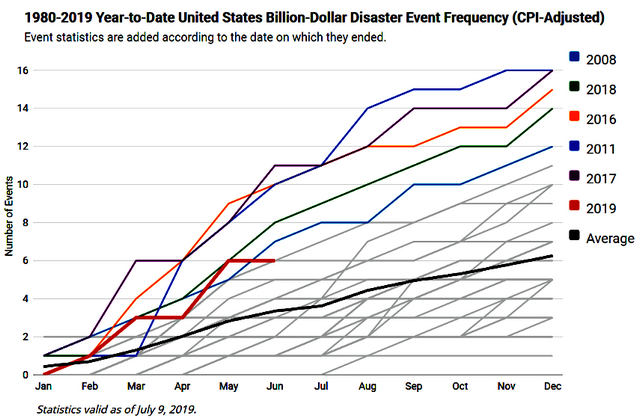
NOAA graphic on frequency of billion-dollar climate disasters 1980-2019
NOAA
“The Psychology of Resilience”
McLeod said they are “thinking about the psychology of resilience,” person by person, with families doing things differently, too. This is behavior modification, so they are also looking at how culture can help.
For example, video games that teach kids about climate change and being psychologically resilient (“such as a competition to beat the storm, beat the flood”), plays about it, and Batik art that inspires resilience.

Open Source
“Everything we do is going to be open source,” McLeod emphasized, because “one of the tenets of our work, is that we’re going to share how these projects are going early and often…as frequently as every 90 days,” because scaling fast is crucial.
This will create a huge collection of best practices for improving the resilience of communities and reducing the risks of climate change, including what has not worked for which communities and why, that anyone anywhere can access for free.

Links

Greta Thunberg Sets Sail For New York On Zero-Carbon Yacht

The Guardian - 

Climate activist begins voyage from Plymouth to Trump’s US with father and two-man crew
Greta Thunberg begins zero-carbon Atlantic voyage.

On white-crested swells under leaden skies, the teenage climate activist Greta Thunberg has set sail from Plymouth on arguably her most daunting challenge yet.
A two-week crossing of the Atlantic during hurricane season in a solar-powered yacht is the first obstacle, but it is unlikely to be the toughest in an odyssey through the Americas over many months.
This will be both the ultimate gap year and a journey into the heart of climate darkness: first to the United States of president Donald Trump, who has promised to pull out of the Paris climate agreement, and then down to South America, possibly including Brazil where president Jair Bolsonaro is overseeing a surge of Amazon deforestation.
In between, the 16-year-old Swede will add her increasingly influential voice to appeals for deeper emissions cuts at two crucial global gatherings: the Climate Action Summit in New York on 23 September and the the UN climate conference in Santiago in early December.
The reception awaiting her on the other side is likely to be mixed, with the climate issue a polarising point in US politics.


In a taste of the hostility that is likely to come from supporters of the fossil fuel industry, Steve Milloy, a Fox News contributor and former member of the Trump transition team, described Thunberg on Twitter earlier this week as “the ignorant teenage climate puppet”.
The young founder of the school climate strike movement appeared unfazed in a quayside press conference before she boarded the vessel. “There’ll always be people who don’t understand or accept the science. I’ll ignore them,” she said. “Climate delayers want to shift the focus from the climate crisis to something else. I won’t worry about that. I’ll do what I need.”
Speaking to a throng of several dozen reporters from around the world, she said her primary goal was to raise awareness among the public about the climate emergency. “People (need to) come together and put pressure on people in power so they have to do something,” she said.
Asked if she will meet Donald Trump, the teenager said it would be a waste of time because the US president hasn’t been persuaded by the experts he has already spoken to. “I’m not that special. I can’t convince everyone,” she said.
The voyage is a demonstration of her declared values, which revolve around reducing emissions. A flight to New York would have been much quicker, but it would pump close to 1,000kg of carbon dioxide into the atmosphere. Conventional cruise ships often have an even bigger footprint.
Instead, Thunberg – along with her father, a cameraman and a two-man crew – are taking a zero carbon option.
The Malizia II is an 18 metre (60ft) racing yacht that was built for round-the-world challenges and has just completed the annual Fastnet competition. It generates the power for lighting and communication through solar panels and underwater turbines. The racing team have removed sponsorship logos from the hull and emblazoned Greta’s slogan “Unite Behind the Science” on the mainsail.
The yacht is designed for speed rather than luxury so conditions will range from basic to difficult. There is no toilet or shower on the boat, only blue plastic buckets. Inside the cabins the lights are dim so Thunberg will need a headlamp or torch to read and keep her journal. Internet access is also likely to be patchy, so her 883,000 Twitter followers may have to wait longer than usual for updates via satellite phone. Her diet will be freeze-dried vegan meals – she has given up meat, which is a major source of emissions.
The young Swede is braced for sea sickness. Although the waves were small as she left Mayflower Marina in Plymouth, she will be fortunate if they remain that way. August is part of the hurricane season in the Atlantic. Even in moderate swells, the vessel is noisy and bumpy.
The experienced German captain, Boris Hermann, said the 3,500 nautical mile journey would demonstrate that it is possible to cope without fossil fuels and get closer to nature. “I want to show that this can be positive and exciting,” he said. “And that solidarity with Greta is not limited to eco-activists.”
Make America Greta Again placard seen as Climate change activist Greta Thunberg sets sail for New York in the 60ft Malizia II yacht. Photograph: Finnbarr Webster/Getty Images
The journey marks a new stage in the remarkable rise of the young Swede, who was unknown outside of her family and school until she started a climate strike last August. She has been diagnosed with Aspergers and has at various times experienced depression, anxiety and selective mutism. Today, however, she has become the spokesperson for the global climate movement and its most recognisable face.Her Fridays for Future campaign has now mobilised more than a million students across the globe. She has been invited to UN summits, feted at the World Economic Forum in Davos, nominated for the Nobel peace prize, collaborated on a song with the band the 1975, appeared on the cover of countless magazines and been credited with injecting new life into the climate movement.
Last month, the head of the trillion-dollar Organization of the Petroleum Exporting Countries (Opec) described the campaign by Greta and others as the greatest threat to the fossil fuel industry.
“Some things are actually changing, like the mindsets of people. It’s not fast enough, but it’s something,” she said.
Thunberg gets a hug before she begins her voyage. Photograph: Kirsty Wigglesworth/PA 


The scale of the movement will be tested on 20 September, when Thunberg and others have called for a global general strike for the climate.
By that time Thunberg should be in the US, where she plans to meet the UN secretary general, António Guterres, as well as US politicians. She has been promised a warm welcome from the congresswoman Alexandria Ocasio-Cortez, with whom she has already discussed strategies to raise climate ambitions and mobilise campaigners.
Supporters hope Thunberg’s 12 months off school will be a world-changing gap year. After the US, Thunberg will head south to the UN climate summit in Santiago. Asked if she would also visit Brazil, Thunberg was vague. “I’ll travel around the whole continent,” she said. “I’m taking it step by step … I’ll travel for I don’t know how long. I want it to be loose. Not a tight schedule so that it can change as time goes by.” That includes the return voyage. “I don’t know yet how I will get home.”
As she walked towards the yacht in her black waterproofs, there were cheers, applause and cries of “Safe journey.” By the time the vessel pulled into the harbour, the skies cleared, and better weather is forecast this evening and next week.
On Tuesday, Thunberg will pass the first-year anniversary of her campaign in the middle of the Atlantic. “I will see how I will celebrate. I don’t know yet. I will think about it,” she said. “I think it will be quite an adventure.”

Links

15/08/2019

New Zealand Caught In The Middle Of Australia's Climate Change Tussle With The Pacific

ABC News - Melissa Clarke

New Zealand Prime Minister Jacinda Ardern speaks to journalists in Tuvalu. (Pool)
Key points:
  • Jacinda Ardern said every country must commit to greater cuts in carbon emissions
  • The world leaders are expected to come to a consensus on a statement on climate change
  • Mr Morrison has committed to talk about the future of the environment
New Zealand has become caught in the middle of the stoush brewing between Australia and Pacific leaders in Tuvalu over climate change.
Pacific countries want Australia to take stronger action on climate change domestically, a demand Australia's Prime Minister Scott Morrison has so far rebuffed.
As the leaders meet for the Pacific Islands Forum (PIF) in Tuvalu's capital, Funafuti, New Zealand Prime Minister Jacinda Ardern's position will be crucial to determining what the group of leaders can agree upon.
Mr Morrison yesterday announced a $500 million package of funding, redirected from aid spending, to help Pacific countries invest in renewable energy and become more resilient to climate and weather events.
But Tuvalu's Prime Minister, Enele Sopoaga, warned that the climate money should not be used by Australia as an excuse to avoid reducing emissions and phasing out coal-fired power generation.
Today, Ms Ardern has backed calls by the leaders of Tuvalu and Fiji that every country must commit to greater cuts in carbon emissions.
"Like our Pacific Island neighbours, we will continue that international call," she said.
"We will continue to say that New Zealand will do its bit and we have an expectation that everyone else will as well — we have to.
"New Zealand, relative to other nations, has a relatively small emissions profile, however, if we all took the perspective that if you're small it doesn't matter, we wouldn't see change.
"Every single little bit matters."
Ms Ardern would not give a direct answer when pressed on whether Australia's commitment under the Paris Agreement to cut emissions by 26 to 28 per cent was adequate, as other Pacific leaders have said.
"Australia has to answer to the Pacific [and] that's a matter for them," she said.
The 50th Pacific Islands Forum is being held in Tuvalu, a small Pacific country north-east of Australia. (ABC News: Melissa Clarke)
The leaders at the PIF meeting in Funafuti are expected to come to a consensus on a statement on climate change, which is being negotiated over the course of the week.
Australia is pushing back against plans to include in the statement a timeframe for phasing out the use of coal-fired power generation and committing more funding to the UN-backed Green Climate Fund that supports developing countries.

The Carteret Islands were the first place in the world to require population relocations due to climate change, with predictions they would be submerged by 2015.

Ms Ardern did not rule out New Zealand making future contributions to the Green Climate Fund, but echoed concerns Australia has raised about its efficacy.
"Some of our Pacific neighbours haven't been able to access climate finance," she said.
"That some of the direct funding that we're able to put in around protecting water supply, around costal hazards, that's equally important too.
"So you'll see from some our aid and development support, we've gone directly while also acknowledging the multilateral institutions and funds."
At a function with the leaders of Tuvalu and Nauru, Mr Morrison committed to "talk[ing] about the future of the environment".
"When families come together, they talk about the stuff that matters, what's most important to them," he said.
The 50th Pacific Islands Forum is being held in Tuvalu, a small Pacific country north-east of Australia. (ABC News: Melissa Clarke)
Mr Morrison is yet to directly address the Pacific leaders' climate change concerns, but has promised to talk about it.
"To step up, you have to show up and Australia is going to show up," he said.
"We're going to show up for the hard conversations, the good conversations, the family conversations."

Links

Lethal Heating is a citizens' initiative