26/09/2019

Climate Change Could Stretch Our Capabilities, Defence Force Chief Speech Warns

ABC NewsMelissa Clarke

The speech, obtained under freedom of information, was prepared for General Angus Campbell. (AAP: Andrew Taylor)
Key points
  • The Defence Chief's speech warns of the threat climate change poses to Australia's military and deployments
  • The speech was prepared for General Angus Campbell for an invitation-only event in regional NSW
  • It stated that climate change disasters have required more Australian personnel than the Afghan war
Increasingly frequent natural disasters caused by climate change could stretch the capability of the Australian Defence Force (ADF), according to a speech prepared for Defence Force Chief Angus Campbell.
It warns of climate change prompting more disaster relief efforts, as well as more peace-keeping missions, given it says climate change has "the potential to exacerbate conflict".
The speech, obtained under freedom of information, was prepared for General Campbell to deliver to an invitation-only retreat in regional New South Wales in June for managers from government departments and agencies.
It's not clear how closely he followed it, with General Campbell characterising his presentation as "extemporaneous" but drawing on "key facts and vignettes" from the written speech.
The speech notes that Australia is in "the most natural disaster-prone region in the world" and that "climate change is predicted to make disasters more extreme and more common".
It sets out the level of commitment required from the ADF to respond to climate change-related events compared to more traditional deployments.
"Australia sent around 1,000 troops to support Operation Fiji Assist [after Cyclone Winston], about 1,600 ADF personnel assisted after Cyclone Debbie hit Queensland and earlier this year, close to 3,000 troops helped North Queensland clean up after the floods," the written speech states.
"At the height of our involvement, we had about 1,500 troops in Afghanistan.
"The number of troops deployed on disaster relief missions can, at times, be a significant commitment for Defence.
"Deploying troops on numerous disaster relief missions, at the same time, may stretch our capability and capacity."
The global effort to combat climate change has been discussed at the United Nations in New York this week. (AP Photo: Evan Vucci)


Warming unprecedented in 2,000 years
As well as missions to assist after natural disasters, climate change could see the ADF drawn into more conflicts around the world, the speech warned.
It considers the Syrian civil war, setting out how climate change-induced drought "added enormous pressure" to existing problems.
"Defence may also be increasingly called upon to support stabilisation, governance or peace-keeping activities."
The written speech also set out how the Federal Government's actions on climate change could affect relationships with Pacific island nations, given they are asking Australia to do more to reduce emissions.
"It could impact our ability to influence their choices for support in the region."

Labor's Pat Conroy said whether or not the speech was delivered remains irrelevant. (ABC News: Matt Roberts)
Labor's spokesman for the Pacific, Pat Conroy, described the speech as the most significant from Defence in a decade, whilst noting General Campbell's insistence he spoke off-the-cuff at the event.
"It doesn't actually matter whether it was given or not," he said.
"This was the final speech, signed off by all of Defence, including the Chief of the Defence Force, as their official views at this forum on climate change as a national security threat."


An island's race against time
The Carteret Islands were the first place in the world to require population relocations due to climate change, with predictions they would be submerged by 2015.

The Department of Defence declined to clarify what General Campbell said, however prior reporting of the presentation included remarks identical to the written speech.
"If this is in a prepared speech for an outside event, you can guarantee Defence is giving this same advice to Government," Mr Conroy said.
"I'm heartened that the ADF is thinking about this seriously, as they should, and projecting into the long term.
"[The] Government is clearly not taking it seriously, otherwise you wouldn't have a very weak 2030 target that they have no hope of achieving."
The Federal Government last year signed the Boe Declaration, a Pacific-wide declaration stating that climate change is the single greatest threat to security in the region.
However, the Coalition was slammed at last month's Pacific Islands Forum leaders meeting in Tuvalu over its refusal to take stronger action to combat climate change.

Links

Australian Government Seen Globally As Climate 'Denialist', UN Summit Observers Say

The Guardian

Experts at the meeting say Australia is seen as ‘engaging in greenwashing’ and using accounting tricks to increase emissions
Scott Morrison inspects an interactive menu in Chicago while other leaders attend the climate summit. Photograph: Mick Tsikas/AAP
Scott Morrison is increasingly seen as running a “denialist government” that is not serious about finding a global climate solution and uses “greenwash” to meet its emissions commitments, analysts and former diplomats say.
Australian observers in New York said Morrison’s failure to attend a UN climate action summit on Monday despite being in the US, and his apparent rejection of the need for Australia to do more to address its rising greenhouse gas emissions, eroded goodwill for the country on the issue.
While representatives from about 60 nations spoke at the summit, Morrison gave a keynote speech at the Chicago Institute for Global Affairs in which he challenged China to do more heavy lifting on climate change and suggested it should be treated as a “newly developed” economy rather than a developing one.
Bill Hare, the chief executive and senior scientist of Climate Analytics and a longtime adviser to countries at climate talks, said the UN summit had been “very disappointing” as most larger polluters, including Australia, had failed to meet the secretary general Antonio Guterres’ call to increase commitments, leaving ambitious strides to smaller nations.
He said country representatives at the summit were dismissive of Australia’s intentions.
“Diplomatic officials from countries that I speak with see Australia as a denialist government,” he said. “It’s just accepted that’s what it is. It is seen as doing its own promotion of coal and natural gas against the science.”
Hare said Morrison’s suggestion China should be doing more on climate, and be treated similarly to the most developed countries, while Australia’s emissions continued to increase year-on-year was a “ridiculous fake argument”.
He said China, the world’s most populous country and biggest annual polluter, was not doing anywhere near enough to tackle the crisis, but was doing more than Australia on many measures. It had national policies in a number of areas – boosting renewable energy, energy efficiency, electric vehicles and efficiency in industry – where Australia did not.
“Is that having enough of an effect in China? No. But will China peak its emissions by the end of the 2020s? Yes,” Hare said.
“Will Australia? There is no evidence that Australia will peak its emissions as far as I’ve seen in any projections that have been published.”
A report backed by the world’s major climate science bodies released on the eve of the summit found current plans would lead to a rise in average global temperatures of between 2.9C and 3.4C by 2100, a shift likely to bring catastrophic change across the globe.
Richie Merzian, a former climate diplomat who now works at progressive thinktank the Australian Institute, said Australia was seen by other countries as denying the severity of the problem and in engaging in “greenwashing” by using accounting tricks to meet targets while actual emissions increased.
While leaders from other countries did not attend – notably Japan, Brazil and South Africa, while Donald Trump made a surprise passing appearance – Merzian said Morrison’s absence was seen as condescending as he was nearby. “If prime minister Morrison thinks he has skipped this meeting and not damaged his relationship with the Pacific, he’s in denial,” Merzian said.
With Morrison absent, having not being invited to speak, Australia’s delegation was instead led by the foreign affairs minister, Marise Payne, and the Australian ambassador for the environment, Patrick Suckling.

Kevin Rudd: Australia is ‘free-riding’
The former Australian prime minister Kevin Rudd told the ABC Morrison’s failure to attend sent a message to corporate Australia it was not serious about climate action. National emissions have increased each year since the carbon pricing scheme was abolished in 2014.“When you have a prime minister of the country not stepping up to the plate, addressing the world’s forum, and indicating what Australia’s future carbon reduction commitments will be, it sends a very clear message to the Australian domestic community and the international community that the Australian government is just not serious,” Rudd said.
“We are free-riding on the rest of the world. I believe it’s unacceptable.”
Asked about criticism thrown at the Swedish teenage climate activist Greta Thunberg, who gave an impassioned address at the summit, Rudd said she represented “the anger of that generation and does so effectively”.
“It might insult a whole lot of middle-aged white guys, because it is not the way that we would talk, or we think that it is inappropriate for a young girl to speak that way, but when I speak to young people around the world, whether it is in China, here in the United States or back home in Australia, frankly there is a rising rage that our generation has failed to step up to the plate,” he said.
Greta Thunberg at the climate summit. Kevin Rudd says she represents ‘the anger of that generation and does so effectively’. Photograph: Kena Betancur/AFP/Getty Images
Dean Bialek, a former Australian diplomat to the UN, now working with the Mission 2020 campaign led by ex-UN climate chief Christiana Figueres, said Australia was increasingly perceived as a “self-interested laggard”, pointing to the Morrison government’s support for new coalmines as the mainstream science community and the UN secretary general called for thermal coal to be rapidly phased out.
He said Australia was also seen as engaging in double-speak as it claimed to be meeting its international commitments while planning to use “carryover credits” from the Kyoto protocol that did not represent new emission cuts and were not referred to in the Paris agreement.
Australia was also ignoring a key part of the Paris deal: that the targets volunteered in France, in Australia’s case a 26-28% cut below 2005 levels by 2030, were not enough and would be reviewed and ramped up.
“Not only has Australia started with a very weak target but it is now saying it is not planning to increase that very weak target next year,” Bialek said. “There seems to be complete amnesia about this big commitment made in Paris.”
Under questioning in the US, Morrison ducked questions about when Australia would develop an emissions reduction strategy for 2050, despite signing on at the Pacific Islands Forum to a communique pledging to develop one next year.
He said his government would meet the 2030 commitments made at the election. Asked what the plan beyond that was, Morrison said: “We are making our commitments to 2030, that’s what we are doing. We keep setting the targets and we keep meeting them.”

Links

2019 Arctic Sea Ice Minimum Tied For Second Lowest On Record

NASA - Maria-José Viñas

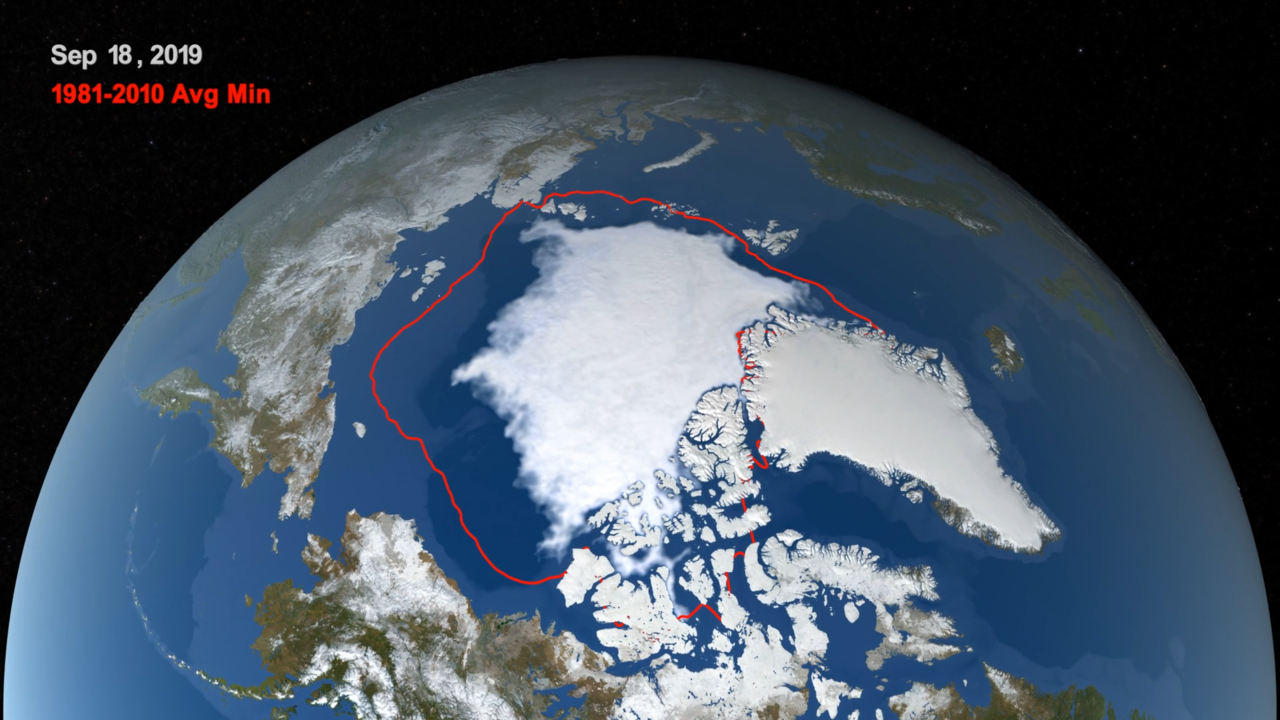
Arctic sea ice likely reached its 2019 minimum extent on Sept. 18. At 1.60 million square miles (4.15 million square kilometers), this year's summertime extent is effectively tied for the second in the satellite record, according to NASA and the National Snow and Ice Data Center. Credit: NASA/Trent Schindler
LARGE IMAGE
The extent of Arctic sea ice at the end of this summer was effectively tied with 2007 and 2016 for second lowest since modern record keeping began in the late 1970s. An analysis of satellite data by NASA and the National Snow and Ice Data Center (NSIDC) at the University of Colorado Boulder shows that the 2019 minimum extent, which was likely reached on Sept. 18, measured 1.60 million square miles (4.15 million square kilometers).


Arctic sea ice likely reached its 2019 minimum extent on Sept. 18. At 1.60 million square miles (4.15 million square kilometers), this year's summertime extent is effectively tied for the second in the satellite record, according to NASA and the National Snow and Ice Data Center. Credit: NASA/ Katie Jepson. 
This video can be downloaded at NASA's Scientific Visualization Studio.

The Arctic sea ice cap is an expanse of frozen seawater floating on top of the Arctic Ocean and neighboring seas. Every year, it expands and thickens during the fall and winter and grows smaller and thinner during the spring and summer. But in the past decades, increasing temperatures have caused marked decreases in the Arctic sea ice extents in all seasons, with particularly rapid reductions in the minimum end-of-summer ice extent.
Changes in Arctic sea ice cover have wide-ranging impacts. The sea ice affects local ecosystems, regional and global weather patterns, and the circulation of the oceans.
“This year’s minimum sea ice extent shows that there is no sign that the sea ice cover is rebounding,” said Claire Parkinson, a climate change senior scientist at NASA’s Goddard Space Flight Center in Greenbelt, Maryland. “The long-term trend for Arctic sea ice extent has been definitively downward. But in recent years, the extent is low enough that weather conditions can either make that particular year’s extent into a new record low or keep it within the group of the lowest.”
An opening in the sea ice cover north of Greenland is partially filled in by much smaller sea ice rubble and floes, as seen during an Operation IceBridge flight on Sept. 9, 2019. Credit: NASA/Linette Boisvert
The melt season started with a very low sea ice extent, followed by a very rapid ice loss in July that slowed down considerably after mid-August. Microwave instruments onboard United States Department of Defense’s meteorological satellites monitored the changes from space.
“This was an interesting melt season,” said Walt Meier, a sea ice researcher at NSIDC. “At the beginning of August we were at record low ice levels for that time of the year, so a new minimum record low could have been in the offering.
”But unlike 2012, the year with the lowest ice extent on record, which experienced a powerful August cyclone that smashed the ice cover and accelerated its decline, the 2019 melt season didn’t see any extreme weather events. Although it was a warm summer in the Arctic, with average temperatures 7 to 9 degrees Fahrenheit (4 to 5 degrees Celsius) above what is normal for the central Arctic, events such as this year’s severe Arctic wildfire season or European heat wave ended up not having much impact on the sea ice melt.
“By the time the Siberian fires kicked into high gear in late July, the Sun was already getting low in the Arctic, so the effect of the soot from the fires darkening the sea ice surface wasn’t that large,” Meier said. “As for the European heat wave, it definitely affected land ice loss in Greenland and also caused a spike in melt along Greenland’s east coast, but that’s an area where sea ice is being transported down the coast and melting fairly quickly anyway.”

Links

25/09/2019

David Attenborough Slams Australian PM On Climate Record

ABC triplej Hack

Sir David Attenborough has slammed Prime Minister Scott Morrison's support for new coal mines and lack of action on climate change, in his most damning assessment yet of Australia's environmental record.
In an interview with Hack, the world's most renowned natural historian said previous governments had been "saying all the right things" but this had suddenly changed.
"You are the keepers of an extraordinary section of the surface of this planet, including the Barrier Reef, and what you say, what you do, really, really matters."
"And then you suddenly say, 'No it doesn't matter ... it doesn't matter how much coal we burn ... we don't give a damn what it does to the rest of the world.'"


"It's their world": Sir David Attenborough praises young people protesting for climate change, and slams Scott Morrison for bringing a lump of coal into Parliament in 2017.

The veteran conservationist responded to Scott Morrison bringing a lump of coal into Question Time in February 2017, when he was Treasurer.
"I don't think it was a joke," he said.
"If you weren't opening a coal mine okay I would agree, it's a joke. But you are opening a coal mine."
He also commented on the recent federal election, which Mr Morrison won with a platform of support for new coal mines, including the proposed large Adani mine in Queensland, as well as a less ambitious emissions reduction target than Labor.Asked how politicians can carry the public with them on taking action on climate change, he said politicians had "to appeal to what people think is right."
"Do you think it's right that we go on destroying the natural world?" he said.
The Government’s own projections show Australia is not on track to meet its current Paris target.
A cardboard cutout of Sir David Attenborough with Extinction Rebellion flags in London.
Getty

The September 20 climate strike in Sydney.
Getty


But he also made an economic argument for action: "We have to convince bankers and big business that, in the end, the long-term future lies in having a healthy planet. And unless you do something about it ... you're going to lose your money."
And one for basic self-preservation: "The world is going to be running short of food, seriously short of food."
Tens of millions could be exposed to crop failure and famine in the next few decades due to climate change, according to the UN panel for assessing the science of climate change, the IPCC.

On the global climate strike and mass protest
Speaking to Hack ahead of last week's global climate strike, the 93-year-old threw his support behind young people taking to the streets in protest.
"Young people see things very clearly. And they are speaking very clearly to politicians," he said.
"They [people under 18] may not have the vote ... but it's their world that's coming along and they want to make it clear to the politicians that they know that."
Australian school students at the September 20 climate strikes. ABC News: Brendan Esposito
A cardboard cutout of Sir David Attenborough
with Extinction Rebellion flags in London.
Getty

Climate strikers in Sydney.
ABC News: Brendan Esposito
The BBC presenter, who regularly tops polls of Britain's favourite people, recently narrated a documentary on climate change titled The Facts.This, along with the Extinction Rebellion, which occupied parts of central London over two weeks in April, has been credited as the reason why the UK declared a climate emergency.
Sir David said he backed the strategy of non-violent direct action.
"If they just sit on the sidelines, and [debate] in a nice, reasonable way, you know, they'll say, 'oh kids'. But if they actually do something in the way that they have been doing in this era, then politicians have to sit up and take notice."
"And you can say, 'It gets you nowhere, just stopping the traffic'. But it gets you notice. People listen to what you say. And that you're important.
"And they are important. They are the people who are going to inherit the mess that we've made."

On the Great Barrier Reef
Sir David said his most vivid impression of climate change's human impact was returning to the Great Barrier Reef, where he had first dived in the 1950s.
"A bleached reef is a tragic sight," he said of his last dive there, 10 years ago.
"A desperately tragic sight, particularly if you've seen it before, and you know what it could have been like.
"You just see acre after acre of deathly white coral."
A diver checks out coral bleaching on the Great Barrier Reef in February 2016. Supplied: The Ocean Agency / XL Catlin Seaview Survey
David Attenborough

On climate denialism: "The world is sick, we really have to do things about it. And there's no more time for argument."

On a sustainable diet: "Maybe everybody when they get into their 70s 80s or 90s loses their taste for meat. I've certainly lost mine."

On population: "All the evidence is that wherever women are educated and literate, and have the vote, and are able to determine what they do, and when they have children, and they have medical advice to help them, then the birth rate falls."

On plastic: "I can't help feeling we invented the stuff; surely, for heavens, we are clever enough to think of a way of disposing of it."

On his least favourite animal: "I don't hate many things but I do hate rats."
Since then, the reef has had at least two more severe coral bleaching events.
Sir David has previously said Australia will face some of the worst effects of climate change. He told Hack the country has been having "a really bad time".
But the present impact of climate change paled in comparison to his description of the refugee crisis predicted to occur as the planet warms.
"The drought areas of this world, and you have more than your fair share, are due to spread, simply because of the rise in temperature.
"The front line is southern Europe."
"We're talking about tens of thousands of people who suddenly won't have a bit of land in which they can grow their food.
"And, poor souls, they want somewhere to live, and raise their kids. Now are you going to turn them away?
"And if you are going to turn them away where are you going to put them?"

On facing his own death
At 93, Sir David is working on a new BBC documentary for 2020. Extinction: The Facts looks at what mass animal and plant extinctions mean for humanity.
He says he feels blessed to be able to keep working, and to have lasted long enough to see a rising environmental consciousness.
Asked whether he was afraid of dying, he said he simply hoped it won't be "tiresome for others".
"I hope it won't be painful," he said.
On life after death, the great educator of natural selection said he remains agnostic.
"I am quite sure that the mechanism by which this world has become populated with all these different species of animals and plants we understand pretty well now," he said.
"Whether you say that means that God doesn't exist is another question.
"It may be that there is an overall creative spirit that we don't know about. I have no idea. And whether it's a life after death, I have no idea."

Links

Climate Change To Hit Super Returns

AFRJoanna Mather

The drag on economic growth associated with climate change will wipe 0.25 per cent a year from superannuation returns for the foreseeable future, according to the asset consultants at Frontier Advisors.
Frontier, whose core clients are industry funds, is convinced that even under the most optimistic scenarios, climate change will weigh on economic growth and therefore investment returns.
“We have lowered the likely returns we believe investors can expect, across all asset classes, by 0.25 per cent a year," principal consultant Philip Naylor said.
“The primary driver of this downward revision has been the long-term impact on the global economy of climate change.


"What we're saying to trustees is that if in the past you've been aiming for a 7 per cent return, for example, you should expect the same portfolio will only deliver at 6.75 per cent return."
Frontier provides investment advice and research to clients that collectively have $380 billion in funds under management.
One response from those funds to the lower assumed return might be to increase their exposure to riskier or illiquid assets to make up for the expected shortfall.
But they might also choose to accept the drop and convey that message to regulators and members.

Drought, storms
Assets can be directly damaged by flood, drought and severe storms, but portfolios can also be harmed indirectly, through weaker growth and lower returns.
Frontier's modelling takes into account the cost of damage associated with climate change – such as more frequent and destructive weather events – and the cost of mitigation, meaning the cost of trying to limit the magnitude of global warming and its related effects.
"We’re saying to our clients: you can lock in a loss of 25 basis points as best case," Mr Naylor said.
The modelling assumes that governments will implement already agreed measures to address climate change such as the Paris Agreement − the global pact to keep temperature increases this century below 2 degrees above pre-industrial levels.
Frontier modelled the net impact of climate change on investment returns across different policy paths to the end of the century.
Frontier, which is owned by AustralianSuper, Cbus, HESTA and First Super, will this week tell its clients about the cut in its assumed risk-free rate.
The risk-free rate is the likely return on a safe investment, typically a government bond, and is used to compare returns with riskier investment options.
Frontier conducts annual reviews of long-term investment themes but adjustments to its risk-free rate are infrequent.
The last revision occurred in 2015, when the rate was cut largely due to the likely effects of demographic change, including lower birth rates and ageing populations in some parts of the world.

Links

Pacific Leaders Urge The World Not To Accept The 'Living Nightmare' Of Climate Change

ABC NewsMichael Walsh | Agencies

Pacific leaders warned climate change was creating a terrifying "new normal" for their citizens. (Supplied: Darren James)
Key points
  • World leaders are meeting in New York for a UN Climate Action Summit
  • Fiji's Frank Bainimarama said climate change was a "living nightmare" for island nations
  • Teen activist Greta Thunberg said world leaders had "stolen" her childhood
Pacific leaders have sought to remind the world what is at stake for the most vulnerable, amid warnings not enough is being done to stave off the most damaging impacts of climate change.
World leaders have gathered at the United Nations in New York for a Climate Action Summit, where countries have been urged to account for the sluggish progress being made on reducing global greenhouse gas emissions.
A new report from the World Meteorological Organisation released ahead of the conference warned the world was falling far behind in the race to avert a climate disaster.


An island's race against time
The Carteret Islands were the first place in the world to require population relocations due to climate change, with predictions they would be submerged by 2015.

The last five years have been the hottest on record, the report said, with ice sheets melting and sea levels rising at an unprecedented rate.
Opening remarks from UN secretary-general Antonio Guterres set the tone early with another urgent warning.
"Nature is angry. And we fool ourselves if we think we can fool nature, because nature always strikes back and around the world, nature is striking back with fury," he said.
It was a theme later picked up by Fiji's Prime Minister Frank Bainimarama, whose country has borne the brunt of that fury in recent years.
Forty-four people were killed when Cyclone Winston struck Fiji in February 2016. (ABC News: Brant Cumming)
"The brutality of our changing climate has already driven vulnerable communities into a nightmare scenario, one in which the hellscape of storms like Cyclone Winston and Hurricane Dorian have become the new normal," he told the summit.
"Acceptance of this living nightmare is morally unthinkable, and denial is unconscionable."
Mr Bainimarama warned that even if temperature rises were restricted to the 1.5 degrees Celsius limit outlined in the Paris Agreement, many more innocent people would die without urgent adaptation measures.

'How dare you'
Before world leaders started to deliver their speeches, 16-year-old climate activist Greta Thunberg gave an emotional appeal in which she chided the leaders with the repeated phrase, "How dare you."
Ms Thunberg's lone protest outside the Swedish Parliament more than a year ago sparked a global movement, culminating in Friday's global climate strikes
Marshall Islands President Hilda Heine told the summit falling short of that 1.5 degrees target "would mean the greatest failure of humanity that we have ever seen."
Marshall Islands' President Hilda Heine called for better climate change adaptation for vulnerable countries. (AP: Jason DeCrow)
The average elevation in the Marshall Islands is barely 2 metres above sea level — the Pacific nation is even looking into raising the elevation of its more than 1,000 islands, in response to the threat posed by rising seas.
"Not enough is being done to adapt our world to the impacts that we have already locked in, let alone the worst that's yet to come," Dr Heine said.
"This summit must be the moment we choose survival over selfishness, communities over coal and planet over profits."

Trump's surprise appearance
Donald Trump did not speak at the summit, but briefly listened in to one of the speeches. (AP Photo: Evan Vucci)

Leaders were only permitted to speak at the event if they could offer up new climate action plans — even major emitters like the United States, Japan and Saudi Arabia did not take the podium.
However, this didn't stop US President Donald Trump from making a brief appearance, listening in to a speech by German Chancellor Angela Merkel, before making a silent exit.
Fiji, Marshall Islands, Palau and Tonga were all given speaking slots due to their commitment to global efforts.


Warming unprecedented in 2,000 years
Mr Bainimarama said Fiji was in the process of relocating vulnerable communities and had submitted its roadmap for reaching net zero emissions by 2050, among other measures.
"While Fiji did not cause the climate crisis, we are fully awake to its reality. Someone must act with clear purpose and resolve, someone must clear a path for others to follow," he said.
With climate impacts such as extreme weather, thawing permafrost and sea-level rise unfolding much faster than expected, scientists say the urgency of the crisis has intensified since the Paris agreement was struck.
However pledges made so far under the agreement are nowhere near enough to avert catastrophic warming, scientists say, and last year carbon emissions hit a record high.
The agreement will enter a crucial implementation phase next year, and Dr Heine said history would not forgive leaders who failed to step up to the challenge.
"This is the lens through which history will judge this summit and all of us," she said.
"The time has come for leaders to do just that — lead," she said.
Mr Bainimarama and Mr Morrison have previously locked horns over climate change action. (ABC News: Tamara Penniket)

Australian Prime Minister Scott Morrison, who did not attend the conference, has previously sparred with Pacific leaders over climate change: most recently at the Pacific Islands Forum in Tuvalu, where Mr Morrison's stance on the issue sparked a fairly public spat.
Mr Bainimarama told media at the time that Mr Morrison had brought up Australia's aid commitments to the Pacific after he was urged to endorse a statement calling for a ban on new coal mines and faster cuts to greenhouse gas emissions.
Mr Morrison refused, and the statement did not make it into the forum's final communique. Mr Bainimarama described Mr Morrison's behaviour was "very insulting, very condescending".
The summit comes days after millions of people around the world took to the streets to demand emergency action on climate change — including more than 100,000 in Australia, across all capital cities and 104 other places.

Links

24/09/2019

Greta Thunberg Condemns World Leaders In Emotional Speech At UN

The Guardian | Agencies at the United Nation
  • Thunberg, 16, says governments have betrayed young people
  • ‘You are not mature enough to tell it like it is. You are failing us’
Greta Thunberg excoriates world leaders.
Greta Thunberg has excoriated world leaders for their “betrayal” of young people through their inertia over the climate crisis at a United Nations summit that failed to deliver ambitious new commitments to address dangerous global heating.
In a stinging speech on Monday, the teenage Swedish climate activist told governments that “you are still not mature enough to tell it like it is. You are failing us. But the young people are starting to understand your betrayal.”


Greta Thunberg to world leaders: 'How dare you? You have stolen my dreams and my childhood'

Days after millions of young people took to the streets worldwide to demand emergency action on climate change, leaders gathered for the annual United Nations general assembly aiming to inject fresh momentum into efforts to curb carbon emissions.
But Thunberg predicted the summit would not deliver any new plans in line with the radical cuts in greenhouse gas emissions that scientists say are needed to avoid catastrophic climate breakdown. “The eyes of all future generations are upon you,” a visibly emotional Thunberg said. “And if you choose to fail us I say we will never forgive you. We will not let you get away with this. Right here, right now is where we draw the line.”
As the summit spooled through about 60 speeches from national representatives, it became clear that Thunberg’s forecast was prescient. Narendra Modi, the prime minister of India, told delegates that “the time for talking is over” in announcing a plan to ramp up renewable energy but didn’t announce any phase-out of coal – a key goal set by António Guterres, the UN secretary-general who convened the summit.


Greta Thunberg's full speech to world leaders at UN Climate Action Summit

Angela Merkel, the German chancellor, did set out the end of coalmining in her country but only by 2038 – a lengthy timeframe that disappointed environmentalists.
Meanwhile, China declined to put forward any new measures to tackle the climate crisis.
Emmanuel Macron, the French president, called for the European Union to deepen its emissions cuts and said that France would not make trade deals with countries not signed up tor the landmark Paris climate agreement. “We cannot allow our youth to strike every Friday without action,” Macron said, in reference to Friday’s global climate strikes.
Despite Guterres’ efforts, the summit was somewhat overshadowed by its absentees – most notably the US, and Jair Bolsonaro’s Brazil, whose representatives were reportedly not selected to make a presentation there because of Brazil’s failure to outline plans to strengthen its efforts to counter climate change.
Donald Trump did visit the UN on Monday but only briefly dipped into the climate summit to see Modi’s speech before attending a meeting which he had called on religious freedom.
As he arrived at the UN, Trump crossed paths with Thunberg, who fixed the president with a hard stare.


 Greta Thunberg sees Trump as he arrives for UN climate action summit

The summit was designed to accelerate countries’ ambition to address the climate crisis amid increasingly urgent warnings by scientists. A new UN analysis has found that commitments to cut planet-warming gases must be at least tripled and increased by up to fivefold if the world is to meet the goals of the 2015 Paris agreement of holding the temperature rise to at least 2C above the pre-industrial era.
The world is currently on track to warm by as much as 3.4C by the end of the century, the UN warned, a situation that would escalate disastrous heatwaves, flooding, droughts and societal unrest. Major coral reefs and many other species face extinction.
“There’s a big dissonance between every leader saying to Greta ‘we hear you’ and the commitments they are putting on to the table,” said Isabel Cavelier, a former climate negotiator for Colombia who is now senior adviser at the Mission 2020 climate group. “China said absolutely nothing new, India mentioned commitments made in the past, the US, Canada and Australia aren’t here. We are seeing governments showing up empty-handed. There’s a feeling that the big emitters are holding things back.”
There were a few signs of progress. A group of nearly 90 large companies promised to reach net zero emissions by 2050, while a handful of countries said they will be winding down coal use. But it became apparent that most of the ambition was coming from developing countries, rather than the major polluters.
Thunberg speaks at the summit. Photograph: Timothy A Clary/AFP/Getty Images
Thunberg’s speech was “very emotional and grounded in science”, said Alden Meyer, director of strategy at the Union of Concerned Scientists. “If I were a world leader I’d feel very uncomfortable. But we’ve seen nothing from the big national leaders, the G20 players. It’s hard to say the summit moved the needle on the emissions curve.”
“Other countries must follow our lead,” said Hilda Heine, president of the Marshall Islands, a country situated on coral atolls in the Pacific that is extremely vulnerable to sea level rise. “Falling short will represent the greatest failure humanity has ever seen. The summit must be the moment we choose survival over selfishness.”
In his opening remarks, Guterres tried to capture the urgency of climate change and called out the fossil fuel industry.
“Nature is angry. And we fool ourselves if we think we can fool nature, because nature always strikes back, and around the world nature is striking back with fury,” Guterres said.
“There is a cost to everything. But the biggest cost is doing nothing. The biggest cost is subsidising a dying fossil fuel industry, building more and more coal plants, and denying what is plain as day: that we are in a deep climate hole, and to get out we must first stop digging,” he said.
Over the past year, Guterres has called for no new coal plants to be built after 2020, urged a phase-out of fossil fuel subsidies and asked countries to map out how to achieve carbon neutrality by 2050.
While some countries have made progress, some of the biggest-emitting countries remain far behind, even as wildfires, heatwaves and record temperatures have provided glimpses of the devastation that could lie in store in a warmer world.
Pope Francis, in a message broadcast to the conference, called for honesty, responsibility and courage to face “one of the most serious and worrying phenomena of our time“.

Links

Lethal Heating is a citizens' initiative