07/10/2019

‘Incredibly Worrying’: Legal Fight Looms Around Australia Over Clampdown On Protest

The Guardian

Peter Dutton has described protesters as ‘a scourge’, with the threat of increased penalties and imprisonment in several states
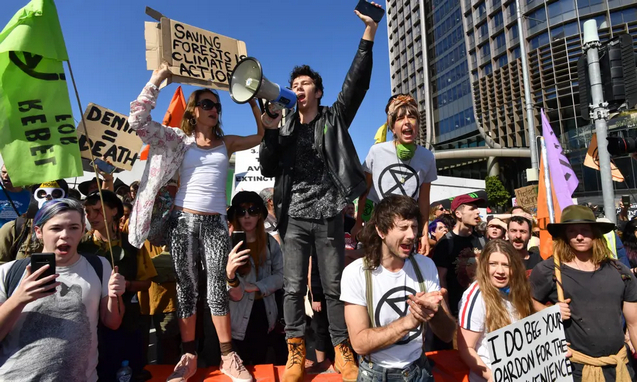
Extinction Rebellion protesters in Brisbane have been the target of Peter Dutton’s anger, as protesters around Australia face a series of new laws to curb the scope of their actions. Photograph: Dan Peled/EPA 
Today the activist group Extinction Rebellion will begin a week of global protests.
In Brisbane, home to the grassroots organisation’s first Australian chapter, activists are preparing to stage protests around the city. At the group’s headquarters in Woolloongabba, a busy training schedule is under way. It is hosting introductory sessions at local libraries planning two large-scale marches, with a litany of other “non-violent disruptive actions”.
Since the group conducted its first action in Australia in April, there have been more than 170 arrests, with penalties ranging from a warning to a $1,500 fine.
When new laws designed to target the tactics used by Extinction Rebellion pass parliament, those penalties will escalate. The use of a purpose-designed “dangerous attachment device to disrupt lawful activities”, referring to the Extinction Rebellion tactic of locking on to railways and roads, will attract a $6,500 fine or two years’ imprisonment.
Peaceful protest, the Queensland government says, is only acceptable if it does not disrupt people going about their ordinary business.
But disruption is the point.
“We are using civil disobedience to cause economic disruption and a disruption to business as usual,” Extinction Rebellion south-east Queensland member Emma Dorge says. “Without disruption, our voices are not being heard.”
She is not deterred by harsher penalties.
“We are fighting against extinction,” she says. “People are doing what’s necessary in the face of complete inaction from governments on climate change.”
Queensland has proposed two new amendments this year designed to clamp down on protests: increased trespass penalties aimed at animal welfare protests, currently going through a parliamentary committee, and the lock-on laws. It has also introduced biosecurity regulations with on-the-spot fines for entering an agricultural premises.
New South Wales has also introduced new $1,000 on-the-spot penalties through biosecurity regulations and is considering draft laws with broad new trespass penalties.
When the Western Australian premier, Mark McGowan, was opposition leader in 2016, he ceremonially ripped up anti-protest laws proposed by his predecessor, but his government has also said it will increase penalties for trespass. The reforms are aimed at animal welfare protesters described by the attorney general as “mushy-headed vegans”.
Without disruption, our voices are not being heard. Emma Dorge, Extinction Rebellion
Victoria is holding a parliamentary inquiry to determine if it ought to strengthen trespass laws, following uproar about a $1 fine levied against an activist who stole a goat from a Gippsland cheese cafe. The Law Institute of Victoria has suggested the government instead introduce laws promoting greater transparency in the agriculture industry.
Tasmania, still bruised from a 2017 high court decision that struck down its anti-protest laws, is working on amended legislation to reintroduce the laws.
That high court ruling – that environmental protests are political and protected under the constitutional implied freedom of political communication – could potentially apply to Queensland and NSW laws as proposed.
“When we see the positioning that’s been coming out of the government we tend to look at it through two filters,” the Wilderness Society national director, Lyndon Schneiders, says. “One is: is what they are proposing actually legal? And secondly, what are they trying to achieve politically?”
The NSW Nature Conservation Council chief executive, Chris Gambian, says the NSW legislation is framed as a narrow provision supporting farmers but could actually work against their interests by penalising almost all protest actions.
Farmers have been heavily involved in environmental protests in Australia, particularly against coal seam gas. The Bentley Blockade, a seven-year protest in the Northern Rivers region which successfully halted gas exploration and is cited as inspiration by Dorge and other Extinction Rebellion members as an example of successful activism, was underpinned by farmers.
And when more than 300,000 people join climate strikes around Australia, can protesting still be considered a fringe activity?
“There is a culture war going on that is trying to pit those people that care about the environment against other people, and I think that’s incredibly worrying,” Gambian says.
Take these comments from Peter Dutton.
The home affairs minister, Peter Dutton, says disruptive protesters deserve to be shamed. Photograph: Glenn Hunt/AAP
“People should take these names, and the photos of these people, and distribute them as far and wide as we can so that we shame these people,” said the home affairs minister in his regular spot on Sydney’s 2GB radio. “Let their families know what you think of their behaviour … We should push back on it because these people are a scourge, they are doing the wrong thing. If you want to protest, do it peacefully.”
In this context, “peaceful” can be taken to mean “unobtrusive”.
Dutton also suggested protesters should face mandatory minimum sentences and murmured support for host Ray Hadley’s suggestion that the welfare payments of protesters be restricted. In the world of talkback radio, the Venn diagram of ordinary working Australians and people who protest are two circles that never meet. Reality has more overlap.
Gambian is a spokesperson for a loose coalition of environment groups, Unions NSW and legal groups that have banded together to oppose the proposed NSW anti-protest laws, which would result in protesters facing fines of up to $22,000.
A similar coalition of 80 organisations, from unions to religious groups, staved off the most recent anti-protest laws in WA and is waiting to see the draft of the new proposed laws.
“It was a matter that brought together a really broad cross-section of society,” Perth-based public advocacy lawyer Kate Davis says. “I don’t think any laws that are targeted at restricting the right to protest have a place in our democracy.”
The proposed NSW laws, like new federal laws passed in August, are targeted at “farm invasion” protests from animal activists who have targeted abattoirs, factory farming operations and family-run farms in the past 18-months.
They make use of the Inclosed Lands Protection Act and are “breathtakingly broad,” says Gambian, and would capture protests on environmental grounds, including anti-mining protests.
That act was amended in 2016 to introduce a $5,500 penalty for aggravated unlawful entry to enclosed lands. It was up for review next month, but that review has now been superseded by the proposed Right to Farm Bill.
The proposed amendments would increase the penalty for aggravated trespass to $13,200 or 12 months’ jail. If a person was accompanied by two or more other people, or taken to be interfering with the conduct of the business, they would face a $22,000 fine or three years’ jail.
“Enclosed land is any land that has a fence around it,” Gambian says. “Including a temporary fence. Including a temporary fence erected while the protest is going on.”
It includes public land, such as state parliament.
Emily Howie, legal director for the Human Rights Law Centre, says the proposed laws could run afoul of the same constitutional provisions that allowed the former Greens leader Bob Brown to win his high court challenge against the Tasmanian anti-protest laws.
If the laws were found to be denying Australians their constitutional freedom to talk about things that are politically important, Howie says, they could be found to be invalid.
Moves by governments to protect businesses from disruption are legitimate, Howie says, but they must be “reasonable and proportionate”.
“The last thing that we want is for laws that are meant to be protecting business to in fact be deterring people from engaging in peaceful and lawful protest and our concern about this bill in New South Wales is that is exactly what it does,” she says.

Links

French Citizens' Panel To Advise On Climate Crisis Strategies

The Guardian - 

Body of 150 non-experts to explore ways of cutting carbon emissions by 40% before 2030
Protesters march in Paris in September to highlight the global climate crisis. Photograph: Abdulmonam Eassa/Barcroft Media 
A sample group of 150 French citizens — from unemployed people to pensioners and factory workers — will this week begin advising the French president Emmanuel Macron on how France can cut carbon emissions to tackle the climate emergency.
The panel was chosen by selecting people, aged from 16 to over 65, from towns and villages across France. More than 25,000 automatically generated calls were made to mobile numbers and landlines to find a representative “sample of national life”.
Coming from various backgrounds and professions, the citizens are not experts on environmental issues but are expected to have views on the difficulties of combating the climate change and to offer ideas. They will be asked to consider the role of individuals, and society as a whole – covering housing, work, transport, food, shopping and methods of production — and suggest solutions for cutting emissions, which will be put before parliament.
Julien Blanchet, who is overseeing the process, said the citizens would represent “the diversity of the French population”.
Environmental campaigners said the process, which will run until February, should not be used as an excuse to delay urgent climate action.
Macron, the French president, had promised to appoint a citizens’ consultation body after he faced a crisis in climate policy last year when the anti-government gilets jaunes (yellow vests) protesters took to the streets against a new carbon tax intended to urge motorists to change their behaviour. People in the countryside said it was deeply unfair to raise taxes on fuel use where there was no alternative transport to private cars, and while vast corporations were not doing enough. The tax was later abandoned.
Macron has presented himself as a world leader on the climate emergency. But despite France’s ambitious promises to reduce greenhouse gas emissions, in reality the country is far from delivering its goals, the French independent advisory council on climate has warned. Everyday life in France does not match political promises – particularly with regard to transport, car use and building renovation – and the government is seen as not doing enough to meet a net-zero emissions target for 2050.
The citizens’ panel will advise on how France can cut carbon emissions by 40% before 2030, in terms of building construction and housing, transport methods, food production and consumption
At their first meeting, the participants will be briefed by climate experts and will then meet over several weekends until the end of January.
Of the thousands of French people contacted by phone to join the consultation, 30% quickly expressed interest, 35% asked to consider the idea, and 35% refused.

Links

Commonwealth Targets Climate Change With Regeneration Projects

AFP

Demonstrators take part in a climate march in Hendaye, south-west France on August 24, 2019, to protest against the annual G7 Summit. AFP/File / GEORGES GOBET
The Commonwealth on Friday launched an ideas-sharing network to tackle the effects of climate change through replicable regeneration projects.
The 53-country bloc held a two-day brainstorming of indigenous groups, environmentalists, scientists and experts at its headquarters in London.
The Common Earth initiative will be a network of projects that can be copied and adapted to suit communities around the world.
While the Commonwealth contains G20 industrial powers like Britain, Canada and Australia and emerging forces like India and Nigeria, many of its members are developing island microstates which feel exceptionally vulnerable to climate change.
Ideas that can hold sway in the diverse Commonwealth tend to be taken up more widely, such as its climate change accords which were instrumental in the Paris COP21 UN conference deal in 2015.
"This about looking at practical, existing strategies to clean streams, restore forests and damaged ecosystems, protect marine health, educate our populations and challenge the economic and development approaches that led to the decline of our planet," said Commonwealth Secretary-General Patricia Scotland.

Planning for hurricanes
Nichie Abo, a farmer from the indigenous Kalinago territory in Dominica who grows mangos and avocados, said 95 percent of the homes in his community were destroyed by Hurricane Maria in September 2017.
The electricity network—all above ground on poles—was vulnerable to hurricanes and the area was left without power for more than a year.
The indigenous Kalinago community in Dominica wants to make its electricity network independent of the national grid, such as by building wind turbines, to protect against hurricanes. dpa/AFP/File / Julian Stratenschulte
The community wants to make its electricity network independent of the national grid, with each home having its own power source such as solar panels or a wind turbine.
They also want to construct a central building that can withstand hurricanes for use during emergencies and act as a community centre at other times.
"We're looking for funding," Abo told AFP.
"It is going to happen again, so we need to be prepared.
"This idea could be replicated across the Caribbean," he added, citing the Bahamas, hit last month by the devastating Hurricane Dorian.
The gathering also heard from contributors on developing more sustainable economic models.
"We're in a time of crisis. Emergencies, historically, are a time of great innovation and often bring out the best in us," said Stuart Cowan, regenerative development director at Capital Institute, a US-based finance think-tank.
"We need to start from scratch. We need to design economies that allow people to flourish within the limits of a finite planet," he told AFP.
With a eye on funding, Secretary-General Scotland is to take forward the meeting's initiatives to upcoming summits of Commonwealth trade and finance ministers.

Links

06/10/2019

(AU) Reserve Bank Warns Climate Change Posing Increasing Risk To Financial Stability


The Reserve Bank says climate change can result in a decline in the income or value of collateral that banks are lending against. Photograph: Saeed Khan/AFP/Getty Images
Australia’s central bank has delivered a clear warning that climate change is exposing financial institutions and the financial system more broadly to risks that will rise over time if action isn’t taken.
The RBA’s financial stability review, released Friday, concluded that while climate change is not yet a significant threat to financial stability in Australia, it is becoming increasingly important for investors and institutions to actively manage carbon risk.
The bank notes Australian insurers are the most directly exposed to the physical impacts of climate change, and points out that inflation-adjusted insurance claims for natural disasters this decade are more than twice what they were in the previous 10 years. It notes “this impact is likely to grow over time”.
“An increase in the frequency and severity of natural disasters will increase the incidence of damage to, or destruction of, physical assets that are insured or used as collateral,” the RBA said.
“Assets that are exposed to increasing physical risk – such as property located in bushfire-prone or coastal areas – could decline in value, particularly if these risks become uninsurable.
“Climate change could also reduce certain types of business income that is used to service loans. Examples include changing rainfall patterns that result in lower or less predictable income from agriculture, more frequent storms disrupting supply chains and therefore sales, and damage to natural assets that reduces tourism income.”
The RBA says banks and other lending institutions are also exposed to physical risks because climate change can result in a decline in the income or value of collateral that they are lending against.
It says Australian financial institutions that have exposure to carbon-intensive industries – such as power generation and mining, or to energy-intensive firms – “will also be exposed to transition risk”.
“Transition risk will be greatest for banks that lend to firms in carbon-intensive industries and to individuals or businesses that are reliant on these firms,” the bank said.
“Other financial institutions investing in carbon-intensive industries, such as superannuation and investment funds, are also exposed to the risk that climate change will diminish the value of their investments. This could occur both through direct investments in carbon-intensive industries, or indirect investments in banks that lend to these industries”.
It warns financial institutions “also face reputational damage if they are seen to be contributing to climate change or failing to manage climate risks”.
The RBA concludes that climate change poses a clear systemic risk, but it is not yet an imminent threat to financial stability. But it warns this could change. “Climate change could emerge as a risk to financial stability if it is not properly managed, or if the size of climate-related losses increased materially.
“Rising climate-related losses could also erode confidence in an institution or the financial system, leading to a withdrawal of funding. This would be more likely if the physical impacts of climate change are more severe or occur sooner than currently projected, or if the transition to a low-carbon economy occurs in a disruptive and costly manner.”
The RBA notes that both the banking regulator Apra and the corporate watchdog Asic have become proactive in managing carbon risk, and the Council of Financial Regulators has established a working group on the financial implications of climate change to help coordinate agencies’ actions.
Friday’s analysis builds on a warning by the Reserve Bank deputy governor, Guy Debelle, who said in March climate change posed risks to Australia’s financial stability.
Debelle said policymakers needed to consider warming as a trend and not a cyclical event. He said policymakers and businesses needed to “think in terms of trend rather than cycles in the weather”.
“Droughts have generally been regarded, at least economically, as cyclical events that recur every so often. In contrast, climate change is a trend change. The impact of a trend is ongoing, whereas a cycle is temporary.”
The deputy governor said there was a need to reassess the frequency of climate change events, and “our assumptions about the severity and longevity of the climatic events”.
In March, Apra flagged an intention to increase scrutiny of how banks, insurers and superannuation trustees are managing the financial risks of climate change to their businesses.
Last year Asic said climate change was “a foreseeable risk facing many listed companies in the Australian market in a range of different industries” and warned directors and management of listed companies “to understand and continually reassess existing and emerging risks including climate risk that may affect the company’s business”.
In that same assessment by the corporate watchdog, 17% of listed companies in the Asic sample identified climate risk as a material risk in their operating and financial reviews.
The RBA noted on Friday, according to the Intergovernmental Panel on Climate Change (IPCC), it will take significant effort to limit global warming to 1.5C above pre-industrial levels, as targeted in the Paris agreement.
“Even if targets are met, this level of warming is likely to be accompanied by rising sea levels and an increase in the frequency and intensity of extreme weather including storms, heatwaves and droughts,” it said. “Some of these outcomes are already apparent. These changes will create both financial and macroeconomic risks”.

Links

Australia’s Biggest Property Companies Are Making Net-Zero Emissions Pledges – Now We Can Track Them

The Conversation

Huge crowds marched last week to demand progress towards net zero emissions – and companies are listening. AAP Image/James Ross
Corporate Australia is taking action on climate change. Most recently, at the UN Climate Summit, Atlassian cofounder Michael Cannon-Brookes announced the A$26 billion Australian software company’s commitment to net zero emissions by 2050.
Net zero pledges like this are becoming more common but currently there is no way to really track momentum towards net zero emissions across different sectors of the economy.
Now, a Net Zero Momentum Tracker initiative has been established by ClimateWorks Australia and the Monash Sustainable Development Institute to track emissions reduction commitments made by major Australian companies and organisations, as well as state and local governments.
The tracker aims to place all commitments to net zero emissions in Australia in one place and evaluate how well they align with the Paris climate goals.

Property sector tracking towards net zero emissions
We began by assessing Australia’s property sector. Last week we released a report examining all property companies listed in the ASX 200, plus all of those required to report their emissions under the National Greenhouse and Energy Reporting Act.
Among the companies we looked at are Dexus, Mirvac, Stockland Corporation, GPT Group, and Lendlease. They develop, own or manage some of Australia’s largest corporate offices, commercial properties, retail centres, retirement villages, and residential developments.
The report found almost half – 43% – of Australia’s largest listed property companies have made commitments that closely align with the Paris Climate Agreement, aiming to achieve net zero greenhouse emissions before 2050 for their owned and managed assets.
Significantly, the six companies with the most ambitious net zero targets represent 36% of the ASX 200 property sector. Among these six, several major companies – Dexus, Mirvac, GPT Group, and Vicinity – are aiming for net zero emissions by 2030, demonstrating the business case for strong climate action.

Sector leaders can inspire copycat action
By highlighting what action organisations are taking and how, the Net Zero Momentum Tracker initiative aims to encourage more organisations to make and strengthen commitments to reduce their emissions, in line with the goal of net zero emissions by 2050.
For example, Australia’s largest owner and manager of office property, Dexus, has a comprehensive strategy for reaching its goal of net zero emissions across the group’s managed property portfolio. This includes reducing energy use, shifting to renewable electricity, electrifying their buildings, and reducing their non-energy emissions from waste, waste water and air conditioning.
Of particular significance is Mirvac’s pledge to be “net positive” by 2030. This means the company aims to go beyond net zero, reducing emissions by more than its operations emit. Mirvac has established an energy company to install rooftop solar on their commercial buildings and is selling power to occupants, among other initiatives. The company also has a “house with no bills” pilot project, to explore how their upstream indirect emissions can be minimised for residential developments.
Another major company, the GPT Group, has extended its commitment beyond the assets it owns and manages to all buildings it has an ownership interest in, including buildings it co-owns or does not manage.
These companies will get multiple benefits from their action, including reduced operating costs, better health and productivity for occupants, and increased sales prices, rents and occupancy rates.

Need to accelerate action
While many property companies are tracking in the right direction, none of the companies we considered had net zero targets which comprehensively covered all of their emissions – such as those from co-owned assets, their supply chains and investments.
There is still significant opportunity for property companies to strengthen their commitments towards net zero emissions. This requires targets which address the full scope of direct and indirect emissions within each company’s influence, supported by detailed plans to achieve this.
By making these public commitments to reduce emissions, the property sector is helping build momentum towards achieving this goal across the entire Australian economy.
The next assessments to be undertaken by the Net Zero Momentum Tracker initiative include the banking sector and state and local governments.

Links

Climate Change Is Really About Prosperity, Peace, Public Health And Posterity – Not Saving The Environment

The Conversation | 

What will it take to get people to connect to the climate change story? mauro mora/UnsplashCC BY
The story of climate change is one that people have struggled to tell convincingly for more than two decades. But it’s not for lack of trying.
The problem is emphatically not a lack of facts and figures. The world’s best scientific minds have produced blockbuster report after blockbuster report, setting out in ever more terrifying detail just how much of an impact we humans have had on the Earth since the dawn of the industrial revolution. Many people believe anthropogenic climate change – rapid and far-reaching shifts in the climate caused by human activity – is now the story that will define the 21st century, whether anyone’s good at telling it or not.
Nor is it merely a problem of delivery. The past decade has witnessed an explosion of climate change communication efforts spanning nearly every conceivable medium, channel and messenger. Documentaries, popular books and articles, interactive websites, immersive virtual reality, community events — all are being used in increasingly creative ways to communicate the story of climate change. Many of these efforts are beautifully designed and executed, visually and narratively engaging and careful to avoid common traps and shortcomings that have tripped up previous efforts.
As communications specialists who have each spent more than a decade observing and studying how people, media and organizations talk and think about climate change, we’ve come to understand that the climate change communication problem runs much deeper: It’s baked into the nature of the issue itself.
It’s hard for a single person to connect
with a global-scale problem.
JPL/NASA, CC BY
Climate change is abstract, uncertain, unfamiliar, impersonal, diffuse and seemingly distant, even as the frequency of climate-related events continues to increase in many parts of the world. This is not to say that the well-documented and well-funded efforts to sow misinformation, doubt and denial aren’t also real challenges facing climate change communicators and advocates; of course they are.
But even without explicit efforts to confuse and divide the public, climate change would still be a uniquely challenging issue to talk about in ways that motivate public engagement rather than inspire despair and fatalism.
The sad irony, of course, is that the story of climate change is in fact a deeply human one – we caused it, we will suffer from it and we alone can take action to avoid its worst consequences and prepare for the rest.
But shifting climate change from a scientific reality to a social, economic and political reality has proven extremely difficult. This is still primarily an “environmental” issue in many people’s minds, and that is a real problem for building a broad-based social movement around climate change.
What other health and security benefits come with tackling climate change? sergio souza/UnsplashCC BY

Solve additional problems by tackling the first
Over the past few years, one suggested solution around this communications roadblock has been to tell the story of what are called climate change co-benefits.
The idea is simple and compelling: If the public won’t or can’t get behind climate action for climate’s sake, maybe they will if all the many nonenvironmental benefits of reducing carbon emissions are brought to the foreground. Hence, climate change as a threat to public health, to national security, to social mobility.
Traditional co-benefits framing tells the story like this: If humanity does something about climate change – if we reduce carbon emissions through massive investments in renewable energy and retrofitting of inefficient buildings, if we improve resilience through investing in green infrastructure, nature-based solutions and all the rest – we will not only solve the climate change problem, we’ll also reduce economic inequality, improve public health, reduce threats to national sovereignty and geo-political stability, and generally make people’s lives better.
These and many other co-benefits of aggressive and proactive action on climate change are real, and they will very much improve the lives of billions of people living on this planet today and in the future. But is this the best way to talk about the issue in service of building a powerful social movement?
The problem with the standard co-benefits narrative isn’t that it distracts too much from the core climate change challenge (it doesn’t), nor that it is somehow manipulative (it’s not) or simply not necessary (it is).
We suggest the problem is that it still leaves too much of the focus on climate change as an environmental or scientific issue while relegating all the other things people often care more about – addressing rampant inequality, increasing access to affordable health care, improving people’s material and emotional lives – to the background.
Leading with “if you really cared about your pet issue, then climate change should be your priority” is neither welcoming and inclusive nor likely to succeed in building a broad base of support for aggressive action on climate. Condescension rarely wins converts.
A wind farm promotes human health – and just happens to benefit the climate?
Brandon Hoogenboom/Unsplash,CC BY
Rethink which benefit drives the story
But that doesn’t mean advocates should necessarily give up on co-benefits. Maybe they just need to flip the script on its head – to lead with and keep the focus on the nonclimate benefits of aggressive decarbonization and adaptation efforts. Maybe “addressing climate change” should be treated as the co-benefit rather than the leading motivation for action that could materially help billions of people, today and in the future.
Ultimately, the most effective long-term approach to getting diverse audiences to engage deeply with climate change may require that advocates stop treating it as a standalone problem that could benefit from being linked to other topics many people care more about. Instead, advocates may need to fundamentally rethink and alter the way they talk about and position climate change as an issue in the first place.
If climate change is now becoming a meta-narrative against which all other stories play out, perhaps no one needs to argue that decarbonization of the global economy will produce some health benefits or improve people’s well-being. Perhaps the best strategy is to simply say that climate change is a health risk, a risk to peace and prosperity, a risk to humanity’s survival – that the climate change story is our story as a species.
This is not about mobilizing the muscle of co-benefits to make the climate change narrative more robust or appealing. It’s about merging the co-benefits and climate change itself so thoroughly that they become one and the same.

Links

05/10/2019

Reasons There Might Be No Path To Success On Climate Change

Forbes - Chunka Mui

"Grasp the larger hope" -- Winston Churchill. Gamma-Keystone via Getty Images
I want to scream “You’re not helping!” every time I read a story like this one, which recently ran in USA Today: “End of civilization: climate change apocalypse could start by 2050 if we don't act, report warns.”
I certainly worry about what might befall us and our children by 2030, 2050 and 2100—three often cited milestones (such as herehere and here). But, I want to scream because I fear that such warnings about far-in-the-future calamities make it much less likely that what we do anything today to mitigate or adapt to the challenges we face.
That’s because, ironically, while such climate scenarios are intended to mobilize public opinion towards urgent action, they likely hurt that very cause.
Daniel Kahneman receives the Nobel Prize in Economics. (JONAS EKSTROMER/AFP/Getty Images)
To understand why, consider the pessimism of Daniel Kahneman, the Nobel Prize winning behavioral scientist: “I really see no path to success on climate change,” he told George Marshall in Marshall’s bracing book, “Don’t Even Think About It: Why Our Brains are Wired to Ignore Climate Change.”
Kahneman fears that climate change is a hopeless problem for three reasons:
First, it lacks salience. It is too “abstract, distant, invisible and disputed” to capture our attention. Without attention, there is no action
Second, dealing with climate change is typically thought to require people to accept short-term costs and reductions on living standard in order to address higher but uncertain future losses. Such sacrifice is not in our nature. One University of Chicago poll found that while 72% of respondents believed that climate change is happening, half were unwilling pay even $1 each month to help address it.
Third, climate change seems uncertain and contested—“even if there is a National Academy on one side and some cranks on the other.”
By focusing our minds on what might happen 10, 30 or even 80 years from now, far-off doomsday scenarios reinforce the abstract and distant nature of climate change. They widen the window of scientific uncertainty both the outcome and costs, and therefore enhance the opportunity for rebuttal and confusion.
“The bottom line,” Kahneman concluded, “is that I’m extremely skeptical that we can cope with climate change. To mobilize people, this has to become an emotional issue. It has to have immediacy and salience. A distant, abstract and disputed threat just doesn’t have the necessary characteristics for seriously mobilizing public opinion.”
Kahneman’s pessimism is unfortunately well supported by other researchers—and applies not just to climate change but to the broader challenge of why we, individually and as a society, underprepare for slow moving, predictable disasters. As solidly laid out by Robert Meyer and Howard Krunreuther in “The Ostrich Paradox: Why We Underprepare for Disasters”:
“Our ability to foresee and protect against natural catastrophes has never been greater; yet, we consistently fail to heed the warnings and protect ourselves and our communities, with devastating consequences.”
So, are we doomed? Perhaps. But, remember the observation of Arthur C. Clarke, in what has become known as Clarke’s First Law:
“When a distinguished but elderly scientist states that something is possible, he is almost certainly right. When he states that something is impossible, he is very probably wrong.”
Let’s hope that the distinguished Daniel Kahneman is “probably wrong.” Also, take a lesson from Winston Churchill on the gathering storm of World War II: “Having got ourselves into this awful plight in 1939, it was vital to grasp the larger hope.”

Links

Lethal Heating is a citizens' initiative