Thursday, November 14, 2019

Greta Thunberg Catches Lift To UN COP25 Climate Summit In Madrid With Australian Sailing Couple

ABC News - Rhiannon Shine | James Carmody

Riley Whitelum, Nikki Henderson, Greta Thunberg and Elayna Carausu with her son Lenny on their yacht preparing to set sail. (Facebook: Greta Thunberg)
Key Points
  • Greta Thunberg is one of the world's highest profile environmental activists
  • She was stranded in the US after travelling there to attend a UN climate summit
  • She will travel to the new summit location in Spain with an Australian couple
Teen climate activist Greta Thunberg will make the COP25 UN climate summit after hitching a ride back across the Atlantic with an Australian couple travelling the world.
The 16-year-old had travelled from her native Sweden to California by boat, train and electric car and was planning to continue on to the next round of climate negotiations, originally scheduled to be held in Santiago, Chile in December.
The Santiago summit was cancelled by Chile's government because of political unrest in the South American country and moved to the Spanish capital of Madrid.
Ms Thunberg refuses to fly because of the carbon emissions involved and had been searching for an environmentally-friendly way to travel back to Europe to attend the summit.


Swedish teen climate activist Greta Thunberg lands in New York City following 14-day trans-Atlantic trip (ABC News)

"As #COP25 has officially been moved from Santiago to Madrid I'll need some help," Ms Thunberg tweeted earlier this month.
"Now I need to find a way to cross the Atlantic in November … If anyone could help me find transport I would be so grateful."

Australian couple to the rescue
A week ago, South Australian Riley Whitelum, who travels around the world in a 48-foot catamaran called La Vagabonde with his West Australian partner Elayna Carausu and their son Lenny, responded to the tweet with an offer of help.
Ms Thunberg posted to her Instagram page earlier today saying she had accepted the offer from the couple, who will take her from Virginia to Spain with the help of professional yachtswoman Nikki Henderson.
"So happy to say that I'll hopefully make it to COP25 in Madrid," Ms Thunberg said.
Greta Thunberg (centre) and British sailor Nikki Henderson (second right) are joining the couple on the catamaran La Vagabonde. (Facebook: Sailing La Vagabonde)
"I've been offered a ride from Virginia on the 48ft catamaran La Vagabonde. We sail for Europe tomorrow morning!"
Ms Thunberg said she expected the voyage to take three weeks.
"If I get to the COP25 in time then I will participate in that because I received an invitation to do so. And then I will go home," she said.

A voyage funded by YouTube
Mr Whitelum and Ms Carausu have been sailing around the world since 2014, filming their adventures and posting them to YouTube where they have amassed more than 1 million followers.
"We've suffered terrifying storms, pirate scares, financial breakdowns, equipment failures, water shortages and other interesting mishaps, but we wouldn't trade living on the sea and traveling wherever the wind takes us for anything," their website states.


Ms Carausu posted to Instagram that the crew would set sail from 7:30am US eastern standard time tomorrow.
Ms Thunberg rose to prominence last year after she started spending her Fridays protesting outside Sweden's parliament.


Her action has grown into a global campaign, with an estimated 300,000 Australians taking part in climate change rallies around the country in September.
Ms Thunberg's zero-emissions expedition has been highly publicised and has included travelling by boat, train and an electric car borrowed from Arnold Schwarzenegger.

Final preparations underway
Speaking to ABC Radio Perth from aboard La Vagabonde docked in Virginia, Mr Whitelum said he was surprised when he heard back from Ms Thunberg, but he thought they were suitable travel companions.


"Elayna and I responded [to Ms Thunberg's tweet], and about a week later here we are about to sail 3,000 nautical miles across to Europe," he said.
"It sort of came back through to us through a back channel and they just said, 'are you available, do you think you can do it? We've been let down a couple of times, are you sure you would be able to do it?'"
Mr Whitelum said after confirming they were up for the challenge, he and Ms Carausu had been busy preparing for the trip and getting to know Ms Thunberg.
"When I met her I wasn't ready for quite how young and short she would be," he said.
"We've been hanging out basically for the last five or six days getting the boat prepared.
"She's smart, kind of powerful and independent, she's a good person to have around."
Mr Whitelum said while he and Ms Carausu had crossed the Atlantic twice before as well as the Pacific Ocean, and had about 70,000 nautical miles of sailing under their belts, getting to Madrid would be no mean feat.
"The journey is long and fairly complicated. The northern Atlantic at this time of year is fairly treacherous," he said.
"We're working with some of the best weather routers in the world.
"On this particular trip the first 500 or 600 nautical miles are super important, so it's good that we've been able to choose our window, which is tomorrow morning."

Links

(UK) A Legal Approach To Fighting Climate Change

New York Times - Farah Nayeri

Gillian Lobo is the senior lawyer for ClientEarth, an environmental law charity. 
Credit...Suzanne Plunkett for The New York Times
LONDON — What does Pink Floyd’s David Gilmour have in common with the London-based environmental law charity ClientEarth?
Quite a lot, as it happens. Mr. Gilmour sold his guitar collection for $21.5 million at Christie’s New York in June — and donated every penny to ClientEarth to help it fight climate change.
For a nonprofit with rock-star benefactors, ClientEarth is fairly low key. It operates in the background, incrementally and strategically, much like the lawyer who set up its climate team four years ago, Gillian Lobo.
Ms. Lobo, a Briton of Indian descent who spent the first six years of her life in Tanzania and Kenya, started her legal career at a private practice in Croydon (outside London), then became an in-house lawyer for Royal Mail, the postal service.
From 2006 to 2015, she worked for the British government, mostly as a litigator in military cases. Starting in 2010, she was part of the team that defended the Ministry of Defense against negligence claims linked to the deaths of three British servicemen and the serious injuries of two others in “friendly fire” episodes in Iraq.
She joined ClientEarth in 2015 and has been busy taking the British government to court pretty much ever since.
While the bulk of her career has taken place in Britain, she also spent six months volunteering for the Presbyterian Church in Rwanda in 2002, eight years after the genocide. In the following conversation, which was edited and condensed, she began by recalling the experience.

What was Rwanda like?
It was a real eye-opener. I went out to all the projects — schools, medical institutions, places that trained people in agriculture. You could see how local people, given the knowledge and the ability, could actually do a lot for themselves, how effective projects could be.
I also saw how powerless people are treated. The authorities can abuse street children in any way, hit them, and no one can step in.
I saw a little boy being beaten in Kigali. We were trained to be careful not to enter into situations that we didn’t know the outcome of. You can go in and try and protect that child, and once you’re out of there, the police are going to take out any humiliation that you’ve heaped on them on that person. That was really important training.
It’s about being strategic. It’s pointless just tampering at the edges: You need to change important infrastructures.

Why did you choose climate as a field?
If you don’t get this sorted out, all of the development work that you ever wanted to do is never going to get off the ground. It’s all linked to droughts, water supply, how people work. The places that are being impacted are the ones that can least afford it: the droughts, the rains, the typhoons, the hurricanes, the increased heat that’s going to reduce the nutrient value of food growing in soil.

One could argue that what you do will produce benefits in the future, but won’t put bread on people’s table now.
We should be doing both. If you don’t get the fundamentals right, these problems are going to get worse and worse. If you build carefully and strategically, you can have an immediate impact.
You want to stop subsidies going to companies producing fossil fuels. You want subsidies going to renewables, or for it to be a level playing field — meaning no subsidies. Then renewables can increase, and immediately that money can go to something that’s going to protect the environment. It can also create jobs at a local level. People can be a bit more self-sufficient and have control of their lives.
Credit...Suzanne Plunkett for The New York Times
What is the impact of climate change on women?
The impact is big, because the women most affected are generally poor women. They’re disproportionately impacted by extreme weather events and droughts. They’re usually the ones who have to go and collect water, and if there’s a drought, they have to go further. They’re the ones who collect wood, who feed the children. As the men go to the cities, they’re left on their own. And women, through wars and everything else, are more vulnerable — physically, sexually. It just makes everything a lot worse.

What is women’s role in fighting climate change?
Fundamental. They need to be part of the discussion, because they’re the ones on the ground. They’re seeing what’s happening. They can feed in far more valuable information about what’s happening to the land, what’s happening to the water, what improvements can be done, and how things are changing around them.
These women have cultural knowledge. They have practical, actual knowledge on the way to deal with climate change. That’s what you need.

What do you see as your own role in the world?
I can help develop the lawyers of the future, to work with these lawyers who are so bright but not necessarily experienced enough, and give them the tools and empower them.

To do what?
My aim is to make the world a fairer place. I believe in fairness, I believe in justice. I do recognize that the law is about tactics, strategies, doing the right thing at the right time. It can be seen as game playing. Don’t get me wrong, I quite enjoy it. But it’s not always about justice.
I believe in the rule of law and the need to maintain it. So much is being stripped from it across different states.
I also work on access to justice in the U.K. We’re trying to ensure that the cost for N.G.O.s and individuals bringing claims in order to protect the environment are kept as low as possible.

Where would you like to be in 10 or 20 years?
I’d like to have left a legacy where the law is safeguarded from fickle arbitrary executive decisions; where people can access and protect their environment, which is so important; and where we protect the world as much as we can from climate impacts.

Links

Climate Visuals Photography Award 2019: Winners And Shortlisted

The Guardian

Climate Visuals is a project that aims to create a new visual language for climate change. Images of polar bears, melting ice and factories do not convey the urgent human stories at the heart of the issue. Based on international social research, Climate Visuals provides insights for a more compelling visual language for climate change. It has recognised existing and outstanding images with impact for its inaugural photography awards. The project is run by Climate Outreach, Europe’s leading climate communication organisation, which celebrated its 15th anniversary on 7 November

Winner
2019 Climate Visuals Photography Award
Solar Power
Ann Johanssen

Shohida Begum poses for photographs lit by a solar powered lantern in a slum where she lives in Lucknow, Uttar Pradesh, India. Date taken: 11/11/2018
Shortlisted
2019 Climate Visuals Photography Award
High on Tide Mousuni Island
Sumit Sanyal

A man collecting water from a hand pump while huge waves caused by high tides strikes the edges. Where the pump is located, the wall has been destroyed due to erosion from tidal flooding. Date taken: 11/10/2018
Shortlisted
2019 Climate Visuals Photography Award
Destroyed Shoe Shop
Kianoush Saadati

Severe floods struck Golestan province of Iran in March and affected 10 cities: Gorgan, Bandar Turkman, Azad Shahr, Aq Qqala, Gonbad-e Kavus, Bandar-e Gaz, Ali Abad, Kalaleh, Kordkuy, and Minodasht. The heavy rain in Golestan was unprecedented, with 70% of average annual rain falling in the first 24 hours. In Golestan and Mazandran provinces, 11 people were confirmed dead and an estimated 20 people injured. Over 60,000 people were affected by the flooding, with at least 10,000 people are provided emergency shelter in stadiums, exhibition areas, schools. Date taken: 21/03/2019
Shortlisted
2019 Climate Visuals Photography Award
Looking Through The Doorway

Greta Rybus
A man looks through a doorway, which just hours before lead to another room in his home. The sea, which has been rising and eroding the shore, chewed into the home’s foundation and it crumbled into the sea. The United Nations named Saint Louis as the area most at-risk from climate change in Africa. Guet Ndar, where this family called home, is highly populated fishing community. The fishermen have noticed huge changes. They say the ocean used to be a long distance across the beach during low tides; now it laps at their homes. And, they’ve seen an increase in strange winds and storms, making their work at sea more dangerous and volatile. Many people have lost their homes. Date taken: 19/03/2015
Shortlisted
2019 Climate Visuals Photography Award
Water World Child
Jashim Salem


Links

Wednesday, November 13, 2019

Scientists looked at sea levels 125,000 years in the past. The results are terrifying

The Conversation -  |  | 

A polar bear wandering on melting pack ice in Canada, north of the Arctic Circle, during the summer 2017. Scientists say the last interglacial offers lessons for future sea level rise. Florian Ledoux/The Nature Conservancy
Sea levels rose 10 metres above present levels during Earth’s last warm period 125,000 years ago, according to new research that offers a glimpse of what may happen under our current climate change trajectory.
Our paper, published today in Nature Communications, shows that melting ice from Antarctica was the main driver of sea level rise in the last interglacial period, which lasted about 10,000 years.
Rising sea levels are one of the biggest challenges to humanity posed by climate change, and sound predictions are crucial if we are to adapt.
This research shows that Antarctica, long thought to be the “sleeping giant” of sea level rise, is actually a key player. Its ice sheets can change quickly, and in ways that could have huge implications for coastal communities and infrastructure in future.
Aerial footage showing devastation caused by severe storms at Collaroy on Sydney’s northern beaches in June 2016. UNSW Water Research Laboratory
A warning from the past
Earth’s cycles consist of both cold glacial periods - or ice ages - when large parts of the world are covered in large ice sheets, and warmer interglacial periods when the ice thaws and sea levels rise.
The Earth is presently in an interglacial period which began about 10,000 years ago. But greenhouse gas emissions over the past 200 years have caused climate changes that are faster and more extreme than experienced during the last interglacial. This means past rates of sea level rise provide only low-end predictions of what might happen in future.
We examined data from the last interglacial, which occurred 125,000 to 118,000 years ago. Temperatures were up to 1℃ higher than today - similar to those projected for the near future
Our research reveals that ice melt in the last interglacial period caused global seas to rise about 10 metres above the present level. The ice melted first in Antarctica, then a few thousand years later in Greenland.
Sea levels rose at up to 3 metres per century, far exceeding the roughly 0.3-metre rise observed over the past 150 years.
The early ice loss in Antarctica occurred when the Southern Ocean warmed at the start of the interglacial. This meltwater changed the way Earth’s oceans circulated, which caused warming in the northern polar region and triggered ice melt in Greenland.
Dogs hauling a sled through meltwater on coastal sea ice during an expedition in northwest Greenland,June 2019. STEFFEN M. OLSEN/DANISH METEOROLOGICAL INSTITUTE
Understanding the data
Global average sea level is currently estimated to be rising at more than 3 millimetres a year. This rate is projected to increase and total sea-level rise by 2100 (relative to 2000) is projected to reach 70-100 centimetres, depending on which greenhouse gas emissions pathway we follow.
Such projections usually rely on records gathered this century from tide gauges, and since the 1990s from satellite data.
Most of these projections do not account for a key natural process - ice-cliff instability - which is not observed in the short instrumental record. This is why geological observations are vital.
When ice reaches the ocean, it becomes a floating ice-shelf which ends in an ice-cliff. When these cliffs get very large, they become unstable and can rapidly collapse.
This collapse increases the discharge of land ice into the ocean. The end result is global sea-level rise. A few models have attempted to include ice-cliff instability, but the results are contentious. Outputs from these models do, however, predict rates of sea-level rise that are intriguingly similar to our newly observed last interglacial data.
Antactica was long thought to be the sleeping giant of sea level rise, but is now considered a key driver. Australian Antarctic Division
Our work examines records of total sea-level change, which by definition includes all relevant natural processes.
We examined chemical changes in fossil plankton shells in marine sediments from the Red Sea, which reliably relate to changes in sea level. Together with evidence of meltwater input around Antarctica and Greenland, this record reveals how rapidly sea level rose, and distinguishes between different ice sheet contributions.

Looking to the future
What is striking about the last interglacial record is how high and quickly sea level rose above present levels. Temperatures during the last interglacial were similar to those projected for the near future, which means melting polar ice sheets will likely affect future sea levels far more dramatically than anticipated to date.
The last interglacial is not a perfect scenario for the future. Incoming solar radiation was higher than today because of differences in Earth’s position relative to the Sun. Carbon dioxide levels were only 280 parts per million, compared with more than 410 parts per million today.
Crucially, warming between the two poles in the last interglacial did not happen simultaneously. But under today’s greenhouse-gas-driven climate change, warming and ice loss are happening in both regions at the same time. This means that if climate change continues unabated, Earth’s past dramatic sea level rise could be a small taste of what’s to come.

Links

(AU) Drought And Climate Change Were The Kindling, And Now The East Coast Is Ablaze

The Conversation -  | 

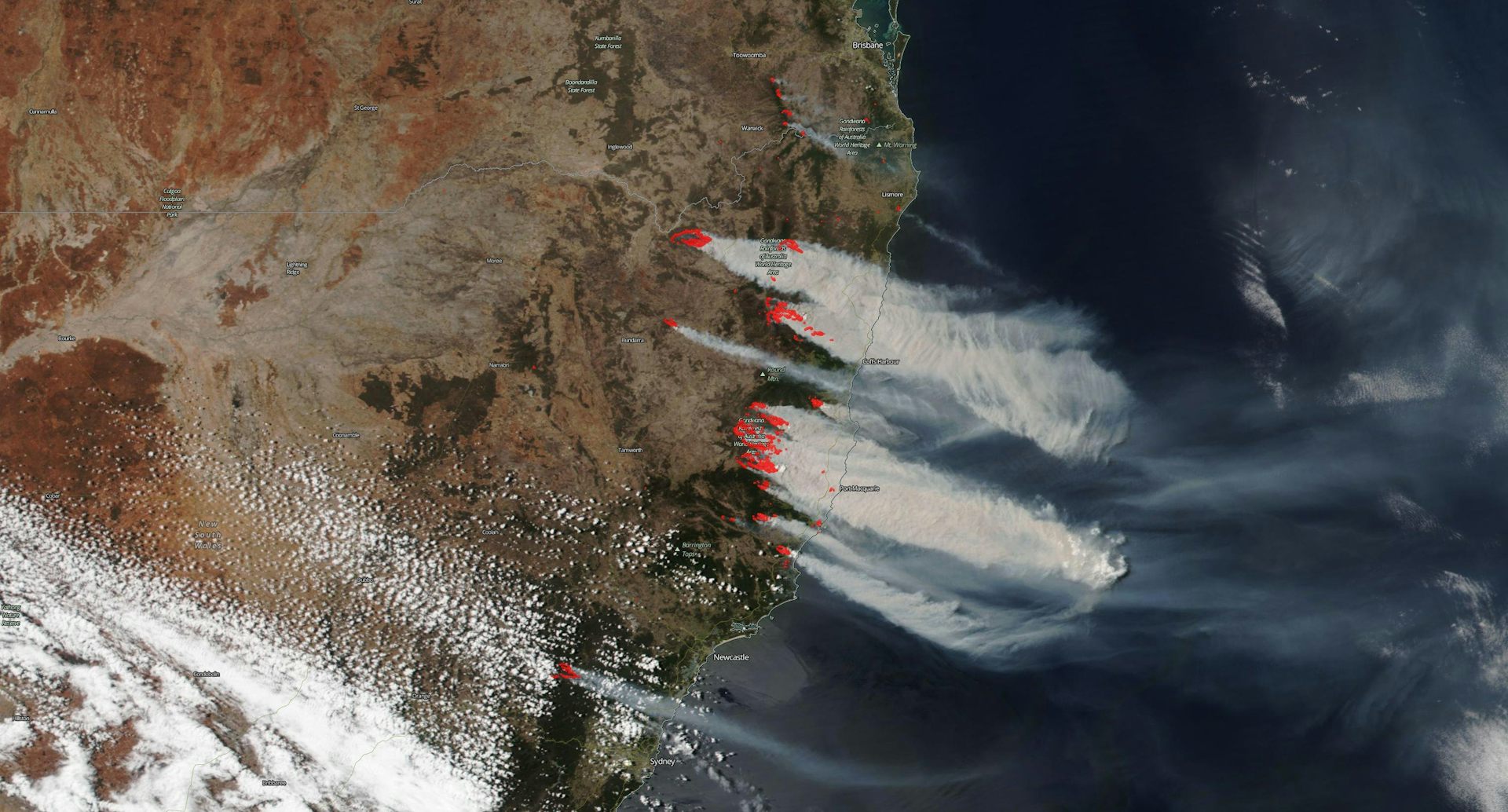
Multiple large, intense fires are stretching from Australia’s coast to the tablelands and parts of the interior. AAP Image/Supplied, JPSS | LARGE IMAGE
Last week saw an unprecedented outbreak of large, intense fires stretching from the mid-north coast of New South Wales into central Queensland.
The most tragic losses are concentrated in northern NSW, where 970,000 hectares have been burned, three people have died, and at least 150 homes have been destroyed.
A catastrophic fire warning for Tuesday has been issued for the Greater Sydney, Greater Hunter, Shoalhaven and Illawarra areas. It is the first time Sydney has received a catastrophic rating since the rating system was developed in 2009.
No relief is in sight from this extremely hot, dry and windy weather, and the extraordinary magnitude of these fires is likely to increase in the coming week. Alarmingly, as Australians increasingly seek a sea-change or tree-change, more people are living in the path of these destructive fires.

Unprecedented state of emergency
Large fires have happened before in northern NSW and southern Queensland during spring and early summer (for example in 1994, 1997, 2000, 2002, and 2018 in northern NSW). But this latest extraordinary situation raises many questions.
It is as if many of the major fires in the past are now being rerun concurrently. What is unprecedented is the size and number of fires rather than the seasonal timing.
The potential for large, intense fires is determined by four fundamental ingredients: a continuous expanse of fuel; extensive and continuous dryness of that fuel; weather conditions conducive to the rapid spread of fire; and ignitions, either human or lightning. These act as a set of switches, in series: all must be “on” for major fires to occur.
Live fuel moisture content in late October 2019. The ‘dry’ and ‘transitional’ moisture categories correspond to conditions associated with over 95% of historical area burned by bushfire. Estimated from MODIS satellite imagery for the Sydney basin Bioregion.
The NSW north coast and tablelands, along with much of the southern coastal regions of Queensland are famous for their diverse range of eucalypt forest, heathlands and rainforests, which flourish in the warm temperate to subtropical climate.
These forests and shrublands can rapidly accumulate bushfire fuels such as leaf litter, twigs and grasses. The unprecedented drought across much of Australia has created exceptional dryness, including high-altitude areas and places like gullies, water courses, swamps and steep south-facing slopes that are normally too wet to burn.
These typically wet parts of the landscape have literally evaporated, allowing fire to spread unimpeded. The drought has been particularly acute in northern NSW where record low rainfall has led to widespread defoliation and tree death. It is no coincidence current fires correspond directly with hotspots of record low rainfall and above-average temperatures.
Annual trends in live fuel moisture. The horizontal line represents the threshold for the critical ‘dry’ fuel category, which corresponds to the historical occurrence of most major wildfires in the Bioregion. Estimated from MODIS imagery for the Sydney basin Bioregion
Thus, the North Coast and northern ranges of NSW as well as much of southern and central Queensland have been primed for major fires. A continuous swathe of critically dry fuels across these diverse landscapes existed well before last week, as shown by damaging fires in September and October.
High temperatures and wind speeds, low humidity, and a wave of new ignitions on top of pre-existing fires has created an unprecedented situation of multiple large, intense fires stretching from the coast to the tablelands and parts of the interior.

More people in harm’s way
Many parts of the NSW north coast, southern Queensland and adjacent hinterlands have seen population growth around major towns and cities, as people look for pleasant coastal and rural homes away from the capital cities.
The extraordinary number and ferocity of these fires, plus the increased exposure of people and property, have contributed to the tragic results of the past few days.
Communities flanked by forests along the coast and ranges are highly vulnerable because of the way fires spread under the influence of strong westerly winds. Coastal communities wedged between highly flammable forests and heathlands and the sea, are particularly at risk.
As a full picture of the extent and location of losses and damage becomes available, we will see the extent to which planning, building regulations, and fire preparation has mitigated losses and damage.
A firefighter defends a property in Torrington, near Glen Innes, Sunday, November 10, 2019. There are more than 80 fires burning around the state, with about half of those uncontained. AAP Image/Dan Peled
These unprecedented fires are an indication that a much-feared future under climate change may have arrived earlier than predicted. The week ahead will present high-stakes new challenges.
The most heavily populated region of the nation is now at critically dry levels of fuel moisture, below those at the time of the disastrous Christmas fires of 2001 and 2013. Climate change has been predicted to strongly increase the chance of large fires across this region. The conditions for Tuesday are a real and more extreme manifestation of these longstanding predictions.
Whatever the successes and failures in this crisis, it is likely that we will have to rethink the way we plan and prepare for wildfires in a hotter, drier and more flammable world.

Links

(AU) 'Old Hat': Is There A Link Between Climate Change And Bushfires?

Sydney Morning Herald - Peter Hannam

As Sydney braces for its first ever day of catastrophic fire danger, it's worth recapping what scientists think about the links between bushfire risks and a warming world.
Is there a link between climate change and more severe and frequent bushfires?
The aftermath of fire in Rainbow Flat near the Pacific Highway on November 9. Credit: Dean Sewell


How do scientists measure fire danger?
The likelihood of hostile extreme weather can be measured in a range of ways. For bushfires, scientists look at the McArthur Forest Fire Danger Index, developed in the 1960s by CSIRO scientist A.G. McArthur to forecast how weather would affect fire behaviour.
As the name suggests, the gauge examines the risks to woodlands from fire using a combination of rainfall or drought conditions along with predicted wind speeds, temperature and relative humidity.
Typically, winter and spring see the highest ratings on this fire danger index in the north and these move southwards as spring makes way for summer.

How bad is catastrophic then?
Fire and emergency authorities started to review response plans in 2008 to adjust to "the growing intensity and severity of recent bushfire experiences across the country".
Then Black Saturday's bushfires erupted in Victoria on February 7 in 2009, leaving 173 people dead. That event "brought into sharp focus the possibility that the current legislation, systems, practices and processes to support effective community safety outcomes may no longer match the increasing levels of risk and expectations", a bushfire warning taskforce report noted.
The highest fire danger rating was set as "catastrophic" for index readings of 100 or more. (In Victoria, they are dubbed Code Red.) The basic message was boiled down to: "For your survival, leaving is the best option."
The dire assessment is because some fires on such days are likely to become "uncontrollable, unpredictable and fast moving" and "there is a very high likelihood that people in the path of the fire will die or be injured", the taskforce said.
Melbourne reached an index reading of about 150 on Black Saturday, according to Ross Bradstock, director of the Centre for Environmental Risk Management of Bushfires at the University of Wollongong. For Sydney to exceed 100 on the index could be a first, at least for its Observatory Hill and Sydney Airport sites, where the weather is measured.

Does climate change play a part?
Yes, there is a link between climate change and the prevalence and severity of fires. In fact, the research identifying a link between fires and climate change is "old hat", says Professor Bradstock. "The research has all been done. We don’t need to keep doing it."
As the Bureau of Meteorology and CSIRO pointed out in last year's latest State of the Climate report, the number of the most extreme 10 per cent of fire weather days based on the fire danger index "has increased in recent decades across many regions of Australia, especially in southern and eastern Australia".
How fire danger risks are rising in Australia
Source: Bureau of Meteorology, CSIRO

"There has been an associated increase in the length of the fire weather season," it said. "Climate change, including increasing temperatures, is contributing to these changes."
Or, as Hamish Clarke, a former NSW government scientist and now with the University of Wollongong, puts it: "Across the country, at a number of high-quality long-term weather stations, there had either been an increase, or no change [in the fire danger index]. We didn’t find a significant decrease anywhere."
In general, one consequence for fire authorities is that the fire season is getting longer. In eastern Australia, that means fire risks start to increase earlier in the spring and last longer into the autumn. The window for hazard-reduction burning is shifting into winter – if it's not too damp to do it.
How human activity and natural climate variability factored in bushfire ratings increases from 1973 to 2017 was the focus of research by Sarah Harris, from the Victoria's Country Fire Authority, and Chris Lucas in September.
Firefighters north of Forster near the junction of the Pacific Highway on November 8. Credit: Dean Sewell
While rainfall changes from one year to the next, with phenomena such as El Ninos in the Pacific and shifting Indian Ocean conditions playing a role, the researchers' findings were conclusive:
"We propose that anthropogenic [human-led] climate change is the primary driver of the [upward trend in the fire danger index], through both higher mean temperatures and, potentially, through associated shifts in large-scale rainfall patterns."

How unusual is this year?
Depending on where you are, very unusual. NSW, for instance, could see a million hectares burned so far this fire season within days – if it hasn't already done so. That is about the same as the past three fire seasons combined – and summer is yet to arrive.
Rainfall deficiencies – or what most of us call "drought" – are already the worst on record for northern NSW and parts of southern Queensland. And it has also been hot.

Fires will take off when forests are as dry as this
Median live fuel moisture content, Sydney Basin

2013 saw Sydney's last major fires.

Source: R.H.Nolan, M.M. Boer and R.A. Bradstock
According to the Bureau of Meteorology, Australia posted its hottest January-October in records going back to 1910 for maximum temperatures. It looks like only a cool spell, which is not on the forecast charts, will stop 2019 being the hottest year on record for daytime readings.
Of particular concern for this week is how very dry areas are around big population centres such as Sydney, Newcastle and Wollongong.
Temperatures are likely to reach the mid- to high 30s on November 12 at a time when moisture levels in plants – a gauge of how quickly they will burn if fire breaks out – are tracking below those of the big fire season of 2013 in the Sydney area, and the worst since 2002.
Professor Bradstock published research in 2009 that predicted how the fire danger index would track to 2030 and 2050, using CSIRO data from 2007.
"The current predictions [for Sydney on November 12] are beyond what we predicted back in 2007," he says. "That's not good."
The Hillville fire on November 8. Credit: Dean Sewell 
Links

Tuesday, November 12, 2019

Regional Mayors Criticise Politicians For Failing To Link Climate Change And Deadly Bushfires

ABC News - Jenya Goloubeva | Nour Haydar


Deputy PM Michael McCormack needs to read the science: Glen Innes Mayor responds to comments on climate change. (ABC News)

Key points
  • Coalition politicians have criticised people for linking deadly bushfires and climate change
  • Mayors from fire-ravaged NSW have hit back at that, saying climate change is contributing to fires
  • Glen Innes mayor Carol Sparks says politicians need to believe the scientific evidence on climate change
Mayors from fire-ravaged areas of New South Wales have said there is no doubt in their minds that the devastating blazes tearing through their communities are a result of climate change.
Their comments are a rebuke to senior leaders within the state and federal governments, including Prime Minister Scott Morrison and Deputy PM Michael McCormack, who have criticised people for linking the current deadly bushfires to climate change.
Three people died in fires across the state at the weekend, with the State Government declaring a state of emergency amid predicted catastrophic conditions and predictions that the coming days will see "the most dangerous bushfire week this nation has ever seen".
"What people need now is a little bit of sympathy and understanding and real assistance, they need help, they need shelter," Mr McCormack said on ABC Radio National this morning.
"They don't need the ravings of some pure enlightened and woke capital city greenies at this time when they are trying to save their homes."


Firefighters drive through the middle of the Hillville bushfire near Taree, on the NSW mid-north coast, on Friday. (ABC News)

Carol Sparks, the Mayor of Glen Innes, where two people died at the weekend, called on Mr McCormack to refer to scientific evidence before commenting further.
"I think that Michael McCormack needs to read the science, and that is what I am going by, is the science," she said.
"It is not a political thing - it is a scientific fact that we are going through climate change."
Responding directly to the comments made by the Deputy PM this morning, Mid Coast mayor Claire Pontin said she felt "cranky" when she heard Mr McCormack say that "we've had fires in Australia since time began".
"They need to get out and have a real look at what's happening to this country," Ms Pontin said.
"We've not had situations like that. Fifty years ago, this would never happen."
Ms Pontin said the issue went beyond politics and said it was essential to talking about climate change when considering how to respond to the bushfires,
"We don't have capital city greenies around here, we have farmers coming to us and saying, "look what's happened to my farm, I can't afford to feed the cows anymore because I've been buying feed for the last 18 months." she said.
"It's just ridiculous.
"It's not going to go away if we bury our heads in the sand."
The Bureau of Meteorology has said that "climate change is influencing the frequency and severity of dangerous bushfire conditions in Australia."
Federal Greens MP Adam Bandt said the weekend fires demonstrated that "the Government does not have the climate emergency under control".
"Scott Morrison has done everything in his power to increase the risk of catastrophic bushfires and sadly we are now witnessing apocalyptic scenes that none of us — none of us —want to see in Australia,” he said.
But Mr McCormack accused the Greens of exploiting the issue to score a "political point."
"That's what Adam Bandt, and the Greens, and Richard Di Natale, and all those other inner-city raving lunatics — and quite frankly, that's how he was carrying on yesterday — that's what they want, we're not going to go down that path."
Michael McCormack dismissed concerns the bushfires were linked to climate change. (AAP: Lukas Coch)

Mayor says Deputy Prime Minister needs to read the science
Former NSW Fire and Rescue chief Greg Mullins has been trying to set up a meeting with the Prime Minister and his team to address the bushfire emergency.
Mr Mullins and 22 other former emergency chiefs wrote a letter to Mr Morrison earlier this year predicting a bushfire crisis and calling the Prime Minister to the table to come with an action plan. The meeting has not been held.
"The numbers don't lie, and the science is clear," he wrote in an opinion piece in the Sydney Morning Herald.
"Unprecedented dryness; reductions in long-term rainfall; low humidity; high temperatures; wind velocities; fire danger indices; fire spread and ferocity; instances of pyro-convective fires "fire storms - making their own weather); early starts and late finishes to bushfire season." An established long-term trend drive by a warming, drying climate," he wrote.
Mr Mullins cited previous examples when federal politicians shut down the climate change discussion saying it was inappropriate while fires are still burning. "But if not now, then when?" he asked.
NSW Deputy Premier John Barilaro is another politician who has said now is not the time, lashing out at people for raising the issue of climate change.
"For any bloody greenie, lefty out there that wants to talk about climate change when communities are at risk — and over the next 48 hours we may lose more lives — and if this is the time that people talk about climate change they are a bloody disgrace," he said.
Fires also burned across Queensland at the weekend, such as this one near Yeppoon. (Facebook: Anthony Carter)
But Ms Pontin dismissed that.
"It's always the time to be talking about it," she said.
"Every level of government needs to recognise that there is a big issue and it's almost too late to act, but we've got to start doing something now."
What remains of a fire that tore through Rainbow Flat. (ABC News: Mridula Amin)

 
Links

Lethal Heating is a citizens' initiative