07/12/2019

Global Greenhouse Gas Emissions Will Hit Yet Another Record High This Year, Experts Project

Washington PostChris Mooney | Brady Dennis 

“We’re blowing through our carbon budget the way an addict blows through cash,” said one author

The trend marks three straight years of rising emissions, and suggests the world is continually failing to live up to its climate ambitions. (Luis Velarde/The Washington Post)

The world has lost another year in the quest to finally start reducing its carbon emissions, which scientists say is crucial to avoid the steadily worsening impacts of climate change.
Instead of beginning a long-awaited decline, global greenhouse gas emissions are projected to grow slightly during 2019, reaching another record high, according to a new analysis published Tuesday. Total carbon dioxide emissions from fossil fuels and industry totaled 36.8 billion tons, according to an estimate from the Global Carbon Project, an academic consortium that produces the figures annually. That represents a 0.6 percent increase from 2018, which until now stood as the record.
“We’re blowing through our carbon budget the way an addict blows through cash,” Rob Jackson, a professor of Earth science at Stanford University and chair of the Global Carbon Project, said in an interview. “It’s troubling, because carbon dioxide pollution is higher than it’s ever been.”
Global emissions have risen for three consecutive years, at a time when they should be starting to drop sharply if the world is to meet the goals of the Paris climate agreement.
The news of still-growing greenhouse gas emissions is the latest in a drumbeat of negative findings that come as world leaders gather in Madrid for an annual climate change conference, where they face mounting pressure to alter the current trajectory.
Last week, a bleak report from the U.N. Environment Program detailed how off-target the world remains in its collective goal of limiting the Earth’s warming. It said global emissions must fall by nearly 8 percent per year over the next decade to stay in line with the goal of limiting warming to just 1.5 degrees Celsius (2.7 degrees Fahrenheit) above preindustrial levels.
A slower pace of cuts of about 3 percent per year would keep the world on track for around 2 degrees Celsius (3.6 degrees Fahrenheit) of warming by 2100 — a level of warming that would have severe consequences, including the death of nearly all coral reefs and the possible destabilization of ice sheets in Greenland and Antarctica.
The globe already has warmed about 1.1 degrees Celsius (2 degrees Fahrenheit) since the late 19th century, according to separate findings published Tuesday by the World Meteorological Organization.
The WMO also found that 2019 “concludes a decade of exceptional global heat, retreating ice and record sea levels driven by greenhouse gases from human activities,” and added that this year is on pace to be the second- or third-warmest on record.
Tuesday’s report from the Global Carbon Project, published in several journals, including Environmental Research Letters, makes clear that the transformation necessary to rapidly cut greenhouse gas emissions is nowhere in sight.
But the findings were not entirely negative.
U.S. emissions are projected to fall 1.7 percent in 2019 after rising the previous year, as coal is steadily displaced by natural gas and renewable energy. U.S. coal burning is projected to have fallen 11 percent in 2019 alone. Emissions in the European Union are expected to decline at a similar rate, as nations there also move away from coal.
“We’re not in the same position we were five or 10 years ago,” Corinne Le Quéré, a professor of climate change science at the University of East Anglia and a member of the team that published Tuesday’s figures, said in an interview. “We have demonstrated that making these investments [in renewable energy] do pay off, that emissions can go down.”
Le Quéré noted that not long ago, global emissions routinely grew by 2 to 3 percent each year, a rate that appears to have slowed. But, she added, “Emissions, at the end of the day, need to decrease to zero.”
While emissions fell in the United States and Europe during 2019, they are projected to have grown in China (by 2.6 percent), India (1.8 percent) and the rest of the world (by 0.5 percent).
The Global Carbon Project found, meanwhile, that the burning of natural gas is booming, growing by an additional 2.6 percent this year after strong growth last year. Petroleum use in automobiles, airplanes and other vehicles continues to increase around the globe.
In China, the world’s largest consumer of coal, natural gas burning grew by nearly 10 percent in 2019 and petroleum use jumped nearly 7 percent, according to the projection.
These trends are being driven by multiple factors, researchers said, including growing supplies of liquefied natural gas; increasing vehicle ownership, especially in India and China; and ongoing global economic growth, which traditionally creates greater energy demand.
Deforestation and other forms of land use during 2019 also contributed to the human-caused emissions of methane and other greenhouse gases. The Global Carbon Project said wildfires in the Amazon and elsewhere helped drive land-use emissions to 6 billion tons of carbon dioxide — an increase over 2018 levels. The net result is that the world is projected to have produced 43 billion tons of carbon dioxide emissions from all sources in 2019.
While some of that gas will be absorbed into the oceans and some will be consumed by plants, much will linger in the atmosphere, strengthening the greenhouse effect.
Researchers are able to estimate annual fossil fuel emissions before the year is even over by monitoring official government reports on fossil fuel production, imports and consumption in China, the world’s largest emitter. A similar method is used for India. For the rest of the world, the 2019 estimate is based on the linkage between emissions and economic growth rates. For the United States, the group adopts the official projection of the U.S. Energy Information Administration.
The estimate of 0.6 percent emissions growth also comes with some uncertainty. The actual number, researchers said, could be a slight emissions decline of 0.2 percent, or an emissions rise as high as 1.5 percent.
Jackson said a faster shift toward cleaner energy could create new jobs, improve national security and have measurable public health benefits. But he also said it would leave a better legacy than the one of inaction on climate change that has defined recent years.
“It’s another lost year, another lost decade,” he said of the trend of rising global emissions. “I don’t want to belittle the important things that have happened and are happening, but they are not enough. People will look back at us and wonder, ‘What were you doing?’”

Links

(NZ) Climate Explained: How Climate Change Will Affect Food Production And Security

The Conversation

According to the United Nations, food shortages are a threat due to climate change. Are food shortages a major threat to New Zealand due to climate change?
Many temperate crops require winter chilling to initiate flowering or fruit ripening, and orchards may need to shift to colder areas. from www.shutterstock.com, CC BY-ND
Climate change is altering conditions that sustain food production, with cascading consequences for food security and global economies. Recent research evaluated the simultaneous impacts of climate change on agriculture and marine fisheries globally.
Modelling of those impacts under a business-as-usual carbon emission scenario suggested about 90% of the world’s population – most of whom live in the least developed countries – will experience reductions in food production this century.
New Zealanders are fortunate to live in a part of the world blessed with relatively fertile soils, adequate water supplies and mild temperatures. This gives us a comparative advantage for agriculture and horticulture over many other countries, including our main trading partner, Australia.
New Zealand produces more than enough food for its population. Exports exceed local consumption, and climate-change induced food shortages should not be an imminent risk for New Zealand. But behind every general statement like this lies some rather more troubling detail.

Overcoming domestic challenges
As residents of a developed country, we are accustomed to accessing the world’s resources through supermarkets. New Zealanders take for granted that most foods (even those we do not produce, like rice or bananas) will be available all year round.
Asparagus, new potatoes and strawberries are examples of foods New Zealanders may expect to see only at particular times of the year, but if apples or kiwifruit are out of stock, people usually complain. Our expectations are based on imports of products when they are out of season in New Zealand. The availability of those imports may be seriously compromised by climate change.
A recent Ministry for the Environment report describes climate impacts, including detailed projections of the average temperature increase and changes in rainfall patterns across New Zealand. The consistent trends are towards wetter conditions in the west, drier in the east and the largest average temperature rises in the north.
Implications for agriculture are manifold. For example, many temperate crops require cool autumn or winter temperatures to initiate flowering or fruit ripening. Orchards may need to be relocated further south, or novel low-chill varieties may need to be bred, as is already happening around the world.
Insect pests and diseases are normally controlled by our low winter temperatures, but they may become more of a problem in the future. Introduced pests and diseases include fruit flies that have a major impact in Australia and other more tropical countries, but struggle to establish breeding colonies in New Zealand. Strong biosecurity controls are our best bet for reducing this risk.
What matters more than the gradual increase in temperature predicted by climate change models, is the greater frequency of extreme weather events. These include droughts, floods and hail, which can lead to total crop losses in particular regions. One obvious mitigation strategy is to expand the provision of irrigation in our drier eastern regions, but concerns over water quality in our rivers mean this is not a popular option with the public – for example on the Heretaunga Plains or in Canterbury.

Risks to imported products
New Zealand is a net exporter of dairy, beef, lamb and many fruit and vegetables, but for some products, we depend heavily on imports. Figures from the US Department of Agriculture are not perfect, but they highlight trade imbalances for major commodities.
New Zealand imports all rice and most of its wheat. It is a net importer of pork products. Horticultural data released annually in Fresh Facts show New Zealand’s major horticultural imports are (in order of value) wine, nuts, processed vegetables, coffee, bananas and table grapes. These imported products come primarily from Australia, China, the US and Ecuador – all countries that may be less resilient to climate change than New Zealand.
As a recent report by the UN Food and Agriculture Organisation (FAO) explains, rising temperatures, rising seas and the increasing frequency of adverse weather events will interact to reduce agricultural and horticultural productivity in many regions around the world. While New Zealand is unlikely to experience food shortages in the near future as a direct result of climate change, the price and availability of imported products may increase significantly.

Food poverty
Unfortunately, there is another important consideration. Some New Zealanders already experience food insecurity. The 2008/9 Adult Nutrition Survey found 14% of New Zealand households reported running out of food often or sometimes due to lack of money.
Perhaps rather than worrying about the future impact of climate change on the price or availability of imported rice or bananas, we should be paying more attention to this social inequity.
As a wealthy agricultural nation and a net exporter of food, it does not seem right that one sector of our society is already regularly experiencing food shortages.

Links

Could Climate Change Become A Security Issue — And Threaten Democracy?

ABC Radio National - Farz Edraki | Ann Arnold

Professor Ole Wæver argues that delayed action on climate change could lead to drastic measures. (Unsplash: Markus Spiske)
Action to address climate change has been left so late that any political response will likely become an international security issue — and could threaten democracy.
That's the view of Ole Wæver, a prominent international relations professor at the University of Copenhagen, who also says climate inaction could lead to armed conflict.
"At some point this whole climate debate is going to tip over," he tells RN's Late Night Live.
"The current way we talk about climate is one side and the other side. One side is those who want to do something, and the other is the deniers who say we shouldn't do anything."

'We are running out of time' - Late Night Live

He believes that quite soon, another battle will replace it. Then, politicians that do 'something' will be challenged by critics demanding that policies actually add up to realistic solutions.
When decision-makers — after delaying for so long — suddenly try to find a shortcut to realistic action, climate change is likely to "be securitised".
Professor Wæver, who first coined the term "securitisation", says more abrupt change could potentially threaten democracy.
"The United Nations Security Council could, in principle, tomorrow decide that climate change is a threat to international peace and security," he says.
"And then it's within their competencies to decide 'and you are doing this, you are doing this, you are doing this, this is how we deal with it'."

A risk of armed conflict?
Professor Wæver says despite "overwhelmingly good arguments" as to why action should be taken on climate change, not enough has been done.
And he says that could eventually lead to a greater risk of armed conflict, particularly in unstable political climates.
Professor Ole Wæver is currently a James Fellow in Social Sciences at the University of Sydney until January 2020. (Supplied: Lars Svankjær)
"Imagine these kinds of fires that we are seeing happening [in Australia] in a part of Africa or South-East Asia where you have groups that are already in a tense relationship, with different ethnic groups, different religious orientations," he says.
"And then you get events like this and suddenly they are not out of each other's way, they'll be crossing paths, and then you get military conflicts by the push."
He isn't the first expert to warn of the security risks of climate change.

Climate change and the ADF
Chris Barrie, former Defence Force chief and honorary professor at the ANU's Strategic and Defence Studies Centre, wrote in October that "climate change is a threat multiplier".
"It exacerbates the drivers of conflict by deepening existing fragilities within societies, straining weak institutions, reshaping power balances and undermining post-conflict recovery and peacebuilding," he wrote.
And current Defence chief Angus Campbell has warned that increased incidences of climate change-related natural disasters could stretch the capability of the ADF.

Letting 'the dark forces' loose
Professor Wæver argues that delayed action will lead to more drastic measures.
"The longer we wait, the more abrupt the change has to be," he says.
"So a transformation of our economy and our energy systems that might have been less painful if we had started 20 years ago, 30 years ago.
"If we have to do that in a very short time, it becomes extremely painful.
"And then comes the question: can you carry through such painful transformations through the normal democratic system?"
He says classifying climate change as a security issue could justify more extreme policy responses.
"That's what happens when something becomes a security issue, it gets the urgency, the intensity, the priority, which is helpful sometimes, but it also lets the dark forces loose in the sense that it can justify problematic means," he says.

Audio: Hear more from Ole Wæver on climate security
Late Night Live
17m 20secs

This urgency, he says, could lead to more abrupt action at an international level.
"If there was something that was decided internationally by some more centralised procedure and every country was told 'this is your emission target, it's not negotiable, we can actually take military measures if you don't fulfil it', then you would basically have to get that down the throat of your population, whether they like it or not," he says.
"Aa bit like what we saw in southern Europe with countries like Greece and the debt crisis and so on.
"There were decisions that were made for them and then they just had to have a more or less technocratic government and get it through."

Partnerships as pathways
Major events like bushfires elevate concerns about climate change in Australia, Professor Mark Howden says. (Supplied: Qld Dept of Community Safety)
But Mark Howden, director of the ANU's Climate Change Institute, does not see this happening any time soon — and says it would be counter-productive in the long-term.
"I wouldn't support that sort of hypothesised action by the UN, because I think solutions to climate change need to be a partnership," he says.
"The way to generate persistent, long-term and positive action is by partnerships, so actually bringing people along, developing a collective vision of what could be, and making climate change not something to fear but something to take sensible decisions over.
"So for me, taking a security approach — taking a unilateral, very militaristic, interventionist approach — would break apart all those positives.
"It wouldn't necessarily generate partnerships, it wouldn't generate bottom-up action and wouldn't generate innovation."

Paris 2030: Will we make it?
But, Professor Howden says, there's an "elevated conversation happening across many different domains" about climate change in Australia, particularly because of bushfires and droughts.
He says climate-related disasters create a "step up in terms of public concern in relation to climate change" — whether or not they are linked.
"Climate-related disasters tend to get people reflecting on their lived experience and the things they value and it raises that level of concern and tends to stay high for an extended period."
He recognises "we haven't solved this problem", but says the Paris Agreement — and the national and international greenhouse gas inventories that support it — still shows promise. He says "it is the only global game in town to limit climate change".
The 2015 agreement set targets to block global warming at well below 2C, and 1.5C if possible.
But a recent UN report revealed global fossil fuel output is currently projected to overwhelm these efforts.
"Everyone knows that those initial commitments aren't adequate to meet the temperature targets, but they're a start," Professor Howden says.
"The key to the effectiveness of the Paris Agreement is the mechanism that ratchets up those commitments over time."
Professor Howden says we should give the Paris Agreement "a chance to work" — and if it does, it will "take a chunk out" of greenhouse gas emissions.
"The big question is: is it going to happen fast enough?"

Links

04/12/2019

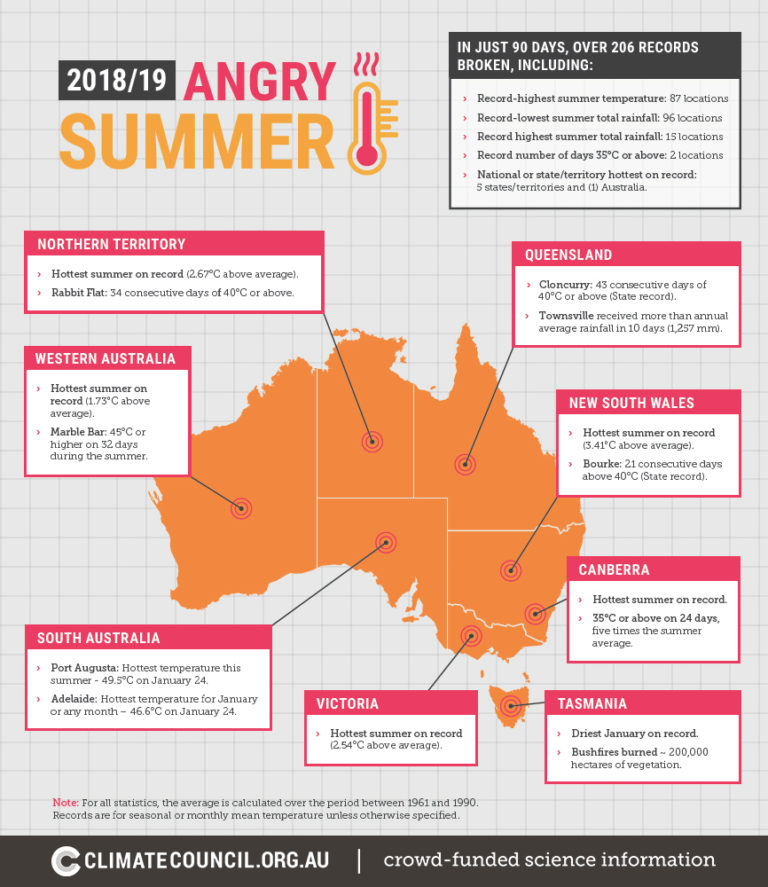
(AU) More Than 206 Heat Records Broken In Just 90 Days This Year, Climate Council Report Says

NEWS.com.auCharis Chang

NSW Rural Fire Service crews watch on as fire burns close to a property on Wheelbarrow Ridge at Colo Heights, northwest of Sydney, on November 19. Picture: Dan Himbrechts/AAP
Sydney and Melbourne could experience 50C summer days before the end of the century if greenhouse gas emissions continue to rise, a new report highlights.
The Climate Council’s report said more than 206 heat records had been broken in just 90 days this year including record-highest temperatures in 87 locations.
In NSW, temperatures are 3.41C above average.
“Queensland and New South Wales have both lost more homes (to bushfire) since August 2019 than in any previous year, with the hottest months of the fire season still to come,” the report said.
Recent bushfires have also created a health hazard in cities like Sydney, which were covered in smoke haze for several days.
Dr Kate Charlesworth said air quality had been impacted so badly in some areas, “it’s the equivalent of smoking 40 cigarettes a day”.
In Australia, the main risk to human life from climate change arises from heatwaves, which can lead to illnesses like heat exhaustion and the worsening of heart and kidney disease.
“Climate change is a serious health issue. Health professionals like myself have a duty to speak up just as we did with asbestos and tobacco,” Dr Charlesworth said.
Heatwaves, defined as at least three days in a row of unusually high temperatures, are occurring more frequently in Australia.
They now start 19 days earlier in Sydney and 17 days earlier in Melbourne if you compare the data for 1981-2011 and 1950-1980.
The number of heatwave days each year has also increased in Perth, Adelaide, Melbourne, Sydney, Canberra and Hobart since 1950.
The hottest day of the heatwave is also becoming hotter.
Most dramatically, the peak day in Adelaide is on average now 4.3C higher in 1981-2011 compared with 1950-1980.
The report noted Sydney and Melbourne could experience 50C summer days by the end of the century.
Smoke shrouds the Sydney Harbour Bridge on November 21 in Sydney. Picture: Cassie Trotter/Getty Images
Drought is also an issue, with the central west of NSW facing a dangerous summer.
The period from January 2017 to October 2019 has been the driest on record for the Murray-Darling Basin as a whole.
The current prolonged drought across eastern Australia is threatening crops for the third year in a row, and national summer crop production is forecast to fall by 20 per cent to 2.1 million tonnes in 2019/20.
“Major regional centres such as Orange and Dubbo are currently facing severe water shortages, and this summer is shaping up as a terrible trifecta of heatwaves, droughts and bushfires with no reprieve for the Central West,” Climate councillor and report author Professor Will Steffen said.
“We have seen bushfires starting in winter, a heatwave traversing the country in spring, and a prolonged drought. Climate change is influencing all of these things,” Prof Steffen said.
Rob Lee, a beef and sheep farmer in Larras Lee, northwest of Orange, said he had been anxious about the changing climate for more than 15 years, which is why he joined Farmers for Climate Action.
“We can see the conditions changing out here. We have less rainfall, winters are getting drier, the surface water is no longer reliable and dams are drying up,” Mr Lee said.
“We have never seen a drought as bad as this. In 2018, we sold one-third of our cows, and again this year we sold another third. Once we are through the next calving, we will get out altogether and run just sheep.
“We have also built drought lots to contain our sheep. This protects the topsoil which can turn to dust in the dry conditions.
“We have made a number of changes to our farming practices, but if climate change continues to accelerate, driving more drought conditions, it is going to be very hard to make a living as a farmer.
“Australia needs to take serious, credible action on climate change. Renewable energy is an investment in the future, an opportunity that could create a lot of industries in regional areas like the Central West,” Mr Lee said.
The Bureau of Meteorology is forecasting above-average maximum temperatures for most of Australia this summer with eastern Australia likely to be drier than average.
“This long-term warming trend driven by the burning of coal, oil and gas is putting Australian lives, our economy and the environment at risk,” Climate Council chief executive officer Amanda McKenzie said.

(AU) Dangerous Summer: Escalating Bushfire, Heat And Drought Risk

Climate Council

Download Report
A long-term warming trend from the burning of coal, oil and gas is supercharging extreme weather events, putting Australian lives, our economy and our environment at risk.
The Climate Council’s new report, ‘Dangerous Summer: Escalating Bushfire, Heat and Drought Risk‘, has found this summer is shaping up as a terrible trifecta of heatwaves, drought and bushfires, made worse by climate change.

Key Findings
Australia is being battered by extreme weather events, made worse by climate change. The summer of 2019/20 is shaping up as another terrible trifecta of heatwaves, droughts and bushfires.
  • The projections for the summer of 2019/20 are extremely concerning. The Bureau of Meteorology is forecasting above-average maximum temperatures for most of Australia with eastern Australia – already plagued by drought – likely to be drier than average.
  • The 2019/20 bushfire season in New South Wales and southeast Queensland began in winter. Already six lives have been lost and more than 600 homes destroyed in New South Wales, mostly in remote and rural areas and small towns. It is now only the beginning of summer, which means the hottest weather and greatest danger period may still be to come.
  • The bushfires have been costly for farmers. In Cobraball, Queensland, for example, an estimated 12,000 hectares of farmland have been destroyed, including 230 hectares of high-value horticultural crops, with an estimated $20 million damage bill for farms in the region.
  • Wildlife has also been badly affected by the ongoing bushfires, with reports of at least 1,000 koala deaths in important habitats in New South Wales, Queensland and South Australia and the habitats of some of the most ancient and globally iconic songbirds have either been burnt or are under threat.
Climate change is making many extreme weather events in Australia worse.
  • Climate change is now making hot days hotter, and heatwaves longer and more frequent. This has implications for bushfire weather, with fire seasons starting earlier and lasting longer.
  • Long-term heating and the reduction in cool season rainfall in mainland southern Australia are exacerbating drought conditions.
  • The period from January 2017 to October 2019 has been the driest on record for the Murray- Darling Basin as a whole. Over the same period of time, new long-term records for low soil moisture have been set, with ten of the Basin’s 26 river catchments recording the lowest soil moisture levels on record.
LARGE IMAGE
Worsening extreme events, such as heatwaves, drought and bushfires, are affecting the health and well-being of Australians and important sectors such as farming.
  • The number of heatwave days each year has been increasing in Perth, Adelaide, Melbourne, Sydney, Canberra and Hobart, and across Australia as a whole since 1950. Heatwaves can have severe effects on human health, including both direct heat illnesses (e.g. heat exhaustion) and indirect impacts (e.g. cardiovascular failure).
  • The heatwave that occurred during the summer of 2009 is estimated to have resulted in as many as 500 excess deaths in Melbourne and Adelaide (374 deaths in Melbourne and 50-150 deaths in Adelaide).
  • The current prolonged drought across eastern Australia is threatening crops for the third year in a row, and national summer crop production is forecast to fall by 20 percent to 2.1 million tonnes in 2019/20.
  • Bushfires also cause serious health impacts, including direct loss of life, physical injuries and mental health issues. Large populations are also at risk from the health impacts of bushfire smoke, which contains respiratory irritants and cancer-causing substances.
The catastrophic events that are unfolding in Australia are not “normal”. Now is the time to act decisively and swiftly.
  • A long-term heating trend from the burning of coal, oil and gas is supercharging extreme weather events, putting Australian lives, our economy and our environment at risk. Australia is one of the most vulnerable developed countries to climate change.
  • If greenhouse gas emissions continue to rise, the unusually hot weather currently experienced will become commonplace, occurring every summer across the country. Sydney and Melbourne could experience unprecedented 50°C summer days by the end of the century.
  • Australian states, territories, towns and cities are leading the way on climate action. This leadership is hugely important because the Federal Government has no credible pathway for reducing emissions.
  • Australia must contribute to the global effort to deeply and rapidly reduce greenhouse gas emissions and we must prepare our fire and emergency services and communities for worsening extreme weather events.
Links

Climate Change: The COP25 Talks Trying To Change The World

BBC - Imran Rahman-Jones

GETTY IMAGES
We know the warnings by now.2019 is on course to be in the top three warmest years on record.
The UK government has declared a national climate emergency.
And now, UN Secretary General António Guterres says the "point of no return is no longer over the horizon".
That came ahead of the UN's two-week gathering of countries to discuss climate change and set targets - the 25th Conference of the Parties (COP25).
So what really gets done at these conferences - and do they actually work?
Climate activist Greta Thunberg was at last year's COP event in Poland. GETTY IMAGES
Many countries have individual targets related to climate change.
For example, the UK government has committed to cutting greenhouse gas emissions right down to net-zero by 2050.
But there are also worldwide targets for countries which take part in the UN climate change summits.
The Montreal Protocol, adopted in 1987, was an international agreement to try to heal the ozone layer, which protects Earth from ultraviolet rays but was being destroyed by man-made chemicals.
By last year it was found to be successfully healing - the Northern Hemisphere could be fully fixed by the 2030s and Antarctica by the 2060s, according to a UN report.
The COP meetings - which focus on greenhouse gases - started in 1995. But it was 1997 when the first significant targets were set.

The Kyoto Protocol
The Kyoto Protocol is named after the Japanese city where it was agreed. GETTY IMAGES
The Kyoto Protocol, agreed in Japan in 1997, set targets for 37 countries to cut greenhouse gas emissions.
The targets were different for each country, depending on how developed they were.
But the US pulled out in 2001 - because they were unhappy that developed countries had legally binding targets, while less developed nations didn't have binding targets.
Canada pulled out in 2011 and a lot of other countries missed their targets.
Doha in Qatar was where the Kyoto Protocol was amended. GETTY IMAGES
In 2012, the Kyoto Protocol was updated in Doha, Qatar.
But the deal only covered Europe and Australia, whose share of world greenhouse gas emissions was less than 15%.
However, it paved the way for the Paris Agreement in 2015 - also known as COP21 - which was another significant step in climate change talks.

The Paris Agreement
GETTY IMAGES
The Paris Agreement went further than any other international climate change deal.
It was agreed by 195 countries in 2015 and came into force in November 2016.
Some of the main pledges were:
  • To keep global temperatures "well below" 2C above pre-industrial times and "endeavour to limit" them even more, to 1.5C.
  • To limit the amount of greenhouse gases emitted by human activity to the same levels that trees, soil and oceans can absorb naturally, beginning at some point between 2050 and 2100.
  • To review each country's contribution to cutting emissions every five years so they scale up to the challenge.
  • For rich countries to help poorer nations by providing "climate finance" to adapt to climate change and switch to renewable energy.
One of the main differences to the Paris deal was that it allowed countries to submit their own targets - rather than tell countries what their targets were.
This got the US and Canada back on board.
But since then, the US has started to withdraw from the agreement, as President Trump says it's unfair on the US economy.
He has said he wants to make it easier for fossil fuel producers in the US.
But there's an election in the US in November 2020, and a different president could cancel the withdrawal.

Do the talks actually work?
COP25 has started in Madrid and runs until 13 December. GETTY IMAGES
Although the Paris Agreement was generally well-received, the UN itself has said it doesn't go far enough.
A report from the UN Environment Programme in 2017 says the Paris Agreement only covers a third of the emission reductions needed.
It says that the world is still on course to warm by more than 2C.
The report recommends putting more ambitious targets in place in 2020.


COP25: What you need to know about the climate conference.

Next year's targets are what's expected to be discussed at this year's COP25 in Madrid.
The 2020 summit will be held in Glasgow and countries have committed to submit new and updated national climate action plans.
The UN Secretary General António Guterres will tell the meeting that the world is now facing a full-blown climate emergency.
He said before the conference: "In the crucial 12 months ahead, it is essential that we secure more ambitious national commitments - particularly from the main emitters - to immediately start reducing greenhouse gas emissions at a pace consistent to reaching carbon neutrality by 2050."
It could be seen as an acknowledgement that while the climate change summits can be a step towards a better future, more needs to be done - and time is running out.

Links

03/12/2019

UN Chief: Climate Change Near 'Point Of No Return'

Deutsche WelleAP | AFP | Reuters

Antonio Guterres has taken the world's major economies to task for not "pulling their weight" to reduce emissions. Ahead of the COP25 climate summit, the UN head said we were rapidly approaching the "point of no return."


Guterres sounds stark climate warning

"We are confronted with a global climate crisis and the point of no return is no longer over the horizon, it is in sight and hurtling towards us," said United Nations Secretary-General Antonio Guterres on the eve of the two-week COP25 global climate summit in Madrid.
"Our war against nature must stop, and we know that it is possible," he said Sunday. "We simply have to stop digging and drilling and take advantage of the vast possibilities offered by renewable energy and nature-based solutions."
Across the globe, catastrophic weather patterns — from floods to fire to extreme droughts and heavy snowstorms — are wreaking havoc on both human and animal life. Scientists are warning that the world is running out of time to reverse the worst possible effects of man-made climate breakdown.
Guterres took member nations to task for not sticking to the 2015 Paris climate agreement, which calls on a limit to fossil fuel use in an attempt to curb global temperatures increases.


Protesters around the world demand action


World's largest emitters are not pulling their weight'
"We also see clearly that the world's largest emitters are not pulling their weight," he said, "and without them, our goal is unreachable."
The world's largest carbon emitter is China and the second-largest, the United States.
At last year's UN climate summit in Katowice, Poland, member states drew up a framework for monitoring emission reductions and made plans for further cuts in the future. However, there has still been no agreement on key elements like putting a price on CO2 emissions that could allow carbon taxes to be traded between countries.
On Friday, mass rallies were held around the world as people called on their governments to address climate change before it's too late.

How is climate change affecting Europe?
Record-setting heat waves
The summer of 2019 saw heat records in Europe broken across the continent. In July, Germany recorded its highest temperature ever at 42.6 C (108 F). France broke its heat record twice in 2019, the highest temperature measuring 46.C (114.8 F) in July. Climate change increases the frequency of heat waves. 

Venice under water
In November 2019, the Italian archipelago city of Venice experienced multiple flooding events and the high water mark of 1.5 meters was reached three times in one week for the first time in recorded history. Projected sea level rise due to climate change could make these events more likely in the future.

Wildfires burning Spain
The same heat wave that brought record temperatures to France sparked the worst wildfires to hit Spain in 20 years. On the Spanish island of Gran Canaria, wildfires in August decimated a national park on the popular tourist island. Hotter temperatures and drier air due to climate change increase the risk of fires. 

German forests dying
A combination of drought, storms and extreme heat is depleting Germany's forests. According to BDF, a forest advocacy group, in Germany, more than 1 million established trees have died since 2018. "These are no longer single unusual weather events. That is climate change," said a BDF representative. 

Disappearing glaciers in the Alps
A glacier on the Italian side of Mont Blanc experienced accelerated melting in 2019. And enthusiasts held a "funeral" for the Pizol glacier in the Swiss Alps, which has almost completely disappeared. Scientists say climate change accelerates glacial melting in the Alps. 

Drought affecting food production
Two consecutive years of drought in Germany have hit farmers hard. In 2018, record drought caused major crop failures, and heat waves in 2019 also damaged crops. "Climate change means more frequent droughts and extreme weather events in Germany,"said German Weather Service Vice President Paul Becker.


New EU Commission plans 'Green Deal'
The newly minted leadership of the European Commission, under former German Defense Minister Ursula von der Leyen, has set lofty climate goals for itself under a policy initiative called the "European Green Deal." Among the goals set out by the campaign is the plan to make Europe the "first carbon-neutral continent."
As von der Leyen and her cabinet took office on Sunday, she hailed the COP25 summit as the perfect "starting point" for her climate policy plans.
"Europe is leading in this topic and we know that we have to be ambitious for our planet,'' von der Leyen told reporters.


Seychelles: An ecosystem under threat

On Thursday, European lawmakers voted to declare an EU-wide climate emergency in a symbolic move aimed at increasing pressure on the incoming European Commission to take a stronger stance on climate change.
On Sunday, European Parliament President David Sassoli also spoke of the need "to turn the promises of the past few months into results that improve people's lives. From the fight against climate change to tackling the rise in the cost of living, Europeans want to see real action.''


Will a 'climate emergency' make a difference?

Links

Lethal Heating is a citizens' initiative