07/02/2020

Are Economists Globally Understating Or Overstating The Cost Of Climate Change?

ABC News - Nassim Khadem

Some economists argue that the world can financially cope with 4°C of warming. (ABC News: Alistair Kroie)
In a blog written after the devastating bushfires that swept across his home state of New South Wales, Australian economist Steve Keen states, "I have to admit that I am personally not coping well with climate change".
Professor Keen says he's feeling the "same generalised anxiety about the future felt by Greta Thunberg and the young people she's inspired to strike for the climate", before criticising the work of William Nordhaus and other neoclassical economists.
"Since policymakers take what economists predict seriously — even after the 2008 financial crisis — they have been duped and have drastically underestimated how severe climate change will actually be," Professor Keen argues.
William Nordhaus is a renowned American economist whose work modelling the economic impact of climate change earned him the 2018 Nobel Memorial Prize in Economic Sciences.
He is not a climate change denialist. His view is that greenhouse gas emissions from human activities will have a negative impact and he's urged governments globally to implement a carbon tax.
But it's the extent to which Professor Nordhaus — and other economists who agree with him — predict climate change will impact the economy (and thereby the level of action needed to curb it) that has been the subject of intense debate.
The Paris Agreement goal is to keep global warming this century well below two degrees Celsius compared with pre-industrial levels.
Swedish climate activist Greta Thunberg has inspired many young people around the world to strike for climate change. (AP: Markus Schreiber)
At one end of the scale are Professor Nordhaus and Richard Tol.
Tol, a professor of economics at the University of Sussex, has since 1994 been a convening lead author with the United Nations body for assessing the science related to climate change, the Intergovernmental Panel on Climate Change (IPCC).
Both Nordhaus and Tol argue that the world can survive a 4°C increase in global average temperature and the economic impact won't be severe.
They also argue we shouldn't reduce emissions too quickly, because the economic cost to people today will be higher than the benefit of protecting people in the future.
Professor Nordhaus told ABC News he was not available to comment, but has previously said that "optimal policy" would result in global warming of about 3°C by 2100 and 4°C by 2150.
William Nordhaus, one of the laureates of the Nobel Prize in Economics on the screen, has long argued that we shouldn't reduce emissions too quickly. (AP: Henrik Montgomery)
At the other end of the scale are people like British economist Nicholas Stern and Professor Keen who argue that at 4°C the world would reach a tipping point — when the impacts of climate change become so catastrophic that it is possibly too late to reverse them.
So why do economists differ so greatly, and is anyone ultimately right?

Richard Tol: the loss from climate change won't be immense
When the IPCC delivered its Fifth Assessment Report in October 2014, Professor Tol was one of the authors of chapter 10.
Richard Tol, a convening lead author with the IPCC since 1994, believes technology will help advanced nations cope with climate change and limit economic damage. (Supplied: Richard Tol )

This chapter looked specifically at the economic impacts of climate change, and has come under criticism from other economists for some of its estimates.
It suggested that, while "many estimates do not account for catastrophic changes, tipping points, and many other factors", the global annual economic losses for additional temperature increases of ~2°C are between 0.2 and 2.0 per cent of income.
Meanwhile, a summary chapter of that report used far stronger language.
The summary said that mitigation pathways to limit warming to below 2°C relative to pre-industrial levels "would require substantial emissions reductions over the next few decades and near zero emissions of CO2 and other long-lived greenhouse gases by the end of the century".
Can extreme weather events be 
attributed to climate change?
Every time there is an extreme weather event it seems to trigger a whirlwind of climate change discussion. But how do scientists decide if climate change is involved?

At the time Professor Tol had disagreed with some findings of the summary of that chapter as being "too alarmist".
Professor Tol's view is that climate change is a problem, but that welfare loss will not be immense.
He believes that technological advancement will help advanced nations cope with the impact of climate change, and this in turn will dent the negative economic impact.
"We have decent observations on natural disasters going back a century, data on crop yields going back longer," Tol tells ABC News.
"These data all show that, over time, we have become much less vulnerable to weather and climate, partly because economic growth has meant that we can afford to better protect ourselves, and partly because technology is so much better now."
But Professor Tol is worried that the impact will be disproportionate depending on where people live. That is, people in poorer countries are more vulnerable than those living in richer countries.
He says, while rapid warming of the earth would be very costly, he believes that "warming is not very rapid".
Even moving beyond 4°C to a 6°C warming scenario, he says the world won't end.
"6°C is the difference between Melbourne and Perth," Professor Tol argues.
"If it were to warm by 6°C degrees in a century — it will not — you have about 100 years to upgrade Melbourne's air-conditioning, drainage, etc, to Perth standards. That costs money, but it won't ruin the economy."

Steve Keen: 4°C would unleash a 'howitzer'
But Professor Steve Keen, who now works as an honorary professor at University College London, responds that humanity has never existed in, let alone experienced, a planet with that temperature.
Australian economist Steven Keen says humanity has never existed in, let alone experienced, a planet with a 4°C increase in global average temperature. (The 7.30 Report)
"How on earth would such a drastic change in temperature make such a tiny difference to GDP?," Professor Keen asks.
He says economists like Nordhaus and Tol use data on GDP and temperature today across the globe (and primarily, across the USA) as a proxy for what will happen when global temperatures rise.
Their models, he argues, assume technology improves at such a rapid pace that the impact of such catastrophic events will be muted.
"All their models tell us is that they have faith — and a faith that bears no relation to the actual way in which capitalist economies function," Professor Keen says.
One of Professor Nordhaus's papers includes an equation for calculating the damage from climate change impacts that "assumes that damages are 2.1 per cent of global income at 3°C warming and 8.5 per cent of income at 6 °C warming".
Professor Keen argues that even if we had 500 years to do adapt to rising sea levels, Nordhaus' argument is ridiculous.
"So much of humanity's resources would be damaged or destroyed, so much would need to be devoted to rebuilding, moving, and resettling," Professor Keen says.
"We would be lucky to have any resources left to produce output, let alone expand it."

Mark McVeigh is taking on
REST super on climate change
In July, a landmark trial could change the way funds invest Australians' almost $3 trillion in retirement savings.

He also notes in a recent blog that Nordhaus's estimates of the potential economic damage exclude entire industries such as manufacturing and mining.
"Nordhaus has put the world into a Dirty Harry movie gone bad: having advised policymakers that a simple and low tax on carbon is a Magnum 44 for shooting climate change, they scoff at the danger, telling climate change, 'Do you feel lucky, punk?'.
"In reality, climate change is armed with a howitzer, and the policy Nordhaus recommends — letting the global temperature reach levels 4 degrees above preindustrial levels — would unleash that howitzer."
Nicholas Stern: economists 'grossly underestimate' climate change cost
The Grantham Research Institute on Climate Change and the Environment is chaired by Nicholas Stern, who in 2006 led a review on the economics of climate change for the British Government.
British economist Nicholas Stern co-authored a report noting economists had "grossly underestimated many of the most serious consequences" of climate change. (Kieran Doherty: Reuters)
Grantham, in September 2019, released a report noting that "economic assessments of the potential future risks of climate change have been omitting or grossly underestimating many of the most serious consequences for lives and livelihoods".
The report argued this happened because such risks are difficult to quantify and lie outside of human experience.
Dr Stern was not available to comment.
But Bob Ward, the policy and communications director at Grantham who co-authored that report with Dr Stern and other economists, tells ABC News there are problems with models used by Nordhaus, Tol and others.
"There is good evidence that we are rapidly approaching, or may already have passed, the critical temperature at which destabilisation of the major land-based ice sheets in Greenland and West Antarctica becomes inevitable," Mr Ward says.
This, he adds, would see several metres of global sea level rise.
"Together, the Greenland and West Antarctica ice sheets contain enough ice to raise global sea levels by about 13 metres.
"Such sea level rise might take several centuries to occur, but we cannot rule out rises of more than a metre by the end of this century, which would threaten the lives and livelihoods of millions of people around the world's coastlines."

Kamiar Mohaddes: whether rich or poor, all countries will suffer
Kamiar Mohaddes is an economist at the Cambridge Judge Business School at the University of Cambridge.
University of Cambridge economist Kamiar Mohaddes predicts at least 7 per cent of global GDP will disappear by 2100 because of business-as-usual carbon emissions. (Supplied: Kamiar Mohaddes)
He co-authored a recent study that suggested at least 7 per cent of global GDP will disappear by 2100 as a result of business-as-usual carbon emissions.
This includes more than 10 per cent of incomes in developed nations including Canada, New Zealand and the United States, and a 7 per cent loss for Australia.

Climate and economy linked
The Morrison Government risks being stranded at the intersection of climate change related disasters and their economic fallout, writes Ian Verrender.

"In fact allowing for temperature increases to affect the variability of temperature shocks, they show that the estimated GDP per capita losses would almost double at the global level to over 13 per cent, with the income losses being more than 16 per cent for Australia and the United States," Dr Mohaddes explains.
The study found that, whether rich or poor, virtually all countries would suffer economically by 2100 without mitigation and adaptation policies.
There are several reasons why the losses estimated in his study were larger than those generally discussed in policy circles.
Firstly, he says, the frequency and severity of weather events and natural disasters depend heavily on the variability of temperatures.
"We explicitly model the variability of weather patterns, not only averages of climate variables," Dr Mohaddes explains.
He also notes that traditionally economists (such as Nordhaus) have argued that climate change affects economic activity mainly through the agricultural sector.
But he says other sectors, including forestry, fisheries, mining, construction, manufacturing, transport, communications, public utilities, wholesale trade, retail trade and services would all be hit by climate change.

Nicki Hutley: costs of climate change will be 'astronomical'
Deloitte Access Economics partner Nicki Hutley says there are all sorts of technological options available to help reduce emissions, but none of that contradicts the fact that if we get to a 4°C rise in global average temperatures there would be huge economic costs.
Deloitte Access Economics partner Nicki Hutley says if we get to a 4°C rise in average temperatures there will be huge economic costs. (Supplied: Deloitte)

"Anyone who says a 4°C [rise] is not going to have an impact is quite frankly drinking something weird," Ms Hutley exclaims.
The Australian Business Roundtable for Disaster Resilience and Safer Communities — a group made up of community and business leaders who are working towards ensuring Australia becomes more equipped for extreme weather events — has considered the economic damage of natural disasters across states and territories.
In a 2017 report, it found that the total economic cost of natural disasters in the 10 years to 2016 averaged $18.2 billion per year, equivalent to 1.2 per cent of average gross domestic product (GDP) over the same period.
It said this was expected to reach $39.3 billion per year on average by 2050 (in present value terms), even without considering the impact of climate change (and the latest bushfires are likely to hugely inflate those estimates).
The report noted that "while the science has advanced, it remains difficult for experts to model the timing, location and intensity of disaster events in response to climate variability and change", and therefore the $39.3 billion estimate was conservative.
"This [climate change] is so multidimensional, and the costs are astronomical," Ms Hutley says.
She also points out that the IPCC itself has called on international leaders to limit global warming below or close to 1.5°C, which would require the world to cut net emissions by about half by 2030 and reach net zero by 2050.
"The idea is that we avoid getting to four degrees," she said.

John Quiggin: Economists don't look beyond tipping points
John Quiggin, an Australian Laureate Fellow in Economics at the University of Queensland, says the problem with economic models is how they treat the worst-case scenarios.
John Quiggin, from the University of Queensland, said the problem with economic models is how they treat the worst-case scenarios. (Supplied: John Quiggin)
"A lot of attention has been paid to the lower levels of [global] warming because they are easier to evaluate," he observes.
"Once you get past tipping points, we don't really have a good handle on what may happen."
He estimates the economic cost of the latest Australian bushfires alone could hit about $100 billion.


Bushfire cost could run into billions
Ross Garnaut's climate change prediction is coming true and it's going to cost Australia billions, economists warn.

This estimate takes into account massive underinsurance by households and businesses, damage to public infrastructure (which will have to be rebuilt to a higher standard in preparation for future disasters), lost tourism, ongoing health effects from smoke and pollution, and the destruction of entire ecosystems.
"If you look at the way economists were framing the debate, the assumption was bad things will happen around 2050, so how you discount costs and benefits 30 years into the future is a big deal," Dr Quiggin explains.
"The arrival of climate change much sooner than people expected will render the debate about the discount rate largely irrelevant. Climate change is happening now."
Another issue that has divided economists is how much it will cost to reduce emissions.
"The technological advancements we have seen mean we could decarbonise the economy very cheaply if we choose to," Dr Quiggin argues.
"But even with technological improvements, it will only happen if the policymakers want it to happen."

Links

As Our Planet Gets Greener, Plants Are Slowing Global Warming

Phys.org - 

Credit: CC0 Public Domain
Preface
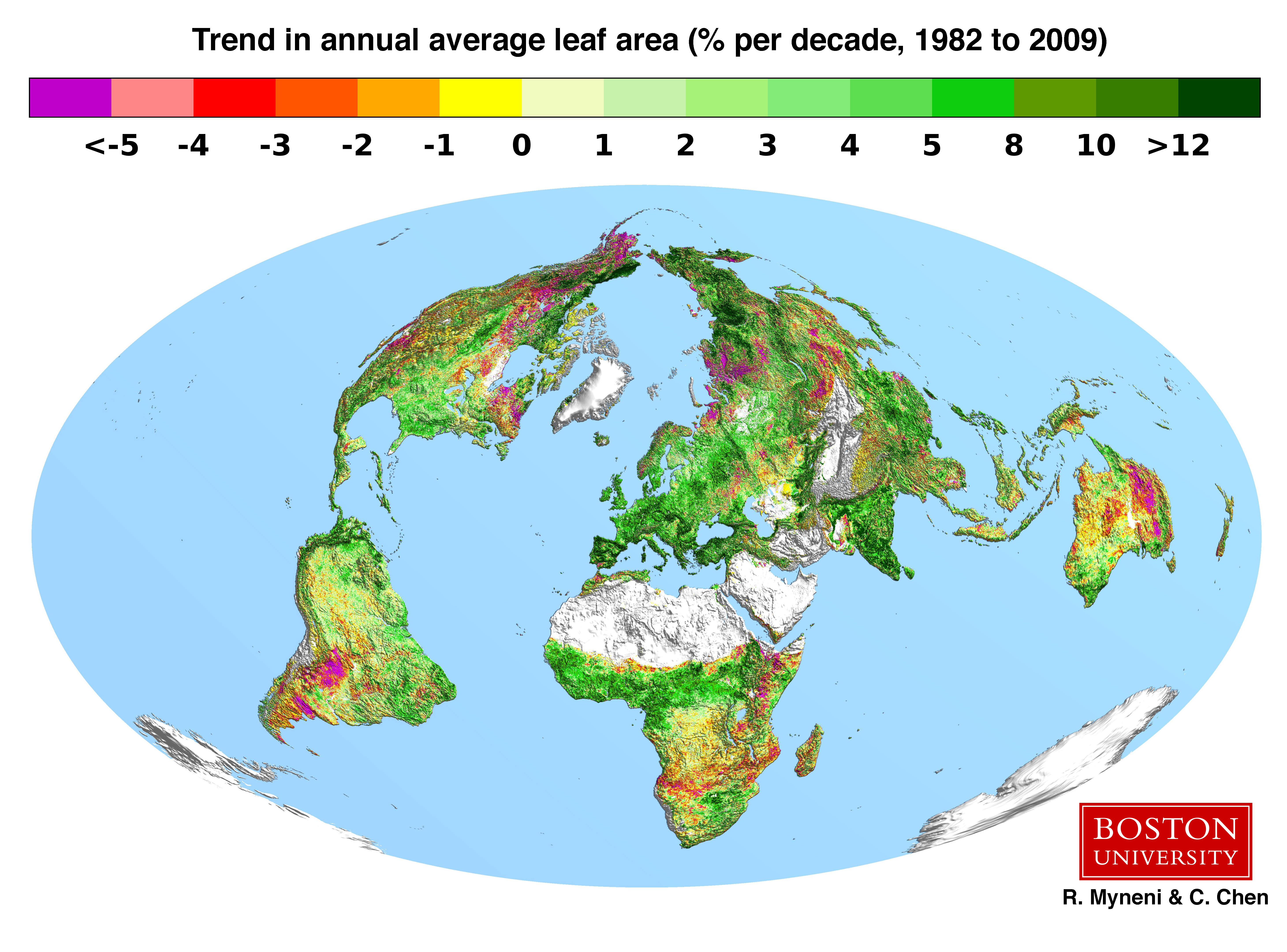
Chi Chen, a Boston University graduate researcher, and Ranga Myneni, a BU College of Arts & Sciences professor of earth and environment, have released a new paper that reveals how humans are helping to increase the Earth's plant and tree cover, which absorbs carbon from the atmosphere and cools our planet.
The boom of vegetation, fueled by greenhouse gas emissions, could be skewing our perception of how fast we're warming the planet.

Key points
  • Long-term satellite records reveal a significant global greening of vegetated areas since the 1980s, which recent data suggest has continued past 2010.
  • Pronounced greening is observed in China and India due to afforestation and agricultural intensification.
  • Global vegetation models suggest that CO2 fertilization is the main driver of global vegetation greening.
  • Warming is the major cause of greening in boreal and Arctic biomes, but has negative effects on greening in the tropics.
  • Greening was found to mitigate global warming through enhanced land carbon uptake and evaporative cooling, but might also lead to decreased albedo that could potentially cause local warming.
  • Greening enhances transpiration, a process that reduces soil moisture and runoff locally, but can either amplify or reduce runoff and soil moisture regionally through altering the pattern of precipitation.
Taking a closer look at 250 scientific studies, land-monitoring , climate and environmental models, and field observations, a team of Boston University researchers and international collaborators have illuminated several causes and consequences of a global increase in vegetation growth, an effect called greening.
In a new study, published in Nature Reviews Earth & Environment, the researchers report that climate-altering carbon emissions and intensive land use have inadvertently greened half of the Earth's vegetated lands. And while that sounds like it may be a good thing, this phenomenal rate of greening, together with , , and sea-ice decline, represents highly credible evidence that human industry and activity is dramatically impacting the Earth's climate, say the study's first authors, Shilong Piao and Xuhui Wang of Peking University.
Green leaves convert sunlight to sugars while replacing in the air with oxygen, which cools the Earth's surface. The reasons for greening vary around the world, but often involve intensive use of land for farming, large-scale planting of trees, a warmer and wetter climate in northern regions, natural reforestation of abandoned lands, and recovery from past disturbances.
And the chief cause of global greening we're experiencing? It seems to be that rising are providing more and more fertilizer for plants, the researchers say. As a result, the boom of global greening since the early 1980s may have slowed the rate of global warming, the researchers say, possibly by as much as 0.2 to 0.25 degrees Celsius.
"It is ironic that the very same carbon emissions responsible for harmful changes to climate are also fertilizing plant growth, which in turn is somewhat moderating global warming," says study coauthor Dr. Jarle Bjerke of the Norwegian Institute for Nature Research.
Boston University researchers previously discovered that, based on near-daily NASA and NOAA satellite imaging observations since the early 1980s, vast expanses of the Earth's vegetated lands from the Arctic to the temperate latitudes have gotten markedly more green.
"Notably, the NASA [satellite data] observed pronounced greening during the 21st century in the world's most populous and still-developing countries, China and India," says Ranga Myneni, the new study's senior author.
Even regions far, far removed from human reach have not escaped the global warming and greening trends. "Svalbard in the high-arctic, for example, has seen a 30 percent increase in greenness [in addition to] an increase in [summer temperatures] from 2.9 to 4.7 degrees Celcius between 1986 and 2015," says study coauthor Rama Nemani of NASA's Ames Research Center.
Over the last 40 years, carbon emissions from fossil fuel use and have added 160 parts per million (ppm), a unit of measure for air pollutants, of CO2 to Earth's atmosphere. About 40 ppm of that has diffused passively into the oceans and another 50 ppm has been actively taken up by plants, the researchers say. But 70 ppm remains in the atmosphere, and together with other greenhouse gases, is responsible the land warming patterns that have been observed since the 1980s.
"Plants are actively defending against the dangers of carbon pollution by not only sequestering on land but also by wetting the atmosphere through transpiration of ground water and evaporation of precipitation intercepted by their bodies," says study coauthor Philippe Ciais, of the Laboratory of Climate and Environmental Sciences, Gif-sur-Yvette, France. "Stopping deforestation and sustainable, ecologically sensible afforestation could be one of the simplest and cost-effective, though not sufficient, defenses against climate change," he adds.
LARGE IMAGE

It is not easy to accurately estimate the cooling benefit from global greening because of the complex interconnected nature of the climate system, the researchers say. "This unintended benefit of global greening, and its potential transitory nature, suggests how much more daunting, and urgent, is the stated goal of keeping global warming to below 1.5 to 2 degrees Celsius, especially given the trajectory of and history of inaction during the past decades," says study coauthor Hans Tømmervik of the Norwegian Institute for Nature Research, Norway.

Links

RBA Governor Warns Of 'Profound' Impact From Climate Change, Urges Investment

Sydney Morning Herald - Shane Wright | Matt Wade

Reserve Bank governor Philip Lowe has warned climate change will have a "profound" impact on the economy and leave businesses with stranded assets while urging governments to borrow more to boost productivity and protect it from a warming environment.
As economists warned the country faced its first quarter of negative growth in nine years due to the combined impact of the coronavirus and the summer's bushfires, Dr Lowe used his first public address of the year to urge more investment to deliver "strong and consistent growth" rather than relying on the nation's fundamentals to get by.
RBA governor Philip Lowe says business and government should borrow more to invest in productivity-enhancing projects including ways to deal with climate change. Credit: AFR
The bank kept official interest rates at an equal record low of 0.75 per cent at its February board meeting on Tuesday, tipping the economy to grow 2.75 per cent this year despite the impact of the bushfires and the outbreak of coronavirus.
Dr Lowe said the bank believed the fires would likely cut GDP across the December and March quarters by 0.2 percentage points while the drought would hurt growth by 0.25 per cent through the year. It was too early to determine the full impact of the coronavirus.
The Federal Chamber of Automotive Industries reported on Tuesday there were 71,731 new cars bought through January, the worst opening to a year since 2003. The chamber noted bushfires and international issues such as the coronavirus were likely reasons for the poor performance.
In an address to the National Press Club, Dr Lowe said low interest rates meant there was no excuse for business and governments not to borrow and invest in projects such as infrastructure, technology upgrades, education and training or energy systems.
He said governments and businesses should also invest in dealing with climate change, arguing it was already having a financial impact that would only grow.
"I think that we're seeing climate change affect patterns of production and distribution and investment. We're seeing the cost and availability of insurance change, which is going to affect where people invest," he said.
"The fact that it is affecting the value of assets and can likely do that in the future means that there are financial stability implications over time. We're likely to see at some point some stranded assets and the value falls."
The Morrison government is aiming to deliver the nation's first federal budget surplus since before the global financial crisis.
But Dr Lowe said there are more pressing budget policy challenges, including the way for fiscal and monetary policy to stabilise the economy given low interest rate settings.
"Whether or not the government has a small budget surplus from an economic perspective is not really that important," he said.
Interest rates and the budget may be called in to help the economy with growing concerns about the impact of coronavirus.
ANZ's economics team had initially expected the virus to lower growth by 0.2 percentage points in the March quarter, but now say it appeared the virus and the response to it across the world would likely take half a percentage point off growth through the first three months of this year.
Several market economists are now tipping the coronavirus may see Australia post its first quarter of negative growth in nine years. Credit: Getty
Economists Felicity Emmett and David Plank said the tourism and education sectors would be hit hardest but there would be a broader impact across the country.
"Local consumer sentiment took a hit from the bushfires and the news regarding the virus is keeping confidence levels low," they said.
"Rising uncertainty about the impact of the virus is likely to test business confidence, and there is the potential for investment plans to be delayed."
They were backed by AMP Capital chief economist Shane Oliver who said GDP could be 0.2 percentage points lower this quarter, but growth would rebound in the June quarter.
The last time the Australian economy contracted in a quarter was in early 2011 when cyclones closed key ports across Queensland and Western Australia. The economy quickly rebound in the June quarter.

Links

06/02/2020

(AU) Scott Morrison Says He Won't Be 'Bullied' On Climate By Inner City Voters

SBS - Tom Stayner

Prime Minister Scott Morrison says he "won't be bullied" into changing his government's position on climate change as National MPs renew demands for more investment in coal.
Prime Minister Scott Morrison speaks in Parliament House, Canberra. Source: AAP

Prime Minister Scott Morrison has declared he won't be "bullied" by inner-city voters as he downplayed concerns of a fresh climate war inside the Coalition.
Some National MPs are demanding more coal-fired power stations and urging Scott Morrison to resist calls to take stronger action on climate change.
Nationals Leader Michael McCormack also declared the Coalition should hold the line on climate policy, following a challenge to his leadership from former leader Barnaby Joyce.
Mr Morrison said being in coalition with the Nationals had ensured the government's response to climate change was sensible and balanced, rather than being dictated by those in the inner city.
Re-elected Nationals Party leader Michael McCormack and newly-elected deputy leader David Littleproud maintain the Coalition is united on climate policy. AAP /Lukas Coch)
"We listen to all Australians and we listen to Australians right across the country, not just those in the inner city," he told Nine's Today. 
He said action should not come at the expense of jobs and industries.
“What we’ll do is take practical actions that deal with these challenges and that challenge is living in a hotter, drier and longer summer.
“So we won’t be bullied into higher taxes and higher electricity prices.”
Mr Morrison's comments echoed those of his deputy prime minister during the height of the bushfire crisis.
In November, Mr McCormack attacked those who were linking climate change to the severity of the bushfires, labelling them "inner-city raving lunatics".
Mr McCormack held off an attempt by Barnaby Joyce to reclaim the Nationals’ leadership at a party room meeting on Tuesday.
Mr Joyce's platform had been backed by Senator Matt Canavan, the pair urging the government to increase support for coal and investment in new coal-fired power stations.
It is understood Nationals MP George Christensen also spoke out against climate change policy and advocated for coal at the first Coalition meeting of the year held hours after the leadership spill.
While Mr Morrison has previously said the government's policy on climate would "evolve" in the wake of the bushfire crisis, Mr McCormack said the Coalition should not stray from its current climate policies.
“It’s all well and good for some people to say we should stop all fossil fuels,” he told SBS News.
“Well go and tell that to somebody in central Queensland who is working hard for and on behalf of their family … they deserve a job too.”
The Morrison government has committed to reducing emissions by 26-28 per cent on 2005 levels by 2030 under the global Paris Agreement.
But it has faced pressure over its planned use of so-called carry-over credits to meet this target from previous emission agreements.
Nationals Deputy Leader David Littleproud maintained the Coalition is united on taking action on climate change.
“We made international commitments and we are going to live up to them and instead of us beating ourselves up saying we’re this boogeyman in the global stage – we’re not,” he said.
“The quiet Australians out there have had a gutfull of all of this narrative … they just want action … they want us to get on with the job.”

Links

(AU) If There's A Silver Lining In The Clouds Of Choking Smoke It's That This May Be A Tipping Point

The Guardian - 

Australia’s horrific bushfires could be the catalyst that pushes the world to a mass recognition that it’s time to act
Smoke form the almost-biblical fires bearing down on Canberra: ‘This is a stark reminder that climate change seems gradual until it is on your doorstep.’ Photograph: Xinhua/Barcroft Media
Michael E Mann
Michael E Mann is distinguished professor of atmospheric science at Pennsylvania State University. His most recent book, with Tom Toles, is The Madhouse Effect: How Climate Change Denial Is Threatening Our Planet, Destroying Our Politics, and Driving Us Crazy (Columbia University Press, 2016)
As a climate scientist on sabbatical in Australia, I’ve had plenty of conversations about the climate crisis lately as bushfires have burned their way to the front of everyone’s mind. Although the Murdoch media make it seem as if there’s plenty of debate, the reality is that most Australians I talk to get it.
And why shouldn’t they? More carbon pollution means warmer temperatures which dry out the landscape, making it easier for fires to spread. The fact that the bushfires tore through Australia as we ended the hottest decade ever recorded is no coincidence.
But those opposed to climate action have tied themselves in knots trying to fool the public into believing that it’s really environmentalists and arsonists at fault.
Yet it’s hard to sell denial when people are busy fleeing the flames. It’s tough to distract from the reality of climate change when plumes of smoke dim the sky, and when every breath of soot-filled air stings your throat. As one climate scientist colleague put it in response to the almost-biblical fires bearing down on Canberra: “This is a stark reminder that climate change seems gradual until it is on your doorstep.”
That’s precisely what happened to Jeremy Wright, a Rotary Club member who came to a lecture I gave the other day at the University of New South Wales, in Sydney. Wright lost much of his family farm that has been around for 180 years, outside Milton in south-east NSW where the Australian author Henry Kendall was born. The bridge that provides access to the farm burned and he lost a herd of steer, several vehicles and his farm shed. Climate change is no longer just a theoretical construct for Jeremy.
Some of the steer that died in the fire on Jeremy Wright’s farm on New Year’s Eve.
Despite the tragedies playing out around the country, I’m hopeful we’re hitting a tipping point. Not a physical one – which we will hopefully avoid, where the global climate undergoes dramatic, irreversible and catastrophic change – but a psychological one.
Here and around the world these fires appear to be pushing us toward a tipping point in public consciousness, a mass recognition that we must act.
But there has always been a disconnect between what the public knows and what their elected leaders choose to do. Ruling political parties in Australia, the US and Britain are particularly intransigent, their denial driven by ties to fossil-fuel interests and bolstered by the Murdoch media’s steady drumbeat of denial.
It’s something I’ve noticed quite clearly in my time here. The Australians I’ve talked to about climate change seem well aware of the science, are very concerned about reducing emissions and, most of all, are frustrated by their leaders’ unwillingness to take meaningful action.
If there can possibly be a silver lining to the clouds of smoke from the bushfires, it is that they are galvanising public opinion, making it clear that deniers’ and delayers’ rhetoric is a smokescreen to cover for the fossil-fuel industry. Much like how sea level rise and unprecedented wildfires, heatwaves and floods in the US have begun softening the Republican party’s staunch denial, the bushfires have brought the climate crisis to the front and centre of Australian consciousness.
For years, fossil-fuel-funded voices have taken to Rupert Murdoch’s media outlets to tell the public that climate change isn’t real, or it won’t be a problem until years from now, at which point we’ll all be so rich we can just buy our way out of trouble. They told the public to ignore climate scientists who are ringing the planetary fire alarm, that all is well despite the increasingly stark warnings from those who have devoted their lives to studying the issue.
Sadly, despite criticism from within the Murdoch empire, and even from Murdoch’s son James, the promotion of denial and delay continues unabated. “Warming is good for us” read the headline on Andrew Bolt’s column in the Herald Sun the other day to widespread derision as climate change-fuelled bushfires continue to engulf the continent. The headline on Paul Kelly’s column in the Australian read “Any climate policy change is going to be slow burn”, with no apparent sense of irony.
But telling people to ignore the fire alarm doesn’t work so well when they can feel the heat, with flames consuming their country and with so much smoke it’s made a full circuit around the globe.We won’t know if this will be a tipping point for the public’s demand for climate action until we have the benefit of hindsight. But people will have an option: to vote out politicians in denial, and vote in candidates who are honest about the issue.
Perhaps we shouldn’t call it a tipping point, but a flipping point.
Then perhaps she’ll be right, mate.

Links

(AU) Fire Royal Commission Accepts The Role Of Climate Change: PM

AFR - Phillip Coorey

The royal commission into the bushfires will operate on the assumption that the scale and severity of the blazes was fuelled by climate change, Scott Morrison says.
As the Coalition again grapples with internal divisions over climate change, the Prime Minister gave the undertaking to stop the royal commission being distracted by the brawl over whether climate change was real.
Scott Morrison and Michael McCormack in parliament after the Nationals leadership spill. Alex Ellinghausen
While Mr Morrison is unambiguous in drawing links between the fires and climate change, others in his party continue to hedge or deny.
Nationals leader Michael McCormack, who on Monday survived a leadership spill led by Barnaby Joyce and others who do not subscribe to climate change science, is choosing his words carefully so as not to further inflame his already-fractured party.
"What we do, no doubt,  probably has a fair effect on the climate and where we're going to,'' he said of the contributions of humans to global warming.
"How much? That's for scientists to determine.''
Home Affairs Minister Peter Dutton was also sceptical, saying arson was partly to blame for the fires.
"I don't see huge points of difference in our party room ... we're experiencing hotter weather,'' he said.
"But did the bushfires start in some of these regions because of climate change? No. It started because somebody lit a match."
Mr Morrison has announced that former defence force chief Mark Binskin will lead the royal commission into the fires which continue to burn in NSW and the ACT.
The Prime Minister has written to the states seeking input for the terms of reference. Under pressure not to ignore climate change, Mr Morrison said that would be the operating premise of the probe.
"It is accepted that climate change has impacted Australia, and that we're in for longer, hotter, dryer summers,'' he said.
"The royal commission assumes that our climate has changed and there is climate change.
"The issue is what you do about it, the practical actions that keep people safe, and emissions reductions, land clearing. All of these things are critical to that."
He maintained the hazard reduction was just as, if not more, important than emissions reduction.
Despite pressure from within sections of his party, Mr Morrison is holding firm against doing more to decrease Australia's emissions.
He was lukewarm when asked whether he would follow the example of Britain's conservative Prime Minister Boris Johnston, who has committed his nation to zero net emissions by 2050. Also, from 2035, the sale of new petrol, diesel and hybrid cars will be banned in the UK.
"I would never make a commitment like that if I couldn't tell the Australian people what it would cost them,'' Mr Morrison said of the 2050 target.
The leadership challenge in the Nationals was sparked by the sacking from cabinet of the party's deputy leader, Bridget McKenzie, over the sports rorts affair. That, in turn, has rekindled old tensions over climate change.
Mr McCormack told Sky News on Wednesday that Senator McKenzie would return to the frontbench at some stage.
He also said he wanted to change the rules in his party to make leadership challenges harder by introducing a threshold, similar to those Labor and the Liberals have introduced.
Having these rules adopted looms as another test of his leadership next week.
Mr Morrison will announce his new ministry today, Nationals Darren Chester and Keith Pitt are expected to take the cabinet spots of Senator McKenzie and Matt Canavan, who quit in an unsuccessful attempt to generate momentum for Mr Joyce's challenge.

Links

05/02/2020

(AU) Media Watch: News Corp's Fire Fight

ABC - Media Watch

A Media Watch feature on the bushfire crisis. We examine how News Corp’s loudest voices denied or downplayed the role of climate change.

Media Watch: News Corp's Fire Fight

Transcript

ROWAN DEAN: Unprecedented bushfires? Unprecedented drought? No, this Australian summer has been the summer of unprecedented stupidity. Never before have we had to suffer such idiocy in public debate and political commentary, nationally and internationally, in relation to two of the most common and predictable occurrences in Australia’s climate cycle, drought and bushfires.  
- Outsiders, Sky News, 26 January, 2020
Hello, I’m Paul Barry, welcome to Media Watch.
And welcome to Groundhog Day, where the loudest voices at News Corp are adamant that the summer’s terrifying bushfires have nothing to do with climate change. 
Or, if they have, there’s nothing we can do about it. 
And, as always, welcome back to News Corp’s team of hand-picked, highly-paid columnists and TV hosts on Sky, who are leading the chorus: 
PETA CREDLIN: So, let me deal with the issue head on. Does climate change cause these fires? No. 
- Credlin, Sky News, 20 January, 2020
CHRIS KENNY: … So that’s the key. The drought. And if drought can’t be blamed on climate change you can’t blame the fires on climate change, especially when so many are deliberately lit ...
- The Kenny Report, Sky News, 11 December, 2019
ALAN JONES: What’s burning in Victoria are eucalypts. What’s burning in South Australia are eucalypts ... When are we going to wake up and stop using this as an excuse to justify the climate change hoax?
- Richo & Jones, Sky News, 29 January, 2019
Passionate denial that the bushfires should make us act on climate change runs right across the Murdoch media in this country reaching an audience of millions. 
But it’s also echoed by Murdoch’s Fox News in the US, as two former Prime Ministers noted last month: 
MALCOLM TURNBULL: If you go to any of the right-wing think tanks or you read the Murdoch press, it's just full of climate denialism and it’s, it is designed to deflect from the real objective which has to be to reduce our greenhouse gas emissions …
- BBC News, 22 January, 2020
KEVIN RUDD: … the politics of fear around, let’s call it the cost of climate change action, has been well mobilised by the conservatives and Murdoch in Australia just as it’s been well mobilised in the United States by the conservatives through the echo chamber of Fox News.
- Fareed Zakaria GPS, CNN, 17 January, 2020
So why are Murdoch’s men and women so passionate in their protests? And what would it take to change their tune? Or, as Malcolm Turnbull asked the BBC: 
MALCOLM TURNBULL: You know, how many more lives and homes have to be lost before the climate change deniers acknowledge they are wrong?  
- BBC News, 22 January, 2020
It is a fair question. And it’s one that’s hard to answer. 
But News Corp’s deniers claim, remarkably, that science is on their side:
PETA CREDLIN: In this debate, like few others, fact is often replaced with misinformation, analysis with hysteria, evidence-based assessments with mere anecdote, or lectures from teenagers. And balance and sober discussions: they’re long dead. 
- Credlin, Sky News, 20 January, 2020
It’s hard to disagree. But most bushfire experts would level that charge of ignoring the facts at Peta Credlin and her fellow climate sceptics, as this group of former fire chiefs made clear in November:
LEE JOHNSON: ... and certainly climate change is exacerbating the very, very dry conditions that we’re all experiencing.
NEIL BIBBY: Bushfires are a symptom of climate change.
MIKE BROWN: I’ve had 39 years of Tasmanian Fire Service and I didn’t see too many dry lightning strikes earlier on in my career but now, and due to climate change, we’re seeing this as a regular event. 
- NewsDay, Sky News, 14 November, 2019
The Bureau of Meteorology has also warned that climate change is making our fires worse, and made its verdict clear last month:
Hottest, driest year on record led to extreme bushfire season
- Bureau of Meteorology, press release, Annual Climate Statement 2019, 9 January, 2020
And three weeks ago, the Australian Academy of Science piped up with a similar conclusion:
The scientific evidence base shows that as the world warms due to human induced climate change, we experience an increase in the frequency and severity of extreme weather events.
- The Australian Academy of Science, 10 January, 2020
Countless climate scientists say the same. 
Whether they’re at NASA or the Royal Society. 
Or at Britain’s Met Office and the CSIRO, which have just reviewed 57 scientific studies on climate change and reached the same conclusion.
But no amount of expert opinion is enough to convince the know-it-alls on Sky and 2GB and in the News Corp papers who argue tirelessly that climate change isn’t happening, or isn’t to blame, and/or this summer’s fires are nothing new:
ALAN JONES: From Black Saturday in 2009 to Ash Wednesday in 1983, Black Tuesday in 1967, Black Friday in 1939, Black Thursday in 1851. Millions of hectares were burnt …
… let me assure you, this is a long way from our worst-ever fire season.
- Jones & Credlin, Sky News, 28 January, 2020
PETA CREDLIN: … tragic, yes. Unprecedented, sadly no. 
- Credlin, Sky News, 20 January, 2020
The argument that we’ve seen it all before was laid out in The Australian on New Year’s Eve, just before the fires went nuclear on the New South Wales South Coast. 
And it is that grass fires across remote Australia in 74 -75 burnt a far larger area, while 2009’s Black Saturday fires in Victoria killed far more people.
But did either really match the impact of what we’ve seen this year?  
Mass evacuations, homes and businesses destroyed, 1 billion animals dead, an area 1.5 times the size of Tasmania burnt to ashes, our big cities choking with smoke and fires still raging.
It’s no wonder the Australian Academy of Science concludes -- for reasons you can read on our website:
The scale of these bushfires is unprecedented anywhere in the world.
- Australian Academy of Science, 10 January, 2020
Meanwhile, fire ecologist David Bowman told Media Watch that the scale, reach, duration and impact of this season’s inferno makes it like no other:
… there has never been a fire event that has affected the forested rim of Australia stretching down from southeast Queensland to NSW to Victoria, some parts of South Australia and parts of Western Australia and Tasmania ...
- Phone interview, Professor David Bowman, University of Tasmania, 30 January, 2020
Once again most bushfire experts agree. 
Yet once again, the News Corp choir insists it knows better:
CHRIS KENNY: … climate change exaggeration, alarmism and hysteria ...
- The Kenny Report, Sky News, 22 January, 2020
PETA CREDLIN: … hysteria or worse ...
- Credlin, Sky News, 20 January, 2020
ALAN JONES: … hysteria …
- Jones & Credlin, Sky News, 28 January, 2020
ROWAN DEAN: … the loonies in the climate cult ...
- Outsiders, Sky News, 26 January, 2020
ANDREW BOLT: Lunatic stuff. 
- The Bolt Report, Sky News, 27 January, 2020
News Corp’s ridicule of climate science is not unprecedented.  
And Media Watch has ripped into its columnists and reporters many times.
But it’s been so bad this summer that insiders have condemned it too, like Rupert Murdoch’s son James and his wife Kathryn, who issued this public statement three weeks ago: 
“Kathryn and James’ views on climate are well established and their frustration with some of the News Corp and Fox coverage of the topic is also well known,” …
“They are particularly disappointed with the ongoing denial among the news outlets in Australia given obvious evidence to the contrary.”
- Daily Beast, 14 January, 2020
Note the word ‘denial’ coming from a Murdoch and director of News Corp. An extraordinary public rebuke. 
So what was News Corp’s reaction? 
Total silence. Until today, as far as we can see, the group’s Australian papers had not even mentioned it.  
But Rupert’s son wasn’t the only one. A few days earlier, outgoing finance manager at The Australian, Emily Townsend, sent this damning email, in which she told News Corp chairman Michael Miller:  
“I find it unconscionable to continue working for this company, knowing I am contributing to the spread of climate change denial and lies. The reporting I have witnessed in the Australian, the Daily Telegraph and the Herald Sun is not only irresponsible, but dangerous and damaging to our communities …”
- The Guardian, 10 January, 2020
Townsend received huge support from colleagues for taking that stand. We’ve seen several of the messages. 
But Michael Miller responded in a statement that News does not ‘deny climate change’ or its threat, and is proud of its journalists and columnists:
“Our coverage has recognised that Australia is having a serious conversation about climate change and how to respond to it. However, it has also reflected there are a variety of views and opinions about the current fire crisis.”
- The Guardian, 10 January, 2020
But the main variety News has offered has been in new angles on denial. Such as this news story in The Australian -- featuring favourite sceptic Jennifer Marohasy -- claiming the weatherman is lying to us:
Bureau of Meteorology ‘cooling the past to declare record heat’
- The Australian, 20 December, 2019
Yes, seriously. The Australian is happy to suggest that the BOM is part of a huge conspiracy.
But if that was peak stupid, News Corp’s front-line columnists have offered more of the same. And with this line-up, who could be surprised?  
Sky’s big stars, featured in this ad in the Telegraph, Peta Credlin, Andrew Bolt, Paul Murray, Chris Kenny, and Alan Jones spread a similar message on man-made global warming and they don’t mince their words:
ANDREW BOLT: The bottom line, global warming may actually not be all bad, at all.
- The Bolt Report, Sky News, 27 January, 2020
ALAN JONES: … apparently now there’s a pile-on on Scott Morrison, it’s all his fault, and it’s climate change. I mean these people deserve to be buried. It’s just appalling.
- Richo & Jones, Sky News, 29 January, 2020
All these Sky hosts also write columns for the News Corp papers where like-minded souls like Miranda Devine and Piers Akerman sing a similar tune.
Their key theme this summer has been to blame the fires on the Greens and lack of hazard reduction to reduce the fuel load. 
And on Sky and 2GB Alan Jones has pushed that line too:
ALAN JONES: There’s one reason above all others for the fire catastrophe. You can’t start a fire without fuel.
- Jones & Credlin, Sky News, 28 January, 2020
Greater hazard reduction must certainly be looked at but New South Wales Rural Fire Chief Shane Fitzsimmons insists it’s no panacea and has said publicly that this year’s fires have been so fierce it would have hardly held them back:
SHANE FITZSIMMONS: … hazard reduction has a place and is a valuable tool for day-to-day fires, for normal seasons, but when you’ve got a really tough season, when you’ve got awful fire-weather conditions, so when you’re running fires under severe, extreme or worse conditions, hazard reduction has very little effect at all....
- ABC News Breakfast, 8 January, 2020
Another key argument sparked by a story in The Australian has been that arson is to blame:
Firebugs fuelling crisis as arson arrest toll hits 183
- The Australian, 7 January, 2020
That claim in early January, with the inferno at its height, was picked up by the Murdochs’ London Sun, tweeted in America by Donald Trump Jr, rehashed by the Murdochs’ Fox News star Sean Hannity on his website and promoted on Fox as the real cause of the fires: 
TOMI LAHREN: … So I hate to break it to the Greta Thunbergs of the world ... 
...the fact of the matter is this: Australia has an arson problem you can’t pin on global warming, climate change, or whatever title you’re giving your environmental boogeyman these days.
- Final Thought with Tomi Lahren, Fox Nation, 10 January, 2020
Arson is a part of the bushfire story, of course, but the key issue is not what started the fires but why they’ve burned so fiercely.
And The Australian’s figures were wrong, because not all of those 183 arrests were for arson. Many included offences like breaching a fire ban or tossing a cigarette.
And 43 of the arrests came before the bushfire season started.
But there was plenty more online.
Like this Facebook post from PragerU, a conservative American video producer, which used the original Australian article to claim that 200 arsonists had been arrested and that arson was responsible for 50 per cent of the fires.
Those claims were wrong and the video’s now been flagged as false by Facebook.
But not before it was seen by 2 million people.
So, who is PragerU? It was set up 11 years ago by a conservative talk-show host, with funding from two Texan, evangelical, fracking billionaires. It now spends millions of dollars a year to spread conservative information, or in this case misinformation.  
But the arson beat up was not just on Facebook, it was also trending on Twitter where the hashtag #arsonemergency was being spread by an army of bots, as the BBC explains:
ROS ATKINS: One researcher analysed over 300 accounts using this hashtag. He found a third of them displayed highly-automated and inauthentic behaviour, meaning they could be bots or trolls and he concluded: ‘The conspiracy theories going around, (including arson as the main cause of the fires) reflect an increased distrust in expertise and scepticism in the media.
- BBC Outside Source, 9 January, 2020
So who is commanding this bot army?
QUT’s Professor Tim Graham, told Media Watch there was no evidence of them being run by a single controller, but their aim was clear: 
… the evidence indicates that (fringe) right-wing accounts around the globe have ‘jumped on the bandwagon’ to push and promote the narrative of #ArsonEmergency to counter the #ClimateEmergency narrative. 
- Email, Professor Tim Graham, Queensland University of Technology, 23 January, 2020
So was arson actually responsible for any of the big fires?
On 9 January, Victorian Police said no:
“… there is no intelligence to indicate that the fires in East Gippsland and north-east Victoria have been caused by arson or any other suspicious behaviour”...
- The Age, 9 January, 2020
And according to the ABC, which crunched the numbers in mid-January:
Only about 1 per cent of the land burnt in NSW this bushfire season can be officially attributed to arson … 
- ABC News, 18 January, 2020
Adding:
NSW Rural Fire Service (RFS) Inspector Ben Shepherd said earlier this week lightning was predominantly responsible for the bushfire crisis.
- ABC News, 18 January, 2020
Despite that, The Australian’s firebug beat up remains on its website with the headline virtually unchanged.
But as the political storm over the fires continues, News Corp is perhaps showing small signs of movement.  
After James Murdoch’s criticism, the NT News declared on its front page:
Now is the time to discuss climate change.
- NT News, 16 January, 2020
And a few days earlier, The Australian conceded in this editorial: 
More intense fires are an observed reality consistent with the predictions of climate change science.
- The Weekend Australian, 11 January, 2020
And even Andrew Bolt has flirted with that idea, telling viewers last week: 
ANDREW BOLT: I can understand some people saying, ‘Oh look I think global warming did play a big role in these fires’. I don’t personally believe it, or I think the role is minor if anything, but I can believe it.
- The Bolt Report, 29 January, 2020
Is that real change or just lip service? We’ll have to wait and see. 
There’s no doubt that climate change activists across the world think the fires should be a tipping point.  
And many Australians agree, with 72 per cent of respondents to an Australia Institute poll last month saying the fires should be a wake-up call to the world. 
January’s IPSOS Monitor also shows a huge spike in concern over the environment, with it showing as the most important issue for the first time ever.
Add to that, last week, climate protests in Sydney by a couple of hundred so-called Quiet Australians.
And more than twice that number of people lying outside News Corp, with banners saying, News Corp lies all the time so it’s OK for us to lie here. 
So, what’s News Corp’s answer to this chorus of criticism? It told us in a statement: 
We publish hundreds of columnists across multiple mastheads and magazines, websites and  television and other platforms. These represent a wide range of views, opinions and positions on a range of topics. You identify a handful of columnists to suit your own agenda. To suggest, as Media Watch is doing, that on major issues in Australia there cannot be many opinions aired across media platforms is contrary to the role of free and open media.
- Email, News Corp Australia spokesperson, 3 February, 2020
We don’t suggest that for a moment.  
Our point is that News Corp’s star columnists, whom the group heavily promotes, all sing from the same song sheet on climate change. 
And that matters. Because it stops the debate from moving on.  
The Science Media Centre told Media Watch that having influential voices which do not reflect the science: 
… creates confusion, uncertainty and apathy among the public, even when the science is quite clear.
- Email, The Australian Science Media Centre, 30 January, 2020
Rupert Murdoch assured shareholders last year there are no climate change deniers at News Corp. 
But sadly, that is just not true. 
And here in Australia its most strident voices show no sign of piping down.
Links

Lethal Heating is a citizens' initiative