16/02/2020

The Trio Of Obstacles On Climate Change

AFR - Willem Buiter

It's not denialism but the economics of emissions reductions that is the real barrier to mitigating the climate crisis.
Jonas Gratzer/LightRocket via Getty Images
Willem Buiter
Willem Buiter, a former chief economist at Citigroup, is a visiting professor at Columbia University
Despite the buzz around climate action at this year’s World Economic Forum meeting in Davos, the world’s current environmental prospects look grim. There are three obstacles: climate-change denial; the economics of reducing greenhouse-gas (GHGs) emissions; and the politics of mitigation policies, which tend to be highly regressive.
According to the Intergovernmental Panel on Climate Change, global carbon-dioxide emissions must be cut 45 per cent from 2010 levels by 2030, and then eliminated entirely by 2050, to have even a reasonable chance of preventing global warming of 1.5°C above pre-industrial levels. “We need quick wins,” warns the United Nations Environment Program in its latest Emissions Gap Report, “or the 1.5°C goal of the Paris Agreement will slip out of reach.”
That is an understatement. Even if the current Nationally Determined Contributions (NDCs) under the 2015 Paris accord are met, emissions in 2030 will be 38 per cent above where they need to be. Global average temperatures will be on track to rise by a disastrous 2.9-3.4°C by 2100, with continuing increases thereafter. The NDC targets would need to be roughly tripled just to limit warming to 2°C, and would have to increase fivefold to achieve the 1.5°C goal.
That is not going to happen. The only time in recent history when CO2 emissions have looked as though they might plateau was in 2014-2016, owing to weak global growth. According to the Global Carbon Project, emissions have since increased again, by 2.7 per cent in 2018 and 0.6 per cent in 2019. Making matters worse, the December 2019 UN Climate Change Conference (COP25) was a dismal failure, resulting in no new climate pledges or clear messages of intent for this year’s COP26 summit in Glasgow.
To limit global warming to less than 2°C, however, would require an average effective price of $75 per ton by 2030.
Why is humanity so reluctant to save itself? First, many people simply do not accept the predictions issued by climate scientists. But denialism is the least serious of the three main obstacles. There will always be a minority for whom facts and logic are unwelcome distractions. Yet even US President Donald Trump must realise by now that climate change will undermine the future viability and profitability of Mar-a-Lago.
As the real-world costs of climate-driven disasters mount over time, denialism will become less of an issue. Indeed, a November 2019 Yale University survey finds that 62 per cent of registered voters in the United States already would support a president “declaring global warming a national emergency if Congress does not act”.
The second major challenge is that GHG emissions are the quintessential global economic externality. Climate change doesn’t respect borders; GHGs emitted anywhere will affect everyone eventually. That means there is a massive free-rider problem. Under current circumstances, it will always be individually rational to let others cut back on their emissions rather than doing so yourself. The only way to correct this problem is through collective rationality or enlightened self-interest. But given the current state of multilateralism, expecting a truly global effort in pursuit of the common good is a tall order.
The third obstacle is that effective policies to reduce GHG emissions disproportionately hurt the poor (both globally and within countries). The International Monetary Fund recently calculated that the current effective global price of CO2 emissions is a mere $2 per ton. To limit global warming to less than 2°C, however, would require an average effective price of $75 per ton by 2030.
In India, China, and many other countries, coal-fired power plants will likely continue to be built for years to come.
I agree with Harvard University economist Kenneth Rogoff that a uniform global carbon-emissions tax is likely to be the best solution to the climate challenge, at least from an environmental perspective.
But with such a tax in place, average household electricity prices over the next decade would increase cumulatively by 45 per cent, and gasoline prices by 15 per cent. Hence, even within rich countries, the distributional consequences would be difficult to handle, as France’s government found out after it tried to introduce a modest fuel tax in 2018. Worse, since the 1980s, effective redistributive fiscal mechanisms in most advanced economies have been emasculated.
Moreover, the larger distributional burden of a global carbon tax would fall disproportionately on poor countries that are hoping to pursue rapid development in the coming decades. Around 570 million people in Sub-Saharan Africa alone lack access to basic electricity; globally, the number is closer to 1.2 billion.
Needless to say, long-overdue growth in developing and emerging economies will bring massive increases in energy consumption and GHG emissions.
In India, China, and many other countries, coal-fired power plants will likely continue to be built for years to come. Clean and renewable energy from solar and wind will complement, but not displace, fossil fuels in these countries. Despite the strides made in battery storage technology, the intermittency problems associated with wind and solar imply a continuing role for fossil fuels and nuclear power.
Consider India, which accounts for 7 per cent of annual global GHG emissions, making it the world’s fourth-largest emitter, after China (27 per cent), the US (15 per cent), and the European Union (10 per cent). That is despite the fact that India’s per capita energy consumption is around one-tenth of America’s. And even if that figure doubles by 2030, it will still be only half of what China’s was in 2015.
Countries like India and those in Sub-Saharan Africa are not going to sacrifice their economic development for the sake of emissions reductions. The only way to square the circle is to extend financial aid to developing and emerging economies undergoing unavoidably energy-intensive development, so that they can afford to internalise the GHG externality through an appropriately steep tax on emissions.
Unfortunately, sustained large-scale international aid programs are deeply unpopular. And given that domestic fiscal solidarity is already wanting, cross-border fiscal solidarity seems like a non-starter. Unless and until that changes, an existential crisis of our own making will only worsen.

Links

Can We Have Prosperity Without Growth?

New Yorker - 

The critique of economic growth, once a fringe position, is gaining widespread attention in the face of the climate crisis.
The degrowth movement would overhaul social values and production patterns. Illustration by Till Lauer
In 1930, the English economist John Maynard Keynes took a break from writing about the problems of the interwar economy and indulged in a bit of futurology. In an essay entitled “Economic Possibilities for Our Grandchildren,” he speculated that by the year 2030 capital investment and technological progress would have raised living standards as much as eightfold, creating a society so rich that people would work as little as fifteen hours a week, devoting the rest of their time to leisure and other “non-economic purposes.” As striving for greater affluence faded, he predicted, “the love of money as a possession . . . will be recognized for what it is, a somewhat disgusting morbidity.”

This transformation hasn’t taken place yet, and most economic policymakers remain committed to maximizing the rate of economic growth. But Keynes’s predictions weren’t entirely off base. After a century in which G.D.P. per person has gone up more than sixfold in the United States, a vigorous debate has arisen about the feasibility and wisdom of creating and consuming ever more stuff, year after year. On the left, increasing alarm about climate change and other environmental threats has given birth to the “degrowth” movement, which calls on advanced countries to embrace zero or even negative G.D.P. growth. “The faster we produce and consume goods, the more we damage the environment,” Giorgos Kallis, an ecological economist at the Autonomous University of Barcelona, writes in his manifesto, “Degrowth.” “There is no way to both have your cake and eat it, here. If humanity is not to destroy the planet’s life support systems, the global economy should slow down.” In “Growth: From Microorganisms to Megacities,” Vaclav Smil, a Czech-Canadian environmental scientist, complains that economists haven’t grasped “the synergistic functioning of civilization and the biosphere,” yet they “maintain a monopoly on supplying their physically impossible narratives of continuing growth that guide decisions made by national governments and companies.”

Once confined to the margins, the ecological critique of economic growth has gained widespread attention. At a United Nations climate-change summit in September, the teen-age Swedish environmental activist Greta Thunberg declared, “We are in the beginning of a mass extinction, and all you can talk about is money and fairy tales of eternal economic growth. How dare you!” The degrowth movement has its own academic journals and conferences. Some of its adherents favor dismantling the entirety of global capitalism, not just the fossil-fuel industry. Others envisage “post-growth capitalism,” in which production for profit would continue, but the economy would be reorganized along very different lines. In the influential book “Prosperity Without Growth: Foundations for the Economy of Tomorrow,” Tim Jackson, a professor of sustainable development at the University of Surrey, in England, calls on Western countries to shift their economies from mass-market production to local services—such as nursing, teaching, and handicrafts—that could be less resource-intensive. Jackson doesn’t underestimate the scale of the changes, in social values as well as in production patterns, that such a transformation would entail, but he sounds an optimistic note: “People can flourish without endlessly accumulating more stuff. Another world is possible.”

Even within mainstream economics, the growth orthodoxy is being challenged, and not merely because of a heightened awareness of environmental perils. In “Good Economics for Hard Times,” two winners of the 2019 Nobel Prize in Economics, Abhijit Banerjee and Esther Duflo, point out that a larger G.D.P. doesn’t necessarily mean a rise in human well-being—especially if it isn’t distributed equitably—and the pursuit of it can sometimes be counterproductive. “Nothing in either our theory or the data proves the highest G.D.P. per capita is generally desirable,” Banerjee and Duflo, a husband-and-wife team who teach at M.I.T., write.

The two made their reputations by applying rigorous experimental methods to investigate what types of policy interventions work in poor communities; they conducted randomized controlled trials, in which one group of people was subjected to a given policy intervention—paying parents to keep their children in school, say—and a control group wasn’t. Drawing on their findings, Banerjee and Duflo argue that, rather than chase “the growth mirage,” governments should concentrate on specific measures with proven benefits, such as helping the poorest members of society get access to health care, education, and social advancement.

Banerjee and Duflo also maintain that in advanced countries like the United States the misguided pursuit of economic growth since the Reagan-Thatcher revolution has contributed to a rise in inequality, mortality rates, and political polarization. When the benefits of growth are mainly captured by an élite, they warn, social disaster can result.

That’s not to say that Banerjee and Duflo are opposed to economic growth. In a recent essay for Foreign Affairs, they noted that, since 1990, the number of people living on less than $1.90 a day—the World Bank’s definition of extreme poverty—fell from nearly two billion to around seven hundred million. “In addition to increasing people’s income, steadily expanding G.D.P.s have allowed governments (and others) to spend more on schools, hospitals, medicines, and income transfers to the poor,” they wrote. Yet for advanced countries, in particular, they think policies that slow G.D.P. growth may prove to be beneficial, especially if the result is that the fruits of growth are shared more widely. In this sense, Banerjee and Duflo might be termed “slowthers”—a label that certainly applies to Dietrich Vollrath, an economist at the University of Houston and the author of “Fully Grown: Why a Stagnant Economy Is a Sign of Success.”

As his subtitle suggests, he thinks that slower rates of economic growth in advanced countries are nothing to worry about. Between 1950 and 2000, G.D.P. per person in the U.S. rose at an annual rate of more than three per cent. Since 2000, the growth rate has slowed to about two per cent. (Donald Trump has not, as he promised, boosted over-all G.D.P. growth to four or five per cent.) The phenomenon of slow growth is often bemoaned as “secular stagnation,” a term popularized by Lawrence Summers, the Harvard economist and former Treasury Secretary. Yet Vollrath argues that slower growth is appropriate for a society as rich and industrially developed as ours. Unlike other growth skeptics, he doesn’t base his case on environmental concerns or rising inequality or the shortcomings of G.D.P. as a measurement. Rather, he explains this phenomenon as the result of personal choices—the core of economic orthodoxy.

Vollrath offers a detailed decomposition of the sources of economic growth, which uses a mathematical technique that the eminent M.I.T. economist Robert Solow pioneered in the nineteen-fifties. The movement of women into the workplace provided a onetime boost to the labor supply; in its aftermath, other trends dragged down the growth curve. As countries like the United States have become richer and richer, Vollrath points out, their inhabitants have chosen to spend less time at work and to have smaller families—the result of higher wages and the advent of contraceptive pills. G.D.P. growth slows when the growth of the labor force declines. But this isn’t any sort of failure, in Vollrath’s view: it reflects “the advance of women’s rights and economic success.”

Vollrath estimates that about two-thirds of the recent slowdown in G.D.P. growth can be accounted for by the decline in the growth of labor inputs. He also cites a switch in spending patterns from tangible goods—such as clothes, cars, and furniture—to services, such as child care, health care, and spa treatments. In 1950, spending on services accounted for forty per cent of G.D.P.; today, the proportion is more than seventy per cent. And service industries, which tend to be labor-intensive, exhibit lower rates of productivity growth than goods-producing industries, which are often factory-based. (The person who cuts your hair isn’t getting more efficient; the plant that makes his or her scissors probably is.) Since rising productivity is a key component of G.D.P. growth, that growth will be further constrained by the expansion of the service sector. But, again, this isn’t necessarily a failure. “In the end, that reallocation of economic activity away from goods and into services comes down to our success,” Vollrath writes. “We’ve gotten so productive at making goods that this has freed up our money to spend on services.”

Taken together, slower growth in the labor force and the shift to services can explain almost all the recent slowdown, according to Vollrath. He’s unimpressed by many other explanations that have been offered, such as sluggish rates of capital investment, rising trade pressures, soaring inequality, shrinking technological possibilities, or an increase in monopoly power. In his account, it all flows from the choices we’ve made: “Slow growth, it turns out, is the optimal response to massive economic success.”

Vollrath’s analysis implies that all the major economies are likely to see slower growth rates as their populations age—a pattern first established in Japan during the nineteen-nineties. But two-per-cent growth isn’t negligible. If the U.S. economy continues to expand at this rate, it will have doubled in size by 2055, and a century from now it will be almost eight times its current size. If you think about growth-compounding in other rich countries, and developing economies growing at somewhat faster rates, you can readily summon up scenarios in which, by the end of the next century, global G.D.P. has risen fiftyfold, or even a hundredfold.

Is such a scenario environmentally sustainable? Proponents of “green growth,” who now include many European governments, the World Bank, the Organization for Economic Co-operation and Development, and all the remaining U.S. Democratic Presidential candidates, insist that it is. They say that, given the right policy measures and continued technological progress, we can enjoy perpetual growth and prosperity while also reducing carbon emissions and our consumption of natural resources. A 2018 report by the Global Commission on the Economy and Climate, an international group of economists, government officials, and business leaders, declared, “We are on the cusp of a new economic era: one where growth is driven by the interaction between rapid technological innovation, sustainable infrastructure investment, and increased resource productivity. We can have growth that is strong, sustainable, balanced, and inclusive.”


This judgment reflected a belief in what’s sometimes termed “absolute decoupling”—a prospect in which G.D.P. can grow while carbon emissions decline. The environmental economists Alex Bowen and Cameron Hepburn have conjectured that, by 2050, absolute decoupling may appear “to have been a relatively easy challenge,” as renewables become significantly cheaper than fossil fuels. They endorse scientific research into green technology, and hefty taxes on fossil fuels, but oppose the idea of stopping economic growth. From an environmental perspective, they write, “it would be counterproductive; recessions have slowed and in some cases derailed efforts to adopt cleaner modes of production.”

For a time, official carbon-emissions figures seemed to support this argument. Between 2000 and 2013, Britain’s G.D.P. grew by twenty-seven per cent while emissions fell by nine per cent, Kate Raworth, an English economist and author, noted in her thought-provoking book, “Doughnut Economics: Seven Ways to Think Like a 21st Century Economist,” published in 2017. The pattern was similar in the United States: G.D.P. up, emissions down. Globally, carbon emissions were flat between 2014 and 2016, according to figures from the International Energy Agency. Unfortunately, this trend didn’t last. According to a recent report from the Global Carbon Project, carbon emissions worldwide have been edging up in each of the past three years.

The pause in the rise of emissions may well have been the temporary product of a depressed economy—the Great Recession and its aftermath—and the shift from coal to natural gas, which can’t be repeated. According to a recent report by the United Nations and a number of climate-research institutes, “Governments are planning to produce about 50% more fossil fuels by 2030 than would be consistent with a 2°C pathway and 120% more than would be consistent with a 1.5°C pathway.” (Those were the targets established in the 2016 Paris Agreement.) In a recent review of the literature about green growth, Giorgos Kallis and Jason Hickel, an anthropologist at Goldsmiths, University of London, concluded that “green growth is likely to be a misguided objective, and that policymakers need to look toward alternative strategies.”

Can such “alternative strategies” be implemented without huge ruptures? For decades, economists have cautioned that they can’t. “If growth were to be abandoned as an objective of policy, democracy too would have to be abandoned,” Wilfred Beckerman, an Oxford economist, wrote in “In Defense of Economic Growth,” which appeared in 1974. “The costs of deliberate non-growth, in terms of the political and social transformation that would be required in society, are astronomical.” Beckerman was responding to the publication of “The Limits to Growth,” a widely read report by an international team of environmental scientists and other experts who warned that unrestrained G.D.P. growth would lead to disaster, as natural resources such as fossil fuels and industrial metals ran out. Beckerman said that the authors of “The Limits to Growth” had greatly underestimated the capacity of technology and the market system to produce a cleaner and less resource-intensive type of economic growth—the same argument that proponents of green growth make today.

Whether or not you share this optimism about technology, it’s clear that any comprehensive degrowth strategy would have to deal with distributional conflicts in the developed world and poverty in the developing world. As long as G.D.P. is steadily rising, all groups in society can, in theory, see their living standards rise at the same time. Beckerman argued that this was the key to avoiding such conflict. But, if growth were abandoned, helping the worst off would pit winners against losers. The fact that, in many Western countries over the past couple of decades, slower growth has been accompanied by rising political polarization suggests that Beckerman may have been on to something.

Some degrowth proponents say that distributional conflicts could be resolved through work-sharing and income transfers. A decade ago, Peter A. Victor, an emeritus professor of environmental economics at York University, in Toronto, built a computer model, since updated, to see what would happen to the Canadian economy under various scenarios. In a degrowth scenario, G.D.P. per person was gradually reduced by roughly fifty per cent over thirty years, but offsetting policies—such as work-sharing, redistributive-income transfers, and adult-education programs—were also introduced. Reporting his results in a 2011 paper, Victor wrote, “There are very substantial reductions in unemployment, the human poverty index and the debt to GDP ratio. Greenhouse gas emissions are reduced by nearly 80%. This reduction results from the decline in GDP and a very substantial carbon tax.”

More recently, Kallis and other degrowthers have called for the introduction of a universal basic income, which would guarantee people some level of subsistence. Last year, when progressive Democrats unveiled their plan for a Green New Deal, aiming to create a zero-emission economy by 2050, it included a federal job guarantee; some backers also advocate a universal basic income. Yet Green New Deal proponents appear to be in favor of green growth rather than degrowth. Some sponsors of the plan have even argued that it would eventually pay for itself through economic growth.

There’s another challenge for growth skeptics: how would they reduce global poverty? China and India lifted millions out of extreme deprivation by integrating their countries into the global capitalist economy, supplying low-cost goods and services to more advanced countries. The process involved mass rural-to-urban migration, the proliferation of sweatshops, and environmental degradation. But the eventual result was higher incomes and, in some places, the emergence of a new middle class that is loath to give up its gains. If major industrialized economies were to cut back their consumption and reorganize along more communal lines, who would buy all the components and gadgets and clothes that developing countries like Bangladesh, Indonesia, and Vietnam produce? What would happen to the economies of African countries such as Ethiopia, Ghana, and Rwanda, which have seen rapid G.D.P. growth in recent years, as they, too, have started to join the world economy? Degrowthers have yet to provide a convincing answer to these questions.

Given the scale of the environmental threat and the need to lift up poor countries, some sort of green-growth policy would seem to be the only option, but it may involve emphasizing “green” over “growth.” Kate Raworth has proposed that we adopt environmentally sound policies even when we’re uncertain how they will affect the long-term rate of growth. There are plenty of such policies available. To begin with, all major countries could take more definitive steps to meet their Paris Agreement commitments by investing heavily in renewable sources of energy, shutting down any remaining coal-fired power plants, and introducing a carbon tax to discourage the use of fossil fuels. According to Ian Parry, an economist at the World Bank, a carbon tax of thirty-five dollars per ton, which would raise the price of gasoline by about ten per cent and the cost of electricity by roughly twenty-five per cent, would be sufficient for many countries, including China, India, and the United Kingdom, to meet their emissions pledges. A carbon tax of this kind would raise a lot of money, which could be used to finance green investments or reduce other taxes, or even be handed out to the public as a carbon dividend.

Taking energy efficiency seriously is also vital. In a 2018 piece for the New Left Review, Robert Pollin, an economist at the University of Massachusetts, Amherst, who has helped design Green New Deal plans for a number of states, listed several measures that can be taken, including insulating old buildings to reduce heat loss, requiring cars to be more fuel efficient, expanding public transportation, and reducing energy use in the industrial sector. “Expanding energy-efficiency investment,” he pointed out, “supports rising living standards because, by definition, it saves money for energy consumers.”

To ameliorate the effects of slower G.D.P. growth, policies such as work-sharing and universal basic income could also be considered—especially if the warnings about artificial intelligence eliminating huge numbers of jobs turn out to be true. In the United Kingdom, the New Economics Foundation has called for the standard workweek to be shortened from thirty-five to twenty-one hours, a proposal that harks back to Victor’s modelling and Keynes’s 1930 essay. Proposals like these would have to be financed by higher taxes, particularly on the wealthy, but that redistributive aspect is a feature, not a bug. In a low-growth world, it is essential to share what growth there is more equitably. Otherwise, as Beckerman argued many years ago, the consequences could be catastrophic.

Finally, rethinking economic growth may well require loosening the grip on modern life exercised by competitive consumption, which undergirds the incessant demand for expansion. Keynes, a Cambridge aesthete, believed that people whose basic economic needs had been satisfied would naturally gravitate to other, non-economic pursuits, perhaps embracing the arts and nature. A century of experience suggests that this was wishful thinking. As Raworth writes, “Reversing consumerism’s financial and cultural dominance in public and private life is set to be one of the twenty-first century’s most gripping psychological dramas.”

Links

(AU) What Are The Full Economic Costs To Australia From Climate Change?

Melbourne Sustainable Society Institute - Tom Kompas

In the face of extreme weather events,  modelling shows the economic benefits of emissions reduction far outweigh the costs

Tom Kompas
Tom Kompas is a Professor of Environmental Economics and Biosecurity in the School of Biosciences and the School of Ecosystem and Forest Sciences at the University of Melbourne.
He is also one of three Chief Investigators in the Centre of Excellence for Biosecurity Risk Analysis (CEBRA), Research Group Director of the Centre for Environmental and Economic Research (CEER) at the University of Melbourne, and the Foundation Director of the Australian Centre for Biosecurity and Environmental Economics at the Australian National University (ANU).
It certainly appears that the effects of climate change are happening faster than we thought.
We have more destructive hurricanes and devasting fires burn on virtually every continent.
Weather is more extreme and water supplies are shrinking in many parts of the world, with droughts threatening landscapes, farms, livelihoods and food security.
We also know that sea-level rise is accelerating, threatening not only Pacific Island Nations but major cities (e.g., Miami, Singapore, Shanghai) and coastal areas throughout the world.
The ocean is warming and becoming more acidic, destroying coral reefs and harming (or at least translocating) fish populations, and record temperatures are also making many parts of the planet unliveable with the number of climate refugees projected to grow rapidly.
Do we have a full measure of the economic costs from all of these damages, going forward, globally and for Australia? In a word, no. Projections for economic damages under different global warming scenarios are difficult to come by, save for simple, highly aggregated measures drawn from basic computational models (e.g., DICE), which can often be very misleading given their extreme and implicit tendency to average effects.
But we do have a start. Projects supported by Climate Council and MSSI have started to better map out damages in large-dimensional global trade and climate models, giving more finely calibrated measures of the costs of climate change.
According to this modelling, recently updated, for 55 different commodity sectors, the costs to Australia from not meeting the Paris Accord target from now to 2050, is $1.19 trillion dollars. Much of this is due to infrastructure damage ($611 billion from lost property values) and agricultural and labour productivity losses ($211 billion), but losses in biodiversity and human health also add considerably to the total ($368 billion).
However, none of these measures fully accounts for extreme weather events, and the damages from potential bushfires, in particular, were not included. The estimated cost from Australia’s recent bushfires ranges from $4.4 billion (narrowly defined) to a more credible estimate of over $100 billion, noting that the cost of ecological damage and effects on human health are difficult to measure, whereas losses in tourism, infrastructure and property are more tangible.
The losses in biodiversity, for example, obtained through a choice modelling exercise to elicit willingness to pay to maintain biodiversity (without actually asking participants for a dollar amount, but instead giving them pair-wise choices over different alternatives), would suggest that damages alone to Australia (in QLD, NSW and Victoria) would top $240 billion from now to 2050.
The question is how often will these costs from bushfires be incurred (yearly and in a way that avoids double counting?), and will damages become more severe if global temperatures continue to rise? It’s hard to know with precision, although higher temperatures would surely increase potential losses nationwide.
Even if the recent severe frequency was half of the years from now to 2050 (keep in mind that the BoM projects that rainfall disruptions will be 56% higher over the next 30 years), losses would be up to a staggering $1.5 trillion or more.
All up, that gives us total cumulative losses of nearly $2.7 trillion from climate change. That’s a number that is hard to comprehend (noting that current GDP is roughly $1.9 trillion and total wealth $10.9 trillion in Australia), but someone will need to pay for these damages.
It would be typical to think of this large dollar amount in per capita terms or as a percentage of GDP going forward. Unfortunately, that layers in additional assumptions. I think it’s best, instead, to consider the value-added from addressing climate change, or the cost of estimated damages compared to the costs of emissions reduction, in the same model setting.
The modelling here, although still under further development, is already clear. We can think of the cost of meeting a Paris Accord Target for Australia for 2050 (roughly 1.8C warming or slightly less, and more aggressive than a 45% reduction in emissions by 2030 compared to 2005), assuming the rest of the world also complies.
That cost is $122 billion, accounting for the loss in net exports., land-use change, deadweight (welfare) losses and limited negative emissions technology. That’s more than a 20 to 1 ratio of the damages from climate change to the costs of emissions reduction! Even a 10 to 1 ratio would be outstanding. The low cost and the big return stems largely from the rapidly falling prices of renewables. The switch to renewables lowers electricity prices and labour and capital in fossil fuel industries is largely absorbed into other sectors.
Of course, we’ll still incur considerable damages from climate change at 1.8C warming. This needs to be accounted for.
But it is also clear that the longer we wait to act both the larger the damages from climate change and the costs of emissions reduction will be.
IMF estimates of the annual taxpayer (government) subsidies to energy producers in Australia alone, at $29 billion per year, would more than pay for the cost of emissions reduction.
Trade-offs matter and that’s a substantial opportunity cost.

Links

15/02/2020

Climate Change Impacts In Bangladesh Show How Geography, Wealth And Culture Affect Vulnerability

The Conversation - 

River erosion in Bangladesh, Sept. 12, 2019. Zakir Hossain Chowdhury / Barcroft Media via Getty Images
Unpredictable weather and climate patterns recently prompted New York Times columnist Paul Krugman to proclaim in January 2020 that “Apocalypse will become the new normal.”
Extreme storms, tides and other awful surprises the world has experienced in recent years suggest that Krugman could be right. July 2019 registered the hottest average global temperature on record. Wildfires, like the dangerous blazes of January 2020 in Australia, endanger health and safety. In Venice in November 2019, the highest tides in 50 years washed more than three feet of water over the landmark Piazza San Marco.
About 4,500 miles farther east, in my home country of Bangladesh, people have been living with dangerous flooding for decades. I have devoted my career to understanding how patterns of living combine with climate and weather patterns, making Bangladesh the poster child for global climate change impacts.
During floods in 1998 I waded chest-deep through floodwaters in Darsana, in southwestern Bangladesh, watching out for dangerous snakes, just to buy rice and kerosene for my family. In 2019, months before the tides that inundated Venice, flooding in Bangladesh killed more than 60 people and displaced hundreds of thousands.
Floodwaters rise in a village in southern Bangladesh in July 2019. Mohammad Saiful Islam/Getty Images
However, everyone is not equally vulnerable to these threats. In coastal Bangladesh, I have documented the disproportionate nature of climate impacts. To support people living in distressed situations caused by natural hazards, I believe it is essential to understand the complex social landscape of local vulnerability.

Geographically and socially vulnerable
Most countries face adverse consequences from climate change, but low-income developing countries are particularly at risk – first, because they have limited capacities to cope; and second, because they rely heavily on farming and fishing. Of all countries in this plight, I believe Bangladesh suffers the most.
While the entire country is exposed to climate stresses, Bangladesh’s densely populated coastal region along the Bay of Bengal is a vulnerability front line where people are constantly exposed to sea level rise, flooding, erosion, tropical cyclones, storm surge, saltwater intrusion and varying rainfall patterns.
Studies show that any change in expected weather and climate patterns will seriously reduce Bangladesh’s food security. This will hinder the nation’s efforts to reduce poverty and reach the United Nations Sustainable Development Goals.
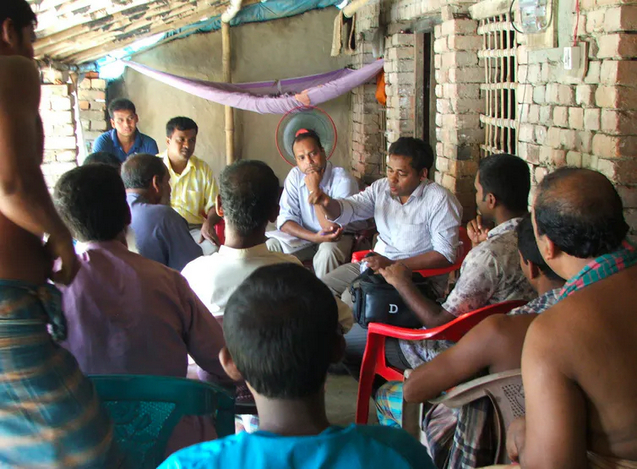
Farmers come together in field schools, where they discuss how to handle the changing climate. Saleh Ahmed, CC BY-ND
Most people in this disaster-prone region also live in challenging socioeconomic conditions. Evidence shows that race, ethnicity, religion, gender, age and other socioeconomic differences can amplify disaster outcomes and shape local vulnerability. For example, women, children and elderly populations are more vulnerable than others because they have limited social and economic resources and access to public and private support before and after disasters.
Connections between land, people, societies and cultures should guide policymakers and leaders to help Bangladesh’s distinct ethnic groups adapt.

The role of wealth, religion and gender
In 2017 and 2018 I interviewed 250 local farmers and several others in the Kalapara area of coastal Bangladesh. Many of them were directly impacted by sea level rise, tropical cyclones, coastal flooding, rainfall variability and saltwater intrusion. Kalapara is one of the most climate-vulnerable locations in Bangladesh.
Here residents’ vulnerability depends on religion, ethnicity, gender and the size of their farm operations. Large farmers usually have more money, social power and local influence. They also have better access to various public and private resources that can be critical for coping with environmental stresses. The poor and those with limited resources are least equipped to confront those crises.
Sea level rise in the Kalapara region of coastal Bangladesh illustrates life on the edge of changing climate patterns. Saleh Ahmed, CC BY-ND
Religion can play a delicate role. In Kalapara, Muslims are the religious majority and Hindus are the minority. My own findings indicated that in most cases Muslim farmers earn more money from both farming and nonfarm activities than the Hindu farmers.
Muslim farmers also get better access to early warnings and other public and private resources, such as financial support and food aid in times of disaster. Since Muslims are the religious majority in Bangladesh, they have more social capital and stronger networks than other religious groups. In Kalapara, Hindu farmers are often marginalized and receive limited access to resources in times of crisis.
I have found that gender is a factor too. Most women who go into farming are excluded from local power structures. Men’s farms tend to be larger and earn more money than those owned by women. But female farmers usually earn more money off the farm, by selling poultry or handicrafts, than men do.
Men receive more of the critical early weather and climate warnings than women because they have stronger connections with agricultural extension agents. Men also enjoy easier access to local markets and mobile phones. All of these resources offer them information on weather and climate, whereas women often face barriers because of religious and cultural restrictions.

Rakhines remain somewhat isolated
In the complex landscape of local vulnerability in Kalapara, the majority of the people are ethnic Bengalis who are largely divided between Muslims and Hindus. Others are members of the Rakhine ethnic minority. These farmers, who settled in the region in the late 18th century, came from modern-day Myanmar. At that time most of coastal Bangladesh was covered by forests, which Rakhines cleared to establish their settlements.
As time passed, more and more Bengalis started to settle around the Rakhines in the region. Rakhine farmers’ culture and religion differ substantially from those of mainstream Bengali farmers. Many Rakhines still speak their native language, also called Rakhine, although they can speak some Bangla.
The language barrier limits their ability to participate in local government or other social and political activities. They live in remote villages, and tend not to understand official early warnings of major storms or other natural hazards.
Local action guides the world
Bangladesh’s climate is changing quickly. Adapting to this crisis requires understanding how complex and vulnerable the landscape is.
Policymakers sometimes overlook local social dynamics when providing early warnings, food or other social services. Reacting without careful planning or understanding local societies could leave some people vulnerable and risks overlooking groups who are already under stress because of climate change. As Bangladesh seeks ways to adapt to climate change, it could set an example of inclusive planning for other nations to follow.

Links

Can Puppets Save The World From Extinction?

New York Times - 

Two new productions use everyday materials and artistic ingenuity to gently warn young audiences of the perils of climate change.
Credit...Cameron Blaylock
As an all-terrain vehicle rumbles through a serene desert valley, its driver unwittingly starts a devastating fire by flicking cigar embers out the window. In another landscape, volcanoes are erupting, acidifying the ocean and threatening the life within it.
These scenes unfold on different theatrical stages and in periods 500 million years apart. But both come from productions intended for children, an audience usually left out of the conversation on climate change. “PackRat,” presented by Dixon Place, and “Riddle of the Trilobites,” at the New Victory Theater, convey their messages through protagonists who aren’t human but who gain vivid life as puppets. Carlo Adinolfi, who designed the set, projections and larger-than-life puppetry for “PackRat,” has created amazingly expressive rodents, reptiles, birds of prey, a jack rabbit — and even Cowgirl, the cigar-smoking driver — from wood, papier-mâché, cardboard, wire and, fittingly, recycled trash. Some of the same materials help form the goofier-looking but no less compelling creatures of “Riddle of the Trilobites.” Designed by Amanda Villalobos, the prehistoric arthropods in this show gambol about with googly eyes and flicking antennas and tails. Each production has talented puppeteers who seem not to manipulate these marvelous inventions so much as merge with them.
Credit...Stefan Hagen
“PackRat,” written and directed by Renee Philippi, who collaborated with Adinolfi in creating it, draws inspiration from “Watership Down,” Richard Adams’s 1972 best seller about rabbits in exile. But this Concrete Temple Theater production offers an allegory more ecological than political. It stars the lowly animal of the title, a hoarder named Bud. After the blaze ignited by the cigar, his fellow creatures banish him, convinced that the human set the fire deliberately to punish Bud for collecting people’s “treasures,” including a spoon and a bag of marshmallows.
Accompanied by the jackrabbit Firestone and eventually Happy, another rat, Bud goes on a journey of rescue and redemption, trying to find Artemisia, a land said to be free of human intervention. But despite the stage craft, which is thoroughly mesmerizing, the animals’ odyssey can be hard to follow. Not even adults will immediately grasp that a second, more skeletal set of bamboo puppets is supposed to be enacting dream sequences. And the prerecorded narration and dialogue, both delivered by Vera Beren, have the solemn austerity of an ancient fable. “PackRat,” which includes a wrenching onstage death, will appeal most to theatergoers over 10, who are less likely to be troubled that the wildlife’s arduous story has no clear resolution.
Credit...Stefan Hagen
But what resolution can climate activists hope for? Prehistoric species saw their environments deteriorate, and we all know what happened to them. Still, “Riddle of the Trilobites,” geared toward a younger audience than “PackRat,” manages to be something unusual: a cheerful, peppy musical about extinction.
With a book and lyrics by Geo Decas O’Donnell and Jordan Seavey, and score and lyrics by Nicholas Williams, “Riddle” focuses on the trials of Aphra (Sifiso Mabena), a rebellious adolescent trilobite who learns on her first Molting Day that she’s destined to fulfill an ancient prophecy. She alone can unravel the riddle of her kind: “When the ocean changes, the trilobites cannot live but will not die.” With Judomiah (Richard Saudek), her initially fearful best friend, Aphra embarks on an adventure that is just as dangerous as Bud’s, but leavened with hefty doses of humor — sometimes corny, but still welcome — and rollicking song. (I kept writing “good score” in my notes.) These trilobites’ travels bring them into contact with other creatures, including Hai (Phillip Taratula), an early species of fish. The actors, who talk, sing and frolic while operating the puppets, multitask brilliantly. Directed by Lee Sunday Evans and produced by CollaborationTown and Flint Repertory Theater, “Riddle” dances around — sometimes literally — the ultimate fate of Aphra and her fellow trilobites. But even though the destructive powers of Homo sapiens are millions of years away, the show demonstrates that the ocean is a source of life and its pollution a harbinger of doom. It also cautions against any species’ assumed superiority: When the trilobite elders first see Hai, they lock him in a cage.
These productions emphasize that the young must take charge, and that environmental action is desperately needed. As Bud, the beleaguered pack rat, says: “I don’t want to just sit around! That’s what humans do.”

Links

January 2020: Earth’s Warmest January On Record

Scientific American - Jeff Masters

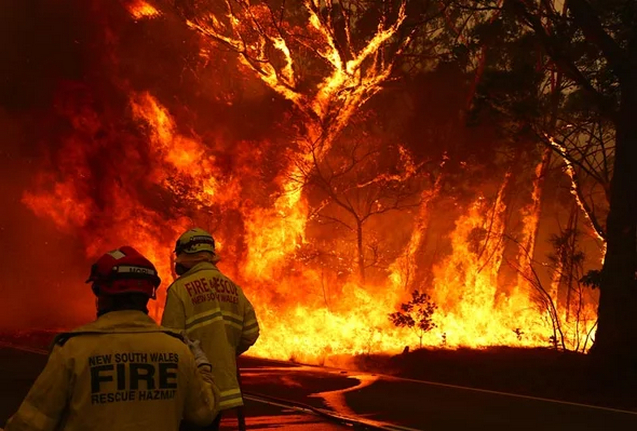
Fire and Rescue personnel run to move their truck as a bushfire burns on December 19, 2019 near Sydney, Australia. Fires in Australia were the most expensive weather-related disaster so far in 2020, with damages estimated in the billions by insurance broker Aon. Credit: David Gray Getty Images

January 2020 was the planet's warmest January since record keeping began in 1880, said NOAA's National Centers for Environmental Information (NCEI) on Thursday. Global ocean temperatures during January 2020 were the second warmest on record, and global land temperatures were the warmest on record. Global satellite-measured temperatures in January 2020 for the lowest 8 km of the atmosphere were the warmest or second warmest in the 42-year record, according to the University of Alabama Huntsville (UAH) and RSS, respectively.
January 2020 had the fourth highest departure of temperature from average of any month since 1880. Only March 2016, February 2016 and December 2015 had a greater temperature departure. Impressively, the warmth of January 2020 came without an El Niño event being present. Furthermore, we are also near the nadir of one of the least active solar cycles in the past century--a time when it is more difficult to set global heat records, due to the reduced amount of solar energy Earth receives. Thus, the remarkable warmth of January 2020 is a strong reminder that human-caused global warming is the primary driver of our warming climate.
Figure 1. Departure of temperature from average for January 2020, the warmest January for the globe since record keeping began in 1880. Record warm January surface temperatures were present across parts of Scandinavia, Asia, the Indian Ocean, the central and western Pacific Ocean, the Atlantic Ocean, and Central and South America. No land or ocean areas had record cold January temperatures. Credit: NOAA National Centers for Environmental Information (NCEI).

  • Two billion-dollar weather disasters in January 2020
    Two billion-dollar weather-related disaster hit the Earth last month, according to the January 2020 Catastrophe Report from insurance broker Aon:
  • U.S. severe weather outbreak
    A powerful winter storm over central and eastern sections of the U.S. from January 10 - 12 killed 12 and did $1.2 billion in damage. The storm brought a multi-day severe weather outbreak to parts of Texas, Oklahoma, Missouri, Arkansas, Louisiana, Mississippi, Alabama, Tennessee, Kentucky and Georgia, with 79 confirmed tornadoes.
  • Australia wildfires
    Intense heat and drought over much of Australia in January caused destructive wildfires blamed for billions of dollars in damages. The combined death toll for the 2019/20 Australia bushfire season stands at 34, with more than 5,900 homes and other structures destroyed. Guardian Australia has launched the first of six very impressive immersive multimedia features on climate change, reported through the experiences of people living through it in Australia. The first episode--on bushfires--is best viewed on a large screen (not mobile) with the sound on.

Neutral El Niño conditions reign
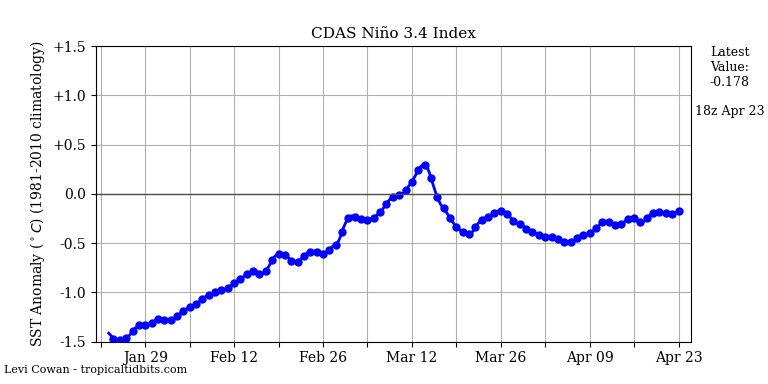
NOAA’s February 13 monthly discussion of the state of the El Niño/Southern Oscillation (ENSO) stated that neutral ENSO conditions existed, with neither an El Niño nor a La Niña event in progress. Over the past month, sea surface temperatures (SSTs) in the benchmark Niño3.4 region of the eastern tropical Pacific, though warmer than average, have been below the 0.5°C above-average threshold need to be considered El Niño conditions.
Forecasters at NOAA and the International Research Institute for Climate and Society (IRI) are calling for a roughly 60% chance of neutral conditions continuing through Northern Hemisphere spring, and a 50% chance of continuing through summer. They put the odds of an El Niño event during the August-September-October peak of the hurricane season at 23%, and the odds of a La Niña event during that period at 33%.

Figure 2. Departure of sea surface temperatures (SSTs) in the benchmark Niño 3.4 region (in the equatorial Pacific) ending on February 13, 2020. Over the past month, SSTs were about 0.3°C above average, falling short of the 0.5°C above-average threshold need to be considered El Niño conditions. Credit: Levi Cowan, tropicaltidbits.com. 
Arctic sea ice: eighth lowest January extent on record
Arctic sea ice extent during January 2020 was tied for eighth lowest in the 41-year satellite record, according to the National Snow and Ice Data Center (NSIDC). The ice extent was higher than seen in recent years thanks to a strongly positive phase of the Arctic Oscillation (AO), which kept cold air bottled up in the Arctic. Antarctic sea ice extent in January 2020 was the tenth lowest on record.

Notable global heat and cold marks for January 2020
  • Hottest temperature in the Northern Hemisphere: 42.0°C (107.6°F) at Vicente Guerrero, Mexico, 21 January
  • Coldest temperature in the Northern Hemisphere: -66.0°C (-86.8°F) at Geo Summit, Greenland, 3 January (dubious data)
  • Hottest temperature in the Southern Hemisphere: 48.9°C (120.0°F) at Penrith, Australia, 4 January
  • Coldest temperature in the Southern Hemisphere: -47.4°C (-53.3°F) at Concordia, Antarctica, 31 
Major weather stations that set (not tied) new all-time heat or cold records in January 2020
Among global stations with a period of record of at least 40 years, 28 set new all-time heat records in January, and 3 set all-time cold records:
  • Canberra (Australia) max. 44.0°C, 4 January
  • Newcastle (Australia) max. 44.9°C, 4 January    
  • Katoomba (Australia) max. 39.8°C, 4 January   
  • Parramatta (Australia) max. 47.0°C, 4 January  
  • Bankstown (Australia) max. 47.0 °C, 4 January  
  • Taralga (Australia) max. 40.5°C, 4 January
  • Goulburn Airport (Australia) max. 42.0°C, 4 January  
  • Albury (Australia) max. 46.1°C, 4 January
  • Burrinjuck Dam (Australia) max. 45.0°C, 4 January  
  • Grenfell (Australia) max. 44.0°C, 4 January
  • Young (Australia) max. 44.9°C, 4 January  
  • Gundagai (Australia) max. 45.2°C, 4 January  
  • Cootamundra (Australia) max. 45.0°C, 4 January  
  • Temora (Australia) max. 46.4°C, 4 January
  • Narrandera (Australia) max. 47.4°C, 4 January  
  • Griffith (Australia) max. 47.2°C, 4 January
  • Calama (Chile) max. 31.2 °C, 12 January
  • Fraserburg (South Africa) max. 42.4°C, 16 January
  • Pofadder (South Africa) max. 43.0°C, 16 January
  • Willowmore (South Africa) max. 42.2°C, 16 January
  • Beaufort West (South Africa) max. 44.5°C, 16 January
  • Saint Raphael-Cargados Islands (Mauritius) max. 35.6°C, 9 January
  • Honiara Downtown (Solomon Islands) max. 35.4°C, 3 January
  • Veguitas (Cuba) min. 7.0 °C, 23 January
  • Pinares de Mayari (Cuba) min. 6.5°C, 23 January
  • Conakry Airport (Guinea) max. 38.0°C, 24 January
  • Kalewa (Myanmar) min. 6.6°C, 26 January
  • Cabramurra (Australia) max. 34.0°C, 31 January
  • Hobart Airport (Australia) max. 41.4°C, 31 January
  • Maydena (Australia) max. 38.2°C, 31 January
  • Gisborne (New Zealand) max. 38.2°C, 31 January
No all-time national heat or cold records have been set thus far in 2020.

Thirteen monthly national/territorial heat record beaten or tied in 2020 as of February 13
As of February 13, 13 national monthly all-time heat records have been beaten or tied in 2020:
  • January (10): Norway, South Korea, Angola, Congo Brazzaville, Dominica, Mexico, Indonesia, Guinea Bissau, Gambia, Sao Tome and Principe
  • February (3): Spain, Antarctica, Azerbaijan
  • No monthly national cold records have been beaten or tied in 2020.
Hemispherical and continental temperature records in 2020
  • Highest minimum temperature ever recorded the Northern Hemisphere in January: 29.1°C (84.4°F) at Bonriki, Kiribati, 17 January.
  • Highest maximum temperature ever recorded in North America in January: 42.0°C (107.6°F) at Vicente Guerrero, Mexico, 21 January.
  • Highest temperature ever recorded in continental Antarctica and highest February temperature ever recorded in Antarctica plus the surrounding islands: 18.4°C (65.1°F) at Base Esperanza, 6 February.
Links

14/02/2020

(AU) Bushfires Royal Commission Needs To Examine How To Cut Carbon Emissions, The ACT Government Says

A political stoush seems to be brewing over the terms of reference of the bushfires inquiry. (AAP: Lukas Coch)

Key points
  • The ACT Government says the terms of reference of the proposed bushfires inquiry play down the role of climate change
  • ACT Chief Minister Andrew Barr also says that, if the royal commission goes ahead, it will need more time than proposed
  • He says states, territories and the Commonwealth need to share resources more effectively during disasters
Climate change must play a far more significant role in the proposed bushfire royal commission, which is in danger of being rushed, the ACT Government says.
January's Orroral Valley bushfire burned 35 per cent of the ACT's land mass, and across Australia, more than 10 million hectares have been burned since the fires began.
But ACT Chief Minister Andrew Barr hinted the bushfires commission was unnecessary, and said it would be "most efficient" to read the work of past inquiries.
Prime Minister Scott Morrison said last week he wanted the inquiry to report by August on a range of issues, such as hazard-reduction burns and whether the Commonwealth should be able to declare a state of emergency.
His draft terms of reference say the changing climate "carries risks for the Australian environment".
The terms — which were sent to all states and territories for feedback — also say climate change is affecting Australia's ability to prevent, mitigate and respond to natural disasters.
The Orroral Valley bushfire, which is still burning, has burnt about 80 per cent of Namadgi National Park. (ABC: Greg Nelson)
But the ACT Government said the draft terms play down the role of climate change, and it fears the inquiry will not comprehensively address the issue.
In a letter to Mr Morrison, Mr Barr said the inquiry should consider climate change more broadly.
In particular, it should examine how to reduce carbon emissions.
"As it currently stands, the draft letters patent ignores the important role Australia must play in reducing global emissions to minimise the extent of climate change and its potential impacts on the Australian community," Mr Barr's letter read.
"Omitting climate change mitigation from the scope of the royal commission overlooks one of the key national drivers in determining the frequency and severity of future national disasters."
The Federal Government has been grappling with how to respond to public pressure over climate change, which has led moderate Liberals to clash publicly with their Nationals colleagues.
Protestors gathered again on the lawns of Parliament House yesterday, some bringing debris from homes lost to bushfires on the NSW South Coast.
The climate debate has split the public but also the governing Coalition. (ABC News: Andrew Kennedy)


'Unclear' guidelines around disaster aid
The ACT Government also wants to examine the coordination between Commonwealth, state and territory governments during emergencies, and how they share resources.
It has already raised concerns about access to firefighting planes.
In his letter, Mr Barr argued it was unclear how and when states and territories could seek help from the Federal Government during disasters.
"The ACT considers that the current mechanisms and criteria to request national involvement in emergencies is unclear and should be reviewed, given that the frequency of future national disasters is likely to be higher," he said.
Mr Barr noted the importance of learning from the latest bushfires, but appeared to question the need for a royal commission at all, given the work done in the past.
"The ACT considers the most efficient way to coordinate national action on this issue is to draw on the large body of analysis and recommendations made by previous commissions and inquiries."
He also argued that, if the inquiry was to go ahead, the August deadline was too tight — Mr Barr suggested "late 2020" instead.


Text of Letter
ACT Chief Minister Andrew Barr to Prime Minister Scott Morrison

I write in response to your recent correspondence between December 2019 and February 2020 relating to the proposed Bushfire Royal Commission, the national bushfire emergency, and out-of-session agreement to Council of Australian Governments (COAG) matters.

Firstly, I wish to acknowledge the important role the Australian Defence Force has played in prevention and recovery efforts during this disaster. I commend the quick action undertaken by the Commonwealth in relation to the northern road access to the ACT Emergency Control Centre at the Fairbairn base.

Activation of National Disaster Recovery Funding Arrangements
I wrote to you on the 29th of January seeking confirmation that the ACT would have access to Disaster Recovery Funding Arrangements (DFRA) relating to the impact of severe smoke on ACT businesses and other bushfire relief efforts provided by the ACT. ACT officials have lodged the relevant DRFA notification with Commonwealth officials. Since that letter, you would be aware of the significant bushfire in the Namadgi National Park. As a result of this development I wish to activate all available supports including DRFA funding for small business grants and loans, automatic deferral of ATO payments and lodgements and Disaster Recovery Payments for which the ACT is now eligible.

In relation to DRFA supports for the Orroral Valley Bushfire, ACT officials will shortly lodge this request with the Emergency Management Authority.

National Royal Commission into natural disaster preparedness
Reviewing and learning from the searing experience of the 2019?20 bushfire season will be important, and many states and territories are already undertaking reviews or inquiries as a standard practice following these events. Noting your announcement of the establishment of a, national Royal Commission into natural disaster preparedness, the ACT considers the most efficient way to coordinate national action on this issue is to draw on the large body of analysis and recommendations made by previous commissions and inquiries.

I welcome the opportunity to comment on the draft Letters Patent. The ACT provides the following comments aimed at clarifying the scope and purpose of the proposed Royal Commission:
  • The Royal Commission should consider broader mitigation strategies relating to climate change. As it currently stands, the draft Letters Patent ignores the important role Australia must play in reducing global emissions to minimise the extent of climate change and its potential impacts on the Australian community. Omitting climate change mitigation from the scope of the Royal Commission overlooks one of the key national drivers in determining the frequency and severity of future natural disasters. 
  • In addition to a focus on preparedness, response and resilience to natural disasters, the Letters Patent should also instruct the Commissioner to examine appropriate coordination of recovery arrangements for natural disasters, as this is a crucial stage in the process of rebuilding communities and the economy following natural disasters.
  • Section (c) of the draft Letters Patent appears to presume uniformity between states and territories and an ability for the Commonwealth to take unilateral action are needed to effectively manage responses to natural disasters. The Royal Commission should consider the need to increase the interoperability between the Commonwealth, and each state and territory's disaster management framework which is, appropriately, specific to the legal, social and environmental context of that jurisdiction.
  • The Royal Commission should consider the circumstances and thresholds under which the states and territories can call on the Commonwealth for support and examine opportunities to improve the availability of Commonwealth, State and Territory resources and infrastructure in the instances of emergencies, such as Public Safety Mobile Broadband and aerial firefighter appliances. The ACT considers that the current mechanisms and criteria to request national involvement in emergencies is unclear and should be reviewed, given that the frequency of future national disasters is likely to be higher.
  • Acknowledging the need for the Royal Commission to be expedient, an August 2020 deadline will be challenging, particularly noting many communities and workers are still fighting fires or beginning their recovery. The ACT would support the Royal Commission providing a draft report or interim recommendations in August 2020, with a final report developed by late 2020.
A number of terms in the Letters Patent require clearer definition that will assist in clarifying the scope of the inquiry. Of primary importance, a definition of 'natural disaster' is required to confirm the scope of the Royal Commission. The ACT considers that any national inquiry should consider response approaches that can be applied to all natural disasters inclusive of bushfires, cyclones, floods and droughts. By considering broader national disaster events, the inquiry can determine the role of the Commonwealth in responding to all national disasters.

ACT officials continue to be involved in conversations with your Commonwealth officials in relation to specific drafting changes to the draft Letters Patent.

Links

Lethal Heating is a citizens' initiative