10/04/2020

Unchecked Global Warming Could Collapse Whole Ecosystems, Maybe Within 10 Years

InsideClimate News -  Bob Berwyn

A new study shows that as rising heat drives some key species extinct, it will affect other species, as well, in a domino effect.

A gray whale was found dead off the Alaska coast in 2019. Credit: Ceona Koch/NOAA

Global warming is about to tear big holes into Earth's delicate web of life, pushing temperatures beyond the tolerance of thousands of animals at the same time. As some key species go extinct, entire ecosystems like coral reefs and forests will crumble, and some will collapse abruptly, starting as soon as this decade, a new study in the journal Nature warns.

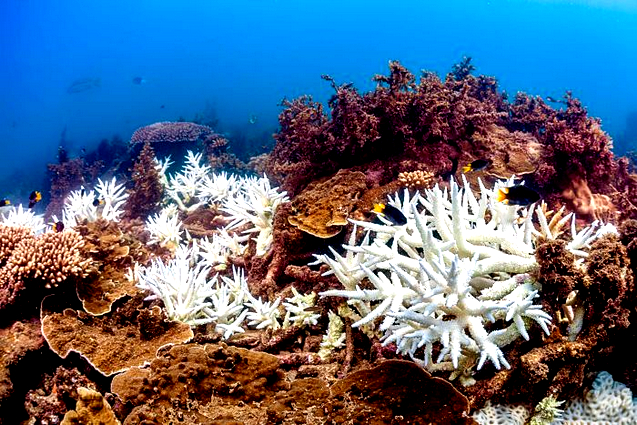
Many scientists see recent climate-related mass die-offs, including the coral bleaching of the Great Barrier Reef and widespread seabird and marine mammal mortality in the Northeastern Pacific linked to a marine heat wave, as warning signs of impending biodiversity collapse, said lead author Alex Pigot, a biodiversity researcher at University College, London. The new study shows that nowhere on Earth will escape the impacts.

"In the U.S., the southern states from Texas to Florida, the Appalachians and the West Coast are projected to be at particularly high risk, with between 20 and 40 percent of species facing conditions beyond anything they have previously experienced," Pigot said.

In those regions many species live in small geographic areas under a narrow range of climatic conditions. As global warming heats their habitat to the point that it is intolerable, many species have no place to go. Some will go extinct, with a domino effect that affects scores of other species. If it gets too hot for bumblebees, for example, it affects the reproduction of plants. If it gets too warm for insects and reptiles, it affects food supplies for birds and mammals.

"I hope our predictions are wrong. But increasingly, what we're observing around us are the signs of this happening," Pigot said, referring to research showing how global warming affects individual species. "I think these studies are showing that many species are already living very near their thermal limits. Our results suggest that these losses are likely to involve multiple species near simultaneously rather than happening gradually, one species at a time," he said.

At the current rate of warming, abrupt exposure events in tropical oceans will begin before 2030 and spread to tropical forests and higher latitudes by 2050. The risks decrease and arrive more slowly if global warming is capped at less than 3.6 degrees Fahrenheit, as per the goals of the 2015 Paris climate agreement, the study concluded.

"If we can avert the worst of the warming we can buy extra time," Pigot said. "Even if we can get a few extra decades, it gives us time to work on expanding protected areas, or deciding on whether to try things like assisted migration and assisted evolution."

Even an immediate curb on greenhouse gas emissions doesn't preclude warming of up to 7 degrees Fahrenheit by the end of the century because the current amount of warming could be magnified by big increases of heat-trapping methane in the Arctic or by changes to cloud processes, he said.

Jennifer Sunday, a research biologist at McGill University, said the new study for the first time shows when species will be faced with warmer temperatures than they've ever experienced for five years in a row. And it turns out that a surprising number of animals within various ecosystems will hit those climate thresholds at the same time, which can lead to widespread ecosystem disruptions or collapse, said Sunday, who was not involved in the research.

"We did not know about the time-course of events. We have lots of models that compare species ranges today to those at a future date, but we did not know when most of the changes were going to happen," she said. The research also makes it clear that global warming's impacts on ecosystems could arrive very suddenly.

"I think we often and maybe subconsciously expect climate change to be a gradual process, but this helps to illustrate that the impacts may be in fits and spurts," she said. "As we know today, our human adaptive systems are not great at dealing with synchronous events," she said, referring to the global response to the coronavirus pandemic. The findings show that some climate impacts could be as sudden and widespread as the pandemic, challenging our adaptive management systems.

Species in Tropics, Polar Regions, Will be Hardest Hit

In the study, Pigot's team assessed temperatures ranges for more than 30,000 land and sea species—birds, mammals, reptiles, amphibians, fish and other marine animals and plants—to estimate when they will start experiencing unprecedented temperature conditions. Capping global warming at 2.7 degrees Fahrenheit would decrease the risk of ecosystem failures significantly, but allowing global warming to continue unchecked would lead to widespread biodiversity decline quickly, they found.

Ecological communities in tropical regions near the equators will be hard hit because many species there are already living near the upper end of their heat tolerance spectrum. In high latitudes, toward the poles, communities of species will struggle because those areas are warming about twice as fast as the global average, giving them even less time to adapt, he said.

Pigot said the study shows how the risks from climate change will change from year to year. "The key finding of our study, that exposure to potentially dangerous climate conditions is likely to occur abruptly, hasn't been previously detected." he said.

Pigot said he sees parallels between the new study and current discussions about the response to the coronavirus pandemic, which seems to be raising general awareness of how nonlinear systems work, changing slowly at first, then dramatically spiking all at once. The study shows how risks to biodiversity are highly magnified in a non-linear way with warming of 3.6 degrees Fahrenheit or more, he said.

"By the time things get really bad it's going to be too late," he said. "But our results show very clearly that it is not too late to act to delay the risk or even avert it entirely for many thousands of species. By holding warming below 2 degrees Celsius (3.6 degrees Fahrenheit), we can effectively flatten the curve of how climate risks to biodiversity accumulate over time."

Links

Rising Tides, Troubled Waters: The Future Of Our Ocean

Rolling Stone - 

The ocean is undergoing unprecedented changes. What does it mean for marine life, the planet, and us? 

A giant kelp forest off Santa Barbara Island. Dave Fleetham/Newscom

The blob went unnoticed at first. In the summer of 2013, a high-pressure ridge settled over a Texas-size area in the northern Pacific, pushing the sky down over the ocean like an invisible lid. The winds died down, and the water became weirdly calm. Without waves and wind to break up the surface and dissipate heat, warmth from the sun accumulated in the water, eventually raising the temperature by 5 degrees Fahrenheit — a huge spike for the ocean.

When scientists noticed this temperature anomaly in the satellite data, they had never seen anything like it. Everyone knew about heat waves on land, but in the ocean? “As the Earth heats up, the ocean is changing in very dramatic ways,” says Jane Lubchenco, a marine ecologist and former head of the National Oceanic and Atmospheric Administration. “It is less predictable, and we are seeing more surprises. The heat waves are one of those surprises.”

Nick Bond, a climatologist at the University of Washington, nicknamed the Pacific heat wave “the Blob,” after a campy 1958 sci-fi movie about a gelatinous monster that arrives on Earth in a meteor and eats up a small town. But this Blob would turn out to be far more deadly than anything Hollywood imagined.

The hot water killed the phytoplankton — a form of microscopic algae — that live in the top few hundred feet of the ocean. The tiny organisms that feast on them starved, including krill, the small shrimplike creatures that swarm the ocean by the billions and are the preferred food for whales, salmon, seabirds, and many other creatures. The population of herring and sardines, an important food source for many larger fish and marine mammals, also declined. By killing phytoplankton, the Blob disrupted the entire Pacific food chain.

Over the next two years, it drifted down the coast of Alaska to California, eventually responsible for thousands of whale and sea lion strandings on beaches along the coast; the collapse of the Alaska cod fishery; the bankruptcy of fishermen and worker layoffs at fish-processing plants; the vanishing of great kelp forests on the Pacific coast; and the starvation and death of a billion seabirds — the largest single mass mortality of seabirds ever recorded. Dead murres littered beaches like washed-up plastic bottles.

And its destruction was not limited to the ocean: The Blob changed the weather on the Pacific coast, pushing heat inland and altering rainfall patterns, contributing to the California drought. “It raised temperatures on the coast all the way from British Columbia down to Southern California,” says Daniel Swain, a climate scientist at UCLA. The big question is how much the Blob accelerated wildfires; 2017-18 saw historic blazes, including the Camp Fire in Northern California, the largest in the state’s history, which burned more than 150,000 acres and killed at least 85 people. Swain says the Blob increased nighttime temperatures in the western third of the state, where many of the wildfires flared. “Firefighters will tell you that’s really important, because wildfires often lie down at night, burning more slowly and behaving less erratically, becoming less dangerous to approach for human crews. While the Blob was off the coast, that didn’t happen.”

All in all, the Blob was a slow-rolling climate catastrophe. It’s also compelling evidence of how tightly all life on Earth is linked to the ocean. Because we live on land, we often think of the climate crisis as a terrestrial event. But as the planet heats up, it’s what happens in the ocean that will have the biggest impact on our future.

Earth was not born with an ocean. Water arrived here from the cold depths of space with icy asteroids and comets, which bombarded the planet during the first few million years of its existence. It’s been a watery world ever since. Today, 97 percent of the Earth’s water is in the ocean, which covers more than 70 percent of the planet. The ocean was the petri dish for the creation of life, and we carry that early history within us. The salt content of our blood plasma is similar to the salt content of seawater. “The bones we use to hear with were once gill bones of sharks,” says Neil Shubin, professor of anatomy at the University of Chicago and author of Your Inner Fish: A Journey Into the 3.5 Billion-Year History of the Human Body. “Our hands are modified fish fins, and the genes that build our basic body architecture are shared with worms and fish.”

Despite our intimate connection to the sea, for most of human history the ocean has been as strange to us as a distant planet, a realm of monsters and mayhem. Humans stuck close to the shore, mostly, and our ignorance about the ocean was profound. It still is. Scientists have only a vague understanding of exactly how ocean currents are driven, or how ocean temperatures impact cloud formation, or what creatures thrive in the depths. Far more people have been to the moon, which is 240,000 miles above us, than have been to the deepest part of the ocean, which is seven miles down. Eighty percent of the ocean remains unmapped, unobserved, unexplored. Marine biologists don’t know how sharks sleep or an octopus learns to open a jar.

But scientists know enough to know that the ocean is in trouble. Largely because of overfishing, 90 percent of the large fish that were here in the 1950s are now gone. One metric ton of plastic enters the ocean every four seconds (at this rate, there will be more plastic than fish in the ocean by 2050). But the biggest problem, thanks largely to our insatiable appetite for fossil fuels, is that the ocean is heating up fast. The past five years have been the five warmest ever measured in the ocean, with 2019 the hottest ever. According to one study, the amount of heat being added to the ocean is equivalent to every person on the planet running 100 microwave ovens all day and night.

Until now, the ocean has been the hero of the climate crisis — about 90 percent of the additional heat we’ve trapped from burning fossil fuels has been absorbed by it. “Without the ocean, the atmosphere would be a lot hotter than it already is,” says Ken Caldeira, a climate scientist at the Carnegie Institution for Science in Palo Alto. But the heat the ocean absorbed has not magically vanished — it’s just stored in the depths and radiated out later. By absorbing and slowly releasing heat, the ocean reduces the volatility of our climate, cushioning the highs and lows as temperatures change from day to night, winter to summer. It also means the heat will continue to seep out for centuries to come, slowing any human efforts to cool the planet.

“The ocean is the main driver of our climate system,” Hans-Otto Pörtner, a scientist at the Alfred Wegener Institute for Polar and Marine Research in Germany, tells me. One of the central functions of the ocean, Pörtner says, is to redistribute heat from the tropics toward the poles via deep currents like the Gulf Stream system, which begins in the Southern Ocean near Antarctica, flows across the equator, up to the Arctic and back again. “Even small changes in that system can have large impacts on things like the size and intensity of storms, rainfall patterns, sea-level rise,” says Pörtner, “and of course the habitats of all the creatures that live in the ocean.”

A dead whale in Pacifica, California, 2015, amid an ocean heat wave that disrupted the food chain in the Pacific. Photo credit: Bruce Gifford/Getty Images

The ocean is also one of the main drivers of many regional economies. In Alaska, one of the fastest-changing parts of the planet, the seafood industry employs more than 50,000 workers, earning $2 billion in total annual income. Across the U.S., fishing, ocean farming, shipping, ocean tourism and recreation support 3.25 million jobs and contribute about $300 billion to the U.S.’s annual gross domestic product. No one thinks this blue economy is going to vanish overnight, but as fish and other species migrate to cool waters or die off from temperature changes, there can be profound impacts on local fisheries — just ask the cod fishermen in Alaska, or shrimpers in the Gulf of Maine, who have been wiped out by rapidly warming waters in the Atlantic.

Pörtner is one of the lead authors of a recent report on the ocean and cryosphere by the Intergovernmental Panel on Climate Change. It was the IPCC’s first report to focus specifically on the world’s oceans and ice — it was a massive project, the work of 105 scientists over a three-year period. There is a lot of nuance in the report, but the basic message is clear: In the coming decades, the ocean will get hotter, more acidic, with less oxygen and less biodiversity. Seas will rise, flooding coastal cities. Ocean circulation patterns will shift, driving big and unpredictable changes in the weather, with scary implications for the global food supply. The report’s summary was blunt: “Over the 21st century, the ocean is projected to transition to unprecedented conditions.”

Monterey Bay is a crescent on the Northern California coast, a place haunted by the ghosts of John Steinbeck’s Cannery Row. The old sardine canneries are now T-shirt shops and touristy restaurants. From the pier, you can watch sea otters playing in the surf and, if you’re lucky, whales breeching just offshore. A deep canyon delivers cold, nutrient-rich waters into the bay, creating one of the most diverse ecosystems in the Pacific, including giant kelp beds that grow along the coast all the way up to Alaska. In good times, these kelp beds are teeming with life — otters, seals, sharks, rockfish, lingcod. “The kelp beds are the rainforests of the Pacific,” Kyle Van Houtan, the chief scientist at the Monterey Bay Aquarium, tells me.

But like everything in the ocean, the kelp beds are changing fast. On a recent Saturday morning, I pulled on scuba gear and jumped in the water near Monterey to have a look for myself. What I saw was not the rainforest of the Pacific. Instead, I was greeted with nothing but rock and water and hundreds of purple sea urchins, their thorny spikes like medieval armor. A voracious horde had invaded the once-magnificent kelp forest and devoured everything (“purple urchins are the cockroaches of the sea,” one scientist told me), leaving only some empty abalone shells, a rockfish poking around, and a few pathetic kelp stipes. And this spot is just one fragment of a bigger picture. As a result of the Blob, many of the kelp forests along the coast from California to Oregon have vanished, done in by warming and the army of purple sea urchins, which thrive in a hotter world.

“If a 200-mile-long stretch of forest in the California mountains suddenly died, people would be shocked and outraged,” says Laura Rogers-Bennett, a marine scientist at the California Department of Fish and Wildlife, who works at the Bodega Marine Lab just up the coast. “We’re talking about the collapse of an entire ecosystem. But because it happened in the ocean, nobody notices.”

Rogers-Bennett was one of the first scientists to understand the impact of marine heat waves like the Blob. In 2013, she was diving in Northern California when she saw a sea star that looked like it was melting. “When I touched it, its skin came off in my hand,” she recalls. And it wasn’t just one sea star, she discovered. This was the beginning of a mass die-off of 20 species of sea stars in the Pacific from a condition known as “sea star wasting disease,” which is linked to warming waters. With the loss of sea stars, which are one of the main predators of purple sea urchins, the urchin population exploded and devoured the kelp forests. “It’s very scary,” Rogers-Bennett says. “The Blob shows you how fast a tipping point can happen.”

In the past decade, scientists have detected marine heat waves around the world: The Mediterranean was hit in 2012, 2015, and 2017. In 2018, a marine heat wave appeared off the coast of New Zealand and helped spike land temperatures to record highs. Along the coast of Tasmania, giant kelp once stretched over 9 million square meters. Today, thanks to warmer water and an invasion of urchins, the kelp covers fewer than 500,000 meters. Off the Uruguayan coast, a blob of hot water covers 130,000 square miles of ocean, an area nearly twice as big as Uruguay itself. It has caused a massive die-off of clams and mussels, an important food source for tens of thousands of people who live on the coast. “Last fall, another heat wave started building in the northern Pacific,” says Andrew Leising, a scientist at NOAA’s Southwest Fisheries Science Center. “It couldn’t come at a worse time — the fisheries are just beginning to recover from the Blob.”

Marine heat waves are driving a massive reorganization of underwater life, with many creatures migrating to cooler waters. “Right now, you can go diving off the Monterey pier and see spiny lobsters,” says Van Houtan. “They are a subtropical species that are normally found down in Baja. It’s absurd to see them up here.” (Attention swimmers: Van Houtan also says warmer waters are encouraging juvenile great white sharks to linger in the area). At the Bodega Marine Lab, scientists documented 37 species that had never been found so far north before. Bull sharks have been hanging off the coast of North Carolina, 500 miles north of their habitat in Florida. Lobsters have all but vanished from Long Island Sound. These migrations are radically changing underwater ecosystems, as well as the lives of people who depend on healthy fisheries. A recent study by scientists at the University of California, Santa Barbara, showed that nations in the tropics would be hit hardest by fish migration. By 2100, some countries in northwest Africa could lose half their stocks as fish move to colder water. “If you know you are losing a stock, then the short-term incentive is to overfish it,” said James Salzman, a professor of environmental law at UC Santa Barbara and co-author of the study. “What have you got to lose? The stock’s going to move anyway.”

Marine heat waves are also inflicting massive damage on coral reefs (where they are often called “bleaching events”). Reefs are the most bio-diverse ecosystems on the planet — they occupy less than one percent of the ocean floor, but are home to more than 25 percent of marine life. Reefs are created by millions of coral colonies that build calcium carbonate skeletons. For the past 100 million years or so, corals have thrived in a happy marriage with microscopic plants called zooxanthellae that live embedded in their tissues. Zooxanthellae produce 85 to 95 percent of corals’ food through photosynthesis. In return, corals give the plants protection, nutrients, and carbon dioxide, one of the ingredients for photosynthetic food production. This marriage, however, is exquisitely sensitive to changes in ocean temperature. One or two degrees of warming, and the zooxanthellae become toxic to the corals. The corals spit them out like an abusive spouse and eventually starve to death, leaving only their bleached skeletons behind.

Australia’s Great Barrier Reef, a UNESCO World Heritage site and one of the crown jewels of the natural world, has been hit hard by warming. The reef stretches about 1,400 miles along the east coast of Australia — it’s the largest structure built by living organisms on the planet, so big it’s visible from space. Since 1998, the Great Barrier Reef has suffered four bleaching events, including devastating back-to-back heat waves in 2016 and 2017. Further bleaching in 2020 has scientists worried it will be a near-annual event. According to Terry Hughes, a marine scientist at James Cook University in Queensland, Australia, 93 percent of the corals in the Great Barrier Reef have been impacted by some level of bleaching. “We’ve now added enough greenhouse gases to the atmosphere that mass bleaching of the reef is at risk every summer,” Hughes says. “It’s like Russian roulette.”

If you look at a few drops of ocean water under a microscope, you’ll see a wild world of bizarre-looking creatures swimming around, fighting and devouring each other. Many of these animals — forams, pteropods — have thin shells made of calcium carbonate. And thanks to the rising acidity of ocean waters, their shells — like the shells and skeletons of many other creatures in the sea — are slowly dissolving.

Acidification is primarily a consequence of rapidly rising CO2 levels in the atmosphere. The IPCC report notes that carbon pollution so far has decreased the average ocean pH, which is based on a logarithmic scale, from 8.2 to 8.1, meaning the ocean is 25 percent more acidic today than before the Industrial Revolution. If we manage to hold global warming to 2 C, we could limit ocean acidification to 40 percent by 2100. But in a high-emissions scenario, the ocean could become 150 percent more acidic than it was before we began burning fossil fuels. In effect, we’re running a giant chemistry experiment in the ocean, and nobody has a clear understanding of how it will turn out.

Purple sea urchins — the “cockroaches of the sea” — thrive in a hotter world, and they devour giant kelp forests. Photo courtesy of Katie Sowul/California Department of Fish and Wildlife/UC Davis

The increasingly acidic waters in the Pacific are already impacting the shells of Dungeness crabs, jeopardizing the $200 million crabbing industry on the West Coast. To prevent the acidic waters from dissolving those shells, oyster farmers in Oregon and Washington have to raise baby oysters in incubators before planting them on the beach to grow to adulthood.

In lab experiments, scientists have found acidification can do strange things to a fish’s mind. Clown fish, for example, normally stay close to home in coral reefs. But as the water becomes increasingly acidic, they wander farther and farther away, making them more likely to be eaten. Greater acidity also “impairs their ability to discriminate between the smell of kin and not, and of predators and not,” according to Philip Munday, a professor at the Coral Reef Studies center at James Cook University in Australia.

Over time, the biggest threat from acidification is the impact it could have on the food chain. Pteropods, a.k.a. “the potato chips of the sea,” are a food source for everything from seabirds to whales. Their thin shells are extremely sensitive to changes in ocean pH. A collapse of the pteropod population would have a domino effect on the entire ocean food chain, especially in the Southern Ocean.

On coral reefs, most of which are already weakened by bleaching events, acidification attacks the calcium skeletons that they build to support themselves. “By midcentury, pretty much every reef in the world will be eroding away,” says Caldeira. That’s astonishing. Coral reefs have been around for about 250 million years, evolving into some of the most complex, diverse, and beautiful living structures on Earth. And yet if nothing changes, within 40 or 50 years, they will be crumbling ruins. “I think if we stopped emitting C02 tomorrow, some reefs would probably survive,” Caldeira says. “But if we go on a few more decades, I think the reefs are gone. Over geological time scales, they will come back, depending how long it takes the ocean chemistry to recover. But it’s likely to be at least 10,000 years before anyone sees a reef again.”

Sea-level rise is driven by a number of physical processes, including the fact that as the ocean warms, its water expands. And even though scientists often talk about “global” sea-level rise as if the ocean were one big bathtub, there is actually considerable local variation due to changes in the tug of gravity from melting ice sheets and the rising or sinking of land along the shore.

But for the future of -coastal cities, what really matters are two things: the rate of carbon emissions in the coming decades, and how sensitive the big ice sheets in Greenland and Antarctica are to the warming from those emissions. Greenland holds enough ice to raise sea levels about 22 feet; Antarctica holds enough to raise them more than 200 feet. According to the IPCC report, the ice sheets in Greenland and Antarctica are now contributing 700 percent more to sea levels than two decades ago. In both cases, the ice melt is being driven largely by the warming of the ocean.

On a research expedition I took to Antarctica last year with British and U.S. scientists aboard the Nathaniel B. Palmer, the big question scientists were trying to answer was how much warm circumpolar deep water was upwelling onto the continental shelf and how much of that warm water was getting beneath the West Antarctic Ice Sheet, melting it from below. “The ocean holds the key,” one scientist told me. “To understand what is happening in West Antarctica, you have to understand what is happening in the Southern Ocean.”

The more scientists learn about ocean and ice-sheet dynamics, the more concerned they get. The latest IPCC assessment puts the range of sea-level rise by 2100 at two feet in a low-emissions scenario, or up to 3.6 feet in a high-emissions scenario, which is about 10 percent higher than predicted in the last IPCC report, in 2018. But this is, as Pörtner tells me, “a conservative number. We are basing it on what we know, not on processes that we think could happen.”

In fact, virtually every scientist I know who studies sea-level rise thinks the risk is understated, even if they don’t yet have enough data or sophisticated-enough climate models to say by how much. As Richard Alley, a geophysicist at Penn State and one of the most respected ice scientists in the world, recently argued: “It could be two feet of sea-level rise, it could be 15 or 20 feet [by the end of the century]. There is no good to offset the bad. And the chances of something really bad are really there.”

In West Antarctica, the ice sheet is particularly vulnerable to melting from below, due to its contact with ocean water on the edge of the continent and because the ground beneath the ice sheet is a reverse slope — warm ocean water could run down the slope and penetrate deep underneath the glacier, which could begin a cascading collapse in which enormous sheets of ice begin falling into the sea like a giant pile of ice cubes. A big concern is how much warm circumpolar deep water is upwelling near Thwaites glacier, a chunk of ice the size of Florida that is basically the cork in the bottle for the West Antarctic Ice Sheet. If it goes, the rest of the glaciers behind it could collapse quickly, raising sea levels more than 10 feet. How fast could this happen? No one knows for sure.

In Antarctica, small changes in ocean temperature have big implications. A change of even one or two degrees in the waters that wash up against the base of the glaciers could cause the ice to melt. “Before our trip last year, I think I was already convinced that extensive retreat of Thwaites is almost inevitable,” Robert Larter, a marine geophysicist and the chief scientist on my trip to Antarctica, told me. “But the more research results I see from our trip and others, the more certain I become.”

Sea-level rise is not the only potential consequence of melting glaciers. Thirty years ago, Wallace Broecker, a pioneering climate scientist at Columbia University’s Lamont-Doherty Earth Observatory, saw a very different climate catastrophe developing in the North Atlantic. Broecker understood that as the Greenland Ice Sheet melted, it would dump huge volumes of fresh water into the North Atlantic. This would interfere with circulation of the Gulf Stream system, which depends on the sinking of dense, salty water in the Atlantic to drive the great deepwater current that circulates warm water from the tropics up to the North Atlantic.

“The Gulf Stream system is why the East Coast of the U.S. is much colder than the western coast of Europe,” says Stefan Rahmstorf, a climate scientist at the Potsdam Institute for Climate Research in Germany. “If the Gulf system were to slow down or stop, it would have a major impact on the weather of the Northern Hemisphere.” Broecker (who died in 2019) hypothesized that the shutdown of the system could plunge Northern Europe into a reign of snow and ice — which is more or less the scenario that plays out in The Day After Tomorrow, a cheesy 2003 disaster flick.

“The Hollywood scenario is not going to happen,” says Rahmstorf. In his view, the shutdown of the Gulf system is a decades- and century-scale risk, not an overnight event. But the Gulf Stream doesn’t have to collapse to wreak havoc. The IPCC report noted that the Gulf Stream system slowed down 15 percent in the 20th century. In the coming years, the report says, it will likely continue to weaken, intensifying storms and bringing frigid weather to Northern Europe, as well as shifting the path of the West African monsoon season, which 300 million people in one of the poorest, most climate-vulnerable areas depend on to grow food.

A healthy reef in Palmyra Atoll. “By midcentury, pretty much every reef will be eroding,” says one scientist. Photo credit: Kydd Pollack/ARC Centre of Excellence For Coral Reef Studies

Nature is change. But humans have stomped on the accelerator. We are dumping carbon dioxide into the atmosphere about 10 times faster than volcanoes did 250 million years ago, which cooked the planet, triggering the End-Permian extinction that wiped out 96 percent of the species on Earth and turned the ocean into a lifeless, slimy Jacuzzi. “No one knows where our modern experiment with geochemistry will lead,” writes Peter Brannen in The Ends of the World: Volcanic Apocalypses, Lethal Oceans, and Our Quest to Understand Earth’s Past Mass Extinctions, “but in the End-Permian, massive injections of greenhouse gases into the atmosphere led straight to the cemetery.”

Despite all the massive climate impacts that are transforming the ocean now, it’s a long way from dead. “If we stopped putting carbon in the atmosphere today, most of the species in the ocean would bounce back,” says Caldeira. “It might take some time, but they will make it back.” Unfortunately, we are not going to stop putting carbon into the atmosphere today. And it’s less clear that, even if we did, we could stabilize the ice sheets. But we can certainly reduce the risk of catastrophic collapse.

Tragic images of sea turtles wrapped in fishing lines and dead whales on the beach with hundreds of plastic shopping bags in their stomachs have helped people connect the dots between what they buy at Target and what happens in the ocean. As a Democratic presidential candidate, Elizabeth Warren championed “the Blue New Deal,” which addresses everything from streamlined permitting for new offshore wind farms to climate-smart management of wild fisheries. Globally, there is a big push by scientists and conservationists for a U.N. treaty that would protect 30 percent of the world’s ocean from human activity by 2030 (right now, only about two percent is protected). The rise of aquaculture gives hope that, if it’s done intelligently, the ocean can become a steady source of low-carbon, high-protein food.

Matthew Moretti, the 36-year-old CEO of Bangs Island Mussels in Portland, Maine, grows 300,000 pounds of mussels and 100,000 pounds of kelp each year on seven acres of ocean. Mussels, which grow on fuzzy ropes that hang down from the company’s rafts in Casco Bay, filter the water, removing nitrogen and carbon. Kelp, a highly nutritious food that is increasingly popular in everything from pickled salads to animal feed, grows nearby, sucking up carbon and de-acidifying the water around the mussels. “Aquaculture is hope,” says Moretti. “I see so much potential to do a lot of good, to produce a lot of food for a lot of hungry people. We can adapt to changes. As the water warms, we can move. As the ocean chemistry changes, we can change our practices. Ocean farming will produce the seafood of the future, and it’s starting now.”

Former NOAA director Jane Lubchenco says it’s time to stop thinking of the ocean as a victim of climate change and start thinking of it as a powerful part of the solution. A recent study that Lubchenco co-authored suggests that by developing renewable energy from the ocean, including tidal power and offshore wind farms, as well as eating more fish and less red meat and substituting kelp for traditional feeds for farm animals, as much as one-fifth of the carbon-emission reductions needed to hit the 1.5 C target could be found in the ocean.

To Lubchenco, we have spent far too long focused on the problems and not enough on the solutions. “For the last few decades, the narrative about the ocean is that it’s too big to fix,” says Lubchenco. “Coral bleaching, gross plastic pollution, ocean acidification, heat waves, collapsing fisheries. It’s been one disaster after another. But now a new narrative is beginning to emerge, one that recognizes how central the oceans are to mitigating climate change, to adapting to climate change, to providing food security, to so many things that we care about. The new narrative is far more hopeful, and it says the ocean is too big to ignore.”

But we are in a race against time. Every ton of coal and every barrel of oil we burn heats up the atmosphere a little bit more, and that heat makes its way into the ocean, changing currents in nearly imperceptible ways, bringing new droughts and storms, shifting rainfall patterns, melting ice, eroding coral reefs, spawning toxic algae blooms, and moving the ocean a little closer to a world dominated by jellyfish and slime. “The future of the ocean,” says marine biologist and ocean activist Ayana Elizabeth Johnson, “is in our hands.”

Links

Airlines Lobby To Rewrite Carbon Deal In Light Of Coronavirus

The Guardian -  |

Industry says it is not trying to dodge obligations but that it is a ‘matter of survival’

United Airlines planes at Orlando international airport. The pandemic is expected to make emissions targets tougher to meet. Photograph: Joe Burbank/AP

Airlines are lobbying to rewrite the rules of a global agreement designed to tackle aviation emissions, with the coronavirus outbreak expected to make its targets tougher to meet.

Campaigners accused airlines of attempting to “dodge their obligations”, but the industry said it was “a matter of survival”, with most international travel currently frozen in the Covid-19 crisis.

The International Air Transport Association (IATA) has called on the International Civil Aviation Organisation (ICAO) to amend the carbon offsetting and reduction scheme for international aviation (Corsia), or risk airlines pulling out.

Under the system, airlines have to pay to offset any growth in carbon emissions above a baseline set by the average emissions of 2019 and 2020. The grounding of aircraft during the pandemic means the baseline will be far lower than envisaged, and the carbon targets much more challenging, if Corsia goes ahead without changes.

IATA has told ICAO that the baseline “must be adjusted to ensure the sustainable development of international aviation and avoid an inappropriate economic burden on the sector”. It said some nations could pull out of the agreement if the costs were too high.

Before the Covid-19 crisis, estimates showed that airlines were likely to have to spend between £4bn and £18bn a year globally on carbon credits by 2035 to satisfy the Corsia rules. A report by the Green Alliance, before the coronavirus lockdown, found that this was not enough to meet the goals set out in the Paris agreement.

The ICAO council had signed off on the Corsia plans on 13 March, gaining plaudits from green campaigners for sticking with its pledges on the climate crisis instead of shelving them in the face of the pandemic. However, airlines’ commitment now looks distinctly shaky.

The US Environmental Defense Fund (EDF), a long-time mover behind the Corsia scheme, argued that the existing Corsia rules allowed enough flexibility for governments to address the “suppressed activity in 2020, without any need to renegotiate the measure in a drawn-out political discussion”.

James Elliott, a Green Alliance policy adviser, said: “Calls to reduce burdens on the [aviation] sector as it recovers are understandable. But the climate emergency also presents an urgent challenge which must be addressed. If the sector cannot find ways to rebuild itself sustainably after the Covid-19 crisis, it will face painful disruption again in the future as its part in the climate emergency has to be addressed.

“If Corsia is amended, it must be done in a way which also strengthens its ambition, with targets to limit and reduce actual emissions levels.”

Greenpeace UK’s executive director, John Sauven, said: “At the same time as they’re asking for huge government bailouts, airlines are also lobbying furiously to dodge their obligations towards cutting carbon emissions.

“Offsetting schemes have always been big polluters’ favourite excuse to carry on polluting while shifting responsibility for their emissions to someone else. The industry’s current proposal would only make the buck-passing easier.”

IATA denied that it was backing away from Corsia. Its director general, Alexandre de Juniac, said: “We haven’t given up our environmental goals … After the recovery we will continue to reduce emissions and noise footprints – that hasn’t changed.

“This crisis is a matter of survival for the industry … We are asking governments for urgent help. Of course we will comply with our environmental obligations. Before that, we have to survive – or there will be no issue with the environment, the industry will have disappeared.”

Links

09/04/2020

It’s Important To Keep Talking About Climate Change Now

Outside - 

Is it tone-deaf to talk about climate right now? Or is this an opportunity to tackle major global problems in tandem?

Photo: Li-An Lim/Unsplash
On Tuesday I woke up to an email in my inbox: “We’re thrilled to hear you’ve signed up for Sunrise School’s Green New Deal & Coronavirus crash course!”

While stress-scrolling through the internet the day before, looking for signs of hope amid the pandemic news, I’d registered for Sunrise Movement’s webinar series about the overlap between climate organizing and the novel coronavirus. The youth-led group is known for organizing climate actions in the U.S. in solidarity with Greta Thunberg’s international strikes; but when the pandemic struck, it pivoted to address the burgeoning global health crisis.

“Right now, health is the top priority for all people, with no exceptions,” says Sunrise spokesperson Naina Agrawal-Hardin. Climate strikes and events have moved online, due to the risk of gathering in large crowds. In late February, the group’s organizers began to realize how disruptive the virus could be and shifted to a broader vision of public health: both the current viral disaster and the long-term threat of climate change.

In the midst of a pandemic with an immediate and visible toll on human life and the economy, other ongoing crises have fallen lower on the public’s radar. But environmentalists are finding ways to keep climate change relevant by advocating loudly for an agenda that protects people as well as the planet.

The Sunrise School webinar that I joined is just one small example of ongoing activism. Global climate strikes and rallies are now being held online. Last week, as Congress debated a historic economic-stimulus package, Sunrise, along with 500 other organizations, like Greenpeace and the Indigenous Environmental Network, put forth the People’s Bailout, an economic plan for addressing the fallout from COVID-19.

Another coalition of prominent environmental leaders signed a Green Stimulus proposal, designed to tackle climate change and economic disruptions from the novel coronavirus in tandem. Now that a $2 trillion rescue bill has become law, activists are fighting to ensure sustainability is included in additional aid packages that the country is likely to require as the economy adjusts to the ongoing pandemic.

“We didn’t want to come out last week and be like, ‘Climate is an issue!’ when people are terrified about their jobs and parents,” says Samantha Killgore, a spokesperson for the environmental-advocacy group Protect Our Winters. Before the pandemic took hold, POW was centering advocacy on the 2020 election. It has since dialed back campaign messaging and canceled in-person events but is still fighting hard for the planet. “Our community overwhelmingly said, ‘We want you to keep doing it. We need the goal, we need something to be focused on,’” Killgore adds.

A consensus seems to be emerging from environmental groups that climate change and coronavirus are both massive global problems that may require similar strategies to solve. Each requires a combination of individual action and sweeping, potentially unpopular political policies. Both bleed across political and social boundaries but affect the most vulnerable populations (even if the vulnerable are usually not the ones spewing carbon into the atmosphere or partying close together in Miami Beach). Both will progress too far to effectively contain if we wait until we can see the impact of the crisis, but it’s hard to convince people to change if they can’t see the results. Both are growing exponentially, overwhelming the systems we rely on to sustain our daily lives. In the case of each crisis, we knew in advance that things could become apocalyptically bad.

Coronavirus has made it sharply clear that ignoring science can be deadly, and that placing responsibility for widespread crises on individual choice instead of government negligence can stall any realistic solutions. Those are lessons that environmental groups have tried to hammer home for years. For activists and journalists in the climate-change space, the pandemic exposes or exacerbates existing problems. “Coronavirus is raising questions about everything from global carbon emissions to ecosystem restoration to corporate bailouts to how we treat each other” is how climate journalist Emily Atkin put it in a recent issue of her newsletter, Heated. The question is how to move forward.

As Elizabeth Sawin, codirector of the think tank Climate Interactive, told Yale360, tackling our biggest problems together may be more effective than trying to take them on one by one. There is not yet a clear map for dealing with either crisis, but it’s obvious that sustaining our energy and activism for the long haul will require a multipronged approach, especially now that we’re having to reconfigure to socially distant life 

The U.S. Youth Climate Strike Coalition canceled in-person Earth Day protests but is encouraging advocates to rally online that day to show solidarity and keep pressure on politicians. When I logged on to my Sunrise webinar last week, the first two topics of our lessons were “militant optimism” and “how to answer tough questions,” evidence that any kind of long-term activism takes social resilience, and grassroots messaging, along with political action.

But right now, government leadership is paramount. To push policy in an ecologically and environmentally positive direction, as the federal government works through a series of stimulus packages, activists have outlined green stimulus plans that align our health care systems and the economy with environmental goals. Those plans combine the government’s main priorities—namely, saving lives and keeping the economy from collapsing—with goals that climate and social-justice advocates are gunning for.

The Green Stimulus, signed by leaders like Bill McKibben and Gina McCarthy, proposes clean-energy investments, tax credits for sustainable businesses, and shoring up housing, public-land, and resource access. It’s not the only policy suggestion around; in addition to the People’s Bailout, the Natural Resources Defense Council sent recommendations to Congress on March 20.

“We’re already seeing bailouts that prioritize fossil-fuel CEOs when we need to be bailing out small businesses and [communities],” says Sunrise Movement’s Agrawal-Hardin. “We have to be prioritizing people over profit or polluters.” She says the bailouts in the $2 trillion rescue bill, which the president signed into law on Friday, are skewed toward large corporations and faltering, carbon-intensive industries—$25 billion for the airline industry, for example, without any emission-reduction caveats.

Neither party was particularly happy with the parts of the bill that dealt with the environment: the final version did not include $3 billion for the strategic petroleum reserve the president had asked for, for instance, but it also didn’t include tax credits for renewables, which Democratic lawmakers wanted. But environmental groups see this stimulus package as a starting point—and they plan to advocate for increased short-term relief for struggling individuals, as well as long-term investment in systems like healthy agriculture, clean public transit, and carbon-neutral energy infrastructure in future bills.

And for the most part, many Americans want to see equitable climate-change goals become policy. The group Data for Progress recently reported that voters support a Green New Deal, even in the midst of the outbreak. Lots of things that outdoorspeople love, including national parks, historic trails, and public beaches, were first protected by Franklin Delano Roosevelt’s New Deal. Maybe the pandemic we’re living through is another historic opportunity for Americans to go back to work in a way that prioritizes the public good—and, by extension, the outdoors.

There will be more government stimulus in the coming months. But environmentalists have to be loud and advocate for what we value forcefully—because big businesses, like airlines and the oil industry, haven’t been shy about asking for money. As Rhode Island’s Democratic junior senator Sheldon Whitehouse recently said to the writer and activist Bill McKibben: “I fear that enviros don’t know how to ask, because, so far in this scrum, we haven’t heard much from them.”

That’s why I don’t think it’s tone-deaf, insensitive, or irrational to keep talking about climate change as we continue to confront the novel coronavirus. As a society, we need to learn to invest in long-term solutions before the consequences of our lack of foresight are right on our doorstep. As we do, we may find ourselves fighting against collective fear, instability, and the desire to revert back to a pre-pandemic status quo. But by not silencing ourselves in this moment, we might just bring about lasting, positive change.

“One of the things we always run up against is the belief that things can’t change that quickly,” says Protect Our Winters’ Killgore. “In the past, policy makers have said, ‘If we need to move away from the fossil-fuel economy in ten years, that’s not possible.’ But look at what we’ve done in the last three weeks.”

Links

Climate Disasters Seen Increasing Conflict Risk In Large Countries

Reuters - Thin Lei Win

Extreme weather bring greater risk of conflict in underdeveloped countries with large populations and ethnic tensions
Mauritanian gendarmes patrol a desert area near Mbera refugee camp, about 40 km (25 m) from the border with Mali, May 24 2012. REUTERS/Joe Penney
ROME - Countries with large populations and low levels of development are most likely to see a rise in the risk of armed conflict after extreme weather events, according to a new study that researchers said underscored the need to boost their resilience.

Almost one in three conflicts in large countries with ethnic tensions and low levels of development over the last 25 years broke out within seven days of such a disaster, said scientists from Germany, Sweden and Australia.

Even small-scale disasters can increase the risk of conflict in vulnerable places, according to the research paper, published in the journal Global Environmental Change this week.

They cited Mali, where the militant group Al-Qaeda in the Islamic Maghreb exploited a weak state and people's desperation after a severe drought in 2009 to recruit fighters to expand its area of operation.

Co-author Jonathan Donges said it was the first time scientists had conducted such a broad study of conflicts preceded by climate disaster, combining statistical analysis, observation data and regional case study assessments.

"Based on this case analysis, we are able to show that in many of the identified disaster-conflict events, the climate disaster is likely to have causally contributed to increasing the risk for the conflict outbreak," he told the Thomson Reuters Foundation.

Donges, a researcher with the Potsdam Institute for Climate Impact Research in Germany, said the research showed the link was much stronger in countries with large populations, ethnic exclusion and low levels of development.

"The results described above suggest that aid aiming at fostering human development and building more inclusive societies can help increase the resilience of countries to the risks of climate conflicts to arise," he added.

Researchers have long warned that climate change is likely to increase the frequency and intensity of disasters, with some fearing a vicious cycle - disasters fuelling conflicts that in turn make populations more vulnerable to disasters.

A 2019 study led by Stanford University said a 4-degree Celsius (7.2-degree F) increase in global temperatures - a possible scenario as greenhouse gas emissions continue to rise - could dramatically increase the risk of armed conflict.

Already, poor, vulnerable communities around the world are struggling to cope with weather extremes brought about by climate change and the spread of the deadly coronavirus pandemic.

Links

(NZ) Climate Change: We're Borrowing From Our Children, So Let's Make It Count

Stuff - James Every-Palmer


Dr James Every-Palmer QC is part of Lawyers for Climate Action NZ, a group of more than 250 lawyers advocating for legislation and policies to ensure New Zealand meets or exceeds its commitment under the Paris Agreement and achieves net zero carbon emissions as soon as possible and no later than 2050.
He is calling for government to revive the economy by investing in sustainable infrastructure.
When we exit from level 4 lockdown, a tremendous fiscal stimulus package will be required to revive the economy. All in all, tens if not hundreds of billions of dollars will be spent keeping businesses afloat and jobs open so that we can return to a semblance of normality as quickly as possible.

This economic survival package will create a massive debt to be repaid in the decades to come. The way that it is spent will shape our economy and society for generations. As it will be the next generation of taxpayers that faces the greatest share of this burden, it would be a deep and tragic irony if this spending compounds the other global crisis we face, the climate crisis.

But with the pandemic crisis comes climate opportunity. Our fiscal response to Covid-19 represents a once-in-a-generation opportunity to move our economy onto a path towards a zero-carbon and environmentally sustainable future.

Progress in tackling the looming climate change crisis has felt painfully slow. We need urgent systemic changes to transport infrastructure, energy production and incentives for land use in order to limit global warming to 1.5°C and avoid the worst impacts of climate change. A slow response causes additional and avoidable suffering tomorrow.


What is global warming?
Greenhouse gas emissions have hit record highs in recent years, though the Covid-19 outbreak will – at least temporarily – slow this trend.

Across the globe, government responses to the pandemic shows that we can mobilise in the face of a global emergency. When the scale and consequences of the pandemic were appreciated, governments shut down borders, enforced social distancing and created new forms of fiscal support overnight.  

These actions remind us that the state's primary responsibility is to protect its citizens, and that when radical action is required the government should not defer or delay.  In responding to both the Covid-19 emergency and the climate crisis, clear leadership and decisive action from the government are vital.

As well as infrastructure investment and creating the right price signals to decarbonise, this includes explaining what individual actions are required and why, so that citizens are informed and empowered to be part of the solution, rather than patronised and subordinated.

We are today living in a re-wired world that we could not have imagined a month ago. We have glimpsed a future of telecommuting, roads as pedestrian thoroughfares and reduced pollution.

Let this give us the confidence and courage to change our travel preferences, diets and consumption patterns, and to demand a fiscal response to Covid-19 that supports the infrastructure to allow us to thrive within a sustainable environment.

The government could use the economic stimulus to build a sustainable transport network and promote electric vehicles.


The economic stimulus can form a cornerstone of our response to climate change if it is used strategically to:
  • build a sustainable transport network that prioritises rail, light rail, cycling, walking and public transport over petrol and diesel cars and trucks;
  • support electric transport options;
  • improve the energy efficiency of our homes;
  • improve the sustainability of our agriculture sector; and
  • restore essential natural resources: our forests, rivers, lakes, wetlands and coastal waters.
The Government has acted swiftly in relation to wage subsidies, mortgage deferrals, winter energy payments, rent freezes, changes to the Companies Act and business loan guarantees. Budget 2020 is due in just over a month's time, and is the perfect opportunity to signal that we will rebuild from Covid-19 through a climate-friendly stimulus package.

We have asked our children to stay at home even though the evidence is that they would be relatively untroubled by Covid-19 themselves. We will soon borrow from their future incomes to kickstart the economy.

If we are asking this from them, then there must be a duty to make the most of this unique opportunity to reset our economy and protect the environment that they will inherit.

Links

08/04/2020

(AU) Great Barrier Reef Found To Be Coral Bleached From North To South For First Time

ABC News - Michael Slezak | Penny Timms

This summer bleaching affected all three regions of the Great Barrier Reef. (Supplied: Morgan Pratchett/ARC Centre for Excellence for Coral Reef Studies)

Key points
  • Warmer sea temperatures have led to coral bleaching along the length of the Great Barrier Reef
  • More coral reefs were bleached in 2016, although the damage was concentrated in the north
  • Marine biologist Terry Hughes says the reef is rapidly adapting to climate change
The Great Barrier Reef is currently experiencing the most widespread bleaching ever recorded, with 60 per cent of reefs across all three regions affected, according to a detailed survey of the system.

It is the third mass bleaching event on the reef in five years — a phenomenon primarily caused by greenhouse gas emissions, and one that had never been recorded before 1997.

"We were hoping that this year would be a relatively mild bleaching event, but unfortunately that's not the case," said Professor Terry Hughes, head of the ARC Centre of Excellence in Coral Reef Studies.
"We were really shocked. No scientist expected to see three severe bleaching events in just five years."
Professor Hughes spent nine days in an aeroplane surveying the damage to the reef.

In that time, he covered more than 10,000 kilometres to visually inspect more than 1,000 reefs, retracing surveys he did after previous bleaching events.

Coral bleaches when the water is too warm for too long.

The coral becomes stressed and expels the algae that live inside it.

That algae gives coral its colour, and also provides it with most of the energy it needs to survive.

If temperatures do not recover quickly, the coral starves and dies.

It is too early to know yet how much coral will die as a result of this bleaching, but Professor Hughes said he feared the worst, particularly in the southern part of the reef.

"The southern bleaching was very severe and we were most concerned about the south because of the naivete of the corals that are there," he said.

Terry Hughes spent nine days surveying 10,000 kilometres of the reef. (Supplied: Ed Roberts/ARC Centre of Excellence for Coral Reef Studies)


"They hadn't bleached before, which means there are more corals and more of the corals that are particularly susceptible to heat stress," he said.

Great Barrier Reef's 'huge transformation' to adapt

In the last two bleaching events in 2016 and 2017, about half the coral on the Great Barrier Reef was estimated to have died.

Bleaching in 2016 was more severe than 2020, but was concentrated in the north of the Great Barrier Reef. (Supplied: ARC Centre of Excellence for Coral Reef Studies)

In those events, the areas hit hardest were in the remote northern stretches of the reef, around Lizard Island and beyond.

The southern and central reef had mostly been spared.

This time those parts were not so lucky.

Coral bleaching at Magnetic Island, around the centre of the Great Barrier Reef. (Supplied: Victor Huertas)

"For the first time, the [Great] Barrier Reef has bleached in all three major regions: in the north, in the central region and in the southern regions," Professor Hughes said.

He said this time we might see coral die in the southern stretches in a similar way to what happened in the northern region a few years ago.

Professor Hughes said one reason the north did not bleach so badly was because global warming was rapidly transforming its makeup.

"Quite frankly, [I'm] astonished by the speed of these changes," he said.

This year's bleaching event was the second worst on record. (Supplied: ARC Centre of Excellence for Coral Reef Studies)
"What we're seeing on the Great Barrier Reef now is a huge transformation in the mix of species.

"We're seeing less and less of the heat-sensitive, susceptible species — the so-called losers — compared to the tougher corals, which are persisting.
"The Great Barrier Reef is transitioning to a new mix of species that are tougher.
"Optimistically, we think it will take more heat in the future to cause the same level of bleaching and the same level of mortality as it does today."

But he said the species of coral that did not recover well after that previous bleaching — known as branching coral — provided important habitat for many fish species.

"Branching corals make all of the nooks and crannies that the rest of the biodiversity — the fish and so on — depend on," he said.

"So having fewer and fewer corals is having a much broader effect, not just on the corals themselves, but in the broader ecosystem."

Scientists are hopeful some of the coral will recover from the bleaching. (Supplied: Kristen Brown/ARC Centre of Excellence for Coral Reef Studies)

The big problem for any coral, he said, was repeated bleaching events in quick succession.

"As these bleachings occur more and more frequently, the damage from them accumulates," he said.

"There's less and less opportunity for a proper recovery between them — there isn't enough time," he said.

'Really, really hot' summer in the south

Dr Selina Ward leads the University of Queensland's research station on Heron Island in the southern section of the reef, offshore from Gladstone.

The reefs directly around Heron Island were spared in 2016 and 2017 and she is hopeful they will recover from the limited bleaching that did occur this year.

"The station manager told me it was great that they had 11 straight days of rainy, cloudy, windy weather," she said.

"That might just mean that it won't be as severe or last as long. It's hard to tell until you see the recovery — when the colour starts to come back."

Twenty kilometres east sits One Tree Island — the tiny coral cay lies within a scientific zone of the World Heritage Site.

One Tree Island is shaped like a boomerang and surrounded by a lagoon , which is home to colonies of coral. (ABC News: Elena de Bruijne)

It is shaped like a boomerang, surrounded by a lagoon, and is home to a research station for the University of Sydney.

The island's only inhabitants are the station managers, Ruby Holmes and her partner.

"We have this emotional connection to this place because we live here, and we see the ocean; it's like our playground," Ms Holmes said.
"We know lots of the colonies and corals and spots really well. So when it started to change like that, I definitely felt emotional."
Coral within the surrounding lagoon started bleaching in early February when Ms Holmes said water temperatures were around 30 degrees Celsius.

Since then, she estimates around 80 per cent of coral in the lagoon has been bleached.

It is estimated 80 per cent of coral in the One Tree Island lagoon was bleached in this summer's warmer temperatures. (Supplied: Ruby Holmes, One Tree Island Sydney University Research Station)

She too hopes cooler, overcast, weather in March will help the coral recover, rather than die, but she fears this mass bleaching event is a sign of things to come.
"With global climate change, unfortunately, this is the kind of stuff that we're seeing in areas that were kind of 'safe havens'," she said.
"Because we're further down south and we have a lot of tidal movement and water rushing in and out of the lagoon system and around them … it helped keep the coral cooler and the water moving [in 2016 and 2017].

"But it's just been really, really, hot over summer. Unfortunately, this is what happens."

Lone scientists remain to study coral

The coronavirus pandemic is also creating some problems for research on both Heron Island and One Tree Island, because scientists can no longer travel to the island to carry out their research.

Coral near One Tree Island was not affected by previous mass bleaching events. (ABC News: Elena de Bruijne)
On One Tree Island, Ms Holmes has had to try to fill some of those gaps.

"It puts us in that unique position where we can provide updates of what's happening out here for all the researchers and for the director of the station," Ms Holmes said.

One observational experiment set up in the nearby waters, by a scientist from the University of Wollongong, is to study if certain coral colonies are more resistant to bleaching than others.

This event could provide crucial insights, and the pair will monitor the coral, take photographs and collect data from sites within the lagoon.

"It's nice to be able to keep that research going for them or at least provide them with some insight into what's happening," Ms Holmes said.

Scientists hope to return to the Great Barrier Reef later this year to determine if any coral has died as a result of this year's mass bleaching event.

One Tree Island coral started bleaching in February, when water temperatures were around 30 degrees Celsius. (Supplied: Ruby Holmes, One Tree Island Sydney University Research Station)


Links

Lethal Heating is a citizens' initiative